



2XKO Neutral Game Guide (2026): Footsies, Spacing & Pokes
2XKO Neutral Game Guide 2026: Footsies, Spacing, and Poke Strategies for Beginners
Neutral is where most matches are won in the long run—not by flashy combos, but by consistent decisions: standing at the right distance, pressing the right button, and taking the turn only when it’s truly yours. In 2XKO, neutral is even more interesting because it’s a fast 2v2 fighter with assists, momentum swings, and tag interactions that can turn one small mistake into a big sequence.
This guide is written to stay useful over time. Instead of relying on patch-specific frame data, we’ll build a timeless neutral game framework you can apply across characters, partners, and future updates. You’ll learn what “footsies” really means in practice, how to control space with pokes, how to whiff punish reliably, and how to use assists without getting blown up.
If you’re new to fighting games or new to 2XKO, don’t worry—this is designed for beginners. We’ll use simple language, clear checklists, and drills you can practice in short sessions.
1) What “Neutral Game” Means in 2XKO
In fighting games, neutral is the phase where neither player has a guaranteed advantage. Nobody is in a confirmed combo. Nobody is locked down by unavoidable pressure. You’re both moving, probing, and trying to create an opening.
In 2XKO specifically, neutral often looks like:
- Positioning battles (who controls the space in front of them)
- Pokes and checks (safe buttons to occupy space and discourage approaches)
- Whiff punishes (punishing the opponent’s missed attacks)
- Assist layers (calling a partner to cover an approach or protect a poke)
- Momentum shifts (one hit can lead to pressure, corner carry, or tag sequences)
If 2XKO feels “too fast,” your goal is not to speed up—it’s to simplify. Neutral is about making the opponent play your game. That happens when you understand spacing and threats.
2) Footsies Explained: The Real Goal
“Footsies” is a classic fighting game term. Don’t overthink it. At its core, footsies is the battle for controlling the space in front of you using movement, pokes, and timing to bait mistakes and punish them.
A helpful way to define footsies is: stand where your options are strong and the opponent’s options are weak. That’s it. Everything else is detail.
The 3 hidden goals of footsies
- Claim space: occupy a range that makes the opponent uncomfortable. If they walk forward, they eat a poke. If they wait, you slowly take ground.
- Force a decision: make them pick something—dash, jump, poke, assist, or retreat. People make mistakes when they’re pressured to decide.
- Cash out: when they swing and miss, you punish. When they over-approach, you check them. When they panic jump, you anti-air.
Beginners often press buttons because they “want to do something.” Strong players press buttons because they’re controlling a specific range or calling out a specific option. This guide will help you build that mindset.
3) Spacing Fundamentals: Ranges and Threat Bubbles
Spacing is the language of neutral. If you learn spacing, everything becomes easier: pokes become safer, whiff punishes become obvious, and assists become less random.
Think in three ranges
- Close range (scramble range): both players can hit each other quickly. Risk is high. Reactions are harder. Mistakes are expensive.
- Mid range (footsies range): the sweet spot for pokes, whiff punishes, dash-checks, and safe pressure.
- Far range (reset range): fewer immediate threats. People throw longer tools, projectiles, or reposition.
Your threat bubble
Every character has a “threat bubble”—the distance where your best button or best approach becomes dangerous. Your goal in neutral is to keep the opponent in your bubble while avoiding their bubble.
A beginner-friendly exercise: in training mode, walk back and forth and repeatedly ask: “If I press my best poke here, does it hit?” Then ask the same question for the opponent’s best poke. That’s spacing awareness.
Spacing rule that wins matches
Don’t stand at the range where you lose. If the opponent’s poke reaches you but yours doesn’t reach them, you’re donating advantage. Take one step back—or one step forward—until you’re in a range that favors you.
4) Movement: Walking, Dashing, and Micro-Positioning
Neutral isn’t just “buttons.” It’s mostly movement. Movement decides which buttons are safe, which whiffs, and which hits. In 2XKO, movement is also how you manage assist threat and tag timing.
Why walking is underrated
Walking is powerful because it’s low-commitment. You can walk forward to claim space, walk back to make attacks whiff, and stop instantly to punish. Dashes are faster, but they often commit you to a path.
Micro-steps (the pro secret)
A micro-step is a tiny movement—one or two taps—just enough to change spacing. Many whiff punishes happen because you took a micro-step back, made a poke miss, then stepped in to punish.
Dash with a reason
Beginners dash because they want to “get in.” Strong players dash because they want one of three things:
- To threaten a throw/strike mix at close range
- To take space when the opponent is passive
- To bait a reaction (dash-stop to make them swing)
Dash-stop (approach without donating)
Dash-stop means you dash and immediately block or return to a safe state. You’re not “trying to hit,” you’re trying to make the opponent show you their defensive habits. If they panic poke, you can whiff punish. If they freeze, you can take more ground.
If you only learn one movement skill, learn dash-stop into block. It reduces random deaths and builds real neutral discipline.
5) Pokes: Choosing Buttons That Win Neutral
A poke is a safe, space-controlling attack you throw out to occupy a range, stop approaches, or fish for a hit. In 2XKO, pokes are also used to create assist coverage or set up pressure.
What makes a poke “good”?
- Reach: it hits farther than the opponent expects.
- Speed: it interrupts approaches or checks movement.
- Recovery: if it misses, you can still defend in time.
- Hit confirm value: on hit, it leads to a real conversion or advantage.
- Counter-hit reward: it punishes opponents who press at bad times.
The beginner poke toolkit (simple and effective)
You don’t need 20 options. Start with 3:
- Long poke: your farthest safe button to claim mid-range space.
- Fast check: a quick button to stop dashes and scrambles.
- Anti-air: your dedicated answer to jumps.
If you consistently use those three tools at the correct distance, your neutral will immediately look stronger—even before you learn advanced combos.
Don’t poke from “hope range”
Hope range is the distance where you press a button and pray it hits. If it whiffs, you’re stuck recovering and often get hit. Fix: press your long poke only when you’ve visually confirmed you’re in range (or when you intentionally want it to whiff as bait—more on that later).
Safe poke rule
If you poke and miss, your default follow-up should be block or reposition, not “poke again.” Repeating pokes is how you get whiff punished. Poke once, learn what the opponent does, then adjust.
6) Whiff Punishing: Turning Misses Into Damage
A whiff punish is when the opponent attacks, misses (whiffs), and you hit them during their recovery. This is the cleanest way to win neutral because you aren’t guessing—you’re reacting to a mistake.
Why beginners struggle with whiff punishes
- They stand too close (scramble range) where everything is fast and messy.
- They press too many buttons, so they aren’t ready to react.
- They don’t know what range the opponent’s poke reaches.
The whiff punish triangle
- Create the whiff: step just outside their poke range.
- See the miss: train your eyes to recognize the animation.
- Hit the recovery: use a fast, reliable punish button.
Whiff punish starter options
Use a simple, consistent punish. For beginners, that’s usually:
- A fast mid-range button that reaches the whiff
- A quick advancing attack (if your character has one)
- A safe special that covers distance (only if it’s hard to punish on block/miss)
Training drill: “One poke only”
In training mode (or even in casual matches), commit to this rule for one full set: you only press one poke at a time, then you stop. Your job is to watch what the opponent does after your poke: do they dash? do they poke back? do they jump? do they call assist? This discipline is how whiff punishing becomes natural.
The biggest whiff punish mistake
You see them whiff… and you hesitate because you’re unsure. Fix: pre-decide your punish button. Before the match, pick your “default whiff punish.” Then you don’t think—you act.
7) Dash-Checks and Stop-Signs
A dash-check is an attack you use to stop the opponent’s forward dash approach. Think of it as a stop-sign: “No, you don’t get in for free.”
Dash-check checklist 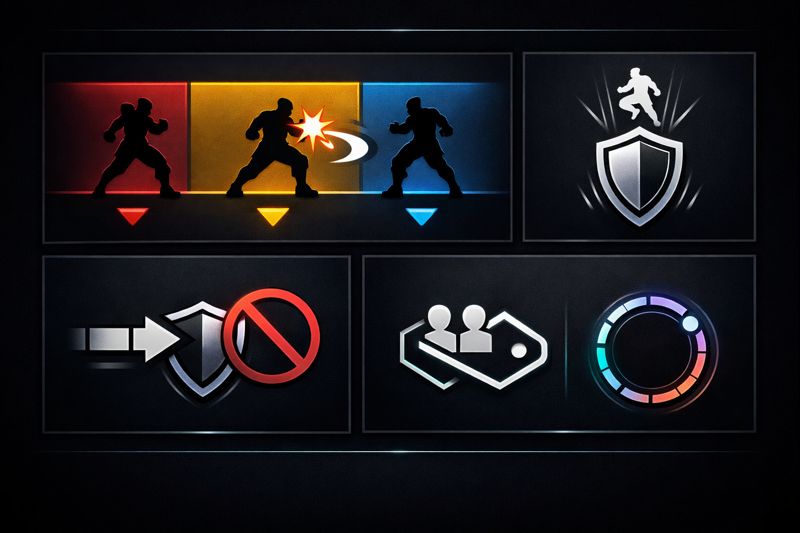
- Fast enough to tag the dash
- Low commitment so you don’t die if you miss
- Good reward on hit (at least advantage, ideally a conversion)
When to dash-check
Dash-check when the opponent is using dash as their main neutral solution. Many beginners dash too much. If you show them one or two clean dash-check hits, they’ll slow down, and now you control the pace.
Dash-stop beats dash-check (sometimes)
If your opponent loves dash-checking, you can beat it by dash-stopping outside their button range, making their check whiff, then whiff punishing. This is why neutral is a loop: every strong option invites a counter-option.
8) Anti-Airs and Air Control
If you can’t anti-air, you can’t play stable neutral. Jumping is a common beginner escape because it avoids ground pokes and creates sudden pressure. Your answer is to make jumping expensive.
Anti-air priorities
- Consistency: pick an anti-air you can do every time.
- Positioning: stand at the range where your anti-air works.
- Awareness: watch for jump timing—especially after they get poked.
Where beginners miss anti-airs
- They’re pressing buttons and can’t react.
- They stand too close and get crossed up or scrambled.
- They panic and use the wrong anti-air option.
Air control beyond anti-air
Anti-air is the direct answer, but you can also control air space by:
- Occupying air lanes with air-to-air attacks (when appropriate)
- Holding your ground so they land into your poke range
- Calling an assist that covers the air approach (carefully—see Assist section)
The goal isn’t to “never let them jump.” The goal is to make jumping a risk instead of a free approach.
9) Risk/Reward: When to Commit and When to Chill
Neutral is decision-making under uncertainty. The best players don’t guess “more.” They guess less, and when they do commit, it’s because the reward is worth it.
Low-risk options (build your foundation here)
- Walk and block
- Dash-stop into block
- Single safe poke, then stop
- Hold spacing outside opponent’s best button
Medium-risk options (use when you’ve learned a habit)
- Dash-in to take turn
- Preemptive poke to beat their approach
- Assist call to cover space
High-risk options (use rarely, but strategically)
- Hard call-out specials
- Big jumps from mid-screen
- Full-commit approaches without coverage
A beginner-friendly rule: start each match with low-risk options until you identify a habit. Then you escalate.
10) Neutral in a Tag Fighter: Assists, Safety, and Layers
2XKO is a 2v2 tag fighter where a second character can influence neutral through assists and tags. That means neutral is layered: you aren’t just fighting the point character, you’re fighting the team.
Why assists feel “unfair” to beginners
Because assists let someone attack space without putting their main character at the same risk. If you treat assists as “random chaos,” you’ll get overwhelmed. If you treat assists as a resource with rules, you’ll start seeing patterns.
Assist safety principle
Call assists when your point character is safe. The safest moments are:
- After a poke that the opponent respects
- When you are already at a range that discourages a hard punish
- When the opponent is blocking or recovering
The most dangerous moment to call an assist is when you are already losing neutral and panicking. That often turns one lost exchange into a full team disaster.
Two core assist uses in neutral
- Coverage: you move forward while an assist covers a lane, making your approach safer.
- Control: you occupy a zone with an assist so the opponent can’t comfortably stand there.
Beginner assist rule
If you don’t know what to do, use assists for coverage only. Call assist, then approach behind it with dash-stop or a safe button. Don’t overextend. Let the assist do the work.
Anti-assist awareness
You also need a plan to fight the opponent’s assist calls:
- Block first: many assist situations are designed to bait you into swinging.
- Reposition: step out of the assist’s strongest lane rather than challenging it.
- Hit the point: often the real weakness is the point character who called assist at a bad time.
Neutral gets easier when you stop trying to “win every moment” and start trying to “avoid losing big.” Assists punish impatience.
11) Turn-Taking: How to Know When It’s “Your Turn”
Beginners often lose neutral because they don’t understand turns. They press when the opponent is plus/advantaged, and they freeze when the opponent is negative. You don’t need frame data to improve this—you need basic signals.
Simple turn signals
- They hit your block with a big move and you see obvious recovery: often your turn (but confirm safely).
- They whiff a poke: your turn, if you’re in range to punish.
- You poke and they block: it might be neutral again—don’t autopilot.
- You call assist and they block: often your turn to take space, not necessarily to swing.
The “two-step” turn test
When you think it’s your turn, do a low-risk test: walk forward a tiny step or dash-stop. If they panic press, you can punish. If they keep blocking, you can claim space. If they challenge with a fast button, you learned something without dying.
Neutral is not always “press or don’t press”
Sometimes the best “turn” is to reposition into a better range. Winning neutral often looks boring: fewer buttons, more control.
12) Screen Position: Mid-Screen vs Corner Strategy
Position is invisible advantage. Mid-screen gives you room to retreat and reset spacing. The corner removes options and makes assists and pressure scarier.
Neutral goals in mid-screen
- Hold your best poke range
- Make them over-approach
- Convert small hits into pressure and space
Neutral goals near the corner
- Don’t back up for free: every step back is giving away options.
- Fight for the line: contest the space where you still have movement.
- Escape intelligently: dash-stop, jump only with a plan, or use coverage (assist) to exit.
Corner escape mindset
Many beginners think: “I must escape now.” That panic creates predictable jumps and unsafe dashes. A stronger mindset is: “I will reduce risk and wait for a real chance.” Block, look for a gap, then escape with coverage.
13) Archetypes: How Neutral Changes by Character Style
You don’t need exact move lists to understand archetypes. If you can identify what the opponent wants, you can shape neutral around it.
Common archetypes (and how to fight them)
1) Long-range control (space holders)
- What they want: keep you at the tip of their buttons.
- Your plan: dash-stop, micro-steps, whiff punish; approach behind assist coverage.
- Beginner mistake: jumping from too far away and getting anti-aired or air-to-aired.
2) Rushdown (close-range pressure)
- What they want: get into scramble range and never leave.
- Your plan: dash-check, anti-air, and keep them at mid-range where you can react.
- Beginner mistake: backing up forever until you hit the corner.
3) Trick/angle characters (mobility and weird timing)
- What they want: make you swing at the wrong time.
- Your plan: simplify—block more, poke less, punish the obvious commitments.
- Beginner mistake: trying to “out-random” them instead of stabilizing.
4) Team-synergy bully (assist-heavy neutral)
- What they want: overwhelm you with layered coverage.
- Your plan: respect the assist, reposition, then punish the point character’s bad calls.
- Beginner mistake: challenging the assist every time and getting clipped.
14) Matchup Adjustments Without Frame Data
You can improve matchups even if you don’t know exact numbers. Here’s a simple method to adapt in real time.
The 4-question adaptation loop
- What range do they want? (close, mid, or far)
- What do they do when I walk forward? (poke, dash back, jump, assist)
- What do they do when I block? (throw, reset, overextend)
- What do they do after I poke? (poke back, whiff punish attempt, jump)
After two or three exchanges, you’ll see a pattern. Then you choose a counter:
- If they poke back predictably: micro-step back and whiff punish.
- If they dash after blocking: dash-check.
- If they jump after taking damage: anti-air, then take space.
- If they call assist to approach: block, reposition, punish the point’s recovery.
Neutral becomes easy when you stop guessing “what should I do?” and start answering “what are they doing?”
15) Beginner Practice Plan: Drills That Actually Work
You don’t need five-hour training sessions. Neutral improves fastest with short, focused drills repeated consistently. Here’s a practical plan you can run 4–5 days a week in 20–30 minutes.
Drill A (5 minutes): Spacing calibration
- Pick your long poke.
- Walk in and out of range.
- Press it only when you’re sure it hits.
- Repeat until your “range feel” is automatic.
Drill B (5 minutes): Whiff punish setup
- Pick your default punish button.
- Practice micro-step back → punish.
- Focus on seeing the whiff, not on speed.
Drill C (5 minutes): Dash-stop discipline
- Dash → immediate block.
- Dash → immediate block.
- Dash → tiny walk back.
- Repeat until you stop overcommitting.
Drill D (5 minutes): Anti-air readiness
Set the dummy to jump-in at random intervals. Your job is to block until you see jump, then anti-air. The key is not reaction speed; it’s not pressing buttons that prevent reaction.
Drill E (5–10 minutes): Assist coverage approach
- Call assist from a safe range.
- Approach behind it using dash-stop.
- Do not swing unless you confirm advantage.
- Repeat until your assist use becomes structured, not panic-based.
One weekly goal that changes everything
Play one session where you focus on only one concept: either anti-airing, dash-checking, or whiff punishing. You’ll improve faster than trying to “play perfect” all at once.
16) Common Beginner Neutral Mistakes (and Fixes)
Mistake 1: Pressing too many buttons
Fix: poke once, then stop. Build the habit of watching.
Mistake 2: Living in scramble range
Fix: back up half a step. Fight from mid-range where you can react.
Mistake 3: Jumping to solve everything
Fix: earn your jump. Use jump when you’ve conditioned them to fear ground options—or when you have coverage.
Mistake 4: Calling assist while losing
Fix: block first. Call assist from stability, not panic.
Mistake 5: “Hope range” pokes
Fix: calibrate range in training mode and press when you’re sure.
Mistake 6: Not cashing out on whiffs
Fix: pick one default whiff punish and commit to it. Remove the decision.
17) The Mental Stack: Seeing More While Doing Less
The “mental stack” is the amount of information you’re trying to process at once. Beginners overload themselves: combo routes, assist ideas, movement, defense, and reactions—everything at the same time. That’s why neutral collapses.
Reduce your mental stack with a priority list
- Don’t get jumped on for free (watch for jump → anti-air)
- Don’t let dash in for free (dash-check)
- Control your best range (long poke discipline)
- Cash out on mistakes (whiff punish)
- Layer assists safely (coverage, not panic)
When you focus on these priorities, you’ll feel calmer. Calm players react. Panicked players guess.
18) FAQ
How do I know what my “best poke” is?
In training mode, look for the button that reaches far, recovers fast enough to stay safe, and feels consistent. If it frequently gets you whiff punished, you’re probably using it from the wrong range or repeating it predictably.
Should I play neutral aggressively or defensively?
Start defensively until you understand the opponent. Then become selectively aggressive. The strongest neutral is “patient pressure”: you take space, you test reactions, and you commit only when the reward is high.
I get hit when I try to whiff punish—why?
Usually because you’re punishing too late (they already recovered), or you’re punishing from too far (your button doesn’t reach). Fix it by choosing a closer punish button or stepping in slightly before punishing.
How do I stop getting overwhelmed by assists?
Treat assists like a weather event: don’t fight the storm—position around it. Block first, move to a safer lane, then punish the point character when they overcommit.
19) Summary and Next Steps
Strong neutral in 2XKO is not about playing faster. It’s about playing cleaner. If you remember only a few rules, remember these:
- Stand where you win: live in mid-range where your tools are strongest.
- Poke with discipline: one poke, then stop and observe.
- Whiff punish on purpose: create the whiff, then cash out.
- Dash-stop builds control: approach without donating.
- Anti-air consistently: make jumping expensive.
- Use assists for coverage: call them when you’re safe, not when you’re panicking.
If you want faster progress in competitive games, structured improvement helps—whether that’s coaching, replay review, or a clear training routine. For players who like measurable rank progress across titles, you can also check Boosteria’s competitive services here: https://boosteria.org/elo-boost/prices
Recommended trusted learning resources