



CS2 Grenade Throws Guide: Smoke Lineups & Flash Basics
How to Master Grenade Throws in CS2 (2026): Smoke Lineups and Flash Basics for Beginners
Grenades are the fastest, most reliable way for a new CS2 player to raise their impact without needing perfect aim. A single smoke can delete an enemy’s sightline. A good flash can turn a risky peek into a free entry. The problem is that beginners usually treat utility like a panic button: they buy grenades because they “should,” then throw them randomly, too late, or in a way that helps the enemy more than it helps the team.
This guide gives you a timeless framework for grenade mastery in Counter-Strike 2: how smokes and flashes work, how to build consistent lineups without memorizing hundreds of pixel-perfect spots, and how to practice in a way that survives map pool changes and updates. You will also learn beginner-safe smoke and flash patterns you can adapt to any map, any role, and any level of team coordination.
If you want structured improvement with real match feedback, consider pairing this guide with a coaching-first approach (utility planning, role clarity, and repeatable routines). You can also explore Boosteria’s CS2 boosting prices for rank-focused help and guided progress.
1) Why utility wins rounds (especially for beginners)
In CS2, aim is important, but visibility and timing decide whether you even get a fair fight. Smokes and flashes are “fight designers”: they choose what information both teams are allowed to see, and when. This matters more for beginners because:
- Utility creates low-risk value. Even if you miss shots, a smoke that blocks a sniper angle still works.
- Utility reduces decision complexity. A smoke isolates angles so you clear fewer threats at once.
- Utility buys time. A defensive smoke delays a push and forces the other team to waste their own grenades.
- Utility upgrades teammates. One good flash can let a teammate win a duel they had no right to win.
Beginners often lose rounds for predictable reasons: peeking too many angles, dry-walking into crossfires, trying to clear everything with raw aim, or giving the enemy early information. Good utility directly attacks those weaknesses.
Your first goal is not to learn “cool lineups.” Your first goal is to build a repeatable habit: every round, use utility with a purpose. When your grenades have purpose, your mechanics improve faster because you spend more time in fair fights.
2) CS2 grenade fundamentals: throws, bounces, and timing
You do not need to become an engineer, but you do need to understand the three levers you control: throw strength, release movement, and bounce geometry. If you learn these, you can build lineups on any map without relying on a spreadsheet of memorized pixels.
2.1 Throw strength: full, medium, underhand
Most beginner inconsistency comes from “almost the same throw” errors. CS2 gives you three core strengths:
- Full throw (usually left-click): longest distance, faster travel, higher arc risk if you clip edges.
- Medium throw (often both mouse buttons): useful for controlled distance without underthrowing.
- Underhand (usually right-click): short, controlled, excellent for pop flashes and close smokes.
Timeless rule: choose the lowest power that still reaches the job. Lower power is usually more consistent because small aim changes move the landing spot less dramatically.
2.2 Movement at release: standing, running, jumpthrow
Your movement changes where the grenade leaves your hand. That matters for lineups. If you want consistency, you must be consistent about movement.
- Standing throws are easiest to repeat and the best default for beginners.
- Step or run throws extend distance and change the release point; useful but easy to mess up.
- Jumpthrows standardize a high release for certain smokes; they can be consistent if you build a habit.
Important mindset: if a lineup “sometimes works,” assume you are changing one of these variables (power, movement, or aim). Your job is to remove variables until it becomes boringly reliable.
2.3 Bounce geometry: walls, edges, and “soft” surfaces
Flashes and smokes become much easier when you stop thinking of them as “throws” and start thinking of them as planned bounces.
- Hard bounces off flat walls create predictable angles for pop flashes.
- Edge clips (door frames, window edges, railings) create random outcomes and should be avoided in beginner lineups.
- Ceiling/roof bounces can give safe, high flashes that detonate out of enemy line of sight.
Beginner-friendly principle: build lineups that tolerate small aim errors. That usually means aiming at big, obvious features (a lamp, a corner, a roofline) and avoiding tiny edges.
2.4 Timing: when the grenade matters more than where it lands
A perfect grenade thrown at the wrong moment is still a bad grenade. Timing is especially important for flashes:
- Entry flashes must detonate as teammates peek, not before and not after.
- Defensive flashes should trigger when you hear commitment (multiple footsteps, utility, or contact).
- Retake flashes should be chained with teammates so enemies cannot turn away from all of them.
A useful beginner rule is “two-beat timing”: call the plan, then throw on a predictable count. Example: “Flashing now—one, two,” then your teammate swings on “two.” It is simple, and it works.
3) Practice setup: bindings, jumpthrow habits, and a simple training server
The fastest improvement comes from making practice easy. If setting up grenade practice feels annoying, you will avoid it. Your goal is a minimal setup you can use repeatedly across months.
3.1 Buy order and grenade slots
Beginners waste utility because they fumble inventory. Build a simple rule:
- Smoke = plan. If you bought a smoke, you should know the first situation you want to use it.
- Flash = help someone take space. If you bought a flash, you should be ready to use it early for info or entry.
Consider binding grenades to specific keys you can reach without looking (smoke, flash, HE, molotov/incendiary). Consistency reduces panic throws.
3.2 A beginner-safe jumpthrow habit
Some lineups rely on a jumpthrow-style release. Even if you do not memorize those immediately, it is valuable to practice the motion so it is not stressful later. The key is: make your release timing consistent. If you use a jumpthrow bind, use it consistently; if you do not, practice the same rhythm until it is repeatable.
3.3 Offline practice: what to enable and why
Offline practice lets you repeat throws quickly. CS2 practice commands can evolve, so treat these as a concept: enable cheats for practice, set infinite grenades, and display trajectories/impact feedback. If a command changes, you can verify current equivalents via the Valve Developer Community: developer.valvesoftware.com.
A typical practice flow looks like this:
- Load the map you want to practice.
- Enable practice-friendly settings (infinite grenades, trajectory display, long round time).
- Repeat the same throw 10 times, adjusting only one variable at a time.
- Save the result as a “binder entry”: what it blocks, why you throw it, and when you use it.
Beginners improve fastest when they treat utility like a skill, not a trivia quiz. That means repetition and notes. Even a small text file with “3 smokes + 3 flashes” per map becomes an advantage quickly.
4) Smoke fundamentals: what a “good smoke” really means
Smoke grenades are the most strategic utility in CS2 because they change the map’s information flow. A “good smoke” is not defined by whether it looks professional; it is defined by whether it achieves one of these goals:
- Block a critical sightline so your team can cross or take space safely.
- Isolate a defender so you fight one angle instead of three.
- Deny information so the enemy cannot confirm your setup or rotation.
- Delay a push by forcing enemies to respect spam, mollies, or timing windows.
- Create a timing gap where your team moves while the enemy hesitates.
4.1 Smoke shapes: “wall smokes” vs “pocket smokes”
Most smokes fall into two categories:
- Wall smoke: blocks a long angle (crossing lanes, CT sightlines, AWP lines).
- Pocket smoke: blocks a small “pocket” like a doorway, window, or tight choke.
Beginners should prioritize wall smokes first because they solve the biggest problem: moving without dying. Pocket smokes become more valuable as you learn how defenders reposition.
4.2 The “no-gap” principle (and why beginners get punished)
A smoke that leaves a tiny gap can be worse than no smoke at all because it gives the enemy a free “kill slot.” Beginners often aim at edges and accidentally create gaps. Your fix is simple:
- When you want to block a line, overfill slightly so the smoke “spills” into the angle.
- Avoid lineups that rely on tight edges or thin rails.
- Test the smoke from the enemy’s perspective in practice.
4.3 The “smoke economy” concept: every smoke has an opportunity cost
If you throw your only smoke early for no reason, you cannot:
- cross a dangerous lane later,
- deny a retake angle,
- fake pressure,
- or save a bomb plant.
That does not mean you should hoard smokes forever. It means you should have a plan: one smoke for taking space, or one smoke for survival. The best beginner rule is: if you do not know why you are smoking, wait.
4.4 Smokes vs AWPs: the beginner’s best equalizer
AWP players thrive on predictable lines. If you routinely smoke key sightlines before you cross, you force the AWP to relocate or take risks. This is one reason utility knowledge scales so well: it works even when the enemy has better mechanics.
5) Flashbang fundamentals: pop flashes, high flashes, and safe timing
Flashbangs are the most “mechanical” grenade because they are timing-sensitive. A flash only wins rounds if it: (1) detonates where enemies can see it, and (2) detonates when your team can capitalize.
5.1 The three flash types you should learn first
- Pop flash: detonates quickly after a bounce, giving enemies little time to turn away.
- High flash: arcs above rooflines and detonates in the open sky, harder to dodge without full cover.
- Support/deep flash: travels farther to blind defenders holding deep angles.
Beginners should prioritize pop flashes because they are the most consistent when you are close to a fight and you can control the bounce.
5.2 The “flash safety” checklist (to avoid teamflashes)
A teamflash is worse than no flash: it removes your team’s ability to trade and often gives the enemy free kills. Before you throw, run this fast checklist:
- Line: Will my teammate see the flash as it pops?
- Timing: Is my teammate ready to swing within one second of the pop?
- Call: Did I say “flashing” clearly, early enough?
- Cover: Can I throw it without exposing myself to a dry peek?
If any answer is “no,” either adjust or do not throw. “Holding” a flash for five seconds while your teammate fights is a common beginner error; the solution is to call it and commit quickly.
5.3 Understanding flash value: “forced turn” beats “full blind”
You do not always need a perfect full-white flash. Often, the real value is forcing defenders to:
- turn away and lose crosshair placement,
- give up an angle,
- shoot the flash and reveal position,
- or delay a peek so your team takes space first.
Beginners should measure flash success by space gained, not by how long the enemy is blinded.
6) The beginner lineup system: how to create reliable smokes anywhere
Memorizing dozens of lineups can work, but it often fails beginners because it becomes brittle: one map update, one different spawn timing, or one small position change and the lineup breaks. A better approach is a system: learn how to build a lineup that is repeatable, forgiving, and purpose-driven.
6.1 The “Lineup Triangle”: Anchor, Aim, Action
Every reliable smoke lineup can be described with three parts:
- Anchor: where your feet go (a corner, a seam, a box edge). The best anchors are obvious and repeatable.
- Aim: what you aim at (a roof corner, a sign edge, a lamp). The best aim points are large and visible.
- Action: how you throw (stand throw, step throw, jumpthrow; full/medium/underhand).
If your lineup fails, one of these is changing. The beginner fix is to simplify: make the anchor bigger, make the aim point bigger, or remove movement.
6.2 Two tests that make a lineup “beginner-proof”
Before you adopt a lineup, test it with two rules:
- Error tolerance test: if you aim slightly left/right, does it still mostly work?
- Pressure test: can you do it quickly without staring at the ground for five seconds?
If the answer is “no,” that lineup is advanced. Skip it for now. Your goal is consistent utility under stress.
6.3 The “utility binder”: the most underrated beginner tool
Make a small binder for each map with just 6 entries:
- 2 smokes for crossing or taking space
- 2 smokes for planting or denying retake sightlines
- 1 pop flash for entry
- 1 flash for retake or defense
That is enough to outperform most new players. When you can execute those six throws under pressure, you expand slowly.
To study how pros use utility in real matches and how it supports team movement, HLTV and Liquipedia are practical references: HLTV and Liquipedia Counter-Strike. Use them for concepts (timing, roles, spacing), not as a replacement for practicing your own repeatable lineups.
7) Starter smoke patterns (map-agnostic) + examples on common maps
Map pools change over time. The patterns below do not depend on a specific map being “in the pool.” They are utility concepts you can apply anywhere. After each pattern, you will see examples on common CS2 maps (these are illustrative; always validate on the current version of the map).
7.1 Pattern A: The “Cross Smoke” (move safely across a lane)
Goal: block the longest, most dangerous sightline so your team can cross without getting picked.
How to choose placement: stand where you want to cross and identify the enemy’s long line; the smoke should land closer to the enemy’s angle than to you (so it blocks their vision fully).
Examples:
- Mirage: crossing mid safely by smoking the defender’s vision from window/connector areas before exposing.
- Nuke: outside lanes often require layered cross smokes to break long AWP sightlines.
- Overpass: crossing toward bathrooms or long approaches often becomes safer with a well-placed wall smoke.
7.2 Pattern B: The “Isolate Smoke” (turn a site into one angle at a time)
Goal: remove a common crossfire angle so your entry focuses on fewer threats. This is the smoke that makes your aim “feel better” because you no longer fight two defenders at once.
Examples:
- Inferno: isolating key defender sightlines during a site hit so entries can clear close angles first.
- Mirage: isolating common jungle/connector or CT-style angles so you can take the site in layers.
- Ancient: isolating lanes that connect defenders to the bombsite so retakes arrive later and more predictable.
7.3 Pattern C: The “Plant Smoke” (create a safe plant window)
Goal: remove the most dangerous line onto the default plant location, creating a short window where planting is safe. Beginners often forget that planting is a timing event. A plant smoke is not “nice to have”; it is a tool to convert space into a round win.
Beginner tip: if your team will plant, you should already know which smoke creates the plant window. If you do not, you may accidentally plant in full view and lose a won round.
Examples:
- Mirage: a CT-style plant smoke conceptually blocks the main defender lane so the planter can commit.
- Inferno: plant windows often revolve around blocking long defender sightlines while clearing close corners.
- Anubis: plant smokes often deny long lanes that defenders use for quick peeks during the plant sound.
7.4 Pattern D: The “Retake Denial Smoke” (protect post-plant positions)
Goal: after the bomb is planted, smokes can deny retake angles that punish your post-plant positions. Many beginners waste their smoke on entry and then have nothing to stop the retake.
If you commonly end up alive after the plant, consider saving a smoke specifically for retake denial. Even one smoke can force defenders to push through a choke or wait out a timer.
Examples: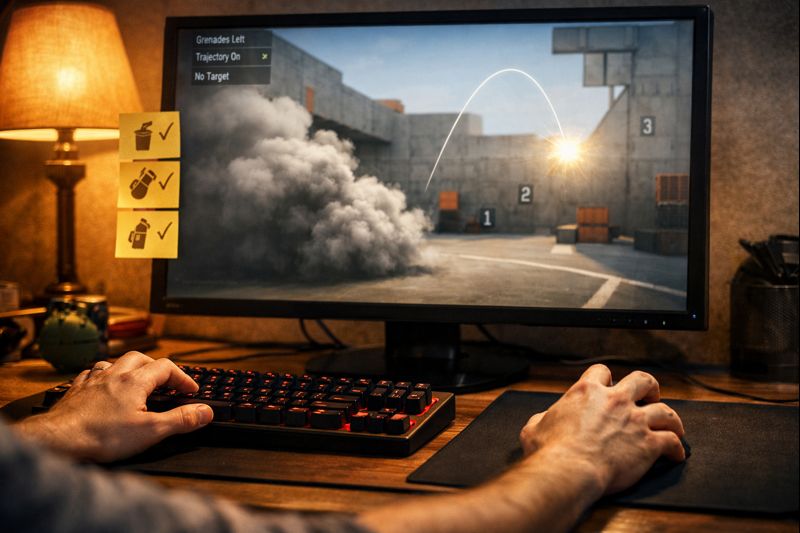
- Nuke: post-plant smokes can cut off defender rotations through key lanes and force awkward defuses.
- Overpass: retake denial often means blocking a long “re-clear” angle so your teammate can hold closer.
- Mirage: once planted, denying a common retake lane can keep defenders from coordinating swings.
7.5 Pattern E: The “Delay Smoke” (defensive time-buy)
Goal: defensively, smokes are a time tool. A good delay smoke forces the enemy to choose: wait, push through blind, or waste counter-utility. All outcomes favor you if your team is ready to react.
Beginner rule: throw delay smokes when you have a plan to capitalize (a flash ready, a teammate rotating, or a crossfire set).
8) Starter flash patterns (map-agnostic) + entry/retake examples
Flashes are easier than smokes if you focus on a few repeatable patterns. Your priority is: pop flashes that do not teamflash.
8.1 Pattern A: The “Self Pop” (win a duel you must take)
Goal: bounce a flash off a close wall so it detonates quickly as you peek. This is the most beginner-friendly flash because your timing is under your control.
Checklist:
- Pick a wall close to the corner you want to swing.
- Underhand or medium throw to reduce travel time.
- Peek immediately after the pop; do not hesitate or you waste the blind window.
8.2 Pattern B: The “Support Pop” (enable a teammate’s swing)
Goal: pop a flash for a teammate without blinding them. You do this by positioning the bounce so the flash pops around the corner, out of your teammate’s direct view, while still visible to defenders.
Communication habit: “Flashing for you—swing on pop.” If your teammate does not acknowledge, do not throw.
8.3 Pattern C: The “High Flash” (force defenders off angles)
Goal: throw a flash high into open space so turning away is difficult without full cover. High flashes are strong for beginners because they do not require a precise wall bounce.
Risk: high flashes can also blind teammates if thrown without warning. Always call them early.
8.4 Pattern D: The “Retake Chain” (two flashes beat one)
Goal: on retakes, single flashes often get turned. Two flashes in sequence forces defenders into a bad choice: turn the first and get blinded by the second, or eat the first and get swung.
Even in low coordination games, you can create a chain by throwing one flash, then a second flash one second later, then swinging. The key is not perfection; it is predictable sequencing.
8.5 Pattern E: The “Anti-Push Flash” (defensive punish)
Goal: if you hear a rush or a fast commitment, a defensive flash thrown into a choke can stop momentum. The best anti-push flashes pop where the enemy is forced to look (narrow corridors, tight chokepoints).
9) Utility combos: smoke + flash, isolate + clear, and simple executes
Utility is strongest in combinations. Beginners often throw grenades one at a time with no connection. Your job is to create “packages” you can repeat.
9.1 The simplest winning package: Smoke the problem, flash the fight
This is the beginner bread-and-butter:
- Smoke the longest sightline (the one that can kill you during the approach).
- Flash the first fight you must take to enter or hold space.
- Trade with a teammate. Do not take isolated duels after spending utility.
If you do nothing else but repeat this package with purpose, you will climb.
9.2 “Isolate + clear”: smokes create a clearing order
A common beginner mistake is trying to clear all angles at once. Smokes are a tool for creating a clearing sequence:
- Smoke the far/strong angle first.
- Clear the close angles second (because they are now isolated).
- Clear the remaining angles last with a flash or teammate trade.
9.3 Simple execute mindset: you do not need five smokes to take a site
New players often think “executes” are only for coordinated teams. In reality, even a simple two-player plan is an execute: one smoke plus one flash can be enough to take space if done at the right timing.
Example structure you can apply anywhere:
- Player A: throws a smoke that blocks the longest defender line.
- Player B: throws a pop flash for the first corner/fight.
- Both: swing together and trade.
9.4 Defensive combo: smoke to stall, flash to punish the push
On defense, a smoke is rarely the end of the plan. It is the start:
- Smoke the choke to stall and create uncertainty.
- Listen for commitment (utility, multiple steps, contact).
- Flash into the choke as they push, then swing with a teammate.
This approach beats “dry holding” because it gives you a timing advantage.
10) Decision-making: when to throw, when to hold, and how not to waste
A timeless rule in CS2 is that utility should either create a fight you want or prevent a fight you do not want. If your grenade does neither, it is likely wasted.
10.1 The “three moments” for smokes
- Before you take space: smoke to cross and remove long angles.
- During the take: smoke to isolate defenders and control trade paths.
- After the plant: smoke to deny retake angles and protect post-plant positions.
If you throw your smoke outside these moments, you should have a clear reason (fake pressure, emergency survival, or delay).
10.2 The “two flashes per round” habit (beginner-friendly)
If you buy two flashes, use them with structure:
- Flash 1 (early): info or entry to take first space.
- Flash 2 (late): post-plant, retake, or to break a stalemate.
This prevents the common beginner pattern of throwing both flashes early for no benefit.
10.3 When holding utility is correct
Holding utility is correct when:
- you expect a push and want to punish it,
- your team is rotating and you need to buy time,
- you are the post-plant anchor and a smoke/flash can deny the retake.
Holding utility is incorrect when:
- your team is fighting now and your utility could swing the outcome,
- you are last alive and saving utility provides no future value,
- you are “waiting” without a clear trigger for using it.
10.4 Utility and economy: the beginner’s buying priority
Grenades matter most when you can still buy a functional weapon. A simple buying hierarchy:
- Weapon that can win fights at your role’s distance
- Armor (as appropriate to the round)
- Smoke (if you have a plan for it)
- Flashes (if you will use them early or for retake/post-plant)
- Molotov/incendiary (for clearing or delaying)
- HE grenade (bonus damage, anti-armor chip, finishing tool)
For beginners, the most consistent value is usually smoke + one flash. Add more as your decision-making improves.
11) Communication basics: calls that prevent teamflashes and wasted smokes
You do not need complicated comms. You need clear, early, short comms. Utility comms should answer three questions: what, where, when.
11.1 Flash calls
- What: “Flashing” or “Pop flashing”
- Where: “Out [choke]” or “Over [area]”
- When: “Now” or “On my count”
Example: “Pop flashing out—swing on pop.” Simple and effective.
11.2 Smoke calls
Smoke calls are mostly about what line is blocked:
- “Smoking the long line so we can cross.”
- “Smoking the retake lane after plant.”
- “Smoking choke to delay; be ready to punish push.”
If you consistently communicate your intent, teammates will time their movement better even in solo queue.
12) A timeless 7-day practice plan (30 minutes a day)
This plan is intentionally small. The best plan is the one you actually repeat. Do not rush to learn 30 lineups. Learn 6 that you can hit under pressure.
Day 1: Fundamentals and consistency
- 10 minutes: practice full/medium/underhand throws to the same general target area.
- 10 minutes: practice two pop flashes (self pop and support pop) on any corner.
- 10 minutes: throw one smoke 10 times, then check for gaps from the enemy angle.
Day 2: Cross smoke + entry pop
- Pick one map you play often.
- Learn one cross smoke (safe lane crossing).
- Learn one pop flash for the first fight after the cross.
- Repeat each 10 times without rushing.
Day 3: Isolate smoke + clear order
- Learn one isolate smoke that reduces the number of angles to clear.
- Practice clearing order: close corners first, then deeper angles.
- Finish with 5 repetitions of “smoke then swing with flash timing.”
Day 4: Defensive delay smoke + punish flash
- Learn one delay smoke for a common choke.
- Learn one anti-push flash that pops into that choke.
- Practice: smoke, wait two beats, flash, swing (simulate hearing steps).
Day 5: Plant smoke + post-plant flash
- Learn one plant smoke concept for a common site.
- Learn one flash that helps you hold post-plant or retake a lane.
- Practice: smoke, “plant,” reposition, flash for retake denial timing.
Day 6: Retake chain
- Practice two-flash chaining: first flash, one-second pause, second flash, swing.
- Repeat 10 times on two different chokes.
- Goal: consistent rhythm, no hesitation.
Day 7: Binder day (lock in your six throws)
- Pick your six throws for the map: 4 smokes + 2 flashes.
- Throw each 10 times.
- Write one sentence for each: what it blocks and when you use it.
After one week, you will not “know every lineup,” but you will have something more valuable: a repeatable set of grenades that reliably wins space. That is what climbs.
13) Common mistakes and quick fixes
Mistake 1: Throwing utility with no purpose
Fix: Say your intent out loud (even to yourself): “This smoke blocks the long line so we can cross.”
Mistake 2: Smokes with gaps
Fix: Aim to overfill, avoid edge clips, and verify from the enemy angle in practice.
Mistake 3: Flashes that pop behind enemies or too early
Fix: Use pop flashes off close walls and swing immediately after detonation.
Mistake 4: Teamflashing
Fix: Call early, throw from safe positions, and learn support pop placements that pop around corners.
Mistake 5: Holding grenades until the round is over
Fix: Commit your first flash early for space or info; save your second for late-round conversion.
Mistake 6: Practicing too many lineups at once
Fix: Six throws per map first. Expand only after you can hit them under stress.
14) FAQ
How many lineups should a beginner learn per map?
Start with six: four smokes (cross, isolate, plant window, retake denial) and two flashes (entry pop and retake/defense). This is enough to outperform most players at the same rank.
Should I prioritize smokes or flashes?
Smokes teach structure and reduce risk, so they are usually the best first priority. Flashes then multiply the value of the space your smokes create. If you solo queue a lot, smokes often give more independent value; flashes scale better with teammates.
Do I need perfect “pro” lineups to rank up?
No. You need repeatable grenades with clear purpose. A slightly imperfect smoke that reliably blocks the right lane is far better than a perfect lineup you fail under pressure.
What’s the best way to learn utility from pro play?
Watch rounds with a question in mind: “What line are they trying to block?” and “What timing window are they creating?” Sites like HLTV can help you follow events and matches, and Liquipedia helps with map and team context. Use pro examples to learn the concept, then rebuild a beginner-proof version for your own consistency.
15) Wrap-up and next steps
Mastering grenades in CS2 is not about memorizing a thousand throws. It is about owning a small set of repeatable tools that consistently create space, isolate fights, and protect key timings. Smokes remove information. Flashes create favorable engagements. When you combine them with simple communication and a practice routine, your rounds become structured instead of chaotic.
Your next step is straightforward: pick one map you play most, build a six-throw utility binder, and practice for 30 minutes a day for a week. Then bring those grenades into matches and evaluate them by one metric: did they help you gain space or win a fight?
If you want faster progress through structured review (grenade planning, role clarity, demo feedback, and targeted routines), you can also check Boosteria’s CS2 boosting prices and choose a path that matches your goals.