



Valorant Peeking Guide 2026: Jiggle, Wide & Shoulder Peeks
How to Master Peeking in Valorant (2026): Jiggle, Wide, and Shoulder Peek Drills for Beginners
Peeking is the single most repeatable duel skill in VALORANT: it turns “50/50 gunfights” into predictable, controllable interactions. If you’ve ever felt like you die the instant you swing, or you over-peek into two defenders, you don’t need “better aim” first—you need cleaner peeking fundamentals.
This guide teaches beginner-friendly peeking mechanics that stay useful across patches and metas: jiggle peeks for information, shoulder peeks to bait shots and confirm angles, and wide peeks to break crosshair placement and win committed duels. You’ll get step-by-step drills, a repeatable warm-up plan, and decision rules you can apply on any map.
Official game info and competitive resources: playvalorant.com · Riot Support (VALORANT) · Liquipedia VALORANT
Table of Contents
1) What “Peeking” Means in VALORANT
A peek is any intentional movement that changes what you and your opponent can see. In practical terms, peeking is how you enter a duel: you decide the timing, how much of your body is exposed, and whether you’re gathering information or committing to a fight. Beginners often focus on aim alone, but in a tactical shooter, the first 200–400 milliseconds of a duel are often decided by positioning and exposure—not raw flick speed.
In VALORANT, peeking is especially important because defenders commonly hold tight angles with pre-aimed crosshair placement. If you stroll into that crosshair, you’ll feel like the enemy “never misses.” The fix is not to blame reaction time—it’s to peek in a way that forces the defender to adjust. Your job is to make their shot harder while keeping yours easy.
Think of peeking as a toolkit with three default tools: jiggle peeks (quick information without committing), shoulder peeks (bait a shot / confirm an angle), and wide peeks (commit to the duel with a swing that disrupts their aim).
2) Core Principles: Angle Advantage, Timing, and Exposure
Angle advantage (why “distance from the wall” matters)
Angle advantage is the geometry behind who sees whom first. If you stand tight to a corner and swing, your model often appears earlier to someone holding farther away than you can see them, depending on exact positioning. The takeaway for beginners is simple: be intentional about how close you are to the wall before you peek. Small steps forward or backward can change how quickly you become visible and how much you have to move to clear an angle.
- Tighter to the wall: you reveal less initially, but you may need to swing farther to see deep angles.
- Farther from the wall: you clear deeper angles sooner, but you may expose more of your body earlier.
You don’t need to calculate geometry mid-round. Instead, follow a stable rule: when clearing a close corner, play tighter; when clearing a deep line (long sightline), give yourself room to see sooner.
Timing (peeking when the defender is least ready)
Timing is everything in a tactical FPS. Even strong defenders can’t hold perfect focus forever. Your goal is to peek at moments that reduce their readiness:
- Right after utility pops (flash detonation, smoke refresh, recon ping, stun ending).
- During noise (teammate footsteps, spike tap, wall breaking).
- After you bait a shot (especially against Operators or players who panic fire).
- On a trade timing (you swing a fraction after a teammate is seen/shot).
Beginners often peek on autopilot: “I arrived at the corner, so I swing.” Replace that with: “What event makes my swing stronger right now?”
Exposure budget (how many angles can see you at once)
Most “instant deaths” come from being visible to multiple enemies. When you peek, you’re not just fighting one player—you’re choosing how many angles can shoot you. Control that with an exposure budget:
- Good peek: you are exposed to one likely angle at a time.
- Bad peek: you swing into two angles (or a crossfire) and hope for miracles.
This is why “slicing the pie” (clearing angles incrementally) is not optional; it’s the mechanism that keeps your exposure budget low.
3) Peek Types: Jiggle vs Shoulder vs Wide (When and Why)
| Peek Type | Main Goal | Best Use | Risk | Beginner Cue |
|---|---|---|---|---|
| Jiggle Peek | Information | Spot an enemy, confirm presence, bait a shot | Low–Medium | “I want info, not a duel.” |
| Shoulder Peek | Bait & confirm | Trigger Operator shot, force audio reaction, test angle discipline | Medium | “Make them shoot first.” |
| Wide Peek | Commit to win | Break a tight hold, isolate a duelist, trade for teammate | Medium–High | “I’m taking the fight now.” |
Jiggle peek (micro-exposure)
A jiggle peek is a small, fast in-and-out movement at the edge of a corner. It is designed to show the minimum possible body for the shortest time while gaining information: “Is someone holding this?” “Did the Operator fire?” “Did someone react and reposition?” Done correctly, it looks almost like a stutter at the corner.
Shoulder peek (bait the shot)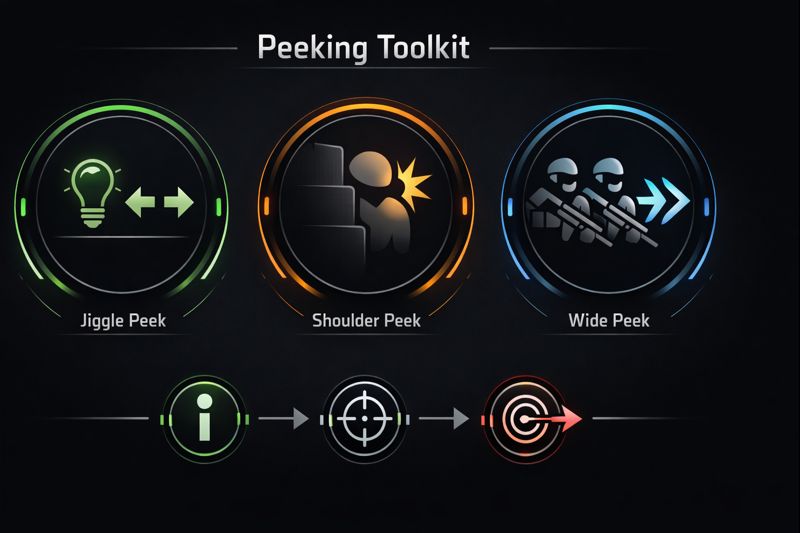
A shoulder peek is similar to a jiggle but slightly larger, intended to show enough of your character model to trigger a reaction shot—especially from an Operator. You’re not trying to shoot; you’re trying to provoke and then punish: bait the shot, then swing with advantage while they reset.
Wide peek (commit with a purpose)
A wide peek is a larger swing that changes your position enough to disrupt a defender’s crosshair placement. This is the peek you use when you intend to take the duel. The key is that a wide peek is not random ego-swinging; it’s a controlled commitment often paired with a plan: isolate one angle, pre-aim head height, and stop cleanly.
4) Movement & Accuracy: Stopping Cleanly Without Overthinking
Beginners struggle with peeking because they try to shoot while moving or they stop inconsistently. The good news: you don’t need fancy tech to fix this. Your goal is simply: move → stop → shoot, and do it the same way every time.
“Counter-strafing” in VALORANT (beginner version)
In some shooters, counter-strafing is mandatory to regain accuracy. In VALORANT, movement deceleration is already snappy, so the beginner-friendly approach is: release your movement key to stop, then shoot. If you want to add a little extra consistency, lightly tap the opposite key as you stop, but don’t let this become a distraction. The real issue for most players is not “wrong technique”—it’s shooting too early.
The stop-shot rhythm
Here’s the rhythm you’re training in every drill:
- Pre-aim where a head could be.
- Strafe out just enough to see the angle you’re clearing.
- Stop (release key) the moment you see the target area.
- First bullet discipline: make the first shot clean; then follow with controlled bursts.
- Reset: strafe back to safety or continue the clear with your exposure budget in mind.
If you miss, don’t instantly panic-spray while drifting. Instead, reset your feet and re-take control. Beginners improve fastest when they prioritize clean first shots over “maximum bullets.”
Why “wide swings while spraying” feels terrible
A wide peek is meant to disrupt the defender, but it only works when you regain accuracy at the right moment. If you wide swing and hold mouse1 while drifting, your bullets become random and your crosshair floats away from head level. The defender gets an easy kill because you gave them time and a stable target. The fix is simple: wide peek does not mean “shoot while sliding.” It means “move farther, then stop and shoot.”
5) Crosshair Placement for Peeking (The Head-Level System)
Crosshair placement is what makes peeking feel “easy.” If your crosshair is already at the correct height and distance from the corner, your job becomes a small adjustment instead of a flick. Great peekers rarely hit insane flicks—they hit predictable headshots because their crosshair starts in the right place.
Head level is non-negotiable
Before you practice advanced peeks, commit to one habit: your crosshair lives at head height. On most angles, that means the top third of typical doorway/box geometry. If you struggle with head level, run a simple range drill (below) until it becomes automatic.
“Distance from the corner” crosshair rule
Beginners aim too close to the edge and get surprised by wide swings; or they aim too far and get killed by tight holds. Use this stable rule:
- If you expect a tight hold (defender close to the corner), keep your crosshair closer to the edge.
- If you expect a wide swing (defender peeking you), hold slightly wider from the edge.
When you are the one peeking, you invert the logic: as you clear, place the crosshair where the first head could appear, then “drag” it smoothly to the next angle. This is slicing the pie with your crosshair, not your eyes.
Micro-correction vs flicking
Flicking is a last resort. A clean peek aims to create micro-corrections: tiny left-right adjustments at head height. If your peeks consistently require giant flicks, your crosshair placement or your clear path is wrong.
6) Clearing Angles Properly: Slicing the Pie
“Slicing the pie” is clearing an angle incrementally so that you fight one position at a time. Beginners often swing too far and expose themselves to multiple spots. The fix is to treat each corner like a sequence: near angle → mid angle → deep angle.
The three-step clear
- Close corner check: the spot right next to the angle you’re about to pass.
- Common hold: the typical head-level hold where defenders anchor.
- Deep line: the far angle that becomes visible only after you swing more.
Use “mini-stops” to stabilize
Beginners try to clear while gliding. Instead, clear with small stops: strafe out → stop → confirm → strafe a bit more → stop → confirm. This makes your first bullet accurate on every micro-stage, and it keeps your brain calm under pressure.
Clear with your crosshair, not your camera
Many players “look around” with the camera and let the crosshair lag behind. Flip that: keep the crosshair leading, and let your eyes follow it. The crosshair is your plan.
7) Jiggle Peek Drills (Information First)
Jiggle peeking is your safest tool for early-round information. It teaches two core skills: (1) minimizing exposure time and (2) returning to safety without panic. Your goal is not to hit shots; it’s to develop a repeatable peek → read → reset habit.
Drill A: Range jiggle rhythm (5 minutes)
- Enter the Practice Range.
- Pick a corner/box to use as your “wall.”
- Stand just behind cover with crosshair at head height.
- Strafe out a tiny amount, then immediately strafe back in.
- Repeat with a steady rhythm: out-in, out-in for 60 seconds.
Focus points: minimal exposure, no jumping, no crouch spam, and consistent head-level crosshair.
Drill B: Jiggle → stop-shot (7 minutes)
This drill connects jiggle peeking to real duels. You’ll jiggle twice for info, then commit with a clean stop-shot.
- Use bots or a static target in the range.
- Jiggle peek twice without shooting (simulate info gathering).
- On the third peek, swing slightly more, stop, and fire a clean burst.
- Reset behind cover immediately after the burst.
The beginner mistake is shooting while drifting. If your bullets feel inconsistent, slow down the third swing and exaggerate the stop.
Drill C: Jiggle for audio discipline (custom game, 5 minutes)
In a custom game, stand near a common chokepoint and practice jiggle peeking while listening for sound cues: footsteps, ability activations, weapon swaps. The goal is to train patience: you jiggle, you listen, you reset. This helps you stop “panic swinging” after you suspect an enemy.
When to use jiggle peeks in real matches
- When you suspect an Operator or a disciplined anchor.
- When you need info to decide whether to rotate.
- When you’re alone and cannot be traded.
- When your team is waiting on utility cooldowns.
8) Shoulder Peek Drills (Bait & Confirm)
Shoulder peeking is a “reaction test” for the defender. You show enough to trigger a shot, then you punish the shot window. This is especially valuable against Operators, but it also works versus riflers who shoot on instinct.
Shoulder peek fundamentals (what makes it different from jiggle)
- More body shown than a jiggle so it reliably draws fire.
- Still not a committed fight: your weapon stays ready, but your first intent is bait.
- Immediate reset behind cover after the bait moment.
Drill A: Shoulder bait timing (range/corner, 6 minutes)
- Pick a wall and a target area.
- Strafe out enough that you imagine your shoulder would be seen.
- Pause for the smallest moment (a “beat”), then strafe back in.
- Repeat until the motion feels smooth, not jerky.
The “beat” is important: too fast and the defender may not react; too slow and you die. Your goal is a consistent, controlled exposure that you can repeat without panic.
Drill B: Shoulder bait → punish swing (10 minutes)
This is the classic Operator counter pattern: bait the shot, then swing while they recover.
- Shoulder peek once to “bait.”
- Immediately reset behind cover.
- On the next timing, wide peek and stop-shot where their head would be.
- Reset and repeat.
You’re training a two-step sequence: bait creates advantage; punish converts it. If you skip the reset or you punish too slowly, you lose the benefit.
Drill C: Shoulder peeking with utility (10 minutes)
In a custom game, practice pairing shoulder peeks with a simple utility plan: shoulder peek to confirm, then flash/smoke, then commit with a wide peek. The goal is not perfect lineups; it’s learning the order: confirm → disrupt → commit.
When shoulder peeks shine
- Against Operators holding long lines.
- Against nervous riflers who shoot on first contact.
- When you want to force the defender to reveal their discipline (do they shoot? do they reposition?).
- When your team wants to cross a dangerous lane—bait first, then move.
9) Wide Peek Drills (Commit & Win)
Wide peeking is the most misunderstood. It’s not “swing everything and pray.” It’s a committed duel tool that works because you change your position enough to throw off the defender’s pre-aim, then you stop and land a clean first burst. You use wide peeks when information is already available or when the round demands a fight.
Wide peek fundamentals (beginner checklist)
- Isolate: ensure only one angle can see you (or you have a trade).
- Pre-aim: start at head level where the defender is likely holding.
- Commit: swing far enough that their crosshair must move.
- Stop: release movement and fire a controlled burst.
- Decide fast: win, fall back, or reposition—don’t hover in the open.
Drill A: Wide peek stop-shot ladder (range, 10 minutes)
- Pick a corner.
- Do a small swing, stop, fire a 2–4 bullet burst, reset.
- Next rep, swing slightly wider, stop, burst, reset.
- Continue for 10–15 reps, then restart from small to wide.
This teaches that “wide” is a variable, not a binary. You can swing 10%, 30%, 60% depending on the situation. Your stop-shot must remain consistent across all of them.
Drill B: Wide peek with strafe re-peek (deathmatch focus, 15 minutes)
In Deathmatch, choose one rule for the session: no crouch spraying. Your goal is to swing, stop, burst, then either reset or re-peek from a new timing. You’re training duels as sequences, not single moments.
- If you miss first burst: strafe back behind cover, then re-peek with a different timing.
- If you hit: immediately move to a new angle (don’t stand still in the open).
- If you get tagged: stop fighting the same angle—reposition.
Drill C: Wide peek + trade discipline (with a duo, 15 minutes)
The safest way to wide peek in real matches is with a teammate ready to trade. In a custom game or scrim scenario, practice this simple structure:
- Player 1 wide peeks first and commits to the duel.
- Player 2 holds a half-step behind, ready to instantly trade if Player 1 dies.
- Swap roles after 5 reps.
This builds a critical ranked skill: you stop taking solo 50/50s and start converting fights with trade timing.
10) How to Peek an Operator (Beginner-Safe Rules)
Operators punish predictable peeks because one shot ends the duel. Beginners often either never challenge (giving the Operator infinite map control) or ego-swing and donate picks. You need a balanced plan built on baiting and timing, not bravery.
Rule 1: Don’t dry wide swing an Operator if you can’t be traded
If you’re alone and the Operator holds a long line, a dry wide peek is a low-percentage play. Prefer a jiggle or shoulder peek for information first. If you must challenge, do it with utility or with a teammate ready to trade.
Rule 2: Bait the shot, then move the problem
Operators thrive on stable lines. Your sequence should be: shoulder bait → reset → punish swing or cross while they reset. Even if you don’t kill them, you often gain space because they either back up or re-aim.
Rule 3: Use disruption (smokes, flashes, recon) to force uncertainty
You don’t need perfect lineups; you need the concept: the Operator should not see a clean target. If your team can smoke the line or flash the hold, your peek becomes dramatically safer.
Rule 4: Change timing on re-peeks
The fastest way to lose is to re-peek the same timing. If you baited a shot once, don’t re-peek on autopilot. Count a beat, reposition slightly, or have a teammate take the next contact.
11) Common Peeking Mistakes (And Fixes)
Mistake: You peek while your crosshair is not ready
If your crosshair is at the floor or drifting, your peek starts as a disadvantage. Fix it with a simple rule: crosshair set first, then move. In practice, this means you stop “checking corners with your eyes” and you start checking with a pre-aimed crosshair.
Mistake: You expose yourself to two angles at once
This is the #1 beginner ranked leak. Fix it with exposure budgeting: clear the closest angle first, then the next, then the deep angle. If you can’t do that because the geometry opens into a wide area, you need either utility or a teammate trade setup.
Mistake: You shoot while drifting
If your bullets feel random, you’re likely firing before you stop. Fix it by exaggerating the stop-shot rhythm in drills. If needed, slow the peek speed for a few days—consistency first, speed later.
Mistake: You repeat the same peek timing
Good defenders pre-fire predictable re-peeks. Fix it with a rule: never re-peek the same angle with the same timing twice. Add a beat, change your distance from the wall, or switch to a different peek type (jiggle → shoulder → wide).
Mistake: You crouch as a panic button
Crouching can be useful, but beginners often crouch immediately, locking themselves into a spray and making them easier to track. Fix it by removing crouch from your first-burst habit. For two weeks, let crouch be a conscious choice, not a reflex.
Mistake: You take fights without a reason
Not every corner needs a duel. Fix it by labeling your peek before you do it: info (jiggle), bait (shoulder), or commit (wide). This single habit dramatically reduces random deaths.
12) A 7-Day Training Plan You Can Repeat
Improvement happens when you repeat a small set of drills long enough for them to become automatic. This plan is designed to be realistic (30–45 minutes) and repeatable. If you can only do 15 minutes, do the first two items each day and rotate the focus drill.
| Day | Warm-up (10–15m) | Focus Drill (10–15m) | Application (10–15m) |
|---|---|---|---|
| 1 | Head-level tracking + jiggle rhythm | Jiggle → stop-shot | 1 DM: no crouch, stop-shot only |
| 2 | Crosshair placement walk-through | Shoulder bait timing | 1 DM: bait then commit on re-peek |
| 3 | Stop-shot bursts (2–4 bullets) | Shoulder bait → punish swing | 2 Swiftplay/Unrated: focus on OP counter rules |
| 4 | Jiggle rhythm + mini-stops | Wide peek ladder | 1 DM: wide peek then reset (no drifting shots) |
| 5 | Angle slicing walk-through | Wide peek + re-peek timing changes | 2 matches: label each peek (info/bait/commit) |
| 6 | Mixed: jiggle + shoulder | Utility pairing (confirm → disrupt → commit) | Play with a duo: trade discipline reps |
| 7 | Review day: easy warm-up | Redo your weakest drill | VOD review: 10 duels, note one fix |
Optional aim trainer (if you already use one)
If you use an aim trainer, keep it simple and relevant: short sessions that reinforce stop-shot accuracy and micro-corrections. Aim training can help, but it should support your peeking habits, not replace them. Popular tools include Aim Lab.
13) Applying Drills in Real Games: Simple Decision Flow
Beginners fail to “transfer” practice into ranked because they don’t have a decision rule. Use this flow at every corner until it becomes natural:
Step 1: Can I be traded?
- No → prefer jiggle/shoulder for info; avoid dry wide peeks into strong angles.
- Yes → you can commit more often; wide peeks become higher value.
Step 2: What is my purpose?
- Info → jiggle peek (minimal exposure).
- Bait → shoulder peek (force shot/reaction).
- Commit → wide peek (stop-shot burst).
Step 3: How many angles can see me?
If the answer is “more than one,” don’t swing without a plan. Slice the pie, use utility, or coordinate a trade. This is the moment where most unnecessary deaths happen.
Step 4: After contact, what’s my reset?
Before you peek, decide your reset: fall back behind cover, re-peek with changed timing, or reposition. This prevents “hovering” in the open after a missed burst.
A beginner-friendly round example (attacking)
You approach a choke. First, jiggle for info to confirm presence. If you hear an Operator shot or see a tracer, shoulder bait once and reset. Then, as utility goes out, wide peek with a clean stop-shot while a teammate is positioned to trade. You are no longer gambling; you’re running a sequence.
A beginner-friendly round example (defending)
You’re anchoring a site. Instead of “holding the same pixel forever,” you can shoulder/jiggle from safety to confirm whether attackers are walking up, then reposition to a new angle. This keeps you unpredictable and reduces the chance you get pre-fired on a known hold.
14) VOD Review Checklist: Find Your Real Leak Fast
You don’t need hours of review. Take 10 rounds from a recent match and look only at your first contact moments. Ask these questions:
- Was my crosshair at head level before I peeked?
- Did I label the peek (info/bait/commit), or was it autopilot?
- How many angles could see me when I swung?
- Did I stop before shooting, or did I drift?
- Did I re-peek the same timing after missing?
- Could I have used a jiggle/shoulder first to reduce risk?
- Was there a trade available, and did I coordinate it?
Pick one fix only for your next session. For most beginners, the highest ROI fix is: stop shooting while moving and reduce multi-angle exposure.
15) FAQ
Do I need perfect counter-strafing to peek well?
No. Most beginners improve fastest by mastering the simple stop-shot rhythm: move, stop, burst. If you consistently stop before shooting, your peek quality rises immediately.
Why do I lose even when I peek “correctly”?
“Correct” peeking increases your odds; it doesn’t guarantee every duel. You still need repetition, calm first-burst mechanics, and better decision-making about when to commit. Track outcomes over many fights, not one round.
When should I wide peek instead of jiggle?
Wide peek when you have a clear purpose: you can be traded, you’ve confirmed the angle, or the round requires space. Jiggle when you’re unsure or alone. If you feel “coin-flippy,” you’re likely committing too often without setup.
How do I stop re-peeking the same angle?
Give yourself a replacement habit: after a missed burst, always strafe back and wait a beat. Then either re-peek with a different timing or reposition. Making the reset automatic breaks the panic loop.
What’s the fastest way to improve peeking for ranked?
Combine one mechanical drill (stop-shot) with one decision rule (exposure budget). If you only do one thing this week, stop swinging into two angles at once.
16) Next Steps
Mastering peeks is a compounding skill: once you stop donating first deaths, your confidence, economy, and round impact all improve. Start with the 7-day plan, keep your drills consistent, and use the decision flow in real matches.
If you want a faster improvement curve with structured help—whether that’s coaching-style guidance or rank assistance— you can review Boosteria’s options here: Valorant pricing.
Finally, stay aligned with Riot’s competitive ecosystem and account security guidance via the official resources: Riot Support (VALORANT).