



15-Min Aim Routine: Micro-Corrections, Flicks & Tracking
15-Min Aim Routine: Micro-Corrections, Flicks, and Tracking
If you want more consistent aim without spending hours in an aim trainer, a short, structured routine is the fastest way to improve the mechanics that decide fights: micro-corrections (small adjustments that turn “almost” into hits), flicks (fast target acquisition with clean stopping power), and tracking (staying glued to moving targets without jitter).
This guide gives you a timeless 15-minute aim routine you can repeat daily as a warm-up or a standalone practice block. It works across tactical shooters, battle royales, and hero shooters because it trains the universal foundations: mouse control, stopping, smoothness, click timing, and target switching.
You’ll also get technique cues, progression rules, a simple way to measure improvement, and multiple drill options so you can run the routine in an aim trainer or entirely in-game. (If you’re using a trainer, consider official resources like Aim Lab and reputable display/latency education such as Blur Busters or input-latency features like NVIDIA Reflex.)
What This 15-Min Routine Builds
Good aim isn’t one skill—it’s a stack of mini-skills that must happen in the right order. This routine targets the three that most players undertrain:
- Micro-corrections: tiny adjustments after the first movement. This is where most “I swear I was on him” moments live. Micro-corrections improve your ability to stop precisely, stabilize, and click at the right time.
- Flicks: quick acquisition with braking control. Flick training is not just “go fast”—it’s “go fast, stop cleaner, then confirm with a micro-correction.”
- Tracking: smooth follow-through. Tracking is less about reaction speed and more about smoothness + prediction and staying calm under motion.
The routine is designed to be short but complete: it starts by settling your hand and posture, then trains precision (micro-corrections), then speed + stopping (flicks), then smooth control (tracking), and finishes with a brief calibration so you leave practice feeling “locked in” instead of frantic.
Setup for Consistent Aim
You don’t need perfect gear to improve aim, but you do need consistency. The goal is to reduce randomness so practice results carry into matches.
1) Sensitivity: pick stable, not magical
A timeless rule: choose a sensitivity that lets you control small corrections without feeling stuck on big turns. If you constantly overshoot close targets, your sens may be too high (or your braking is weak). If you can’t keep up with lateral movement, your sens may be too low (or your tracking technique is tense).
Don’t change sensitivity daily. If you adjust, do it in small steps and keep it for at least a week of consistent practice.
2) Posture: stable base, relaxed hands
Aim quality drops when your shoulders are tense, your wrist is bent, or your chair height forces awkward angles. You want:
- Shoulders down and relaxed (no shrugging).
- Neutral wrist (not sharply bent up/down).
- Forearm lightly supported; avoid pressing hard into the desk.
- Mousepad space that allows comfortable arm movement.
If you want a practical, credible ergonomics starting point, Cornell’s ergonomics guidance is a solid reference: Cornell University Ergonomics.
3) Framerate and latency: “feel” matters
Aim feels more controllable when your motion-to-photon latency is lower and your framerate is stable. You don’t need to chase extreme numbers, but you do want consistency. Resources like Blur Busters explain motion clarity, and features like NVIDIA Reflex discuss latency reduction in a general, evergreen way.
4) Crosshair and visuals: reduce clutter
Choose a crosshair that stays readable during recoil and movement. Avoid changing crosshair styles frequently. Your eyes should spend less effort “finding” your crosshair so they can focus on target confirmation.
The 15-Min Aim Routine (Minute-by-Minute)
This is the exact structure. Use a timer. The biggest difference between “random warm-up” and “effective routine” is time pressure + focus cues.
| Time | Block | Goal | Key Cues |
|---|---|---|---|
| 0:00–1:30 | Reset | Relax, stabilize, prepare fine control | Shoulders down, neutral wrist, slow smooth lines |
| 1:30–6:00 | Micro-Corrections | Stop cleanly and confirm tiny adjustments | Brake → settle → click; no panic clicks |
| 6:00–10:00 | Flicks | Fast acquisition with precise stopping | Speed first, then micro-correct; controlled rhythm |
| 10:00–14:00 | Tracking | Smooth follow and reactive control | Smooth hands, quiet crosshair, match target motion |
| 14:00–15:00 | Calibration | Finish confident and match-ready | Accuracy over speed, clean reps only |
Block 1 (0:00–1:30): Reset
This is not “wasted time.” It turns your first minutes from shaky to controlled. Do one of the options below:
- Option A (Aim trainer): slow line tracing or “smoothness” task. Draw clean arcs and straight lines. Keep speed low.
- Option B (In-game): stand still, move crosshair between two fixed points slowly, then slightly faster. No clicking needed.
- Option C (Universal): 3 deep breaths, relax shoulders, then 20 seconds of gentle wrist circles and forearm looseness.
Reset cue: Your crosshair should feel “quiet,” not vibrating. If you feel jitter, slow down and release tension.
Block 2 (1:30–6:00): Micro-Corrections
Micro-corrections are the foundation for every aim style. Even “tracking” ends with micro-corrections when the target changes speed or direction.
Choose 1 micro-correction drill for 4:30 minutes:
- Static micro-correction clicks: small targets at medium distance. Focus on stopping and clicking only after you’re stable.
- Stop-and-confirm: move to target, stop completely, tiny correction, then click. Slow it down until reps are clean.
- Micro target-switch: two close targets. Snap between them with minimal overshoot. Click only on stabilized crosshair.
Micro-correction cue (repeat in your head): Brake → settle → click.
The moment you start “panic clicking,” you’re training noise. Slow down, increase control, then rebuild speed.
Block 3 (6:00–10:00): Flicks
Flicking is a two-step skill: fast acquisition + controlled stop. The best flick players don’t just move fast—they stop better.
Choose 1 flick drill for 4:00 minutes:
- Wide flicks: targets appear with larger angle changes. Train arm movement and braking.
- Mixed distance flicks: alternate near and far targets to practice different stopping demands.
- Flick + micro-correct: allow yourself to land “near” the target, then finish with a tiny correction before clicking.
Keep a steady rhythm. If you go too fast and miss wildly, you’re not training “flick aim,” you’re training random swipes.
Block 4 (10:00–14:00): Tracking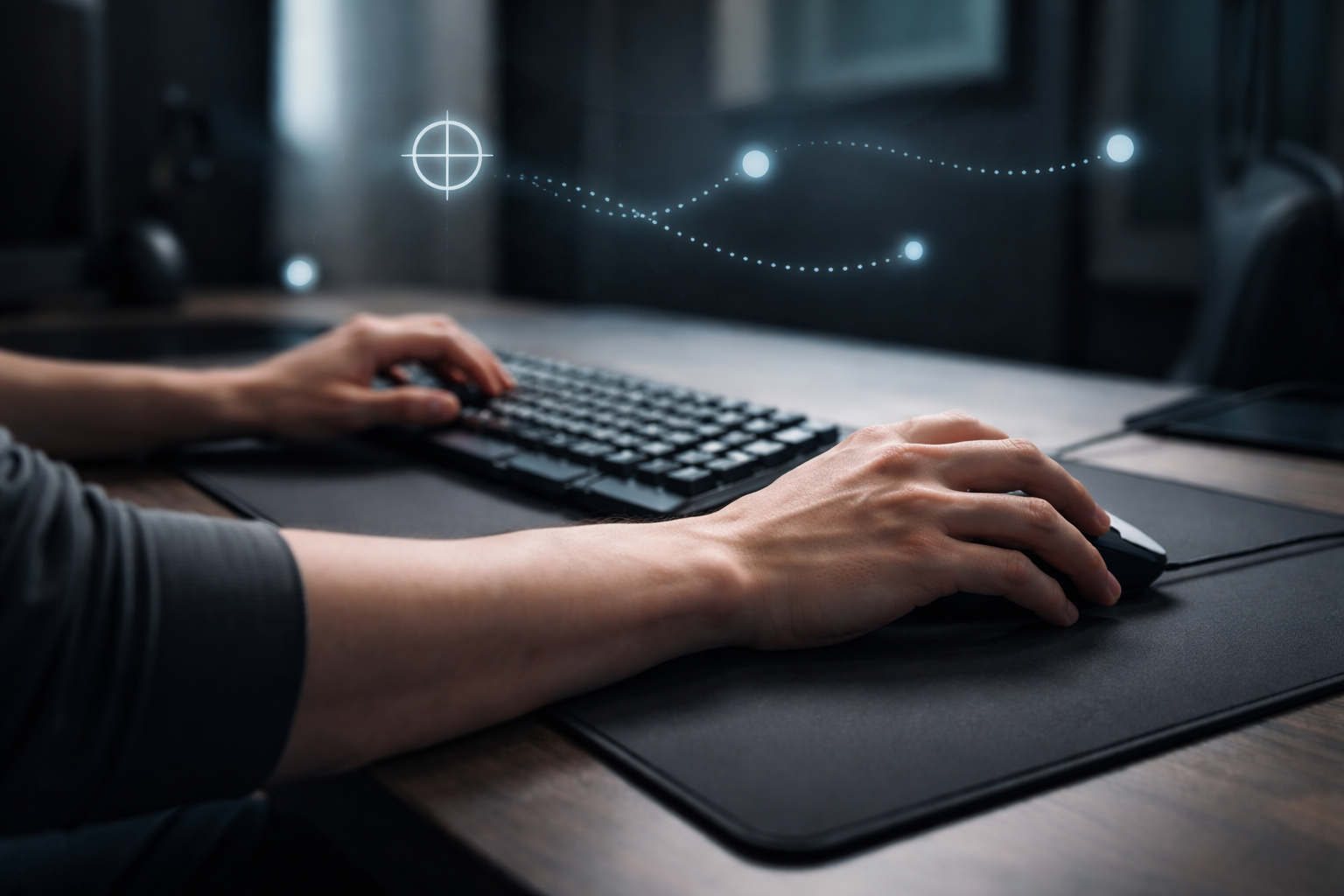
Tracking trains smoothness and continuous control. It also teaches you to stay calm while the target moves—critical for real fights.
Choose 1 tracking drill for 4:00 minutes:
- Smooth tracking: predictable target movement. Focus on zero jitter and steady follow.
- Reactive tracking: target changes direction. Focus on quick re-centering without overflicking.
- Strafe-sync tracking (in-game friendly): track while you strafe. Train coordination between movement and aim.
Tracking cue: Quiet crosshair, soft hand, match the motion.
Block 5 (14:00–15:00): Calibration
Finish with a one-minute “confidence set.” This reduces match anxiety and locks your mechanics into a calmer state.
- Option A: 60 seconds of easy micro-corrections (accuracy focus).
- Option B: 60 seconds of moderate flicks at controlled speed.
- Option C: 60 seconds of smooth tracking with zero tension.
Calibration rule: leave the routine feeling stable, not exhausted.
Micro-Corrections Deep Dive
Micro-corrections are the hidden difference between “decent aim” and “reliable aim.” Many players only practice big motions, then wonder why they miss easy shots under pressure. Micro-corrections teach your hand to do the tiny work quickly and calmly.
How micro-corrections actually work
Think of a shot as a sequence:
- Acquire: move toward the target quickly.
- Brake: decelerate before you cross past the target.
- Settle: stabilize crosshair for a fraction of a second.
- Confirm: final micro-adjust if needed.
- Click/commit: fire once alignment is real.
Most misses happen because one step is skipped—usually brake or settle. Players rush the click and “hope” it lands. The routine trains you to click because you know it’s aligned, not because you’re anxious.
Micro-correction technique cues
- Lead the stop: start slowing down slightly before target center, not on it.
- Minimal pressure grip: gripping hard creates jitter. Hold the mouse firmly enough to control it, loosely enough to stay smooth.
- Eyes confirm first: your eyes should confirm alignment before your finger clicks.
- One clean click: avoid “double-clicking hope.”
Micro-correction troubleshooting
Problem: You constantly overshoot tiny targets.
- Slow your first movement by 10–15% and focus on braking earlier.
- Reduce tension in your hand; overshoot often comes from “panic speed.”
- Practice “stop-and-confirm” for one full week before pushing speed.
Problem: You freeze and become too slow.
- Set a rhythm: one shot per beat (metronome in your head).
- Use slightly larger targets for a few sessions, then scale down.
- Commit to “good enough” alignment rather than perfect stillness.
Problem: Your crosshair jitters near the target.
- Relax your shoulder and forearm; jitter is often tension-based.
- Lower your speed for 30 seconds, then rebuild gradually.
- Try smoother mouse skates/mousepad or clean pad surface; friction inconsistency can cause micro-jitter.
Flicks Deep Dive
Flicks are often misunderstood. The goal is not to be flashy; the goal is to be repeatable. The best flick aim looks boring—fast, controlled, and consistent.
The “two-part flick”
Train flicks as:
- Fast approach: get close quickly using a confident movement.
- Micro-finish: complete with a small correction, then click.
If you try to land perfectly in one movement, you’ll either slow down too much or miss unpredictably. The two-part flick gives you speed without gambling accuracy.
Flick cues that actually help
- Stop with intention: your stop should feel like a controlled brake, not a crash.
- Keep crosshair height consistent: many flick misses are vertical mistakes from inconsistent crosshair placement.
- Don’t chase misses: if you miss, reset and do the next rep cleanly. Chasing trains panic behavior.
- Rhythm over chaos: aim improvements come from quality reps, not random speed spikes.
Flick progression: how to get faster safely
Use the “80% rule”:
- If you can hit around 80% clean reps at your current speed, raise speed slightly.
- If you drop far below that, reduce speed and rebuild stability.
This keeps your training in the zone where you’re challenged but not sloppy.
Tracking Deep Dive
Tracking aim is about smooth control and prediction. Most players fail tracking because they tense up and start “micro-flicking” constantly instead of flowing with the target.
Two types of tracking you must train
- Smooth tracking: target moves predictably; you train steadiness and low jitter.
- Reactive tracking: target changes direction; you train quick re-centering without overcorrecting.
In real fights, you need both. Smoothness keeps your beam stable. Reactive control keeps you on target after dodges, strafes, slides, or sudden movement bursts.
Tracking cues
- “Quiet crosshair”: the crosshair should glide, not shake.
- Match the target, don’t chase it: chasing often creates lagging movement and late corrections.
- Use your arm for long paths, wrist for fine control: blend them naturally.
- Breathing matters: tension rises when you hold your breath. Exhale gently during long tracks.
Tracking troubleshooting
Problem: You lag behind the target.
- Increase your initial “catch-up” speed slightly, then return to smooth follow.
- Focus on anticipating direction changes rather than reacting late.
- Lower tension; lag often comes from stiff movement.
Problem: You keep overcorrecting and zig-zagging.
- Slow down and prioritize smoothness for 60 seconds.
- Think “small corrections” rather than “big fixes.”
- Practice smooth tracking tasks more often than reactive until jitter improves.
How to Run It Anywhere (Aim Trainer or In-Game)
The routine is universal. The only thing that changes is where you perform the blocks. Below are plug-and-play options.
Option A: Aim trainer version (fastest structure)
In trainers like Aim Lab or alternatives found on platforms like Steam, pick tasks that map to each block:
- Reset: smoothness/line tracing.
- Micro-corrections: small static targets, stop-and-confirm tasks, tiny target-switch.
- Flicks: wide flick tasks, mixed distance flicks, flick-to-micro-confirm tasks.
- Tracking: smooth tracking tasks, reactive tracking tasks.
- Calibration: your easiest precision task for confidence.
Trainer tip: avoid constantly switching tasks. Choose a stable set for two weeks so your brain learns the patterns and your improvements become measurable.
Option B: In-game version (best for transfer)
In-game practice has one advantage: you train with the same movement, FOV, weapon feel, and visual context you fight in. Use these general substitutions:
- Reset: aim at fixed points on a wall, then glide between them smoothly at consistent speed.
- Micro-corrections: small targets (distant objects or training targets). Focus on stop → tiny adjust → single shot.
- Flicks: snap between targets at different angles; keep crosshair height consistent; finish with micro-correction.
- Tracking: track moving targets or bots; if none exist, strafe while keeping crosshair pinned on a mark.
- Calibration: one minute of easy, clean shots to end with confidence.
How to adapt the routine by game type
Tactical shooters
Tactical shooters reward first-shot precision and disciplined micro-corrections. Keep your micro-correction block strict: click only when stable. In flicks, train clean stops and head-height consistency. Tracking still matters (moving targets, swings, strafe fights), but prioritize calm control over frantic speed.
Battle royales
BR fights include longer engagements and more tracking. Keep tracking quality high and add strafe-sync. Flicks matter for quick target switches and snap shots, but tracking often decides who wins sustained duels.
Hero shooters
Hero shooters often combine tracking weapons, burst weapons, and movement-heavy duels. Rotate your tracking drill types: one day smooth, one day reactive. Keep micro-corrections sharp for precise burst shots and mid-range accuracy.
Progression and Measurement
A routine works only if you progress it intelligently. The goal is not to “grind”—it’s to accumulate high-quality reps that slowly increase in difficulty.
What to track (simple metrics)
- Accuracy consistency: do your results swing wildly day to day, or stay stable?
- Time-to-kill feel: in matches, do you confirm shots faster with less panic?
- Miss type: are misses mostly overshoots, undershoots, or late clicks?
- Comfort under pressure: do you feel calmer taking duels?
If you use an aim trainer, record one number per block (score, accuracy, or hits) and compare weekly averages—not single days.
The weekly progression rule
For each block, adjust only one variable per week:
- Targets smaller, or
- Targets faster, or
- More direction changes, or
- Less time per target, or
- Longer engagement duration.
Don’t increase everything at once. That creates sloppiness and hides what you’re actually improving.
4-week progression plan (timeless and repeatable)
- Week 1: Clean mechanics. Prioritize stability and repeatable rhythm. Keep misses controlled. Train calm clicking.
- Week 2: Controlled speed. Slightly increase pace in flicks and reactive tracking while keeping micro-corrections strict.
- Week 3: Pressure simulation. Reduce “thinking time.” Add more target switching or faster direction changes, but keep quality reps.
- Week 4: Consolidation. Keep difficulty stable and aim for your best weekly average. Lock in confidence and consistency.
After week 4, repeat the cycle with slightly harder tasks or stricter standards.
Common Mistakes and Fixes
Mistake 1: Treating warm-up like a speedrun
If you rush, you train panic. The routine is short—there’s no need to sprint through it. Instead, aim for clean reps with a steady rhythm.
Mistake 2: Changing sensitivity constantly
Sensitivity changes can be useful, but frequent changes destroy consistency. Keep one sens stable long enough that your brain can build reliable control patterns.
Mistake 3: Clicking before confirmation
If your finger “shoots for you,” micro-corrections never become dependable. Train eyes confirm → hand settles → click.
Mistake 4: Overgripping the mouse
Overgripping creates jitter and fatigue. Use a controlled but relaxed grip. If you feel your forearm burning during 15 minutes, you’re using too much tension.
Mistake 5: Only training one aim style
Many players spam flick tasks and ignore tracking or micro-corrections. Real fights demand all three. This routine stays balanced so your aim becomes reliable in more situations.
Mistake 6: Measuring improvement incorrectly
One good day doesn’t mean you improved; one bad day doesn’t mean you lost skill. Measure weekly averages and pay attention to how calm and consistent your aim feels in matches.
Daily Schedule, Recovery, and Consistency
The best aim routine is the one you can repeat. Fifteen minutes is intentionally sustainable. Use it in one of these ways:
Use case A: Pre-match warm-up
- Run the full 15 minutes.
- Play matches immediately while you’re warm.
- Keep calibration accuracy-focused so you enter games calm.
Use case B: Standalone daily training
- Run 15 minutes once per day.
- On days you have more time, add an extra 10–20 minutes after (but keep the 15-minute routine as the base).
- On busy days, do only the 15-minute routine to maintain consistency.
Use case C: Two short sessions (morning + evening)
- 7–8 minutes reset + micro-corrections in one session.
- 7–8 minutes flicks + tracking in the other session.
- This can reduce fatigue and keep quality high.
Recovery matters (yes, even for aim)
If your hand feels sore, stiff, or shaky, reduce intensity. Aim improves with quality reps, not pain. Better to do 10 clean minutes than 30 tense minutes.
FAQ
Is 15 minutes really enough to improve aim?
Yes—if it’s structured and consistent. Fifteen minutes daily builds better mechanics than random hours once in a while. Consistency teaches your nervous system faster than occasional long sessions.
Should I do this before every session?
If you play frequently, run it before serious matches or ranked sessions. If you play casually, do it once per day as a baseline and rely on shorter resets before quick sessions.
What if I only care about one game?
Keep the routine, but run it in-game whenever possible. The technique is universal; the best transfer comes from practicing in the same environment you compete in.
Should I prioritize accuracy or speed?
Prioritize accuracy with rhythm. Then raise speed slowly. Aim that is “fast but random” collapses under pressure. Aim that is “controlled and repeatable” scales into speed naturally.
How long until I notice improvement?
Many players feel better aim within a week because the routine reduces randomness and builds confidence. Deeper consistency typically shows over several weeks of daily reps.
Next Step for Faster Rank Progress
Mechanics are a huge part of winning duels, but ranked progress also depends on decision-making, positioning, utility usage, and consistency under pressure. If you want a faster path to climbing—especially in aim-heavy tactical environments—you can pair this routine with structured help and match-ready execution.
If your current goal is to climb efficiently in Valorant, you can check Boosteria’s options here: https://boosteria.org/valorant-boosting/prices
Keep the routine simple, repeat it daily, and focus on clean reps. In a month, your aim won’t just feel better—it will feel more reliable when it matters most.