



CoD Mobile Team Roles & Callouts for Ranked Wins
CoD Mobile — Team Roles & Callouts: Simple Comms for Ranked Wins
Good mechanics win duels, but clear communication wins ranked sessions. In CoD Mobile, many teams lose matches they were fully capable of winning because five players are trying to solve the same problem in five different ways. One player pushes early with no trade. Another watches the wrong lane. Someone silently dies on flank. The objective is left open for two seconds, and that is enough for the round to flip.
The fix is usually not a miracle strat. It is a simple communication structure. If every player understands their job, uses short callouts, and shares only useful information, ranked starts to feel slower, cleaner, and more controllable. That is true in solo queue, duo queue, and full stacks. It is also true across patches, because while weapons, balance, and map pools may change over time, the fundamentals of communication, spacing, trading, timing, and role clarity stay valuable.
This guide breaks down timeless CoD Mobile team roles and practical callout habits that help players win more often without sounding like a pro team trying too hard. You do not need complex code words. You do not need a fully drilled playbook. You need a shared language, a few repeatable responsibilities, and the discipline to say the right thing at the right moment.
If you want to study the game’s official ecosystem alongside your own improvement, check the official Call of Duty: Mobile page, Activision’s Multiplayer overview, the official esports settings page, and Liquipedia’s CoD Mobile hub. And if you want to pair better comms with faster ladder progress, you can also review Boosteria’s CoD Mobile boost pricing.
Table of Contents
- Why Simple Comms Work in Ranked
- A Simple Five-Role System for CoD Mobile
- Role 1: Entry
- Role 2: Trade
- Role 3: Anchor
- Role 4: Objective
- Role 5: Flex / Info
- How Roles Change by Mode
- Building a Callout System That Actually Works
- The Essential Types of Callouts
- What Good Callouts Sound Like
- What Bad Callouts Sound Like
- How to Communicate in Solo Queue
- How to Communicate in Duos, Trios, and Full Stacks
- Objective Comms for Hardpoint, Domination, and Search
- Timing, Trading, and Tempo Calls
- Mid-Game Adaptation: Fixing Problems Fast
- Common Communication Mistakes
- Practice Drills for Better Team Comms
- Sample Voice Comms You Can Copy
- How to Review Your Team Communication
- Final Thoughts
Why Simple Comms Work in Ranked
Most ranked games are not decided by perfect aim alone. They are decided by information speed. The team that identifies danger first, rotates earlier, stacks the right side of the map, and trades cleanly usually gets the better fight. Communication is what converts one player’s knowledge into a team advantage.
Simple comms work because mobile shooters are fast. Players do not have time to process long speeches. When the enemy hits a lane, your teammate does not need a story. They need a compact signal: “Two mid, one weak,” “Flank dead,” “Hold, wait for me,” “Back up, rotate now,” “Last seen top cat,” “I can break first,” or “Play time, don’t chase.” These are short, useful, and actionable.
Strong ranked communication also reduces panic. A lot of bad decisions happen because players feel surprised. Clear callouts remove that surprise. If your anchor warns that a spawn side is open, your slayers stop overcommitting. If your objective player says the point is safe for four seconds, your flex can hold a deeper angle instead of stacking uselessly. If your trade player says “I’m with you,” the entry can hit with confidence instead of shoulder-peeking forever.
Another benefit is consistency. Some ranked wins come from raw momentum, but lasting improvement comes from habits you can repeat every session. A player who learns how to call enemy numbers, lane pressure, timing windows, and objective status will stay useful even if their shot is cold that day. Communication lets you contribute on off-aim games, and that matters over hundreds of matches.
Think of comms as a force multiplier. One strong individual can carry a few fights. Five players sharing clean information can carry entire maps.
A Simple Five-Role System for CoD Mobile
You do not need rigid pro-level role labels to improve in ranked. But you do need structure. The easiest system is to divide your team into five responsibilities:
- Entry — starts fights, takes first space, forces reactions.
- Trade — follows the entry, punishes anyone who challenges them.
- Anchor — protects the safe side, stabilizes spawn or map control, denies flanks.
- Objective — secures the win condition, manages hill time, capture pressure, or bomb utility.
- Flex / Info — fills gaps, tracks routes, supports weak lanes, and communicates rotations.
These roles are not prison cells. Good teams swap them based on spawns, man advantage, map side, or mode. The point is not to freeze everyone into one identity forever. The point is to stop five players from freelancing at the same moment.
In one round, your flex may become the anchor because the usual anchor died. In the next break, your objective player may become the entry because they spawn closest to the route. Roles are best understood as responsibilities for the current play, not permanent job titles tattooed on a player’s forehead.
Still, assigning default tendencies helps. Every player should know what they usually do first when the round or rotation begins. That initial clarity prevents overlap. Ranked teams often throw away lives because two players think they are lurking, or because nobody thinks they are responsible for watching the cross.
If your team is new, keep it simple. Before the match starts, decide who is most comfortable entering, who is reliable for trades, who tends to think about spawns and flank safety, who naturally focuses the objective, and who adapts best under pressure. That alone will make your comms cleaner.
Role 1: Entry
The entry is the player who takes the first risk to create usable space. In ranked, this role is often misunderstood. People think entry means “run in first and die.” That is not the job. A good entry does three things: pressures key angles, draws attention, and creates openings that can be traded.
Your entry is usually the player saying things like “I’m hitting left,” “Flash then swing,” “I’m checking top,” or “I’m first through door.” Their goal is to force defenders to reveal themselves or reposition. Even if the entry dies, a good first contact gives the trade player and flex player the information needed to convert the fight.
The entry’s communication must be proactive. They should announce intention before moving, not after. “I’m peeking mid in three.” “I’m sliding in, be ready.” “I can break first; follow me.” These calls let teammates time their support. Silent entries are one of the biggest reasons teams fail to trade properly.
The entry must also know when not to over-force. If the anchor says the weak side is open or the flex says two enemies already crossed, the entry may need to pause. Great entry players are aggressive, but they are not random. They create pressure with a plan.
When your entry wins the first duel, their next comm matters just as much as the kill. “One dead, I’m weak.” “I have space.” “Cross open.” “Push up with me.” “Back up, second guy close.” This tells the team whether to flood, hold, or reset. The entry creates the first chapter of the fight; communication determines how the team writes the rest.
Role 2: Trade
The trade player is the partner every entry wants. Their job is to stay close enough to punish any challenge on the first contact without stacking so tightly that one spray or explosive removes both players. Good trading is spacing plus timing.
In most ranked games, the trade player is one of the most important yet least appreciated roles. Everyone notices the flashy first blood. Fewer players notice the teammate who instantly converts a 4v5 threat into a 4v4 or 5v4 advantage. But over a long session, that conversion decides a huge number of rounds and hills.
The best trade calls are extremely short: “With you.” “Swinging off you.” “I have your cross.” “Don’t peek yet.” “Go now.” “I can trade.” This language is powerful because it synchronizes the team. The trade player is often the timing manager of close fights.
A common mistake is trading too late because the player watches the entry from too far away. Another mistake is face-checking beside the entry and blocking each other’s movement. The ideal trade distance is one that lets you react instantly while still using a slightly different angle. If the first player is challenged, the second player sees the challenger’s focus and capitalizes.
Trade players should also call damage and weakness clearly. “One shot behind box.” “Two there, I can only trade one.” “I got one, second is close right.” Information after the trade matters because the rest of the team often arrives into a messy half-cleared fight.
When players say their teammates never trade them, the issue is usually not friendship or selfishness. It is role confusion and bad comm timing. Solve those, and your fight success rate rises immediately.
Role 3: Anchor
The anchor is the team’s stabilizer. In objective modes, this player helps protect favorable spawn influence, watches the lane your aggressive players are not watching, and makes sure the team does not get pinched from behind. In elimination-style moments, the anchor often becomes the player who prevents a chaotic wraparound.
Anchoring is not passive camping. It is intelligent restraint. The anchor understands which part of the map must remain safe so the rest of the team can pressure elsewhere. This player often sees the game one step earlier than others because they are not tunnel-visioned on the main gunfight.
The anchor’s callouts are some of the highest-value comms in ranked: “Back route open.” “They can spawn behind if we overpush.” “I’m holding flank; go.” “One crossed our back side.” “Don’t chase too deep.” “We lost safe side.” “I died, flank is open for five.” These calls prevent collapses before they happen.
Many teams ruin strong setups because nobody wants to anchor. Everyone wants to farm kills on the hot lane. But good anchors win maps by preventing disaster. If your team always seems strong for 15 seconds and then suddenly gets broken from two directions, chances are your anchoring and related comms are weak.
The anchor should be calm, specific, and early. Saying “flank, flank, flank!” while dead is much less useful than saying “one could wrap through back in three seconds; I’m checking it.” Great anchors make the game feel organized. Poor anchors make every hold feel fragile.
Role 4: Objective
The objective player keeps the team honest. Ranked players often lose because they become kill-focused and forget the actual win condition. The objective role makes sure someone is always thinking about time, presence, capture progress, plant pressure, defuse windows, and the practical math of the round.
This does not mean the objective player must always sit still on the point or be the only one touching the zone. It means they are the default voice for objective status. Their calls sound like this: “Point safe for now.” “Need one more on capture.” “We have enough time, don’t overpeek.” “Touch then back off.” “Play around hill, not past hill.” “Bomb down here.” “Hold cross on defuse.” “Stack for three seconds, then spread.”
One of the smartest habits for the objective player is giving the team a priority reminder in stressful moments. When three gunfights happen at once, players can forget whether they need kills, space, or seconds. A calm “Play time,” “We only need hold,” or “No need to chase” can rescue rounds that are about to be thrown.
Strong objective players also understand when they should become support instead of center point. Sometimes the best way to secure hill time is not sitting on the exact center of it, but holding the doorway that would otherwise blow up your teammate. Sometimes the best bomb support is not planting immediately, but first making sure the trade routes are covered.
Objective communication is about realism. It turns ranked from a deathmatch mindset into a winning mindset.
Role 5: Flex / Info
The flex or info player is the glue role. They fill the hole no one else is covering and often produce the most important read of the round: where the enemy is likely weak, where your team is overloaded, and whether the next move should be a flood, a wrap, or a reset.
This role suits players with strong awareness. They do not always top frag, but they constantly make the team smarter. They call missing lanes, likely rotations, soft openings, and pressure shifts. Their voice sounds like: “Nothing mid yet.” “They overstacked A side.” “We can pinch the guy on top.” “One might still be spawn.” “They gave up right lane.” “I can hold your outer while you push in.”
The flex player should watch the minimap, teammate deaths, and timing more than anyone else. They are often the first to notice patterns: a repeated late flank, a defender who always re-peeks after taking damage, or a team that abandons the objective too quickly under pressure. Those reads do not need to become speeches. Simple adaptations are enough: “Watch the late wrap every round,” or “After first pick they always stack site.”
Flex players are also excellent secondary shot-callers. If your main loud voice goes down, the flex can take over briefly: “Hold, wait for two,” “Give up scrap, play next,” “Don’t split here,” “Three together through mid.” That temporary clarity can save momentum.
In messy ranked environments, the flex role is often what separates coordinated teams from talented chaos.
How Roles Change by Mode
Roles stay useful across modes, but their emphasis changes.
Hardpoint
Hardpoint emphasizes rotation timing, spawn awareness, and layered pressure. Here, the anchor and objective roles become especially valuable. Your entry and trade pair usually start the break or hold the forward doorways, while the anchor protects the favorable side and the objective player manages time. The flex tracks routes and helps decide whether to fight for remaining seconds or leave early for the next setup.
Domination
Domination rewards balanced lane control. Overcommitting to one flag or chase route often opens the entire map. The anchor matters because spawn stability matters. The objective player must constantly remind teammates when to defend instead of overextend. The flex often becomes the lane balancer, making sure one side is not left empty.
Search and Destroy
Search compresses information into fewer, more meaningful lives. Entry and trade become crucial because the first duel heavily shapes the round. The anchor role becomes more about flank denial and post-plant safety than spawn management. The objective role centers around bomb pathing, plant timing, crossfires, and composure in clutch windows.
Control or Similar Multi-Zone Competitive Modes
These modes demand coordinated hits and strong space denial. Entry starts pressure, trade follows, objective makes sure progress is respected, anchor prevents the collapse route, and flex bridges lanes while reading the enemy stack. In these modes, “group, clear, capture, then spread” is often a stronger plan than everyone freelancing for hero plays.
The key lesson is that roles are not mode-exclusive. They simply shift in value depending on what wins the round.
Building a Callout System That Actually Works
The best callout system is not the fanciest one. It is the one everyone on your team remembers under pressure. If your squad uses twenty different names for the same doorway, you do not have a system. You have noise.
A strong CoD Mobile callout system should follow four rules:
- It must be short. One or two words is ideal for locations.
- It must be visual. Use names tied to obvious landmarks, lanes, height, or function.
- It must be consistent. Do not rename areas every round.
- It must be actionable. A good callout tells teammates where to look or how to react.
A universal map naming system helps a lot. Even if a map changes, most environments can still be described with repeatable language: spawn, mid, left lane, right lane, top, bottom, window, connector, stairs, headglitch, cross, outer, close, deep, back, front, weak side, and strong side.
You do not need perfect map lore. “Top mid window” is better than a teammate inventing a long nickname nobody else understands. When in doubt, functional names beat creative names.
For new teams, spend five minutes before queueing to align on common words. Pick the names you will use for power positions, flank routes, and the most contested entry points. That tiny preparation pays off across the whole session.
The Essential Types of Callouts
Most useful comms fall into a few categories. If your team learns these categories, communication becomes easier and cleaner.
1. Enemy Location
This is the classic callout: “One top mid,” “Two right lane,” “Close left box,” “Back spawn,” “On point,” “Deep outer.” Keep it direct.
2. Enemy Numbers
Numbers matter because they shape decisions. “Two there” is very different from “one there.” If you know numbers, say them. If you do not, do not guess wildly. “At least two” is better than pretending certainty.
3. Timing
Examples: “Flank in five,” “They hit late,” “Wait two seconds,” “I’m there now,” “Rotate early,” “Touch now.” Timing callouts often separate coordinated pushes from staggered deaths.
4. Damage / Weakness
“One shot,” “Weak behind pillar,” “Tagged two crossing,” or “I cracked the guy top.” Use damage calls only when they help a teammate decide to challenge.
5. Intent
Tell teammates what you are about to do. “I’m swinging,” “I’m nading point,” “I’ll hold cross,” “I’m playing bomb,” “I’m wrapping spawn.” Intent is incredibly powerful because it prevents overlap.
6. Objective Status
“Hill clear,” “Need touch,” “Bomb down,” “Half cap,” “We have time,” “Play zone,” “No need to chall.” This language keeps your team tied to the actual win condition.
7. Risk Warnings
“Flank open,” “We are split,” “Don’t overpush,” “Watch pinch,” “Their spawn may flip,” “Back route free.” These warnings save rounds before the collapse happens.
8. Reset / Regroup Calls
“Back up,” “Give scrap,” “Wait for all five,” “Don’t trickle,” “Reset and hit together.” Many teams know how to start fights but not how to stop bad ones. Reset calls fix that.
What Good Callouts Sound Like
Good callouts are concise, calm, and useful. They usually follow a simple formula:
What + where + how many + what next
For example:
- “Two mid, I’m backing up.”
- “One close left weak, swing him.”
- “Flank dead, you can face front.”
- “I have bomb down, hold cross.”
- “One top, one point, rotate now.”
- “They stacked B side, hit A fast.”
- “We have hill control, don’t chase kills.”
- “I’m first in, trade me.”
Notice what these do well. They are short. They are directional. They create immediate decisions. And they avoid unnecessary emotion. Even excitement should stay informative.
Another sign of good comms is that they help teammates who are not looking at the same thing you are. The best callout is not the one that best describes your feelings. It is the one that changes a teammate’s next action for the better.
What Bad Callouts Sound Like
Bad callouts are usually vague, late, emotional, or overloaded.
- “He’s over there!”
- “On me, on me, on me!”
- “Bro where is my team?”
- “They’re literally everywhere!”
- “I think maybe one could be doing something weird.”
- “I died. Nice.”
These comms create stress without clarity. “On me” only works if everyone already knows exactly where you are. “Over there” is meaningless. Complaining mid-round steals attention from useful information. And long, uncertain monologues often hide the simple fact that a player saw one enemy in one place.
A good rule: if your callout does not answer a teammate’s question about where, how many, or what to do, it is probably weak.
Another common problem is repeating the same call too many times. Once or twice is enough. If you scream “flank, flank, flank” five times with no added detail, you are just flooding the channel. Better: “One flank, back left, close now.” That finishes the job.
How to Communicate in Solo Queue
Solo queue communication should be simple, positive, and low-friction. You cannot assume chemistry. You cannot expect everyone to use your terms. And you definitely should not try to become a lecture machine after one lost fight.
In solo queue, focus on high-value basics:
- Enemy numbers on key lanes
- Flank warnings
- Objective reminders
- Your own intention before pushing
- Simple regroup calls after a lost fight
Good solo queue lines include: “Two pushing mid,” “I’ll hold flank,” “Wait for spawn,” “Play point, no need to chase,” “I’m hitting left, trade if you can,” and “Bomb down here.” These are easy to understand even if strangers use different map nicknames.
Do not try to control every move. Ranked strangers usually respond better to useful info than to bossy orders. Instead of “Why are you there?” say “Back route open.” Instead of “Stop feeding,” say “Wait two, hit together.” Replace blame with direction.
Also, understand when silence is better. If three teammates are already speaking and the round becomes chaotic, only say what matters most. Information competition is real. Too many voices can be worse than too few.
The best solo queue communicator is not the loudest player. It is the one who keeps the team functional without creating extra tilt.
How to Communicate in Duos, Trios, and Full Stacks
With a duo or trio, communication can become more layered. You can pre-plan simple pairings: entry plus trade, anchor plus flex, objective plus support. A duo queue can create a lot of value just by guaranteeing one clean trade partnership every round.
In trios, define a micro-core. For example, one player entries, one trades, and one flexes behind them while strangers fill out the rest. This lets your group create dependable pressure without needing perfect cooperation from everyone else.
In a full five-stack, structure matters more. Assign default roles and default voices. Not everyone should be speaking the same amount. Usually, one primary shot-caller handles broad direction, while others specialize in information: anchor for flank and safety, objective for win condition, flex for map reads, entry for contact timing, trade for immediate fight synchronization.
Full stacks should also decide how much they want to talk between deaths. Some teams get cluttered when dead players keep narrating everything. A good rule is that dead players speak only when they have useful information from spectating or can remind the living players of objective math.
Another strong full-stack habit is pre-round role declarations. Nothing complicated. Just quick confirmation: “I anchor back side.” “I’m first in mid.” “Trade me on A hit.” “I’ll watch wrap.” “I’m on bomb.” That ten-second investment makes rounds feel much cleaner.
Objective Comms for Hardpoint, Domination, and Search
Hardpoint
Hardpoint comms should revolve around four things: current hill control, next hill timing, spawn safety, and break path. A good team constantly answers these questions: Are we stable? Is a flank open? Do we fight for remaining time or rotate? Which door or lane is the real threat?
Strong Hardpoint calls include: “We have scrap only, rotate now.” “I’m anchoring next.” “They’re hitting front only.” “Watch back spawn flip.” “One in hill, two outer.” “Break together from left in three.” “Need one more to hold point.” “Play kills around hill, not deep.”
The biggest Hardpoint communication error is indecision around transition. Teams stay half-committed to old time while half the squad drifts toward next. That split usually loses both. Your flex and objective players should be especially vocal about when to leave and when to flood.
Domination
Domination requires lane balance and composure. The best comms are often defensive and practical: “Hold two flags.” “Don’t overpush their spawn.” “One trying to backcap.” “Stack B then spread.” “Watch cross to mid.” “They’re spawning weak side.”
Many Domination throws happen because teams confuse map control with endless pushing. Communication should remind players that once you have the favorable setup, the goal is to deny the retake, not sprint into random duels.
Search and Destroy
Search demands your cleanest comms. The first blood, bomb position, and route confirmation are everything. Good lines include: “Bomb crossing A.” “One close site, one outer.” “Nothing B yet.” “Planting safe side.” “Hold my swing.” “Don’t peek, play defuse sound.” “Last seen top mid.” “Bomb dropped outside.”
In Search, dead silence can sometimes be useful after setup is confirmed. Once the post-plant crossfire is established, players should not overtalk. Say only what helps the living teammate make the next correct move.
Timing, Trading, and Tempo Calls
Many players know what they want to do but fail because they do not communicate when to do it. Timing is where good ranked teams start to feel dangerous.
Tempo calls are simple phrases that align action:
- “Go now.”
- “Wait half a second.”
- “Hit after my nade.”
- “Let them walk up, then swing.”
- “Don’t chall yet, I’m almost there.”
- “Three-man hit in two.”
- “Pause, they might push into us.”
These calls are vital because ranked teams often die in layers rather than together. One player enters too early, one peeks too late, and one rotates while the other two are still fighting. That creates permanent disadvantage. Tempo calls fix staggered decision-making.
Trading also improves massively when players verbalize readiness. “Ready to trade.” “Hold, not with you yet.” “I have your pinch.” “Swing off my contact.” If your team starts saying these phrases consistently, your close-range fights become far more efficient.
The best teams also control tempo strategically. They know when to speed up after spotting a weak side and when to slow down because the enemy over-rotated into a trap. Communication is what changes tempo from accidental to intentional.
Mid-Game Adaptation: Fixing Problems Fast
Not every plan survives first contact. That is normal. Strong teams adapt without emotional collapse. The easiest mid-game adaptation method is to ask three questions after a lost fight or round:
- Where did we lose space?
- What information did we miss?
- What one adjustment matters most next time?
Keep the answer short. Examples:
- “We ignored late flank; anchor it next round.”
- “We hit too split; wait for trade player.”
- “They overstack front; wrap the weak lane.”
- “We chased kills and lost hill time; objective first.”
- “Bomb path was obvious; fake pressure then regroup.”
Do not try to rewrite the entire match in one timeout-style speech. Ranked improvement happens faster when teams make one clean correction at a time. Overloading players with five adjustments usually means they remember none of them.
The flex player and anchor are often best positioned to spot repeated patterns, while the objective player helps keep adjustments tied to the actual win condition. If your team is emotionally heated, default to the calmest, most practical fix. Simplicity survives pressure.
Common Communication Mistakes
Even mechanically strong players make the same comm mistakes over and over. Here are the most common ones:
Calling Too Late
If your teammate hears the danger only when you are already dead, the call has lost most of its value. Early information is premium information.
Talking Instead of Fighting
Some players narrate everything while losing gunfights. Keep the call short enough that your mechanics do not disappear.
Overexplaining
Ranked rounds move quickly. A six-second story about where you think one enemy maybe could be is often worse than “Last seen outer; possible wrap.”
Emotion Over Information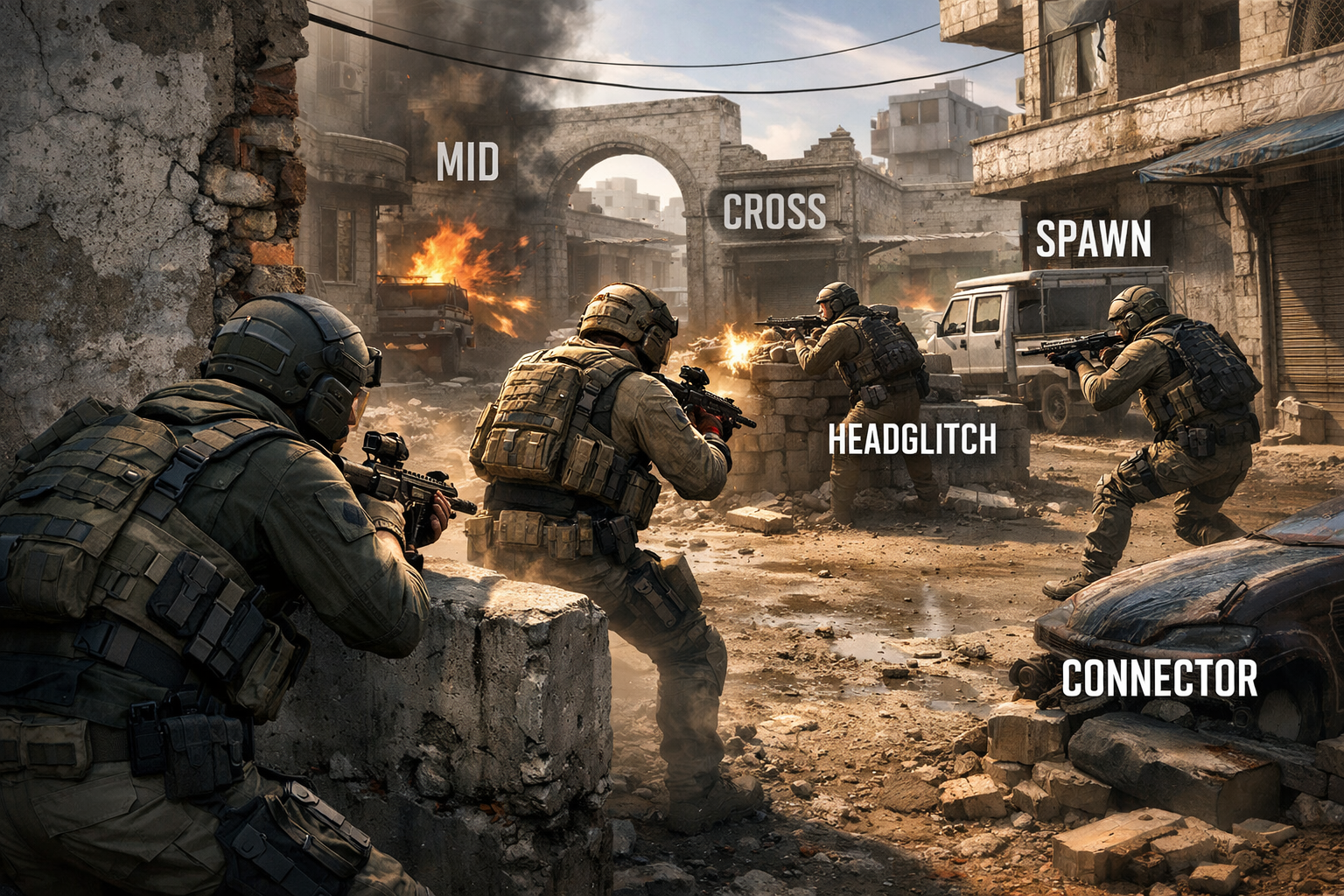
Frustration, sarcasm, or blame mid-round usually reduces team quality. Fix the problem, not your teammate’s soul.
Everyone Calling the Same Thing
Duplicate callouts can flood the channel. Once the information is established, move on unless something changes.
No Intent Calls
Teams often communicate what the enemy is doing but not what they themselves are about to do. That creates overlap and hesitation.
Ignoring Objective Math
Players chase low-value kills and forget time, capture percentage, or bomb pressure. The objective voice must stay active.
Not Resetting After Lost Fights
A lot of ranked losses happen because teams trickle one by one into unwinnable situations. Somebody has to say “back up” and mean it.
Practice Drills for Better Team Comms
You can improve communication on purpose. Here are practical drills that work.
1. Two-Word Location Drill
Load into maps or review clips and force yourselves to describe every major zone in one or two words. This builds fast, consistent naming.
2. Intent-First Drill
For one session, require players to say their action before taking it whenever possible: “I’m swinging,” “I’m rotating,” “I’m holding flank,” “I’m planting.” This immediately reduces overlap.
3. Silent After Setup Drill
In post-plant or established hill holds, practice speaking only when something changes. This teaches discipline and reduces clutter.
4. Trade Pair Drill
Queue with one partner and focus only on spacing and trade comms for multiple games. Use phrases like “with you,” “not with you yet,” and “go now.”
5. Review One Collapse Per Session
After a match, identify one lost hold or one bad round and ask what missing call would have prevented it. This is one of the fastest ways to improve.
6. Objective Reminder Drill
Assign one player to make sure the win condition is spoken every major fight: “Play time,” “Stack B,” “Don’t overchase,” “Bomb down.” Soon the whole team starts thinking that way.
Sample Voice Comms You Can Copy
Opening Hardpoint Break
“I’m first in left.”
“With you, I can trade.”
“I’m holding back route.”
“One point, one outer.”
“Break together now.”
“Hill clear, watch flank.”
Early Rotation
“Scrap only, leave now.”
“I’m anchoring next.”
“Two still old hill.”
“They can hit right lane first.”
“Play setup, don’t overpush.”
Domination Hold
“We have two, play defense.”
“One trying to cross mid.”
“Don’t push their spawn.”
“Backcap route open.”
“Stack B for two seconds, then spread.”
Search Attack Round
“I’m taking first peek mid.”
“I have your trade.”
“Nothing B so far.”
“Bomb can come A.”
“One site, one outer.”
“Planting safe side, hold cross.”
Search Defense Round
“I’m playing info, not overpeeking.”
“One crossed bomb side.”
“Could be late mid.”
“Hold, don’t give 1v1s.”
“Bomb down here.”
“Play sound, don’t chall together.”
After Losing a Fight
“Back up.”
“Wait for two.”
“Don’t trickle.”
“We lost safe side.”
“Hit together through weak lane.”
You do not need to copy these word for word forever. Use them as training wheels until your own team language becomes natural.
How to Review Your Team Communication
Most players review aim mistakes and positioning mistakes but almost never review communication mistakes. That is a huge missed opportunity. A team can improve faster by fixing communication because one good adjustment affects multiple players at once.
When reviewing matches, ask:
- Did we identify enemy pressure early enough?
- Did our entry announce their hit?
- Were trade players actually in position?
- Did somebody track flank or safe side consistently?
- Did we clearly state when to rotate or reset?
- Did objective reminders happen at the right moments?
- Did we overtalk in clutch situations?
- What single missing call caused the collapse?
It helps to label mistakes by category: late call, wrong location, no intent, duplicate noise, no reset, objective forgotten, or flank ignored. These labels keep review practical and prevent vague criticism like “our comms were bad.”
You should also notice what worked. Maybe your duo traded beautifully all session. Maybe your anchor calls saved multiple holds. Maybe your objective reminders stopped several throws. Reinforcing good communication is just as important as correcting bad communication, because teams improve faster when they know which habits to keep repeating.
If you want to improve efficiently, review one close loss and one clean win. In the loss, find the missing structure. In the win, identify the communication habits that made the map feel easy. Then bring those habits into the next session deliberately.
Final Thoughts
CoD Mobile ranked does not require perfect coordination to reward better communication. Even a modest upgrade in comm quality can change your results quickly. If your team learns who usually entries, who trades, who anchors, who tracks the objective, and who flexes for information, your matches become easier to read. If you pair that with short, repeatable callouts, you reduce panic, improve trading, and waste fewer lives on preventable mistakes.
The most important idea in this guide is simple: do not try to sound impressive. Try to sound useful. Clean comms beat complicated comms. Early warnings beat emotional reactions. Role clarity beats five players freelancing. And objective reminders beat highlight-chasing.
Start with a few habits. Call your intention before you move. Use simple location names. State numbers when you know them. Warn the team when the weak side is open. Say when to reset. Say when to rotate. Say when the objective matters more than the kill. Those habits are timeless, and they win matches in every version of ranked.
If your gunskill is already decent, communication may be the fastest path to more consistent wins. And if your mechanics are still improving, strong comms let you contribute immediately while your shot catches up. Either way, better team roles and better callouts turn chaos into structure. In ranked, structure wins a lot of games.