



LoL Jungle Pathing Guide 2026 for Beginners
LoL Jungle Pathing Guide 2026: Efficient Routes, Clear Speed and Gank Timings for Beginners
If you are new to the jungle in LoL, the role can feel overwhelming at first. You are expected to farm camps, read lanes, secure objectives, track the enemy jungler, manage vision, and somehow still arrive on time for ganks. That sounds like too much because, honestly, it is a lot. The good news is that beginner jungle improvement does not come from memorizing dozens of fancy routes. It comes from understanding a few reliable pathing ideas and using them with discipline.
This guide is built for beginners who want practical results. Instead of locking you into one patch-specific route, it teaches the timeless rules behind strong jungle pathing: why some clears are safer than others, when to farm instead of forcing action, how to choose your first gank window, when to reset, and how to path with a purpose instead of wandering between camps. If you learn these principles, you will still make good decisions even when seasonal systems or champion balance change.
You do not need to become a high-level shotcaller overnight. Start with clear structure. Know your first route before the game starts. Know which lane you would like to end near. Know what counts as a good gank and what counts as a bait. Then repeat that process every game until it becomes natural. That is how most stable jungle improvement begins.
If you want to cross-check live route trends later, Riot’s official How to Play page is a good systems refresher, Riot’s 2026 gameplay preview explains broader seasonal context, and League of Graphs jungle paths is useful for checking what routes players are actually using on live servers.
1. Why Jungle Pathing Matters
Pathing is the route you take through the jungle and the reason behind it. That second part matters. Many new players think pathing is only the camp order. It is not. Real pathing is camp order plus destination plus timing plus purpose. A beginner who clears camps randomly might still collect gold, but a jungler with a real path arrives in the right place at the right moment with enough health, enough time, and enough information to make the next play.
Strong pathing does four things at once. First, it gives you income through camps. Second, it positions you near a lane or objective you actually want to affect. Third, it protects your tempo so you are not standing idle while the map moves without you. Fourth, it reduces coin-flip decisions. When your route has structure, you spend less time improvising under pressure.
This is why two junglers with similar mechanics can have very different games. One reaches level spikes on time, shows up to punish overextended lanes, and resets before an objective. The other clears half a quadrant, hovers a lane that cannot be ganked, misses camp respawns, and arrives late to everything. The difference is usually not raw mechanics. It is pathing quality.
For beginners, pathing matters even more because it covers for mistakes. You may miss some abilities, you may hesitate on engages, and your lane reads may not be perfect yet. A solid route still keeps you relevant. Bad pathing, on the other hand, puts you behind before the fight even starts.
2. Core Jungle Terms You Must Know
Before talking routes, let’s define the language. A full clear means taking all six standard camps on one side-to-side first rotation before looking for a major play. A 3-camp route means taking three camps quickly and then moving into an early gank or contest. A 4-camp route is the flexible middle ground. It gives you more experience and safety than a 3-camp play while still letting you reach a lane early enough to influence it.
Tempo means how efficiently you move from one useful action to another without wasting time. Lane priority means which laner can move first to help a fight near river or jungle. Strong side is the part of the map where your team is more likely to support you. Weak side is where you are more isolated or where your laner is less likely to help. Cross-map means taking value on one side when the enemy commits on the other.
You should also understand hovering, which means staying near a lane or zone because action is likely soon, and shadowing, which means moving in a way that mirrors an ally or likely enemy path. Finally, reset discipline means recalling at a smart moment, usually after spending gold efficiently or after finishing a route without losing too much pressure.
These words are not there to sound advanced. They help you think clearly. If you can say, “I am full clearing top because top has setup and bot has no priority,” you are already jungling with more structure than many beginners.
3. What to Decide Before the Game Starts
The biggest beginner mistake often happens before the first camp spawns: entering the game with no route in mind. Your first path should not be decided after you have already started hitting a camp. It should be decided in loading screen or at least in the first seconds of the game.
Ask yourself five simple questions:
- Which of my lanes has the best gank setup?
- Which enemy lane is most likely to overpush?
- Do I want to path toward top or bot on my first clear?
- Is my champion better at fast farming, early fighting, or early ganking?
- What do I think the enemy jungler wants to do?
If your top laner has reliable crowd control and the enemy top is a melee champion who tends to push, ending your path top makes sense. If your bot lane has strong engage and your duo lane matchup will likely fight early, pathing bot may be better. If your champion is weak in early skirmishes but clears very well, a full clear is usually safer than forcing a coin-flip 3-camp fight.
Beginners often overcomplicate this. You do not need perfect foresight. You just need a plan that matches your champion and one likely lane state. Even a simple thought like “I am pathing toward bot because that lane is volatile” creates more value than wandering without direction.
4. The Three Goals of a Good First Clear
Your first clear sets the tone of the game, but its job is simpler than many players think. A good first clear has only three main goals: stay efficient, stay healthy enough to act, and end near a meaningful option. That option might be a gank, a river fight, a reset, or simply a safe transition into your next cycle of camps.
Efficiency means you are not pathing back and forth for no reason. If you clear Blue, then randomly walk across mid, then return for Gromp, you are bleeding time. Health matters because a route that leaves you too low removes your freedom. Even if a lane looks good, you may not be able to contest or dive safely. Ending near a meaningful option matters because the route should create pressure, not just numbers on your scoreboard.
A useful beginner benchmark is this: after your first path, you should be able to answer the question, “What am I doing next?” with a clear sentence. For example: “I will gank top if the wave is good, otherwise take river vision and reset.” That is a healthy first clear. If your answer is, “I’m not sure, I guess I’ll walk around and see,” your first route probably lacked purpose.
Do not judge your first clear only by kills. A clean route that gets no kill but preserves camp tempo and map control is often better than a messy forced gank that wastes time and ruins your next spawn cycle.
5. The Best Beginner Route: Safe Full Clear
If you are brand new to jungle, the safest and most educational first route is the classic full clear. On one side, that often looks like Blue into Gromp into Wolves into Raptors into Red into Krugs, ending near top or bot depending on your side and goal. On the opposite side, you can mirror it by starting Red into Krugs into Raptors into Wolves into Blue into Gromp. The exact order can vary by champion, but the logic stays the same: collect your camps in a smooth line and finish in position to react.
Why is full clear so good for beginners? Because it solves several problems at once. It gives strong early income. It usually gets you to an early level breakpoint without risky fights. It teaches you map flow. It reduces the chance that you waste time hovering a lane with no angle. And it keeps your next camp cycle predictable, which is huge for learning tempo.
Full clearing is strongest on champions who want resources, scale well with levels, or do not need to gamble on the first minute of lane interaction. It is also excellent when your lanes have uncertain setup. If none of your lanes look obviously gankable, taking your camps and ending with information is simply correct.
The most important beginner lesson here is that a full clear is not passive if you end with purpose. After your sixth camp, you can still gank, contest vision, take river control, or reset for a powerful return path. Passive jungling is not farming. Passive jungling is farming with no plan. Full clear with intention is one of the most stable ways to learn the role.
A simple rule: if you are unsure, full clear toward the lane that is most likely to be volatile. That gives you the highest chance of arriving where the action actually happens.
6. The Fastest Early Pressure Route: 3-Camp Gank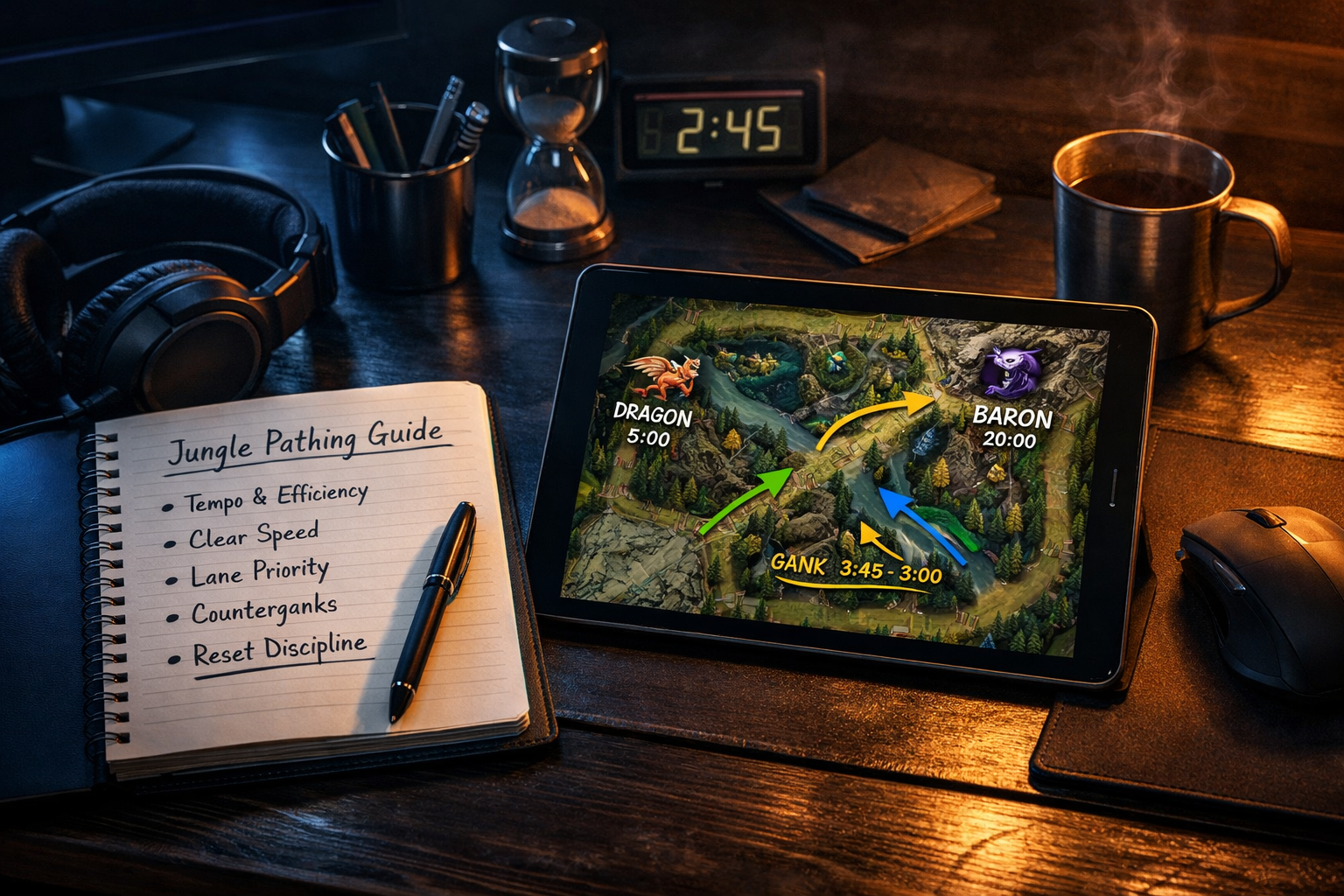
The 3-camp route is for early impact. Instead of taking all six camps, you clear three quickly and look for a lane play or river contest. Common versions are Red into Krugs into Raptors into a nearby lane, or Blue into Gromp into Wolves into a lane on that side. The goal is simple: arrive before the enemy expects full-clear timing and punish a lane that is naturally exposed.
This route is powerful, but only when used for the right reasons. A 3-camp gank works best if your champion has reliable early pressure, your target lane has setup, and the enemy lane is likely to be extended. If none of those conditions are true, forcing this route usually makes your game worse. You sacrifice camp tempo to create early threat. If the threat is fake, the sacrifice is not worth it.
Beginners love 3-camp ganks because getting an early kill feels great. The danger is that they start doing it every game. That is how you become inconsistent. You will snowball some games, but in many others you will fail the gank, lose camps, fall behind in levels, and wonder why your champion suddenly feels weak.
Use a 3-camp route when the lane state is predictable. For example, your laner has crowd control, the enemy lane tends to push early, and your own champion has enough damage or utility to convert quickly. If the lane is full of dashes, has no allied setup, or is too healthy and close to tower, do not force it. Finish a safer route instead.
For beginners, a healthy habit is this: only choose 3-camp when you can say exactly which lane you are ganking and why it should work. If you cannot explain both, pick a more stable path.
7. The Flexible Route: 4-Camp Into Fight, Crab, or Gank
The 4-camp route is often the most underrated path for beginners. It gives more income and safety than a 3-camp route but reaches action earlier than a full clear. That makes it perfect when you want flexibility. You are not fully committing to a farm-only start, but you are also not sacrificing too much to force a low-percentage early play.
A common 4-camp route might look like Blue, Gromp, Wolves, Raptors and then decision time. Or Red, Krugs, Raptors, Wolves and then move toward river or lane. After four camps, ask what the map is giving you. Is there a clean gank? Is the enemy jungler likely near river? Does your nearby lane have priority for a fight? If yes, act. If not, continue your clear or reset on your terms.
This route is great for new jungle players because it teaches decision-making at the correct speed. You reach your first fork in the road with enough resources to matter, but not so late that every lane state has already changed. It is also forgiving when your original plan breaks. If the lane you wanted to gank becomes ungankable, you still have a clean fallback because you already secured four camps.
If you are struggling to choose between early ganking and full clearing, this route is often the answer. It lets you play honest League: farm first, check the map, then commit only if the opportunity is real.
8. When Invading Is Good and When It Is Terrible
Invading is one of the most misunderstood pathing choices in LoL. New players often think invading is automatically aggressive and therefore good. It is not. A smart invade is based on information, lane priority, matchup strength, and camp timing. A random invade is just volunteering to lose tempo.
Invade when at least some of the following are true: you know where the enemy jungler started, your nearby lanes can move first, your champion wins the early duel, or you are entering a side where camps should be up and contestable. Invading is especially effective after you see the enemy reveal on the opposite side of the map. That is classic cross-map value: if they gank bot, you can take top-side camps, drop vision, or threaten top.
Do not invade just because you are ahead in confidence. Do not invade a side where both of your lanes are shoved in and cannot move. Do not invade with no idea where the enemy laners are. And do not invade when your own camps are sitting alive for free on the opposite side unless you are sure the reward is bigger.
For beginners, treat invade as a reward for correct information, not a substitute for it. If you can track the enemy path and your lanes have priority, invading can feel easy. If you cannot answer those questions, pathing your own camps is usually the better play.
9. How to Improve Clear Speed Without Panicking
Clear speed matters because it creates time. Faster clears do not just give you more gold; they let you arrive earlier to ganks, river fights, resets, and camp respawns. But many beginners try to improve clear speed in the wrong way. They focus on going faster before learning how to go cleanly.
First, learn a stable order. Second, learn clean ability use on camps. Third, reduce unnecessary walking. Those three improvements matter more than flashy optimization. If your path between camps is smooth and your abilities are used consistently, your clear speed will improve naturally.
Here are the basics:
- Start your next movement as the current camp is about to die, not after it is already gone.
- Use abilities in a repeatable pattern instead of mashing them from panic.
- Avoid taking extra damage by standing still for no reason.
- Practice one first clear in the practice tool until it feels automatic.
- Do not copy challenger micro-optimizations before you understand the route itself.
The biggest hidden clear-speed skill is decision speed. Some junglers lose more time thinking than fighting. If you finish Raptors and then spend three seconds staring at lanes, that is clear-speed loss too. This is why route planning matters. You should already know the likely next step before the current camp dies.
Another important point: clear speed is champion-dependent. Some champions are naturally efficient and healthy in the jungle. Others need more careful routing or prefer earlier interaction. Do not compare your first clear on a slower utility jungler to a power farmer and assume you are doing everything wrong. Focus on hitting your own champion’s stable standard.
10. Beginner Gank Timings That Actually Make Sense
Many beginners ask for exact gank timings, but the better question is: what makes a good gank window? The answer is a combination of route timing, lane state, health bars, summoner spells, and wave position. Still, for practical learning, there are three reliable beginner windows you should know.
First window: after 3 camps. This is your earliest serious pressure timing. Use it only if the lane is highly gankable and your champion can make something happen immediately. This is for proactive routes, not for random wandering.
Second window: after 4 camps. This is the best flexible window for many beginners. You have more resources, more safety, and still enough speed to punish aggressive lane states. If you are unsure, this is usually the healthiest balance between tempo and pressure.
Third window: after full clear. This is your most stable timing. If a lane is still extended when you finish your route, great. If not, you can reset, take vision, or contest river with stronger tempo than someone who failed an early force.
A good beginner rule is this: do not gank because you are “near” a lane. Gank because the lane state and your timing line up. A lot of wasted jungle time comes from walking into a lane simply because you ended nearby. Proximity is not a reason. Opportunity is the reason.
If the enemy is healthy, close to tower, has easy escape, and your ally has no setup, the lane is not gankable just because it is next to you. Keep your camps and tempo alive. That discipline alone can raise your win rate.
11. How to Read a Lane Before You Gank It
Lane reading is the skill that turns routes into results. Before you enter a lane, check five things. Is the enemy pushed far enough? Does your laner have health and mana? Does your laner have crowd control or burst ready? Does the enemy have obvious escape tools available? And where is the wave likely to go in the next few seconds?
The best beginner ganks usually happen when the enemy has committed forward for farm or pressure and cannot safely retreat without losing a lot. This is why wave position matters so much. A long lane gives you time to chase. A short lane near enemy tower removes that time.
You should also pay attention to lane behavior, not just location. Some enemies are visibly trading hard and using cooldowns. Some are slow-pushing a big wave. Some are freezing near their tower and are almost impossible to gank. Learning to tell the difference is one of the biggest jungle upgrades you can get.
Here is a simple beginner test. Before entering a lane, say one sentence in your head: “How do we actually kill here?” If you cannot answer, the gank is probably weak. Your answer might be, “My top laner lands CC and we have enough room to run them down,” or “Bot is low and has no flash.” That clarity matters.
Good junglers do not just appear in lanes. They appear in lanes where the map has already made the kill possible.
12. Tempo, Reset Timing, and Why Bad Recalls Ruin Games
Tempo is the rhythm of useful actions. A bad recall breaks that rhythm. One of the most common beginner jungle problems is resetting at awkward moments: too early with little gold, too late with low health, or on the wrong side of the map before an important contest.
Your best resets usually happen after one of four things: you completed a clean route and spent gold efficiently, you made a successful play and have time to return with stronger items, your health or resources are too low to contest meaningfully, or your next camp cycle lines up well with a fresh base. What you want to avoid is the ugly half-measure where you neither finish your route nor make a real play, then recall from a random brush because the game feels chaotic.
Good reset discipline does two important things. It keeps your item tempo healthy, and it places you on the map where your next action makes sense. A strong recall is not only about buying power. It is about re-entering the map with structure. Ask yourself: after base, where am I going and why?
If an objective is spawning soon, think about which side you need to be on before recalling. If your camps are about to respawn on one half of the map, base in a way that lets you collect them efficiently. If you just showed for a gank on one side, consider whether the enemy jungler will now pressure the other. Your recall should support the next play, not interrupt it.
13. Tracking the Enemy Jungler With Simple Clues
You do not need perfect information to track the enemy jungler. You just need enough clues to narrow possibilities. Start with the easiest clue: where did they probably start? Look for which lane arrived late. Watch for early ward information. Notice which side of the map gets pressured first. If the enemy shows on bot after a likely 3-camp route, you can infer a lot about what camps may still be up on the opposite side.
Tracking becomes much easier if you think in path shapes instead of exact seconds. Ask: are they likely clearing top to bot, bot to top, or taking an early shortcut for pressure? Once you identify the likely shape, your own pathing gets cleaner. You know when to avoid a fight, when to countergank, and when to take cross-map camps or objectives.
Beginners often make tracking too emotional. They see the enemy appear once and instantly chase them around the map. That is rarely correct. Tracking is not about following them everywhere. It is about using their likely position to improve your own next decision.
One of the best beginner habits is to ask after every enemy reveal: “What side of the map is now vulnerable?” If the answer is top side, you can path there. If the answer is bot side, maybe you protect, countergank, or take opposite value. Jungle becomes much easier when you stop treating enemy appearances as surprises and start treating them as information.
14. Scuttle, Early Objectives, and Cross-Map Thinking
River fights and early objectives often decide whether your path converts into lasting value. But beginners frequently make the same mistake: they contest everything because it feels important. Not every river fight is worth taking, and not every objective is free just because it exists.
When thinking about Scuttle or early objective setups, ask three questions. Do my nearby lanes have priority? Am I healthy enough to fight? Do I win the champion matchup if the enemy arrives? If the answer to two or three of these is no, forcing the play is usually bad. Give the enemy less, take something else, and preserve your tempo.
Cross-map thinking is the cure here. If the enemy commits several people to one side, take value on the other. That might mean camps, vision, Herald-side pressure, Dragon-side pressure, lane cover, or even just a fast reset and efficient sequencing. Strong junglers are not obsessed with taking every object. They are obsessed with losing as little value as possible when the map splits.
Objective planning also starts earlier than many beginners think. If you want to play around a neutral objective, your path should begin moving toward that side before the contest actually starts. Clear the camps that allow you to arrive on time, base with enough gold spent, and avoid showing on the far side too late. Many “missed objective” problems are really pathing problems from a minute earlier.
For a broader gameplay systems refresher, Riot’s seasonal updates and how-to-play materials are worth checking occasionally, especially when major SR systems change. But the principle stays constant: objective control begins with pathing, lane priority, and timing, not with panic-running to the pit.
15. Pathing by Champion Type
Not every jungler should play the same route. One reason beginners get confused is that they copy a path from a different champion archetype and then wonder why it feels terrible. You need to think about what your champion naturally wants.
Power farmers want gold and experience. They often prefer full clears, efficient respawn cycling, and fights on their terms. Their route should protect tempo and avoid low-value early coin flips.
Early gankers want to use strong setup, mobility, or crowd control before lanes stabilize. They are more willing to use 3-camp or 4-camp routes, especially toward volatile lanes.
Duelists and invaders want information and isolated fights. Their pathing often aims to meet the enemy jungler, punish predictable clears, or threaten camp steals when lanes can support them.
Utility initiators want reliable presence. They may not farm as explosively as a pure carry, but they can create stable value through smart route endings, cover, and repeatable gank paths.
This is why one jungler can full clear almost every game and look brilliant, while another needs early lane contact to stay relevant. Neither is automatically correct in all games. The right path is the one that matches your champion’s strengths and the current map state.
If you are new, pick one or two beginner-friendly champions and learn two opening routes on each: one full clear and one early pressure route. That is enough to start building real jungle understanding without drowning in options.
16. What to Do When Your First Path Goes Wrong
Sometimes your first route fails. Maybe your early gank gets nothing. Maybe your lane dies before you arrive. Maybe the enemy invades unexpectedly. Maybe you misclear and lose health. This happens to everyone. The difference between improving junglers and tilted junglers is what happens next.
The first rule is simple: do not force another bad play to “fix” the first one. Beginners often fail a gank and instantly run to another lane from frustration. That usually creates a bigger tempo disaster. Instead, stabilize. Ask what camps are up, where the enemy likely is, and which side of the map still gives you real value.
If your early pressure path failed, it is often correct to transition into farming and vision rather than doubling down. If you got invaded and lost a side, look for cross-map compensation instead of sprinting into a losing fight. If your health is poor and the map is not helping, reset and come back with structure.
Playing from behind in jungle is about shrinking losses. You do not need a miracle play every time. You need camp efficiency, safe information, lane cover when possible, and disciplined counterpunches when the enemy overextends. Many games are won simply because one jungler stops the bleeding faster than the other can snowball cleanly.
17. The Most Common Jungle Pathing Mistakes for Beginners
Let’s make this practical. These are the biggest pathing errors new jungle players make again and again:
- No first-clear plan. Entering the game without deciding where you want to end your path.
- Ganking by proximity. Walking into lanes just because you are nearby, even when the lane is not actually gankable.
- Over-forcing early action. Treating every game like a 3-camp gank game, regardless of champion or matchup.
- Ignoring lane priority. Contesting river or invade fights while nearby laners cannot move first.
- Breaking camp cycles. Leaving camps alive all over the map and ruining your future tempo.
- Late, awkward resets. Recalling after too much wasted time or on the wrong side of the map.
- Playing emotionally after failure. Chasing kills or revenge instead of stabilizing your route.
- Copying high-level paths blindly. Using routes that depend on champion-specific clear tricks or lane coordination you do not yet have.
The fix for most of these is not mechanical genius. It is discipline. Decide your route early. End near value. Gank only when the lane state supports it. Reset with purpose. Track the enemy with simple clues. Repeat. The jungle gets much less chaotic when you remove self-inflicted randomness.
18. A Simple Practice Plan for Faster Improvement
If you want to improve quickly, do not try to learn every jungle concept at once. Use a simple three-part practice system.
Step one: master one champion. Choose a champion you enjoy and stick with them long enough to make the first clear automatic. Familiarity removes noise.
Step two: learn two starting routes. One should be a safe full clear. One should be an early pressure route such as 3-camp or 4-camp. Decide in loading screen which one fits the game better.
Step three: review only the first eight minutes. You do not need to analyze the whole game at first. Review your opening. Did you start on the correct side? Did you waste time between camps? Was your gank actually gankable? Did your reset make sense? Did you track the enemy at all? This is where most beginner jungle games are won or lost.
You can even keep a tiny checklist:
- Did I have a route before camps spawned?
- Did I end my path near a meaningful option?
- Did I force any bad ganks?
- Did I miss camps because I hovered too long?
- Did I reset at a good time?
If you answer those questions honestly after each game, your jungle pathing will improve faster than if you only focus on kills and scoreboard stats.
19. Advanced Beginner Concepts That Matter a Lot
Once you understand your first few routes, there are a few “advanced beginner” concepts that create a surprisingly big jump in performance.
Sequencing camps toward future action. Do not just clear what is closest. Clear in a way that moves you toward where you want to be 30 to 60 seconds later.
Holding information value. Sometimes not showing on the map is powerful. If the enemy does not know where you are, lanes have to respect more possibilities.
Countergank pathing. If you know the enemy jungler wants one lane, you can path there not to start the play, but to punish it.
Lane cover. Not every useful visit needs to be a kill attempt. Sometimes you protect a crashing wave, help a laner reset safely, or discourage a dive. That still has real map value.
Respawn discipline. Camps are not just current income. They are future tempo. Clean first clears create clean respawn patterns, which create more efficient future movement.
These ideas matter because they move you from “reactive jungler” to “intentional jungler.” At that point, you are no longer just surviving the role. You are shaping the game with your path choices.
20. FAQ
Should beginners full clear every game?
No, but full clear should be your default when you are unsure. It is consistent, safe, and excellent for learning tempo. Branch into early routes when your champion and lane state clearly support them.
What is the easiest jungle route to learn first?
A side-to-side full clear is usually the easiest. It teaches sequencing, health management, and route endings without forcing early coin-flip fights.
When should I stop farming and gank?
When the lane is truly gankable and the timing fits your route. Do not stop farming just because you are close to a lane. Stop when the map is actually offering a play.
How do I know which side to start on?
Usually start on the side that lets you finish near the lane or objective zone you want to affect first. Think destination first, not starting camp first.
Should I copy high-level jungle routes from stats sites?
Use them as references, not laws. Live data can show common routes, but your own champion skill, clear comfort, lane states, and rank matter too. Learn the idea behind the route, not just the order.
What if my lanes are all losing early?
Stabilize. Protect your tempo, avoid hopeless fights, take safe camps, track enemy movement, and punish overextensions instead of forcing miracles. Jungle comebacks often start with refusing bad plays.
Is pathing or mechanics more important for beginners?
Pathing. Mechanics still matter, but clean pathing gives you more good opportunities and fewer doomed ones. That makes every other part of the role easier.
21. Final Thoughts
The jungle in LoL becomes much simpler when you stop thinking of it as endless chaos and start thinking of it as route management. Your job is not to be everywhere. Your job is to arrive where you matter most, with the right timing, after collecting as much reliable value as possible along the way.
For beginners, that means learning a stable full clear, one flexible early route, and a basic lane-reading checklist. It means ending your path near a real option instead of wandering. It means respecting lane priority before fighting in river. It means giving up low-value contests when cross-map value is available. And it means treating every failed early play as a problem to stabilize, not a crisis to overreact to.
If you build those habits, your jungle games will feel less random almost immediately. You will farm better without being passive, gank more cleanly without forcing, and arrive at objectives with more control. Most importantly, you will start understanding why a route is good, which is the real skill that survives patch changes.
If you also want a shortcut for climbing while you keep learning, you can check Boosteria’s LoL elo boosting prices. For learning and self-improvement, though, start with your first clear. It is the foundation of everything that happens next.