



CS2 Demo Review Guide: What Pros Look For to Improve Fast
CS2 — Demo Review Guide: What Pros Look For (So You Improve Faster)
Most players treat improvement in CS2 like a mystery. They queue more, warm up more, watch more highlights, and hope their level rises on its own. Sometimes it does for a while. But eventually progress slows down because repetition alone does not teach you why rounds are won or lost. That is where demo review becomes a real separator.
A good demo review does not exist to prove you played badly. It exists to reveal patterns that are invisible while you are in the server. In the moment, everything feels fast, emotional, and justified. After the round, you often remember only the final duel or the biggest mistake. A demo shows the round before your feelings rewrite it. It lets you see where your crosshair was before the peek, where your teammate was when you swung, whether your utility created space or just looked busy, and whether your “unlucky death” was really a predictable result of bad timing, poor spacing, weak pathing, or a misunderstanding of the round.
This is why strong players improve faster than average players. They do not only play; they study. They review their own habits, compare them to stronger standards, and turn vague frustration into specific corrections. Over time, that compounds. Ten players can grind the same number of matches, but the one who learns the right lesson from each loss will climb far faster than the one who simply queues again.
In CS2, that edge matters even more. The game is built around precision, timing, utility coordination, map control, economy, and role clarity. Raw aim still matters, but aim rarely explains an entire match. If your positioning is lazy, your utility is late, your spacing is wrong, and your decisions ignore the round state, better mechanics alone will not save you. That is why the best demo reviews go beyond “did I hit the shot?” and focus instead on “was this the right fight, from the right place, at the right time, with the right support?”
This guide will show you how pros, coaches, and serious improvers think when reviewing CS2 demos. It is designed to stay useful even as maps, meta details, and small balance changes evolve. Instead of chasing short-lived patch notes, we will focus on timeless review principles: structure, awareness, trade discipline, utility value, round logic, and decision quality. If you learn these, you will improve faster on any map, in any role, and at nearly any level of play.
If you want to cross-reference broader official game information while improving, it is worth keeping Valve’s official Counter-Strike 2 page and the official CS2 Steam page bookmarked. For terminology, role language, and economy vocabulary, Liquipedia’s Counter-Strike definitions are also useful. And if you want more insight into how top-level teams think, interviews and analysis on HLTV are consistently valuable.
Table of Contents
- What Demo Review Is Really For
- How Pros Actually Review Demos
- What to Prepare Before You Start
- The Five Questions Every Round Should Answer
- Crosshair Placement and Mechanical Review
- Positioning, Pathing, and Exposure
- Utility Review: Value, Not Volume
- Timing, Tempo, and Initiative
- Trading, Spacing, and Team Distance
- Mid-Round Decision-Making
- Late Rounds, Clutches, and Conversion
- Economy Awareness in Review
- What to Review on T Side
- What to Review on CT Side
- Common Demo Review Mistakes by Rank
- How to Turn Notes Into Faster Improvement
- A 30-Minute CS2 Demo Review Routine
- When to Get Outside Feedback
- Final Thoughts
What Demo Review Is Really For
Many players open a demo with the wrong goal. They want confirmation that they were right. They want proof that teammates threw, that the enemy got lucky, or that the loss came down to aim. That mindset wastes the entire exercise.
The real purpose of demo review is to find the highest-value mistakes. Not the loudest mistakes. Not the most embarrassing ones. Not the ones that are easiest to notice. The highest-value mistake is the one that repeats often and changes many rounds. Sometimes that is poor crosshair placement. Sometimes it is rotating too early. Sometimes it is using grenades with no follow-up. Sometimes it is giving away your position too soon. Sometimes it is failing to understand what the opponent is likely to do next.
That is why pros do not just watch frags and deaths. They study the round before the duel. They ask what information was available, what the plan was, what options existed, and whether the move made sense. In other words, they review process before outcome.
Suppose you lose a duel while defending a bombsite. The casual review says, “I missed.” The better review asks:
- Did I take the fight with support nearby?
- Did I show before I needed to?
- Was my utility available and unused?
- Was I holding the most likely line?
- Did I reposition after giving contact?
- Did I understand the enemy’s numbers and economy?
Often the kill itself is the least interesting part of the clip. The real lesson lives in the five seconds before contact.
This is also why demo review is one of the best anti-tilt tools in Counter-Strike. It turns emotional losses into useful information. Instead of saying “that lobby was impossible,” you can say “I gave up mid too cheaply three rounds in a row,” or “I kept re-peeking after my first shot,” or “I over-rotated every time my anchor called pressure.” That kind of language creates improvement. Vague anger does not.
How Pros Actually Review Demos
Strong players usually do not review demos as a giant chaotic movie. They break the process into layers.
1. First Pass: Understand the Match Story
Start with the broad picture. What kind of match was this? Did your team struggle on one side more than the other? Were you losing early map control? Were executes disjointed? Were retakes impossible? Was your economy unstable? Were you repeatedly down a player first? Were clutches slipping away? This first pass is not about micro detail. It is about locating the match pattern.
2. Second Pass: Review Your Own Decision Chains
Now zoom in on your rounds, especially deaths, man-advantage losses, whiffed conversion rounds, and pivotal clutches. Look at your choices in order: spawn, path, utility, first contact, reposition, second decision, communication logic, and whether your move matched the round state. This is where personal leaks become visible.
3. Third Pass: Group Mistakes by Category
Do not leave review with twenty random notes. Group them. For example: “crosshair low on common elevations,” “too much solo utility with no timing,” “re-peeking after first contact,” “late to trade entry,” “poor patience in 4v3 post-plants.” Once mistakes are categorized, they become trainable.
4. Final Step: Convert Notes Into Practice
This step is where most players fail. They identify mistakes but never create a correction plan. A useful review always ends with one to three priorities for the next session. That might mean five minutes of pre-aim work on common angles, focused spacing on T side, or a rule like “after first contact on CT, reposition unless flashed in by plan.” Review without application becomes entertainment.
Pros also understand something average players miss: the point is not to find everything. The point is to find what matters most. A cleaner review with three recurring issues is better than a huge list of scattered observations.
What to Prepare Before You Start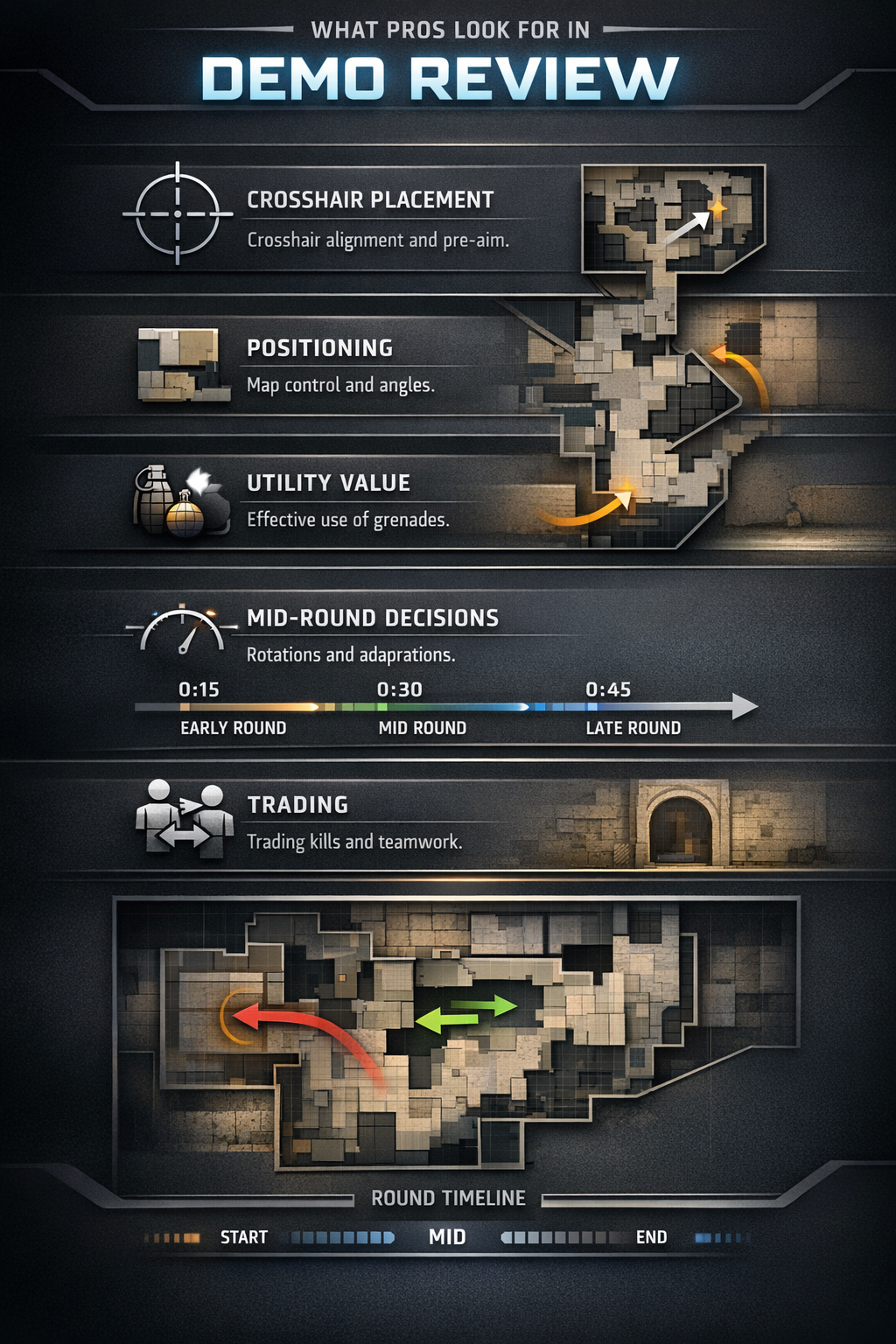
Your review will be much better if you prepare a simple framework before pressing play.
Pick the Right Demo
Do not only review your worst losses. Some of the best learning comes from close matches, narrow wins, and games where you felt “fine” but suspect your impact was lower than it should have been. A stomp often teaches less than a balanced match with repeated decision points.
Identify Key Rounds First
Mark rounds that changed momentum or exposed a weakness:
- Pistol rounds and conversions
- First gun rounds
- Man-advantage losses
- Eco losses or anti-eco sloppiness
- Clutches and post-plants
- Repeated deaths in the same area
- Rounds where you felt confused or tilted
Use a Note Template
Keep your notes in the same format every time. A simple structure works:
- Round: What happened?
- Mistake type: Positioning, utility, timing, trade, economy, decision, communication, or mechanics
- What I should have done: The better option
- Why it matters: What this mistake changed
- Practice action: What I will train next
That format forces clarity. If you cannot describe the better option in one sentence, you may not fully understand the mistake yet.
The Five Questions Every Round Should Answer
If you want one universal review framework, use these five questions on every important round:
- What was the round’s win condition?
On T side, maybe it was getting a clean site hit with utility. On CT side, maybe it was delaying long enough for the rotator. If your play ignored the win condition, the mistake usually started there. - What information did I actually have?
Players often act as if they “knew” something the demo proves they did not know at all. Review strips away false certainty. - Was my position and timing logical for the situation?
Even good aim loses value if you arrive early, late, or from the wrong lane. - Did my utility create an advantage?
Your grenade either created safety, time, space, pressure, or information—or it did not. - Was I tradeable and connected to the team?
Many avoidable deaths happen because the spacing made a trade impossible.
These questions sound simple, but they cover a massive amount of Counter-Strike. Most recurring errors fit inside one of them.
Crosshair Placement and Mechanical Review
Mechanical review is often misunderstood. Most players focus on whiffs because whiffs are obvious. Pros care more about the habits that created the whiff in the first place.
Crosshair Placement
Check whether your crosshair is:
- At head level on common fights
- Placed where the next threat is most likely to appear
- Too centered while moving through dangerous space
- Dragging across open areas instead of snapping from angle to angle
- Ready for the widest swing, the jiggle, or the off-angle
Bad crosshair placement is not only “too low.” It can also be too lazy, too broad, or disconnected from the timing of the peek. Many players hold the correct height but the wrong threat. In review, pause right before contact and ask: if the enemy appears now, is my crosshair already solving the most likely duel?
Movement Into Fights
Review whether your movement makes your shots harder than they need to be. Did you stop cleanly? Did you over-swing into two angles? Did you expose yourself before your aim was set? Did you crowd a corner and remove your ability to adjust? Mechanics are never only about mouse control. Footwork matters too.
Spray Choice vs Burst Choice
Ask whether your shot selection matched the range and the situation. Some players commit to full sprays when a short burst would secure the opening duel. Others tap too carefully in fights that require immediate stopping power. Review should connect mechanical choices to context, not just to accuracy.
Mechanical Notes Should Be Specific
“Aim bad” is a useless review note. “Crosshair too wide when clearing connector exits,” “panic sprayed after first bullet miss,” and “re-adjusted vertically after every swing” are useful notes. The more specific the language, the easier the fix.
Positioning, Pathing, and Exposure
This is one of the biggest areas pros care about because it influences almost every duel before the duel even begins.
Positioning
Good positioning is not just about hiding in strong spots. It is about aligning your spot with the round goal. A good anchor position buys time, limits exposure, and gives you an escape or a second layer. A good lurk position threatens rotation routes and holds over-rotations. A good support position allows a flash, trade, or crossfire. During review, always ask whether your position served the role you were trying to perform.
Exposure Count
One of the easiest demo review tools is to count how many angles you exposed yourself to. If you repeatedly die while exposed to three possible threats, the issue may not be reaction speed at all. It may simply be poor pathing. Pros are extremely sensitive to overexposure because it reduces consistency. They try to take one problem at a time.
Repositioning After Contact
A classic mistake in CS2 is winning or taking first contact and then staying in the same place without a reason. Review whether you keep giving the enemy the same answer to solve. Repositioning does not always mean running away. Sometimes it means moving half a step, changing elevation, shifting to a new off-angle, or syncing with a teammate’s flash before re-peeking.
Pathing Between Zones
Many mid-round deaths happen while moving between safe and unsafe areas. Watch your transitions. Do you knife out too often? Do you cross open gaps with no cover timing? Do you clear in the wrong order? Do you hug walls that make you easy to prefire? Good pathing is quiet value. It does not make highlights, but it prevents many free deaths.
Utility Review: Value, Not Volume
One of the clearest differences between average and strong players is how they judge grenades. Weak review asks, “Did I throw my smoke?” Strong review asks, “What did the smoke actually accomplish?”
Every grenade should create one of a few forms of value:
- Space: allowing your team to move safely
- Time: slowing an enemy hit or delaying a retake
- Pressure: forcing defenders off comfortable positions
- Isolation: cutting a site or duel into manageable pieces
- Information: revealing a player, forcing movement, or confirming absence
- Conversion: helping a teammate trade, enter, escape, or survive
If your grenade created none of those things, it probably had low value.
Common Utility Review Questions
- Was the grenade early, late, or well timed?
- Did it support a plan or happen in isolation?
- Did my teammate actually benefit from it?
- Did I spend utility to solve a real threat?
- Did I waste useful utility in a low-pressure moment?
- Did I hold utility too long and die with it?
Pros also review utility in relation to identity. If you are an anchor, a late smoke might be more valuable than early damage utility. If you are an entry support player, your flash timing may matter more than your survival. If you are lurking, a grenade that fakes pressure at the right time can have enormous strategic value even if it causes zero direct damage.
In your notes, avoid generic comments like “bad molly” or “missed smoke.” Instead write “molly had no follow-up so defender re-peeked on fade,” or “smoke blocked vision but gave them room to push through unsupported,” or “flash popped after entry was already committed.” That language improves your next review and your next server session.
Timing, Tempo, and Initiative
One of the most important things pros look for is whether a player understands when to act. A technically correct idea at the wrong time often becomes a terrible play.
Timing review is about context. Did you fight before your teammate was close enough to trade? Did you rotate before pressure became real? Did you throw utility after the enemy had already taken the space? Did you push when the opponent’s default made your aggression readable? Did you save too early when a retake was still realistic? Did you attempt a hero play when the round only required patience?
Initiative is related, but slightly different. Pros notice whether players can recognize moments where they must create action. Some players are too passive and surrender too much map control. Others force the issue every round and become predictable. Review should ask whether you understood the round’s demand. Sometimes the best play is to wait. Sometimes waiting is the mistake.
A great timing note often sounds like this: “Good idea, wrong timing.” That is common in Counter-Strike. The fix is not throwing away the idea forever. It is learning the window where the idea becomes strong.
Trading, Spacing, and Team Distance
If you want one category that instantly improves many players, it is this one. A huge number of “solo mistakes” are actually spacing mistakes.
What Good Spacing Looks Like
Good spacing means your team is close enough to punish contact but not so close that one spray, nade, or angle solves both players. It also means your movement speed and route support the first player’s plan. If the entry wants to scale quickly, the second player cannot hesitate. If the first player is walking a contact timing, the second player cannot stomp into a different rhythm.
Questions to Review
- Was I close enough to trade?
- Was I so close that I blocked or baited awkwardly?
- Did I swing on my teammate’s contact or after he was already dead?
- Did I hold the correct trade angle while he cleared?
- Did my route and pace match the entry’s purpose?
Many players say they were “baited” when the real issue was unclear spacing. Demo review helps you distinguish true baiting from simple desync. That matters because the fix is different. Baiting is a decision problem. Desync is a timing and team-distance problem.
On CT side, spacing review matters in crossfires, retakes, and multi-man holds. If one player fights too early and the second cannot see or respond, the setup was weaker than it looked. On T side, spacing decides whether entries are heroic or disposable.
Mid-Round Decision-Making
This is where a lot of separation happens between players who can aim and players who can win difficult matches.
The mid-round starts when the opening plan changes. Maybe the default gets resistance. Maybe a pick changes numbers. Maybe utility has been spent unevenly. Maybe you identify a weak side. Maybe your lurker loses a duel and the whole map geometry changes. Strong demo review pays close attention to those moments because that is where many rounds are actually decided.
What Pros Look For in Mid-Rounds
- How quickly you react to new information
- Whether you understand numbers advantage or disadvantage
- Whether you know when to regroup versus when to punish
- How often you over-rotate or under-rotate
- Whether you use utility to support the next step or hold it pointlessly
- Whether your pathing preserves options or locks you into bad fights
Mid-round mistakes are often disguised as unlucky timings. Review can reveal that the timing only looked unlucky because your prior decision narrowed your safe options. For example, if you pushed for information with no support and died to a late lurk, the problem was not only timing. It was the decision to solve uncertainty with a low-percentage move.
A useful review habit is to pause at the moment the round’s original plan breaks and ask: what were the three best options here? Even if you chose one of them, compare your execution to the cleaner version of that same idea. Over time, this builds game sense far faster than simple queue grinding.
Late Rounds, Clutches, and Conversion
Late rounds expose discipline. Many players can survive the first half of a round with decent habits. The real leaks appear when numbers get smaller and every sound cue matters.
Clutch Review
When reviewing a clutch, do not only ask whether your mechanics held up. Ask:
- Did I correctly identify the enemy’s most likely position?
- Did I create isolated duels or run into layered angles?
- Did I use audio and utility efficiently?
- Did I force the opponent to move first?
- Did I manage the clock or panic against it?
Clutches are also where patience becomes visible. Many losses come from players feeling obligated to act immediately when the situation actually rewards delay. Review whether you confuse activity with control.
Post-Plants
In post-plants, pros review whether positions make the bomb hard to defuse and easy to trade for. A common mistake is choosing a “safe” position that disconnects you from every teammate and every trade path. Another is peeking one by one instead of on a cue. Another is giving away your spot too early when the clock already favors you.
Retakes
Retake review should focus on realism. Did you actually have enough time, utility, and health to attempt it? Did you clear in an order that made sense? Did you trade on contact? Did you respect likely anti-flash or anti-defuse positions? Many failed retakes are lost before the first duel because the timing is fragmented.
Economy Awareness in Review
Economy mistakes rarely look dramatic in a single round, but across a match they are costly. Good reviewers ask whether their choices respected the financial state of both teams.
Review your economy awareness in these areas:
- Did I understand whether the enemy was likely full-buying, half-buying, forcing, or saving?
- Did my pathing versus weaker weapons make sense, or did I gift isolated fights?
- Did I spend utility like the round mattered financially?
- Did I over-save in rounds where survival value was low?
- Did I force low-percentage hero plays that damaged future rounds?
Players often think economy knowledge is only for in-game leaders. It is not. Even in solo queue or loosely coordinated teams, your own choices should reflect likely weapon states and how risky the round should be. If the enemy is on a weak buy, careless anti-eco spacing can swing the game. If your team’s money is broken, a reckless re-peek can do more damage than a simple death count suggests.
During review, try to understand not only what your buy was, but what the round should have felt like. Was it a stability round? A gamble? A high-pressure conversion? A low-utility survive-and-damage scenario? Those labels create smarter decisions.
What to Review on T Side
T side review should focus heavily on intent and coordination, because attackers usually need to create the round rather than wait for it.
Entry and Space Creation
If you are first or second in, review whether your route, utility timing, and swing order created pressure together. Did you hesitate in the choke? Did you get flashed properly? Did you clear the correct first threat? Did the second player support the first or stare at the same problem too late?
Map Control
Review how your team earned space. Was it taken with utility? Timing? Contact? Punishing over-aggression? Or did you simply walk into resistance every round with no adaptation? Good T sides understand that map control is not cosmetic. It shapes rotation pressure, lurk strength, and site hit quality.
Lurking
Lurk review is one of the most misunderstood areas in Counter-Strike. A good lurk is not a player disappearing from the team and hoping for a flank. Review whether your lurk:
- Controlled a meaningful rotation lane
- Created timing pressure on defenders
- Fed useful information to the team
- Moved in sync with the main pack
- Preserved value if no duel appeared
If your lurk regularly leaves the team 4v5 for too long, it is probably not adding real value.
Site Exec Discipline
On executes, review whether utility sequence, entry path, bomb path, and post-plant positioning worked together. Many failed execs are not because the strat was bad; they fail because one smoke was late, one flash missed the timing, one player carried bomb through the wrong line, or one anchor position was left uncleared.
What to Review on CT Side
CT review is usually about time, information, and survival value.
Anchoring
If you anchor a site, review whether your choices bought time. Did you use utility early for comfort instead of late for denial? Did you give first contact for free? Did you die without a fallback? Did you committ too hard before support arrived? A good anchor does not always get kills. Often the real success is delaying the hit long enough for the round to become retakeable or holdable.
Rotations
Rotation mistakes are common in ranked CS2. Review whether you rotated on sound, on confirmed information, on teammate panic, or on an actual read. Early over-rotations can lose rounds without any duel happening. Under-rotations can leave anchors abandoned. Review teaches you to separate noise from certainty.
Info Plays
Info plays are powerful, but only when they fit the round. Ask:
- Was the timing unpredictable?
- Did I have utility or teammate support?
- What was the cost if I died?
- Did the info actually matter to the team?
Many players overrate “getting info” and underrate simply holding stable lines. A bad info play often creates more uncertainty than it removes.
Retake Setup Before the Hit
CT rounds are not only won by stopping site takes. Sometimes they are won by preserving players, utility, and positions that make the retake favored. When reviewing CT side, check whether your setup allowed a realistic second phase.
Common Demo Review Mistakes by Rank
Lower Ranks
Lower-ranked players usually focus too much on aim and not enough on decision quality. Common issues include exposing too many angles, dry peeking obvious positions, wasting grenades with no plan, and moving through the map with a centered crosshair instead of clearing likely threats. Their reviews often stop at “I lost the duel,” which leaves most of the real lesson untouched.
Mid Ranks
Mid-level players often understand basic ideas but apply them inconsistently. They know they should trade, but spacing is still off. They know utility matters, but timing is sloppy. They know not to over-rotate, but emotional reads still drag them around the map. Their reviews improve most when they stop looking for “major blunders” and start tracking recurring small leaks.
Higher Ranks
Stronger players usually lose value in narrower places: initiative timing, role detail, overconfidence after opening picks, post-plant patience, and adaptation speed. At that level, demo review becomes less about obvious mistakes and more about efficiency. Could this duel have been taken with better support? Could this rotate have preserved more uncertainty? Could this clutch have isolated a cleaner first fight?
The higher you go, the more review becomes about precision rather than basic correctness.
How to Turn Notes Into Faster Improvement
This is the section that actually makes demo review powerful.
After every review, choose only one primary focus and one secondary focus for your next block of matches. For example:
- Primary: Take fewer solo first contacts on CT without trade support
- Secondary: Hold utility longer as anchor for hit denial
Or:
- Primary: Fix T-side spacing behind entries
- Secondary: Reposition after first contact instead of re-peeking instantly
That is enough. You do not need seven goals per session. You need a small correction loop you can actually remember while playing.
Link Each Review Category to a Practice Type
- Crosshair / mechanics: pre-aim routines, burst discipline, stop-shoot timing
- Positioning: angle review, demo screenshots, map walkthroughs
- Utility: repeatable lineups only when they support real round plans
- Trading / spacing: duo work, entry-follow timing, scrim focus
- Decision-making: pause-and-predict review on your own demos and pro demos
- Clutching: scenario review, patience rules, audio discipline
The best part is that demo review makes practice more efficient. Instead of training everything, you train the exact weakness currently costing you rounds.
Create Rules, Not Hopes
Weak improvement goals sound like this: “play smarter,” “use more utility,” “stop throwing.” Strong goals sound like this: “when anchoring and first contact happens, either fall after one duel or call for flash before re-peek,” or “on T side, never be more than one swing late behind entry unless holding flank by plan.” Rules are easier to execute under pressure.
A 30-Minute CS2 Demo Review Routine
If you want a practical structure, use this simple routine after a match or at the end of a session.
Minutes 1–5: Match Summary
Write down the score, map, side splits, and your immediate feeling about why the game was hard. Then review that feeling against the demo rather than trusting it blindly.
Minutes 6–12: Review All Deaths Quickly
Do a fast pass of your deaths. Categorize each one in a few words: aim, overexposure, bad spacing, no support, utility mistake, timing, greed, poor read, or unavoidable. This creates a pattern fast.
Minutes 13–20: Deep Review the 5 Most Important Rounds
Pick five rounds that mattered most. Usually this includes at least one pistol, one gun round, one man-advantage loss, one mid-round confusion round, and one late-round or clutch scenario. Pause more here. Check teammate positions, timing, utility, and your options.
Minutes 21–25: Group the Mistakes
Write your top three recurring issues. If you cannot identify a pattern, your review is probably still too focused on isolated moments.
Minutes 26–30: Create Next-Session Goals
Choose one main focus and one small supporting focus. That is your improvement plan for the next play block.
This short routine is enough for meaningful progress if you do it consistently. You do not need to review every second of every demo. You need a repeatable system.
When to Get Outside Feedback
Self-review is powerful, but it has limits. Your own perspective can miss habits that are obvious to stronger players. That is especially true if you keep running into the same wall: similar stats, similar frustration, similar mistakes, and no clear reason why your level is stuck.
In those cases, outside feedback can speed up progress. That might mean reviewing a stronger player’s POV in your role, comparing your rounds to high-level examples, or getting direct guidance. Sites like HLTV help you understand how top teams talk about roles, pressure, and decision-making, while broader game references from Valve and the official CS2 ecosystem help keep your understanding grounded in the current game. If you want a more direct improvement shortcut tied to your own play, Boosteria’s CS2 boosting prices page is one place to start exploring structured help options.
The key point is this: outside input is valuable when it sharpens your self-correction, not when it replaces thinking. The goal is still to become a player who understands why rounds work.
Final Thoughts
CS2 demo review is not a glamorous skill, but it is one of the highest-return habits in competitive improvement. It transforms your matches from random emotional experiences into a library of lessons. The more consistently you review, the faster you begin to notice the same game from a different level: not as a chain of duels, but as a chain of decisions.
That shift is what pros, coaches, and fast improvers share. They understand that skill is not only measured by the shot you hit. It is measured by the quality of the position, timing, utility, spacing, and round logic that created the shot in the first place.
So the next time you lose a close match, resist the urge to instantly requeue and call it unlucky. Open the demo. Look at the round before the fight. Count the angles. Check the spacing. Study the utility. Ask what the win condition really was. Then leave with two clear corrections and apply them immediately.
Do that often enough, and your demo reviews stop being post-match analysis. They become your fastest path to better Counter-Strike.
Quick Recap Checklist
- Review process before outcome
- Track recurring mistakes, not just flashy errors
- Study crosshair, positioning, utility, timing, and spacing together
- Pay special attention to mid-round transitions and late-round discipline
- Convert every review into one or two practice goals
- Compare your decisions to the round’s actual win condition
- Use review consistently instead of only after bad losses
That is what pros look for. And once you start looking for the same things, you improve faster too.