



Mobile Legends Solo Queue Climb Plan: 3-Hero Pool Rules
Mobile Legends — Solo Queue Climb Plan: 3-Hero Pool + Decision Rules
Climbing in Mobile Legends as a solo player is not mainly about finding the perfect meta pick. Most ranked players already know basic mechanics, basic itemization, and basic combos. The real difference between a player who hovers in the same bracket and a player who steadily rises is this: the climber reduces chaos. They enter queue with a simple system, they play a small set of heroes well, and they make the same strong decisions over and over instead of reinventing the game every match.
This guide gives you a timeless solo queue plan built around two ideas that stay useful in almost every season: a focused 3-hero pool and a set of decision rules. The goal is not to chase every patch, copy every tier list, or force risky plays just because content creators call them “OP.” The goal is to win more often with a stable method that works even when teammates are inconsistent, draft order is awkward, or the match starts badly.
If you want to study official hero classes and lane labels, the official MLBB hero page is useful. If you want broader educational material, the MLBB Academy is a solid place to review hero strategy basics. And if you want to sharpen your game sense by watching strong macro habits from top teams, following major MLBB events on the Esports World Cup MLBB coverage hub can help you notice how disciplined teams structure objectives, rotations, and fights. If your goal is faster rank progress with direct help, you can also review the Boosteria Mobile Legends pricing page.
Table of Contents
- Why Most Solo Queue Climbs Stall
- Why a 3-Hero Pool Works Better Than Constant Switching
- How to Build Your 3-Hero Pool
- 3-Hero Pool Templates by Role
- Decision Rules Before You Queue
- Decision Rules in Draft
- Decision Rules for the Early Game
- Decision Rules Around Turtle, Lord, and Towers
- Decision Rules for Mid Game and Side-Lane Pressure
- Decision Rules for Late Game
- How to Play From Behind Without Throwing
- The Mental Game of Solo Queue Climbing
- A Weekly Practice System That Actually Improves Rank
- The Biggest Mistakes That Keep Players Stuck
- FAQ
- Conclusion
Why Most Solo Queue Climbs Stall
Most players do not stay stuck because they lack talent. They stay stuck because their ranked process changes every day. One night they spam a scaling marksman. The next day they panic-pick a tank because the team “needs one.” After that they try a hero from a tournament clip, then swap builds after one bad game, then keep queueing while tilted. Their match history becomes a random collection of heroes, lanes, and moods. That makes improvement slow because there is no stable sample. If everything changes, you never know what actually caused the win or loss.
Solo queue is already noisy. Your teammates differ in mechanics, map awareness, and patience. Some overfight early. Some ignore objectives. Some last-pick without regard for team balance. Since you cannot control the lobby, your best answer is to control your own system. That means reducing the number of decisions you make before the game even starts. The fewer unnecessary choices you leave to impulse, the more energy you save for the decisions that matter: lane pressure, objective setups, target focus, retreat timing, and wave management.
Another reason climbs stall is that players confuse “can play” with “should queue.” Maybe you can technically use twelve heroes. That does not mean you can produce ranked-quality decisions on twelve heroes under pressure. Solo climbing rewards depth more than breadth. It rewards knowing exactly when your hero spikes, how much damage you can threaten, which fights are good, how to recover a weak lane, how to path into river safely, and when not to follow a bad call. That kind of understanding comes from repetition.
The final reason many climbs stall is emotional overreaction. Players think every loss means they need a new hero, a new emblem page, a new role, or a new teammate. Often they need none of those things. Often they need a clearer plan and better decision rules. If your plan is strong, short-term variance bothers you less. One unlucky match does not break your system. You simply run the system again.
Why a 3-Hero Pool Works Better Than Constant Switching
A 3-hero pool is the sweet spot for solo queue. One hero is often too narrow because bans, role conflicts, and bad matchups happen. Five or six heroes are usually too many for a player who wants consistent ranked performance. Three is enough to create flexibility without losing mastery.
Think of your 3-hero pool as a triangle of stability:
- Your comfort carry — the hero you trust when you want maximum impact.
- Your blind pick — the safest hero when draft information is limited.
- Your emergency stabilizer — the hero you pick when the team composition becomes awkward or risky.
This structure solves several common ranked problems. If your favorite carry is banned, you still have a strong fallback. If the enemy draft threatens your usual pick, you are not forced into panic mode. If your team already locked a lot of greed, damage, or fragility, you can stabilize the composition with utility or front line. Over time, this leads to cleaner drafts and fewer auto-losses created by your own champion select.
A 3-hero pool also improves learning speed. Because you repeat the same kits, matchups, and macro patterns, you start recognizing game states faster. You stop guessing. You know when your lane is winning enough to rotate. You know when your hero can contest river vision safely. You know how many resources you need before fighting. You know which enemy cooldowns matter most. That kind of recognition is what makes good solo queue players look calm while everyone else looks rushed.
Most importantly, a small pool protects you from emotional drafting. After two losses, your brain wants novelty. It says, “Maybe the answer is a different hero.” Usually it is not. Usually the answer is better execution on a familiar hero. The 3-hero model keeps you from solving temporary frustration with permanent inconsistency.
How to Build Your 3-Hero Pool
Do not build your pool by asking, “Who is strongest right now?” Build it by asking, “Which three heroes allow me to produce the best decisions most often?” The strongest hero in a vacuum is not always the strongest hero for your climb. A stable, comfortable pick you understand deeply will usually beat a trendy hero you only half understand.
1) Start with one main role
Your climb is easier when your identity is clear. Pick one main role where you want most of your games. That does not mean you can never fill. It means your pool is built around giving you the best chance to influence games from one role cluster rather than scattering your effort everywhere. Many solo queue players improve faster once they stop trying to be a universal answer to every lobby.
2) Choose a comfort carry
This is your best hero, but not necessarily your flashiest hero. A true comfort carry has four qualities: you can lane or path well on it, you understand its damage windows, you know how to recover when behind, and you are willing to first-pick it in difficult matches. If a hero only feels good when you are already ahead, it may not be a real comfort carry.
3) Choose a blind pick
Your blind pick should be hard to punish. It should have reliable waveclear, safe range, durable utility, or flexible itemization. A good blind pick does not need to dominate lane. It needs to survive uncertainty and stay useful. In solo queue, consistency is worth more than theoretical ceiling.
4) Choose an emergency stabilizer
This hero exists for messy drafts. Maybe your team lacks engage. Maybe you have enough damage but no peel. Maybe your side lanes need space. Maybe the enemy composition punishes fragile carries. Your stabilizer should reduce risk and make your team easier to play. Sometimes the best solo queue pick is not the hero that gets the montage. It is the hero that makes the game understandable for four strangers.
5) Cover different game states
Your pool should not contain three heroes that all lose the same way. If all three need heavy farm, your draft becomes greedy. If all three are weak into dive, you will suffer against aggressive teams. If all three depend on perfect team follow-up, your climb will be too teammate-dependent. Try to make sure your trio covers at least three different needs: pressure, safety, and utility.
6) Keep mechanics realistic
Do not overload your pool with three mechanically intense heroes unless you truly play that way under stress. Ranked is not a training montage. If the hero demands perfect timing every fight and you cannot reproduce that under pressure, it is not helping your climb. Clean execution on simple but effective heroes wins many more games than inconsistent brilliance.
3-Hero Pool Templates by Role
You do not need to copy these exactly, but these templates show the logic behind a good trio.
Jungle-focused pool
- Comfort carry: a tempo jungler who can punish weak lanes and accelerate objective leads.
- Blind pick: a stable jungler with safe clears and dependable teamfight value.
- Emergency stabilizer: a utility fighter or engage jungler that gives the team front line and easier objective setups.
This pool is strong if you like controlling map pace, but it requires discipline. The key is not farming forever. It is converting pathing into pressure.
Gold lane-focused pool
- Comfort carry: a high-damage scaling marksman you can pilot confidently in late-game fights.
- Blind pick: a safer ranged pick with waveclear and better self-preservation.
- Emergency stabilizer: a lane-safe option that still contributes when roamer support is low.
This is ideal if you are patient, farm well, and understand spacing. The danger is greed. Your decision rules must protect your mid-game positioning.
EXP lane-focused pool
- Comfort carry: a durable duelist who can pressure side lanes and survive long skirmishes.
- Blind pick: a reliable frontliner with straightforward teamfight entry.
- Emergency stabilizer: an anti-dive or peel-oriented fighter/tank that protects fragile teammates.
This pool works well for players who read engages well and want influence without depending on being overfed.
Mid lane-focused pool
- Comfort carry: a control mage or burst mage you rotate well with.
- Blind pick: a safe waveclear mage that rarely loses lane priority for free.
- Emergency stabilizer: a utility mage that adds zone control, peel, or better setup around objectives.
Mid is excellent for players who enjoy reading the map and linking lanes together rather than living in one side lane.
Roam-focused pool
- Comfort carry: an engage roamer that can create fights and tempo.
- Blind pick: a dependable tank or support with safe scouting and teamfight value.
- Emergency stabilizer: a peel-heavy or anti-burst option for protecting carries.
This is the least selfish climb style and can be excellent if your map awareness is better than your mechanics. The key is making the map easier for others to play, not randomly roaming for “activity.”
Decision Rules Before You Queue
Solo queue starts before champion select. Good players do not only prepare their hands. They prepare their process.
- Do not queue without a role priority in mind. Entering lobby with “I’ll just see what happens” creates weak drafts and weak confidence.
- Do not queue your third-best role when tired. Fatigue shrinks your decision quality. In low-energy sessions, stay on your cleanest heroes.
- Do not expand the pool during a climb session. Ranked is for executing known answers, not experimenting.
- Set a stop rule after tilt. If you catch yourself blaming teammates before reviewing your own decisions, your next game is already in danger.
- Review the last loss with one question: what decision lost the most value? Not “who trolled,” but “what was my biggest mistake?”
A simple pre-queue checklist helps more than people think:
- Which role am I prioritizing?
- Which of my three heroes is the likely default first choice?
- Which hero is my safe fallback if draft goes badly?
- Am I calm enough to play late-game situations cleanly?
If you cannot answer these quickly, you are not really prepared. Ranked rewards clarity.
Decision Rules in Draft
Draft is where many solo queue players sabotage themselves. They either overreact to the enemy too early or ignore team balance completely. Your job in draft is not to create a perfect professional composition. Your job is to avoid obvious structural weaknesses and give yourself a playable game.
Rule 1: Prioritize your blind pick when information is low
If you pick early and the draft is still open, choose the safest hero in your pool rather than the highest-variance one. Blind picking a comfort carry into unknown counters can make your own game much harder than it needs to be.
Rule 2: Do not duplicate the same weakness
If your team already has fragile backline damage, do not add another hero that needs perfect peeling unless you are absolutely certain you can carry through it. If the team already lacks engage, consider adding setup rather than a fourth source of conditional damage.
Rule 3: Respect lane stability
In solo queue, stable lanes matter. A composition that survives lane and arrives at first objectives in decent shape is often stronger than a high-ceiling composition that needs everything to go right. Ask: can our lanes function without constant rescue?
Rule 4: Draft for your real teammates, not your imagined teammates
Do not assume perfect synergy from strangers. Heroes that require exact follow-up can work, but they are riskier in solo queue. When unsure, prefer picks that create obvious fights, obvious peel, obvious zoning, or obvious waveclear.
Rule 5: Think in win conditions, not just counters
Counterpicking matters, but your composition still needs a way to win. Can you burst someone before the fight settles? Can you front-to-back teamfight? Can you split pressure and force map trades? Can you survive long enough for your carry to scale? A good draft answers one of those clearly.
Rule 6: When your team locks greed, you become the adult in the room
If teammates choose scaling and selfish picks, you often gain more rank by selecting structure: engage, peel, front line, or dependable setup. It may look less glamorous, but it prevents many losses that start in draft.
Rule 7: Ban with honesty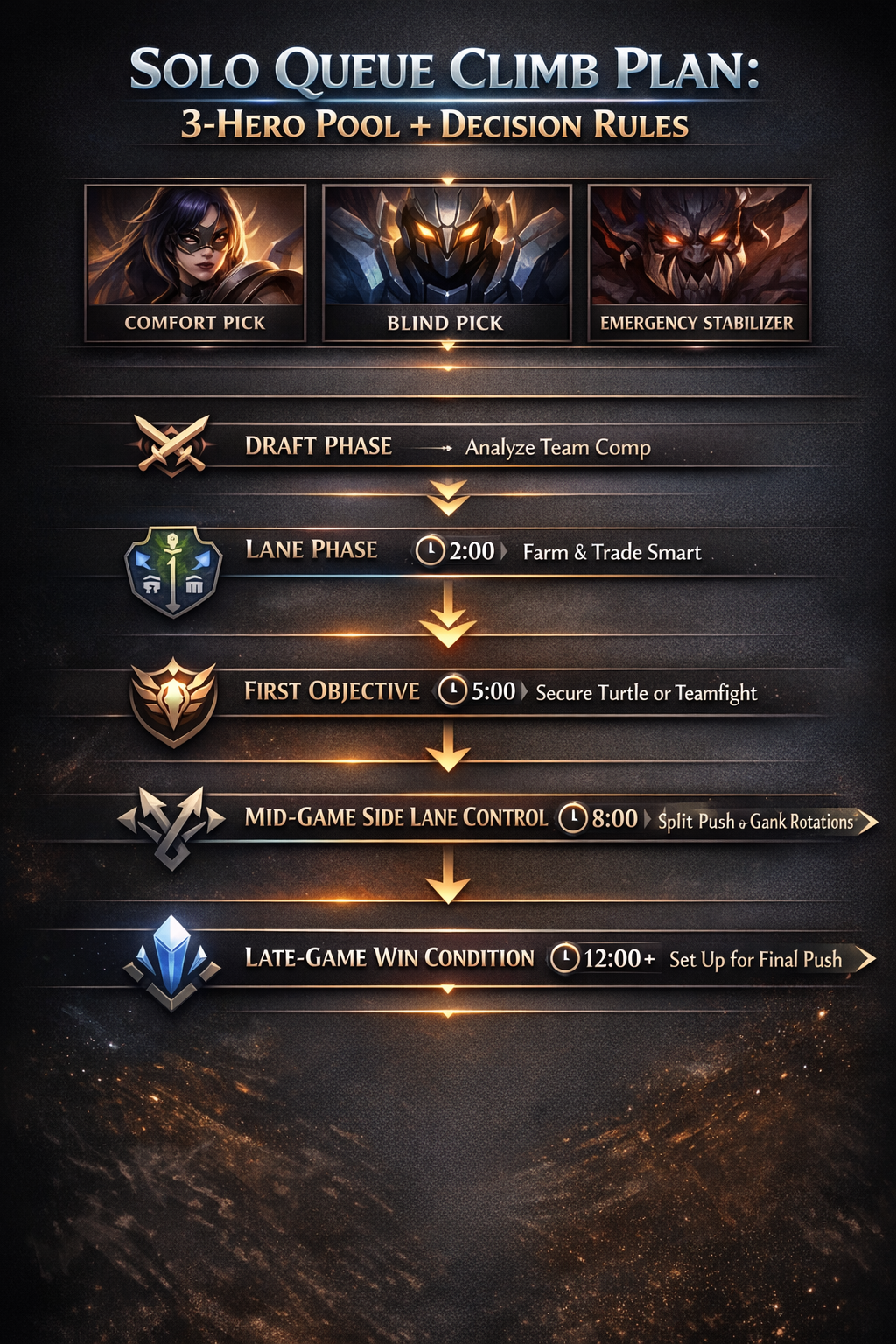
Ban what either breaks your pool or makes solo queue execution too difficult. Do not ban for style points. Ban for comfort, lane integrity, and playable fights.
Decision Rules for the Early Game
The early game in Mobile Legends is where players leak value without noticing. A lot of ranked losses are not caused by one giant mistake. They are caused by ten small errors before the first major objective.
Rule 1: Protect lane state before chasing kills
If you win a skirmish but lose an important wave, plate, or reset timing, the play may not be worth it. The early game is about building a clean foundation. Farm, lane priority, and health totals matter because they shape who reaches the first objective first.
Rule 2: Do not rotate just because a fight exists
Low-rank chaos teaches bad habits. People run to every ping. Stronger players ask: if I move, what do I lose, and what do I gain? A rotation is good when it has a clear prize: securing a kill with numbers, protecting an objective, covering a lane collapse, or converting a pushed wave into pressure. Random movement wastes tempo.
Rule 3: Track who has priority
Priority means a lane or jungle path is in a condition where a player can move first without bleeding too much. If you have priority, you can support river, help invade, or threaten vision. If you do not have priority, forcing river contests becomes dangerous. Many deaths happen because players try to fight from a losing lane state.
Rule 4: Fight around spikes, not feelings
Your hero’s first meaningful spike might come from a level, skill unlock, first core component, completed item, or reaching a grouped fight where your kit becomes valuable. Learn those moments. Solo queue players often coin-flip before they are actually ready.
Rule 5: Keep deaths expensive
Ask before every risky early move: if I die here, what opens for the enemy? Tower pressure? Turtle? Jungle camps? A snowball lane? If the answer is “a lot,” back off unless the reward is truly big. Early deaths are not just deaths. They are map permission.
Decision Rules Around Turtle, Lord, and Towers
Objectives are where structured players separate themselves from emotional players. Solo queue creates many fights that feel important but are not. Turtle, Lord, and tower pressure create value even when no flashy montage happens.
Rule 1: Set up before spawn, not after
If you arrive to an objective at the spawn timer with no lane prep, no health, and no vision, you are already late. Strong objective play usually begins 20 to 40 seconds earlier with wave control, reset timing, positioning, and rotation. The players who are “magically first” were simply earlier.
Rule 2: If you cannot contest cleanly, trade
Many solo queue teams throw by contesting from a bad state. If the enemy arrives first with better health, numbers, or cooldowns, ask what you can trade elsewhere: tower damage, opposite-side farm, cross-map pick, or wave denial. Not every objective must be flipped.
Rule 3: Use towers as objective amplifiers
A won fight matters more when it breaks a tower line. A secured objective matters more when it creates map access. Always think beyond the monster itself. Ask what structure becomes vulnerable afterward.
Rule 4: Do not overstay after success
Solo queue greed destroys many good sequences. You win the fight, get the objective, and then someone wants one more kill, one more wave, one more invade. Good players know when the play is complete. Reset, spend gold, and prepare the next sequence.
Rule 5: Front-to-back discipline wins messy fights
At objectives, players often tunnel on enemy backliners while exposing their own. If your composition does not have a clean dive angle, play the nearest threat first, maintain formation, and protect your damage source. In solo queue, disciplined basics often beat heroic overreach.
Decision Rules for Mid Game and Side-Lane Pressure
The mid game is where most climbs either accelerate or collapse. Early game gives you material. Mid game decides whether you use it properly. The main skill here is understanding map shape: where the next wave is, which side lane can be pressured, which enemy is showing, and what objective or tower line is exposed.
Rule 1: Someone must collect side waves
Teams that ignore side lanes lose invisible gold and give the enemy free breathing room. If you are the right hero to catch a wave safely, do it. This does not mean overextending alone for no reason. It means keeping the map from shrinking around your team.
Rule 2: Do not ARAM without purpose
One of the most common bad habits in solo queue is useless mid grouping. Five players stand in vision, throw occasional abilities, and accomplish nothing while side waves die. Group when there is a reason: objective setup, tower siege, pick window, or protection of a pushing lane. Otherwise, maintain farm and map pressure.
Rule 3: Pressure and vision work together
A pushed wave forces response. Forced response creates information. Information creates safer movement. This is why side-lane pressure is so powerful even before it takes a tower. It tells you where enemies probably are or are not. Use that to decide whether to invade, rotate, collapse, or reset.
Rule 4: Hit the easiest tower, not the fanciest one
Players sometimes ignore a free outer or inner tower while dreaming of a base-ending play. Take the easy structure first. Towers change the map. They open deeper vision, safer rotations, and stronger objective setups later.
Rule 5: If your carry is strong, play around range and protection
When your primary damage dealer is ahead, mid game becomes simpler. Stop trying to make the game harder than necessary. Use that lead to secure space, towers, and neutral objectives. Do not leave your fed carry unsupported while chasing random action on the opposite side.
Rule 6: If you are the fed player, stop donating shutdown value
Ahead players often lose games by acting invincible. Your gold lead is not permission to take every duel or face-check every bush. When fed, your job is to convert power into safe map control, not ego plays.
Decision Rules for Late Game
Late game punishes impatience. The map is more open, death timers are harsher, and one bad fight can erase twenty minutes of good work. The best late-game players simplify the match. They stop forcing chaos and start protecting certainty.
Rule 1: Value life more than flashy picks
In late game, getting caught alone is often worse than losing a small objective. Position conservatively when vision is thin. If your hero is essential to waveclear, peel, or damage, your death changes everything.
Rule 2: Fight on your terms
You do not need to start every engagement you see. Wait for cooldowns, wave positions, and vision advantage. If the enemy must answer a pushed lane, that creates a better fight than forcing through fog blindly.
Rule 3: Protect the highest-value damage source
Late game is rarely about everyone doing maximum damage independently. It is about the team enabling the right person to keep hitting. If your team has one true late-game threat, build the fight around that player’s range, spacing, and safety.
Rule 4: Lord is not only about capture; it is about shape
The Lord matters because it changes how waves and towers behave, but the deeper late-game lesson is this: big objectives reshape the map. Even if you do not immediately end, they create pressure that can split the enemy, expose cooldowns, and unlock cleaner sieges.
Rule 5: When unsure, reset first
Many late-game losses happen because a team wins a small exchange and refuses to reset. Gold is unspent, health bars are uneven, cooldowns are missing, but someone insists on forcing the finish. Resetting is not passive. It is often what protects the win.
How to Play From Behind Without Throwing
Every solo queue climber needs a behind-game protocol. If your only plan is “hope someone throws,” you will never maximize comeback chances. Good comeback play is not desperate. It is disciplined.
1) Stop feeding the winning lane
If one side of the map is collapsing, do not keep sending resources there just because it feels unfair. You must identify what is salvageable. Sometimes the correct play is to give up a little space to preserve the rest of the map.
2) Clear waves safely
Waveclear is your breathing room. If you can keep the map from closing completely, you buy time for levels, items, and mistakes from the enemy. Risky face-checks are rarely the answer when behind.
3) Trade, do not beg
Teams that are behind often run to every objective out of fear. That creates more losses. If a clean contest is impossible, look for opposite-side farm, delayed tower defense, or a pick on a rotating enemy. Trade something real.
4) Narrow the game
When behind, avoid wide chaotic fights unless your composition specifically thrives on them. Narrow the game into waveclear, pick windows, tower defense, and one clean teamfight around a key cooldown. Make the enemy work harder.
5) Punish impatience
Winning teams in solo queue often get bored. They dive too deep, chase into bad terrain, split without vision, or force Lord too casually. Your comeback often comes from discipline against their impatience.
The Mental Game of Solo Queue Climbing
Your mechanics matter. Your macro matters. But your emotional discipline decides whether those strengths show up often enough to change rank.
First, understand that solo queue contains variance by design. You will lose some good games and win some bad games. The goal is not emotional perfection. The goal is process stability. If your decisions are improving, rank tends to follow over a large sample.
Second, stop using teammates as your main explanation. This is not because teammates never play badly. They do. The problem is that “bad teammates” gives you no actionable next step. “I rotated late to first objective,” “I overstayed after tower,” and “I drafted greed into no front line” are useful sentences. They improve future games.
Third, protect your confidence properly. Real confidence is not “I can 1v9 every lobby.” Real confidence is “I know my pool, I know my rules, and I can execute them again.” That kind of confidence survives bad teammates and bad starts better than ego does.
Fourth, separate outcome from quality. A bad decision can work. A good decision can fail. Review your choices, not only the final screen. Climbers become stable when they stop letting short-term results rewrite obvious truths.
A Weekly Practice System That Actually Improves Rank
If you want your rank to rise and stay there, you need a practice system that supports your 3-hero pool.
Game block structure
- Play in blocks of 3 to 5 ranked games rather than endless sessions.
- After each block, review one repeated mistake.
- Do not switch heroes inside a block unless draft truly demands it.
Review structure
- What was my hero pick and why?
- Did my draft choice fit the team composition?
- What was the first big mistake I made?
- Did I play early objectives with proper setup?
- Did I create or collect side-lane pressure correctly?
- How did I die, and was that death avoidable?
Weekly skill themes
Instead of trying to improve everything at once, rotate themes by week:
- Week 1: lane discipline and wave management
- Week 2: first objective setups and resets
- Week 3: mid-game side-lane decisions
- Week 4: late-game positioning and fight patience
This works because solo queue progress comes from compounding small advantages. Players get stuck when every session has no learning focus and every loss becomes a vague emotional memory.
The Biggest Mistakes That Keep Players Stuck
Playing too many heroes
This is the biggest one. Variety feels productive, but in ranked it usually delays mastery. If you want to climb, depth wins.
Confusing action with impact
Some players always look busy: rotating, skirmishing, poking, invading, pinging. But busyness is not value. Good play converts into lane stability, objective control, tower pressure, and safer map states.
Drafting for fantasy combos
Do not build your game around ideal teammates. Build it around likely solo queue realities. Reliable engage, reliable peel, reliable waveclear, reliable scaling, reliable lane states.
Ignoring wave states
Many “teamfight” players do not realize how many fights are lost because side lanes were unmanaged first. Waves create the conditions that make fights good or bad.
Face-checking when ahead
A lead is easiest to throw through arrogance. The better you are doing, the less you should donate random deaths.
Overforcing from behind
When behind, urgency often turns into panic. You do not need miracle plays every minute. You need survival, trades, and one clean comeback window.
Queueing emotionally
One tilted game easily becomes three. A player who respects their mental state often climbs faster than a more talented player who refuses to stop.
FAQ
Is a 3-hero pool really enough to climb Mobile Legends solo queue?
Yes. In fact, for most players it is more than enough. Three heroes provide flexibility against bans and role conflicts while still allowing deep mastery. You do not need a giant roster to climb. You need a stable roster that fits your style and covers common draft problems.
Should all three heroes be in the same role?
Usually, two should strongly support your main role and one can give you draft or role flexibility. The exact mix depends on how often you get your preferred role. The main point is that your pool should not scatter your practice so widely that you lose consistency.
Is one-tricking better than using three heroes?
One-tricking can work, but it becomes fragile in ranked environments with bans, contested picks, bad matchups, and role variance. A 3-hero pool is usually the healthier long-term climb model because it protects you from draft disasters without sacrificing mastery.
How do I know which hero should be my blind pick?
Your blind pick should be the hero in your pool that survives uncertainty best. Look for stable lane or jungle patterns, lower punishment into counters, useful teamfight contribution, and dependable value even when the game starts awkwardly.
What if my teammates lock my best role?
This is exactly why your pool needs a stabilizer. Instead of mentally collapsing, ask what the team now needs most: safer lane, peel, engage, or utility. Solo queue climbing improves when you stop thinking in terms of “my perfect game” and start thinking in terms of “our most playable game.”
Should I follow MLBB tier lists closely?
Tier lists can be useful for context, but they should not replace your pool logic. A top-tier hero you barely understand is often worse for your climb than a slightly less fashionable hero you play with confidence and discipline.
How many games should I give a hero before deciding it belongs in my pool?
You need enough games to feel its lane patterns, damage windows, recovery options, and late-game role. Do not decide after one win or one loss. Look for whether the hero makes your decisions clearer and more repeatable over a meaningful sample.
What matters more for climbing: mechanics or decision-making?
Both matter, but decision-making is the stronger long-term separator for most solo queue players. Better decisions improve drafting, lane states, objective timing, positioning, and map movement across every match. Mechanics shine brightest when the decisions around them are clean.
Conclusion
If you want a cleaner and more reliable Mobile Legends climb, stop asking for a magical secret and start using a system. A focused 3-hero pool simplifies your draft, sharpens your match knowledge, and reduces emotional switching. Clear decision rules keep your games stable from the first wave to the final Lord fight.
Remember the core model:
- Pick one main role identity.
- Build a 3-hero pool with a comfort carry, a blind pick, and an emergency stabilizer.
- Draft for a playable game, not a fantasy game.
- Protect lane state and objective setup in early game.
- Use side lanes and towers to shape the map in mid game.
- Play patient, high-value fights in late game.
- When behind, trade and stabilize instead of panicking.
- Review decisions, not just outcomes.
That is how solo queue players climb without burning out. Not by knowing every hero. Not by copying every patch discussion. Not by blaming every teammate. They climb by making the game simpler, more repeatable, and more under control. If you do that long enough, your rank usually stops being a mystery and starts becoming a reflection of your process.