



CS2 Site Anchoring Guide: Hold, Fall Back, Rotate Correctly
CS2 Site Anchoring Guide: How to Hold, Fall Back, and Rotate Correctly
In competitive tactical shooters, few roles are as misunderstood — yet as important — as the site anchor. In Counter-Strike 2 (CS2), anchoring a bombsite is not simply about holding an angle and waiting for enemies. It is about information control, timing, positioning, survival, and smart decision-making under pressure.
A strong anchor can delay a push long enough for teammates to rotate. A weak anchor can lose a bombsite in seconds. The difference between these outcomes often determines whether your team wins the round.
This guide explains how to anchor a site properly in CS2, covering positioning, utility usage, communication, fallback timing, and correct rotations. Whether you are playing solo queue or coordinated team play, mastering the anchor role will dramatically improve your defensive consistency.
The principles described here are timeless fundamentals. While maps and metas may evolve, the core ideas of anchoring — information, delay, survival, and control — remain essential in every version of Counter-Strike.
Table of Contents
- What Is a Site Anchor in CS2?
- The Real Objective of an Anchor
- Core Anchoring Principles
- Best Positions for Anchoring
- Using Utility as an Anchor
- How to Gather Information Safely
- When to Fight and When to Survive
- The Art of Falling Back
- Correct Rotation Timing
- How Anchors Work With Rotators
- Reading Enemy Executes
- Dealing With Fake Executes
- How Anchors Control Round Tempo
- Common Mistakes Anchors Make
- Solo Queue Anchoring Tips
- Professional Anchor Habits to Learn
- Training Your Anchor Skills
- Conclusion
What Is a Site Anchor in CS2?
The site anchor is the defender responsible for holding a bombsite when attackers attempt to execute. Anchors are typically the last line of defense before the Terrorist team takes full control of the site.
While some players assume anchoring means playing passively, the role actually requires a complex balance of aggression and discipline.
An anchor must:
- Spot enemy pushes early
- Delay attackers with utility
- Take advantageous fights
- Survive long enough for teammates to rotate
- Maintain control of critical angles
On most maps, anchors are supported by one or two rotators who can quickly assist the site when pressure begins.
You can learn more about professional CS strategies and map design from resources such as HLTV and Liquipedia Counter-Strike, which analyze competitive play in detail.
The Real Objective of an Anchor
Many players misunderstand the purpose of anchoring. The goal is not to kill every attacker entering the site.
The real objective is to:
Delay the enemy long enough for teammates to arrive.
This changes the entire mindset of the role.
Instead of asking:
“Can I kill all five players?”
An anchor asks:
“How can I make the attackers spend as much time and utility as possible before taking the site?”
Even surviving an extra 3–4 seconds can allow a rotator to arrive and completely change the outcome of the round.
Core Anchoring Principles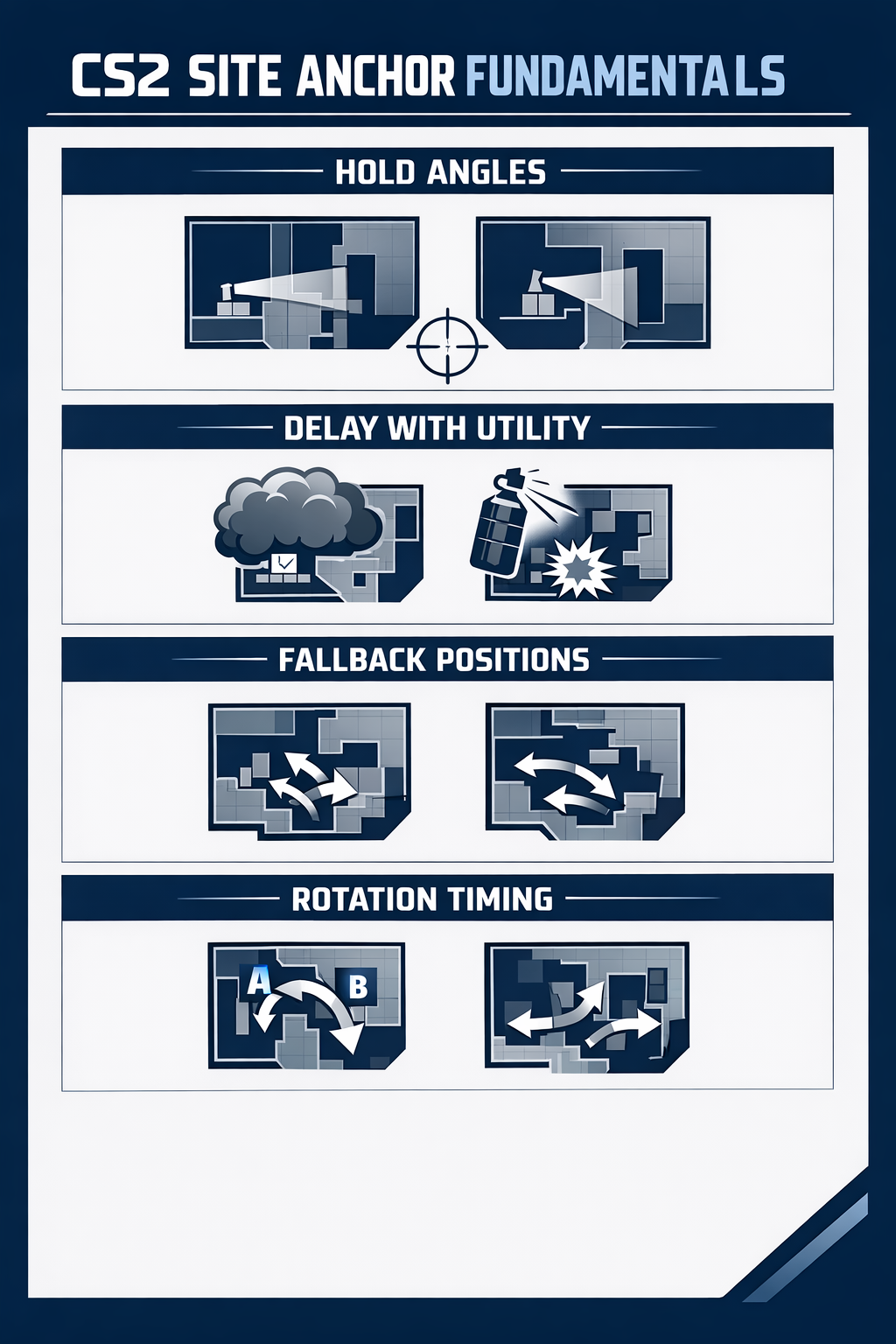
1. Information Comes First
An anchor’s first job is detecting the attack early.
If you see enemies entering the site, your team must know immediately.
Clear communication should include:
- Number of enemies
- Utility used
- Bomb spotted
- Direction of push
2. Utility Is More Valuable Than Kills
A well-timed smoke or molotov can delay attackers longer than multiple kills.
Utility forces attackers to slow down and reposition.
3. Survival Over Hero Plays
Anchors should avoid unnecessary fights.
If you die instantly, the site becomes free for attackers.
Instead, prioritize survival while inflicting damage and slowing the push.
4. Smart Positioning
Good anchor positions allow you to:
- See enemies before they see you
- Escape safely
- Reposition after taking a fight
Best Positions for Anchoring
Strong anchor positions share several characteristics.
Cover and Escape Routes
You should always have a way to reposition after shooting.
Static positions often get cleared quickly.
Multiple Angles
Anchors should control positions where they can switch angles after each fight.
Crossfire Potential
Anchors often coordinate with rotators to create crossfires.
This allows two defenders to cover each other while watching different angles.
Late-Round Repositioning
The best anchors frequently change positions after the first engagement.
This forces attackers to clear multiple areas, slowing the execute.
Using Utility as an Anchor
Utility is the anchor’s most powerful tool.
Smokes
Smokes block enemy vision and delay pushes.
Good anchor smokes:
- Block entry points
- Separate attackers
- Create one-on-one fights
Molotovs
Molotovs are excellent for delaying rushes.
Use them:
- At choke points
- During bomb plants
- When enemies commit to site
Flashbangs
Flashbangs allow anchors to escape dangerous situations.
They also enable surprise re-peeks.
HE Grenades
HE grenades can punish grouped attackers during executes.
How to Gather Information Safely
Information gathering is critical for anchors.
However, peeking aggressively can lead to early deaths.
Safe information techniques include:
- Shoulder peeking
- Jump spotting
- Listening for footsteps
- Watching utility usage
Even small clues can reveal enemy intentions.
When to Fight and When to Survive
Anchors must constantly decide whether to fight or delay.
Fight when:
- Enemies are isolated
- You have utility advantage
- You control the angle
Delay when:
- Multiple enemies appear
- Your teammates are rotating
- The attackers use heavy utility
The Art of Falling Back
One of the most important anchor skills is knowing when to fall back.
Many players lose rounds because they refuse to give up space.
Smart anchors understand that giving up the site temporarily can create a stronger retake.
Effective fallback positions allow you to:
- Survive the initial execute
- Maintain vision of the bombsite
- Coordinate with teammates
Correct Rotation Timing
Rotations must be carefully timed.
Rotating too early can weaken the other site.
Rotating too late can leave anchors overwhelmed.
Good rotation signals include:
- Bomb spotted
- Multiple enemies confirmed
- Heavy utility usage
How Anchors Work With Rotators
Anchors rarely defend alone.
Rotators provide support when pressure increases.
Successful teamwork requires:
- Clear communication
- Crossfire setups
- Coordinated utility
Reading Enemy Executes
Experienced anchors can identify executes based on utility patterns.
For example:
- Multiple smokes often indicate a full execute
- Single flashes may signal a fake
- Late-round pushes often indicate desperation
Dealing With Fake Executes
Attackers frequently fake bombsite pushes.
Anchors must avoid overreacting.
Instead of immediately rotating, anchors should confirm:
- Number of enemies
- Bomb presence
- Commitment level
How Anchors Control Round Tempo
Anchors indirectly control the pace of the round.
By delaying pushes and gathering information, anchors force attackers to react.
This creates strategic advantages for defenders.
Common Mistakes Anchors Make
- Overpeeking early
- Using utility too soon
- Playing predictable positions
- Ignoring communication
- Refusing to fall back
Avoiding these mistakes dramatically improves defensive consistency.
Solo Queue Anchoring Tips
Solo queue presents additional challenges.
Without coordinated teammates, anchors must rely on strong fundamentals.
Key tips include:
- Play safer positions
- Communicate clearly
- Use utility conservatively
- Prioritize survival
For players who want to climb faster in competitive ranks, professional coaching or assistance can accelerate improvement. Services such as CS2 rank boosting provide support for players looking to reach higher ranks while learning advanced gameplay strategies.
Professional Anchor Habits to Learn
Professional players demonstrate several habits that strong anchors should study.
- Constant repositioning
- Smart utility usage
- Minimal unnecessary peeks
- Clear team communication
- Perfect timing on rotations
Watching professional matches is one of the best ways to improve.
Training Your Anchor Skills
Anchoring is a skill that improves through deliberate practice.
Training methods include:
- Watching demo replays
- Practicing utility lineups
- Learning map timings
- Reviewing positioning mistakes
Players who consistently analyze their gameplay develop better decision-making over time.
Conclusion
Anchoring is one of the most valuable defensive roles in CS2. A strong anchor can delay enemy pushes, gather critical information, and enable teammates to rotate effectively.
By focusing on positioning, communication, utility usage, and intelligent fallback decisions, players can dramatically increase their defensive impact.
Remember: the goal of anchoring is not hero plays — it is control, survival, and time. Master these fundamentals, and you will become a far more reliable defender in competitive matches.