



LoL Champion Pool Strategy: Pick 2–3 Champs to Climb
LoL Champion Pool Strategy: How to Pick 2–3 Champs to Climb
One of the most common reasons players get stuck in ranked is not mechanics, not teammates, and not even bad luck. It is a lack of clarity. Too many players queue up without a real identity. One game they pick a scaling mage, the next they lock an early-game fighter, then they swap to a tank they barely understand because they saw it win in someone else’s match history. Their results feel random because their process is random.
If you want to climb in LoL more reliably, one of the highest-value changes you can make is building a small, deliberate champion pool. Not a massive pool. Not a “play everything” approach. A real 2–3 champion system that gives you comfort, matchup coverage, and a repeatable plan in solo queue.
This guide explains exactly how to do that. You will learn why small champion pools produce better ranked results, how to choose your core picks, how to avoid common drafting mistakes, how to review your pool over time, and how to keep improving without constantly role-swapping or meta-chasing. The goal is not just to tell you to “one-trick less” or “play fewer champs.” The goal is to help you create a practical system for climbing.
Because LoL changes over time, this guide stays focused on timeless principles rather than patch-specific champion recommendations. Exact numbers, balance shifts, and tier placements can change, but the logic behind a strong champion pool stays useful season after season. You can always check the official champion roster, the official how-to-play overview, the current ranked system page, and Riot’s MMR and LP explanation for the latest official details. For live solo queue statistics and role-specific performance trends, many players also review data tools like OP.GG champion stats.
If your goal is faster improvement, cleaner decisions, and more stable ranked progression, a small pool is one of the best foundations you can build. And if you want extra help accelerating your climb after you understand the principles in this guide, you can also compare options on Boosteria’s LoL elo boost pricing page.
Why a Small Champion Pool Helps You Climb
A small champion pool improves ranked results because ranked rewards consistency more than variety. In theory, being flexible sounds powerful. In practice, most solo queue players are not truly flexible. They are inconsistent. They know a little about many picks but not enough to perform under pressure, adapt to different lane states, or recover when a matchup goes wrong.
When you focus on 2–3 champions, several things happen at once. First, your mechanical execution improves. Combos, trading patterns, spacing, cooldown tracking, animation feel, and damage intuition become automatic. You stop guessing and start recognizing windows. Second, your mental load drops. You spend less energy figuring out your champion and more energy reading the map, tracking jungle positions, managing waves, and spotting win conditions. Third, your performance becomes more stable. Instead of random highs and lows based on unfamiliar picks, you get repeatable game plans.
This matters because solo queue is chaotic. You do not control teammates, communication quality, or draft cooperation. What you can control is how often you enter a game on a champion you deeply understand. The more often you do that, the more often you give yourself a real chance to carry, stabilize, or at least play near your level.
A small pool also accelerates learning. If you play ten different champions, you often cannot tell whether a loss came from macro, matchup misunderstanding, poor mechanics, or unfamiliar limits. If you mostly play the same 2–3 champions, patterns become obvious. You begin to notice the exact wave states where you die, the same bad recall timings, the same missed all-in windows, or the same mid-game positioning errors. Improvement becomes measurable.
There is another benefit many players underestimate: draft discipline. Players with wide pools often talk themselves into bad decisions. They pick “for team comp” when they are not good at the champion. They chase a counterpick they cannot execute. They try to rescue a weak draft with a comfortless answer. Players with smaller pools usually draft better because their choices are clearer. Their pool creates boundaries, and those boundaries prevent panic picks.
In short, a small pool is not restrictive. It is liberating. It lets you put more reps into the things that actually move rank: matchup understanding, fundamentals, confidence, and consistency.
What a Good 2–3 Champion Pool Looks Like
A good champion pool is not just three champions you enjoy. It is a set of picks that work together. They should cover common draft situations, give you answers to lane uncertainty, and let you stay inside a familiar strategic identity. The best pools feel simple before the game starts and clear once the game begins.
The first rule is synergy of purpose. Your champions do not need identical kits, but they should make sense together. For example, if you love short-range brawling top laners who spike in skirmishes, you should not randomly add a passive, high-range poke specialist just because it is strong this week. That kind of pick may win on paper but still lower your total win rate because it pulls you into a completely different way of thinking about waves, spacing, and fights.
The second rule is usable coverage. Coverage does not mean “answer everything.” No pool answers everything. Coverage means you have a solid blind pick, at least one backup for difficult drafts or bans, and enough variation to avoid being trapped by one matchup profile. You want a pool that gives you options without destroying your identity.
The third rule is repeatability. Good pools create recurring decisions you can learn from. Maybe your three champions all care deeply about early wave control. Maybe they all function well in skirmishes around objectives. Maybe they all scale in a way you understand. The more repeatable the decision patterns, the easier it is to improve quickly.
The fourth rule is realistic mastery. A good pool respects your time. If you play a few ranked blocks per week, a 2-champion pool is often stronger than a 5-champion pool because you can actually maintain form. If one champion has a very high execution burden, it may need simpler backups around it. Your pool should fit the amount of practice you can sustain.
Finally, a good pool helps you queue with confidence. You should be able to answer these questions in seconds: What is my blind pick? What do I play if my main is banned? What do I pick when my team needs engage, range, waveclear, peel, or side-lane pressure? If those answers are muddy, your pool is probably too loose.
Start With One Main Role
Before choosing champions, choose a role. This sounds obvious, but many players sabotage their climb by being “kind of” a top, “sometimes” a mid, “okay” on support, and “filling when needed.” That approach feels flexible, but it slows development because every role teaches different lane habits, map timings, and teamfight responsibilities.
If climbing is your priority, pick one main role and build your champion pool there first. Your secondary role should be practical and simple, not a second main role that doubles your study load. The reason is simple: the role itself is already a large skill set. Top lane teaches wave control, isolation, and punish windows differently than mid. Jungle teaches route logic, tempo, information processing, and objective timing. ADC teaches spacing and damage discipline under pressure. Support teaches vision economy, lane enablement, and roam timing. If you split too early, you dilute your learning.
Role specialization also makes champion selection easier. A good top lane pool looks different from a good jungle pool. A mid pool often benefits from one safe blind and one more assertive or specialized option. A support pool may want a stable engage-enchanter balance. An ADC pool may prioritize comfort into common lane patterns more than extreme stylistic variation. Once you anchor to one role, your pool choices become more coherent.
If you are unsure which role to main, pick the role where two things overlap: you enjoy the responsibility profile, and you are willing to watch your own mistakes there without making excuses. The best climbing role is usually not the role that looks coolest. It is the one you can review honestly and repeat consistently.
Choose Champions by Identity, Not Hype
The biggest trap in champion pool building is picking based on hype. Players see a tier list, a montage, a pro pick, or a streamer carry, then try to import that success into their own ranked games. But champions are not isolated power packages. They are skill demands. A pick that is strong in one environment can be a disaster in another if it clashes with your habits.
Instead, choose by identity. Ask what kind of League player you actually are when you perform well. Do you like lane control and small health advantages? Do you prefer hard engage and decisive fights? Are you best when playing for scaling and clean front-to-back teamfights? Do you thrive in skirmishes and resets? Do you like simple execution that frees your attention for macro? Or do you rely on outplay-heavy mechanics and creative angles?
Your champion pool should match your natural strengths while still encouraging growth. If you are calm and methodical, picks with reliable waveclear, stable scaling, and clear spacing rules may suit you. If you are proactive and love forcing windows, picks with engage, roam pressure, or duel threat may be better. If your biggest strength is map reading, simpler mechanically efficient champions may help you convert that edge more often. If your biggest strength is mechanics, you can include a higher-skill pick, but it still needs supporting champions that keep your ranked floor stable.
This is why copying pro play pools often fails. Pros draft around voice comms, scrim prep, teammate coordination, and team strategy. Solo queue is different. Your pool should be built for repeated ladder games, not tournament conditions. Reliable self-sufficiency matters more than theoretical perfection.
In other words, the right question is not “What is strongest?” The right question is “What lets me play good League most often?”
The Best 3-Slot Champion Pool Model
For most players, the best 3-champion pool uses three roles inside one role: a blind pick, a comfort carry, and a situational backup. This model is simple, flexible, and easy to maintain.
1. Blind Pick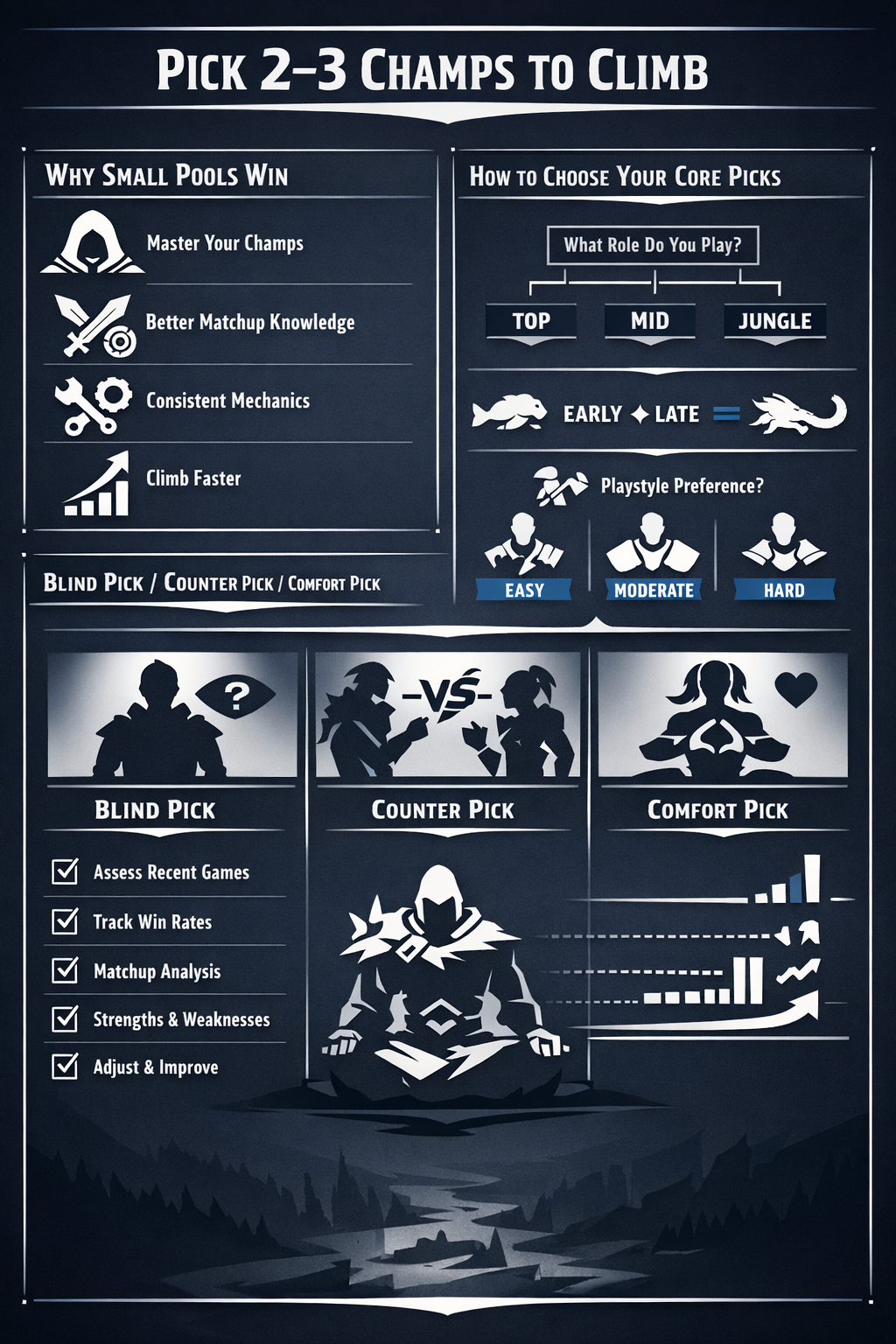
This is the champion you are happy to lock when you do not have ideal draft information or when you need a safe, reliable game. A good blind pick is not necessarily flashy. It is stable. It handles uncertainty, has manageable bad matchups, and gives you a useful mid-game even if lane is neutral. This champion is the anchor of your pool.
2. Comfort Carry
This is the champion you play when the draft or matchup lets you express more pressure. It may have stronger snowball potential, sharper lane agency, or higher carry upside. This is often the pick you trust most when you want to punish weaker fundamentals, force tempo, or take over games.
3. Situational Backup
This is not a random third pick. It exists for a reason. Maybe it covers a ban. Maybe it gives your pool a different damage profile. Maybe it handles a specific class of enemy comps. Maybe it is easier to draft when your team already lacks engage, peel, range, or frontline. The backup should solve a real problem your first two picks do not solve well.
This model works because it keeps your pool small while still letting you adapt. You do not need one champion for every matchup. You need one champion for uncertainty, one for confidence, and one for coverage.
How to Build a Strong 2-Champion Pool
If your schedule is limited, or if you are still developing fundamentals, a 2-champion pool can be even better than a 3-champion pool. In that case, the goal is complementary reliability. Your two champions should not be random alternatives. They should form a simple system.
The classic 2-champion approach is one safe blind and one more specialized comfort pick. The safe blind keeps your ranked sessions stable when draft conditions are unclear. The comfort pick gives you confidence and a proactive option when the game looks favorable. Together, these two champions reduce panic and simplify champion select.
Another strong version is one proactive pick and one fallback pick. The proactive champion lets you create action, while the fallback champion gives you a plan when the lane looks hard, your team comp is awkward, or you simply are not feeling sharp that day.
A 2-champion pool is especially good for players who overcomplicate drafting. It forces clarity. It also makes post-game review easier because your errors become easier to track. If you are serious about improvement and not just novelty, this can be one of the most efficient setups in the game.
The 10 Best Criteria for Picking Your Champions
When deciding which champions deserve a slot in your pool, use these criteria. You do not need every champion to score perfectly in every category, but the overall pool should make sense across them.
1. You genuinely want to play it often
The first test is honesty. If you do not enjoy the champion enough to play it repeatedly, it will never become a true ranked asset. You will avoid it, neglect it, or drop it during a bad patch. Enjoyment matters because repetition matters.
2. The champion matches your natural tempo
Some players are best in slow, controlled games. Others play best when forcing skirmishes. Pick champions that align with your tempo. If you constantly feel rushed or constrained on a champion, that is a sign the fit is wrong.
3. The lane phase makes sense to you
Do you understand what “winning lane” means on this champion? Some champions win by kill pressure, some by wave control, some by surviving to item spikes, some by roaming. If your lane identity on a champion is vague, your results will be unstable.
4. The champion has clear loss conditions
You should know what can go wrong. Does the champion struggle into range? Hard engage? Early invades? Freeze-heavy matchups? Heavy poke? A champion becomes much more usable once you understand exactly what breaks its game plan.
5. The execution burden fits your current level
A mechanically difficult champion is not always bad, but it should be a deliberate choice. If your mechanics are not yet stable under stress, stacking your pool with high-execution champions can cap your climb because your decision quality collapses when teamfights get messy.
6. The champion gives you a useful job in bad games
Some champions feel good only when ahead. Others can still provide waveclear, engage, peel, objective control, or side-lane pressure from behind. In solo queue, that matters. Champions that remain useful in difficult games often produce better long-term ranked value.
7. It does not overlap too heavily with the rest of your pool
Overlap is not always bad. In fact, some overlap is good because it preserves identity. But if all your champions lose to the same class, need the same lane conditions, and provide the same team value, your pool may be too narrow.
8. The champion’s matchup spread is acceptable
You do not need perfection, but you need playability. If a champion has too many lane states that make you miserable, it becomes harder to trust in ranked. Trust is a huge part of climbing.
9. It is resilient to balance changes
Try to prefer champions whose usefulness is not entirely dependent on one overtuned number. Timeless pool choices are often champions with clear fundamentals, well-defined strengths, and transferable skills.
10. You can explain why it is in your pool in one sentence
This is a surprisingly good final filter. “This is my safe blind.” “This is my skirmish carry.” “This is my answer when my team needs engage.” If you cannot explain the slot simply, the pick may not belong there.
Mistakes That Ruin Champion Pools
Most failed champion pools do not fail because the champions are weak. They fail because the structure is wrong. Here are the most common mistakes.
Playing too many champions “for fun” in ranked
There is nothing wrong with fun, but ranked is the wrong place to maintain a huge experimental rotation if climbing is the goal. Use normals, flex, or alternate queues to explore. Protect your ranked environment.
Picking champions from completely different identities
If one champion teaches controlled scaling, another teaches hard engage, and the third requires precise split-push pressure with radically different map priorities, your learning becomes scattered. Variety is useful, but too much identity mismatch slows progress.
Meta-chasing every patch
Tier lists are helpful, but they should not control your pool. A champion being strong does not automatically mean it belongs in your ranked plan. Small balance swings matter less than deep comfort for most players.
Building a pool that only works when ahead
If all your champions depend on lane domination or heavy snowballing, your results may look amazing in wins and awful in losses. Strong pools need at least one champion that still has a clear job when games go badly.
Ignoring bans and queue reality
If your entire pool effectively collapses when one champion is banned, the structure is too fragile. Ranked systems reward reliability across many games, not ideal scenarios.
Confusing “counterpick” with “I saw this once”
True counterpicks only matter if you can play them. A sloppy counterpick is often worse than a strong comfort pick into a mildly bad matchup.
Not reviewing results by champion
Many players assume a champion is good for them because it feels powerful. But feelings can be misleading. You should review your actual performance: lane outcomes, deaths before 15, CS trends, objective involvement, and win rate over a meaningful sample.
How Matchups and Team Comps Should Affect Your Choices
Matchups matter, but most players overestimate how much they matter compared to mastery. A matchup only becomes a huge advantage if you understand the trading patterns, spacing rules, wave control, and kill windows better than the opponent. Otherwise, the value of the “counter” often disappears.
That said, matchups should still influence your pool design. Ideally, your core picks should not all lose in the same way. If you are a mid player, maybe one champion handles waveclear and range better while another functions better in scrappy melee or skirmish-heavy games. If you are top, maybe one champion has dependable blind value while another punishes common short-range melee lanes. If you are support, maybe one pick gives engage while another stabilizes poke or protects scaling carries.
Team comps also matter, but they matter most when the adjustment stays inside your competence. If your team already has no engage and one of your actual comfort champions provides reliable engage, great. That is meaningful adaptation. But if the comp “needs engage” and your only engage champion is something you barely play, the adjustment is probably fake value.
The key principle is this: use comp and matchup information to choose between prepared options, not to force unprepared options. Your pool should be designed to make those choices possible without panic.
Blind Pick, Counter Pick, and Pocket Pick Explained
Blind Pick
A blind pick is the champion you can lock with limited information and still expect a playable game. Good blind picks usually have flexible laning, manageable counters, and a clear role in mid-game fights. This is the most important slot in most pools because solo queue often puts you in uncertain drafts.
Counter Pick
A counter pick is a champion you use because it has specific strategic or lane advantages into certain opponents or draft structures. But remember: a counter pick only works when you understand the reason it is good. Never add counterpicks you cannot explain or execute.
Pocket Pick
A pocket pick is not simply an unusual champion. It is a prepared, practiced option you trust in defined conditions. Maybe it punishes a common meta pattern. Maybe it is your best carry in solo queue chaos. Maybe it is especially hard for your usual MMR bracket to handle. Pocket picks can be extremely valuable, but only if they are genuinely practiced.
Many strong 3-champion pools end up looking like this: one blind, one comfort carry, one pocket or situational answer. That is enough variety for most players without breaking consistency.
Champion Pool Examples by Role
Rather than naming exact champions that may rise or fall with balance updates, it is more useful to show role-based templates. Use these as models.
Top Lane
A strong top lane pool often includes one stable blind, one stronger punish or skirmish pick, and possibly one tank or utility backup. Top lane is highly matchup-sensitive, so confidence and wave knowledge matter a lot. You do not need endless counters. You need one champion you can survive or stabilize on, and one champion you can press advantages with.
Jungle
A strong jungle pool usually balances tempo and simplicity. One champion may offer reliable clear paths and consistent objective setups, while another gives better skirmishing or carry potential. If you add a third, it should usually solve a clear problem such as teamfight engage, tank need, or draft damage balance. Jungle pools benefit enormously from repeatable routes and decision patterns.
Mid Lane
A strong mid pool often benefits from one safe blind with waveclear or stable lane tools, one more assertive skirmish or carry option, and maybe one scaling or utility alternative. Mid influences the map, so your champions should help you play your preferred style around priority, roams, or controlled scaling.
ADC
ADC pools often work best when they are not too cute. Many players climb faster with a small set of marksmen whose ranges, power spikes, and teamfight roles they deeply understand. A good second or third pick may cover lane safety, utility, or a different teamfight profile, but the role heavily rewards repetition and positioning discipline.
Support
Support pools often succeed with one engage option and one peel or enchanter option, plus maybe a third that handles poke or roam-heavy games. Support is one of the easiest roles to over-expand on because many champions feel accessible. Resist that urge. Small support pools improve matchup reading, roam timing, lane identity, and vision habits faster.
How to Practice a Small Pool Efficiently
Once you choose your 2–3 champions, the next step is structured practice. Many players build a good pool on paper but still fail to climb because they practice randomly. If you want the benefits of a small pool, you need repeated, focused reps.
1. Define your lane goals per champion
For each champion, write a short note answering three questions: What does a good early lane look like? What are my first key spikes? What is my job in fights? This prevents autopilot.
2. Focus on one learning theme per block
Do not try to improve everything at once. One block can be about early wave management. Another can be about jungle tracking. Another can be about recall discipline. The smaller your pool, the easier it is to isolate improvement themes.
3. Review the first 10 minutes
Most ranked games are shaped early by wave errors, bad trades, missed windows, poor pathing responses, or preventable deaths. Review those moments. Ask whether the problem was champion-specific or fundamental.
4. Track your common failure pattern on each champion
Maybe on one champion you over-fight before level 6. Maybe on another you miss roam timings because you overvalue side farm. Maybe on your safe blind you play too passively and lose priority for free. Write it down. Small pools make this kind of pattern tracking incredibly powerful.
5. Limit ranked experimentation
When you want to test a new idea, separate it from your main climb environment if possible. Protecting your process is part of climbing.
6. Build matchup notes slowly
You do not need giant spreadsheets. Just keep simple observations: what level matters, what wave state feels dangerous, what spell you must respect, what item spike changes the lane, and what the first big fight should look like. Over time, these notes become real edge.
How to Review and Upgrade Your Pool Over Time
Your champion pool should be stable, but not frozen forever. The right way to update it is through evidence, not emotion.
Every few weeks, review each champion in your pool through three lenses: results, feel, and purpose.
Results
Check your meaningful sample of ranked games. Are you actually winning? Are your lane phases stable? Are your deaths decreasing? Are you getting good farm or consistent impact? One hot streak or cold streak is not enough, but trends matter.
Feel
Does the champion still feel intuitive? Or are you constantly fighting the kit, misjudging damage, or losing clarity in fights? Sometimes a champion remains good on paper but stops fitting your current habits or role priorities.
Purpose
Can you still clearly explain why the champion is in your pool? If not, the slot may be drifting into habit instead of strategy.
When should you replace a champion? Usually when one of these happens: the champion no longer fits your identity, the execution cost is too high for the reward, it overlaps too much with another pick, or it leaves a real gap your pool cannot solve. Replace slowly. Do not rebuild the whole pool after a bad week.
A useful rule is one change at a time. If you swap one slot, keep the rest stable so you can actually evaluate the effect. Constant reinvention feels productive, but stable iteration is what creates ranked progress.
The Mental Advantage of a Tight Pool
Champion pool strategy is not just about mechanics and draft logic. It is also about mindset. Small pools reduce tilt because they reduce uncertainty. You stop entering champion select with panic and guesswork. You know what your plan is. You know your windows. You know your limits better. Even losses feel more informative.
This matters more than many players realize. A lot of tilt comes from avoidable discomfort: picking a champion you do not trust, loading into a lane you do not understand, or feeling helpless because the game is asking questions your pick cannot answer. Small pools reduce that stress.
They also improve confidence without creating ego. Confidence from broad champion ego is fragile: “I can play anything.” Confidence from mastery is real: “I know exactly what my champion wants here.” That kind of confidence survives bad starts and chaotic games because it is rooted in reps, not mood.
There is also less decision fatigue across a long session. Champion select becomes simpler, which preserves mental energy for actual gameplay. Over many ranked games, that matters a lot.
Final Framework: Build Your Pool for Climbing
If you want a simple framework to apply after reading this guide, use this:
- Choose one main role.
- Identify your natural playstyle and tempo.
- Start with two champions, not three, unless you have enough time to maintain all three.
- Make sure one champion is a reliable blind or fallback option.
- Make sure the second gives you confidence, pressure, or a different strategic angle.
- If you add a third, give it a real job: ban coverage, engage, damage profile shift, difficult matchup answer, or comfort pocket pick.
- Do not chase the meta faster than you can learn.
- Use team comps and matchups to choose between prepared options, not to force unfamiliar ones.
- Review early game patterns and repeat the same fundamentals until they become automatic.
- Change your pool only when evidence says the structure needs it.
The truth is that most players do not need more champions. They need more clarity. They need fewer variables, deeper reps, and a system they can trust from game to game. That is what a strong LoL champion pool gives you.
If you pick 2–3 champions with intention, practice them with discipline, and keep your decisions inside a coherent identity, you will usually play better League. And when you play better League more often, climbing stops feeling random.
Small pool. Clear plan. Better games. That is the real value of champion pool strategy.
FAQ: LoL Champion Pool Strategy
Is it better to one-trick or play 2–3 champions?
For many players, 2–3 champions is the best balance. One-tricking can produce very fast mastery, but a small pool is often more resilient against bans, draft issues, and burnout.
Should I change my pool every patch?
No. Small adjustments are fine, but constant changes usually slow improvement. Focus on timeless comfort and good fundamentals first.
How many champions are too many for ranked?
That depends on how much you play, but many players perform best with 2–3 serious picks in their main role. Once you go much wider, consistency often drops.
Do counters matter more than comfort?
For most solo queue players, comfort matters more unless the counter is something they truly know how to use. An uncomfortable counterpick is often weaker than a mastered comfort pick.
Can I have different pools for different moods?
You can, but that usually creates inconsistency. It is better to keep one core pool and simply choose the safer or more proactive option depending on how sharp you feel.