



Deadlock Hero Pool & Team Comps: Draft and Counterplay Guide
Deadlock — Hero Pool & Team Comps: Draft Principles and Counterplay
Drafting in Deadlock feels simple until you start losing games that looked playable on paper. You queue with comfort heroes, your lanes are decent, your team has damage, and yet every mid game fight feels awkward. Someone dives too early, someone cannot walk up, your side lanes collapse under pressure, or the enemy composition scales into an impossible front-to-back fight. That is the point where many players think the draft was “bad” without understanding why.
The truth is that most players do not lose draft phase because they lack mechanical skill. They lose because they misunderstand what a hero pool is supposed to do, what a team composition is supposed to enable, and how counterplay actually works in a game where movement, space, timing, pressure, and objective control all matter at once. Deadlock rewards players who can see beyond isolated hero strength. A strong lineup is not just a pile of “good” picks. It is a set of tools that solves real problems: lane pressure, engage, survivability, burst windows, cleanup, map control, objective security, and scaling.
This guide is built to stay useful for a long time. Deadlock is still evolving, so specific hero tiers, item trends, and even map details can change. What usually survives those updates are the core drafting rules: balance your threats, understand your win condition, know what your composition wants from the map, and pick heroes that give you multiple answers instead of a single narrow idea. Valve’s official Deadlock pages and update hubs make it clear that the game is still changing rapidly, which is exactly why timeless draft principles matter more than temporary meta lists. For current official info, you can check the official Deadlock Steam page, Valve’s update site at playdeadlock.com, and the broader community reference pages on Liquipedia Deadlock.
If your goal is to climb more consistently, your draft process should become boring in the best way possible. You want fewer coin-flip games, fewer compositions that instantly fall apart when behind, and fewer picks that only work when the entire lobby plays around you. A smart hero pool gives you dependable lanes. A smart team comp gives you a plan. A smart counterpick gives you leverage without destroying your own structure. Put those three ideas together and ranked starts feeling less random.
Why Deadlock Drafts Feel Random
Deadlock drafts feel random to many players because they are judged too late. Most players only evaluate the composition once the game becomes uncomfortable. A fight goes badly, an objective is impossible to contest, or the enemy split-pushes while your team never finds a clean initiation. Then the post-game explanation becomes vague: “their comp was broken,” “our draft had no damage,” or “we got countered.” Those statements are sometimes true, but they are rarely precise enough to help you improve.
What usually creates the feeling of randomness is hidden structural weakness. Your draft may have had damage, but no safe damage. It may have had initiation, but no follow-up. It may have had scaling, but no way to survive the first fifteen minutes. It may have had lane bullies, but no answer once fights became more grouped and objective-focused. These are not random outcomes. They are predictable consequences of composition logic.
Another reason drafting feels chaotic is that players overvalue isolated comfort and undervalue interaction. A hero can be individually strong and still be the wrong pick for a specific lineup. If your team already has two fragile backline damage heroes, a third greedier pick may make your damage profile look impressive while actually making the composition harder to execute. Conversely, a lower-damage hero that adds zone control, peel, or reliable initiation may increase your team’s real win rate far more.
Deadlock also punishes compositions that only function in one fight pattern. Some lineups only work if they burst first. Some only work if they kite backward. Some only work if they control angles before the fight starts. Some only work if they secure early map space and keep the game fast. When your draft does not know what kind of fight it wants, every engagement feels improvised. That is the source of a lot of ranked frustration.
The solution is not memorizing a meta chart forever. It is learning to read compositions in layers. Can your team hold lanes? Can it start fights on its terms? Can it disengage bad fights? Can it kill durable targets? Can it protect vulnerable carries? Can it threaten objectives after a won fight? Can it play from behind? The more clearly you can answer those questions, the less random Deadlock becomes.
What a Real Hero Pool Looks Like
A real hero pool is not six heroes you happen to enjoy. It is a curated set of picks that lets you solve common draft problems without forcing you onto unfamiliar terrain. In practical terms, your pool should give you access to different lane types, different fight roles, and different game tempos.
Most players build their pool incorrectly by collecting heroes for aesthetic or emotional reasons. They play one hero because it feels stylish, another because it snowballs hard, another because a streamer made it look easy, and another because it once carried them in a lobby. That is not a pool. That is a pile. A strong pool is built intentionally.
At minimum, your pool should cover three broad needs. First, you need a dependable comfort pick that you can blind without panic. This is the hero you can play when the draft is messy, when you are unsure what teammates want, or when you simply need a stable performance. Second, you need a pick that helps when your team lacks initiation, frontline presence, or playmaking. Third, you need a pick that works when your team already has engage and needs efficient damage, pressure, or scaling. If possible, add a fourth option that is specifically strong into common problem archetypes such as dive-heavy teams, poke-heavy teams, or overly greedy compositions.
The best personal hero pools are narrow enough to stay polished and broad enough to stay useful. For most players, three to five serious heroes is ideal. That lets you learn real matchups, lane patterns, item pivots, and timing windows. A ten-hero pool usually becomes shallow. A one-hero pool becomes fragile. Somewhere in the middle is where consistency lives.
It is also useful to think about your pool in terms of pressure patterns rather than only hero classes. Ask yourself: which of my heroes can safely contest lane? Which can threaten picks? Which can anchor teamfights? Which can absorb cooldowns? Which can close games after a won fight? If your entire pool does the same thing from slightly different angles, you are easier to draft against than you think.
A final rule: your hero pool should help your teammates, not just your ego. If every hero you play demands farm, space, protection, and ideal setups, you are not versatile. You are expensive. In ranked, expensive hero pools create unstable drafts. Cheap hero pools — meaning heroes that can function in multiple compositions and do not require perfect conditions — create more wins.
Why One-Dimensional Hero Pools Fail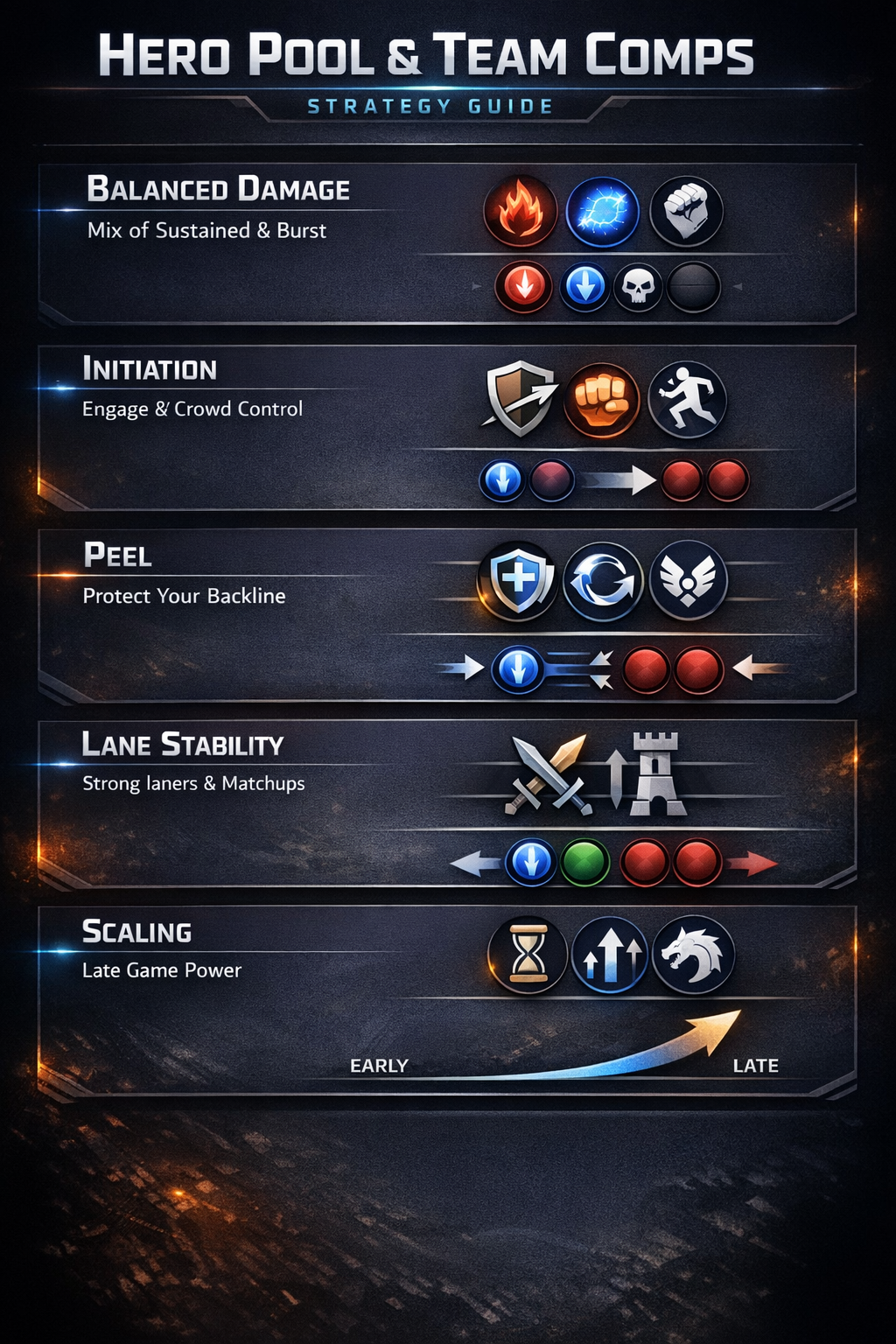
There is nothing wrong with specializing. Many strong players climb by mastering a small set of heroes. The problem starts when specialization becomes one-dimensional. If all of your heroes need the same lane support, the same teamfight structure, or the same item timings, your results become volatile whenever the lobby does not cooperate.
For example, a pool made entirely of greedy scaling carries can look powerful in theory. In practice, it often leaves your team with poor early lane control, weak initiative, and awkward mid game contests. A pool made entirely of aggressive flankers can win random fights, but it may struggle to front-to-back, defend objectives, or operate when the enemy groups tightly. A pool made entirely of poke heroes can feel great until the enemy composition forces close-range all-ins and your team has no answer once angles disappear.
One-dimensional pools also make counterplay easy. If the enemy can predict your preferred engagement range, movement pattern, or damage pattern, they can draft or build with unusual confidence. They do not need to shut down your entire pool; they only need to attack the underlying structure that connects it.
The healthier alternative is a pool with at least two different fight identities. Maybe you main one pressure-oriented hero and one control-oriented hero. Maybe you pair a reliable lane stabilizer with a snowballing playmaker. Maybe you keep one anti-dive answer ready for lobbies that would otherwise be miserable. The point is not to become equally skilled at everything. The point is to avoid being solved before the match even begins.
The Roles Every Good Team Comp Needs
Every Deadlock composition needs more than raw damage. Exact hero labels can change over time, but the strategic roles inside a functioning lineup are remarkably consistent. When you draft, stop asking, “Do we have enough strong heroes?” Start asking, “Do we cover enough jobs?”
1. A way to start fights. This does not always mean a hard-commit dive. It can be long-range pressure that forces movement, zone control that constricts space, or reliable catch that turns vision into a pick. But somebody on your team must create the first real problem for the enemy. If nobody can start, you are waiting for mistakes instead of manufacturing them.
2. A way to survive contact. Some compositions start cleanly and then immediately collapse because they have no staying power. A good comp needs someone who can absorb attention, disrupt return fire, peel, or buy time for cooldown cycling. Surviving the enemy’s first answer is often more important than dealing the first burst.
3. Consistent damage. Burst wins highlights; repeatable damage wins many actual games. Your lineup should be able to threaten enemies even when the perfect combo does not land. If all your damage is tied to one narrow window, missed execution becomes catastrophic.
4. Access to backline or priority targets. Some games are won by slowly collapsing the nearest target. Others require reaching a fragile carry, punishing a stationary backliner, or denying a support-style controller from freely operating. If your composition cannot meaningfully pressure the enemy’s most important hero, your fights become too honest.
5. Objective conversion. Winning a fight should lead somewhere. Good compositions turn picks into map control, pressure, boss windows, lane advancement, or structure damage. Bad compositions win skirmishes and then wander.
6. A fallback pattern. This is the most neglected role in ranked. What happens if your team falls behind? Can you wave clear safely? Can you punish overextensions? Can you kite while scaling? Can you defend without instantly committing? A composition without a fallback plan can look playable for ten minutes and hopeless for the next twenty.
You do not need a separate hero for each job. Many strong picks cover multiple functions at once. The goal is not rigid classification. The goal is making sure every important function exists somewhere in your lineup.
How to Identify Your Team’s Win Condition
The simplest definition of a win condition is this: the recurring game state your composition wants to create. Not the fantasy version of the match. The repeatable one.
Some compositions want stable lanes into controlled mid game skirmishes. Some want constant pick pressure around rotations. Some want grouped objective fights with layered cooldowns. Some want to stretch the map and force bad responses. Some want to survive early pressure and overpower later fights through scaling, durability, or ultimate economy. If you do not know what your composition wants, you cannot judge whether a pick improves it.
To identify a win condition, start with three questions.
Who actually wins your fights? This is not always the highest damage hero. Sometimes it is the initiator who forces cooldowns. Sometimes it is the zone controller who makes the enemy backline useless. Sometimes it is the durable frontliner who lets your damage heroes keep shooting. Find the real engine.
What map state helps that engine? Does your team want grouped lanes, spread lanes, deep vision, short chokes, open sightlines, quick rotations, or patient objective setups? A win condition is always connected to map shape.
What enemy response hurts that plan most? If you know the biggest threat to your preferred game state, you know what your next draft pick or item pivot should cover.
Players often confuse “late game” with a win condition. Late game is a timing category, not a plan. Saying “we scale” is incomplete unless you know what that scaling looks like. Do you scale into stronger front-to-back fights? Better pick threat? Safer objective control? Stronger split pressure? More resilient cooldown trading? The more specific your answer, the better your drafting decisions become.
Drafting for Lane Stability First
One of the biggest ranked mistakes is drafting only for highlight fights and ignoring lane stability. A composition with beautiful teamfight theory can still lose because it never reaches the part of the game where that theory matters. Stable lanes are not glamorous, but they create everything else: item timings, map access, safe rotations, and psychological control over the match.
When evaluating a pick, ask how it affects lane reality. Can it contest space without exposing itself? Can it secure resources under pressure? Can it punish greedy opponents? Can it survive bad pairings without becoming useless? Can it rotate out with meaningful tempo instead of leaving lane in a disaster state?
Lane stability matters even more in solo queue because teammates rarely draft with perfect coordination. A self-sufficient hero is often worth more than a theoretically stronger but highly dependent one. The earlier phase of the game determines how much freedom your composition has later. Stable lanes let your team choose plays. Collapsing lanes force desperate ones.
This does not mean you should always draft passive lane neutralizers. It means every draft should respect early game survivability and pressure. If your team already has two heroes that need protection to exit lane comfortably, adding a third is greed disguised as confidence. The smarter move is usually to add a stabilizer who lowers the total burden on the lineup.
A useful ranked heuristic is simple: never let your composition become too hard to pilot before minute ten. If your draft needs flawless lane execution just to reach its first timing, it is not robust enough for consistent climbing.
Balancing Damage Profiles and Threat Types
Many players say “we need damage” when what they really mean is “we need the right kind of damage.” There is a huge difference between having enough numbers on a scoreboard and having enough pressure to solve an actual fight.
A balanced composition usually mixes at least two of the following threat types: burst, sustained damage, area denial, backline access, and punishment for overextension. If your team only threatens one pattern, the enemy gets to overbuild and overposition against it.
For example, a lineup overloaded on burst can look terrifying until the first target survives. Once that happens, the fight often swings hard because the composition invested too much into one quick window. A lineup overloaded on sustained damage may shred long fights but struggle to secure critical kills before enemies escape, heal, disengage, or re-enter. A lineup overloaded on poke can dominate open space but lose once forced into layered close-range contests.
Good drafts also consider damage delivery. It is not enough to have theoretical DPS. Who is allowed to deal it? Under what protection? Into which ranges? Against which cooldowns? Can your damage function while repositioning? Can it continue after the first commitment? Does it rely on enemies making mistakes, or can it create pressure proactively?
The best compositions make the enemy answer multiple threats at once. A frontline problem plus backline pressure. A poke problem plus dive follow-up. A strong nearest-target burn plus enough disruption to stop the enemy carry from playing freely. Multiplying the number of relevant decisions the enemy must make is one of the cleanest ways to make your draft feel unfair without relying on gimmicks.
Engage, Peel, and Fight Shape
One of the most useful ways to understand team compositions is by fight shape. How does the fight begin, where does pressure travel, and what protects your valuable heroes while that happens?
Some teams are built to dive. They want to cross distance quickly, overload one side of the fight, and create immediate panic. Dive compositions need follow-up, survivability, and enough speed or disruption to prevent clean retaliation. Their weakness is often overcommitment, scattered timing, and vulnerability when the first jump fails.
Some teams are built to front-to-back. They prefer controlled spacing, durable positioning, and steady damage into the nearest accessible target. These comps are often easier to execute but can struggle if the enemy repeatedly bypasses the front line or attacks from multiple angles.
Some teams are built to poke and collapse. They soften targets, force movement, then commit once positioning breaks. These drafts depend on angle control and patience. Their danger is getting hard-engaged before they create enough health or cooldown advantage.
Some teams are built to counter-engage. They look passive until the enemy enters, then punish the commitment with layered control, burst, or zone denial. These compositions can be excellent in ranked because many players overforce fights. Their weakness appears when the enemy refuses to offer clean entries and instead wins through slow map pressure.
Peel is what prevents your fight shape from collapsing. If your carry or high-value damage source cannot function under pressure, you need peel somewhere in the composition. Peel can be displacement, crowd control, body presence, threat of punishment, healing-style sustain, or simply enough counterpressure that diving your backline becomes too expensive. Teams that ignore peel often describe fights as “chaotic,” when the real issue is that nobody was assigned to keep the engine running.
Tempo Comps vs Scaling Comps
Drafting is also about time. Some compositions want to accelerate the match and extract value before enemy scaling, durability, or itemization catches up. Others are willing to absorb pressure because their later game states are easier to execute or harder to answer. Neither style is automatically better. Problems start when a draft mixes conflicting tempos without a clear bridge between them.
A tempo composition usually wants lane initiative, earlier rotations, faster objective pressure, and repeated skirmishes before the enemy stabilizes. These drafts often need decisive playmaking and strong conversion after won fights. Their main danger is running out of gas if the early lead does not become structural.
A scaling composition usually wants controlled damage intake, efficient farming patterns, safe defense, and disciplined fight selection until key timings arrive. These drafts need enough early resilience to avoid being buried. Their danger is drafting too much future value and not enough present survival.
The key is to know whether your picks agree on the clock. A lineup with three early-game enablers and two very slow payoff heroes may end up serving neither plan well. Likewise, a team with strong scaling but no wave control, no defensive utility, and no contest tools may never reach the point where scaling matters. Good drafting is not choosing early or late in isolation. It is building a smooth path from your current tempo to your desired tempo.
Counterplay Principles That Actually Matter
Counterplay is one of the most misunderstood parts of drafting. Many players think counterpicking means choosing the hero that annoys one specific enemy the most. Sometimes that works. More often, it weakens your own composition because the counter was too narrow.
The best counterplay follows four principles.
1. Counter the enemy plan, not just the enemy hero. If the enemy composition wins by hard diving your backline, the real counter may be peel, zone denial, or a sturdier front line — not merely a hero that beats one diver in a vacuum. If the enemy wins through spread pressure and pickoffs, the counter may be safer wave control and stronger grouped punish, not an isolated lane bully.
2. Prefer counters that preserve your own win condition. A good counterpick should make the enemy uncomfortable without making your own lineup incoherent. If you select a hero that technically answers their star player but leaves your team with poor engage, poor lanes, or poor objective conversion, the trade is often not worth it.
3. Draft broad answers over narrow hate picks. Broad answers include durability into burst, mobility denial into slippery compositions, wave control into side pressure, range control into short-range all-ins, or layered disengage into reckless dive. These answers tend to remain useful across many moments of the game.
4. Respect execution difficulty. A theoretical counter only matters if you can pilot it under stress. In ranked, a comfortable 8/10 answer is often better than a perfect 10/10 answer you barely play.
One of the cleanest counterplay habits you can build is asking, “What must the enemy do to win, and what makes that process harder every minute?” Sometimes the answer is a direct counterpick. Sometimes it is lane denial. Sometimes it is better teamfight spacing. Sometimes it is simply refusing to give the enemy the fight shape they want.
Common Draft Mistakes in Ranked
Picking too much damage and not enough structure. This is the classic ranked error. The lineup looks scary in theory, but there is nobody to start, nobody to peel, and nobody to anchor space.
Overreacting to one enemy hero. Players often see a threatening enemy pick and panic into a hard counter, forgetting the other four heroes and their own composition. Drafting is holistic. Tunnel vision creates weak lineups.
Ignoring lane burden. If several of your heroes need babysitting, your team will feel stretched from the first minute. Stable lanes are part of composition strength.
Confusing comfort with stubbornness. Comfort picks are valuable. But locking a familiar hero into a terrible composition is not discipline; it is refusal to adapt.
No backup plan. Many ranked drafts are built entirely for playing ahead. The moment they fall behind, there is no clear defense pattern, no patient scaling line, and no way to stall for better fights.
Too much overlap. Overlap happens when several heroes want the same resources, the same engage angles, or the same enemy mistakes. Overlap reduces flexibility and makes fights easy to read.
Drafting names instead of functions. Players remember that a hero is “meta” and stop thinking. Even strong heroes can create weak drafts if their function is redundant or poorly supported.
How to Expand Your Hero Pool the Smart Way
If you want a better pool, do not randomly add heroes. Expand with a reason. The best way is to diagnose repeated draft pain. Look back over ten to twenty ranked games and ask where your pool failed you. Did you often lack a blindable stable pick? Did your team regularly need engage and you could not provide it? Did you feel helpless into heavy dive or relentless poke? Those recurring problems tell you which new hero type to learn.
When adding a new hero, choose one that covers a missing strategic function while sharing some transferable skills with your current mains. Maybe it uses similar spacing logic, similar aim patterns, or similar map instincts. This makes the learning curve less brutal.
Spend your early reps learning three things first: lane survival patterns, first major timing, and what fights you should refuse. Many players try to master combo ceilings too early. What actually gets the hero into your ranked pool is being able to survive ordinary games.
It is also smart to learn one “glue” hero. A glue hero is not necessarily flashy or overpowered. It is simply a pick that makes many drafts cleaner. Glue heroes stabilize lanes, provide utility, or patch structural holes. Ranked climbers love glue heroes because they reduce the number of doomed-looking lobbies.
Sample Team Comp Frameworks
The following frameworks are intentionally generic so they remain useful across patches and roster changes.
1. Front-to-Back Control Comp
Core idea: durable presence, reliable initiation, safe sustained damage, peel, objective conversion.
Strengths: easy to execute, strong in grouped fights, usually good at protecting carries.
Weaknesses: can struggle versus spread map pressure or repeated backline bypass.
Best when: your team has stable lanes and wants consistent, low-variance teamfights.
2. Dive and Collapse Comp
Core idea: fast access to priority targets, layered follow-up, disruption, short explosive fight windows.
Strengths: punishes fragile backlines, creates chaos, excellent at snowballing tempo.
Weaknesses: vulnerable to peel, counter-engage, and failed first contact.
Best when: the enemy is greedy, immobile, or overly dependent on one backline engine.
3. Poke into Commit Comp
Core idea: control angles, chip health, force movement, then hard-commit once space breaks.
Strengths: strong before objectives, good at controlling chokes and vision-heavy setups.
Weaknesses: can be hard-engaged if angles collapse; requires discipline and spacing.
Best when: your team is patient and the enemy lacks reliable long-range initiation.
4. Counter-Engage Punish Comp
Core idea: bait entries, absorb the first wave, punish overcommitment with layered response.
Strengths: excellent against impatient lobbies, often strong while playing slightly behind.
Weaknesses: can feel passive if the enemy never commits or wins slowly through map spread.
Best when: opponents draft hard dive or habitually force uncertain fights.
5. Split Pressure with Fight Threat Comp
Core idea: pressure multiple lanes, force awkward rotations, regroup when the enemy fractures.
Strengths: stretches the map, creates pick windows, punishes slow teams.
Weaknesses: harder to coordinate in solo queue, risky if your side pressure heroes cannot escape.
Best when: your players understand tempo and do not mind winning through map discomfort instead of constant 5v5s.
These frameworks are more valuable than strict tier lists because they teach you what a composition is trying to do. Once you understand the frame, swapping heroes becomes easier.
How to Adapt in Solo Queue and Duo Queue
Solo queue drafting is not the same as coordinated team drafting. You cannot assume perfect comms, ideal follow-up, or disciplined map play. That means your best ranked picks are often heroes with clear value floors. They do something useful even when coordination is only average.
In solo queue, prioritize picks that:
- do not auto-lose lane when unsupported,
- have obvious fight value,
- can function both ahead and behind,
- do not require complicated multi-step setups every fight,
- fit multiple composition types.
Duo queue opens more possibilities because you can deliberately pair functions. A reliable engage hero plus a dependable follow-up hero. A stable laner plus a roamer. A backline carry plus a peel-oriented partner. A poke engine plus a controller who holds space. The key is complement, not duplication. Two heroes that both need the rest of the team to make them work are a weaker duo than one hero that starts problems and another that cashes them in.
Another solo queue tip: respect the psychology of ordinary lobbies. Random teams often overfight, force bad objective contests, and mismanage patience. That makes counter-engage, stable frontline value, and easy-to-understand teamfight roles stronger than many players realize. You do not always need the highest ceiling draft. You often need the draft that survives confusion better.
How to Review Drafts After the Match
If you want real improvement, review drafts with better questions than “Was our comp good?” Use this post-game checklist.
Did our lanes make sense? If the draft was theoretically strong but your early game was constantly bleeding, there may have been a structural lane issue.
Did we know our first three fights should look like? Many teams lose because nobody understood how they were supposed to engage or where they wanted to stand.
Did our composition have a clear damage pattern? Nearest-target burn, dive burst, poke collapse, attrition, pick-based pressure — which one was it, and did we actually support it?
What enemy pattern beat us repeatedly? Dive? Range? Split pressure? Frontline durability? Objective control? If the same pattern beat you several times, your draft may have lacked the right answer.
Were we missing a function or just misplaying? This is the most important question. Not every loss is a draft loss. Sometimes the composition was fine and execution failed. Improvement depends on telling those apart.
If I could change only one pick, what structural problem would I solve? This forces you to think in terms of roles and functions instead of blame.
Over time, these reviews reveal your personal drafting leaks. Maybe you overprioritize damage. Maybe you underrate peel. Maybe your pool is too greedy. Maybe you blind unstable picks. Once the pattern becomes visible, climbing gets easier because your drafts stop repeating the same failure modes.
Practical Draft Checklist Before You Lock In
Here is a simple ranked checklist you can mentally run in a few seconds before locking your hero:
- Can our lanes survive without miracles?
- Do we have at least one reliable way to start fights?
- Do we have enough peel or counterpressure to protect our core damage?
- Are our damage types and delivery patterns varied enough?
- Does this pick improve our win condition or only attack one enemy hero?
- Can this composition still function if we fall slightly behind?
- Am I picking comfort, or am I hiding inside comfort?
If most answers are good, your draft is probably serviceable. If several answers are bad, do not assume mechanics will save it.
Why Better Drafting Helps Ranked Feel Less Coin-Flip
Players often think of drafting as something that matters only in very high skill games. In reality, smart drafting helps even more in ordinary ranked because it reduces the number of impossible situations your team creates for itself. Better compositions forgive mistakes, create simpler fights, and preserve options when the game turns messy.
A strong hero pool makes you calmer. A strong team comp makes your role clearer. A strong counterplay mindset makes enemy picks feel manageable instead of oppressive. That combination matters more than copying whatever was strongest last week. Meta knowledge is useful, but structure wins consistency.
If you enjoy strategic improvement, it is worth keeping a small note file for your recent games: which pick you chose, what your team composition wanted, what the enemy composition wanted, and which structural issue mattered most. After enough games, you will notice that many “random” losses were predictable. That is good news. Predictable problems can be fixed.
And if your broader goal is to improve efficiently across competitive games, the same principle appears everywhere: good players reduce chaos by choosing better starting conditions. That is true in tactical shooters, MOBAs, hero games, and even rank-grind ecosystems outside Deadlock. If you are interested in broader competitive improvement services and rank progression options, Boosteria’s Deadlock boosting prices page is the most relevant fit for this topic.
Final Thoughts
Deadlock drafting becomes much easier once you stop treating hero selection as a popularity contest between isolated picks. The real question is always structural: what problem does this hero solve for my lineup, and what problem does it create if I take it? The best players do not just choose strong heroes. They choose coherent combinations.
Build a hero pool with purpose. Cover more than one fight identity. Respect lane stability. Draft enough structure to let your damage operate. Counter the enemy’s plan, not just their most annoying hero. And always ask what your team wants the map and the fight to look like. Those habits make you harder to draft against and easier to play with.
If ranked has felt random, that does not mean the game is random. It usually means the logic behind the draft is still blurry. Once that logic gets clearer, the match stops feeling like a coin flip and starts feeling like a puzzle you already know how to solve.
That is the real value of good drafting in Deadlock: not perfection, but repeatability. And repeatability is what climbing is built on.