



Dota 2 Teamfights Guide: Target Priority, Spell Layering, Reset
Dota 2 Teamfights 101: Target Priority, Spell Layering, and Resetting
Teamfights are the defining moments of Dota 2. While laning, farming, and map movements build advantages, most matches are ultimately decided in a handful of decisive engagements. Players often focus on mechanics or hero picks, but consistent teamfight success usually comes down to three core fundamentals:
- Target Priority – attacking the correct hero at the correct time
- Spell Layering – coordinating abilities instead of overlapping them
- Resetting – disengaging and re-engaging when a fight becomes chaotic
Understanding these concepts dramatically improves your consistency in ranked matches. Whether you are playing carry, support, offlane, or mid, mastering teamfight structure helps convert small advantages into game-winning engagements.
In this guide, we will break down how professional and high-MMR players approach teamfights in a systematic way. These principles are timeless and remain effective regardless of balance changes or meta shifts.
Table of Contents
- 1. Why Teamfights Decide Most Dota 2 Games
- 2. Understanding Teamfight Roles
- 3. Target Priority Fundamentals
- 4. Identifying the Real Win Condition
- 5. Spell Layering Explained
- 6. Crowd Control Chains and Damage Windows
- 7. Positioning and Fight Geometry
- 8. Resetting and Re-Engaging
- 9. Common Teamfight Mistakes
- 10. Advanced Teamfight Concepts
- 11. Teamfight Communication and Shotcalling
- 12. Practicing Teamfights in Ranked Games
- 13. How to Review Teamfights and Improve
- 14. Final Thoughts
1. Why Teamfights Decide Most Dota 2 Games
Dota 2 is often described as a strategy game disguised as a mechanical one. Individual skill matters, but coordinated engagements usually determine the outcome of matches.
Most games include multiple key fights around major objectives:
- Roshan
- Tier 2 towers
- High ground defenses
- Smoke gank attempts
- Late-game base pushes
Winning a single fight can lead to multiple objectives. For example:
- Teamfight win → Roshan → Aegis advantage → Tower push
- Pickoff → Force buybacks → Second fight → Barracks
Because of this snowball effect, teamfight fundamentals become extremely valuable for climbing ranked MMR.
You can learn more about the game’s competitive structure through resources like Liquipedia and Dotabuff, which provide professional match data and hero statistics.
2. Understanding Teamfight Roles
Before discussing target priority or spell layering, it’s important to understand that every hero fills a specific function inside a teamfight.
These roles often overlap, but most heroes fall into one of these categories.
Initiators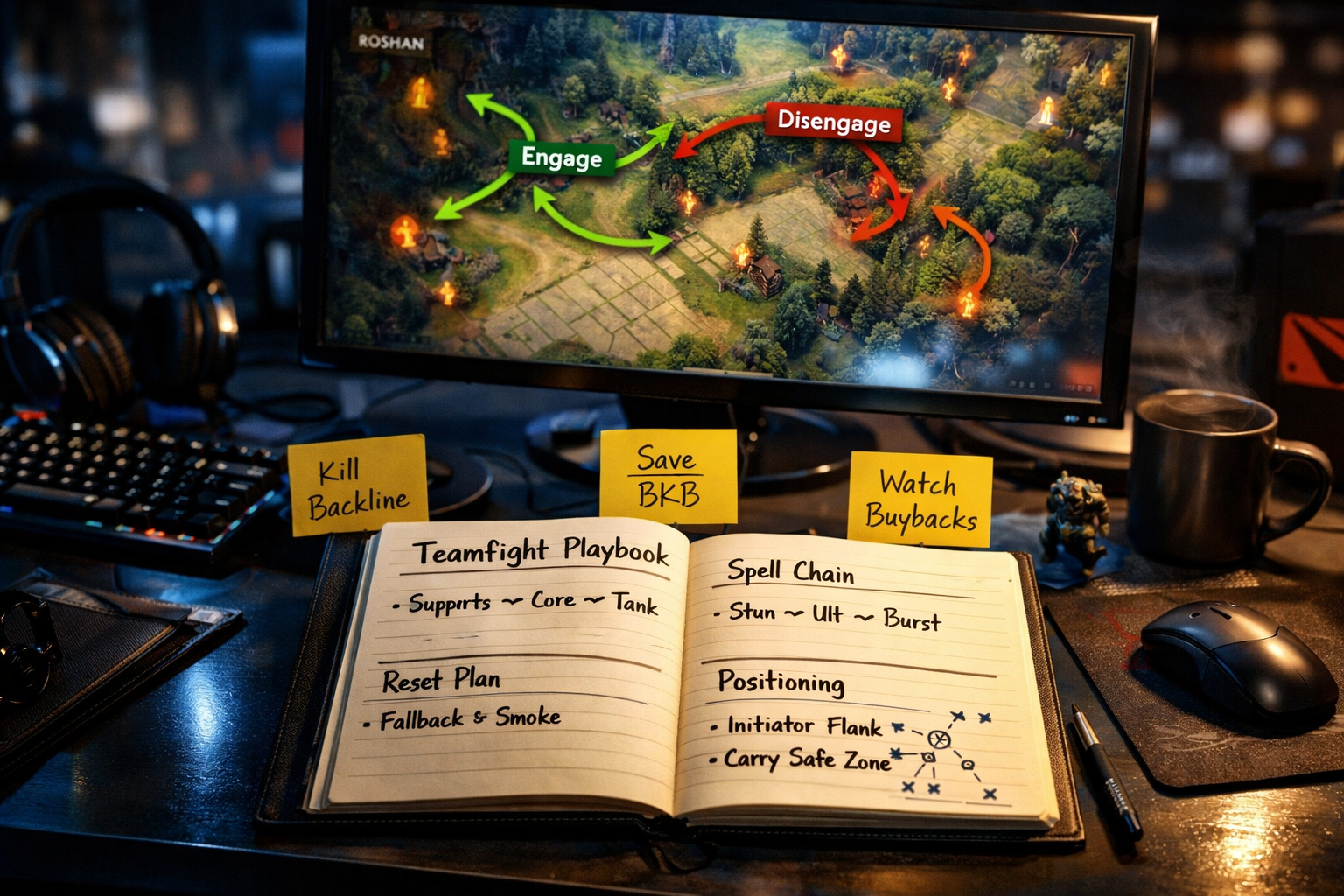
Initiators start engagements and create the first opportunity for damage.
Examples include:
- Tidehunter
- Magnus
- Enigma
- Centaur Warrunner
- Sand King
Their goal is simple: force the enemy team into a disadvantageous fight.
Damage Dealers
Damage cores convert crowd control into kills.
Typical damage roles:
- Carry heroes (Phantom Assassin, Terrorblade)
- Mid heroes (Storm Spirit, Queen of Pain)
- Some offlaners (Dawnbreaker, Mars)
Control Supports
Supports often provide disables, saves, or utility spells that shape the flow of engagements.
Examples:
- Shadow Shaman
- Lion
- Disruptor
- Oracle
Sustain and Save Heroes
Some heroes specialize in protecting teammates or extending fights.
- Dazzle
- Winter Wyvern
- Omniknight
- Abaddon
Recognizing these roles allows you to predict how fights will unfold.
3. Target Priority Fundamentals
Target priority refers to deciding which hero should be attacked first during a fight. Many players make the mistake of focusing whoever appears closest.
Instead, good target priority answers one simple question:
Which enemy hero prevents us from winning this fight?
Common Target Priority Rules
- Disable the enemy initiator
- Eliminate fragile damage dealers
- Force saves early
- Ignore tanky heroes unless necessary
For example, killing a Crystal Maiden early might remove massive crowd control and mana sustain from the enemy team.
Meanwhile attacking a tanky Bristleback may waste valuable damage and cooldowns.
High-Impact Heroes
Some heroes demand immediate attention because of fight-winning abilities:
- Enigma (Black Hole)
- Disruptor (Static Storm)
- Magnus (Reverse Polarity)
- Earthshaker (Echo Slam)
Even if these heroes are tanky, preventing their abilities can win fights.
4. Identifying the Real Win Condition
Target priority changes depending on the game state. A hero that matters early may become irrelevant later.
Early Game Teamfights
Early fights often revolve around mobility and burst damage.
High-priority targets typically include:
- Squishy supports
- Low-HP mid heroes
- Out-of-position cores
Mid Game Fights
In the mid game, teamfight ultimates and item timings become more important.
Examples:
- BKB timing on carries
- Blink initiations
- First Roshan fights
Late Game Fights
Late-game engagements often revolve around one or two hyper-scaling cores.
At this stage the fight may revolve entirely around controlling a single hero such as:
- Terrorblade
- Medusa
- Spectre
- Faceless Void
5. Spell Layering Explained
Spell layering is the coordination of abilities so they complement each other rather than overlap inefficiently.
Many ranked teams lose fights because multiple stuns are used at the same time instead of chaining them.
Bad Spell Usage
- Two stuns used simultaneously
- Damage spells overlapping during immunity
- Ultimates wasted on already dying targets
Good Spell Layering
- Stun → Silence → Root sequence
- Initiation → Follow-up damage
- Save abilities timed after burst
Proper layering can double the effective duration of crowd control.
6. Crowd Control Chains and Damage Windows
Teamfights often revolve around creating “damage windows” where enemies cannot react.
A typical chain might look like this:
- Blink initiation stun
- Follow-up disable
- Damage burst from cores
- Secondary control if enemy survives
Professional teams carefully stagger abilities so the enemy remains disabled for several seconds.
This technique is often visible in professional matches broadcast on platforms like Twitch.
7. Positioning and Fight Geometry
Teamfights are heavily influenced by positioning. Even the strongest abilities can fail if heroes are spread out.
Good Positioning Principles
- Supports stay behind cores
- Initiators remain hidden until engagement
- Damage dealers maintain safe distance
Fight Geometry
The shape of the battlefield matters. Fighting in narrow areas amplifies area-of-effect abilities.
Examples:
- Roshan pit fights
- Ramp choke points
- High ground defenses
Initiators often look for these terrain advantages.
8. Resetting and Re-Engaging
One of the most overlooked teamfight skills is resetting.
Many players assume fights must be fully committed once they start. In reality, strong teams frequently disengage and re-engage.
Why Resetting Matters
- Cooldowns recover
- Enemy positioning breaks
- Regeneration and healing occur
A partial retreat can force enemies to chase into bad positions.
Heroes That Excel at Resetting
- Puck
- Storm Spirit
- Weaver
- Queen of Pain
These heroes can re-enter fights multiple times.
9. Common Teamfight Mistakes
Even experienced players repeat several predictable mistakes during chaotic engagements.
Overcommitting
Players sometimes chase a single hero while ignoring the rest of the enemy team.
Spell Panic
Supports may instantly cast every ability without coordination.
Ignoring Buybacks
Late-game fights can completely change if enemy heroes buy back and rejoin the fight.
Poor Vision
Engaging without proper wards or map information often leads to disastrous fights.
Vision control remains one of the most important macro mechanics in Dota.
10. Advanced Teamfight Concepts
Cooldown Tracking
Knowing when major ultimates are unavailable creates huge opportunities.
Examples include:
- Black Hole
- Chronosphere
- Ravage
- Static Storm
Item Timing Windows
Items dramatically influence teamfights.
- BKB
- Refresher Orb
- Aghanim’s Scepter
- Scythe of Vyse
Coordinating fights around these timings is essential.
11. Teamfight Communication and Shotcalling
Effective communication greatly improves engagement success.
Important Callouts
- Target focus
- Ultimate cooldowns
- Buyback status
- Retreat signals
Even simple calls like “focus the backline” can dramatically improve coordination.
12. Practicing Teamfights in Ranked Games
Improving teamfight skills requires intentional practice.
Focus on one concept per session:
- Target priority
- Ability timing
- Positioning
Recording and reviewing your matches also accelerates improvement.
Players who want structured improvement often use coaching or analytical services to refine these mechanics. If you’re looking to climb faster in ranked Dota, consider checking professional help options on Boosteria’s Dota 2 boosting services.
13. How to Review Teamfights and Improve
One of the fastest ways to improve is by reviewing your own matches.
Ask these questions:
- Did we attack the correct target?
- Were abilities layered correctly?
- Did we overcommit?
- Could we reset earlier?
Even small improvements compound over time.
14. Final Thoughts
Teamfights are the heart of Dota 2. While hero mechanics and farm efficiency matter, mastering the structure of engagements separates average players from consistent climbers.
Remember these three core principles:
- Choose the correct target
- Layer abilities effectively
- Reset fights when necessary
With practice and awareness, these fundamentals will dramatically improve your ranked results.
Whether you’re aiming for your next medal or trying to refine your competitive play, mastering teamfights remains one of the most reliable ways to gain MMR.