



Dota 2 Itemization Fundamentals: Core vs Situational Builds
Dota 2 Itemization Fundamentals 2026: Core vs Situational Builds and Gold Management for New Players
Itemization is one of the fastest ways to improve in Dota 2—because the “right” item often matters more than perfect mechanics. New players usually lose games not because they clicked poorly, but because they bought items that didn’t solve the real problem in the match. This guide teaches a timeless framework: how to build a core that enables your hero, when to pivot into situational answers, and how to manage gold so you hit the right timings without throwing your lead.
The goal isn’t to memorize builds that become outdated. The goal is to understand the logic behind builds so you can adapt to any patch, any lineup, and any rank. We’ll use role-based principles (carry/mid/offlane/support), repeatable checklists, and decision rules you can apply immediately.
If you want a faster path to improvement, structured guidance can accelerate your progress—especially with item decisions and timing discipline. You can also check Boosteria’s Dota 2 options here: https://boosteria.org/dota2-boosting/prices.
1) Core vs Situational: The One-Sentence Difference
Core items are the items your hero (or role) reliably needs to function in a normal game. They enable your main job: farming faster, fighting earlier, catching targets, surviving while dealing damage, or providing team utility.
Situational items are the items you buy because this specific match has a specific problem: a key disable, a burst combo, an invisible threat, a single “must-answer” hero, or a teamfight pattern you must survive.
Simple rule: Core items make you “online.” Situational items keep you online against what the enemy is actually doing.
A common mistake is flipping this: new players buy “cool” situational items too early and never become strong enough to matter, or they tunnel on a standard core build and ignore the one defensive item that would stop the enemy from deleting them. The best itemization is a blend: hit your baseline power, then adapt with targeted answers.
2) The Itemization Mindset: Buy Problems, Not Items
Before you open the shop, ask: What problem am I solving in the next 5–10 minutes? Dota 2 itemization becomes much easier when you translate “items” into “jobs.”
Common “problems” and the item jobs that solve them
- I die to magical burst: magic resistance, HP, dispel, spell block, positioning tools, save items.
- I die to physical burst: armor, HP, evasion, damage block, kite tools.
- I can’t start fights / reach targets: mobility, blink-type initiation, slows, catch, vision control.
- I can’t stay on targets: dispel for slows, movement speed, stickiness (silence/slow), gap-close.
- I don’t deal enough damage: efficient damage per gold, crit/attack speed, minus armor, spell amplification.
- I don’t farm fast enough: wave clear, sustain, attack speed, cleave/splash, mana solutions.
- Enemy has invis or slippery heroes: detection, true sight, instant disables, silence, vision tools.
- Team loses long fights: sustain auras, healing reduction, dispels, saves, cooldown efficiency.
Notice how none of these problems say “buy Item X.” They describe why you buy something. Once you think in “jobs,” you can choose the right item for your hero, role, and timing.
3) Timings: Why “When” Matters as Much as “What”
In Dota 2, item value isn’t fixed—it changes with time. A farming item bought early can pay itself back. The same item bought late might be useless because fights decide the game. A defensive item bought one minute too late can mean you die, lose an objective, and never recover.
Three timing windows every new player should understand
- Lane stability window (0–8 minutes): Items that keep you in lane, secure last hits, and avoid feeding.
- First power spike (8–18 minutes): Your first “I can fight” moment—often a core item + boots upgrade.
- Objective / map control window (18–35 minutes): Items that convert kills into towers, Roshan, and control.
The “timing test” for any item
Ask these questions:
- Does this item help me win the next fight? If a fight is coming, fight items matter more than greed.
- Does this item help me take objectives after a fight? Some damage is meaningless if you can’t hit buildings.
- Does this item protect my lead? If you’re ahead, survival and buyback discipline become stronger than greed.
- Will the enemy’s next item counter me? Anticipate key enemy spikes and buy answers before it’s too late.
Timeless principle: If your team wants to fight now, buy “now” items. If your team wants to delay, buy “later” items.
4) Gold Management Basics: Reliable, Unreliable, and Spend Discipline
Gold management is itemization’s hidden half. Two players can buy the same items, but one hits them earlier and wins. Your goal as a new player is not to “farm forever”—it’s to spend gold at the right times so you gain power when it matters.
Reliable vs Unreliable Gold
Dota 2 uses gold rules that reward consistency and punish risky hoarding. Conceptually:
- Reliable gold is harder for enemies to take away (from periodic income, objectives, and safe sources).
- Unreliable gold is easier to lose when you die (especially from kills and riskier gains).
You don’t need to memorize exact numbers to improve. The actionable takeaway is: hoarding gold while dying is the fastest way to lose. If you’re vulnerable, turn gold into power earlier.
Spend Discipline: The “Inventory Strength” Rule
New players often sit on 1500–3000 gold “saving for one big item,” then die twice and never complete it. Use this rule:
Inventory Strength Rule: If you’re likely to be forced into fights, spend gold to make your current inventory stronger right now—even if it delays a bigger item.
Gold Priorities for New Players
- Survive your lane (regen, small stats, wand-type value).
- Move faster (boots timing is a huge power jump for almost every hero).
- Enable your hero’s job (first core item that makes you “online”).
- Stop dying to the match’s main threat (first situational defensive answer).
- Convert advantage (items that help take objectives and win fights cleanly).
Buyback Discipline (New Player Friendly)
Buyback is one of the most misunderstood systems. Here’s a simple approach that works at any rank:
- If you’re playing a core and the next fight could decide a major objective (tower high ground, Roshan, or a decisive teamfight), keep buyback once you’re in the midgame.
- If you’re far behind, buyback can be a trap—spending everything can prevent you from ever becoming useful again. Use it when it changes the outcome of an objective, not “just because.”
- If you’re a support, buyback value often comes from saving cores and defending structures. But don’t keep buyback so early that you never finish key team items.
The timeless buyback question is: Will buying back immediately change the next objective or prevent a game-losing chain? If yes, it’s worth considering. If not, keep gold for your next power spike.
5) Starting Items: Building a Lane Plan
Starting items should reflect your lane goal: secure last hits, trade efficiently, or keep your core alive. A “default” start is fine for learning, but improving means you start reacting to lane matchups.
Starting item goals (by role)
- Carry: last-hit stability + enough sustain to stay until first small item.
- Mid: mana/HP to contest waves + last-hit tools + quick bottle timing if appropriate.
- Offlane: survive harassment + threaten trades + prep for early pressure items.
- Support: regen to trade + early vision/detection when needed + items that enable pulls/harass.
New-player checklist for lane starts
- If you expect constant trading: prioritize more regen and cheap stats over “dream” greed.
- If you expect to be bullied: buy enough regen to avoid the “walk of shame” to base.
- If your lane wants to fight early: early stats and stick/wand value becomes higher.
- If your lane is stable: you can lean slightly more toward efficient farming components.
A practical tip: if you’re new, err on the side of too much regen rather than too little. Most beginner lanes are lost because players refuse to buy more regen and then get forced out.
6) Early Game Shopping: Boots, Sustain, and Surviving Pressure
Early game itemization is about staying productive. If you can’t farm, you can’t hit timings. If you can’t survive, you can’t show to fights. Early items are less about “damage” and more about permission to play the game.
Boots timing (why it matters)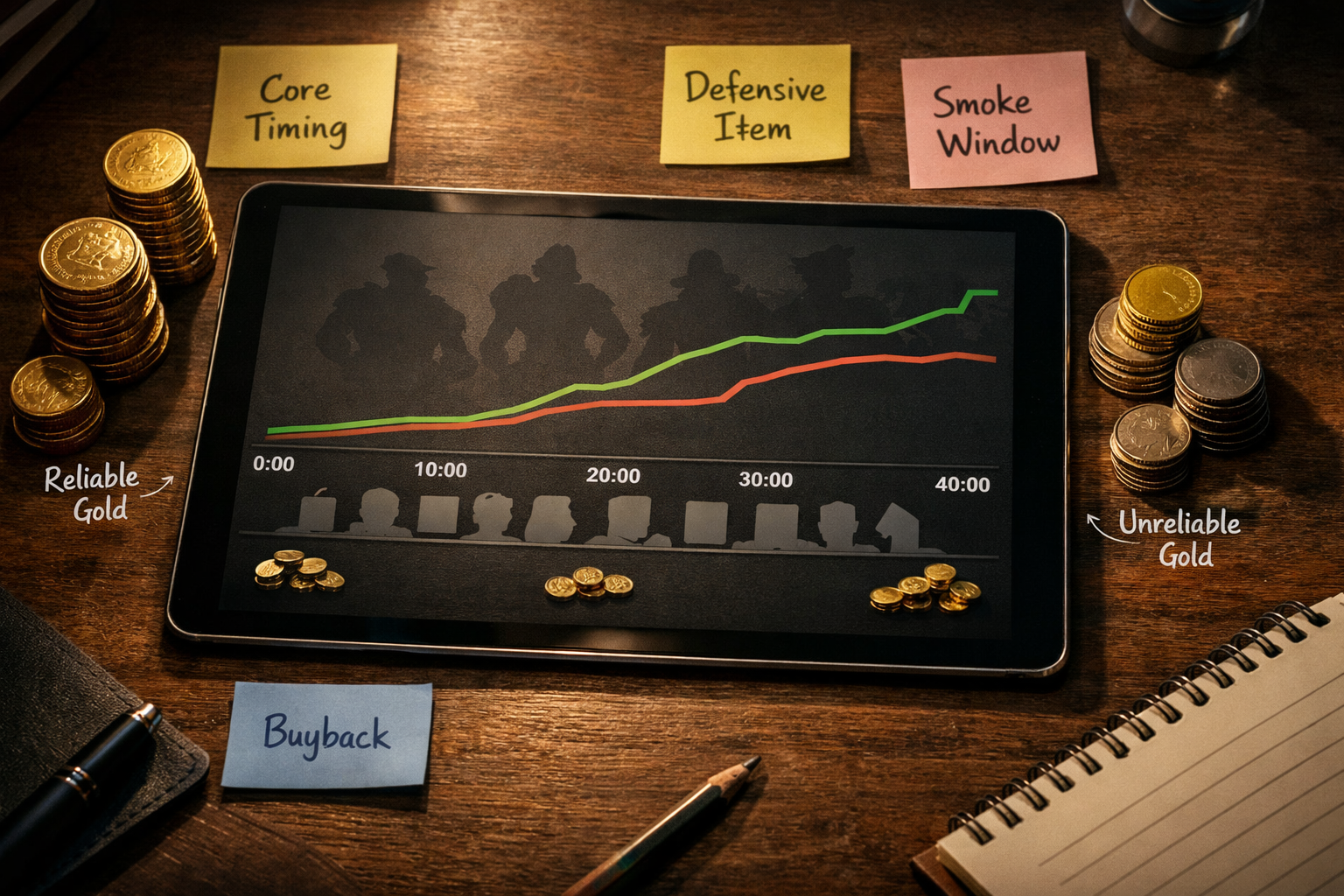
Movement speed affects everything: trading, escaping, chasing, rotating, and farming patterns. For most heroes, boots (and often an upgrade later) are among the best gold-to-impact purchases you can make.
- Boots earlier when: you’re under kill threat, you need to dodge spells, or your lane is dynamic with lots of movement.
- Boots slightly later when: the lane is static, you’re free-farming, and you need a small farming component first.
“Small” items that win lanes
New players often skip small items because they “delay” a bigger purchase. In reality, these items often create the gold that buys your core. Examples of small-item jobs:
- Wand-type value: high impact in spell-heavy lanes; turns burst into survivability.
- Armor / sustain components: keeps you on the map longer; reduces downtime.
- Mana solutions: more spells = more last hits + more lane control.
Early detection discipline
If invis heroes exist, detection is not optional. The “timeless” tip: buy detection before you need it, not after you die to invis. Supports should plan for it; cores should still carry detection when the game demands it.
7) Midgame Core: Damage, Farming Speed, and Fight Readiness
Your midgame core is where “core vs situational” becomes real. Most heroes want a first major item that does one of these:
- Accelerate farm (so you reach later items faster).
- Enable initiation/catch (so you can start fights on your terms).
- Amplify fighting power (so your presence matters immediately).
- Fix resource problems (mana/sustain) so you can stay on map and chain actions.
The “Core Triangle” framework
For most cores, your first 1–2 big items should cover at least two points in this triangle:
- Farm (clear waves / camps faster)
- Fight (deal meaningful damage or provide control)
- Live (survive long enough to use your damage/control)
If your build covers only one point, you’ll feel useless in two-thirds of game states. Example pattern: a pure farming item with no survivability in a high-pressure game—leads to dying and never scaling.
When to buy farming acceleration vs fighting power
Use these rules:
- Buy farming acceleration when your team can delay fights, your lanes aren’t collapsing, and you can farm safely.
- Buy earlier fighting power when towers are threatened, the enemy is grouping, or your hero is needed to defend or take objectives.
- Buy survivability earlier when you die in one disable chain, or when your team can’t protect you yet.
One-liner: If you can’t show to waves without dying, you don’t get to buy greedy items.
8) Situational Defense: How to Stop Dying First
Most losses in mid ranks come from one repeated pattern: a core dies at the start of every fight. If that’s you, stop thinking “I need more damage,” and start thinking “I need one item that lets me play.”
Defensive “jobs” and common solutions
- Dispel: remove silences, slows, roots, certain debuffs so you can fight.
- Spell immunity / mitigation: reduce the impact of disables and magic burst.
- Spell block: prevent a single targeted initiation from starting the chain.
- Positioning tools: escape, reposition, or force the enemy to overcommit.
- Save items (team): protect a core from focus and reset fights.
How to decide if you need defense now
Ask:
- Do I die before casting my key spells? If yes, defense is urgent.
- Is one enemy hero consistently killing me? Buy the item that specifically counters that hero’s kill method.
- Do we lose fights because we can’t reset? Team saves and dispels become higher priority.
Support defensive mindset (pos 4/5)
Supports often “feel poor,” but a single defensive utility item can win fights by saving a core or breaking the enemy’s burst sequence. Don’t chase luxury. Buy the item that changes the next fight’s story: a save, a dispel, a reposition tool, or an aura that nullifies their damage type.
9) Situational Offense: Converting Advantage into Objectives
Offense is also situational. Your “damage item” should match how you actually win: do you need to hit buildings, kill one key hero, or chain-catch slippery targets?
Offensive “jobs”
- Catch and lock: prevent escape and force fights on your terms.
- Break defensive patterns: deal with saves, tanky frontlines, or illusions.
- Objective damage: end the game, not just win fights.
New-player rule: “Objective readiness”
If your team wins a fight, ask: What can we take? Some items increase your ability to convert: more building damage, more sustain to stay on map, more push speed, or faster Roshan control. If you constantly win fights but don’t take objectives, consider whether your itemization supports ending the game.
10) Role Frameworks: Carry, Mid, Offlane, Support
Your role shapes your item priorities. The same item can be correct on one role and grief on another—because roles have different “jobs.” Below are timeless itemization frameworks that hold up even when specific items change.
Carry (Position 1): Core timing + survivability to deal damage
Carries usually need:
- A farming enabler (so you reach later spikes on time).
- A fighting permission item (so you can show to fights without instantly dying).
- A scaling damage item (so you actually win fights and hit objectives).
Carry shopping checklist:
- Can I farm safely for the next 3 minutes? If no, buy survival/mobility before greed.
- Do we need to fight now? If yes, buy a “fight now” component even if it delays perfect DPS.
- Is the enemy’s control chain stopping me? Buy dispel/mitigation earlier than you want.
- Do I have a plan for high ground fights? Consider survivability + buyback discipline.
Mid (Position 2): Tempo control and flexible pivots
Mid heroes often decide the pace: they rotate, start fights, or force objectives. Your items should reflect whether you are:
- Tempo (fight early, take map control), or
- Scaling (farm and become a second carry), or
- Utility (initiation, control, and saves).
Mid itemization rule: buy the item that lets you take the enemy’s safe area away. That’s often mobility/catch or a strong first spike that enables kills and towers.
Offlane (Position 3): Frontline, initiation, and “problem-solving”
Offlaners usually have one of two identities:
- Initiator: starts fights, forces reactions, creates chaos.
- Aura / teamfight core: becomes hard to kill and makes the team stronger around them.
Offlane checklist:
- Can I start fights reliably? If not, initiation/mobility is often your best first big purchase.
- What damage type is killing my team? Aura mitigation can win games.
- Do we need a dispel or save? Utility items can be offlane-friendly and game-winning.
Support (Position 4/5): Enable cores and control the fight’s shape
Supports are not “itemless.” They buy fewer items, but each one can have massive impact. Think in “fight shape”:
- Save: prevent burst, reset fights, protect your win condition core.
- Control: slow, disable, reposition enemies.
- Aura / sustain: make the whole team harder to kill and able to keep fighting.
- Vision tools: turn fights into favorable engagements.
Support spending rule: Buy the cheapest item that solves the biggest problem. You don’t need luxury. You need impact.
11) Reading the Draft: Identify Threats and Win Conditions
Great itemization starts before creeps meet. Draft reading is a skill you can learn with a simple process.
Step 1: Identify the enemy’s win condition
- Pickoff and snowball: they want to kill isolated heroes repeatedly.
- 5v5 teamfight: they want to group, take objectives, and win around cooldowns.
- Split push: they want to dodge fights and pressure lanes.
- Late-game scaling: they want to delay and outscale.
Step 2: Identify the main threat types
- Disable chains: multiple stuns/silences that prevent you from playing.
- Magical burst: you die during a single spell combo.
- Physical burst: you die to crits or rapid right-click focus.
- Summons/illusions: they overwhelm lanes and fights with units.
- Invisibility or mobility: slippery heroes that require catch and vision.
Step 3: Build a simple answer plan
For each threat, pick one answer item category:
- Disable chains → dispel/mitigation/position tools.
- Burst → HP + resist + save synergy.
- Illusions → wave clear + sustained damage tools.
- Mobility → catch, silence, instant disable, vision.
This is timeless because the categories don’t change—even if item names or stats shift.
12) Common Itemization Mistakes New Players Make
Mistake 1: Building a “cookie-cutter” core with no answers
Standard builds are a starting point, not a script. If you die the same way twice, your build must change. Buying the “usual” damage item while getting chain-stunned is a classic loss pattern.
Mistake 2: Hoarding gold while the map collapses
If towers are falling and fights are forced, delaying power for a perfect purchase is often wrong. Small components that keep you alive can be the difference between defending and losing the map.
Mistake 3: Fighting without a timing item
Many players show to fights with 2k gold unspent and incomplete items. If you are about to fight, spend gold to maximize your current strength.
Mistake 4: Over-buying damage on supports
Support damage is rarely the bottleneck. Saves, control, and vision usually decide fights. Ask: “What keeps my core alive?” before asking: “How do I deal more damage?”
Mistake 5: Ignoring objectives in item planning
Some lineups need sustain to stay on the map. Some need building damage to end. Some need catch to force fights. If you win fights but don’t take towers, your itemization might be missing objective power.
13) Practice: How to Review Your Items and Fix Patterns
You can improve itemization quickly with structured review. You don’t need to watch full replays; you need to check key moments.
Three-minute item review method
- Open the match and note your item timings: boots time, first big item time, first defensive answer time.
- Find your first two deaths: ask what item would have prevented the death or allowed you to contribute.
- Check your biggest unspent gold moments: did you die with large gold? Were you saving for something too long?
For self-analysis tools, OpenDota can be useful for timelines and quick match breakdowns: https://www.opendota.com/. Liquipedia is also great for general mechanics and competitive context: https://liquipedia.net/dota2/.
Pattern fixes (simple and effective)
- If you die to burst: buy one survivability piece earlier next game. Don’t “test” again.
- If you never reach fights on time: prioritize boots and mobility earlier.
- If you’re strong but can’t end: buy items that help take objectives or win high ground fights safely.
- If your team loses long fights: consider sustain auras, dispels, and saves over more DPS.
14) Quick Cheat Sheet: Decision Rules You Can Screenshot
Core vs Situational
- Core: makes your hero functional and online.
- Situational: answers the match’s main threat so you can stay online.
Fight vs Farm (the 10-second test)
- If towers are threatened or enemy is grouping: buy fight/survival now.
- If lanes are stable and map is safe: buy farming acceleration.
Stop-dying-first checklist
- Am I chain-disabled? → prioritize dispel/mitigation/position tool.
- Am I one-shot? → prioritize HP/resist or a save plan.
- Am I being picked off? → prioritize mobility, vision, and safer map patterns.
Gold discipline rules
- If you’re about to fight: spend gold to maximize current strength.
- If you died twice with lots of unspent gold: stop saving; buy components earlier.
- When ahead: protect the lead with survivability and buyback discipline.
- When behind: buy cheap impact that changes fights, not luxury that never completes.
15) Trusted Resources
These are useful references for learning and verifying mechanics:
- Official Dota 2 site (general game info, updates, and announcements)
- Liquipedia Dota 2 (competitive context, hero and item references)
- OpenDota (match analysis and item timing review)
- Dota 2 Wiki (mechanics reference; always cross-check if something seems patch-specific)
Conclusion: Build Logic Beats Build Lists
To master Dota 2 itemization as a new player, focus on three timeless skills:
- Core first: get online so your hero can do its job.
- Adapt second: buy situational answers to the match’s main threats.
- Spend smart: manage gold and timing so your power shows up when the game is decided.
If you consistently apply the frameworks in this guide—problem-first thinking, timing discipline, and role-based priorities—you’ll quickly feel the difference: fewer useless deaths, cleaner fights, better map control, and more games where your items “make sense” at every stage.
And if you want extra help accelerating your progress in Dota 2, you can explore Boosteria here: https://boosteria.org/dota2-boosting/prices.