



How to Improve Reaction Time and Aim Consistency in CS2 2026
How to Improve Reaction Time and Aim Consistency in CS2 2026
Every Counter-Strike player wants the same feeling: you see an opponent, your crosshair is already close, your hand stays calm, and the shot lands without hesitation. In CS2, that moment is not only about “fast reflexes.” It is the result of preparation, positioning, clean mechanics, consistent settings, visual discipline, and repeatable habits. Players often say they want better reaction time, but what they really need is a system that lets them react earlier, aim with less wasted movement, and repeat that process across an entire session instead of only during a few hot rounds.
This guide breaks that system down in a practical and timeless way. Instead of chasing gimmicks, we will focus on fundamentals that stay useful regardless of map pool changes, meta shifts, or small balance updates. If you improve how you see fights, prepare for fights, and execute simple mechanics under pressure, your aim becomes more stable and your reactions feel faster even if your raw biological reaction speed barely changes.
That distinction matters. Many players waste months searching for a magic setting, copying a professional’s sensitivity, or grinding random aim drills without structure. Then they wonder why their flicks look flashy in training but disappear in real matches. CS2 rewards repeatable fundamentals more than random hero plays. Strong crosshair placement, clean movement, solid hardware habits, low-landom mental noise, and a sensible practice routine do more for real match performance than almost anything else.
If you are serious about improving, think of reaction time and aim consistency as connected parts of the same skill tree. Better anticipation reduces the amount of raw reaction needed. Better crosshair placement reduces the amount of mouse travel required. Better posture improves control. Better settings reduce friction. Better routines reduce inconsistency between sessions. Put together, these changes make you feel faster, more stable, and more confident in every duel.
You can also explore official CS2 resources on the Counter-Strike 2 website, learn more about display clarity and latency on Blur Busters, and review modern latency tools such as NVIDIA Reflex. For simple reaction testing outside the game, many players use Human Benchmark. Later in the guide, we will explain how to use these kinds of resources properly without letting them distract from actual in-game progress.
Table of Contents
- What Reaction Time and Aim Consistency Really Mean in CS2
- Build the Foundation First: Hardware, FPS, and Settings
- How to Choose a Sensitivity You Can Trust
- Posture, Grip, Mouse Control, and Desk Ergonomics
- Why Faster Players Usually See the Fight Earlier
- Crosshair Placement: The Biggest Shortcut to Better Aim
- Counter-Strafing, Stopping, and Taking Accurate Shots
- Tapping, Bursting, Spraying, and Recoil Discipline
- Peeking Technique and Angle Management
- A Smart Aim Training Structure That Transfers to Matches
- Daily Warm-Up and Weekly Improvement Routine
- How to Review Your Misses and Fix the Real Problem
- Confidence, Tilt Control, and Match-Day Consistency
- Sleep, Recovery, and Physical Habits That Affect Reaction Speed
- The Most Common Mistakes Slowing Your Aim Progress
- A 30-Day Plan to Improve Reaction Time and Aim Consistency
- FAQ
- Final Thoughts
What Reaction Time and Aim Consistency Really Mean in CS2
Reaction time in CS2 is not just the delay between seeing a player and clicking your mouse. In real matches, it includes at least four layers: visual recognition, decision making, movement adjustment, and shot execution. If your crosshair starts in a poor position, or if your character is still moving when you fire, your “reaction” looks slow even when your brain spotted the target quickly. That is why two players with similar raw reflexes can have very different duel success rates.
Aim consistency is even more important. Many players can hit impressive shots during a warm-up. Fewer players can keep the same quality across round 3, round 12, overtime, and the final duel of a tense retake. Consistency means your mechanics remain reliable when you are tired, nervous, or slightly off. It means you can still track heads, correct micro-errors, and control recoil without overthinking. The goal is not to become a highlight machine. The goal is to become dependable.
When players say, “I need faster reactions,” they are often dealing with one of these hidden problems instead:
- Poor crosshair placement that forces a large flick
- Bad anticipation of common angles
- Overflicking because of sensitivity or tension
- Moving while shooting
- Taking fights with bad peeks or bad timing
- Playing tired, tilted, or mentally overloaded
- Using inconsistent settings and routines
So the correct question is not only “How do I react faster?” It is “How do I make every fight easier to process and easier to execute?” That is the lens you should use for the rest of this guide.
In CS2, every duel starts before the enemy appears on your screen. It starts with where you stand, where you aim, when you peek, how you clear, what you expect, and how stable your body feels at the desk. The best aimers are not just fast. They are prepared. They have reduced uncertainty before the fight begins. That is why they often look calm rather than frantic. Their mouse does less because their game sense and setup already did part of the work.
Build the Foundation First: Hardware, FPS, and Settings
No settings menu can replace skill, but poor technical conditions can absolutely hide skill. If your game feels muddy, delayed, unstable, or visually inconsistent, your aim quality will drop. Before you start grinding drills, make sure your environment allows clean input and readable visuals.
Start with performance. Stable frame rate matters more than chasing the prettiest image. In a tactical shooter, visual clarity and input responsiveness are more valuable than decorative effects. Lower input delay makes the game feel more direct, and clear frame delivery helps your timing. Your exact settings will depend on your PC, but the principle is universal: prioritize smoothness, consistency, and readability.
Monitor quality also matters. Higher refresh rates can improve motion clarity and reduce the perceived delay between action and display. If you have access to a good high-refresh monitor, use it properly. Make sure the refresh rate is actually enabled in your system and game environment. Resources such as Blur Busters are useful if you want to understand motion clarity, display persistence, and why the game may feel sharper at higher refresh rates.
Latency reduction features can help too. If your system supports tools like NVIDIA Reflex, they may reduce end-to-end delay, especially in a competitive setup. This will not turn weak fundamentals into strong ones, but it can remove a layer of friction from your aim and timing.
Your mouse and mousepad should feel predictable rather than exotic. You do not need a trendy shape or a giant list of features. You need a mouse sensor that tracks reliably, a shape that lets you control micro-adjustments, and a surface that feels familiar. Consistency is the keyword. The more variables you change, the harder it becomes to build repeatable motor patterns.
Your in-game settings should also avoid chaos. Keep your crosshair readable. Use audio settings that let you identify cues clearly. Remove distractions where possible. If your screen is cluttered or your crosshair disappears into certain backgrounds, your visual processing gets worse. That costs time. A clean setup is not only aesthetic. It protects reaction quality.
Finally, stop changing everything every few days. One of the biggest hidden killers of aim consistency is constant experimentation. Players switch sensitivity, crosshair, resolution, mousepad, and monitor settings so often that they never adapt deeply to any of them. Test intelligently, then commit for long enough to judge results honestly.
How to Choose a Sensitivity You Can Trust
Sensitivity is one of the most misunderstood topics in CS2. Many players believe there is one “best” number. There is not. The correct sensitivity is the one that lets you turn comfortably, track your intended line, stop on targets without panic, and perform small corrections without constant overflicking. A good sensitivity should disappear from your conscious thought. You should feel like the mouse goes exactly where you expect.
A useful way to think about sensitivity is through balance. Too high, and your crosshair becomes unstable under pressure. You overshoot heads, especially during micro-corrections and spray transfers. Too low, and you may struggle with rapid multi-angle clears or large turns. The right middle ground depends on your grip, arm usage, desk space, and personal comfort.
Many competitive players talk about eDPI, which is simply your DPI multiplied by your in-game sensitivity. That is helpful for comparison, but comparison should not become imitation. A professional player’s settings are tied to their grip, posture, years of adaptation, and personal style. Copying them blindly often creates more problems than it solves.
When testing sensitivity, use a structured checklist instead of judging by one good or bad session:
- Can you clear common head angles smoothly without shaking?
- Can you stop your crosshair on a stationary target without drifting past it?
- Can you make small left-right corrections calmly?
- Can you do a controlled 180-degree turn when needed?
- Do your sprays stay manageable, or do they become frantic?
- After 30 to 60 minutes, does the sensitivity still feel stable?
If the answer is mostly yes, you are in a good zone. If not, adjust slightly rather than making dramatic jumps. Small adjustments are easier to evaluate because they preserve most of your existing feel. Huge changes reset too much and make every problem harder to interpret.
Once you settle on a sensitivity, stay with it long enough to build trust. Mechanical consistency grows when your brain no longer questions every movement. Frequent sensitivity changes keep you in a permanent adaptation phase. You may still hit occasional flashy shots, but your baseline becomes unreliable. For ranked improvement, reliable baseline performance is far more valuable.
Posture, Grip, Mouse Control, and Desk Ergonomics
Players often search for advanced aim secrets while ignoring the physical setup that controls every shot. Your posture, arm position, wrist freedom, and general tension level directly affect how precise and repeatable your aim feels. A bad sitting position creates subtle instability. Over time, that instability turns into inconsistency.
Your goal is to sit in a way that feels natural, stable, and sustainable. You should not feel twisted, cramped, or elevated. Your shoulders should stay relaxed. Your forearm should have room to move. Your wrist should not feel jammed into the desk edge. Your mouse space should be sufficient for your sensitivity. If you constantly hit keyboard edges, objects, or the end of the pad, your confidence in fights will drop even if you do not always notice the cause.
Grip style matters, but comfort matters more than labels. Palm, claw, fingertip, or a hybrid version can all work if they allow controlled motion. What matters most is whether your grip gives you stable micro-corrections without excessive finger tension. If your hand is constantly clenched, your aim will look jerky in stressful moments. Relaxed control beats rigid force.
Try to notice when you grip harder than necessary. Many players do this only during duels, which means their hand changes behavior exactly when precision matters most. A calm pre-round posture and steady breathing can reduce this effect. This is one reason elite aim often looks smooth rather than aggressive. The movement is efficient, not desperate.
Physical fatigue matters too. Short breaks between blocks of training can preserve quality better than endless grinding. Stretching your hands, opening and closing your fingers, rolling your shoulders, and resetting your posture can keep your sessions cleaner. If you spend long hours at a desk, general ergonomic guidance from sources such as the CDC/NIOSH ergonomics resources can be genuinely useful. Better desk habits support better aim.
Do not underestimate the psychological value of physical comfort either. When your body feels settled, your brain has more room for information processing. That means better recognition, better timing, and less panic in sudden fights. Good ergonomics are not a luxury. They are part of competitive performance.
Why Faster Players Usually See the Fight Earlier
One of the best ways to improve “reaction time” is to stop relying on raw surprise reactions. Great players are often not superhuman reactors. They are better predictors. They see the fight earlier because they understand where danger is likely to appear, how opponents usually move, and when certain peeks make sense.
Anticipation is the invisible skill behind many clean aim clips. If you expect a player at head level on a common line, your brain is already primed for that possibility. Recognition becomes faster. Your mouse adjustment becomes smaller. The duel looks like a reaction-time win, but it was actually a preparation-time win.
To improve anticipation, study patterns instead of only studying shots. Ask questions like:
- What angles are most common in this area?
- At what timing do players usually appear here?
- Which off-angle punishes my current path?
- If I hear utility or footsteps, which follow-up peek is likely?
- What head level should my crosshair hold as I move?
When you learn a map properly, you reduce the number of surprise scenarios. That alone makes you feel faster. You are no longer “reacting to everything.” You are filtering possibilities and preparing for the most likely one. This improves both reaction speed and aim consistency because your crosshair starts closer to the correct answer.
Visual discipline matters too. Avoid staring lazily at the center of your screen without connecting that point to actual danger zones. Your eyes should actively scan around meaningful information: common swing angles, utility cues, likely movement paths, and positions that matter in the next second. Passive viewing creates slow reactions. Active reading creates early reactions.
This is also why strong players avoid unnecessary distractions. If you are mentally split between radar, team comms, your last miss, and a random fear of being flanked from three places at once, your recognition quality suffers. Good decision frameworks simplify the screen. You identify the next threat more quickly because your attention is organized.
Crosshair Placement: The Biggest Shortcut to Better Aim
If you want one habit that transforms both reaction time and aim consistency, it is crosshair placement. The less distance your mouse has to travel, the easier every duel becomes. Better placement turns impossible-looking fights into simple clicks. Bad placement turns simple fights into panic flicks.
Strong crosshair placement has three parts: head height, angle readiness, and path discipline. Head height means your crosshair naturally sits where an enemy head is most likely to appear. Angle readiness means your crosshair is positioned at the next threat point before it opens. Path discipline means your crosshair moves with purpose as you clear space, instead of floating randomly or dragging behind your movement.
Most players understand this idea in theory but fail to maintain it during live rounds. They hold good head height in practice, then drop their crosshair when rotating, climbing stairs, checking utility, or simply getting nervous. That inconsistency is expensive. In CS2, every unnecessary correction adds time and uncertainty.
A useful drill is to move through maps slowly while focusing only on crosshair pathing. Forget speed. Forget kills. Just practice keeping your aim glued to relevant head lines and likely peek points. Learn where head level changes due to elevation, stairs, boxes, and ramps. Study how your crosshair should travel when slicing angles one by one. This kind of dry practice feels less exciting than aim trainers, but it has huge match transfer.
Another important habit is not overclearing. Many players sweep too far past the angle and must pull back to the target when someone appears. This is usually caused by poor route pacing or lack of discipline. The crosshair should arrive where it needs to be and wait with control, not swing wildly because you are rushing the clear.
Crosshair placement also reduces emotional stress. When your crosshair is already near the correct spot, you do not need to “save” the duel with a miracle flick. That keeps your hand calmer. Calm hands create consistent aim. This is why strong placement improves both your mechanics and your confidence at the same time.
Counter-Strafing, Stopping, and Taking Accurate Shots
Aim consistency in CS2 does not come from mouse control alone. It comes from movement control too. If you are still in motion when you fire, your shot quality suffers. That means many apparent “aim problems” are really movement problems. Players blame their hand when the real issue is that they never became clean at stopping before shooting.
Counter-strafing is the skill of canceling your movement so you can become accurate faster. You do not need to treat it like a mystical mechanic. The goal is simple: move with intention, stop cleanly, then shoot from a stable state. If your movement and firing blend together sloppily, your first bullet consistency will always be lower than it should be.
This matters most in common rifle duels. A player who peeks, stops cleanly, and fires one accurate shot often beats the player with flashier raw aim but messy movement. The duel looks like an aim loss on the scoreboard, but mechanically it started as a stop-timing loss.
To train this, isolate the sequence:
- Strafe left or right
- Stop deliberately
- Confirm crosshair stability
- Fire a single accurate shot or short burst
Then increase speed gradually while preserving the quality of the sequence. If you rush too early, you teach yourself to miss faster rather than aim better. Quality reps matter more than chaotic reps.
You should also learn when not to overmove. Some players weave constantly because movement feels “active,” but they sabotage their own shot windows. Clean aiming often looks quieter than lower-level play. The player peeks with a purpose, stops on time, and executes. There is less wasted motion.
Once your stopping becomes reliable, your reaction time appears faster because your shot becomes available sooner. You are no longer fighting your own movement. That is another example of how mechanical clarity makes reaction speed look better.
Tapping, Bursting, Spraying, and Recoil Discipline
To become consistent in CS2, you need to know what kind of shot the situation actually requires. Not every duel should be solved with the same firing pattern. Tapping, bursting, and spraying each have their place. The mistake many players make is using one pattern emotionally rather than intentionally.
Tapping is strongest when the target is distant, your crosshair is well placed, and the duel is narrow enough that single-bullet precision gives you the best value. Bursting works well in many medium-range fights because it balances speed and control. Spraying becomes more valuable up close, during committed trades, or when you must secure a target quickly and follow through into another enemy.
The key to consistency is not only recoil memorization. It is recoil discipline. That means recognizing when your current spray is no longer worth trusting, resetting when needed, and not dragging mouse patterns longer than the duel demands. Many players ruin their aim by turning every fight into an overcommitted spray battle, even when two clean bullets would have solved it.
Another common mistake is training recoil in a vacuum and assuming it will transfer automatically. Controlled recoil practice is useful, but real matches add movement, peeking rhythm, timing, pressure, and imperfect target presentation. So recoil work should be part of your routine, not the entire routine. Train the pattern, then train the pattern inside actual duel contexts.
Think of shot selection as part of your reaction system. If your brain instantly knows whether to tap, burst, or spray, you lose less time to hesitation. That improves consistency because your firing decision becomes cleaner. Indecisive players often start with a burst, transition into an awkward spray, then panic-correct with a late flick. Decisive players commit to the right tool faster.
When reviewing demos, do not only ask, “Why did I miss?” Also ask, “Was that the correct firing choice for the distance, movement state, and angle?” Better answers there can improve your aim faster than another hour of random flick practice.
Peeking Technique and Angle Management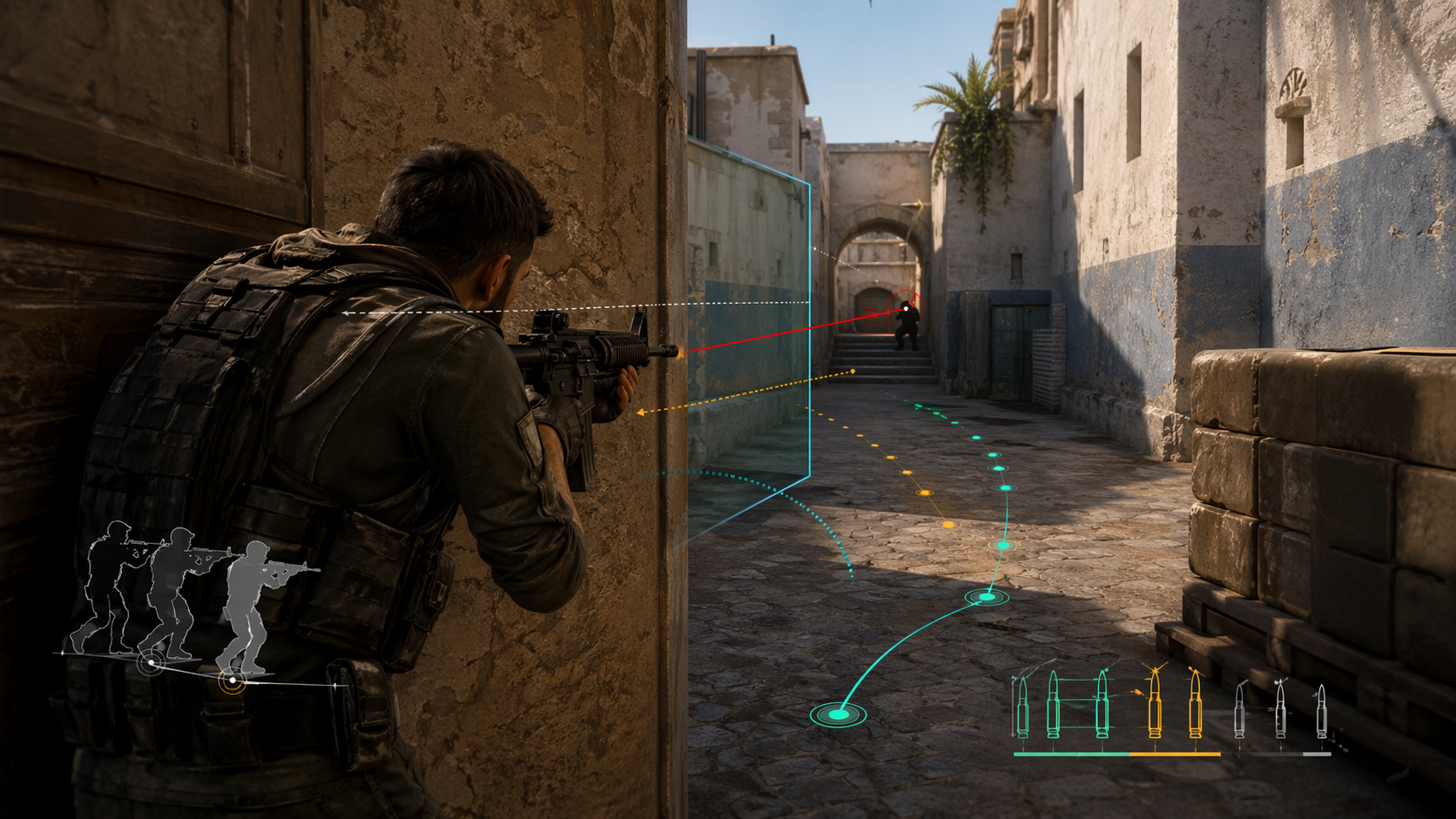
You can have good raw aim and still lose many duels because your peeks are bad. Peeking technique changes how much of your body is exposed, how quickly you gather information, and how comfortable your crosshair feels as the angle opens. In other words, peeking determines whether your aim gets a fair chance.
There is no single universal peek. A shoulder bait, a jiggle, a wide swing, a micro-adjusted clear, and a committed trade peek all serve different purposes. Your aim improves when your peek choice matches your goal. If you are clearing a likely position for a first shot, your movement should support a clean stop and predictable crosshair line. If you are trying to force an AWP shot or gather information, your movement priorities are different.
Angle management is about reducing how many threats can see you at once. Many players enter space too greedily and expose themselves to multiple sightlines, then blame their “slow reaction” when they die instantly. Realistically, they created an impossible duel. Better players isolate angles so their aim can solve one problem at a time.
This is why slicing the pie matters. Instead of exposing yourself to an entire room in one motion, you open it in smaller pieces, keeping your crosshair prepared for the first likely threat. That lowers cognitive load. Less chaos means faster recognition and cleaner shots.
Good peeking also helps your confidence. When your movement path is intentional, you feel more in control of the duel. When you randomly swing into multiple lines, every fight feels like a gamble. Confidence grows from repeatable structure, not blind aggression.
Train peeks with intention. Practice clearing one angle cleanly, then two connected angles, then a wider sequence. Focus on where your crosshair should be before, during, and after the peek. This is how aim and movement become one skill instead of two separate training categories.
A Smart Aim Training Structure That Transfers to Matches
One of the biggest reasons players plateau is that their training has no hierarchy. They do whatever feels productive in the moment: a few flicks, a deathmatch, some spray practice, maybe a workshop map, then straight into ranked. That can maintain your mechanics, but it rarely builds them efficiently. Better training separates different goals instead of mixing everything into one noisy session.
A smart aim structure for CS2 usually includes four layers:
- Activation: Wake up the hand and eyes with low-pressure target acquisition
- Precision: Practice stopping on small targets and making clean micro-corrections
- Duel Transfer: Apply aim inside movement, peeking, and realistic enemy timing
- Match Integration: Play in ways that force focus on one improvement goal
Activation should be short. Its purpose is to remove rust, not to exhaust you. Precision work is where you train control, not speed for its own sake. Duel transfer is the bridge that many players skip. This is where you combine crosshair placement, movement stops, peek timing, and live shooting. Match integration is where you deliberately carry one focus point into actual rounds, such as “keep crosshair at head level during every rotate” or “stop fully before every rifle shot.”
External aim trainers can be useful, but only if you use them with a purpose. If your goal is raw mouse control, target switching, or smoothness, they can help. If you use them as entertainment and then assume they automatically improve your CS2 duels, progress will be limited. In-game work is still essential because CS2 shooting depends heavily on movement state, angle expectation, and tactical context.
Similarly, simple online reaction tests like Human Benchmark can give you a rough baseline, but they should not become your obsession. Clicking a screen after a color change is not the same as identifying a head at the edge of a smoke, while counter-strafing, under round pressure, with audio cues and map knowledge involved. Use these tests as a curiosity tool, not your primary training metric.
The best transfer comes from training the exact reasons you miss in matches. If you miss because your crosshair starts too low, do not spend the entire week on giant flick scenarios. If you miss because you shoot while moving, do not hide inside static target routines. Let match review decide your training emphasis.
Daily Warm-Up and Weekly Improvement Routine
A warm-up should prepare you for competition, not tire you out before it starts. A lot of players warm up too long, too hard, or too randomly. Then they enter ranked mentally flat and physically tense. An efficient warm-up should create clarity, confidence, and readiness.
Here is a practical daily warm-up structure:
1. Five minutes of gentle activation
Use easy targets or simple bots. Focus on relaxed hand movement, stable grip, and visual engagement. This is about waking up coordination, not proving anything.
2. Five to ten minutes of precision focus
Practice small corrections and first-shot control. Emphasize stopping cleanly on targets rather than swiping at them. If you feel yourself rushing, slow down.
3. Ten minutes of duel-oriented practice
Move into drills that include peeking, target acquisition from common angles, and realistic shot selection. This is where mechanics begin to feel like actual CS2.
4. Ten to twenty minutes of focused deathmatch or equivalent live reps
Enter with one intention. For example: head-level discipline, calm bursting, or clean counter-strafes. Do not just chase scoreboard numbers. You are training habits, not farming meaningless warm-up ego.
Your weekly routine should balance maintenance and improvement. Not every day needs to be mechanically intense. A sensible weekly structure could include:
- 2 days focused on precision and first-shot control
- 2 days focused on peeking and duel transfer
- 1 day focused on recoil discipline and burst control
- 1 lighter day focused on demo review and crosshair placement walkthroughs
- 1 flexible day for match play and low-stress maintenance
The point is not to follow this perfectly. The point is to stop drifting. When training has a theme, your brain notices patterns faster. Improvement becomes measurable because you can say, “My crosshair placement improved this week,” instead of “I played a lot but I’m not sure what changed.”
If you want structured support beyond solo practice, some players also compare options like coaching, boosting, or guided rank help through the Boosteria CS2 boosting prices page. Even if you prefer improving on your own, it can be useful to see what kinds of improvement services serious players look for when they want faster progress.
How to Review Your Misses and Fix the Real Problem
Most players review aim problems emotionally. They remember the obvious whiff, call themselves inconsistent, and queue again. That feels honest, but it is not useful. Improvement starts when you diagnose the actual reason behind the miss.
After difficult matches, review key duels with a simple classification system. Ask which category each miss belongs to:
- Placement error: crosshair started in the wrong place
- Movement error: shot taken before becoming accurate
- Timing error: peek chosen at a bad moment
- Decision error: wrong angle, wrong fight, wrong shot type
- Mechanical error: overflick, underflick, poor recoil control
- Mental error: panic, rush, fear, hesitation, tilt
This changes everything. Instead of saying, “My aim is bad,” you begin saying, “I am losing because my crosshair sits too far from common swing points on rifle holds,” or “I rush my second bullet in medium-range duels.” Those are fixable problems.
Try to find trends across several matches rather than obsessing over one clip. One unlucky miss proves little. Ten similar misses prove a pattern. Once you see the pattern, build next week’s training around it. This closes the loop between match play and practice, which is where most real progress comes from.
It also helps to review successful duels, not only failed ones. What did you do right? Did you hold a clean line? Did you stop properly? Did you stay calm and burst instead of panic-spraying? Reinforcing good mechanics is as important as correcting bad ones. Confidence grows when you can identify your good process, not only your mistakes.
Confidence, Tilt Control, and Match-Day Consistency
Aim is psychological as much as physical. Even strong players lose consistency when tension rises. They start gripping too hard, swinging too wide, second-guessing good holds, or chasing compensation flicks after earlier misses. This is why two sessions with identical settings can feel completely different.
Confidence in CS2 should not mean ego. It should mean trust in your process. Trust that your crosshair belongs at head level. Trust that you can stop cleanly before shooting. Trust that a missed duel does not require immediate overcorrection. Process-based confidence is much more stable than emotional hype.
When tilt appears, aim usually gets either too hurried or too passive. Hurried players force fights and flick everything. Passive players hold awkwardly, overthink every angle, and react late because they are mentally stuck. The solution is to reset to simple anchors:
- Head level first
- Stop before shooting
- Clear one angle at a time
- Use the right shot type for the distance
- Play the next duel, not the previous one
Short between-round resets help a lot. Relax your jaw. Drop your shoulders. Unclench your mouse hand. Take one slow breath. Ask one useful question: “What is the next likely fight?” That keeps your brain in the present instead of spiraling around the last mistake.
Consistency under pressure also grows when you expose yourself to realistic stress during practice. If all your training happens in perfect comfort, ranked anxiety will feel foreign. But if you regularly practice focused deathmatch, retake scenarios, or high-attention drills where mistakes matter to you, your competition state becomes more familiar. Familiar pressure is easier to manage.
Sleep, Recovery, and Physical Habits That Affect Reaction Speed
Players often want a purely mechanical answer to reaction problems, but your body is part of your setup. Sleep, hydration, food timing, screen fatigue, and general recovery all influence how sharp you feel. If you are tired, your visual recognition slows, your patience shrinks, and your fine motor control gets worse. That combination destroys aim consistency.
Sleep is especially important. Numerous general health resources, including CDC sleep guidance, emphasize that sleep quality supports attention, decision making, and performance. In gaming terms, better sleep improves your ability to notice details early, stay calm in long duels, and repeat precise actions without sudden mental drop-offs.
Hydration and breaks also matter more than many players think. Long sessions without water or movement make you feel sticky and mentally dull. Even a short standing break between games can restore enough physical freshness to improve your next match. Try not to treat endurance abuse as discipline. It often becomes negative returns disguised as hard work.
Caffeine can help some players, but it should support focus rather than create jitter. Too much stimulation often increases hand tension and impatience. If you notice that your aim becomes twitchy, your decision speed may be outrunning your control. Consistency comes from a balanced state, not maximum intensity at all costs.
You do not need to become a sports scientist to benefit from better habits. Just respect the basics. A rested, calm, and comfortable player almost always aims better than an exhausted player trying to force progress through sheer volume.
The Most Common Mistakes Slowing Your Aim Progress
By now, you can probably see that aim issues rarely come from one single flaw. Still, certain mistakes show up again and again among players who feel “stuck.” Avoiding these can speed up improvement dramatically.
1. Changing settings too often
If you never stay with a setup long enough to adapt, your aim never stabilizes.
2. Chasing raw flick speed instead of duel quality
Most real fights are won by preparation, placement, and clean stopping, not circus flicks.
3. Ignoring movement accuracy
Shooting before becoming accurate makes even good mouse control look bad.
4. Treating warm-up as competition
Warm-up should prepare you, not exhaust your focus before ranked begins.
5. Practicing without a defined goal
Random reps maintain form but rarely solve specific weaknesses.
6. Overvaluing aim trainers and undervaluing in-game fundamentals
Mouse control matters, but CS2 fights depend heavily on map knowledge, peeking, timing, and shot discipline.
7. Reviewing outcomes instead of process
A lucky kill can hide a bad peek, and a lost duel can still contain good mechanics. Study the process.
8. Playing too much while tilted or tired
Volume without quality often reinforces bad habits instead of fixing them.
9. Holding the mouse with unnecessary tension
Tension damages micro-adjustments and creates inconsistent tracking.
10. Forgetting that anticipation is part of reaction time
The best way to be “faster” is often to be more prepared, not more frantic.
A 30-Day Plan to Improve Reaction Time and Aim Consistency
If you want a simple roadmap, here is a practical 30-day improvement plan you can repeat and adapt.
Week 1: Stabilize your setup
- Choose a sensitivity and commit to it
- Clean up your desk space and posture
- Optimize for stable performance and clear visuals
- Run short daily warm-ups focused on relaxed control
- Review one match for placement and movement mistakes
Week 2: Fix crosshair placement
- Do slow map walkthroughs with perfect head-level discipline
- Focus every live session on starting the crosshair in the right place
- In review, count how many duels required large panic flicks
- Reduce overclearing and learn common angle lines
Week 3: Improve stop timing and shot choice
- Train strafe-stop-shoot sequences daily
- Separate tapping, bursting, and spraying by context
- Play focused deathmatch with an emphasis on first-shot accuracy
- Review whether your misses are actually movement errors
Week 4: Integrate everything under pressure
- Enter matches with one clear aim goal per session
- Reset mentally between rounds instead of carrying misses forward
- Review both wins and losses for process quality
- Keep sleep, hydration, and session length under control
At the end of the month, do not only ask whether your highlights improved. Ask whether your average duel quality improved. Are your misses smaller? Are your first bullets cleaner? Are you less rushed? Do your off-days feel less disastrous? Those are the true signs of growing aim consistency.
FAQ
Can reaction time actually be trained?
Yes, but not only through raw reflex exercises. In CS2, the biggest gains usually come from anticipation, crosshair placement, visual discipline, cleaner movement, and lower input friction. Raw reaction drills help a little. Better duel preparation helps a lot.
How long should I warm up before ranked?
Usually 20 to 30 minutes is enough if the routine is focused. Some players need less, some need more, but the goal is readiness, not fatigue.
Should I use aim trainers outside CS2?
They can help mouse control and target switching, but they should support your CS2 practice, not replace it. Transfer is best when you also train peeking, stopping, shot selection, and crosshair placement in-game.
Is lower sensitivity always better for consistency?
No. Lower sensitivity can increase stability for many players, but too low can limit comfort and speed in practical situations. The best sensitivity is the one that gives you reliable control without making turns and clears feel awkward.
Why do I aim well in warm-up but poorly in matches?
Usually because matches add movement, pressure, decision making, timing, angle management, and emotional stress. Your training needs more realistic transfer and your match mindset needs cleaner process anchors.
How important is crosshair placement compared to raw flicking?
For most players, crosshair placement is far more important. Better placement reduces the need for difficult flicks and improves both speed and consistency immediately.
Final Thoughts
If you want to improve reaction time and aim consistency in CS2, stop looking for one magic answer. The real solution is a stack of small advantages working together: stable settings, comfortable posture, clear visuals, sensible sensitivity, strong crosshair placement, accurate stopping, smart shot selection, better anticipation, and a training routine built around your actual mistakes.
This is why the best aimers often look effortless. They are not winning only because they react faster in a biological sense. They are winning because they reduce the difficulty of every duel before it starts. Their preparation shortens the distance between seeing the target and hitting the target. Their habits protect them from randomness. Their confidence comes from repeatable fundamentals.
That is the path to lasting improvement. Not endless sensitivity changes. Not random flick grinding. Not frustration after one bad deathmatch. Build a system you can trust, and your aim will stop feeling temporary. You will become more stable across sessions, more composed under pressure, and more effective in the moments that decide rounds.
CS2 rewards discipline. If you commit to the fundamentals in this guide, your reaction time will feel sharper, your crosshair will feel more connected to your intent, and your aim consistency will rise in a way that actually transfers to real competition. That kind of progress lasts much longer than any short-term trick.