



Valorant Clutches Guide 2026: How to Win 1vX Situations
Valorant Clutches Guide 2026: How to Win 1vX Situations
Clutching is one of the most exciting and skill-defining parts of Valorant. It is also one of the most misunderstood. Many players think a clutch is mostly about aim, raw confidence, or pulling off a highlight play under pressure. Those things can matter, but they are not the foundation. A reliable Valorant clutch is built on information, calm decision-making, angle isolation, timing, utility discipline, and the ability to control the pace of the round when everyone else wants chaos.
If you want to win more 1v2, 1v3, and even occasional 1v4 situations, you need more than mechanics. You need a repeatable framework. The best clutch players do not rely on hope. They create winnable mini-duels, remove uncertainty, manipulate sound, punish impatience, and understand exactly when to play fast and when to slow the round down. That is why some players seem to “always clutch” even when their flicks do not look magical. Their process is better.
This guide is designed to be timeless. Instead of depending on short-lived patch specifics, it focuses on evergreen clutch principles that stay relevant across metas, maps, weapon balance changes, and agent trends. Whether you are a newer player trying to stop panicking in late rounds or an experienced grinder looking to convert more close games into wins, this guide will help you approach every 1vX situation with clarity.
You can also improve your overall game sense by studying the official VALORANT site, keeping up with broad competitive trends on VALORANT Esports, and checking basic system, gameplay, and account resources on Riot’s VALORANT Support. If your bigger goal is steady ranked progress rather than one specific skill, you can also review practical options on Boosteria’s Valorant boosting prices page as part of your broader improvement plan.
Table of Contents
- What a Clutch Really Is
- Why Most Players Lose 1vX Situations
- The Right Clutch Mindset
- The First Five Seconds of Every Clutch
- How to Identify the Real Win Condition
- Positioning Principles That Win Clutches
- How to Isolate Duels Instead of Taking 50/50 Fights
- Utility Usage in 1vX Situations
- Audio, Information, and Reading Opponents
- Attacking-Side Clutches
- Defending-Side Clutches
- How to Clutch Post-Plants
- How to Clutch Retakes
- Weapon-Specific Clutch Advice
- Agent Archetypes and Clutch Identity
- Common Clutch Mistakes
- How to Practice Clutching Efficiently
- A Repeatable 1vX Checklist
- FAQ
- Final Thoughts
What a Clutch Really Is
A clutch is not simply “winning while outnumbered.” In practical terms, a clutch is the art of turning a low-probability round into a controlled sequence of favorable decisions. The scoreboard may say 1v2 or 1v3, but the real battle is rarely fought against all remaining players at once. Strong clutch players break the problem into smaller pieces.
In Valorant, a clutch usually involves one or more of the following:
- Managing limited information better than the enemy team
- Creating a situation where only one opponent can fight you at a time
- Using the spike timer to force enemy movement or hesitation
- Manipulating sound so opponents misread your location or intentions
- Recognizing when the round should be played for the kill and when it should be played for time
- Staying mechanically ready while mentally slowing the game down
That last point matters a lot. Many players treat clutches like emergencies. The best players treat them like puzzles. The pressure is real, but the solution still follows logic. Your goal is not to look heroic. Your goal is to make the enemy team feel uncomfortable, uncertain, rushed, and individually exposed.
Why Most Players Lose 1vX Situations
Most lost clutches are not lost because the final player had worse aim. They are lost because the player made the situation easier for the enemy. Understanding these common failure patterns is the first step to fixing them.
1. They fight too early
When the numbers are against you, taking the first available duel is rarely the best decision. Many players peek instantly because they feel they must “do something.” In reality, every second you stay alive can increase the value of enemy uncertainty. Time creates mistakes. Panic removes them.
2. They give away their location for free
Running loudly, reloading in predictable spots, swapping utility carelessly, or jumping where it is not needed all give opponents a cleaner read of the round. Information is currency in clutch situations. Spending it for free is usually a losing trade.
3. They forget the objective
Some players become obsessed with fragging out and stop tracking the actual win condition. If the spike is down, the round may be about delay. If you are retaking, the round may be about forcing the planter off the angle. If the enemy is low on time, survival and patience may be stronger than aggression.
4. They expose themselves to multiple angles
This is the classic 1vX mistake. You swing wide into two or three possible lines of sight, and even if your crosshair placement is decent, you are asking for a trade. Great clutching is often just disciplined angle reduction.
5. They do not adapt to enemy psychology
Enemies in a man advantage often become either too passive or too overconfident. If you do not recognize which version you are facing, you will miss free wins. Reckless opponents can be punished by holding. Nervous opponents can be punished by pressure. Reading that emotional state is part of elite clutch play.
The Right Clutch Mindset
Mental control is one of the biggest separators between average players and reliable closers. If your heart rate jumps and your brain narrows every time the round becomes a 1v2, you need a mental routine. Good mindset in Valorant is not blind confidence. It is functional clarity.
Accept that you are not supposed to win every clutch
This sounds simple, but it changes everything. When you act like every lost 1v3 is a personal failure, you force bad plays. Clutches are bonus rounds. Your job is to maximize the chance of conversion, not to guarantee the impossible. This mindset reduces panic and keeps your decision-making clean.
Stop narrating the pressure
Do not think, “I have to clutch this.” Think, “What is the next best decision?” That small shift keeps your attention on process instead of outcome. The best clutch players live one action at a time: clear the nearest threat, take space, read sound, check timer, reposition, isolate, repeat.
Assume opponents can make mistakes
A 1v3 is not three perfect opponents playing a flawless setup. It is usually three players with different ideas, different levels of patience, and different expectations. One may swing too early. One may stop watching a key path. One may overrotate on sound. If you stay calm enough to recognize the first crack, the clutch becomes real very quickly.
Play with intent, not fear
Passive does not mean scared. Slow does not mean indecisive. A strong clutch player can hold for five seconds, then explode with total commitment when the timing is correct. That contrast is dangerous. If you are timid instead of purposeful, enemies feel safe. If you are quiet but ready, they feel hunted.
The First Five Seconds of Every Clutch
The first few seconds after you become the last player alive often decide the whole round. These moments should never be random. You need a checklist that resets your brain and stops emotional autopilot.
In the first five seconds, ask yourself these questions:
- Where is the spike, and who controls it?
- How much time is left in the round or on the spike?
- What utility do I still have?
- What weapons are in play?
- What was the last confirmed enemy location?
- Am I being hunted, held, or ignored?
This quick scan gives you your first real plan. Sometimes the answer is immediate aggression because the enemy is weak, split, or mid-transition. Sometimes the answer is total silence and patience. Sometimes the answer is repositioning to a stronger clutch angle before showing any presence at all.
Players who skip this checklist often die because they inherit the chaos of the previous fight. They run into the next decision without resetting. You need that reset. The round has changed. Your brain must change with it.
How to Identify the Real Win Condition
Every clutch has a visible problem and a real problem. The visible problem is the player count. The real problem is the path to victory. If you define the win condition correctly, the round becomes simpler.
Examples of common win conditions
- Post-plant attack clutch: survive, deny the defuse, isolate the tap, and force enemies to expose themselves
- Defensive retake clutch: clear the most dangerous close angle, find the post-plant anchor, then use the clock to force the final duel
- Low-time attack clutch: plant safely first if possible, because the spike can rebalance the round
- Eco clutch: create a short-range duel instead of playing standard angles against better rifles
- Operator clutch: take one clean shot, then reposition before the trade can arrive
A big mistake in Valorant 1vX situations is choosing a plan that ignores your current tools. If you have no utility and little time, the round may demand bold contact. If you have delaying utility and a strong post-plant angle, time becomes your teammate. Your plan must match your resources.
Positioning Principles That Win Clutches
Positioning is the true backbone of consistent clutching. Aim helps you finish fights, but positioning determines what kind of fights you take in the first place. In 1vX situations, you want positions that do at least one of three things: cut enemy information, reduce the number of angles you can be fought from, or create awkward timings for trades.
Use cover that lets you disengage
The best clutch positions are rarely wide-open “hero” angles. They are angles with an exit. If you get one kill, can you fall back? Can you break line of sight? Can you reposition before the second enemy arrives? If the answer is no, your position may only be good for a single frag, not for winning the round.
Value depth over visibility
Many players pick positions that see too much. That sounds useful, but it often means they can be fought from too many places. In a clutch, you usually want less vision with more control. Seeing one lane clearly is often stronger than seeing half the site vaguely.
Play near timing breaks
Good clutch positions often sit near corners, elevation changes, choke points, or objects that force enemies to pause. Those micro-pauses are everything. They give you time to set crosshair height, listen for a second player, or decide whether to commit or drop away.
Reposition after impact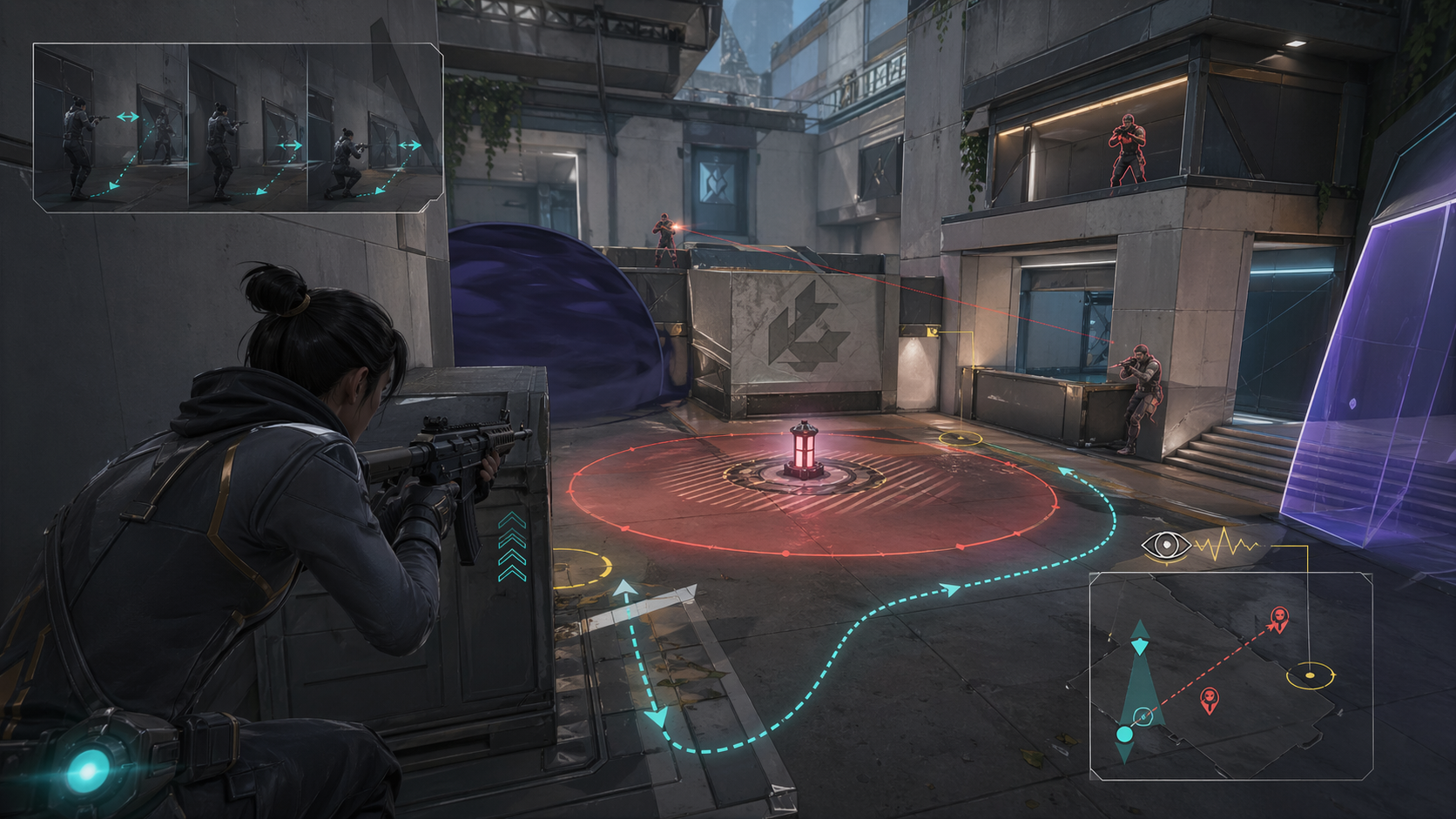
After a kill, your previous position becomes weaker because it is now known. Not every situation allows movement, but whenever possible, change the enemy’s mental map. Even a short sidestep to a new hold can make the second opponent clear you incorrectly.
How to Isolate Duels Instead of Taking 50/50 Fights
If there is one universal rule for winning more Valorant clutches, it is this: do not let the enemy team fight you together. Most 1vX rounds become winnable the moment you transform the round into a series of 1v1s.
Use geometry, not bravery
Angle isolation is not about “being better.” It is about using walls, boxes, doors, corners, and elevation so only one opponent has vision of you at a time. Before you swing, ask: what second angle could also see me? If there is one, adjust the path or timing first.
Make the enemy line up poorly
When opponents know they outnumber you, they often group too tightly or swing with poor spacing. If you hold a narrow choke or punish the first contact instantly, the second player can be forced into a rushed, awkward trade. That is exactly what you want.
Force individual decisions
Sound pressure, fake movement, brief silence, or a half-step of presence can cause one enemy to investigate alone while the other stays back. That is the hidden value of information control. You are not just hiding. You are shaping who feels responsible to act first.
Never “clear everything” at once
In a 1v3, trying to clear five angles in one motion is another way of saying you are willing to lose to any of them. Instead, segment the space. Clear the nearest threat. Move. Re-clear. Advance in layers. Treat the site like a puzzle, not a sprint.
Utility Usage in 1vX Situations
Utility is powerful in clutches, but only if used with discipline. Many rounds are thrown by using utility too early, too obviously, or without a plan for what it should create. In a 1vX, utility should do one of four jobs: block vision, force movement, buy time, or make your next duel easier.
Do not waste utility for comfort
Throwing utility because you feel nervous is one of the most common late-round habits. If your smoke, flash, slow, molly, stun, or information tool does not directly create advantage, save it. The threat of utility can be as valuable as the utility itself.
Pair utility with movement
Utility alone rarely wins the round. Utility plus movement does. If you smoke but stay predictable, the enemy may simply wait it out. If you smoke and reposition, now they have a problem. If you flash and do not swing, you only announce your location. Always connect the utility to a next action.
Use utility to divide the map
One of the strongest clutch concepts is temporary map division. If you can cut one line of pressure for even a few seconds, you can focus on the other side. That might mean turning a 1v2 into a brief 1v1 by denying one approach or delaying one defender from helping.
Save one piece for the final moment if possible
The last piece of utility in a clutch is often the most valuable one, because it is used when information is highest and the round state is clearest. A late piece of delay on the spike, a final flash for the forced swing, or one well-timed info tool can close the round when the enemy has no time left to reset.
Audio, Information, and Reading Opponents
Sound is one of the biggest hidden weapons in Valorant clutches. In many 1vX situations, the player who hears, interprets, and reacts better wins before the duel even starts.
Know when silence is pressure
If enemies do not know where you are, every quiet second increases tension. They start second-guessing. They clear more slowly. They may dedicate two players to one path and leave another weaker. Silence is not inactivity. In a clutch, silence is a tool that changes enemy behavior.
Know when noise is bait
Sometimes making a controlled sound is stronger than hiding. A footstep, brief utility cue, or jump spot can suggest movement you do not actually complete. This is especially effective when the spike timer forces defenders or attackers to react quickly. The trick is to sound believable without fully committing your body.
Track enemy patterns
Across a full match, certain players become predictable. One always swings after a teammate makes contact. One always lurks late. One always panics on spike tap. Clutch conversion improves dramatically when you stop thinking only about positions and start thinking about habits.
Use kill feed and timing memory
If an enemy used utility recently, they may be short on tools. If someone rotated from the other site, their timing may still be long. If a weapon was dropped, another player may detour to recover it. These small clues matter. A clutch is often won by stacking many tiny correct assumptions rather than one perfect read.
Attacking-Side Clutches
Attacking-side clutches are often cleaner than defensive ones because the spike can become your equalizer. If you can get the plant down, the round no longer revolves only around kills. It revolves around time, sound, utility, and forced interaction.
Planting is often the first objective, not the final one
In many 1vX attack situations, players over-prioritize finding kills before the plant. Unless you have a perfect isolated duel, getting the spike down can be the stronger move. A safe plant changes the pressure. Now defenders must come to you, reveal themselves, and interact on your terms.
Choose plant spots with your clutch path in mind
Do not plant just because the site is technically open. Plant for a follow-up plan. Ask where you want to play after the plant. Ask which angle gives you the best deny potential. Ask what path you can fall back through. A smart plant is a strategic decision, not a mechanical chore.
Do not overpeek after planting
Many attackers throw post-plant clutches by immediately hunting for extra info. Unless you need to reclaim control, let the spike pull defenders into the open. The temptation to “confirm where they are” often gives defenders the exact duel they need.
Use repositioning to multiply uncertainty
After planting, consider whether your strongest move is to stay hidden in a powerful angle or to rotate to an off-angle that changes the expected post-plant pattern. The best answer depends on time, utility, and enemy tendencies, but the idea is the same: force defenders to waste time checking the wrong place first.
Defending-Side Clutches
Defensive clutches are usually harder because the attackers have already created structure: spike down, post-plant crossfires, and utility prepared to delay you. That said, defenders still have one huge weapon: urgency. The spike timer compresses the options of the attacking team too. If you read the setup well, their advantage can become rigid and punishable.
Do not rush the retake without a reason
Many players hear the spike and immediately swing into the strongest attacker angle. Unless time is truly critical, start by locating the most likely anchor, identifying utility threats, and clearing the close space that could kill you for free.
Tap with a purpose
A spike tap is not magic. It is a question you ask the enemy: who is going to respond, from where, and how fast? If you tap without cover, without awareness of likely swing paths, or without a follow-up idea, you are just revealing yourself. But if you tap to pull a specific fight, it becomes a powerful information and timing tool.
Recognize when the round is about kills before the defuse
Not every retake is “tap, stick, hope.” Sometimes the enemy post-plant setup is too strong, and the real win condition is removing one specific player first. If an attacker is holding the only safe deny angle, you may need that frag before the spike matters.
Clear close before wide
In defensive clutches, dying to a close corner is usually worse than dying to a far post-plant angle, because close positions often kill you before you can even read the setup. Clear immediate danger first so your later decisions are not built on false safety.
How to Clutch Post-Plants
Post-plant clutching is one of the most skill-rich parts of Valorant because the spike timer creates structure. Structure is good for the clutch player because it reduces chaos and gives you levers to pull.
As the attacker
Your job is to stretch enemy time while protecting the defuse denial moment. Play positions that let you hear or see the tap without exposing you to unnecessary early fights. If you have utility, save it for when the spike becomes urgent. The closer the timer gets to critical, the less patient defenders can be.
Think in terms of layers:
- First layer: hide information and make the retake uncertain
- Second layer: force defenders to spend time clearing or faking
- Third layer: punish the tap or deny the stick
- Final layer: close the last duel when time collapses
As the defender
Your job is to identify the attacker’s denial route and challenge it efficiently. Too many defenders tap without understanding where the post-plant pressure is likely coming from. Even in a 1v2 or 1v3 retake, your first mental map should be: if I were the attacker, where would I play from? That answer gives your clear order.
Do not waste your best timing by using it on a fake tap with no plan. In many clutch retakes, the strongest sequence is clear one dangerous angle, tap, hold for the swing, then commit to the defuse once the setup breaks.
How to Clutch Retakes
Retake clutches are about sequencing. You do not just need good aim. You need the right order of actions. Even a highly mechanical player will lose if they clear the site in the wrong order or challenge the wrong post-plant angle first.
Step 1: Identify the shortest threat
Which enemy can kill you first with the least warning? That player usually matters more than the one holding the longest angle. Short-range threats and tucked positions often need to be solved before long-range ones, because they remove your ability to move or tap safely.
Step 2: Pressure the setup
Once the close danger is reduced, you need to pressure the enemy shape. That may mean a tap, a jiggle, a utility cue, or a wider reposition that forces them to readjust. The goal is not random activity. The goal is to make the post-plant players reveal their priorities.
Step 3: Collapse on the weak link
Every setup has a weak point: the isolated player, the predictable swing, the one without cover after contact, the player forced to deny from too far away. Good clutching means you find that weak point fast and convert it cleanly.
Step 4: Respect the final timing
Many retakes are technically won but then thrown because the defender misjudges how much time remains to stick the spike. Always keep a mental timer. Your plan is only good if it still leaves enough time to finish the objective.
Weapon-Specific Clutch Advice
Your weapon changes your clutch identity. You should not play the same 1vX with a rifle, a pistol, a shotgun, and an Operator. The principles remain the same, but the execution changes.
Rifles
Rifles are the most flexible clutch weapons. With a rifle, you can take mid-range control, punish dry peeks, and still transfer quickly if the enemy spacing is poor. Prioritize clean crosshair placement and avoid overflicking due to nerves. The rifle clutch is about consistency, not spectacle.
Pistols
Pistol clutches demand sharper range control. You usually want closer engagements, surprise timing, or isolated headshot opportunities. Avoid standard angles that favor rifles unless the enemy is already weak or forced by time. A pistol clutch is often won through positioning more than raw duel-taking.
Shotguns
Shotgun clutches are all about space denial. Tight corners, narrow chokes, vertical close angles, and sound manipulation become your best tools. With a shotgun, your mission is to make the enemy feel rushed into your territory. Do not play a fair round. Play a short one.
SMGs
SMGs reward movement, pressure, and close-to-mid range fights. In a 1vX, they work best when you can surprise, spray through utility, or punish opponents who swing without discipline. Be careful not to overextend simply because the weapon feels mobile.
Operator
Operator clutches are unique. Your first bullet is incredibly valuable, but your vulnerability after that shot is just as important. If you get one kill, reposition immediately if possible. Do not assume the second opponent will repeat the same mistake. With an Operator, the clutch often becomes a rhythm of shot, move, reset, and re-establish distance.
Agent Archetypes and Clutch Identity
Rather than focusing on temporary agent rankings, it is more useful to think in archetypes. Your role influences how you should approach 1vX situations.
Duelist-style clutching
If your kit rewards entry, bursts of movement, or fast space-taking, your clutch strength often comes from forcing uncomfortable fights before the enemy can fully set up. But that does not mean mindless aggression. Your power is in choosing a decisive timing, not in permanently running forward.
Controller-style clutching
Controllers often excel in late-round play because they can divide sightlines and create temporary 1v1s. If you are on a controller-type agent, think about how your remaining utility can shrink the map and force the enemy into awkward clears.
Sentinel-style clutching
Sentinel players often have the best natural clutch instincts because they are used to patient holds, trap logic, and playing around information. In a 1vX, lean into that discipline. Make the enemy prove where they are before you overcommit.
Initiator-style clutching
Initiator kits can be exceptional in clutches because one good info or disruption tool can flip an otherwise impossible round. The key is not to waste those tools too early. Use them when the round state is narrow enough that the information they provide actually changes your decision.
No matter your agent type, remember this: your clutch identity should come from your current utility, your position, and the timer, not from a label. Play the round you have, not the stereotype you started with.
Common Clutch Mistakes
Even good players sabotage their own rounds with repeated habits. Here are some of the most common mistakes that keep players from winning more 1vX situations in Valorant.
- Instant reloading after a kill: this is one of the easiest punishments for a nearby opponent
- Wide swinging for information: you do not need to see everything immediately
- Using all utility early: saving one key piece often wins the final interaction
- Repeeking the same angle: once seen, your value drops unless the timing is truly strong
- Ignoring the spike timer: many “almost clutches” are really time management failures
- Panicking after the first frag: the round is not over when the kill feed turns favorable
- Assuming enemies are coordinated: sometimes the best play is to punish their lack of structure
- Holding impossible crossfires alone: move to reduce angles instead of proving bravery
If you want to climb, review your lost clutches and identify which of these patterns appears most often. Most players do not need ten new strategies. They need to stop making the same two late-round errors every game.
How to Practice Clutching Efficiently
Clutching is trainable, but you need to practice the right things. Simply spamming matches and hoping late-round confidence appears is inefficient. You should train the building blocks that create clutch success.
1. Crosshair placement under stress
Most clutches are not won by wild flicks. They are won by having the crosshair ready for the most likely peek. Practice disciplined placement in deathmatch and custom routines. Your goal is to reduce the mechanical burden during real rounds.
2. Micro-timing and patience
Deliberately practice waiting half a second longer than your impulse suggests. Many clutch fights are lost because the player peeks too soon. Learning how to hold your nerve without becoming passive is a real skill.
3. Sound-based reactions
In your review sessions, pay close attention to what the audio told you before each duel. Did footsteps indicate one or two players? Did a utility sound reveal the path? Did a tap tell you where the anchor likely was? The more you train this awareness, the less random late rounds feel.
4. VOD review with one clutch question
After each session, review your lost 1vX rounds and ask one question: what was my win condition, and did I play toward it? This keeps your review focused. You are not just checking whether you missed a shot. You are checking whether your plan matched the round.
5. Custom-game route knowledge
Knowing where sound carries, where off-angles exist, and how long rotations take on each map helps enormously in clutch situations. Even if the meta changes, map geometry still rewards preparation.
For broader improvement beyond clutching, it can help to watch how professionals solve late rounds on VALORANT Esports and compare their patience, spacing reads, and post-plant discipline to your own. You are not copying exact plays. You are learning decision structure.
A Repeatable 1vX Checklist
If you only remember one part of this guide, remember this checklist. It is the easiest way to make your clutch play more consistent immediately.
- Reset: breathe once and stop the emotional autopilot
- Count: how many enemies are alive, and what weapons might they have?
- Locate: where is the spike, and what was the last known enemy information?
- Time: how much time is left, and who does that favor?
- Utility: what tools remain on both sides?
- Reduce angles: move into a path where you can be fought by fewer opponents at once
- Create doubt: use silence, repositioning, or controlled sound to make the enemy uncertain
- Isolate: take the duel that gives the second player the worst trade chance
- Reposition: after impact, change the enemy’s read if the round allows it
- Finish with the objective in mind: spike timer, plant, tap, deny, or stick
This checklist works because it turns a stressful, emotional round into a sequence of manageable decisions. The more often you use it, the more natural it becomes.
Example Clutch Scenarios and Thought Process
Scenario 1: 1v2 as attacker, spike in hand, site partially open
Your first instinct might be to hunt one player and make it a 1v1. But if the site is open enough for a safe plant, planting can be stronger. The spike forces defenders to retake, gives you audio cues, and creates timer pressure. Once planted, you choose an angle that hears the tap and makes a trade difficult. Now the enemy team has to solve your setup instead of you solving theirs.
Scenario 2: 1v3 defender retake, limited utility, medium time left
This is rarely a round you win by raw speed. You need to identify the closest threat first, then pressure the setup. Clear the dangerous close angle, tap to force reactions, punish the first overpeek, and move quickly into the next duel before the final opponent resets. If you just sprint at the site center, you probably die to a layered crossfire.
Scenario 3: 1v2 with a shotgun on defense
You should not try to imitate a rifle clutch. Pull the round into close space. Use silence, corners, and path denial. If the attackers need to recover the spike or move through a choke, that is your invitation. The objective is not pretty crosshair tracking. The objective is one sudden kill followed by immediate relocation or another close hold.
Scenario 4: 1v2 post-plant as attacker with one delay utility piece
This is a classic situation where patience wins. Let the defenders spend time and reveal their clear pattern. Save the final utility for the highest-value moment: when one commits to the spike or both are forced to act. Many players waste the delay early, then have no answer when the round truly becomes urgent.
How to Make Enemies Uncomfortable in Clutches
One of the least discussed parts of 1vX success is emotional pressure. Even when the enemy has the advantage, they often become uncomfortable if you stay alive too long. The round stops feeling “free.” That discomfort creates bad spacing, nervous peeks, fake confidence, and missed utility.
You create discomfort by doing the following:
- Staying unpredictable after contact
- Refusing to give free sound when silence is stronger
- Changing elevation or angle depth after a kill
- Taking just enough space to be a threat without exposing yourself
- Forcing one enemy to feel responsible for making the first move
The enemy team is not just fighting your weapon. They are fighting uncertainty. Once you understand that, clutching becomes much more strategic and much less random.
When to Play Fast in a Clutch
Patience is powerful, but there are times when speed is correct. A strong clutch player knows the difference between deliberate patience and wasted time.
Play fast when:
- The enemy is clearly mid-rotation or not set
- You have a strong read on an isolated opponent
- The clock is running out and delay no longer helps you
- Your weapon or utility is strongest at close range and surprise timing
- The enemy has shown panic or overconfidence that can be punished immediately
The key is that fast does not mean rushed. Fast means decisive. You are acting because the round demands immediate pressure, not because you are scared of waiting.
When to Slow Down in a Clutch
Slow down when the enemy has more to lose from uncertainty than you do. If they need to clear you, retake you, or deny a timer, silence becomes expensive for them. If they do not know where you are, every second they spend guessing is a second you can convert into better odds.
Slowing down is strongest when:
- You have spike advantage after the plant
- The enemy must rotate to you
- You have utility to delay the final commit
- Your position is still unknown
- The enemy team has shown impatience in previous rounds
Many clutches are thrown because the final player feels the need to “keep the momentum.” Momentum is useful, but only when it matches the timer. Otherwise, you are just removing pressure from the opponents.
Building a Long-Term Clutch Reputation in Ranked
There is another hidden benefit to good clutch play: reputation. Over the course of a match, players start to remember who closes rounds well. That changes how enemies behave. They clear you more nervously. They stack more heavily. They overuse utility to remove uncertainty. All of that creates new opportunities.
A player with a clutch reputation often wins rounds before the final duel even starts because the enemy team becomes mentally affected by previous conversions. This is why consistency matters more than occasional miracle plays. A calm 1v2 won with smart timing is more valuable for your long-term ranked impact than one flashy but unrepeatable spray transfer.
If your goal is to improve your whole ranked profile, not just your late-round mechanics, combine this guide with regular review, cleaner communication, and stronger mid-round discipline. Clutching is not isolated from the rest of Valorant. Good lurks, better utility retention, smarter rotations, and cleaner trading all feed into better 1vX opportunities later.
FAQ
How do I stop panicking in a Valorant clutch?
Use a reset phrase and a checklist. Instead of thinking about the pressure, think about the next decision: spike, time, utility, last known enemy information. Panic shrinks when process becomes automatic.
Should I always play slow in a 1vX?
No. You should play at the speed the round demands. Slow is strong when uncertainty helps you. Fast is strong when timing, isolation, or the clock creates a narrow opening you must exploit.
What is the biggest mistake in post-plant clutches?
Overpeeking too early. Many attackers give defenders a free duel before the spike becomes urgent. Let the objective do some of the work for you.
How important is utility for clutching?
Very important, but not because it gets kills on its own. Utility helps you block vision, force movement, buy time, and isolate fights. It becomes powerful when paired with movement and timing.
Can I become a better clutch player even if my aim is average?
Yes. Better aim always helps, but many clutch rounds are decided by positioning, timing, sound reading, and objective control. Smart players regularly outperform mechanically stronger players in late rounds.
What should I review after losing a 1vX?
Ask whether you understood the win condition, whether you reduced angles correctly, whether you gave away free information, and whether your timing matched the objective. Those answers matter more than simply blaming the missed shot.
Final Thoughts
Winning more 1vX situations in Valorant is not about turning yourself into a montage player. It is about becoming a calmer, sharper decision-maker when the round gets loud. The best clutch players understand that every late-round situation has structure. There is always a timer, an information state, a spacing problem, and a psychological battle happening under the surface.
If you learn to reset your mind, define the win condition, reduce the number of angles you can be fought from, and use your utility with purpose, your clutch percentage will rise. Not because luck changed, but because your process improved. That is the real secret behind reliable clutching in Valorant.
Keep this simple idea in mind: a clutch is rarely won all at once. It is won through one correct decision, then another, then another, until the enemy runs out of space, time, or answers. Build your game around that principle, and 1vX situations will stop feeling like chaos and start feeling like opportunities.
If you want to keep improving after reading this guide, review your own late rounds, study broad competitive tendencies on VALORANT Esports, stay familiar with official updates through the official VALORANT site, and use Riot’s support resources whenever you need core gameplay or technical references. And if your priority is faster ranked progress alongside skill development, you can review Boosteria’s Valorant boosting options as part of your broader improvement path.