



Marvel Rivals Drills 2026: Custom Games, Aim & Hero Mechanics
Best Practice Drills for Marvel Rivals (2026): Custom Games, Aim Warm-Ups, and Hero Mechanics
Getting better in Marvel Rivals isn’t about grinding more matches—it’s about turning your time into repeatable reps. This guide gives you a timeless, improvement-first training system: custom game drills, aim warm-ups, and hero mechanics practice you can run in short sessions and still see measurable progress.
You’ll also get role-based routines (frontline / damage / support), duo drills for coordination, simple VOD review templates, and weekly plans you can copy-paste into your schedule.
1) The Practice Mindset That Actually Works
The difference between “playing a lot” and “improving fast” is feedback. Great practice has three ingredients: clear goals, high-quality reps, and tight feedback loops. If any of those are missing, you might still climb, but it’ll be slower and inconsistent.
Use the 3-Part Loop (Forever)
- Isolate a skill (one mechanic, one matchup pattern, one positioning rule).
- Train it in a controlled environment (custom game / range / repeatable scenario).
- Transfer it into real matches with a single focus cue (“Hold off-angle, then reset”).
Choose “One Skill Per Session” (Not Ten)
Your brain learns faster when the session has one headline target. Example: “Today I’m improving target switching,” not “I’m improving everything.” You can still warm up other areas—but your primary reps should be focused.
Make It Measurable
If you can’t measure it, you can’t manage it. Good metrics are simple: hit rate in a drill, time-to-kill on practice targets, deaths per fight, “late to objective” count, missed ult windows. This guide gives you practical metrics you can track in under two minutes.
2) Setup: Controls, Sensitivity, and “No-Excuse” Training Conditions
You don’t need perfect gear, but you do need consistency. If your settings change daily, your aim and movement will feel random. Lock your setup for at least two weeks before making meaningful tweaks.
Controls and Sensitivity (Simple Rules)
- Comfort beats theory. If your arm/wrist hurts, you won’t train enough to improve.
- Stability beats speed. Prefer a sensitivity that keeps your crosshair calm on mid-range targets.
- One baseline, small changes. Adjust by tiny steps and test for 3 sessions before changing again.
Graphics and Visibility
Prioritize stable performance and clarity. Anything that causes stutter or inconsistent input will sabotage mechanics practice. Keep settings stable, reduce distractions, and train in the same conditions you play ranked.
Practice Environment Checklist
- Warm hands (seriously—cold hands reduce control).
- No background “second-screen” distractions during drills.
- Timer ready (phone timer works).
- Short notes doc ready (one line per session).
Optional (but helpful) external tools: Steam hosts popular aim trainers, and NVIDIA Reflex explains latency concepts that can help you troubleshoot “I feel delayed” issues. Use these as references, not rabbit holes.
3) The 10–25 Minute Warm-Up Framework
A warm-up should do two things: (1) wake up your mechanics and (2) prime your decision-making. It should not drain you before you even queue. Here are two templates you can reuse forever.
Template A: 10-Min “Ranked Ready” Warm-Up
- 2 min – Crosshair control: slow tracking on a single target (smoothness first).
- 3 min – Target switching: two targets, clean transitions, no panic flicks.
- 3 min – Hero micro: your main hero’s core combo loop (cooldown rhythm).
- 2 min – Movement + camera: corners, peeks, reset to cover.
Template B: 25-Min “Improvement” Warm-Up (Best for Climbing)
- 5 min – Aim fundamentals (smooth tracking + controlled flicks).
- 8 min – Custom drill (the one skill you’re focusing today).
- 7 min – Hero mechanics reps (combo timing + ability discipline).
- 5 min – Mini-scenario (1v1 angles, retreat paths, objective approach).
Two Rules That Prevent “Fake Warm-Ups”
- Rule 1: If you’re missing, slow down. Speed comes after control.
- Rule 2: Stop before fatigue. Warm-up ends when your aim stabilizes—not when you’re tired.
4) Aim Warm-Ups: Tracking, Flicking, and Target Switching
In hero shooters, aim is rarely “just aim.” It’s aim + movement + timing + ability usage. Still, raw aim fundamentals are the fastest mechanical wins—especially if you turn them into short, repeatable drills.
Drill 1: Smooth Tracking (The Foundation)
Goal: Keep your crosshair glued to a moving target with minimal jitter.
- Duration: 2–4 minutes
- Focus cue: “Smooth hand, steady eyes.”
- Common mistake: Overcorrecting. If you wobble, reduce speed.
- Progress metric: “Seconds on target” (estimate in chunks of 10).
Drill 2: Controlled Flicks (Accuracy First)
Goal: Snap to targets without overshooting, then confirm with micro-correction.
- Duration: 2–3 minutes
- Focus cue: “Snap → settle → shoot.”
- Common mistake: Shooting while still moving your crosshair.
- Progress metric: Clean first-shot percentage.
Drill 3: Target Switching (Most “Ranked Relevant”)
Team fights punish tunnel vision. Target switching is the ability to quickly change targets when someone is low, overextended, or dangerous.
- Duration: 3–6 minutes
- Focus cue: “Head stays calm; eyes lead.”
- Common mistake: Huge flicks. Great switching is usually small, efficient movement.
- Progress metric: Time between kills/confirmations in a multi-target scenario.
Drill 4: Burst Control Under Stress
Even if your hero isn’t recoil-heavy, “burst control” matters: shoot in controlled windows, reposition, then re-engage. This prevents panic spraying and keeps your aim stable while dodging.
- Duration: 3 minutes
- Focus cue: “Burst, strafe, reset.”
- Progress metric: Hit rate while strafing.
If you enjoy dedicated aim trainers, keep them short and specific. Use them to warm up a single skill (smooth tracking / switching / micro-flicks), then immediately transfer into in-game custom drills.
5) Movement + Camera Control Drills (Third-Person Specific)
Third-person shooters reward mechanics most players never practice: camera discipline, corner timing, and cover resets. You can gain a huge edge by training these like aim.
Concept: “See First, Shoot Second”
Your camera can gather information before your body commits. Train yourself to “check” safely, then commit only when you have a plan: shoot, use mobility, or reset behind cover.
Drill A: Corner Peeks + Reset
- Duration: 3–5 minutes
- Set-up: Choose a wall/corner in a custom lobby or practice area.
- Reps: Peek → acquire target → 1–2 controlled bursts → instantly reset to cover.
- Focus cue: “Win the first second.”
- Metric: How often you return to cover with HP intact.
Drill B: Strafe Rhythm (Anti-Panic Movement)
Many players “wiggle” randomly and ruin their own aim. Train a clean rhythm: short strafe → micro-stop → shoot → short strafe → reset.
- Duration: 3 minutes
- Focus cue: “Move with purpose.”
- Metric: Hit rate while moving vs. while stabilized.
Drill C: Vertical Control
Mobility heroes and vertical angles punish players who only aim on one plane. Practice snapping your camera up/down smoothly without losing control.
- Duration: 2–4 minutes
- Reps: Aim at a low point → snap to a high point → settle → repeat.
- Metric: Overshoot rate.
6) Custom Game Drill Templates (Solo + Duo)
Custom games are your “gym.” The goal is to create short scenarios you can repeat with consistent difficulty. Don’t over-engineer—pick a template, run it for 8–12 minutes, and leave.
Template 1: “Cooldown Rhythm” (Solo)
Purpose: Most players misuse cooldowns: too early, too late, or stacked together wastefully. This drill builds a predictable loop.
- Pick your main hero.
- Choose 2–3 abilities you always use in fights.
- Define a loop: engage tool → damage window → disengage tool.
- Repeat the loop 20 times with identical timing.
Metric: Count “dead cooldowns” (abilities used with no value or no follow-up).
Template 2: “Angle + Exit” (Solo)
Purpose: Practice taking an off-angle and escaping on time.
- Choose an angle near a choke.
- Peek for 2 seconds max (use a timer).
- Deal damage, then exit to a second piece of cover.
- Repeat: same timing, different micro adjustments.
Metric: How often you overstay (peek longer than the planned window).
Template 3: “Two-Target Switch” (Solo)
Purpose: Build fast swaps without panic flicking.
- Set two targets/bots at different distances if possible (or use landmarks).
- Alternate shots: 1–2 hits on Target A → 1–2 hits on Target B.
- Increase tempo only when accuracy stays clean.
Metric: Clean transitions per minute.
Template 4: “Duo Timing Drill” (With a Friend)
Most lost fights come from teammates engaging at different times. This drill trains a simple 3-count entry and follow-up.
- One player is the initiator; one is the follow-up.
- Initiator calls: “3…2…1…go.”
- Initiator uses entry tool; follow-up commits instantly (not 2 seconds later).
- Reset, swap roles, repeat 10 times.
Metric: “Late commits” (follow-up arrives after the entry window ends).
Template 5: “Peel Practice” (With a Friend)
Peel is the skill of protecting your backline from dives. It’s a habit—so train it as a habit.
- Player A plays a “support/backline” position.
- Player B practices turning and reacting to threats (even if simulated).
- Repeat: call “DIVE!” → B turns, uses the correct tool, then resets to original plan.
Metric: Reaction time + correct ability choice (not “any button”).
7) Hero Mechanics Training: A Universal Skill Map
Marvel Rivals has many heroes, but most mechanics fit into a few universal categories. If you train the category, you improve faster—even when you swap heroes.
Category A: Precision / “One-Clip” Mechanics
Focus: crosshair placement, micro-corrections, short burst discipline.
- Drill: controlled flicks + peek-reset (Sections 4 and 5).
- Habit: pre-aim likely enemy positions before you peek.
- Common leak: over-peeking and trying to “finish” while exposed.
Category B: Projectile / Leading Mechanics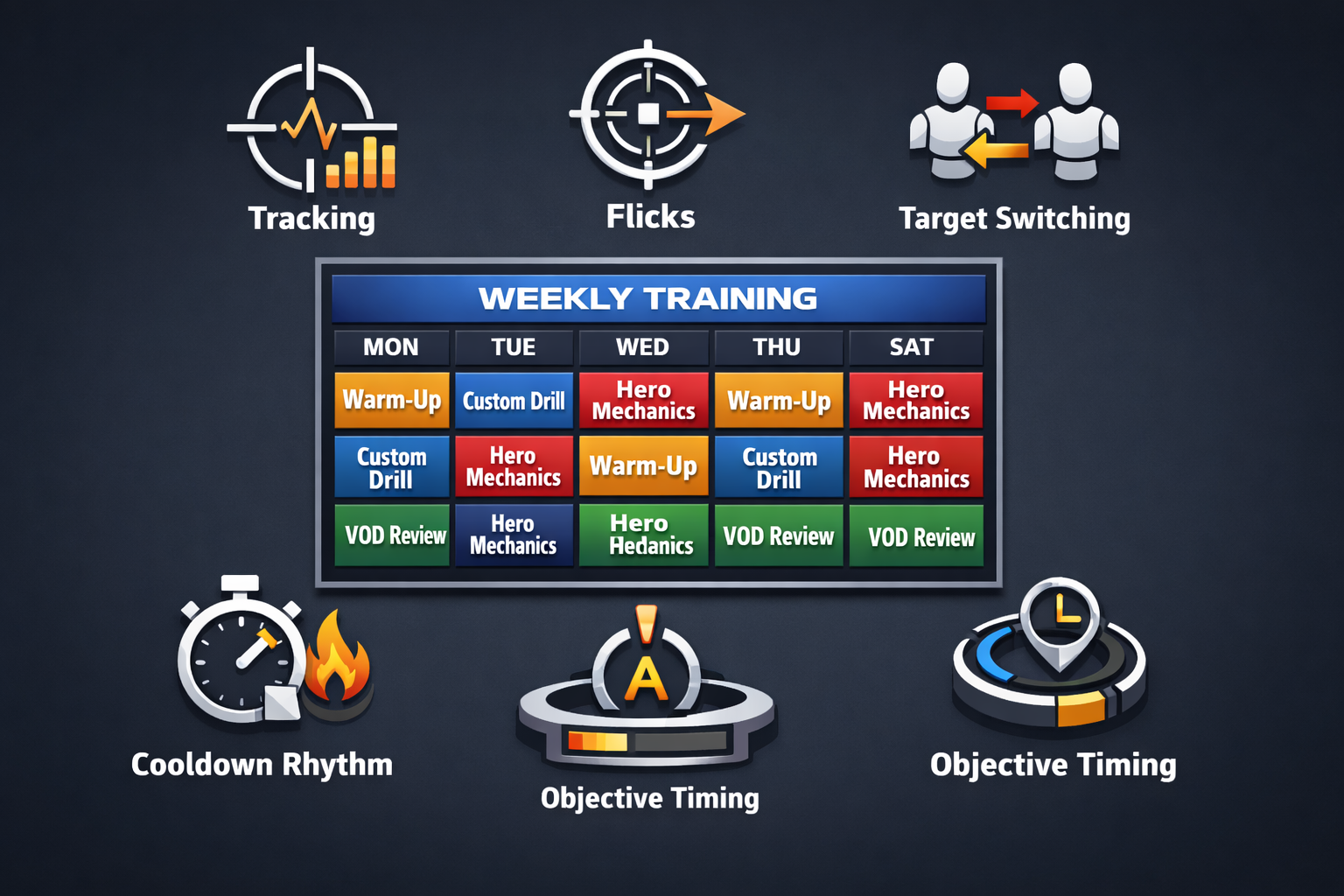
Focus: prediction, rhythm shots, and movement reading. You’re not aiming at the enemy—you’re aiming at where they’ll be.
- Drill: track the target with your eyes, then place shots ahead in a steady tempo.
- Habit: shoot in rhythm instead of spamming.
- Common leak: panic shots when the target changes direction.
Category C: Beam / Continuous Mechanics
Focus: smooth tracking and distance management. Beam heroes often win by holding stable tracking while staying at the correct range.
- Drill: long tracking sets (4–6 minutes) with emphasis on smoothness.
- Habit: reposition before you lose tracking, not after.
- Common leak: standing still to “aim better” (then getting deleted).
Category D: Melee / Brawler Mechanics
Focus: spacing, timing, and ability weaving. In melee fights, “aim” is often positioning: you win by being in the right place at the right time.
- Drill: engage window → hit confirm → exit window (repeat 20 times).
- Habit: never enter without knowing your exit route.
- Common leak: committing all cooldowns at once and becoming helpless.
Category E: Mobility / Dive Mechanics
Focus: entry angles, target selection, and “leave on time.” Dive heroes are punished most by overconfidence.
- Drill: two-second rule—commit for 2 seconds, then exit to cover.
- Habit: pick targets that cannot instantly punish you (or that lack cooldowns).
- Common leak: chasing past your team’s line-of-sight.
Category F: Utility / Support Mechanics
Focus: line-of-sight control, cooldown triage, and survivability. Your mechanics are: stay alive, make teammates unkillable at key moments, and never waste value.
- Drill: “save tools for danger” practice—only use defensive cooldowns after a trigger condition.
- Habit: play a position where you can see both your frontline and your escape route.
- Common leak: drifting too far forward and dying first.
8) Role Drills: Frontline, Damage, Support
Roles vary by hero, but the job stays consistent. These drills train role value that always translates. You can run them in customs or simply as “rules” during real matches.
Frontline Drill Set (Space + Timing)
Frontline goal: create safe space for your team to deal damage and take objectives.
- Drill 1: Space in layers. Step forward to contest, then step back to stabilize. Repeat with a timer.
- Drill 2: Cooldown stagger. Never use two defensive tools at once unless it’s a guaranteed fight win.
- Drill 3: “Don’t die first.” Practice resets: if you drop low, disengage immediately—even if you feel “close.”
Metric: First deaths per match (aim to reduce). Also track “died with cooldowns available.”
Damage Drill Set (Angles + Confirmations)
Damage goal: pressure from safe angles, confirm low targets, and punish mistakes.
- Drill 1: Off-angle timing. Take an angle for 2–3 seconds, then reset before enemies react.
- Drill 2: Low-target priority. In customs, force yourself to swap targets the moment one is “finishable.”
- Drill 3: Burst windows. Practice short high-damage windows, then reposition.
Metric: “Overstay count” + “tunnel deaths” (deaths while chasing a kill too long).
Support Drill Set (Survive + Save + Stabilize)
Support goal: keep fights stable and prevent snowballs by denying enemy spikes.
- Drill 1: Line-of-sight rule. Always keep one escape route and one teammate in view.
- Drill 2: Trigger-based cooldowns. Use defensive tools only after a clear enemy commit (dive, ult, burst).
- Drill 3: Self-preservation. If you die first, you made a positioning mistake—review it.
Metric: Deaths per fight + “died with mobility/escape unused.”
9) Team Combos: Timing, Ult Windows, and Simple Comms
Mechanics win duels. Coordination wins games. The best part: coordination can be trained with simple scripts. You don’t need long comms—just the right words at the right time.
The Three Calls That Matter Most
- “Go in 3” (synchronizes engages)
- “Reset” (prevents feeding and staggers)
- “No escape / no defense” (identifies a punishable target)
Combo Drill: “Layer, Don’t Stack”
Most teams waste value by stacking everything at once. Train this rule: first tool forces movement, second tool secures.
- Initiator uses an engage tool (pressure, displacement, zone).
- Damage follows when enemies are forced into predictable paths.
- Support commits resources only after enemy counter-commit.
Metric: Count how often you “double-commit” (two major tools for one small threat).
Ult Window Drill: “Spend With Purpose”
Ultimates should solve a problem: break a hold, secure an objective, or win a key fight. Practice identifying the problem before you press the button.
- Prompt: “What does this ult win?”
- Bad ults: panic ults to survive when the fight is already lost.
- Good ults: ults that create an unavoidable advantage (space, picks, objective control).
Metric: “Ult used in lost fight” count (reduce it weekly).
10) Objective & Rotation Practice (Without Needing “Scrims”)
Many players practice mechanics and ignore game flow. But objective discipline is one of the easiest ways to climb, because most ranked lobbies are chaotic. Your goal is to be consistently early, set up first, and force opponents into bad entries.
The 20-Second Rule
If an objective fight is coming, your job is to be ready 20 seconds early: take positions, check angles, and stabilize cooldowns. Late arrivals are why teams lose “for no reason.”
Custom Rotation Drill
- Load a map in a custom lobby.
- Choose an objective location.
- Practice 3 approach paths: safe path, fast path, flank path.
- On each path, identify: cover points, retreat points, and “danger corners.”
- Repeat until you can do it without thinking.
Metric: In real matches, track “late to first fight” and aim to reduce it.
Setups That Always Work
- Frontline holds the “stop line” (where enemies must be contested).
- Damage takes an off-angle that sees the stop line.
- Support stays in line-of-sight with an escape route and cover.
11) Fast VOD Review: Fix One Thing at a Time
VOD review doesn’t have to be a 2-hour movie night. You can improve massively with a 10–15 minute review if you know what to look for and you only fix one leak at a time.
The 12-Min VOD Method
- Pick one match where you felt “stuck.”
- Watch only your deaths first (skip everything else).
- For each death, choose one label:
- Positioning (bad angle / no cover / too far forward)
- Timing (late engage / early engage / no reset)
- Mechanics (missed shots / panic aim)
- Cooldown (wasted defense / no escape)
- Awareness (missed flank / tunnel vision)
- Pick the most common label. That’s your next week’s focus.
- Create one rule for ranked: “I do not peek longer than 2 seconds without cover.”
What to Write Down (One Line Only)
Example: “Died first 4 times—overstayed angles. Rule: 2-second peeks, then reset.” That’s enough. Your drills should target that rule.
12) Progress Tracking: Metrics That Don’t Lie
Stats can be misleading in team games, so track metrics that represent decisions and habits—not only damage. Here are the best ones for steady improvement.
Core Metrics (Track 3 Only)
- First deaths per match (reduce it)
- Overstay count (peeking longer than planned)
- Ult waste count (ults used in already-lost fights)
Mechanics Metrics (Optional)
- Warm-up drill score (your own baseline)
- Hit rate while strafing
- Time to confirm low targets in switching drills
Simple Tracking Template
After each session, write: Date — Main focus — 1 metric — 1 rule for next matches. If you keep this for two weeks, patterns become obvious.
13) Weekly Training Plans (Beginner → Advanced)
These plans assume you have limited time. If you play more, don’t extend the warm-up forever—extend your focused reps. The biggest gains come from consistent short sessions, not occasional marathon grinds.
Beginner Plan (4 Days / Week, 45–70 Minutes)
- Day 1: 10-min warm-up + 12-min aim (tracking/switching) + 2 ranked games (focus: reset timing)
- Day 2: 10-min warm-up + 15-min hero mechanics loop + 1 VOD death review (12 minutes)
- Day 3: 10-min warm-up + 12-min movement/corner drill + 2 ranked games (focus: 2-second peeks)
- Day 4: 25-min improvement warm-up + 2 ranked games (focus: ult purpose)
Intermediate Plan (5 Days / Week, 60–90 Minutes)
- 2 days mechanics-heavy (aim + hero loop + movement)
- 2 days custom scenarios (angles + exits, peel, engage timing)
- 1 day VOD + role focus (“I will not die first,” “I will off-angle and reset,” etc.)
Advanced Plan (6 Days / Week, 90–120 Minutes)
- Daily 25-min warm-up
- 3 days duo drills + coordination scripts (timing and layering)
- 2 days objective mapping and rotation practice
- 1 day deep review (two matches) + rebuild next week’s focus
The secret: pick one skill theme per week. Examples: “Angle discipline week,” “Target switching week,” “Cooldown discipline week,” “Don’t die first week.” Weekly themes create momentum.
14) Common Mistakes That Stall Improvement
Mistake 1: Warming Up Too Long
If you spend 45 minutes warming up and then play tired, you’re training fatigue—not skill. Keep warm-ups short and purposeful.
Mistake 2: No Transfer Step
Drills are useless if you don’t bring a single focus cue into real matches. Every session should end with one sentence: “In ranked, I will ___.”
Mistake 3: Changing Heroes Constantly
Learning many heroes at once is fun, but it slows improvement. Use a “main + backup” system: one primary hero to sharpen mechanics, one backup for team needs.
Mistake 4: Playing on Autopilot
Autopilot feels productive because you’re “active,” but it’s not targeted. If you can’t state your focus for today, your session will be random.
15) What to Do When You Plateau
Plateaus usually mean your practice lacks either difficulty, clarity, or recovery. Here’s a fast reset strategy.
Step 1: Reduce Your Focus
If you’re stuck, you’re likely trying to fix too much. Pick one leak: “I die first,” “I overstay,” “I waste ult,” “I miss switching targets.”
Step 2: Increase Drill Quality
Add constraints: timer windows, accuracy thresholds, or fixed cooldown rules. Constraints force better reps and eliminate “lazy practice.”
Step 3: Respect Recovery
Sleep, hydration, and breaks matter more than people admit. If you want a simple reference, the CDC’s sleep resources are a good baseline: cdc.gov/sleep. You don’t need perfection—just consistency.
16) When You Want Faster Results (Coaching / Boosting / Review)
Sometimes you don’t need more practice—you need a faster diagnosis. If you want to accelerate improvement, consider getting a structured review or help reaching a goal rank while you continue training your fundamentals.
If you’re exploring options, Boosteria offers Marvel Rivals services here: Marvel Rivals Boosting Prices. (Use it as a support tool—not a replacement for building your long-term skill.)
And if you play multiple competitive titles, the same training loop in this guide transfers well to other games: stable warm-ups, custom scenario reps, and one-focus ranked sessions.
For general reading on deliberate practice concepts, you can also browse reputable educational sources; keep it light—knowledge is useful only if it turns into reps.
17) FAQ
How long should I warm up before ranked?
10 minutes is enough for most days. Use 25 minutes when you’re specifically training to improve, not when you’re rushing to queue.
Should I practice in custom games or just play matches?
Do both. Custom games build clean mechanics and habits. Matches teach timing, pressure, and decision-making. The best ratio for most players is: short custom reps → ranked with a single focus.
How many heroes should I main?
One main + one backup is the fastest path. Add a third only when you’re stable and consistent.
What’s the best drill if I can only do one?
Target switching (plus peek-reset). It improves fight impact, reduces tunnel vision, and converts damage into wins.
How do I know what to train next?
Review your deaths for 12 minutes and pick the most common reason. Train the reason, not the symptom.
18) Quick Checklist
- Pick today’s focus: one skill only.
- Warm up (10–25 min): aim + hero loop + movement.
- Run one custom drill (8–12 min): repeatable scenario.
- Queue with one rule: “2-second peeks,” “reset on low HP,” “ult with purpose,” etc.
- Track 1 metric: first deaths / overstays / wasted ults.
- Review deaths (optional): 12 minutes, label the pattern, plan next session.
If you do this consistently for two weeks, your gameplay will feel calmer, cleaner, and more intentional. That’s what climbing looks like: fewer mistakes, better windows, and higher-quality reps.