



CS2 Mistakes to Avoid: Overpeeking, Rotations & Utility Fixes
Avoiding Common Mistakes in CS2: Overpeeking, Bad Rotations, and Utility Waste Fixes
In CS2, most players don’t “lose aim” from one round to the next—they lose rounds to repeatable habits. The frustrating part is that these mistakes often feel normal in the moment: one more re-peek to “get info,” a quick rotation “just in case,” a panic smoke because you felt pressure. The result is the same: a round that collapses before you even get a fair fight.
This guide is built to stay useful long-term. It doesn’t rely on a specific map pool, temporary meta, or trendy callouts. Instead, it focuses on three universal round-throwing patterns that show up at every rank: overpeeking, bad rotations, and utility waste. You’ll get practical rules, decision frameworks, checklists, and drills to fix them—without needing a five-stack or a coach in voice every night.
If you want a faster path to consistent results (especially if you’re short on time), you can also check Boosteria CS2 Boosting Prices. Many players use coaching-style guidance and structured play goals to accelerate improvement rather than grinding blindly.
The Real Problem: Why These Three Mistakes Keep Reappearing
Overpeeking, bad rotations, and utility waste share the same root cause: you’re making high-risk decisions without enough structure. When pressure rises—bomb spotted, teammate dies, footsteps heard—your brain wants immediate certainty. That’s when you “check one more angle,” rotate early, or throw a grenade “to be safe.”
The fix is not willpower. The fix is defaults—simple rules you follow under stress. Pros look calm because they’re not inventing decisions mid-round; they’re selecting from a short list of rehearsed options that protect them from panic.
This guide gives you those defaults. If you apply them consistently, you’ll notice three changes:
- You die less to “random” swings and off-angles, because your peeks become intentional.
- You stop losing sites for free, because your rotations become information-driven.
- You win more clutches and retakes, because you actually have utility when it matters.
Quick Win Checklist (Start Winning More Rounds Today)
If you only take one section from this article, take this. These are “queue-safe” rules that work in solo, duo, or full stack. Save them, reread them, and make them your pre-match checklist.
- No re-peek alone. If you peeked and didn’t get the kill, reset or re-peek only with a teammate ready to trade.
- Peek with a purpose. Every peek must answer a question: “Is the angle occupied?” “Can I take space?” “Can we trade?”
- Rotate on information, not vibes. A sound cue, a confirmed sighting, or a teammate’s contact matters. Silence is not proof.
- Utility must have a job. Smoke blocks, flash enables, molly clears, HE finishes. If it doesn’t do one of those, don’t throw it.
- Keep one late-round tool. Save at least one meaningful grenade (flash or smoke) for post-plant, retake, or exit.
- Trade spacing. If you’re with a teammate, be close enough to trade quickly—but not so close you die to the same spray or grenade.
- After a kill, your next goal is survival. The best follow-up to a pick is often falling back and forcing the enemy into worse choices.
Mistake #1: Overpeeking (How to Stop Donating Free Picks)
Overpeeking is the #1 reason ranked games feel “unfair.” You get a kill, you feel hot, you swing again—and suddenly you’re dead to a trade, an off-angle, or a second player holding the exact re-peek you just gave them. This is not bad luck; it’s predictable.
What Overpeeking Looks Like
- Re-peeking the same angle after the enemy now expects you.
- Wide-swinging without support when a tighter “info peek” would do.
- Chasing a kill instead of keeping advantage (especially after first blood).
- Peeking while isolated when no one can trade you.
- Peeking into multiple threats (two angles at once) without clearing one side first.
Why It Happens (The Psychology)
Overpeeking is usually a reaction to uncertainty. You want to confirm what’s happening—fast. But CS2 rewards players who convert uncertainty into controlled information, not reckless certainty. The moment you show your model to the enemy (position, timing, peek style), you lose surprise. The enemy can now set a trap: crosshair placed, teammate ready, utility prepared.
The “Peek Budget” Rule
Give yourself a simple budget per fight: one clean peek for info or a kill, one follow-up only if conditions are met. If conditions aren’t met, you must reset (reposition, change timing, or play off teammate utility).
Conditions to Re-Peek (All Must Be True)
- A teammate can trade you immediately if you die.
- You changed something (timing, height, angle, or utility). Same peek = same death.
- You are not peeking into two threats at once.
- You have a reason beyond curiosity (secure space, punish reload, confirm bomb, stop plant).
If you can’t check all four, don’t re-peek. This alone will reduce your “unlucky” deaths massively.
Three Safe Peek Types You Should Master
1) The Info Peek (Low Commitment)
Goal: confirm presence without committing to a duel. You show minimal body, you don’t chase, and you’re ready to fall back. Use it when you’re unsure, outnumbered, or playing for teammates to rotate.
- Use cover as a shield. Show as little as possible.
- Don’t spray. A quick tap and reset is often safer.
- Fall back after contact to deny an easy trade.
2) The Trade Peek (High Value Team Play)
Goal: swing because your teammate is taking contact, or you’re swinging to trade them instantly. The trade peek is one of the highest win-rate mechanics in the game because it converts “even aim” into guaranteed impact.
- Stand close enough to trade quickly.
- Communicate: “Swing on my contact” or “I’m contact, trade me.”
- Don’t both peek at the same time unless one is baiting intentionally.
3) The Utility Peek (Stack the Odds)
Goal: peek when the enemy is disadvantaged—blinded, smoked off, displaced, or forced to move. This is how you win “impossible” angles without needing hero aim.
- Flash to create a timing window.
- Smoke to isolate a duel (make the fight 1 angle instead of 2).
- Molly to clear a corner so you don’t fight an unseen player.
Overpeeking Fixes: Practical Rules That Work in Ranked
Rule A: After First Blood, Don’t Give It Back
If you get a pick and your team still has the same number of players alive, your next job is often to preserve the advantage. That usually means falling back to a safer position, changing angle, or playing for the next contact. One life can be worth more than one extra kill attempt.
Rule B: If You’re Alone, Your Best Weapon Is Time
Isolated peeks are where solo queue throws are born. If you’re alone on a side of the map, your goal is rarely to fight three people by yourself. Your goal is to delay, gather info, and stay alive so your team can respond. Peek less, reposition more.
Rule C: Never Peek Two Angles at Once
“Dying instantly” often means you exposed yourself to two threats. Fix this with a simple habit: slice the pie. Clear one slice (one angle) at a time. If you must wide swing, do it only when you know the second angle is blocked, smoked, or covered by a teammate.
Micro-Drill: The 10-Minute Anti-Overpeek Session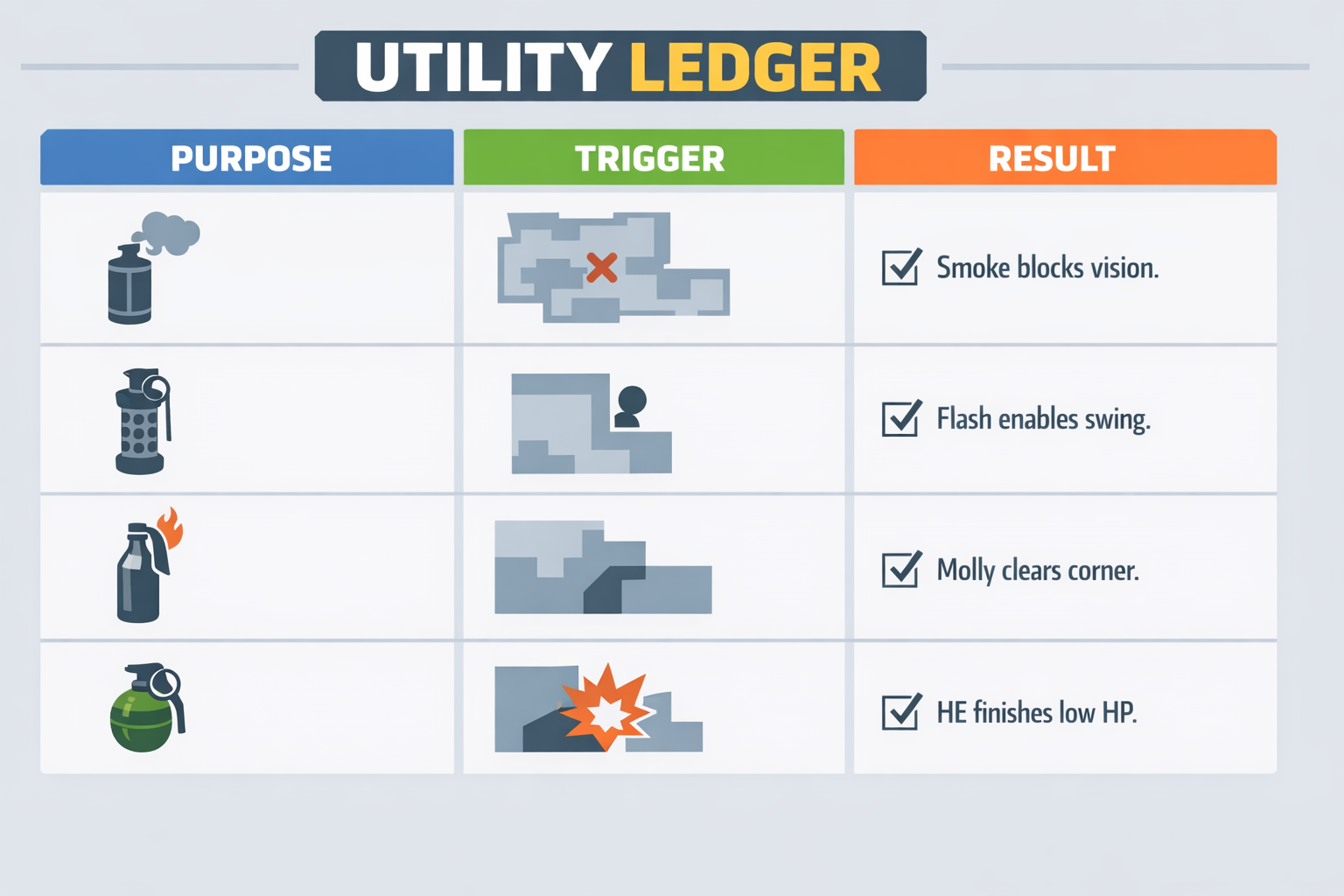
- Queue a fast aim routine (DM or workshop) with one focus: one peek, reset.
- Every time you take a duel, force yourself to break line of sight immediately after 3 bullets.
- Practice “kill then disappear”: get the frag, then change position.
- At the end, ask: “How many times did I die because I wanted a second look?”
Track that number. Your goal is not perfect aim—it’s reducing needless deaths. Less donating = more wins.
Mistake #2: Bad Rotations (How to Rotate with Information, Not Fear)
Rotations decide games. Good rotations feel invisible: the defense is always “just there,” or the offense always finds the weak site. Bad rotations feel like chaos: you arrive late, you stack wrong, you leave gaps, or you give up a site for free.
Two Rotation Errors That Lose the Most Rounds
1) The Panic Rotate (Leaving on Unconfirmed Pressure)
This is the classic: you hear a few steps, a smoke pops, or a teammate says “A!” with no contact. You rotate, and the enemy walks into the empty site you just abandoned. The core issue is treating noise as certainty.
2) The Frozen Rotate (Staying Too Long While the Site Dies)
The opposite problem: you demand perfect proof before moving. By the time you rotate, the bomb is down and your teammates are dead. Now you’re in a low-percentage retake with little utility.
The solution is a rotation framework that turns imperfect information into consistent decisions.
The “3 Questions” Rotation Framework
Before rotating, answer these in your head (or quickly in voice):
- What do we know? (Confirmed sighting, contact, bomb, utility patterns, teammate death location.)
- What can happen next? (Fast hit, fake, split, lurk, delayed exec.)
- How fast can we respond if we’re wrong? (Time to rotate back, path safety, who anchors.)
If you can’t respond quickly when wrong, you must rotate more cautiously: “shade” toward the threatened area, don’t fully abandon your post.
The Difference Between “Shading” and “Rotating”
- Shading = reposition slightly to cover a likely hit while still being able to return fast.
- Rotating = fully committing to support the other site, often giving up your original angle.
Most ranked throws happen because players rotate when they should shade. Shading keeps the defense flexible and protects against fakes.
Rotation Roles (Even in Solo Queue)
You don’t need a team structure to use roles. You just need to recognize what you’re currently doing.
- Anchor: protects a site from being free. Anchors rotate last unless the hit is confirmed.
- Support Rotator: shades early, ready to help, but keeps an escape route to return.
- Info Player: takes a safe line to confirm what’s real (sound, contact, visual) and calls it clearly.
If nobody anchors, sites get given away. If everybody anchors, teammates die alone. Balance wins rounds.
Bad Rotation Triggers (Stop Believing These)
- “They smoked something.” Smokes can be pressure, a fake, or a lurk setup. Wait for contact or layered clues.
- “I heard steps.” Steps can be one player baiting sound. Confirm with timing, utility, or a teammate’s info.
- “They always go A.” Patterns are real, but relying on them blindly makes you predictable. Use patterns as a tie-breaker, not proof.
Good Rotation Triggers (Trust These More)
- Two-player confirmation: two teammates report pressure or contact from different perspectives.
- Contact + utility: shots/spotting plus supportive utility behind it (flashes, smokes, molly clearing).
- Bomb info: visual confirmation, dropped bomb location, or a teammate’s reliable call.
- Teammate death location: where and how a teammate died often reveals the attacking route and timing.
Rotation Pathing: Rotate Like You Want to Live
Even correct rotations fail because the route is unsafe. Common mistakes: rotating through exposed lanes, sprinting loudly, or running through “unknown” territory without clearing.
Safer Pathing Rules
- Rotate through cover when possible, even if it’s slightly slower.
- Clear one danger point on the way. You don’t need to clear the whole map, but don’t run blind.
- Arrive ready: stop sprinting before the last corner so your first bullets aren’t inaccurate and your sound isn’t a warning siren.
- Think about the lurk: if the enemy might have a late player, don’t rotate with your back exposed.
Rotation Timing: “Early Enough to Help, Late Enough to Be Right”
That’s the ideal. Use shading to get early without committing. A simple approach:
- First hint of pressure: shade (move to a position that helps but keeps your original site protected).
- Second hint or contact: prepare (teammate call, utility heard, or death info suggests a real hit).
- Confirmed hit: rotate (commit fully with purpose: trade, retake setup, flank control).
Offense Rotations: How T-Side Throws the Round
Bad rotations aren’t just a defense problem. Attackers throw by “over-rotating” too: you see one smoke, you turn the whole team, you walk into a stack. Or you rotate slowly with no map control and die to flanks.
T-Side Rotation Defaults
- Don’t rotate everyone. Leave at least one player as a “pin” to prevent defenders from pushing freely.
- Rotate with purpose. Are you avoiding stacked defense? Forcing a better bomb plant? Punishing a rotation?
- Take safe space before rotating. If you rotate through open territory with no info, you hand defenders free picks.
For pro examples and structured match knowledge, browsing professional match coverage can help you see how good teams manage space and rotations. Trusted resources include HLTV and Liquipedia Counter-Strike.
Mistake #3: Utility Waste (How to Make Every Grenade Have a Job)
Utility is not decoration. Utility is a decision tool that changes what fights are possible. When you waste grenades early, you remove your ability to solve problems later: retakes become impossible, post-plants become shaky, and defenders walk through your setups.
The Utility Mindset Shift: From “Throwing” to “Assigning Jobs”
Stop thinking: “I should use a smoke here.” Start thinking: “What job must be done?” Every grenade should fit one of these jobs:
- Block: remove vision so you can cross or isolate a duel.
- Enable: flash to create a timing window for a swing.
- Clear: molly a common hold so you don’t face a hidden threat.
- Finish: HE to convert damage into a kill or force a player off a spot.
- Delay: stall pushes, slow retakes, or buy time for rotations.
- Info: force movement or reveal presence through reactions.
If your grenade doesn’t clearly do one of these, it’s probably wasted.
Common Utility Waste Patterns (And the Fix)
1) Panic Smokes
You feel pressure and smoke a choke with no plan. The enemy waits it out, bursts through together, or uses the smoke as cover. Fix: smoke with a follow-up. A smoke is strongest when paired with a second layer: a molly to stop a walk-through, a flash to punish a push, or a reposition to a new angle.
2) Lone Flashes That Help Nobody
Throwing a flash without a teammate swing (or your own swing) is often worthless. Fix: pair flashes with a defined action: “Flash then swing,” “Flash to cross,” “Flash to retake.” If nobody is acting during the flash window, the flash did nothing.
3) Mollying Air (Wrong Timing)
A molly thrown too early clears a corner that no one is holding yet. Too late, and you die before it lands. Fix: use molotovs as “corner insurance” right before you must take a space. If you’re not moving into the area while it burns, the value drops sharply.
4) HEs with No Conversion
Damage is only valuable if it changes behavior: forces someone off a spot, creates a kill opportunity, or wins a trade. Fix: use HE grenades when you can convert damage into a kill or a forced reposition. Otherwise, save them for post-plant denial or retake pressure.
5) Spending Everything Early
Early-round utility can be useful for map control, but spending everything removes late-round power. Fix: keep a “late-round reserve.” A simple rule: save one flash or one smoke for after the bomb is planted or for the retake.
The Utility Ledger (A Simple System You Can Use Immediately)
Imagine you have a small budget. Before the round starts, decide:
- Round goal: take space, hold space, retake, fast execute, slow default.
- Must-have moments: “We need a smoke to cross,” “We need a flash to enter,” “We need something for post-plant.”
- Reserve: one piece of utility you refuse to waste early.
You don’t need perfect nade lineups to use this ledger. You need discipline.
Utility Priority by Situation
On Defense (Holding)
- First priority: delay. Your job is buying time for rotations.
- Second priority: survive. Utility that helps you escape or reposition is often more valuable than “damage.”
- Third priority: punish. Flashes and HE become great when the enemy commits through a choke.
On Attack (Taking Space)
- First priority: isolate fights. Smokes reduce how many angles can shoot you.
- Second priority: create a timing window. Flashes let you move while the enemy can’t respond.
- Third priority: clear the most common hold. Mollies remove the “free kill corner.”
Post-Plant
- Smoke = time tool. It blocks vision and forces retakers into uncomfortable routes.
- Flash = fight tool. It wins the moment retakers have to clear.
- Molly = denial tool. It forces players off defuse angles or clears a stubborn corner.
Retake
- Don’t trickle. Retakes fail because teammates enter one-by-one.
- Use utility to take one “slice” at a time. Smoke an angle, flash a corner, then clear together.
- Save a flash for the final clear. The last fight often decides the round.
Trusted References for Fair Play and Competitive Context
For official game context, competitive ecosystem notes, and platform support information, refer to Counter-Strike official site and CS2 on Steam. These are also good places to confirm official announcements and updates without relying on rumors.
Communication Templates That Prevent Throws
Most ranked comms fail for one reason: they don’t produce decisions. “They’re here” is noise. “Two pushing, one low, bomb seen” creates a response. Use these templates to keep comms short and useful.
The 4-Part Call (Fast and Complete)
- Count: how many you saw/heard.
- Intent: pushing, holding, falling back, planting.
- Status: damage, utility used, bomb seen.
- Request: rotate, flash, trade, hold.
Example: “Two pressuring, one close, smoked off, bomb not seen—shade over, don’t full rotate.”
The Anti-Panic Phrase
Say this when teammates start panic rotating: “Shade, don’t leave.” It reminds the team to support without abandoning the anchor.
The Trade Reminder
Before a contact fight: “Swing with me, trade me.” One sentence can turn a messy duel into a clean 2v1.
Mid-Round Decision Frameworks (What to Do When the Plan Breaks)
Mid-round is where throws are born because it’s where the game stops being scripted. Use these frameworks to reduce “guessing” and increase consistency.
Framework 1: The Reset Rule
If your team loses a player early or your first attempt fails, you don’t have to force a hero play. A reset can win rounds: slow down, regroup, take safe space, and execute with structure.
- Stop feeding: no solo peeks.
- Regain info: take one safe control point as a team.
- Choose a plan: hit together, fake and split, or save and hunt exits (depending on economy).
Framework 2: The “One More Layer” Rule
If you feel stuck, add one layer—don’t add chaos. One layer can be: a flash for entry, a smoke to isolate, a molly to clear, or a teammate to trade. Most players respond to uncertainty by peeking; better players respond by layering.
Framework 3: The Numbers Rule
Your decision should change based on player count:
- 5v4 / 4v3: reduce risk. Make them come into you. Don’t give an equalizer for free.
- 4v5 / 3v4: look for a structured way to recover: trades, grouped plays, or a clear timing window.
- 2v2 / 1vX: value utility and information. Clutches are won by isolating fights, not taking them all at once.
A Simple Practice Plan: Daily, Weekly, and “Before Queue”
You don’t need hours every day. You need consistency and the right focus. Here’s a plan built around fixing the three mistakes from this guide.
Before Queue (10–15 Minutes)
- 2 minutes: crosshair discipline warm-up (slow, deliberate shots).
- 5–8 minutes: fast aim routine (DM or training) with one rule: one peek then reset.
- 2 minutes: utility intention: pick one grenade you will save for late-round.
- 1 minute: read the quick win checklist above.
Daily Focus (Pick One Theme Per Session)
- Anti-overpeek day: no solo re-peeks, trade discipline, reposition after kills.
- Rotation day: shade vs rotate decisions, safer pathing, clearer comms.
- Utility day: “every nade has a job,” save one tool for late-round.
Weekly Improvement (30 Minutes Total)
Once a week, review 2–3 rounds where you lost momentum. Don’t review the whole match. Look for the pattern: overpeek, panic rotate, or wasted utility.
How to Review Your Own Games (Fast, Not Painful)
Most players avoid review because they think it requires deep analysis. You can improve quickly by answering three questions for each mistake category.
Overpeeking Review Questions
- Did I re-peek without trade support?
- Did I peek with a purpose, or just curiosity?
- After a kill, did I reposition or stay predictable?
Rotation Review Questions
- Did I rotate because I knew, or because I felt?
- Was I an anchor when I needed to be?
- Was my rotation path safe, or did I donate a free pick?
Utility Review Questions
- What job did my grenade do?
- Did we act during the flash window?
- Did I save at least one tool for the round-deciding moment?
Write down one “rule” you broke most often. Next session, that becomes your single focus. This is how you turn review into wins.
FAQ
How do I stop overpeeking if my teammates don’t trade?
Assume you’re alone by default. Use info peeks, fall back after contact, and reposition after a kill. If teammates won’t trade, your job becomes survival and delay. You can still win rounds by staying alive and forcing the enemy to waste time and utility.
When should I rotate, and when should I hold?
Rotate on confirmation (contact, layered utility with pressure, bomb info, teammate deaths that reveal the hit). Shade early when you suspect a hit but cannot confirm. Anchors rotate last; support rotators shade first.
What’s the easiest way to improve utility usage without learning tons of lineups?
Use the “utility has a job” rule. Your grenade should block, enable, clear, finish, delay, or gain info. Also adopt a late-round reserve: save one flash or smoke for the final fight (post-plant or retake). You’ll get more value from discipline than from fancy throws.
Why do I feel like I always rotate late?
Many “late rotations” are actually information failures. Improve your calls (count + intent + status + request), shade earlier to reduce travel time, and rotate through safer routes so you don’t stop to fight unnecessary duels.
How do I reduce throw rounds when we have the advantage?
Use the numbers rule: when you’re up a player, reduce risk. Stop solo peeking, force the enemy to make the next mistake, and keep utility for the round-deciding moment. The easiest way to lose a 5v4 is giving the enemy a free 4v4.
Summary: The Habits That Make You Climb
CS2 improvement is not magic. It’s removing the habits that donate rounds. Fix these three and your win rate will rise even if your raw aim stays the same:
- Overpeeking: one peek, reset, re-peek only with trade support and changed conditions.
- Bad rotations: shade vs rotate, commit on information, and rotate through safer routes.
- Utility waste: every grenade has a job, pair flashes with action, keep a late-round reserve.
If you want to accelerate progress with structured goals and a faster climb path, you can review Boosteria CS2 Boosting Prices. Whether you grind ranked or learn through guided improvement, the core remains the same: fewer donated deaths, smarter rotations, and utility that actually decides rounds.