



Marvel Rivals Positioning Guide: Frontline vs Backline
Marvel Rivals — Role Positioning: Frontline Space vs Backline Safety
Positioning is the hidden language of every winning teamfight in Marvel Rivals. Aim matters, cooldown timing matters, and hero choice matters, but all of those things become easier or harder depending on where each player stands. Good positioning turns average mechanics into reliable value. Bad positioning makes strong mechanics feel useless. If your frontline is too passive, your team never gets room to play. If your backline is too exposed, the fight collapses before it really starts. If your damage players take angles without exit plans, pressure turns into feeding. The result is a match that feels chaotic even when the real problem is simple: your team is standing in the wrong places at the wrong times.
This guide is built to stay useful over time. Instead of focusing on one patch, one map gimmick, or one hero trend, it explains the timeless structure behind role positioning in Marvel Rivals. Whether the roster grows, balance changes, or the ranked environment shifts, teams will still need to create space in front and protect value in back. That principle does not expire. If you understand it, you will climb more consistently, review your own mistakes more clearly, and become much harder to punish in solo queue and coordinated play alike.
At the center of the topic is one strategic tension: frontline space vs backline safety. Every team wants both. Every team cannot have both for free. To create room, someone must threaten, contest, body-block, anchor, or pressure key sightlines. To keep the backline safe, someone must control flanks, deny dives, reduce free angles, and refuse bad chases. Great positioning is the art of balancing those needs. The best teams push forward without disconnecting. The best players know when to advance, when to pause, and when to fall back one step so their team can survive the next five seconds.
If you want to follow official updates, hero releases, and game information while practicing these ideas, keep an eye on the official Marvel Rivals website and the game’s Steam page. And if you want a faster route through the ranked ladder while sharpening core fundamentals, you can also check Marvel Rivals boosting prices from Boosteria.
Table of Contents
- Why Positioning Wins More Fights Than Players Realize
- The Core Idea: Frontline Space vs Backline Safety
- How Marvel Rivals Roles Fit Into Positioning
- How to Create Frontline Space Without Feeding
- How to Protect the Backline Without Giving Up the Map
- Where Duelists Should Stand and Why They Often Misposition
- Angles, Cover, and Line of Sight
- Positioning Through the Three Phases of a Teamfight
- Map Geometry, Chokepoints, and Objective Control
- Positioning in Solo Queue vs Coordinated Teams
- The Most Common Positioning Mistakes by Role
- How to Review Your Own Positioning and Improve Faster
- Timeless Habits That Keep You Hard to Punish
- FAQ
- Conclusion
Why Positioning Wins More Fights Than Players Realize
Many players think of positioning as a passive concept. They imagine it as “stand somewhere safe” or “don’t overextend.” That view is incomplete. Positioning is active. It is not just where you are; it is what your location allows and what it denies. A position can create pressure, remove enemy options, screen for allies, bait cooldowns, protect healing lines, threaten a flank, force enemy movement, or secure a retreat. The same hero can feel weak in one position and oppressive in another without changing a single cooldown.
That is why ranked games often feel easier when your team “just clicks,” even if nobody says much. Usually what happened is that your frontline held usable space, your backline stayed in healable sightlines, and your damage players took angles that were dangerous but not suicidal. In other words, the teamfight had shape. The reverse is also true. Bad games often look like individual mistakes, but the deeper cause is that the fight had no shape at all. The tank walked too far, the support stayed too wide, the damage player peeked before pressure was ready, and everyone ended up taking separate duels instead of one connected fight.
Positioning also scales better than aim alone. Great aim wins isolated moments. Great positioning wins more moments per match because it keeps giving you good looks. It lets supports survive long enough to rotate cooldowns twice. It gives Duelists cleaner windows to burst targets that are already under pressure. It lets Vanguards contest without instantly trading their life for nothing. Over a long season, those small structural advantages create a lot of extra wins.
The Core Idea: Frontline Space vs Backline Safety
To understand positioning in Marvel Rivals, define the two sides clearly.
Frontline space is the territory your team can use because someone is contesting danger in front of them. Space is not just distance. It is permission. If your Vanguard stands in a lane, pressures a choke, and forces enemies to respect that presence, your team gains permission to step up, aim, heal, and rotate more comfortably. That is frontline space.
Backline safety is the ability of your vulnerable value pieces to function without being instantly collapsed on. It includes healers, ranged damage dealers, setup-dependent heroes, and any teammate holding an important angle with limited escape. Safety does not mean complete comfort. It means the backline can operate while still having cover, peel access, sightline discipline, and retreat options.
The tension appears because aggressive space creation usually stretches the team forward, while safety usually asks the team to remain connected and layered. Push too hard for space and your backline becomes dive food. Play too defensively for safety and you surrender the map, lose angle control, and let the enemy walk into favorable positions for free. The answer is not choosing one over the other. The answer is syncing them.
Strong teams create usable space rather than decorative space. Decorative space is when the frontline walks deep, but nobody behind them can follow safely. Usable space is when the frontline advances only as far as the backline can still see, heal, and support the fight. That difference separates pressure from overextension.
How Marvel Rivals Roles Fit Into Positioning
Marvel Rivals uses role identities that help frame positioning decisions. Even as hero kits vary, the broad job descriptions remain useful.
Vanguards
Vanguards usually carry the burden of first contact. Their positioning determines whether the team has room to breathe or gets pinned too early. A good Vanguard does not simply absorb damage. They occupy lanes, anchor corners, contest entrances, and force the enemy to spend resources before the backline is threatened. The best Vanguard positioning is assertive but readable to teammates. If your team cannot tell where to play around you, your presence creates noise instead of structure.
Duelists
Duelists convert pressure into kills. Their best positions are rarely the absolute front. They want angles that become powerful because the frontline is already demanding attention. Many Duelists misposition by either stacking directly behind the tank with no angle, or taking a wide flank before the enemy is busy. The role thrives in the window between those extremes.
Strategists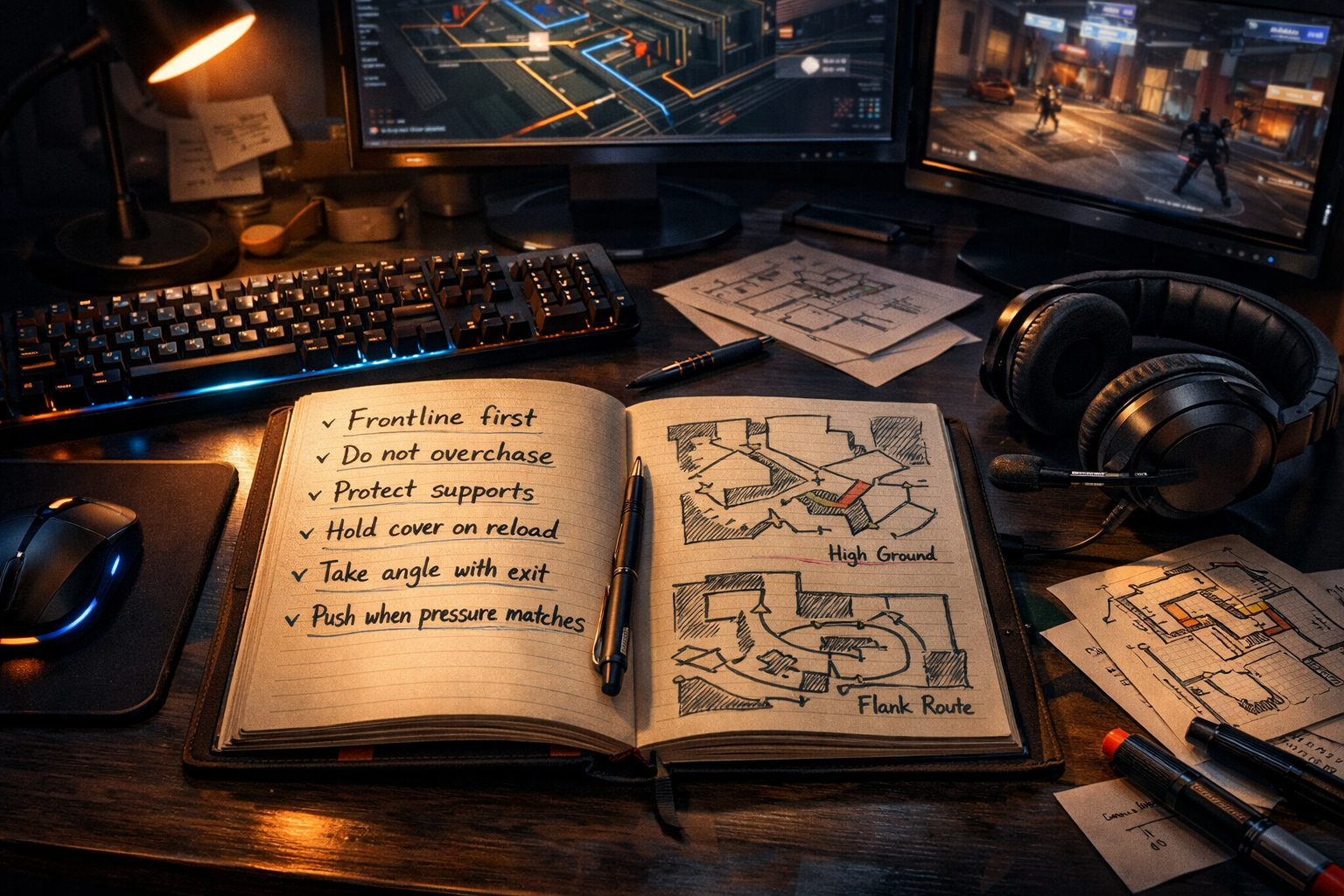
Strategists keep teams alive, stabilize tempo, and often decide whether a fight can be sustained after first contact. Good Strategist positioning is not “stand in the back” by default. It is “stand where you can influence the fight while forcing the enemy to work to reach you.” That usually means nearby cover, clear line of sight to key allies, access to peel, and an easy rotation route if the frontline shifts.
When these roles position well together, the team creates layers. The frontline absorbs attention. The midline converts that attention into damage. The backline sustains the system and denies collapse. When these layers break, everyone starts taking isolated risks, and teamfights become coin flips.
How to Create Frontline Space Without Feeding
Many players hear “make space” and immediately think it means “walk in.” That is the fastest way to feed. Space is created through controlled threat, not mindless movement.
The first rule is simple: own the next useful corner before you own the next open area. Corners are where frontline positioning becomes efficient. A corner lets you pressure, hide, re-peek, and bait cooldowns without exposing your full hitbox for free. Open space only becomes valuable once your team has already won the right to stand there.
The second rule: your team must be able to use the space you create. If you move so far forward that your Strategist loses line of sight or your Duelists cannot safely follow, you have not made good space. You have only moved your own body into a worse place. Frontline space is a team resource, not a solo adventure.
The third rule: pressure enemy sightlines before you pressure their health bars. Sometimes the correct frontline move is not to commit damage. It is to step into a lane, show presence, and force the enemy backline to give ground. That small displacement can open a cleaner angle for your own damage player or give your support safer access to the objective. Space often begins as visual pressure before it becomes lethal pressure.
The fourth rule: do not cross neutral ground alone. Neutral ground is the dangerous distance between cover points, corners, or map features where neither side has clear control. When Vanguards run across that space without timing, they burn cooldowns early, become unhealable, and give the enemy free focus fire. Crossing should be synced with allied sightlines, cooldown readiness, or enemy distraction.
The fifth rule: retreat one step earlier than your ego wants. Good frontlines do not die proving they were brave. They reset, re-hold, and let the next cycle begin from a still-playable position. Living with low health behind a corner is often more valuable than trading out late in a lost push. The team still gets your body, your presence, and your next cooldown rotation.
A useful mental model for Vanguards is this: your job is to make the next five seconds easier for everyone behind you. If your move makes those five seconds more stable, it is probably good. If it makes those five seconds chaotic, blind, or disconnected, it is probably bad.
How to Protect the Backline Without Giving Up the Map
Backline safety is often misunderstood as “stand farther away.” Distance helps, but it is not enough. A backline can be far away and still be completely unsafe if enemies have clean dive routes, if the support cannot break line of sight quickly, or if multiple enemy angles converge on the same spot.
Real safety comes from four things working together: cover, spacing, peel access, and rotation routes.
Cover means you always know what object or corner you can instantly tuck behind. Not in three seconds. Instantly. If you must run through open space to reach safety, you were not safe in the first place.
Spacing means you are not stacked so tightly that one dive or one area threat compromises the whole backline, but not so wide that nobody can help each other. There is a sweet spot where teammates can peel without all becoming the same target.
Peel access means your nearest allies can actually respond when you are pressured. Backline players often misjudge safety because they think help exists in theory. Help only counts if your allies have line of sight, movement options, and enough proximity to matter before the duel ends.
Rotation routes are your escape paths if the frontline loses ground or the enemy shifts angles. Great backline players are already thinking about their second position before the fight fully starts. They know where they will move if the fight tilts left, if a diver appears behind them, or if the objective opens a new lane.
Backline safety also depends on discipline. Do not walk into open sightlines to heal one extra point of damage if a safer micro-step would keep you alive. Do not drift into an isolated off-angle just because the fight feels won. Many backline deaths happen after the team gains advantage, because someone relaxes spacing before the enemy is actually finished.
The best backline players are calm, boring, and difficult to reach. They are not passive. They are simply expensive to punish.
Where Duelists Should Stand and Why They Often Misposition
Duelists are the bridge between frontline pressure and backline punishment. When they position well, they make every bit of space the tank creates feel dangerous. When they position poorly, they either become invisible or feed for a highlight that never comes.
The most common Duelist mistake is taking an angle too early. Off-angles are strongest when the enemy is already forced to split attention. If you peek a flank before your frontline draws eyes, the enemy can isolate you with no cost. That is not pressure. That is a volunteer 1vX.
The second common mistake is taking no angle at all. Some Duelists stand directly behind the Vanguard every fight, shooting the same target from the same line. That reduces the team’s threat footprint. If all pressure comes from one direction, the enemy can hold one cover pattern and survive too easily. Duelists should usually seek a connected angle: a position that creates crossfire while still allowing retreat back into team influence.
The third mistake is chasing too deep after first damage connects. Positioning is most fragile in the moment after advantage begins. A Duelist sees a weak enemy and runs forward, but crosses the invisible line where healing, peel, and cover disappear. Many lost fights begin as almost-won fights because a damage player mistook “we have pressure” for “I can go anywhere.”
Ask yourself three questions before taking a Duelist angle:
- Can the enemy look at me without exposing themselves to my team?
- If someone jumps me, can I break line of sight or get peel quickly?
- Does my timing match the pressure my frontline is creating right now?
If the answer to all three is yes, the angle is probably strong. If two answers are no, the angle is probably grief.
Angles, Cover, and Line of Sight
Most positioning decisions in Marvel Rivals come down to geometry. Heroes and cooldowns matter, but geometry decides whether those tools can be used efficiently. Learn to see every fight through three elements: angles, cover, and line of sight.
Angles
An angle is the direction from which you threaten the enemy. More angles usually mean more pressure, but only if those angles are connected. Two teammates creating a crossfire with mutual timing are powerful. Two teammates on opposite sides of the map with no support for each other are just isolated.
Good angle play does not mean maximum width. It means enough width that the enemy cannot comfortably hide from everyone at once. Connected angles also make healing and peeling more realistic. That is why disciplined mid-width off-angles are often stronger than heroic deep flanks.
Cover
Cover is your best friend because it changes the cost of every peek. With cover, you can pressure in bursts, reload safely, wait for healing, and survive enemy focus. Without cover, even good aim becomes fragile. Players often ask why they die so quickly despite landing shots. The answer is usually that their position required them to stay exposed longer than the enemy did.
A great habit is to treat every fight as a chain of cover points. Move from one usable object or corner to the next. If your route to the next piece of cover is too long, wait for better timing or a different path.
Line of Sight
Line of sight determines who can influence whom. Supports need line of sight to save. Damage players need it to punish. Frontlines need to know when they have it and when they have lost it. A huge amount of ranked frustration comes from players making moves that are technically aggressive but functionally invisible to their team. If nobody can see you, help you, or follow you, your pressure is probably wasted.
At the same time, denying enemy line of sight is one of the easiest ways to stay alive. You do not always need to escape a threat entirely. Sometimes you only need to break vision for one second to force a cooldown, cancel a dive path, or buy time for peel.
Positioning Through the Three Phases of a Teamfight
Positioning changes as fights evolve. A spot that is good before contact may be bad after cooldowns are exchanged. Thinking in phases helps.
1. Pre-fight
This is the setup phase. Your goals are to claim useful space, establish safe sightlines, and avoid losing resources before the real fight begins. Vanguards want to hold a contestable corner or lane. Strategists want clear lines to key allies without becoming the first target. Duelists want connected off-angles, not hero flanks.
In pre-fight, patience wins. Do not leak health for no reason. Do not reveal your best angle too early. Do not burn movement to gain a position you cannot keep. A lot of players sabotage fights before they start by treating setup as if it were already the brawl.
2. First contact
This is the most delicate phase. Pressure arrives, cooldowns trade, and both teams test each other’s spacing. Frontline players should lean into cover usage and readable pressure. Duelists should widen just enough to create crossfire. Strategists should shift with the team’s center of gravity rather than standing frozen in the original setup spot.
The major question here is whether your team stays layered. If the frontline enters but the backline remains too far, the push stalls. If the backline steps too far too fast, they become targetable. If Duelists widen too much, peel lines break. Great teams glide through first contact with small adjustments instead of dramatic movements.
3. Conversion or disengage
Once a fight tips, positioning becomes about discipline. If your team gains advantage, convert without throwing shape away. Push forward, but keep cover, keep line of sight, and keep escape options. If your team loses advantage, disengage quickly to the nearest playable position rather than bleeding out one at a time.
Many players understand how to start fights but not how to end them. That is why so many won fights become messy trades and so many lost fights become complete wipes. Conversion requires restraint. Disengage requires honesty. Both are positioning skills.
Map Geometry, Chokepoints, and Objective Control
Different maps in Marvel Rivals create different positioning puzzles, but the fundamental questions stay the same. Where is the next useful cover? Which lane matters most? Which angle threatens the backline? Which route becomes unsafe if the frontline loses one step of ground?
Chokepoints amplify frontline value. In narrow areas, a good anchor can deny enemy movement, block clean access, and create a stable window for the backline to operate. But chokes also punish stacked teams. If everyone piles into one lane with no angle variation, the enemy only has to aim in one place. The answer is usually layered control: frontline at the edge of the choke, one damage angle offset, and backline positioned to support without being trapped.
Open objectives increase the importance of sightline discipline. In open areas, the question is not just whether you can stand on point. It is whether your team can stand there without being seen from too many directions. Often the strongest way to play an objective is not to sit on it mindlessly, but to control the nearby angles that make standing on it safe.
High ground or elevated pressure positions are valuable because they improve visibility, damage uptime, and retreat routes. But they are not automatically correct forever. A position is only as good as your ability to hold it under current pressure. If the enemy has already shifted resources to contest it and your team cannot support it, stubbornly holding that high-value angle can become a throw.
Always think of objective control as a consequence of space, not a substitute for it. Teams often lose because they rush to touch an objective before controlling the angles around it. The objective is important, but the geometry around the objective decides whether touching it is smart or suicidal.
Positioning in Solo Queue vs Coordinated Teams
Solo queue positioning is not the same as organized team positioning. The principles are identical, but the margin for trust is much lower. In solo queue, you must position for the team you actually have, not the team you wish you had.
If your frontline is overaggressive, the backline often needs to position one layer safer and prioritize self-preservation. If your supports are slow to rotate, your frontline may need to create space in shorter bursts rather than deep holds. If your Duelists never take angles, you may need to play more directly through the main lane and focus on clean target focus instead of elaborate crossfires.
That does not mean abandoning good fundamentals. It means scaling them to reality. In coordinated play, you can hold wider structures because callouts and peel timing are more reliable. In solo queue, connected positions become even more important because rescue windows are smaller and misreads happen constantly.
A strong solo queue rule is this: be aggressive only from positions that still respect low information. If you do not know whether your support sees you, whether your tank will keep walking, or whether your flanker is ready, do not take a line that only works if everyone plays correctly. Choose the line that still works if the next three seconds are messy.
Ironically, disciplined positioning often makes solo queue feel more carryable. Not because you become passive, but because you give yourself more repeatable situations. You survive longer, get more rotations, and are present for more fight-winning moments.
The Most Common Positioning Mistakes by Role
Vanguard mistakes
- Walking past the last safe corner before the team is ready.
- Creating space no ally can use.
- Crossing open ground without cooldown timing or distraction.
- Holding forward positions after healing line of sight is gone.
- Dying late instead of resetting one step earlier.
These mistakes come from confusing courage with value. The frontline is powerful when it is hard to move and easy to support, not when it is merely deep.
Duelist mistakes
- Taking flanks before the frontline demands attention.
- Stacking too centrally and never creating a second threat angle.
- Chasing kills through enemy-controlled space.
- Peeking from angles with no exit plan.
- Breaking team timing because of impatience.
Duelists win fights by appearing at the right angle in the right second, not by being permanently adventurous.
Strategist mistakes
- Standing too far back and losing influence over the frontline.
- Standing too wide and becoming free dive value.
- Healing from exposed sightlines instead of cover edges.
- Failing to rotate early when the fight shifts left or right.
- Trusting teammates to peel from positions where peel is physically impossible.
Strategists are safest when they are involved but layered. Total distance is not the answer. Intelligent connectivity is.
How to Review Your Own Positioning and Improve Faster
If you want to improve quickly, stop reviewing only deaths. Review the position before the death. Most punishments are decided several seconds earlier than players realize.
After a match, ask these questions:
- Was I using cover, or just existing near it?
- Could my team see me and support me from where I stood?
- Was my angle connected, or isolated?
- Did I move because the fight changed, or because I felt impatient?
- When I died, what was my nearest escape route, and had I already given it up?
- Did my position make the next five seconds easier or harder for teammates?
One of the most useful review habits is to pause right before first contact and predict the likely collapse point. Ask yourself which player is easiest to punish if nothing changes. If the answer is “me,” your setup probably had a flaw. Over time, this trains your eye to identify unsafe lines before the enemy does.
Another strong habit is to review lost fights where nobody made an obvious mechanical error. These are gold mines for positioning lessons. When a fight feels unwinnable despite decent execution, the team shape was often wrong from the start.
If you are serious about climbing, build a tiny personal checklist for your role. For example:
Vanguard checklist
- Am I contesting from the next useful corner?
- Can both my damage and support use the space I am making?
- Do I have a retreat line if enemy pressure spikes?
Duelist checklist
- Does my angle create crossfire without leaving heal range or escape routes?
- Am I peeking with frontline timing?
- Am I chasing because it is correct, or because I smell a clip?
Strategist checklist
- Can I influence the frontline from here?
- What is my immediate cover if I am dove?
- Where do I rotate if the fight shifts or collapses?
Improvement gets faster when review becomes specific. “I positioned badly” is too vague. “I widened before my tank touched the corner, so the enemy looked only at me” is actionable.
Timeless Habits That Keep You Hard to Punish
No matter how the meta changes, some habits almost always remain strong.
Play one layer closer to cover than your instincts suggest
Most players drift too far into open space when they feel confident. Staying one micro-step closer to a wall, pillar, doorway, or corner makes your damage uptime slightly lower in theory but your survival dramatically better in practice.
Move on information, not emotion
Do not reposition just because the fight feels exciting. Reposition because a lane opened, an enemy angle shifted, your frontline gained space, or your backline became vulnerable. Emotional movement is how players walk into predictable punish windows.
Never take a strong angle without a leave button
Your position is only strong if you can survive the enemy’s first reasonable response. Exit plans are not cowardly. They are what make pressure sustainable.
Respect the invisible tether to your team
Even flank-heavy heroes need some relationship to team timing. The best aggression still connects back to frontline pressure, support visibility, or a predictable conversion path.
Use advantages to improve shape, not just chase damage
When the enemy yields ground, your first thought should not always be “who can I kill?” It should often be “what better position can my team hold now?” Better shape frequently leads to kills a second later anyway.
When in doubt, simplify
If a match is messy, reduce the complexity of your positioning. Hold cleaner angles. Stay more connected. Fight around clearer cover. Simpler structure beats ambitious chaos in a huge number of ranked games.
FAQ
What is the biggest positioning mistake in Marvel Rivals?
The biggest mistake is disconnecting pressure from support. This happens when a Vanguard pushes where the backline cannot help, when a Duelist takes an angle before the frontline engages, or when a Strategist holds a spot that looks safe but has no peel access. Most positioning errors are really connection errors.
Should the frontline always touch first?
Usually the frontline should anchor first contact, but not always by face-tanking in open space. Often the right first touch is a controlled corner hold, lane denial, or brief contest that forces enemy attention while the rest of the team sets up. “Go first” does not mean “go brainlessly.”
How far back should Strategists play?
Far enough to avoid becoming a free first target, but close enough to influence the frontline and receive peel. The right answer depends on map geometry, enemy dive potential, and teammate spacing. In general, play where you have cover, line of sight, and an escape route, not simply where you are most distant.
Do Duelists need to flank every fight?
No. Duelists need useful angles, not constant flanks. Sometimes the best angle is a slight offset from the main lane that creates crossfire while staying connected. Deep flanks are powerful only when timing, information, and exit paths all support them.
How do I know if I made good space as a Vanguard?
If your team could actually move up, aim, heal, and pressure from behind your hold, you probably made good space. If you advanced alone and your team could not follow without dying, you likely overextended rather than created value.
What is the fastest way to improve positioning?
Review your setup before first contact, not only the moment you die. Look at cover usage, line of sight to teammates, angle timing, and escape routes. Positioning improves quickly when you start noticing the mistake several seconds earlier than before.
Conclusion
Marvel Rivals teamfights are easier to understand when you stop seeing them as random ability storms and start seeing them as positioning puzzles. Every strong fight has shape. The frontline claims room without breaking support lines. The backline stays safe without surrendering all influence. The Duelists take angles that matter because the team made those angles meaningful. Space and safety are not opposites. They are partners that must be timed together.
That is why the phrase frontline space vs backline safety matters so much. It captures the central balancing act behind role positioning. Push too greedily for space and your value pieces disappear. Hide too hard for safety and you give away angles, tempo, and objectives. The answer is layered pressure: readable frontline control, connected damage angles, disciplined support positioning, and fast rotations when the fight changes shape.
If you master that balance, your gameplay becomes cleaner across every rank. Your Vanguards live longer while still leading. Your Strategists become much harder to dive. Your Duelists find better timing for real kill windows instead of desperate peeks. Most importantly, your teamfights stop feeling random and start feeling manageable.
That is the long-term value of learning positioning the right way. Patches change. Rosters expand. Trends come and go. But cover still matters, line of sight still matters, angles still matter, and teams still win by creating usable space in front while protecting valuable pieces in back. Learn those principles once, and they will keep paying you back every season.
If you want to keep sharpening your Marvel Rivals fundamentals while climbing faster, check the Marvel Rivals pricing page on Boosteria for rank support options. And as the game evolves, the official Marvel Rivals website and Steam listing remain good places to follow the game while applying the timeless positioning ideas from this guide.