



CoD Mobile Rank System Explained: Points, Modes, Climb Habits
CoD Mobile — Rank System Explained: Points, Modes, and Climb Habits
Call of Duty: Mobile ranked is one of the most replayable ladders in mobile shooters because it rewards more than raw aim. Yes, mechanics matter. Yes, gunskill can carry individual fights. But if you want to climb consistently instead of bouncing between tiers, you need to understand how the rank system actually works, what each mode asks from you, how points are typically earned or lost, and which daily habits separate steady climbers from frustrated grinders.
This guide is built to stay useful for a long time. Instead of depending on a single season’s exact map pool or balance patch, it explains the timeless structure behind CoD Mobile ranked: why players move up, why they get stuck, and how they can create a reliable climb routine. The official COD Mobile news hub is always worth checking for season-specific updates, while the broader Call of Duty matchmaking intel helps explain why competitive playlists aim for balanced lobbies instead of total chaos. If you want a more competitive view of structured play, the official CoD Mobile esports rules are also useful reading.
If your goal is to push the ladder quickly but you have limited time, some players also compare self-improvement with services like CoD Mobile rank boosting prices to see what kind of time commitment a serious climb would normally require. Even if you plan to do the climb yourself, that comparison often gives perspective: ranked progress is less about “playing more” and more about “wasting fewer games.”
Table of Contents
- What the CoD Mobile Rank System Is Really Testing
- The Rank Ladder From Rookie to Legendary
- Multiplayer Ranked vs Battle Royale Ranked
- How Ranked Points Usually Work
- Modes, Roles, and Why Some Queues Feel Harder
- The Best Climb Habits for Long-Term Progress
- Loadouts, Sensitivity, and Setup for Ranked
- How to Structure a Ranked Session
- How to Break Through Common Rank Plateaus
- Mistakes That Quietly Destroy Rank Progress
- FAQ
- Final Thoughts
What the CoD Mobile Rank System Is Really Testing
Most players describe ranked too simply. They say ranked is an aim test, a reaction-time test, or a punishment simulator full of random teammates. In reality, CoD Mobile ranked is a consistency test. It measures whether you can produce winning value over a large sample of matches. Sometimes that value comes from fragging. Sometimes it comes from objective timing. Sometimes it comes from surviving longer, rotating earlier, or refusing to throw away one life that controls the whole round.
That is why good players can have bad matches but still climb, while flashy players can drop huge kill games and stay stuck. The ladder is not really asking, “Can you pop off?” It is asking, “Can you make winning decisions often enough that your points trend upward over time?” Once you understand that, ranked becomes less emotional. A lost match is not proof that the system is broken. It is one data point inside a much bigger trend.
That mindset matters because CoD Mobile ranked naturally creates emotional swings. You get win streaks that make Legendary feel close. You get one bad stretch and suddenly every gunfight feels cursed. The players who keep climbing are usually the players who refuse to interpret every short streak as destiny. They look at systems, not moods. They ask simple questions: Am I queueing when I’m focused? Am I playing roles that fit my strengths? Am I dying first too often? Am I forcing fights instead of playing win conditions?
In other words, ranked is not only a ladder. It is feedback. Every tier reveals a different weakness. Lower tiers often punish bad fundamentals. Mid tiers punish autopilot play. Higher tiers punish impatience, ego peeks, poor comms, and weak adaptation. If you treat ranked like a learning environment rather than a casino, you improve faster and tilt less.
The Rank Ladder From Rookie to Legendary
CoD Mobile ranked progression has long been built around a ladder that starts at Rookie and rises toward Legendary, with Grandmaster sitting near the top end of the competitive climb. In practical terms, you move through a series of brackets that reward steady performance and progressively punish sloppy habits. The names may be familiar, but what matters more is what each section of the ladder usually represents in player behavior.
Rookie to Elite is mostly about basic control. Can you stay alive long enough to matter? Can you aim well enough to finish common fights? Can you follow the objective instead of wandering? Players who get stuck here usually have serious mechanical or awareness problems: bad centering, poor movement, reckless peeking, or no understanding of what the mode wants from them.
Pro to Master is where many players discover that raw confidence is not the same as ranked readiness. This is where poor map discipline starts costing more. Repeating the same route every round gets punished. Refusing to trade your teammates gets punished. Overchasing kills gets punished. You can still carry games here, but you must start reading flow instead of only reacting to it.
Grandmaster is typically where the climb becomes emotionally expensive for players who lack structure. Enemies are more likely to understand spawn pressure, off-angles, utility timing, lane control, and objective discipline. Mechanical edges still matter, but the average mistake gets more expensive. A careless sprint across an open lane, a greedy challenge after earning streak advantage, or a late rotation can lose an entire sequence.
Legendary is not just “more of the same.” It is where the quality of your bad habits becomes the real story. By that point, most players can shoot. Many can move. Quite a few know the maps. The difference is usually decision quality under pressure. Do you stay patient when a round slows down? Do you understand when not to challenge? Can you recognize when a safe hold is worth more than one more kill? Can you adapt to enemy tendencies instead of replaying your preferred style?
A lot of players make the mistake of treating rank names as identity labels. “I’m a Master player.” “I’m hard-stuck Grandmaster.” That thinking creates passivity. Rank is not identity. Rank is current proof of repeatable results. The right question is not “What rank am I?” The right question is “What does this rank keep exposing in my game?” If you answer that honestly, progress speeds up.
Multiplayer Ranked vs Battle Royale Ranked
One of the most important official details in CoD Mobile ranked is that Multiplayer and Battle Royale have their own ranked progression and rewards. That means you should not think of “your rank” as one universal number across the whole game. You effectively have separate competitive environments, and each one measures a different skill bundle.
Multiplayer ranked is faster, tighter, and more punishing of repeated micro-mistakes. Positioning errors show immediately. Bad route choices get punished right away. If your aim, movement, reaction timing, and short-term decision-making are sharp, Multiplayer is usually the faster place to express skill. But it also creates more emotional volatility because every death matters more often and momentum shifts happen quickly.
Battle Royale ranked is broader and more layered. It rewards survival, macro awareness, repositioning, third-party judgment, terrain use, class timing, and engagement selection. You can win BR points by being smart even when your close-range duels are not elite. That does not make BR “easy.” It simply means the skill expression is wider. Mechanical skill still matters, but it shares the stage with patience and information management.
Because the two ladders are separate, many players should stop assuming their preferred mode is the one they are best built for. Some aggressive players climb faster in BR because they naturally read space well and know when to disengage. Some slower players climb better in MP because they are disciplined with lanes and objectives. The best way to know is not by ego. It is by results over a decent sample.
If you are trying to maximize rank efficiently, test both environments honestly. Play a structured sample in each. Track your win rate, average emotional fatigue, and how often you feel in control of the game state. Then commit harder to the one that converts your strengths into stable points. A lot of wasted grind comes from fighting your own natural profile.
How Ranked Points Usually Work
Exact formulas can change over time, but the core logic of CoD Mobile ranked has been clear for years: you gain ranked progress through successful ranked play, and that progress is influenced by both match outcome and individual contribution. That is the most important timeless idea to understand.
Players often want a single answer to the question “How do points work?” The honest answer is that ranked points usually behave like a weighted summary of value. Winning matters a lot because ranked should reward team success, not stat padding in losing games. But personal performance matters too, which helps distinguish the player who genuinely carried useful pressure from the player who hid all match and happened to be on the right side of the final score.
In Multiplayer ranked, your point trend generally reflects some combination of the following:
- Whether your team won or lost
- How strong your scoreboard impact was
- How much objective value you created
- Whether you stayed active and useful throughout the match
- Whether you avoided griefing behaviors like feeding, quitting, or going AFK
In Battle Royale ranked, the point picture usually adds survival and placement logic:
- Final placement
- Time alive and survival quality
- Eliminations and damage contribution
- Decision quality around engagements and late-game positioning
- Whether you convert strong early loot into a meaningful final result
This is why players sometimes feel confused after a win that gives fewer points than expected or a loss that hurts less than feared. Ranked is not only reading the final banner. It is also reading how you arrived there. The better your contribution profile, the healthier your long-term climb.
Here is the practical lesson: do not optimize for highlight clips. Optimize for point-friendly impact. In MP, that means fewer empty kills and more high-leverage plays. Breaking a hardpoint, anchoring a lane, trading correctly, planting safely, holding an angle instead of overchasing, and living long enough to use earned streaks all matter more than farming low-value frags after the round is already decided.
In BR, it means fewer meaningless hot drops and more smart game flow. A 10-kill game that ends early is often worse than a disciplined match with controlled fights, smarter rotation, and a top finish. If your goal is rank, you must respect the point economy. The system usually rewards stability more than chaos.
Another common mistake is assuming that one huge session can replace habits. It cannot. Ranked points are a momentum system, but they are also a leak system. You can gain a lot quickly, then donate it back through tilt queueing, fatigue, and impatience. The fastest climbers are usually not the players who produce the most explosive spikes. They are the players who protect their floor.
Protecting your floor means three things. First, stop sessions before your decision quality collapses. Second, refuse “just one more” games after multiple frustrating losses. Third, know what a bad match really is. One unlucky game is noise. A series of bad decisions repeated across games is signal. Learn to tell the difference.
Modes, Roles, and Why Some Queues Feel Harder
Every ranked mode in CoD Mobile emphasizes different skills, which is why some players feel powerful in one playlist and invisible in another. If you do not understand that difference, you may blame matchmaking for what is actually a role mismatch.
Objective-heavy modes reward timing, pathing, discipline, and trade awareness. You need to know when to push, when to anchor, when to block a route, when to rotate early, and when a safe death near objective is better than a pointless wide flank. In these modes, “impact” often looks less glamorous than it feels. The player who quietly protects the correct lane can be more valuable than the player topping kills with low objective pressure.
Round-based or elimination-focused modes magnify patience and information usage. A single first death can reshape the whole round. Sound discipline, crosshair placement, off-angle discipline, and timing of aggression matter more. Many players sabotage themselves here by trying to prove confidence every round instead of preserving numbers advantage and map control.
Fast respawn modes often tempt players into autopilot because there is always another gunfight waiting. That is dangerous. Strong players treat every respawn as a fresh tactical decision: where are teammates spawning, which lane is weak, what angle is currently open, what objective timer matters now, and where is the enemy most likely looking?
There is also the question of role fit. Not every player should be entry. Not every player should lurk. Not every player should anchor. Ranked becomes easier when your preferred job aligns with your natural strengths. If your reactions are excellent and your confidence stays stable under pressure, you may thrive as a space-maker. If your reads are strong and you dislike chaos, you may provide more value controlling lanes or late-round decisions. If you are calm under stress and track positioning well, you may shine in clutch situations.
The key is honesty. Too many players choose their role based on ego. They want the most visible job, not the most effective one. But ranked rewards usefulness, not self-image. Ask yourself which of these descriptions sounds most like you:
- I create openings well and win first fights often.
- I am better at trading and stabilizing than opening.
- I read rotations well and arrive early to key zones.
- I stay composed in slow rounds and clutch better than I rush.
- I perform best when holding structure rather than improvising every second.
Once you know your answer, build your ranked choices around it. Choose queues, weapons, routes, and decisions that express that strength instead of constantly forcing yourself into situations that only sometimes work.
The Best Climb Habits for Long-Term Progress
The strongest CoD Mobile players do not only rely on talent. They build habits that reduce variance. That is the real secret behind consistent rank gains. Here are the climb habits that matter most.
1. Play With a Session Goal, Not Just a Rank Goal
“I want Legendary” is fine as a long-term target, but it is useless once the match starts. Good session goals are behavioral. Examples: “I will stop ego peeking after first blood.” “I will rotate earlier in objective modes.” “I will not queue if I feel tilted.” “I will review every first death.” Session goals improve decision quality immediately. Rank then becomes the byproduct.
2. Respect Warm-Up Quality
Jumping into ranked cold is one of the easiest ways to burn points. A short warm-up is not only for aim. It is for tempo recognition. It wakes up your hands, yes, but it also wakes up your reading speed. You want your first ranked match to start when your reactions feel natural and your crosshair discipline is already online.
3. Stop After Mental Drift, Not Only After Losses
Some players think discipline means stopping only after a losing streak. That is incomplete. You should also stop when your attention drifts, even during wins. If you are surviving on momentum while making worse decisions, the crash is coming. Protect your gains before the session turns against you.
4. Review Deaths, Not Only Results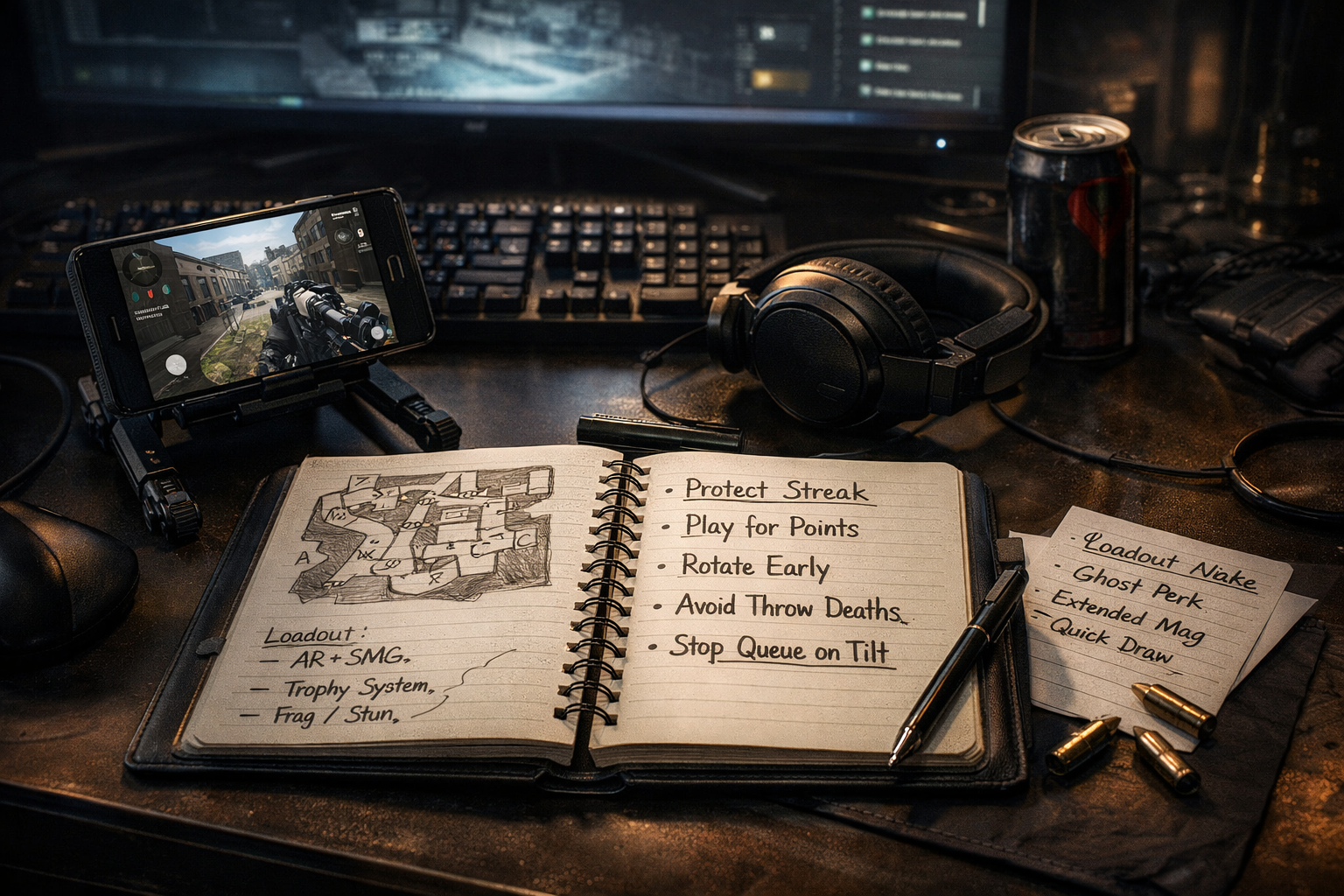
Wins can hide bad habits. Losses can hide good play. Deaths are often the cleanest teacher. Ask simple questions after key deaths: Was my crosshair ready? Did I have information? Was that fight necessary? Was I isolated from teammates? Did I challenge from a weak angle? Did I stay too long after getting one kill? Small answers create large improvement.
5. Learn One Fix at a Time
Many players try to overhaul everything in one night: aim, movement, routes, utility, game sense, patience. That creates mental overload. Pick one fix for the next 20 to 30 games. Maybe it is “die less first.” Maybe it is “stop late rotating.” Maybe it is “play objective before chasing.” One corrected leak can change your whole point trend.
6. Use Teammates Better, Even in Solo Queue
Solo queue does not mean solo play. You still need to read your teammates. Who is overaggressive? Who is passive? Who actually follows objective? Who can trade? Strong solo players adapt quickly. If teammates are wild, you stabilize behind them. If they are passive, you create space carefully. If one player is clearly carrying, stop competing with him and start enabling him.
7. Avoid Hero Syndrome
When games feel messy, players often try to become the whole team. That usually leads to forced fights and bad timing. You do not need to solve every problem at once. Sometimes the most valuable play is the simplest one: hold a lane, protect the rotate, wait for sound, stay alive, or take the guaranteed trade. Ranked rewards restraint more than people admit.
8. Build a Repeatable Queue Schedule
Consistency is easier when your body and focus know when to compete. If possible, queue during the times when your concentration is naturally highest and your connection is stable. Random tired games at random hours often produce random points. The more intentional your schedule, the cleaner your sample.
9. Track Performance by Block, Not Emotion
Evaluate yourself every 10 games or every session block, not after every single match. This helps you notice real patterns. Maybe your first three games are great and your last four are terrible. Maybe your BR climbs are solid but your MP sessions collapse when you get impatient. Without tracking blocks, you will blame luck for patterns that are actually predictable.
10. Protect Confidence Without Protecting Ego
Healthy confidence says, “I can solve this.” Ego says, “I must force proof right now.” Ranked punishes ego constantly. The player who tries to instantly reclaim pride after a bad death often dies again. The better approach is calm correction. Reset. Breathe. Re-enter the match with information, not anger.
Loadouts, Sensitivity, and Setup for Ranked
You do not need to chase every trending setup to climb. In fact, constant loadout change is one of the most common hidden reasons players feel inconsistent. Ranked rewards familiarity. Your loadout should let you make fast decisions without second-guessing recoil, sight picture, or handling.
For most players, the ideal ranked setup has three qualities:
- Reliability: you can trust it in repeated engagements
- Readability: recoil and visual clutter do not confuse you
- Flexibility: it is not worthless outside one niche situation
The same logic applies to sensitivity. Many players change sensitivity too often because one bad day makes them assume the settings are wrong. Usually the real issue is fatigue, cold hands, or shaky timing. Unless your current sensitivity clearly prevents control, stay with one base setup long enough to develop true muscle confidence.
Your ranked setup should also match your role. If you anchor lanes and hold space, choose tools that support controlled engagements. If you entry or take early map control, prioritize responsiveness and fast target acquisition. If you play BR for placement and late-game survival, create a kit that supports repositioning and reliable fight openings rather than flashy over-specialization.
Do not ignore the physical side of mobile ranked either. Grip comfort, finger fatigue, screen clarity, audio awareness, and battery stability all matter. A mechanically “better” player with a sloppy physical setup can underperform against a calmer player with cleaner control. High-level consistency is often built on boring details.
How to Structure a Ranked Session
The fastest way to lose ranked points is to treat every session like a free-form binge. Structure creates protection. A simple session model works well for most players:
Step 1: Warm Up
Spend a few matches or drills waking up aim, movement, and timing. You are not trying to prove skill yet. You are trying to reduce rust.
Step 2: Enter Ranked With One Priority
Example priorities include cleaner first gunfights, earlier rotations, safer BR midgame, or fewer unnecessary re-challenges. One focus keeps your learning sharp.
Step 3: Play in Blocks
Instead of endless queueing, play in blocks of 3 to 5 matches, then take a short pause. This gives your brain a chance to reset and helps you notice drift before it becomes expensive.
Step 4: Use a Stop Rule
Create a hard stop before the session starts. For example: stop after three mentally bad losses, stop after two games where focus felt poor, or stop after reaching a target block size. The rule matters most when you do not want to follow it.
Step 5: Write One Note
After the session, write one sentence: “Today I climbed because…” or “Today I lost points because…” Over time, you will identify the exact behavior patterns tied to good and bad sessions.
This kind of structure sounds simple, but it is incredibly effective because it turns ranked from an emotional stream into a trainable system. You stop reacting to every short-term swing and start shaping the conditions that produce better outcomes.
How to Break Through Common Rank Plateaus
Different tiers produce different forms of frustration. To climb efficiently, you need the right fix for the right plateau.
Stuck in Lower Ranks: Clean Up Mechanics and Awareness
If you are stuck early, do not overcomplicate the diagnosis. Focus on crosshair placement, basic recoil control, easier route choices, and objective understanding. Stop taking low-percentage fights. Learn when to disengage. Most early-rank plateaus disappear once players become less careless, not more creative.
Stuck in Mid Ranks: Improve Predictability Reading
This is the zone where autopilot hurts the most. Enemies start punishing repeated routes and impatient peeks. Improve your lane timing, learn likely enemy habits, and stop assuming every duel should be taken on sight. You are no longer playing against pure chaos. Start playing against tendencies.
Stuck in Grandmaster: Reduce Throw Deaths
Grandmaster often punishes “one extra move.” One extra peek. One extra sprint. One extra chase. One extra challenge while low. At this level, your biggest climb boost may come not from getting more kills, but from deleting the five or six deaths per session that do nothing except hand away momentum.
Touching Legendary but Not Staying There: Raise Your Minimum
At high levels, your average form matters more than your peak form. You may already be good enough to reach the top, but not stable enough to live there. Focus on raising your worst-game quality. How useful are you when your aim feels average? Can you still contribute through positioning, timing, and patience? That is what stabilizes high rank.
Mistakes That Quietly Destroy Rank Progress
Most players know obvious mistakes like quitting, trolling, or ignoring objective. The bigger danger is the quiet mistakes that feel normal.
Playing Too Many Close Games in a Row
Even if you are winning, repeated high-stress games drain decision quality. Your eyes slow down, your patience shrinks, and your tilt threshold lowers. Sometimes the smartest move after a good streak is a break, not another queue.
Changing Everything After One Bad Match
New sensitivity. New weapon. New route. New role. New mindset. This is panic disguised as adaptation. Real adaptation is targeted. Keep what works. Fix the specific leak.
Confusing Activity With Impact
Running constantly, forcing duels, rotating late but aggressively, and chasing every sound can make you feel involved while contributing less. High-level ranked is often won by the player who wastes the fewest actions, not the one who takes the most.
Refusing to Learn From Easy Wins
Easy wins are deceptive because they feel clean. But ask yourself: did I win because I played well, or because the enemy made bigger mistakes? If you only study losses, you miss many habits that will break once lobbies get tougher.
Taking Tilt Personally
Tilt is not a moral failure. It is just a state change. The important thing is recognizing it early. Shortened patience, revenge peeks, exaggerated blame, overtalking, overqueueing, and aggressive sensitivity changes are all common signs. Once you spot tilt, treat it as a condition to manage, not a debate to win.
Expecting Teammates to Match Your Ideal Style
Ranked becomes easier when you stop waiting for perfect teammates and start extracting value from imperfect ones. Even a chaotic teammate creates information. Even a passive teammate can be traded. Even a weak teammate can be used to shape your positioning decisions. Adaptation is a skill. Use it.
FAQ
Is CoD Mobile ranked more about aim or game sense?
Both matter, but game sense becomes more important the higher you go. Aim can win fights. Game sense decides which fights are worth taking.
Is Multiplayer or Battle Royale easier to rank up in?
That depends on your strengths. Multiplayer rewards faster mechanics and short-cycle decision-making. Battle Royale rewards macro reads, survival judgment, and smarter pacing. The easier ladder is the one that better converts your habits into consistent results.
Should I solo queue or play with a squad?
A good squad usually improves consistency, but only if the group communicates well and understands roles. A bad squad can be worse than solo queue. Quality matters more than simply stacking bodies.
How many matches should I play in one session?
Enough to create a meaningful sample, but not so many that mental quality collapses. For many players, shorter structured blocks outperform marathon grinds.
Why do I lose progress even when I feel like I played well?
Because ranked measures outcome and contribution together, not self-perception alone. You may have had strong moments without converting them into the type of value the system rewards most. Focus on high-leverage impact, not only flashy sequences.
How do I know if I am actually improving?
Look beyond rank. Improvement also shows up in cleaner first fights, fewer throw deaths, better objective timing, more stable sessions, and the ability to stay useful even on off-aim days.
Final Thoughts
CoD Mobile ranked is at its best when you stop treating it like a mystery. The system is not perfect, but its core logic is understandable. You climb by producing repeatable winning value. You lose ground when you leak focus, discipline, and adaptation. The ladder rewards players who learn how points are earned, respect the difference between modes, and build habits that survive more than one hot streak.
If you only remember one idea from this guide, make it this: the climb is usually not blocked by a lack of talent. It is blocked by unmanaged variance. The player who minimizes bad decisions, chooses the right queue, respects their mental state, and plays for point-friendly impact will usually outclimb the player who is “more talented” but less structured.
So whether your target is the next bracket, Grandmaster stability, or a push toward Legendary, keep the process simple. Play the right mode for your strengths. Chase efficient value, not empty highlights. Review deaths honestly. End sessions before tilt makes decisions for you. And let the rank follow the habits.