



Marvel Rivals Ultimate Timing Guide 2026: Best Ult Usage
Marvel Rivals Ultimate Timing Guide 2026: When to Pop Your Ultimate
Marvel Rivals is full of flashy moments, but flashy does not always mean correct. One of the biggest differences between average players and consistent climbers is not raw mechanics. It is ultimate timing. In a fast team-based game, many rounds are decided less by who had the stronger ultimate on paper and more by who pressed it at the right second, in the right space, for the right reason.
If you have ever used your ultimate, gotten one elimination, and still lost the fight, you already know the problem. A strong ultimate can still be a bad ultimate if it lands after the fight is already decided, if your team cannot follow up, if the enemy has cover, if key cooldowns are still available, or if the objective is not contestable. On the other hand, some of the best ultimates in Marvel Rivals barely look spectacular at all. They force movement, deny angles, create safety, buy time, bait panic resources, or turn a small advantage into a guaranteed fight win.
This guide is built to stay useful over time. Instead of depending on one short-lived patch trend, it focuses on timeless decision-making: how to identify winning timing windows, how to avoid panic ultimates, how to think about objective pressure, how to coordinate with teammates, and how to use your role as a Vanguard, Duelist, or Strategist to get maximum value from every big button you press.
If you want to improve faster, it helps to study the official Marvel Rivals site, browse the hero roster, and keep an eye on official balance posts so your timing habits stay aligned with the game’s current pace. If your goal is to climb more efficiently while sharpening ranked fundamentals, you can also compare your progress path with Marvel Rivals boosting prices here.
Table of Contents
- Why Ultimate Timing Matters More Than Ultimate Power
- The Core Principle: Value, Not Drama
- The Pre-Ult Checklist
- The Best Times to Pop Your Ultimate
- The Worst Times to Use Your Ultimate
- Role-Based Ultimate Timing
- Layering, Cycling, and Combo Discipline
- Map State, Space, and Objective Timing
- How to Track Enemy Ultimates
- Solo Queue vs Coordinated Team Ultimate Usage
- How to Practice Better Ultimate Timing
- FAQ
Why Ultimate Timing Matters More Than Ultimate Power
Most players ask the wrong question. They ask, “Is my ultimate strong?” The better question is, “What problem does this ultimate solve right now?” If you do not have a clear answer, the timing is probably wrong.
In Marvel Rivals, the answer usually falls into one of five categories:
- Start the fight on your terms.
- Punish enemies who already committed.
- Counter a dangerous enemy push.
- Convert a small advantage into a clean fight win.
- Secure or deny the objective at the final moment.
That is why great ultimate timing feels so consistent. It is not random. Good players are not pressing ult because it looks good. They are pressing it because the battlefield has entered a high-value state. Maybe the enemy has no mobility left. Maybe their front line stepped too far. Maybe your team already found a pick. Maybe the enemy support used a major defensive tool. Maybe the fight is the last real contest before the checkpoint or final capture flips.
Strong ultimate timing does three things at once. First, it creates pressure. Second, it creates follow-up. Third, it reduces enemy answers. If one of those three is missing, your expected value drops fast.
A useful mindset is to stop viewing ultimates as separate from the fight. Your ultimate is not the fight. It is the amplifier. It should strengthen a winning moment, reverse a dangerous moment, or force a moment that benefits your team composition. If you press it in a neutral or disconnected state, you are gambling. If you press it after setting the conditions, you are investing.
The Core Principle: Value, Not Drama
One of the biggest mistakes in ranked is overvaluing highlight-reel outcomes. A five-player wipe looks amazing, but it is not required. In fact, many of the best ultimates in Marvel Rivals do not need to kill anyone directly. If your ultimate forces the enemy off a power angle, splits their formation, saves your backline, buys five extra seconds on the objective, or guarantees a clean engage window, that can be more valuable than a late damage ultimate that secures one low-health target after the fight was already won.
Think in terms of practical value:
- Fight-winning value: your ultimate secures the teamfight.
- Objective value: your ultimate wins time, space, or control.
- Tempo value: your ultimate forces enemy resources and gives your team the next move.
- Protection value: your ultimate prevents a loss condition, such as a dive onto your Strategist.
- Conversion value: your ultimate turns one pick or one cooldown advantage into a full collapse.
This matters because players often hold ultimates too long waiting for a perfect movie scene. That usually results in one of two bad outcomes. Either they die with ultimate available, or they use it after the best window has already passed. In both cases, the problem is not patience. It is misreading value.
Good ultimate usage is not greed and it is not panic. It is informed decisiveness.
The Pre-Ult Checklist
Before you press your ultimate, train yourself to run a quick mental checklist. The best players do this almost automatically.
1. Are We Actually Able to Follow Up?
An amazing engage with no team behind it is just a donation. Check whether your teammates are alive, nearby, looking at the same space, and capable of reaching the targets you will pressure. An ultimate used while two teammates are respawning is usually a bad trade unless you are stalling a final fight.
2. What Enemy Cooldowns Can Ruin This?
Every ultimate has counters. Some are movement abilities. Some are invulnerability tools. Some are shields, displacement, line-of-sight breaks, or defensive ultimates. The ideal timing window appears after enemies burn those answers. That is why patience inside the fight matters more than patience outside the fight. You are not waiting for perfect alignment forever. You are waiting for the enemy to become vulnerable.
3. Does the Objective Make This Worth It?
A fight in open space with no meaningful objective timer is not always worth your ultimate. But a fight near the last contest, a checkpoint doorway, a capture swing, or a narrow re-entry lane often is. The same ultimate can be low value in a random skirmish and game-winning around the real objective window.
4. Am I Starting, Following, or Countering?
Your timing should have a purpose. If you are starting, your team needs readiness. If you are following, you need a trigger like an enemy overstep or pick. If you are countering, you need discipline not to overlap too late or too early. Identify your job before you press.
5. Will the Terrain Help or Hurt Me?
Marvel Rivals rewards awareness of routes, cover, verticality, and broken terrain. Ask yourself whether your ultimate needs open space, enclosed space, line-of-sight access, or forced movement lanes. Some ultimates become far more reliable when enemies are channeled through narrow entries. Others are stronger in open space where escape paths are easier to read and punish.
6. Is One Kill Enough Here?
Sometimes yes. Eliminating a Strategist before the real fight begins can be worth the ultimate. Eliminating a staggered tank when the enemy still holds position might not be. Always connect the likely result to the fight state, not just the kill feed.
7. If I Hold It, What Am I Waiting For?
This simple question prevents passive misuse. If your answer is vague, such as “maybe something better,” you are probably overholding. If your answer is specific, such as “their dive hasn’t committed yet” or “we need it for final recontest,” then holding is smart.
The Best Times to Pop Your Ultimate
1. Right After the Enemy Commits
This is one of the most reliable timing windows in Marvel Rivals. When the enemy has already used mobility, entered your space, or crossed a dangerous choke, they lose flexibility. Their formation is more predictable, retreat becomes harder, and their defensive tools may already be spent. This is the ideal time for many zoning, punish, and counter-engage ultimates.
Why this works:
- The enemy has less room to disengage.
- Their backline may be exposed while helping the frontline.
- Your team gets immediate follow-up because the fight is already live.
If you ult too early, the enemy can simply back up. If you ult too late, your team may already be dead. Right after commitment is often the sweet spot.
2. Immediately After Your Team Gets First Pick
One of the cleanest ways to waste an advantage is to keep fighting slowly after earning first elimination. The better play is often to accelerate. If the enemy loses a key hero, especially a Strategist or a core source of peel, your ultimate can deny the reset and collapse the fight before they stabilize.
This kind of timing is excellent because it turns a probable win into a near-certain one. You are not gambling for value. You are removing variance.
3. To Secure the Real Objective Fight, Not the Warm-Up Skirmish
Many players spend ultimate in the wrong phase of the round. They use it on the skirmish before the important contest, then have nothing for the only fight that actually matters. Learn to identify the real fight. Sometimes that is the final contest before overtime. Sometimes it is the doorway fight before a checkpoint unlocks. Sometimes it is the fight after both teams have regrouped and can fully commit resources.
Ask yourself: if we win this fight, what do we actually gain? If the answer is huge objective progress or complete denial, ultimate commitment becomes much more valuable.
4. As a Counter-Ult, But Only With a Clear Advantage
Counter-ulting is strong, but not all counter-ults are good. The goal is not merely to answer. The goal is to answer efficiently. If the enemy spends a massive engage tool and your answer completely blunts it while preserving your team’s formation, that is excellent. If you panic and trade a high-value ultimate into a fight already lost, you are just matching bad economy with bad economy.
The best counter-ults have three features:
- They are fast enough to matter.
- They protect multiple teammates or deny the core enemy win condition.
- They leave your team in a better fight state after the exchange.
5. When Enemy Escape Paths Are Predictable
Ultimate timing becomes much easier when you stop focusing only on where enemies are and start thinking about where they can go. If the answer is “only left,” “only through the doorway,” “only backward into a corner,” or “only up to that ledge,” your ultimate gains reliability. This is especially true for zoning, area denial, and chase-oriented ultimates.
Good players create this state by coordinating angles. One teammate pressures the exit, another forces cover, then the ultimate cuts off the final route.
6. Off of Cooldown Bait
A hidden high-level timing window appears after you intentionally force enemy buttons first. Maybe your Duelist pressures enough to draw mobility. Maybe your Vanguard forces defensive peel. Maybe a flank scares out a cleanse or movement tool. Once those answers are gone, your ultimate becomes harder to survive.
This is why simple poke and probing are not wasted time. They often set up the real play.
7. To Deny Re-Entry
Not every great ultimate must hit the frontline fight directly. Some of the highest-value ultimates are used slightly after the fight starts to deny re-entry routes, cut off the backline, or trap staggered supports and damage dealers from reconnecting with their team. This is especially strong when the enemy has already taken damage and wants to kite back into cover.
If your ultimate turns the battlefield into two separate fights, your team gains huge control over target priority.
8. To Force Overtime or End Overtime
Clutch objective timing is its own skill. Sometimes the only correct use is not the biggest one, but the latest survivable one. If your ultimate buys touch time, creates contest space, or forces the enemy off the point for a second, it can swing the entire round. In these moments, efficiency matters less than timing precision. A modest ultimate at exactly the right second beats a stronger ultimate a second too early.
The Worst Times to Use Your Ultimate
1. Because It Has Been Ready for a Long Time
This is emotional usage, not strategic usage. Being ready does not mean being correct. Do not press just because you feel overdue.
2. Into a Fight That Is Already Lost
If two teammates are already down and your team has no position, many ultimates only prolong the inevitable. There are exceptions for final stall situations, but in normal fights this is how players destroy their economy for the next real contest.
3. After the Enemy Already Started Disengaging
Late ultimates often look active but produce no value. If the enemy has already left, retreated behind hard cover, or split across multiple safe angles, your timing window may be gone.
4. Overlapping With a Winning Teammate Ultimate for No Reason
Layering can be powerful, but accidental overlap is wasteful. If your teammate’s ultimate already secured the fight, save yours for the next one. The goal is not to maximize fireworks. It is to maximize rounds won.
5. Without Checking Line of Sight
Many ultimates fail because the user sees a target for half a second and assumes the battlefield is open. In reality, pillars, corners, high ground, destructible cover, and vertical movement can ruin the result. Always confirm the geometry.
6. While Your Team Is Not Looking
A good ultimate can become bad if your teammates are reloading, rotating, healing, or simply looking elsewhere. Especially in solo queue, a one-second delay to let your team see the play can double the value.
7. Into Expected Defensive Resources
If the enemy clearly still holds the one tool that makes your ultimate useless, waiting is often better than forcing. Discipline is value.
Role-Based Ultimate Timing
Vanguard Ultimate Timing
Vanguards usually create, absorb, or anchor space. Their ultimates are often strongest when the fight needs shape. That means your best timing is not always “press first.” Sometimes it is “press as the battlefield becomes crowded enough that enemies cannot simply sidestep.”
As a Vanguard, look for these timing windows:
- Your team is stacked behind you and ready to push.
- The enemy frontline has already crossed into a punishable angle.
- The objective area is small enough that enemies must respect your presence.
- Your Strategists need breathing room and the enemy dive has committed.
Common Vanguard mistakes:
- Using engage ultimates before teammates are in range.
- Going too deep without line of sight from support.
- Pressing ult when the enemy still has every escape option available.
Good Vanguard ultimate timing feels like a door slamming shut. The enemy suddenly loses freedom, your team suddenly gains permission to move, and the fight becomes organized around your pressure.
Duelist Ultimate Timing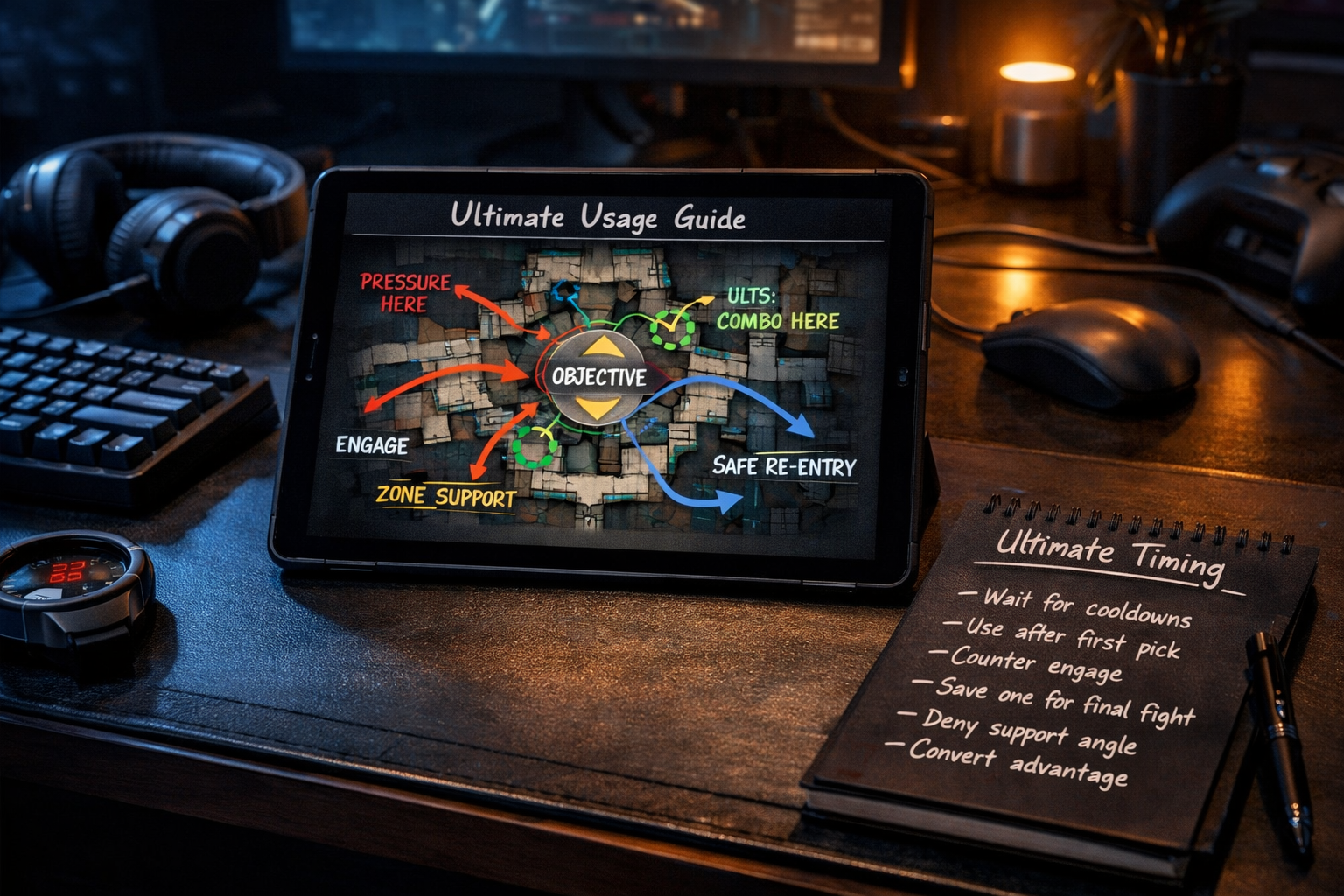
Duelists usually care most about vulnerability windows. You do not always want to be first. In many cases, Duelist ultimates are best as second-wave tools. Let the frontline draw attention, let cooldowns come out, let the enemy reveal their panic movements, then strike when escape options are reduced.
As a Duelist, your best timing often appears when:
- The enemy support is exposed for one clean second.
- Mobility or defensive cooldowns were just used.
- The enemy is grouped by necessity, not by choice.
- Your team already started the fight, so attention is split.
Common Duelist mistakes:
- Opening with ultimate from a predictable angle.
- Trying to force a montage instead of deleting the correct target.
- Holding too long waiting for a multi-kill when one high-priority elimination wins the fight.
The best Duelist ultimate is often ruthless, not flashy. Delete the right player, break the formation, and let the rest of the team clean up.
Strategist Ultimate Timing
Strategists often define whether a fight is stable or chaotic. Their ultimates can rescue tempo, preserve spacing, or reverse an enemy spike. That means Strategist timing is usually strongest in response to pressure rather than in anticipation of it. If used too early, enemies can disengage and re-enter after the effect ends. If used too late, teammates are already gone.
Look for these timing windows:
- The enemy dive crosses the point of no return.
- Your Vanguard is committed and needs sustain to stay in.
- The enemy damage spike is about to land.
- Your team has slight momentum and only needs stability to finish the fight.
Common Strategist mistakes:
- Ulting at the first sign of pressure.
- Using defensive ultimates when retreat was already possible without them.
- Saving the button for too long and dying with it.
Think of your ultimate as a bridge. It should connect your team from danger into control, not just slow down the loss for a moment.
Layering, Cycling, and Combo Discipline
One of the easiest ways to improve teamfight win rate is to stop treating every ultimate like a solo event. Even in solo queue, some basic layering rules create huge value.
Rule 1: One Clear Initiator, One Clear Converter
The cleanest fights often begin with one player forcing the reaction and another player capitalizing on the displacement, panic, or exposed target that follows. When both players try to initiate at the same time, value can overlap. When no one converts, value disappears.
Rule 2: Avoid Triple Investment Unless It Is Truly Final
If two ultimates already secure the fight, the third is usually greed or panic. Save it unless the round genuinely ends here.
Rule 3: Cycle to Maintain Pressure Across Multiple Fights
In ranked, sustainable tempo often beats one explosive wipe. Winning one fight with one or two ultimates and keeping the rest for the next contest is far stronger than dumping everything and hoping the round ends immediately.
Rule 4: Build Around Reliable Follow-Up, Not Wishful Follow-Up
If your composition naturally chains crowd control, space creation, or focused burst, layering is powerful. If your team is scattered, late, or uncoordinated, simpler single-ultimate plans are better.
Ask this every time: does my ultimate need another one to be good, or is it already good on its own? If it is already good, do not force overlap unless the objective demands it.
Map State, Space, and Objective Timing
Marvel Rivals is not played on an empty training map. Terrain, angles, verticality, and destructible features all change the timing equation. That is why the same hero can feel amazing on one push and terrible on the next even if nothing about the hero changed. The map state changed.
Chokes and Doorways
Ultimates that punish grouped movement become far more reliable when enemies must pass through a predictable entry. The best timing is often just after the first enemy crosses, not before. That prevents a free disengage while still catching the group during transition.
High Ground and Split Angles
If enemies are split across levels, many ultimates lose value because the team is not truly grouped. Before you press, ask whether your target cluster is real or only looks real from your angle.
Broken Cover and Opened Paths
Because Marvel Rivals emphasizes destructible and changing environments, spaces can become more open or more dangerous over the course of a fight. A route that was safe thirty seconds ago may no longer exist. A pillar that used to protect the enemy backline may be gone. Strong players constantly update their timing based on the current battlefield, not the remembered battlefield.
If terrain opens up, long-range punish ultimates can become better. If terrain narrows movement, zoning ultimates often gain value. If the battlefield becomes messy and visibility drops, simpler area denial or stabilization tools may outperform precision plays.
Objective Phases
You should always know which of these phases you are in:
- Setup: teams are poking and taking positions.
- Commit: frontline crosses and real cooldowns start flying.
- Convert: one side gains advantage and must snowball it.
- Recontest: respawn timers and touch timing matter more than clean formation.
Different ultimates peak in different phases. Engage and space-creation ultimates are often best at commit. Burst and chase ultimates are often best at convert. Stall, denial, and rescue ultimates are often best at recontest. If you mismatch phase and purpose, value falls off fast.
How to Track Enemy Ultimates
If you want better ultimate timing, you also need better ultimate tracking. Your timing improves dramatically once you can predict what the enemy wants to do before they do it.
Track these signals:
- Which enemies have been alive and active for multiple fights.
- Which heroes have dealt consistent damage or healing recently.
- Who is suddenly taking aggressive positioning that only makes sense with ultimate ready.
- Which fight the enemy is likely saving for, especially late in a round.
You do not need perfect information. You just need probabilities. If you suspect a dangerous enemy ultimate is online, your timing choices change. You may hold a defensive answer. You may spread your team. You may force that enemy to react early with poke pressure. You may rotate through a safer lane.
Tracking also stops panic. A lot of players mis-time their own ultimate because they are surprised. Surprise usually comes from not asking what the enemy is likely holding.
A Simple Tracking Framework
- After every fight, identify who on the enemy team probably gained the most charge.
- Before the next real fight, call or think: “What are the two most likely enemy ultimates?”
- Decide whether your ultimate is for engage, counter, or follow-up.
That small habit alone will improve your win rate because it aligns your button with the actual state of the round.
Solo Queue vs Coordinated Team Ultimate Usage
In Solo Queue
Simplicity wins. Your best ultimates are the ones that teammates can understand instantly. Press when:
- everyone is already looking at the same fight,
- the target is obvious,
- the enemy is committed enough that even random teammates can follow.
In solo queue, avoid fancy delayed combos that require exact timing unless someone is clearly communicating. Use your ultimate to make the fight easier to understand. Big engage windows, clear peel moments, obvious punish angles, and objective denial are all easier for strangers to read.
In Duos, Trios, or Full Stacks
You can be greedier with setup. Communication lets you bait cooldowns first, plan the initiator, announce target priority, and save a second ultimate only if the first one fails. In coordinated play, layered timing becomes far stronger because teammates know whether they are following, protecting, or holding.
A good communication structure is simple:
- “I’m forcing first.”
- “Hold yours unless they counter.”
- “If support burns defensive tool, I go.”
- “Save one for recontest.”
You do not need a long speech. You need role clarity.
How to Practice Better Ultimate Timing
Ultimate timing is a skill, and like any skill, it improves faster when you practice intentionally.
1. Review Every Ultimate by Result and Context
After matches, ask:
- Did it win the fight?
- If yes, why?
- If no, what condition was missing?
- Would waiting one second have helped, or hurt?
- Was I starting, following, or countering?
This teaches judgment much faster than only remembering whether you got kills.
2. Grade Your Ultimates
Use a simple scale:
- A: fight-winning, objective-winning, or game-saving.
- B: solid value, forced resources, or clean conversion.
- C: low but acceptable value.
- D: late, unnecessary, or disconnected.
- F: fight-losing economy mistake.
Do not judge by ego. Judge by expected round value.
3. Pick One Timing Habit Per Session
Examples:
- “Today I will stop first-waving my Duelist ultimate.”
- “Today I will only use my Strategist ultimate after enemy dive commits.”
- “Today I will save one team ultimate for recontest every round.”
One focused correction usually changes play faster than trying to fix everything at once.
4. Use Verbal Triggers
Even if you are playing alone, small verbal cues help. Say to yourself:
- “Wait for mobility.”
- “Use after first pick.”
- “Save for final fight.”
- “Counter, don’t panic.”
This reduces impulsive presses.
5. Learn Your Hero’s Typical Win Pattern
Every hero has a different ideal timing profile. Some want to open. Some want to punish. Some want to rescue. Some want to zone. If you main a hero, write down in one sentence when their ultimate is usually best. That single sentence becomes your default decision rule until the fight gives you a better one.
Advanced Ultimate Timing Concepts
Threat of Ultimate
Sometimes the fact that you have ultimate is already creating value. Enemies position differently when they know a powerful engage, punish, or defensive answer is available. Good players use that threat to control space even before pressing. Do not always reveal your hand early.
Soft Forcing
You can pressure enemies into bad positions without committing your ultimate immediately. A flank, a temporary numbers advantage, or a strong angle can make them stack together, retreat through one lane, or spend a key cooldown. Then your actual ultimate becomes much cleaner.
Anti-Greed Timing
Some players die with ultimate because they want to save it for a dream moment. Others throw it away instantly. The balance is anti-greed timing: use it as soon as the fight reaches your minimum good condition, not your fantasy perfect condition.
Win-More vs Win-Now
A “win-more” ultimate is used when the fight was already secured. A “win-now” ultimate creates or guarantees the win. Always favor win-now.
Tempo Resets
Sometimes the correct ultimate is the one that resets chaos and lets your team breathe. This is especially important when the enemy wants to snowball momentum. A well-timed stabilization ultimate can destroy their rhythm and flip the psychological flow of the match.
Practical In-Game Examples
Example 1: Your team gets first pick on an enemy Strategist, but their Vanguard is still holding space near the objective. Instead of chasing random damage, you use your ultimate immediately to force the remaining enemy players off the angle and prevent a stabilizing retreat. Result: the fight ends before respawn timing matters.
Example 2: The enemy dive waits until your team bunches around cover, then hard commits. You do not panic at the first sign of pressure. You wait until the enemy crosses the no-return line, then pop your defensive or counter-engage ultimate when retreat is no longer clean for them. Result: they are trapped in the danger zone instead of safely poking and backing off.
Example 3: Your Duelist has ultimate and wants a backline kill, but the enemy mobility cooldowns are still available. Instead of forcing immediately, your Vanguard pressures first, the enemy burns escape tools, and only then the Duelist pops ultimate into reduced options. Result: cleaner confirmation, less chance of wasted burst.
Example 4: It is last fight. Your team has two ultimates. Instead of layering both instantly, one player uses theirs to force contest and draw resources. The second is held until the enemy attempts recovery. Result: two separate timing spikes instead of one overloaded burst.
Mental Rules to Remember Mid-Match
- Do not ult to feel useful. Ult to create value.
- One clean kill can be enough.
- If the enemy still has every answer, wait.
- If your team cannot follow, do not force.
- Use the objective to judge economy, not emotion.
- Press when the battlefield becomes predictable.
- Save highlight hunting for the replay, not the decision.
Final Thoughts
If you want to know when to pop your ultimate in Marvel Rivals, the answer is rarely “as soon as it is ready” and rarely “hold it forever for the perfect team wipe.” The real answer sits in the middle: use it when it solves the most important problem in the fight.
That problem might be enemy overcommitment. It might be lack of space. It might be a vulnerable support. It might be a final overtime touch. It might be the need to convert one small advantage before the enemy resets. Once you start thinking this way, your ultimate usage becomes calmer, cleaner, and much more consistent.
Marvel Rivals rewards players who understand pace, pressure, and space. The more you treat ultimate timing like a strategic resource instead of a cinematic button, the more fights you will win without needing miracle mechanics.
Study your hero. Track the enemy. Respect the objective. Bait answers first. Press with purpose. That is how you stop wasting ultimates and start deciding games with them.