



How to Use Teleports in Dota 2: Rotations and Global Ganks
How to Use Teleports in Dota 2 2026: Rotation Timing and Global Ganks
Teleport usage is one of the biggest skill gaps in Dota 2. Players often focus on mechanics, laning, or drafting, but many games are decided by who uses the map better. A great Town Portal Scroll can save a tower, punish a dive, swing a rune fight, defend Roshan vision, or instantly turn a 2v2 into a 4v2. A bad teleport can trap you on the wrong side of the map, ruin your farm pattern, remove your ability to answer the next fight, or hand the enemy a free objective.
If you want to climb, you need to stop thinking about teleports as panic buttons and start treating them as resources. In modern Dota 2, map movement is not just about walking between lanes. It is about sequencing your cooldowns, understanding where the next fight can happen, using Twin Gates intelligently, and recognizing when a defensive reaction is actually a losing move. The best players do not simply TP faster. They TP with purpose.
This guide explains how to use teleports in Dota 2 in a way that stays useful over time. Exact patch numbers may change, but the core principles do not: arrive before the fight is decided, protect your strongest area of the map, trade when a defense is impossible, and always ask what your TP saves, what it threatens, and what it costs you. That is the foundation of smarter rotation timing and cleaner global ganks.
If you are improving your ranked consistency and want extra help with decision-making, lane pressure, or map reads, you can also check Dota 2 boosting prices for coaching-style support and account progress options.
Table of Contents
- Why Teleports Win Games
- Core Teleport Tools in Dota 2
- The Teleport Economy Mindset
- Teleport Rules in the Laning Phase
- Early Midgame Rotations and Tower Pressure
- Midgame Teleports Around Objectives
- Late Game Teleports and Base Defense
- How to Execute Global Ganks
- Support Teleports
- Core Teleports
- Boots of Travel Usage
- How to Use Twin Gates Properly
- How to Read Enemy Teleports
- Common Teleport Mistakes
- How to Practice Better TP Decisions
- Final Thoughts
Why Teleports Win Games
Dota 2 is a game of uneven numbers. Most successful fights are not purely mechanical outplays; they happen because one team creates a numbers advantage faster than the other. Teleports are the fastest way to do that. A support with full HP and mana appearing behind a tower can turn a dive into a double kill. A mid hero rotating with TP to the offlane can blow open the map. A carry who refuses to teleport into a lost fight can keep farming, take the opposite tower, and preserve the team’s win condition.
That is why teleporting is both tactical and strategic. Tactically, you use TP to join, save, punish, or counter-initiate. Strategically, you use TP to place your hero in the correct future part of the map. Good players think one move ahead. They are not only asking, “Should I defend this tower?” They are asking, “If I TP here and the enemy disengages, where can I farm next? What objective becomes vulnerable? Can I still answer Roshan? Will I be stuck in the dead lane?”
Whenever you improve your teleport logic, every role becomes stronger. Supports die less randomly and arrive on time. Mid players connect better with sidelanes. Offlaners become much harder to dive. Carries stop wasting map pressure. Even if your laning is average, disciplined TP usage can increase your win rate because it removes many of the most common ranked mistakes.
Core Teleport Tools in Dota 2
Before discussing strategy, define the tools correctly.
Town Portal Scroll is your baseline map response tool. Use it to reach allied structures, reinforce fights, defend towers, reset lane states, or join objective contests. The dedicated TP slot matters because it reduces friction: every player effectively has access to map reaction if cooldown and timing allow it.
Boots of Travel changes your movement profile. It gives faster repeat access to the map, removes the charge consumption problem, and opens more aggressive target options. On heroes that split push, farm long lanes, or need to connect quickly to structures and units, Boots of Travel can completely change how your team controls waves and objectives.
Twin Gates are not a replacement for TP scrolls, but they are an important rotation layer. They create cheaper cross-map options when your teleport cooldown is unavailable or when you want to preserve TP for the next reaction. Skilled teams use the Gate system to chain map moves: push one side, gate across, smoke, and collapse before the opponent realizes the numbers changed.
Hero-specific global or semi-global abilities also interact with teleport strategy. Heroes such as Nature’s Prophet, Io, Underlord, Tinker, Spectre, Dawnbreaker, and others either create their own global pressure or punish bad TP discipline from opponents. Even when your hero does not have a global spell, your team may still draft around global timing windows.
To keep up with official patch changes and exact current mechanics, it is useful to review the official Dota 2 patch archive, the Town Portal Scroll page on Dota 2 Wiki, and the Liquipedia Town Portal Scroll reference. For replay-based map study, Dotabuff and OpenDota are also useful.
The Teleport Economy Mindset
One of the best ways to think about TP usage is to treat it like an economy. Every teleport has a price even when it looks free.
The first cost is cooldown. If you use TP to respond to a low-value skirmish, you may not have it for the high-value move 40 to 90 seconds later. That is often how teams lose the bigger fight. They answer the bait fight bottom, then cannot contest Roshan or mid tower because half their map mobility is gone.
The second cost is position. After you teleport, you are committed to that side of the map unless you walk or use another transport tool. A carry that TPs to defend a low-HP tier one on the dangerous side may save it, but then loses two minutes of safe farming because the lane remains dead. A support that TPs too deep may survive the fight but be stranded without wards in the wrong zone.
The third cost is information. When you TP, you reveal intent. Smart enemies watch side lanes, count heroes, and instantly know who is missing from the next area. If your mid TPs top to counter-gank, the enemy offlane core may back off bottom and your carry’s pressure disappears. Sometimes the threat of teleport is stronger than the teleport itself.
The fourth cost is wave control. A teleport is never just about heroes. It is about creeps. Are you preserving a catapult? Are you wasting a stacked wave? Are you leaving a lane to crash into your tower? Are you arriving when the allied wave is already dead, which means your tower still falls anyway? Strong TP players read the wave before they react.
Whenever you think about teleporting, use this quick filter:
- What am I saving?
- What am I threatening?
- What objective is next?
- What happens if the enemy disengages?
- Where do I farm or play after arriving?
If you cannot answer those questions, your TP is probably emotional instead of strategic.
Teleport Rules in the Laning Phase
The laning phase creates the first major TP decisions in every match. Most players think only in terms of “my teammate is getting dove, I should help.” That is too simple. Laning teleports are about punishing overextension, preserving lane equilibrium, and protecting your most important hero at the correct moment.
1. TP early, not late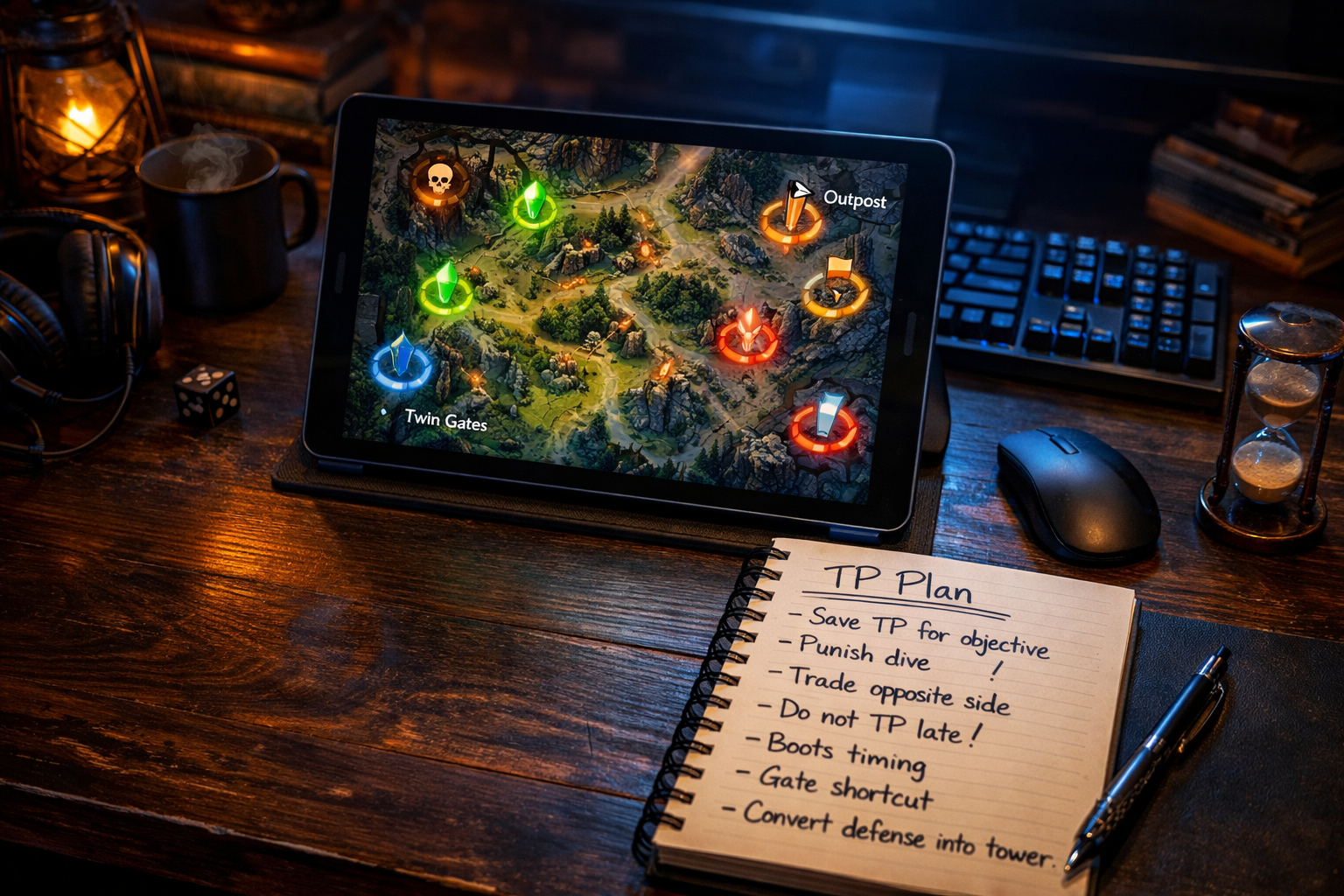
If you are teleporting to a lane, your decision window is small. The best defensive TPs happen when the enemy still believes the dive is good. The worst defensive TPs happen when your teammate is already dead. A late TP often turns a lost 1-for-0 into a worse 2-for-0. That is the most common support mistake in lower and mid ranks.
Watch health bars and creep positions. If your offlaner is at half HP under tower and the enemy wave is large, the dive threat is rising. If the enemy support disappears and the mid wave is shoved, a rotation may already be coming. Good TP reactions start before the fight fully breaks out.
2. Defend the hero who unlocks the map
Not every lane deserves equal investment. Sometimes protecting your carry is correct. Sometimes protecting your offlane is better because that lane unlocks the enemy safe tower, gate access, and future map control. If your offlane duo can punish with one extra hero, that TP may create a tower, jungle invasion, and ward map. If your safe lane is already losing hopelessly, a TP there may only delay the inevitable.
Ask which lane matters most for the next five minutes, not just who is currently screaming for help.
3. TP for kill conversion, not only rescue
The strongest laning teleports do not merely save an ally; they convert aggression into kills. If the enemy has already spent gap closers or committed under tower, your TP arrives into a favorable fight. This is especially true when the enemy wave is deep and their retreat path is long. In those cases, TPing can swing the lane completely.
A support who arrives with a disable, a nuke, or a healing swing can instantly punish the enemy’s greed. That is far better than TPing to a lane where the enemy can simply walk away.
4. Respect the tradeoff on your own lane
When a support leaves lane via TP, something is sacrificed. Your carry may lose pull control. Your tower may be pressured. Your stacked camp may be invaded. Good support teleports balance short-term rescue with long-term lane cost.
If leaving your carry alone makes that lane unplayable, your TP has to create enough value elsewhere to justify it. One assist and a few seconds of relief usually is not enough. Two kills, a reset wave, or tower pressure is.
5. Refill and return intelligently
Another overlooked laning TP is the base reset. Sometimes the best teleport is not into a fight but back to lane with full resources, a fresh ward, and a clean timing. Mid players especially benefit from this. A refill, bottle timing, and TP back to lane can preserve tempo without giving up rune presence or creep control.
Do not think only of defensive reactions. Think of TP as a way to compress recovery time and keep your hero online.
Early Midgame Rotations and Tower Pressure
Once lanes start breaking, teleport decisions become more strategic because towers, outposts, and vision begin to matter more than pure lane outcomes. This is where many games are won or lost by map shape.
The biggest early midgame principle is simple: teleport toward playable areas, not dead areas. A playable area is a part of the map where your team can connect, ward, and farm after the fight. A dead area is a lane or jungle sector where even if you defend successfully, you cannot stay afterward without dying.
For example, imagine your safe lane tower is nearly gone and the enemy offlane duo is stronger than your carry. TPing there to “hold the tower” may sound disciplined, but if the wave is already under tower and the enemy brings one more hero, you risk multiple deaths and still lose the structure. Often the better play is to let that tower go, push the opposite side, and shift your vision to the triangle or central map.
On the other hand, teleporting to your offlane tower when your team can chain stuns, bring mid, and convert into a push is high value. That lane often leads directly into enemy jungle control. If one successful TP creates wards, tower damage, and map ownership, it is usually worth more than a low-impact safe lane defense.
Use TP to arrive first at the next objective
Reactive players TP to the current fight. Stronger players TP to the next point of pressure. If the enemy just showed three heroes bottom and your top wave is pushing toward their tower, a teleport top by your offlaner or support can prepare a response before the enemy rotates across. This creates either a free tower hit or forces enemy TPs that weaken their next move.
The goal is not to chase action. The goal is to shape the map so the enemy reacts to you.
Do not overlap TPs without a reason
Two or three heroes often TP to the same tower when one would have been enough. This is bad for several reasons. It wastes cooldowns, damages farm efficiency, and may extend channel times if multiple heroes pile onto the same location. It also empties another area of the map. Unless you are committing to a decisive fight, avoid stacking reaction TPs out of panic.
Assign roles mentally. One hero saves. One hero pushes opposite. One hero farms the safe camp nearby. One hero holds mid. Ranked teams fail here because everybody thinks only about the local fight.
Midgame Teleports Around Objectives
Midgame is where teleport timing becomes truly elite. Once big cooldowns, smokes, Tormentor contests, Roshan vision, and outer towers matter, the best TP is often the one that preserves objective geometry rather than hero HP.
Defending towers
Do not defend every tower equally. Defend towers that protect your current farming network, your triangle access, your next smoke route, or your ward structure. A TP to save a tower is good when the tower anchors the part of the map you actually want to play. It is bad when the tower is isolated and cannot be held without overcommitting.
Also read the catapult wave. Towers are most vulnerable when siege pressure aligns with hero presence. If the enemy brings a catapult and two cores while your team is split and TP cooldowns are burned, it may be better to trade than to feed into a lost hold.
Roshan and the pre-fight TP
Roshan fights are often decided 15 to 30 seconds before either team commits. Teleports matter here because the side that fixes lanes first arrives with better formation. If your side lanes are shoved in against you, TPing to clear them before grouping can buy crucial time and deny the enemy a clean Rosh setup. If your lanes are already pushing out, save TP for the actual contest or the post-Rosh collapse.
The common mistake is showing a core on the far side lane with TP on cooldown just before Roshan becomes live. That invites the enemy to start immediately. Good map players know that teleport availability changes whether an objective is contestable at all.
High ground defense
Base defense teleports are obvious, but the detail is in the setup. When defending high ground, do not waste your first TP on a meaningless side-wave if the enemy is about to hit barracks. Make sure key heroes are positioned to threaten the wave, not merely stand in base. Conversely, if the enemy lineup cannot high ground quickly and your side lane is about to crash into their tier two, one pre-defense TP to create counter-pressure may force them to back up.
Base defense is not only about surviving. It is about making the enemy choose between committing and retreating into a bad map state.
Late Game Teleports and Base Defense
In late game Dota 2, teleport discipline becomes even more important because death timers are longer, map mistakes are punished harder, and Boots of Travel or global mobility tools are more common. One wasted TP in the late game can mean no answer to split push, no support for Roshan, or no ability to force buybacks efficiently.
Late game teleporting revolves around three ideas:
- Keep buyback plus TP relevance in mind.
- Maintain lane equilibrium before decisive objectives.
- Use your mobility to create impossible choices for the enemy.
If you have buyback, ask where you can re-enter. If your structures are weak and lanes are exposed, buyback without a good TP target becomes much worse. This is one reason why advanced teams preserve buildings, outposts, and wave position so carefully. Mobility is not just about arrival; it is about re-entry after death.
Late game cores with Boots of Travel should constantly think in wave pairs. Push one lane, disappear, threaten another. The enemy sees one core bottom and wants to start a fight mid, but your TP or Boots route means you can appear sooner than expected. That uncertainty alone creates space.
When defending split push, do not automatically TP the strongest hero. Sometimes the correct answer is to send the least committal wave-clear hero and keep your real initiator hidden. Late game teleports work best when they preserve ambiguity.
How to Execute Global Ganks
Global ganks are not only for heroes with literal global abilities. In practical ranked play, a global gank means any fast map collapse that uses TP, Gates, smoke, or long-range initiation to overwhelm a hero who believes he is safe. The key word is timing.
The 5-step structure of a strong global gank
- Shove a nearby lane first. This hides your movement and forces enemy attention elsewhere.
- Gain information. Use wards, scans, creep vision, or hero reveals. Blind teleport ganks are much weaker.
- Pick the correct anchor point. TP to the tower, outpost, or structure that lets you close distance safely.
- Layer arrival, don’t stack randomly. First hero controls, second hero bursts, third hero cuts retreat.
- Convert immediately. After the kill, take ward ground, shove wave, hit tower, invade jungle, or set up Roshan vision.
Too many teams gank successfully and then drift apart. That wastes the value of the teleport. A global gank is good because it removes an enemy and temporarily creates a numbers edge elsewhere. You must spend that edge before the dead hero respawns or the enemy TPs in.
Best targets for TP ganks
The best targets are not always the easiest kills. They are the heroes whose death changes map ownership. That might be the enemy wave-clear core, the support holding defensive vision, the hero showing in the dangerous lane without backup, or the split pusher with no escape cooldown. Killing a random support under his own tower may feel nice, but killing the farming core on the long lane can unlock an entire quadrant of the map.
Do not gank where the enemy wants you to go
This is critical. Some side lanes are traps. The enemy shows a juicy core, but backup is already behind him and your teleport path is obvious. If your team TPs into fog with no vision, you may walk into the counter-gank. Great teleport players ask, “Why is he showing?” before they commit.
Sometimes the best response to a visible split pusher is not to TP on top of him. It is to cut off his escape route, smoke from the nearest structure, or pressure the opposite objective so his TP becomes mandatory.
Support Teleports
Supports usually make the highest number of teleports in a match, so support TP quality heavily influences overall team tempo.
Save spells are more important than hero presence
If your hero has a defensive spell, your TP timing is linked to that spell. Abaddon, Oracle, Shadow Demon, Dazzle, Treant Protector, and similar heroes do not need to arrive first; they need to arrive before the kill threshold is crossed. That sounds obvious, but many support players TP as soon as they see movement, then walk in awkwardly and cast too early or too late. Your value is not your body. It is your spell sequence.
TP with utility in mind
Before teleporting, ask what you are bringing to the area. Sentry? Smoke? Dust? A fresh Observer Ward? Regen? If you TP into a valuable zone but cannot establish vision, your team may win the local fight and still lose long-term control. The best support TPs are followed by map setup, not random wandering.
Do not die after the save
A common bad habit is the “heroic” TP where the support saves a core, then dies pointlessly. Sometimes that trade is worth it, but often it is not. If your job was to break the enemy timing, heal your core, and reset the fight, you do not always need to keep running forward. Exit cleanly when the objective is achieved.
Use dead time well
If your TP is on cooldown, play a more central support map. Hover near mid, near a Gate, or around the ward line your team cares about. Do not wander into remote jungle pockets where you cannot respond. Support positioning between fights is mostly about future teleport value.
Core Teleports
Core teleports are harder because every TP trades against farm. The strongest cores understand not only whether a fight is good, but whether joining it helps their item timing more than staying on the map.
Carry teleports
Carries should be selective. Early and mid game, your TP should usually do one of four things: protect your own farming network, convert a guaranteed numbers advantage, defend an important objective near your next farm route, or join a fight that secures Roshan. If a fight does not satisfy one of those, it is often better to push and trade.
A carry who TPs emotionally to every skirmish becomes underfarmed and arrives late anyway. A carry who never TPs also loses too much map. The balance comes from understanding value density: how much gold, tower pressure, and strategic control your teleport actually creates.
Mid teleports
Mid heroes often dictate the pace of the first meaningful rotations. Their teleports are strongest when paired with power spikes: rune timings, level six, first mobility item, first damage item, or first major cooldown. A mid TP should usually hit a lane where your arrival immediately creates kill threat or tower pressure.
If you TP to a lane and only share experience while the enemy backs out, you probably burned your timing. Push the mid wave first whenever possible so your movement has less visible cost.
Offlane teleports
Offlaners often stand at the center of defensive TP networks because they are naturally closer to contested objectives. Your teleport choices should reflect whether your hero is an initiator, aura carrier, tower defender, or counter-initiator. If your hero loves clustered fights, teleport earlier and posture aggressively. If your hero needs follow-up or vision, arrive to threaten the next move, not the first spell.
Many offlaners waste TPs trying to save dead side lanes. Your job is usually to keep the enemy uncomfortable, not to be a repairman for every lost structure.
Boots of Travel Usage
Boots of Travel is one of the biggest teleport-related game changers because it turns map movement into pressure. The item is not just mobility; it is tempo, lane control, and reaction flexibility.
When Boots of Travel is best
The item shines on heroes that:
- Push side lanes efficiently
- Want to join fights after showing on a wave
- Scale through map coverage rather than raw stat brawling
- Need fast re-positioning for tower trades or base defense
- Can abuse broader targeting options for aggressive movement
It is especially powerful when your team wants to split the map, threaten base races, or force the enemy to reveal multiple heroes on defense.
How players misuse Boots of Travel
The most common mistake is buying it and then playing exactly the same way as before. If you purchase Boots of Travel, use it to alter your farming pattern. Push farther lanes. Show briefly and disappear. Join fights from fog. Make the enemy guess whether you are actually committed to that side of the map.
Another mistake is overvaluing constant presence. Boots of Travel does not mean you should mindlessly join every fight. It means you can push greedier waves before choosing whether to join. The strength of the item is optionality.
Glyph and creep preservation
There are also moments when preserving an allied creep wave or structure for a Boots arrival is more valuable than using resources immediately. If one extra second lets your Boots hero join and swing the defense, that small delay changes everything. This is especially relevant in late game base scenarios.
How to Use Twin Gates Properly
Twin Gates added a new dimension to cross-map movement. Many players still underuse them because they think only in straight-line TP logic. Gates are valuable precisely because they let you preserve TP cooldown while still changing sides of the map quickly.
Best Twin Gate use cases
- Moving from one sidelane to the other without spending TP
- Setting up support rotations behind an active lane
- Converting offlane pressure into safe lane collapse
- Preserving TP for the next reaction while still repositioning
- Creating unexpected timing windows for smoke ganks
A classic strong pattern is this: your team shoves one side lane, one or two heroes disappear through the Gate, and a support or mid hero TPs to a nearby structure. Suddenly the enemy side lane goes from a calm 2v2 to a brutal 4v2 collapse.
When not to use Gates
Do not treat Gates as free movement when enemy vision is obvious. The entrance and exit zones are natural ambush points. If the enemy controls the nearby high ground or expects the route, you can walk into a bad fight. Gates are strongest when combined with wave shove, smoke, or timing ambiguity.
They are also not always faster than simple walking plus TP preservation. Think in terms of total map state, not just travel speed. If using the Gate puts you into a dead lane with no objective, the move was still bad.
Gate plus TP sequencing
Advanced movement often chains both tools. For example, a support can Gate across, ward, then hold TP for the tower defense that comes 20 seconds later. Or a core can shove a lane, use the Gate to relocate, then Boots into the decisive fight. The point is not just to move. It is to arrive with the right resource still available.
How to Read Enemy Teleports
Learning to use teleports is only half the skill. The other half is reading enemy teleports and punishing them.
Count visible heroes and reaction windows
If the enemy mid TP’d top 20 seconds ago, can he appear bottom for this dive? If both supports showed defending mid, can you threaten Roshan vision? If a carry used TP to farm a greedy side lane, can you immediately pressure the opposite side?
Every enemy teleport creates a map vacuum somewhere else. Strong teams attack that vacuum.
Punish forced teleports
One of the best strategic habits in Dota 2 is forcing an enemy TP, then attacking the opposite objective before the cooldown resets. Push a lane hard enough that someone must answer, then smoke or pressure elsewhere. This is how disciplined teams create “artificial” numbers advantages without even getting a kill.
Even at lower ranks, you can do this by simply noticing who defended which lane. Many players teleport reflexively, then remain stranded. That is your chance to take the other tower, invade triangle entrances, or start Roshan control.
Watch for stacked reaction TPs
If two enemy heroes TP to save one side lane, punish them by disengaging and switching focus. They now have fewer tools for the next move. This is especially valuable when those heroes are supports with limited farm and slower map recovery.
Skilled shotcallers do not always chase kills after enemy TPs. They often just say, “Good, now hit the other side.”
Common Teleport Mistakes
Here are the most frequent TP errors that hold players back:
1. Teleporting after the fight is already over
If your teammate is chain-stunned with no counterplay left, your late TP usually feeds. Be honest about whether you are saving or donating.
2. Defending every tower on instinct
Not every building is worth a reaction. Some towers are bait. Some are already gone. Some cost too much to hold. Defend only when the structure protects a map you can still play.
3. Burning TP on low-value farm moves
Sometimes players use TP just to reach a convenient wave, then have no answer for the real fight. Farm efficiency matters, but TP availability matters more when objectives are live.
4. Overlapping teleports
Three heroes do not need to save one support from a harmless poke. If multiple players TP to the same minor fight, the rest of the map opens instantly.
5. Ignoring the next play
The worst TP decisions happen in isolation. Always connect your teleport to the next 30 to 60 seconds of Dota. Fight, tower, ward, Roshan, lane shove, retreat route. Every TP should lead somewhere.
6. Showing too much information
Teleporting visibly with your key core can ruin pressure elsewhere. Sometimes staying hidden is stronger than showing up to “help.”
7. Using Boots of Travel passively
If you bought global mobility and still move like a slow five-man deathball, you are not getting full value.
8. Forgetting wave timing
The best TP target is often determined by the wave, not the hero. If the wave is gone, tower defense becomes weaker. If the wave is huge, your TP may have far more value.
How to Practice Better TP Decisions
You do not improve teleport usage just by reading theory. You improve by reviewing specific moments and building a decision pattern.
Post-game review checklist
- Did I TP before or after the fight was decided?
- Did my TP save a hero, tower, wave, or objective?
- Was there a better trade on the opposite side?
- What happened 30 seconds after I arrived?
- Did my TP leave a stronger area of the map undefended?
- Could I have walked, Gated, or delayed instead?
Replay focus drill
Open one replay and watch only your teleports. Ignore your spell mechanics and item timings. For every TP, pause and write down:
- Why you chose it
- Whether it was proactive or reactive
- What resource it spent
- What better player alternative existed
After doing this for five games, your TP choices will improve dramatically because you will start noticing repeated emotional reactions.
Simple in-game mantra
Use this sentence in your head before every important TP:
“If I teleport here, what do we gain, and what can we no longer answer?”
That one question filters out a huge number of bad movements.
Final Thoughts
Teleport strategy in Dota 2 is really map strategy in disguise. The best players understand that TP scrolls, Boots of Travel, Twin Gates, and global movement tools are not just mobility mechanics. They are ways to control numbers, hide intent, force enemy cooldowns, defend the correct areas, and convert small wins into larger objectives.
If you want a simple summary, remember these rules:
- Teleport early enough to matter, not late enough to donate.
- Defend playable areas, not doomed ones.
- Trade when defense is impossible.
- Use teleports to shape the next play, not only the current fight.
- Preserve TP when an objective is about to become important.
- Use Twin Gates and Boots of Travel to create pressure, not just convenience.
- After every good TP, convert immediately into map control.
Once you internalize those ideas, your entire game becomes more stable. You will feed less to bad reactions, protect your strongest lanes better, punish enemy overextensions more consistently, and create smarter global ganks. In Dota 2, clean teleport usage often looks invisible on the scoreboard, but it wins games anyway. That is why mastering rotation timing is one of the most reliable ways to improve in any patch.