



Master Lane Freezing in LoL: Wave Control & Dives
How to Master Lane Freezing in LoL (2026): Wave Control Tips for Denying Farm and Setting Up Dives
Lane freezing is one of the highest-leverage macro fundamentals in LoL because it converts small advantages (a level lead, a better recall, a favorable trade) into reliable gold and experience denial. A good freeze forces the enemy to walk into danger to last-hit, makes them miss entire waves on bad recalls, and creates predictable windows for your jungler to gank or for your team to coordinate a clean dive.
This guide is written to stay useful over time. Patch-to-patch details may shift, but the core mechanics of waves, turret pressure, and threat zones remain stable. If you internalize the principles here, you will be able to adapt freezing to any season, any meta, and any lane assignment.
What Lane Freezing Actually Is (and What It Isn’t)
A freeze is a controlled lane state where you keep the minion fight “stuck” in a specific spot (usually just outside your turret range) so the enemy wave dies slowly, and the enemy must overextend to farm. The goal is not to “hold the wave forever.” The goal is to force the opponent into bad choices: miss farm, take risky trades, burn summoners, or call for help that costs them tempo elsewhere.
Freeze vs. “just last-hitting”
Many players think freezing is simply last-hitting and not pushing. That’s a start, but it’s incomplete. Freezing is active wave management: you are intentionally shaping the wave so it remains stable. If you only last-hit without managing the enemy wave size, the lane will eventually drift, bounce, or crash.
Freeze vs. Slow push
A slow push is the opposite intent: you allow your wave to build into a large stack that will crash into the enemy turret, creating time to roam, reset, or dive. Freezing denies and threatens; slow pushing builds a timer. Master players switch between these states depending on what the game demands.
Freeze vs. Hard shove
A hard shove is a fast push to crash the wave quickly. It’s used to reset the lane, take plates, force the enemy to farm under turret, or move first to objectives. Freezing is usually slower and more punishing, but it depends on lane matchups and jungle positions.
Why Freezing Wins Games: Deny, Threat, Tempo
1) You deny gold and experience, not just “farm”
When the wave is frozen near your side, the opponent cannot safely walk up for every last-hit. In practice, they miss: gold (minions they cannot kill) and experience (minions dying while they stand too far back). Experience denial is often the hidden killer because it creates level gaps that make all-ins and dives easier later.
2) You create a larger threat zone
Threat is distance plus punishment. When the wave sits closer to your turret, you have: shorter retreat distance, easier access to turret safety, and more room to chase the enemy if they step up. Meanwhile, they must walk deeper into your side of the lane where ganks, collapses, and long trades become dangerous.
3) You control tempo and force the opponent’s hand
A stable freeze forces the enemy to respond. They can:
- Call their jungler/support to break the freeze (giving you information and often freeing your team elsewhere).
- Take a bad recall and lose the wave anyway.
- Flip a risky play (walk up, trade into your minions, or force a fight on your terms).
4) You set up ganks and dives in a predictable way
Freezing makes the enemy position predictable: they must step forward to last-hit. That makes timing and angle selection easier for your jungler. It also creates windows to transition into a slow push and crash, which is the classic setup for dives and plates.
The Three Wave States You Must Understand
State A: Freeze (wave held near your turret)
You keep the enemy wave slightly larger so it pushes into you, but not so large it crashes into your turret. You last-hit at the last possible moment and sometimes “tank” minions briefly so the wave stays where you want.
State B: Slow push (your wave stacking)
You allow your wave to gradually build a minion advantage over multiple waves. This creates a large stacked wave that: forces the enemy to stay, gives you time to roam after the crash, and makes turret dives safer because the minion wave soaks turret shots and adds damage.
State C: Crash / reset (big wave hits turret)
When a wave crashes into the turret, the lane often “bounces” back because the turret kills minions quickly, and the next waves meet closer to the other side. Crashing is how you reset a bad lane state, recall safely, or convert advantage into plates/vision.
Key takeaway
Freezing is not a permanent lifestyle. In real games, you typically: create a freeze to deny and threaten → transition into a slow push → crash and convert.
Minion Rules That Matter for Freezing
You do not need perfect “minion math” to freeze consistently, but you do need a few rules of thumb. These rules remain relevant even if future patches adjust minion stats slightly.
Rule 1: A freeze needs the enemy wave to be slightly bigger
If both waves are equal and you only last-hit, the wave usually drifts or eventually pushes away due to small damage differences, champion interference, or turret influence. To keep the wave pushing toward you, the enemy typically needs a small minion advantage.
- If the enemy wave is too small, your wave will push and the freeze breaks.
- If the enemy wave is too big, it will crash into your turret and reset.
Rule 2: Where the waves meet matters more than exact numbers
The easiest freeze spot is usually just outside your turret range. If the wave is inside turret range, the turret will damage minions and destabilize the freeze unless you have very clean last-hitting and wave trimming.
Rule 3: Minion aggro is a tool, not a nuisance
If you hit the enemy champion in lane, minions may aggro onto you and change wave health distribution. Skilled freezing uses this: sometimes you avoid hitting the enemy to keep the wave stable; other times you take aggro intentionally to reposition the wave. The important principle is consistency: random poke can randomly push the lane and kill your freeze.
Rule 4: Cannon waves stabilize states
Cannon minions tend to live longer, which slows wave resolution and makes freezes and slow pushes easier to manage. When you are learning, use cannon-wave moments to practice holding the lane exactly where you want.
Rule 5: Champion damage breaks freezes faster than you think
Abilities that hit the wave (splash, cleave, AoE, pets) naturally push. If your champion has unavoidable wave damage, freezing is still possible, but you must be deliberate: trim less, hit later, and accept shorter freezes. Conversely, champions with precise single-target last-hitting can hold freezes longer and more safely.
For broader context on core gameplay fundamentals and roles, the official LoL resources can be a helpful baseline: LoL How to Play. For ongoing system updates that might influence wave behavior, keep an eye on: LoL game updates.
How to Create a Freeze: Step-by-Step
Creating the freeze is the hardest part. Holding it is easier once it’s established. Use the sequence below as a repeatable template.
Step 1: Decide your freeze goal (deny, safety, or setup)
Before you manipulate the wave, clarify the purpose:
- Deny: You are stronger and want the enemy to miss farm or die if they walk up.
- Safety: You are weaker and want the wave near you to reduce gank/all-in risk.
- Setup: You want to hold briefly, then transition into a slow push for a crash/dive.
Step 2: Make the wave come to you (the “pull”)
To freeze near your side, the wave must be moving toward you. Common ways to achieve this:
- Let the enemy push: Stop hitting the wave and last-hit only. If they use abilities on the wave, it naturally pushes to you.
- Take a controlled trade: Briefly draw minion aggro by hitting the enemy champion, then step back so the enemy wave remains healthier.
- After an enemy crash: If the enemy shoved into your turret, the wave often bounces back toward them. You can catch the bounce and freeze it.
Step 3: Keep the wave outside turret range
When the wave arrives near your turret, your job is to stop it from entering turret range. This usually requires two actions:
- Tank minions briefly: Stand in front of the enemy minions for a moment so they don’t walk into turret range. Reset aggro by stepping away.
- Trim carefully: If the enemy wave is too large, last-hit a few extra minions to reduce the stack size, but avoid AoE.
Step 4: Establish the “stable difference”
Once the wave meets just outside turret range, you want the enemy wave to remain slightly larger so it keeps pushing into you slowly. In practical terms:
- If your wave is pushing, you trimmed too much or hit the wave too early.
- If the wave is crashing into turret, you did not trim enough or you did not tank long enough.
Step 5: Lock it in with disciplined last-hits
Now you last-hit at the last moment. Avoid “helping” the wave. The wave is working for you. Your job is to preserve it.
Shortcut: The post-crash freeze
The simplest freeze often happens after the enemy hard shoves into your turret. When the wave bounces back, you catch it, let the enemy wave accumulate slightly, and hold it just outside your turret. If you are new to freezing, practice this pattern first.
How to Hold a Freeze Without Breaking It
1) Last-hit late, and avoid splash
Auto-attacking early reduces the enemy wave too quickly and causes your wave to push. If you have abilities that accidentally hit multiple minions, save them unless the freeze is collapsing and you need emergency trimming.
2) Trim only when necessary
Trimming is the art of removing just enough enemy minions to prevent a crash. You trim when:
- The enemy wave is building too large and will enter turret range.
- The enemy champion stopped pushing and the wave is becoming unstable.
- You need to “reset” the wave health distribution after a trade.
3) Use body-blocking to hold the wave position
When the enemy minions are about to step into turret range, stand in their path briefly. This is especially effective against melee minions. You are buying time for your incoming wave to arrive and meet them outside turret range.
4) Manage your own minion wave, not just theirs
Sometimes the reason a freeze breaks is your incoming wave arrives too healthy (for example, you cleared the enemy minions too quickly). If your wave is arriving with too many units, the lane will push even if you last-hit perfectly. The fix is usually: trim less, tank more, and allow the enemy wave to remain slightly larger.
5) Track enemy “break tools”
Freezes don’t break themselves; players break them. The enemy will try to:
- AoE shove: abilities on the wave to crash it into turret.
- Call help: jungler or support arrives to push the wave together.
- Force a fight: all-in you so you cannot maintain the freeze.
If you know which tool they have available (cooldowns, summoners, jungle location), you can hold the freeze longer with less risk.
How to Break the Enemy’s Freeze
If you play enough, you will be frozen on. Breaking a freeze is a core survival skill, and it also teaches you what opponents need to do to break yours.
Option 1: Crash the wave with a fast shove
The most straightforward answer is to push hard enough that the wave reaches the enemy turret and resets. This is easiest when:
- Your champion has safe waveclear.
- The enemy cannot punish you for stepping up.
- You have vision or your jungler is nearby to cover you.
The key is commitment: half-shoving often fails and leaves you exposed in the long lane while still frozen.
Option 2: Call your jungler/support to “break” it together
Against strong duelists or champions that threaten all-ins, solo-breaking is risky. A simple coordinated break looks like:
- Ping for help and communicate “break freeze.”
- Arrive together, push the wave quickly.
- Ensure the wave fully crashes into turret.
- Decide the next action: recall, ward, or transition to objective.
Option 3: Sacrifice and reset (sometimes the correct play)
If breaking is impossible without dying, sometimes you accept a small loss and reset your plan: roam, take jungle camps (if safe and coordinated), secure vision for your team, or play for objective timing. The discipline is knowing when the freeze is “too expensive” to contest.
Option 4: Manipulate the wave by pulling aggro
In some situations, you can hit the enemy champion briefly to pull minion aggro and change how the wave thins. This is situational and risky; use it when you understand your threat limits and have an escape path.
Non-negotiable: you must crash to truly break
A freeze is not broken when the wave moves a little. It is broken when the wave reaches turret and resets the lane state. If you leave the wave short of turret, a skilled opponent can re-freeze immediately.
Freezing by Lane: Top, Mid, Bot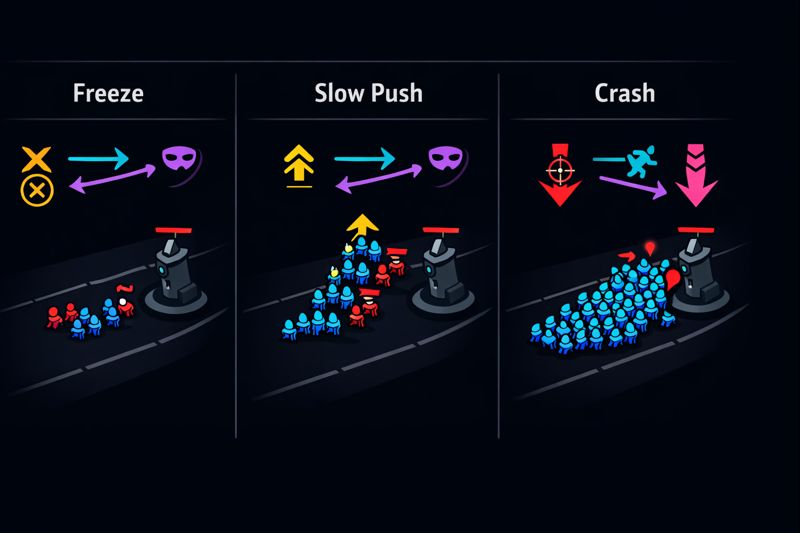
Top lane: where freezing is most brutal
Top lane’s long distance and isolation make freezing especially punishing. A freeze near your turret can force the enemy top laner to walk far up with limited escape routes. This is why top lane players talk about being “zoned off the wave.”
- Best use case: You are stronger in extended trades, or you have jungle threat behind you.
- Risk: Holding a freeze can make you vulnerable to a coordinated 2v1 if you lack vision or if the enemy jungler has strong dive tools.
- Pro tip: Freezing top often pairs with “thin the wave, then slow push” to set up a dive or a plate take on a timing window.
Mid lane: freezing is shorter, but still powerful
Mid lane is shorter and has more access routes, so freezes are often less absolute. Still, freezing mid does two valuable things:
- It makes the enemy mid laner choose between farm and safety.
- It frees you to control vision and coordinate with your jungler for skirmishes.
The mid-lane freezing trick is often timing-based: hold briefly to deny, then crash to move first to river/objectives.
Bot lane: freezing is a duo skill
Bot lane freezes are extremely strong because two players can punish a single enemy step. However, bot also includes more variables: support roaming, jungle pathing, dragon timing, and turret plates. If you freeze bot:
- Make sure your duo understands the plan (do not auto-attack the wave mindlessly).
- Coordinate vision because bot is a common gank lane.
- Watch objective timers; sometimes you must crash and rotate instead of freezing longer.
If you want to cross-check matchup stats or win-rate trends, consider reputable stat sites such as U.GG or OP.GG. Use them as directional signals, not as substitutes for wave fundamentals.
Freezing With Your Jungler: Ganks, Cover, and Threat
The freeze is a signal
A freeze tells both teams something: “If you walk up, you can die.” Your jungler should see a frozen lane as: a high-probability gank lane or a lane that needs cover if the enemy tries to break the freeze with numbers.
When to ping your jungler
- When the enemy must step up: The wave is frozen and the enemy is about to reach last-hit range.
- When the enemy will call help: You anticipate a jungler move to break the freeze.
- When you want a conversion: You plan to transition into slow push → crash → dive.
How to make ganks easier while freezing
Your job is to keep the enemy in a predictable lane position and to preserve your ability to follow up:
- Hold cooldowns that secure the gank (gap closers, CC, slows) instead of spending them on the wave.
- Keep the wave stable so the enemy is still extended when the jungler arrives.
- Ward intelligently so you do not get counterganked. A freeze is valuable only if you do not die holding it.
How to survive the “break freeze” response
Good opponents will send their jungler (or support) to break your freeze. The correct response depends on your information:
- If you have vision and your jungler is near, you can often hold and punish.
- If you lack vision and suspect a numbers play, you may need to let the wave crash and play defensively.
- If you are ahead, consider transitioning into a slow push to crash on your terms rather than being forced to fight.
Simple communication template
“Wave frozen near my turret. Enemy must walk up in ~10 seconds. Can you path here or hover for countergank?”
Turning a Freeze Into a Dive: The Clean Conversion
A freeze is often the first phase of a larger plan. The classic conversion is: freeze to deny and force low resources → build a slow push → crash a stacked wave → dive with minion cover. This pattern works because it aligns three advantages: health/resource gaps, minion damage, and turret pressure timing.
Phase 1: Freeze until the enemy is vulnerable
You do not dive just because you can. You dive when the enemy is low, isolated, or forced to stay:
- They are missing key cooldowns or summoners.
- They are down items because they could not recall.
- They are low HP/mana from trying to contest the freeze.
- They are alone while their support/jungler is on the other side of the map.
Phase 2: Start the slow push (stop holding, start stacking)
To convert, you must intentionally break your own freeze. Do this by killing the enemy minions faster for one or two waves so your wave starts building. The goal is a large wave that reaches turret. The larger the wave, the more: turret shots are soaked and damage is added.
Phase 3: Crash the stacked wave fully
A partial crash is risky. You want the wave under turret so:
- The enemy must choose between fighting you and losing the wave.
- Your minions tank turret shots during the first seconds of the dive.
- After the play, the lane often bounces and you can reset.
Phase 4: Dive with roles and rules
Clean dives are less about mechanics and more about clarity:
- Who tanks first? Decide before you enter turret range.
- What is the exit plan? Kill and leave, or kill and trade 1-for-1 with wave advantage?
- What is the stopwatch moment? Know the point at which you disengage if the kill does not happen quickly.
A timeless dive checklist
- Wave: big enough to crash and tank turret for several seconds.
- Vision: you know where the enemy jungler likely is, or you have coverage wards.
- Cooldowns: you have your key CC/burst; enemy key escape tools are down or limited.
- Numbers: you have equal or greater numbers at turret (or you accept a trade intentionally).
- Outcome: you know what you take after (plates, reset, objective, invade).
If your goal is to climb efficiently and convert wave control into rank gains, consider structured help such as coaching or an Elo climb plan. See pricing here: Boosteria Elo Boost Prices.
Freezing by Matchup Archetype
Freezing is universal, but how you apply it changes based on champions’ kits and win conditions. Think in archetypes:
Archetype 1: You win long trades (bruiser/duelist patterns)
Freezing is excellent here because the enemy must walk up into your extended-trade zone. Your priorities:
- Hold freeze near turret to threaten an all-in when they last-hit.
- Preserve your gap closer/CC for the moment they step forward.
- Transition to slow push for a dive when they are forced low or out of resources.
Archetype 2: You win short trades (poke/burst patterns)
Freezing can still work, but you must avoid accidentally pushing with frequent poke. Your priorities:
- Poke selectively when it does not pull minion aggro in a way that breaks the wave.
- Use the freeze to force them into your skill-shot angles.
- If you cannot hold long, freeze briefly then crash to reset and repeat.
Archetype 3: You are scaling and weaker early
Freezing can be defensive: it reduces how far you must walk to farm, and it minimizes exposure to ganks and all-ins. The key is humility: your freeze is for safety and stable income, not for forcing fights.
- Prioritize wave location and vision over “winning trades.”
- Trim only enough to prevent a crash; do not burn mana unnecessarily.
- Call for help to break enemy freezes rather than dying repeatedly to contest.
Archetype 4: The enemy has superior waveclear
Against heavy waveclear, freezes are harder to maintain because the opponent can quickly crash the wave and reset. In these matchups:
- Accept shorter freezes and look for timed freezes around cannon waves.
- Use freezes to force them to spend mana and cooldowns on the wave.
- Be ready to pivot into fast crashes to keep tempo rather than fighting a losing waveclear battle.
Common Mistakes and How to Fix Them
Mistake 1: Freezing while you are vulnerable to a dive
Freezing near your turret feels safe, but it can be dangerous if the enemy can stack a wave and dive you with jungle help. Fix:
- Track enemy jungle location and mid/support roams.
- If you cannot defend a stacked wave dive, consider thinning earlier or crashing to reset.
- Ward deeper when you intend to hold a freeze for an extended period.
Mistake 2: Over-trimming and “accidentally pushing”
Players often kill a few extra minions “to be safe,” then wonder why the lane pushes away. Fix:
- Trim only when the wave is truly large enough to crash.
- Use single-target autos; avoid AoE unless necessary.
- Last-hit later. Late last-hits preserve enemy minions longer.
Mistake 3: Ignoring the bounce
After you crash a wave into the enemy turret, the lane often bounces back. If you don’t plan for that, you may end up stuck overextended. Fix:
- After crashing, decide: recall, ward, or hover until the wave returns.
- If you want a freeze, be present to catch the returning wave.
Mistake 4: Freezing with no threat
A freeze is most punishing when you can punish steps forward. If you cannot threaten trades or ganks, the enemy may simply farm anyway. Fix:
- Hold the freeze when your cooldowns are up and your health is stable.
- Coordinate with your jungler; a freeze plus a jungler hover creates threat even if you are not a strong duelist.
- Use the freeze to force them into skill-shot angles and chip them down.
Mistake 5: Failing to convert
Many players freeze well but never cash it in. They deny some minions, then the game moves on. Fix:
- Ask: what is my conversion? kill, plates, recall advantage, objective, invade, roam?
- When the enemy is low or forced to stay, start the slow push and plan the crash timing.
Practice Drills to Master Freezing Fast
Drill 1: The post-crash freeze (10 reps)
- Let the wave crash into your turret.
- Clear only enough to avoid losing too much HP.
- As the wave bounces back, establish a freeze outside turret range.
- Hold it for at least one full wave without pushing.
Drill 2: Trim control (5 minutes)
- Create a slightly oversized enemy wave.
- Trim only one minion at a time until the wave stops threatening to crash.
- Repeat while focusing on late last-hits.
Drill 3: Freeze → slow push → crash (5 cycles)
- Hold a freeze for one wave.
- Decide a “go” moment and start slow pushing.
- Build at least two waves, then crash fully into turret.
- Simulate the conversion: roam timer, ward timing, or dive approach angle.
Drill 4: Breaking a freeze (5 scenarios)
Set up a freeze against yourself and practice breaking it with different tools: safe waveclear, jungle help simulation, and “sacrifice then reset” choices.
For deeper macro concepts and role interactions, educational communities and guides can be useful complements to practice. Consider browsing structured improvement resources on Mobalytics or similar reputable coaching platforms, but always validate concepts in-game.
In-Game Checklists: Freeze, Break, Dive
Freeze checklist (10 seconds)
- Do I want deny, safety, or setup?
- Is the wave just outside my turret range?
- Is the enemy wave slightly bigger (pushing into me slowly)?
- Do I have vision to avoid dying while holding?
- Do I have cooldowns ready to punish last-hit steps?
Break checklist (10 seconds)
- Can I shove safely alone, or do I need help?
- Do I have the waveclear and health to commit to a full crash?
- Where is the enemy jungler likely to be?
- Am I committing to crash, not half-shove?
Dive checklist (10 seconds)
- Is the stacked wave large enough and already crashing?
- Do we know enemy reinforcements are late or far?
- Who tanks first and who finishes?
- Do we have a clean exit plan?
- What do we take after: plates, reset, objective?
FAQ
How long should I freeze?
Freeze as long as it produces a clear benefit without increasing your death risk. Often that means one to three waves: enough to force missed farm, burn resources, or create a gank window. If nothing is happening, convert into a slow push and crash.
What if my champion accidentally pushes the wave?
Many champions have wave-influencing kits. In that case, aim for shorter freezes and prioritize “timed freezes” around cannon waves. Focus on the bigger skill: controlling the lane state over time, not holding a perfect freeze indefinitely.
Is freezing always correct when I’m ahead?
Not always. If your team needs you at an objective soon, crashing to move first can be stronger than freezing. Think of freezing as one tool in a macro toolkit: deny when it matters; crash when tempo matters.
Why does my freeze break when I trade?
Trades can pull minion aggro and change which minions die first, altering the wave balance. If your freeze breaks after trading, reduce how often you hit the enemy in the wave, and trade at moments when the wave is stable or when you are intentionally transitioning to a push.
How do I stop the enemy from breaking my freeze with help?
You usually cannot stop it forever. The goal is to extract value while it lasts: deny farm, force them to spend time and resources, and be ready to transition into a crash when you see the help coming. If the enemy sends multiple players, your team often gains value elsewhere.
Next Steps
Mastering lane freezing is less about memorizing numbers and more about repeatable patterns: pull the wave, hold it outside turret, trim intelligently, and convert. If you practice the drills in this guide and use the checklists in real games, you will quickly feel more control over lane outcomes.
If you want a faster feedback loop (wave reviews, matchup plans, and conversion playbooks), structured support can help you turn these fundamentals into consistent rank progress. You can review options here: Boosteria Elo Boost Prices.
Finally, remember the timeless principle: freezing is not the end goal. It is a lever. Use it to force the opponent into bad choices, then cash those choices into tangible map value.