



CS2 Demo Review Guide 2026: Analyze Your Gameplay Step by Step
How to Review Demos in CS2 (2026): Step-by-Step Guide to Analyzing Your Gameplay
If you want consistent improvement in Counter-Strike 2, aim training alone will eventually plateau. The players who climb reliably are the ones who can diagnose why rounds were lost and which habits are creating repeated disadvantages. That is exactly what demo review is for.
This guide gives you a practical, repeatable CS2 demo review workflow you can run in 30–60 minutes and turn into a weekly improvement loop. It is written to stay useful over time: even if maps, metas, and updates change, the underlying analysis methods (decision quality, positioning, timing, utility value, risk management, and communication) remain stable.
You will learn:
- Which demo types to review and what each one is reliable for
- How to set up controls so you can review quickly without getting lost
- A three-pass review system (macro → micro → utility/comms) that prevents overwhelm
- A step-by-step checklist for analyzing rounds, duels, rotates, and mistakes
- How to convert notes into a focused practice plan (not a messy “to-do list”)
Throughout the guide, you will also find templates and checklists you can copy into your notes app.
1. Why Demo Review Works (and Why Most People Fail at It)
Demo review is valuable because CS2 is a decision game disguised as a mechanics game. You can “feel” that you missed shots, but you usually cannot feel the hidden causes that made those shots hard:
- Late rotations that forced rushed retakes
- Bad spacing that made trades impossible
- Utility that created no advantage (or created advantage too late)
- Re-peeks that were unnecessary given the round state
- Information gaps caused by silence, unclear comms, or missing map control
The best part: demo review creates improvement even when you do not have time to grind. One strong insight (for example, “I consistently fight without a trade,” or “I always burn utility while we have no map control”) can give you a concrete rule to follow next week. Rules beat vague motivation.
Most people fail at demo review for predictable reasons:
- They review emotionally. They watch the demo to prove they were right, or to blame teammates, instead of to find controllable actions.
- They review everything. They try to analyze a full match in detail, get overwhelmed, and never build a repeatable habit.
- They take notes that do not convert. “Aim better” and “play smarter” are not action items; they are frustrations.
- They chase highlights. They focus on one clutch or one whiff, ignoring the repeated patterns that decide most rounds.
This guide solves those failure modes by giving you structure: short reviews, repeatable categories, and a conversion step that turns observations into drills and rules.
Key mindset: Your goal is not to become “perfect.” Your goal is to remove the biggest repeatable leak each week. If you do that for 8–12 weeks, your rank will move.
2. CS2 Demo Types, Accuracy, and What You Should Trust
Not all demos are equal, and confusion here wastes time. In practice, you will usually review one of these:
2.1 Match demos (server/GOTV-style)
These are ideal for macro learning: team shape, rotations, utility coordination, spacing, and crossfire setups. They also help you understand the opponent’s patterns because you can swap POVs and see the “why” behind their decisions.
2.2 POV demos (client-recorded)
POV demos are excellent for your mechanics and decision timing: crosshair placement, movement into angles, how you clear, how early you commit utility, and how you react under pressure. Third-party analysis tools often accept POV demos for personal performance breakdowns.
2.3 Demo playback accuracy and “what actually happened”
Historically, demo playback could feel confusing because the replay might show interactions slightly differently than what you experienced in the match (latency, perspective differences, and prediction behavior). Valve introduced a demo playback feature designed to reconstruct the observed player’s experience more closely, which matters when you are analyzing tight duels and “did I get cheated?” moments.
Timeless rule: use demos to learn patterns and decisions first; use precise playback for mechanics second. If you reverse that order, you will spend your energy arguing with the replay instead of improving your game.
2.4 Version mismatch and reliability
Any game update can change how older demos behave. If something looks “off,” do not build a habit-change around a single weird moment. In your notes, mark it as “uncertain” and only act if you see the pattern in multiple demos.
Practical takeaway: For improvement, the most reliable insights come from repeated choices: positioning, spacing, timing, and utility value. Those remain readable even when the replay system changes.
3. Getting and Organizing Demos for Fast Review
Your review quality improves immediately when your demo organization is clean. The goal is simple: you should be able to find the demo you want in under 20 seconds.
3.1 Pick the right matches to review
Do not review every match. Review the matches that teach the most:
- Close losses (10–13, 11–13). These are usually decided by repeatable mistakes, not skill gaps.
- Games where you felt “lost.” That feeling often means your default midround is weak.
- Games where you top-fragged but lost. Often a sign of impact problems (exit kills, low conversion, poor trading, or weak late-round decisions).
- Any match with repeated deaths in the same way. That is a pattern begging for a rule change.
3.2 Name demos so they sort naturally
Use a consistent naming pattern. Example:
- 2026-01-16_Mirage_L_11-13_Role-Entry.dem
- 2026-01-16_Ancient_W_13-9_Role-Anchor.dem
This naming convention creates instant filtering by date, map, result, and role.
3.3 Create a “Review Queue”
Make a simple list in your notes app:
- Next demo to review (one only)
- The one question you want to answer
- Target review time (30, 45, or 60 minutes)
If you keep multiple demos in your queue, you will procrastinate by “choosing.” Keep it tight.
4. Playback Controls, Speed, and a Clean Review Setup
Your goal during review is speed and clarity. You are not producing a cinematic. You are extracting decisions and building habits.
4.1 The two speeds you should use
- Fast scan (2×–4×): for macro flow, rotations, and identifying “candidate rounds” worth deep review.
- Decision speed (0.5×–1×): for duels, utility timing, peeks, and trade spacing.
A common mistake is watching the entire demo at 1×. That is how you turn review into entertainment instead of improvement.
4.2 Your baseline viewing toggles
Whatever interface you use, aim for the same baseline every time:
- Clear HUD and timeline controls so you can jump by round
- A reliable pause keybind you can hit constantly without thinking
- The ability to switch POVs quickly (you, teammate, opponent)
4.3 Create a distraction-free review environment
Because review is cognitive work, treat it like practice:
- Full screen demo or large window, notes visible on a second screen (or split view)
- Phone away (or in focus mode)
- Short timer: 30–60 minutes maximum per session
Shortcut: If you only have 20 minutes, review only pistol rounds and the first gun round on each side. Openings reveal more about your fundamentals than late-round chaos.
5. Your Review Stack: Notes, Categories, and a Simple Template
You do not need complex tooling. You need consistent categories so patterns become obvious. Use any notes app and copy this template.
5.1 The only five categories you need
- Decision (macro): rotations, risk choices, when you fight vs live, economy decisions
- Positioning & spacing: angles, off-angles, trade distance, crossfires, isolation
- Mechanics (micro): crosshair placement, movement, peeks, recoil discipline, spray transfers
- Utility: value created, timing, layering with teammates, wasting, self-flashes
- Information & comms: what you knew, what you said, what you assumed, what you missed
5.2 Copy-paste demo review note template
Demo: [date_map_result_score_role]
Goal question: [example: “Why do my midrounds collapse on T side?”]
3 key rounds to review deeply: [R3, R7, R19]
Findings (by category):
- Decision: …
- Positioning & spacing: …
- Mechanics: …
- Utility: …
- Info & comms: …
Top 1 leak (this week): [one only]
Rule to follow: [one sentence]
Drill/practice: [10–20 minutes, 3–5 days]
In-game reminder: [short phrase you can repeat between rounds]
This template forces conversion: it ends with one leak, one rule, and one drill. That is how improvement becomes real.
6. The Three-Pass Framework: Macro → Micro → Utility/Comms
The biggest improvement hack is reviewing the same demo in different “passes,” each with a different question. This prevents the most common review failure: noticing everything and fixing nothing.
Pass 1: Macro flow (10–15 minutes)
Watch fast. Do not pause for small mistakes. You are building a map of the match:
- How often did your team have early map control?
- Where did rounds usually break (early pick, midround rotate, late exec, retake)?
- What was your default plan on T side?
- How often did CT side lose sites due to poor info vs poor positions?
At the end of Pass 1, write down 3 rounds that represent the match. You will deep-dive only those rounds.
Pass 2: Micro mechanics and duel quality (15–25 minutes)
Now you slow down and pause constantly. You are looking for “how” you fight, not just “did you win.” Focus on:
- Crosshair placement before the enemy appears
- Movement errors (wide-swinging into multiple angles, counter-strafing late, re-peeking without reset)
- Pre-aim discipline and clearing order
- When you choose to commit vs when you should disengage
Important: do not label everything as aim. Many “aim” problems are actually timing, spacing, or angle selection problems.
Pass 3: Utility and communication (10–20 minutes)
Utility review is where many players gain the fastest rank increase because it is the most under-analyzed part of matchmaking. Here you track:
- Did your grenades create a decision advantage (space, delay, isolation, forced reposition)?
- Was utility layered with teammates or thrown alone?
- Did you throw defensive utility too early, leaving nothing for the hit?
- Did you communicate what your utility achieved (or what it failed to do)?
In Pass 3, also review your “information economy”: what you knew, what you said, and what you assumed.
The rule: If you cannot summarize the match in one sentence after Pass 1, you watched too slowly. If you cannot summarize your top two mechanics leaks after Pass 2, you paused too little.
7. Step-by-Step Demo Review Workflow (Repeatable Checklist)
This is the core of the guide. Use it exactly as written for your next three demos. After that, customize it for your role and maps.
Step 1: Define one improvement question
Pick a question that forces focus. Good examples:
- “Why do I die first on T side so often?”
- “Why do my midrounds stall and end in bad late executes?”
- “Am I creating value with utility or just throwing it?”
- “Do I lose rounds from poor positioning or poor rotations?”
Bad questions are emotional or vague: “Why are my teammates bad?” or “Why do I suck?” Avoid them.
Step 2: Identify your role per side (not your ego role)
Many players call themselves “entry” or “IGL,” but the demo shows their real role: lurk timings, trade distance, anchor discipline, rotate speed, or support utility. Write what you actually did:
- T side: entry / second / support / lurk / late-round closer
- CT side: anchor / rotator / info player / aggressive control
Role clarity makes your mistakes measurable. An anchor dying is not always bad; an anchor dying with no delay and no info often is.
Step 3: Run Pass 1 quickly and mark candidate rounds
Watch at higher speed and mark rounds that answer your question. Candidate rounds usually include:
- First gun rounds (where structure shows)
- Rounds with early deaths (where habits show)
- Rounds that felt confusing live (where midround leaks show)
- Any round where you had advantage and still lost (where conversion leaks show)
Step 4: For each candidate round, write the round “story” in one line
Example format:
- R7: Lost mid control, rotated late, took 3 isolated duels, no trade, retake with no utility.
This prevents you from drowning in details. You want narratives first, details second.
Step 5: Deep-dive the first 15 seconds (openings decide the round)
Most repeatable mistakes happen early:
- Crosshair not ready when you could be contacted
- Moving through a choke without a plan
- Taking space with no teammate able to trade
- Using utility before you know the opponent’s setup
Pause and answer:
- What was my plan for the first fight?
- What info did I have, and what did I assume?
- Was I tradable?
- Was my risk appropriate for the economy and score?
Step 6: Check your spacing and tradability on every duel
In matchmaking, “teamwork” often means one simple thing: if you fight, someone can trade. During deep review, every time you die or take a duel, pause and measure:
- Distance to nearest teammate
- Line of sight: could they actually see your duel?
- Timing: were they busy with utility or clearing a different angle?
If you cannot be traded, your duel is usually a low-percentage gamble unless it is a deliberate “space for info” play.
Step 7: Evaluate angle selection (did you choose a fair fight?)
Many deaths are not “missed shots.” They are bad fight selection:
- Holding two angles at once
- Standing in a common pre-aim line with no off-angle variation
- Re-peeking the same angle after being spotted
- Swinging into a crossfire without utility
Write the fix in plain terms: “Hold one angle,” “Play an off-angle for first contact then fall,” “Do not re-peek without flash,” etc.
Step 8: Track your utility value (not your utility usage)
Utility is only “good” if it creates an advantage. For each grenade, ask:
- What did this grenade accomplish?
- Did it force movement, block vision, delay, isolate, or confirm info?
- Was the timing correct (before contact, during contact, after contact)?
- Did my team benefit, or did I only help myself?
If your answer is “nothing,” do not get defensive. That is a gift: utility value is easier to improve than raw aim.
Step 9: Label the mistake type accurately
Use labels that lead to fixes:
- Decision mistake: wrong choice given information and round state
- Timing mistake: right idea, wrong moment
- Spacing mistake: not tradable, broke team shape
- Mechanics mistake: crosshair/movement execution
- Utility mistake: low value, wrong timing, poor layering
- Info mistake: did not communicate, did not check, assumed
“Aim” is not a useful label unless you specify the mechanical root cause (crosshair height, counter-strafe timing, over-flicking, panic spray, etc.).
Step 10: Separate “unlucky” from “repeatable”
CS2 has variance. Sometimes you lose a duel you “should” win. Your job is to identify repeatable edges:
- Did I give myself a trade?
- Did I use utility to isolate?
- Did I choose a position with a safe exit?
- Did I manage risk based on economy and man advantage?
If you did those things and still lost a duel, label it as variance and move on. Do not build your practice plan around emotional moments.
Step 11: Extract one rule and one drill
At the end of the review, you must produce a one-week change. Examples:
- Rule: “No dry re-peek after being spotted unless a teammate can trade.”
- Drill: 12 minutes/day: pre-aim map routine + 10 controlled counter-strafes per angle.
- Rule: “If we have man advantage, I do not take first contact alone.”
- Drill: 10 minutes/day: retake server focus on delaying and living, not fragging.
Step 12: Build a “between rounds” reminder
In real matches, you forget. Create a short phrase you can repeat between rounds:
- “Tradable or don’t fight.”
- “One angle, one exit.”
- “Utility creates decisions.”
- “Advantage = patience.”
This is how demo review becomes ranked performance.
8. What to Look For: T Side, CT Side, and Role-Based Mistakes
To make your reviews sharper, you should know the typical failure patterns by side. This helps you spot the “real problem” faster.
8.1 T side: common demo review patterns
- Early pick obsession: taking 50/50 duels instead of building map control and forcing rotations
- Stalling midround: no plan after default contact, late executes with no utility
- Lurk without value: lurking when the team needs pressure, or lurking with no timing connection
- Bad trade shape: entries alone, second player too far, utility thrown after contact
- Post-plant panic: swinging for ego fights instead of crossfires and time management
Review questions for T side:
- Did we take space that created a rotation?
- Did our utility force defenders off strong positions?
- Were our first two players tradable?
- After plant, did we play time or play highlights?
8.2 CT side: common demo review patterns
- Info starvation: giving up map control with no contest and no info plan
- Over-rotation: rotating on noise or one piece of utility, then getting hit elsewhere
- Anchor deaths with no delay: dying instantly without using utility or forcing time
- Retake with no plan: entering one by one, no utility layering, no trade spacing
- Chasing: pushing for revenge instead of stabilizing the round state
Review questions for CT side:
- Did we have a plan to gather info (without donating a kill)?
- When we rotated, was it based on confirmed info or anxiety?
- Did the anchor create time and information, or just die?
- In retakes, did we isolate angles or walk into crossfires?
8.3 Role-based lens (so you fix the right thing)
If you are often first contact (entry / aggressive CT)
- Are you choosing fights that can be traded?
- Are you clearing angles in a disciplined order?
- Do you use utility to reduce the number of angles you must fight?
- When you get the first kill, do you convert it (fall, call, reset), or do you overheat?
If you are second/third (trader / support)
- Are you close enough to trade instantly?
- Is your crosshair ready for the likely trade angle?
- Do you waste time throwing utility after your entry is already fighting?
- Do you communicate “I can trade” or “I can’t trade” clearly?
If you are an anchor (site holder)
- Do you die in positions with no exit?
- Do you use utility to delay before taking a duel?
- When pressured, do you call early enough for rotations to matter?
- Do you understand when to fight for space vs when to give and retake?
If you are a rotator (CT flexibility)
- Are your rotations early, correct, and based on info?
- Do you arrive with utility, or do you arrive empty-handed?
- Do you create crossfires with the anchor, or crowd the same line?
9. Turning Notes into Practice: Drills, Rules, and Weekly Goals
Notes do not improve you. Behavior improves you. Your job is to compress your review into one-week action.
9.1 The “One Leak Rule”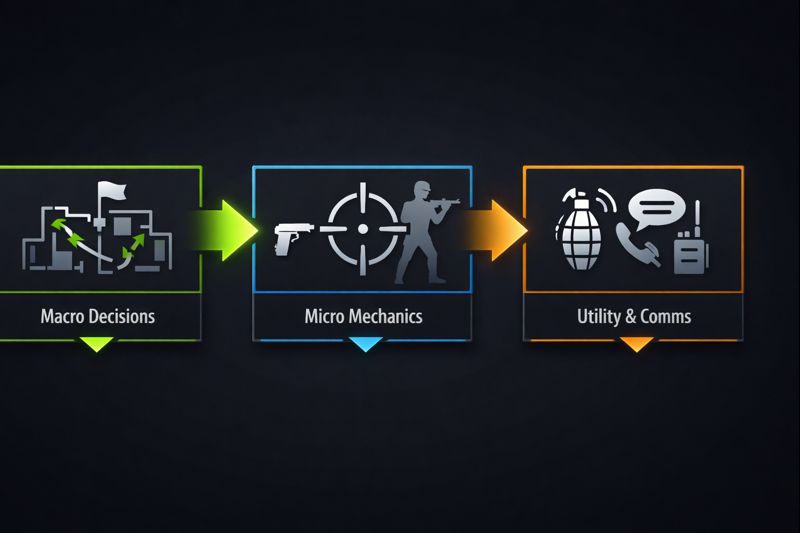
Pick one leak that creates the biggest repeated disadvantage. Examples of high-impact leaks:
- Taking first contact with no trade
- Re-peeking after being spotted
- Using utility too early and having nothing when it matters
- Rotating on unconfirmed info
- Post-plant chasing instead of playing time
High-impact means it happens often and costs rounds. One leak fixed beats five leaks “noticed.”
9.2 Convert the leak into a rule you can execute
Your rule should be short, specific, and tied to a trigger. Examples:
- “If I’m spotted, I do not re-peek without flash or trade.”
- “If we have man advantage, I play information and time, not hero duels.”
- “If my teammate is first contact, I stay within trade distance until the fight resolves.”
9.3 Build a tiny drill that supports the rule
Drills should be short enough that you actually do them. Examples:
- Trade readiness drill (10 min): run a pre-aim routine and stop on likely trade angles; practice stopping movement and placing crosshair at head level instantly.
- Utility value drill (12 min): pick 2 grenades and practice the timing cue (when it should land relative to contact), not only the lineup.
- Post-plant discipline drill (8 min): review two post-plant rounds and write the safest crossfire/escape plan; in matches, repeat “time wins.”
9.4 Add a measurable weekly target
Do not measure your rank day-to-day. Measure execution:
- “Zero dry re-peeks after being tagged in the next 10 games.”
- “In every post-plant, I state my position plan once.”
- “At least 5 rounds per match where my utility creates a clear advantage.”
When you execute better, rank follows.
10. Review Cadence: How Often to Review Without Burning Out
Demo review works best as a rhythm, not a one-time event.
10.1 The minimum effective schedule
- Weekly: 1 full demo review (45–60 minutes)
- Optional: 1 micro-review (15–20 minutes) focusing only on pistol rounds or opening deaths
This schedule is enough to create consistent improvement if you actually follow the “one leak → one rule → one drill” conversion.
10.2 The “two-demo audit” every month
Once per month, review two demos back-to-back and look for repeated categories. Ask:
- Which mistake category appears most often?
- Is my role stable, or am I randomly changing how I play?
- Which mistakes cost the most rounds, not the most emotions?
This monthly audit prevents you from “fixing random things” and keeps your growth strategy coherent.
10.3 Managing tilt during review
If demo review makes you angry, your process is wrong. Use this rule: write fixes in neutral language. Replace “I’m terrible” with “I over-commit after first kill” or “I rotate on sound instead of info.” Neutral labels create actionable change.
11. Built-In vs Third-Party Tools: When to Use Each
Built-in demo viewing is enough for most improvement. Third-party tools can speed up pattern detection, but they should not replace your thinking.
11.1 Use built-in tools for decision learning
- Macro flow and rotation logic
- Spacing and trade structure
- Utility timing relative to contact
- Opponent patterns (where they like to take space)
11.2 Use third-party tools for quick diagnostics
These tools can help highlight patterns (opening duel success, positioning tendencies, utility usage stats). They are best used to generate hypotheses you confirm in the demo. If a tool says you “die early,” the demo tells you why.
12. FAQ: Common Demo Review Problems (and Fixes)
“I don’t know what to look for. Everything feels wrong.”
Run Pass 1 and only answer two questions: where did rounds break, and was I tradable? That alone often reveals the core issue. Then pick one category to improve this week.
“Demo review takes too long.”
Limit the session to 45 minutes. Use fast scan to pick 3 rounds, then deep-dive only those rounds. You are not auditing the entire match; you are extracting the biggest leak.
“I keep writing ‘aim’ as the problem.”
Replace “aim” with a root cause label: crosshair placement, counter-strafe timing, angle selection, or fight selection. Each root cause has a different practice solution.
“I improve in practice but not in matches.”
You are missing the reminder step. Create a single between-round phrase and repeat it. Also, focus on one rule at a time; multiple rules collapse under pressure.
“My teammates make so many mistakes that review feels pointless.”
Teammates change every match; your habits follow you. Demo review works because it targets controllable actions: tradability, discipline, utility value, and decision timing.
“Should I review wins or losses?”
Review close losses for the fastest learning. Review one clean win occasionally to identify what “good structure” looked like when you played well, so you can replicate it.
13. Next Steps: Make Demo Review a Ranking Advantage
If you implement the workflow in this guide, you will build an improvement loop that most players never develop. The advantage is not talent; it is process.
When you want faster progress, the next lever is feedback: a stronger player can often spot your biggest leak in minutes and help you convert it into a clean plan. If you want structured help with role clarity, utility value, and decision-making (not just aim), consider a coaching or ranked improvement plan that fits your goals.
You can review Boosteria’s CS2 options here: https://boosteria.org/cs2-boosting/prices
Final checklist for your next review:
- Pick one question
- Fast scan and choose 3 rounds
- Deep-dive openings, tradability, angle selection, and utility value
- Label mistakes precisely
- Extract one leak, one rule, one drill
- Use a between-round reminder in your next games
Do this weekly, and your results will stop feeling random.