



Rocket League Kickoff Fundamentals: Safe Options and Cheats
Rocket League — Kickoff Fundamentals: Safe Options, Cheats, and Adapting
Kickoffs look simple on the surface. The ball sits at midfield, the countdown ends, and both teams race forward. Yet in Rocket League, few moments decide so many possessions so quickly. A clean kickoff can create immediate pressure, a free shot, a safe first touch, or enough control to let your team settle into shape. A poor kickoff can hand away boost, field position, momentum, and sometimes an instant goal. Because kickoffs happen dozens of times across a session, even small improvements here can produce a real jump in consistency over time.
This guide breaks down Rocket League kickoff fundamentals in a timeless way: what makes a kickoff safe, what a cheat actually does, how responsibilities change by spawn, why adaptation matters more than memorizing one “best” option, and how to build a repeatable kickoff system for 1v1, 2v2, and 3v3. The goal is not to turn you into a flashy specialist overnight. The goal is to help you stop giving away cheap goals, read the first seconds of the play better, and turn kickoffs into reliable advantages.
At every rank, players talk about mechanics, rotations, and speed. Those matter. But kickoff discipline is one of the easiest places to gain win rate without changing your entire playstyle. When you understand safe contact, second-man spacing, cheat timing, and opponent habits, you reduce randomness. You stop treating the kickoff as chaos and start treating it as a structured opening.
If you follow high-level competitive Rocket League, you can also study how organized teams approach early possession, pressure, and recovery through official esports coverage and results on Rocket League, RLCS pages, and community event databases like Liquipedia Rocket League. For practical in-game training and replay habits, Epic’s Rocket League Crash Course is also worth bookmarking. And if your goal is faster rank progress with structured help, you can compare options on Boosteria’s Rocket League boosting prices page.
Table of Contents
- Why kickoffs matter more than most players think
- The core principles of a strong kickoff
- Kickoff spawn types and what each one means
- Safe kickoff options that work at every rank
- What a cheat is and when to use it
- How to adapt to opponent tendencies
- Kickoff fundamentals in 1v1, 2v2, and 3v3
- Second touches, recoveries, and first possession
- Common kickoff mistakes that cost free goals
- Communication, quick chat, and team clarity
- A simple kickoff training routine
- How to review your kickoffs in replays
- Final thoughts
Why kickoffs matter more than most players think
Players often describe kickoffs as a coin flip. That mindset is one reason they stay inconsistent. Kickoffs contain some uncertainty, but they are not pure luck. The car path you choose, the timing of your flip, the angle of your contact, the speed you carry into the ball, your recovery after impact, your teammate’s spacing, and your response to the opponent’s tendencies all shape the outcome.
A single kickoff can decide much more than the first challenge. It determines who reaches the nearest boost pads first, who gets to face the ball with momentum, who is forced to turn awkwardly, and who controls the first meaningful touch after the collision. In many games, the opening goal comes not because someone lost the initial 50 outright, but because the second player guessed wrong, overcommitted, cheated too hard, or drifted too deep for support.
That is why good Rocket League players stop thinking only about “winning” the kickoff. The better question is this: what outcome are you trying to create? Do you want a dead ball for a teammate cheating behind you? Do you want a soft loss to your own corner because you are under pressure and value safety? Do you want a hard neutral that buys time to collect back boost and organize? Do you want to challenge fast because the opponent is slow to react? Different situations call for different answers.
Kickoff skill also scales well. If you improve it once, you benefit in every session, in every rank bracket, on every map, and in every mode. That makes it one of the most efficient areas to study if your goal is consistent climbing in Rocket League.
The core principles of a strong kickoff
Before talking about specific spawn positions or mode-specific strategies, it helps to define a few core principles. These apply whether you are playing casual, ranked, 1v1, 2v2, or 3v3.
1. Arrive under control, not just fast
A fast approach matters, but speed without control often produces weak contact. Many players rush into the ball with messy steering, a late adjustment, or an off-center hit that sends the ball straight to the opponent’s support player. A strong kickoff is not merely about getting there first. It is about arriving balanced enough to direct the challenge.
2. Protect the center line of your car
The cleaner your car’s nose and center mass meet the ball, the more stable the challenge tends to be. Side-on contact can work in specific mind games, but if you are building a reliable baseline, prioritize centered impact. Stable contact reduces accidental pinch-outs and wild losses.
3. Think about where the ball goes after the challenge
The collision is only half the play. The real value comes from where the ball lands and who can reach it next. Great kickoff players think one layer deeper: “If I hit like this, who gets the next touch?” That shift in thinking turns kickoffs from mechanical races into positional decisions.
4. Always account for your teammate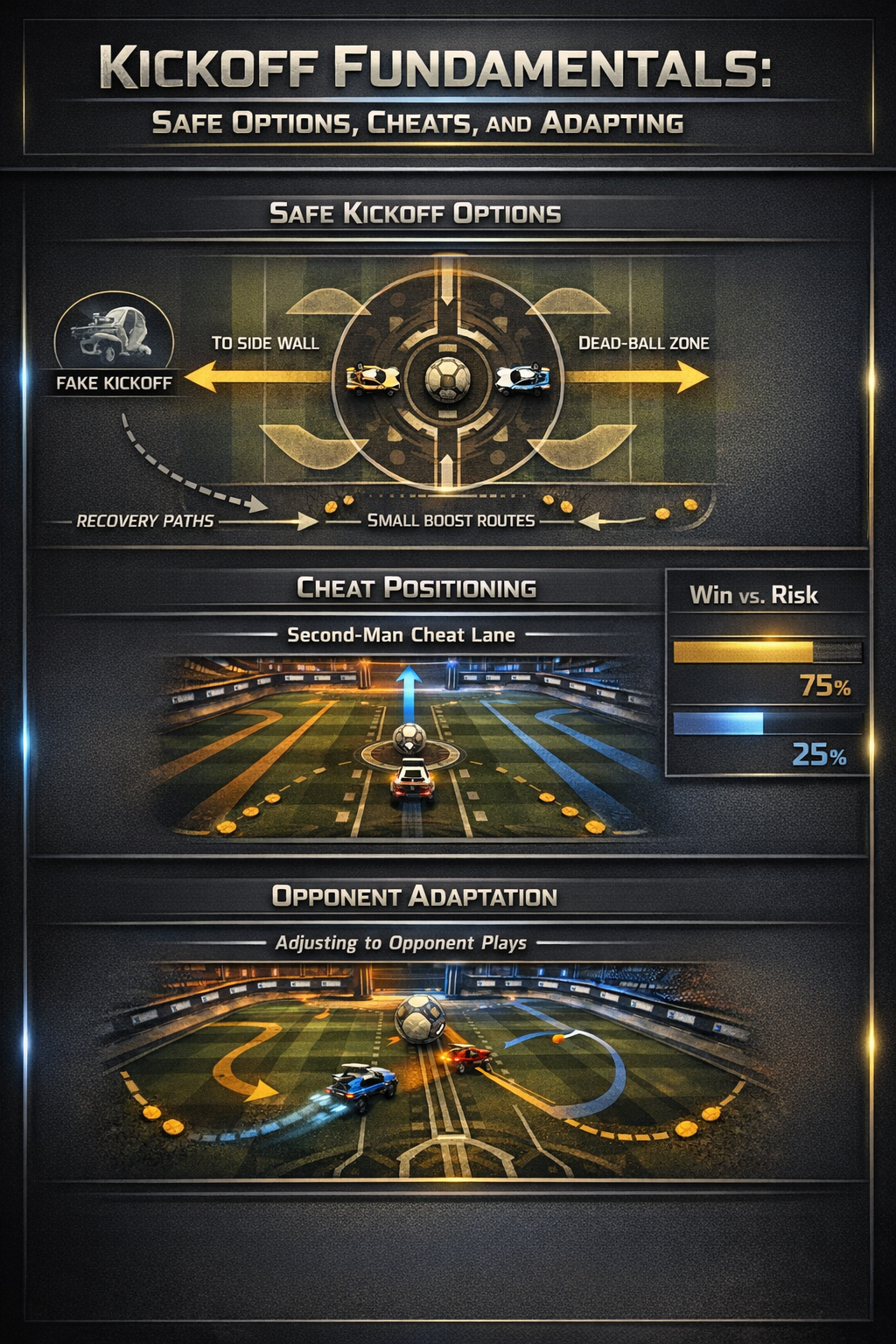
In team modes, kickoff choices are never isolated. A “good” kickoff for a solo player can be bad for the team if the cheat route, boost path, or recovery lane does not match. If your teammate is cheating, a deadened ball can be excellent. If both supporting players dive for boost with no cover, the same ball can become a disaster.
5. Safety beats style when the score matters
Some players obsess over fancy speed-flip kickoffs, delayed fakes, or hard reads before they have built safe habits. Advanced options have value, but the highest priority is reducing free goals against. A simple, controlled kickoff that creates a predictable result is worth more than an aggressive trick you cannot repeat under pressure.
6. Adaptation beats autopilot
If you always use the same approach, good opponents will read you. A kickoff system should include a default option, a safer adjustment, and at least one counter-response once you understand what the opponent prefers. Consistency is powerful, but rigid predictability is exploitable.
Kickoff spawn types and what each one means
Rocket League gives you a limited set of kickoff spawns, but each one creates a different geometry. The details vary by mode and teammate positioning, yet the broad responsibilities remain stable.
Diagonal spawn
Diagonal kickoffs are usually the fastest path to the ball. Because of the angle, they reward clean approach mechanics and precise contact. In many lobbies, the diagonal player is expected to take the kickoff because they have the shortest effective route. If you are the diagonal player, your responsibilities are to arrive efficiently, keep the hit controlled, and avoid giving away an immediate hard loss to your own side wall or net.
Diagonal kickoffs can produce very different results depending on whether you flip early, late, or through the center. Small angle changes matter more here than on straight spawns. That is why diagonal kickoffs are where many players either gain a consistent edge or create recurring problems.
Straight spawn
Straight spawns often feel easier because the path is more direct, but they still require good timing. A straight kickoff can create a very neutral 50 if both players arrive cleanly. It can also become awkward if you hit too low, too early, or off-center. Since the approach line is simpler, straight spawns are a good place to practice consistency and deliberate contact.
Back spawn
Back positions usually function as support roles in team modes. Your job is rarely to panic forward for no reason. Instead, you decide whether to cheat, grab a small pad route, cover net, collect a corner boost, or respond to a called fake. Strong back-spawn players understand that their decision depends on teammate behavior and opponent risk. They do not drift into empty space; they place themselves for the likely second play.
The key lesson across all spawn types is simple: know your role before the countdown ends. Unclear intention creates hesitation, and hesitation destroys kickoff structure.
Safe kickoff options that work at every rank
If you want an evergreen Rocket League kickoff system, build around safe options first. Safe does not mean passive. It means the outcome is readable, recoverable, and hard to punish instantly.
The controlled neutral kickoff
This is the baseline option most players should master. The goal is not necessarily to blast the ball forward. The goal is to meet the ball squarely, keep the challenge stable, and prevent a severe loss. In practical terms, that means using a smooth approach, matching the center of the ball cleanly, and flipping in a way that supports the hit rather than throwing your car wildly through it.
A controlled neutral kickoff is powerful because it gives your team time. Your support player can read the bounce. You can recover more cleanly. The ball is less likely to rocket uncontested into a dangerous zone. In ranked, where teammate coordination is often imperfect, predictability has enormous value.
The soft loss to a safe area
Not every kickoff needs to be neutral or won forward. Sometimes the safest outcome is a controlled loss toward your own corner or side wall, especially if your support player is positioned to collect and play out. This is more advanced than it sounds because “losing safely” still requires intent. You are choosing a manageable zone instead of gambling on a center ball or a bad pinch.
The danger is copying this concept without structure. A soft loss is only safe if your teammate expects it or if you yourself can recover into the next touch. Otherwise, you are simply conceding possession. Used correctly, though, it can deny the opponent a clean mid opportunity and slow the game into a more favorable shape.
The dead-ball kickoff
A dead-ball kickoff aims to kill the ball near center so a cheating teammate can take over immediately. This is extremely effective in 2v2 and 3v3 when the cheat distance is correct. If the support player is close enough to pressure but not so close that they overcommit, a dead ball can turn into instant possession or an immediate shot.
The risk comes when the support player assumes the ball will die and the kickoff player accidentally loses it off to one side. That is why dead-ball strategies work best when the primary kickoff player has repeatable contact and the support player is disciplined enough to react rather than blindly dive.
The delayed safety approach
Some opponents rush every kickoff at maximum speed and maximum commitment. Against those players, slightly delaying your final touch can improve your control and help absorb the collision better. The idea is not to arrive late enough to lose badly. The idea is to let the opponent over-extend into your car-ball line and use their speed against them.
This option is especially useful if you notice the opponent always flips early or tends to slam the ball through one side. The delay changes the collision timing and can force less favorable contact for them.
The fake kickoff
A fake kickoff can be safe or reckless depending on the mode, the score, the communication, and the support position. At its core, a fake asks the on-ball player to sell pressure before retreating or peeling off, while the support player prepares to receive the opponent’s free touch. Done well, it baits a hurried shot or overcommitted push into a prepared defense. Done poorly, it creates an open net.
In ranked, fake kickoffs work best as occasional counters rather than constant habits. They are strongest when the opponent expects a standard challenge and your teammate clearly knows the plan. They are weakest when used randomly with no defensive structure behind them.
What a cheat is and when to use it
In Rocket League, a cheat means the supporting player moves up behind the kickoff instead of going straight for a big corner boost or staying deep in net. The purpose is to be first to a dead ball, soft win, or soft loss that stays near midfield. A good cheat converts neutral kickoffs into immediate possession.
Many players misunderstand cheating. They think it means driving mindlessly toward the ball. That is not what strong teams do. A proper cheat is measured. You move up far enough to pressure the next touch, but you still preserve a recoverable angle. You are close enough to capitalize, not so close that a bad bounce goes over your head uncontested.
Why cheating is powerful
Cheating shrinks the gap between the kickoff collision and the next meaningful play. Without a cheat, a deadened ball can sit free long enough for the opponent’s support player to arrive first. With a cheat, your team can turn a neutral kickoff into offense. This matters even more in 2v2, where one good cheat can create a clean attack against a disorganized defense.
When cheating is best
- When your kickoff player is consistent at creating soft or neutral outcomes.
- When the opponent’s support player tends to retreat too deep for boost.
- When you want immediate pressure and early possession.
- When score, momentum, and game flow reward controlled aggression.
When cheating is risky
- When your kickoff player often loses hard to the side or back.
- When the opponent frequently uses fakes.
- When communication is poor and the support player guesses.
- When the game state calls for safety, such as protecting a late lead.
How far should you cheat?
There is no universal perfect distance. The right cheat distance depends on rank, speed, opponent habits, and whether your kickoff player is aiming for a dead ball or a more directional 50. In general, the best cheat gives you forward pressure without forcing a blind all-in. If you constantly get popped over, you are too aggressive or too flat. If you are never first to the second touch, you are too passive.
The easiest way to improve your cheat is to review your replays and pause right after kickoff contact. Ask one question: could I still react to a loss while also reaching a dead ball first? If the answer is no, adjust your route.
How to adapt to opponent tendencies
One of the biggest differences between average and strong kickoff play is adaptation. Average players repeat the same path every time. Strong players identify patterns and answer them. Since kickoffs repeat often, they create a mini-strategy game inside the match.
If the opponent always arrives very fast
Fast opponents try to overwhelm you with raw pace. Against them, focus on clean, centered contact and consider a slight delay on your final flip. You do not need to out-rush every speed-focused player. Often, you simply need to absorb them better and place the ball somewhere playable. Fast players also tend to leave more space behind the challenge if their support positioning is greedy, so a well-managed dead ball or soft win can punish them.
If the opponent flips early
Early flippers commit their angle sooner. That can make their outcome predictable. Try to read which side they usually favor and adjust your nose and flip timing to block that lane. Early commitments also make them more vulnerable to fakes or delayed challenges once you have shown standard kickoffs a few times.
If the opponent tries to force side wins
Some players deliberately cut the ball left or right on kickoff to feed a teammate or collect their own follow-up. Against them, you need to protect the side they prefer without opening the other completely. This is where replay review helps. Many players think an opponent is “random” until they watch three kickoffs in sequence and notice the same directional bias every time.
If the opponent mixes in fakes
Fakes punish autopilot. The answer is not to panic and stop challenging entirely. The answer is to make your support player more alert, reduce over-aggression on cheats, and watch the opponent’s approach carefully. Once a team has shown fake kickoff once, your entire team should treat future kickoffs with a little more patience until proven otherwise.
If the opponent support player always cheats hard
This often means the center ball is dangerous. Against heavy cheating teams, safer directional outcomes become more valuable. A hard center spill can become an immediate shot against you. In that matchup, it may be smarter to guide the ball slightly away from midfield chaos and into a zone your team can read.
If the opponent support player always retreats for boost
This is an invitation to pressure. Dead balls, soft wins, and active cheats become more rewarding because there is a delay before their second player enters the play. If your team is coordinated, this is when kickoff pressure can snowball into repeated offensive starts.
Kickoff fundamentals in 1v1, 2v2, and 3v3
1v1 kickoffs
In 1v1, the kickoff is brutally important because there is no teammate to clean up behind you. Every loss is personal, every fake is more dangerous, and every recovery matters. The priority in 1v1 is usually safety first, adaptation second, surprise third.
A good 1v1 kickoff denies free goals. That means you value centered contact, clean recoveries, and awareness of what your opponent wants after the challenge. If they love immediate dribbles, you want to keep the ball from landing cleanly in front of them. If they like to boom it from distance, you need a recovery line that gets you back quickly. If they overuse fake kickoffs, your reads and restraint matter more than raw speed.
Because the 1v1 kickoff repeats so often, mind games become more meaningful across the match. Still, do not overcomplicate it. First establish a default you can trust under pressure. Then layer adaptations once you see a pattern. The worst 1v1 kickoff habit is chasing creativity before building control.
2v2 kickoffs
In 2v2, the kickoff often decides which duo gets the first real attack. There is only one supporting teammate, so their role becomes extremely important. This is the mode where cheating is especially powerful, but also especially punishable if done badly.
The best 2v2 kickoff systems are simple and clear. One player goes, one player either cheats, collects a pad route with support, or covers a fake plan. The goal is to avoid the common ranked mistake where the support player disappears to full boost and leaves a dead ball for the opponent. In 2v2, the space behind the first challenge is large enough that one poor support decision often turns into an open lane straight to net.
If you queue with a partner, define your defaults. Decide who goes from ambiguous spawns, when you prefer cheat versus boost, and what your fake kickoff signal looks like. Even tiny clarity improvements can transform your 2v2 kickoff results.
3v3 kickoffs
In 3v3, structure matters most. You have a kickoff player, a likely second man, and a deeper third man. Because there are more layers of support, teams can be slightly bolder, but only if each layer understands its job. The classic problem in 3v3 ranked is double uncertainty: one support player cheats halfway, another drifts for boost, and neither truly owns the next zone.
A healthy 3v3 kickoff structure usually includes one clear challenger, one actionable support player, and one safety player who protects against the worst-case outcome. The support player does not always have to hard cheat, but they should enter a zone where they can influence the next touch. The safety player does not always have to sit frozen in net, but they should be positioned to handle a loss or a fake.
Because 3v3 has more coverage, teams can intentionally use dead balls, directional wins, and rehearsed follow-ups more often. Yet even here, the best systems are built on reliability. A chaotic “everyone sort of does something” kickoff rarely holds up against organized pressure.
Second touches, recoveries, and first possession
The initial collision gets most of the attention, but many kickoff goals are actually decided by the second touch. That is why recovery quality matters so much. After impact, ask yourself three questions immediately: where is the ball going, who is first to it, and what is the safest useful space I can occupy next?
Recover quickly and with purpose
If you are the kickoff player, your work is not done after contact. Land efficiently, keep momentum, and avoid useless spins that remove you from the play. Sometimes your best contribution is a direct follow-up challenge. Other times it is rotating out so your cheating teammate can take over. The key is clarity. Indecision after kickoff is where double commits begin.
Respect possession quality, not just possession itself
Touching the ball first after kickoff does not automatically mean you have control. A rushed touch into pressure can be worse than letting your teammate take the cleaner angle. Strong players look for useful possession: a touch they can continue, a controlled clear, a dribble start, or a passable ball. They do not force low-quality contact just because they arrived first.
Think in lanes
Midfield after kickoff is all about lanes. The ball can spill center, side, corner, or slightly backward. Position yourself based on the lane you expect, but keep enough flexibility to react if the collision changes. Good kickoff teams occupy complementary lanes rather than stacking on top of each other.
Use small pads intelligently
Many kickoff sequences are won by the player who stays active on 24 to 48 boost through good pad routes instead of abandoning the play for 100. Full boosts are tempting, but if collecting one pulls you out of the developing lane, you may lose the more valuable part of the play. Efficient small-pad movement keeps pressure alive and helps you stay relevant in the first five seconds.
Common kickoff mistakes that cost free goals
1. Treating every kickoff like a must-win dunk
When players obsess over “winning” the kickoff forward, they often create huge losses. The better habit is to protect against the worst case while aiming for a favorable next touch. Safe and playable beats flashy and volatile.
2. Cheating without reading the kickoff player
A cheat only works if the kickoff outcome is likely to stay accessible. If your teammate constantly loses hard to the side and you still drive blindly into center, the problem is not just the kickoff contact. It is the lack of adaptation behind it.
3. Going for full boost too often
Boost is valuable, but so is field presence. Many free goals happen because the support player abandons midfield for corner boost while the ball dies in front of the net or middle lane. Do not disappear from the play just to feel full.
4. Not respecting fake kickoffs
Once an opponent has shown fake, your team has to update. Continuing to dive the same way after that is a discipline issue. Strong players learn and respond within the match.
5. Poor post-contact recoveries
Even decent kickoff contact can be ruined by terrible recovery. If you land awkwardly, waste boost while turning, or panic-jump after the challenge, you turn a neutral play into a numbers disadvantage.
6. No team plan from ambiguous spawns
One of the most common ranked problems is hesitation over who goes. Good teams remove this uncertainty with a simple rule. Even a basic “left goes” style rule is better than two players second-guessing each other.
7. Never changing anything
Autopilot kickoffs are easy to read. If you have already shown the same timing and same angle five times, expect good opponents to answer it. You do not need ten kickoff variants. You just need enough flexibility to avoid becoming predictable.
Communication, quick chat, and team clarity
Kickoff quality rises sharply when the team understands the plan before the ball is touched. In organized parties, voice communication handles this easily. In solo queue, quick chat and clear defaults matter more.
If you play a lot of ranked 2v2 or 3v3, build a small communication system. Decide who goes from uncertain setups. Use simple signals for fake kickoffs. If you prefer your teammate to cheat rather than grab boost, say it early when possible. The point is not to overtalk. The point is to reduce ambiguity.
Even in solo queue, one or two clear quick chats can prevent disaster. A fake only becomes truly dangerous when one teammate knows about it and the other does not. Likewise, a support player who expects a dead ball behaves very differently from one who expects a hard side loss. Better clarity creates better spacing.
There is also a mental side here. Teams with kickoff trust play calmer afterward. When players stop fearing random kickoff disasters, they rotate with more confidence. That emotional stability matters over a long ranked grind.
A simple kickoff training routine
You do not need a complicated training plan to improve kickoffs. You need repetition with attention. The following routine is simple, efficient, and sustainable.
Step 1: Build one default approach per spawn
Start with the spawn types you see most often and create one reliable path for each. Focus on smoothness, centered contact, and recovery. Do not chase speed until the path feels automatic.
Step 2: Practice contact quality
Your target is not “hit the ball hard every time.” Your target is “create the result I intended.” Alternate between neutral contact, slight deadening, and slightly directional outcomes. This teaches control rather than panic.
Step 3: Add one adaptation
Once your default feels stable, add one counter option. This could be a delayed final flip, a safer directional loss, or an occasional fake. Keep the menu small. A compact, repeatable system beats a giant bag of tricks you cannot execute in ranked.
Step 4: Train your cheat routes
If you play team modes, spend time on support positioning too. Many players only practice the person taking kickoff. Support decisions are just as important. Work on how far you move up, which pads you collect, and how you stop yourself from overcommitting when the ball spills badly.
Step 5: Review short replay segments
Use saved replays to watch five to ten kickoffs at a time. You do not need a full hour of analysis. Short, focused review is enough. Look for recurring issues: late flips, bad center-line contact, weak recoveries, mistimed cheats, greedy boost routes, or failure to adapt.
Step 6: Measure outcomes, not just mechanics
Ask whether your kickoff gave your team a playable result. Did you concede center possession? Did your cheat create pressure? Did your fake actually bait anything useful? Good review connects the mechanical action to the strategic result.
How to review your kickoffs in replays
Replay review turns vague frustration into specific fixes. If you feel like you “always get unlucky on kickoffs,” replays usually reveal a pattern.
Question 1: What was my intention?
Before judging the result, identify what you were trying to do. Were you aiming for neutral contact, a dead ball, a side loss, or a fake? If you do not know your own intention, that is already a problem. Good kickoffs start with a clear plan.
Question 2: Did my car arrive balanced?
Watch your steering and approach line. Were you stable, or correcting wildly at the last second? Were you forced into awkward contact because your path was inefficient?
Question 3: How centered was the hit?
Small off-center touches create big directional changes. If your kickoff outcomes feel random, poor center-line contact is often the reason.
Question 4: Where did the ball go, and who was favored next?
This is the heart of the review. Many players say, “I didn’t lose that kickoff,” while the replay clearly shows they handed the opponent the best next touch. Evaluate the second play, not just the collision frame.
Question 5: Was the support player positioned correctly?
If you are reviewing team modes, check whether the support route matched the kickoff result. Sometimes the kickoff player is fine and the support player is the real issue. Other times the cheat was reasonable but the kickoff result was impossible to cover.
Question 6: Did we adapt over the series?
Look across several kickoffs in the same game. Did the opponent keep doing the same thing? Did you respond, or keep feeding them the same result? Adaptation is easier to see in sequence than in isolated clips.
When you review this way, your progress becomes much faster. Instead of telling yourself to “do better kickoffs,” you can say, “My diagonal approach is fine, but I flip too early against fast challengers,” or “My teammate and I lose center because I hard cheat when he guides the ball sideward.” Those are actionable fixes.
Final thoughts
Rocket League kickoffs are one of the clearest examples of how small details create large competitive differences. A single kickoff may last only a moment, but it shapes possession, boost control, spacing, and confidence. Over many games, those moments add up.
If you want better results, resist the urge to search for one magic kickoff. The strongest long-term approach is simpler: build a safe default, learn one or two supporting options, align your cheats with your kickoff outcomes, and adapt once the opponent reveals a pattern. That system is strong in 1v1, efficient in 2v2, and even more valuable in 3v3 where team structure matters.
Remember the real goal of a kickoff is not to look fast. It is to create a result your team can play from. Sometimes that means a dead ball for your cheater. Sometimes it means a controlled neutral. Sometimes it means a safe loss to a manageable zone. Once you start thinking this way, kickoffs stop feeling random and start feeling strategic.
So when you queue your next session, keep it simple. Know your spawn role. Choose the safest useful option. Respect the second touch. Review the patterns. Adapt when needed. Do that consistently, and your Rocket League kickoff fundamentals will stop being a weakness and start becoming one of the cleanest edges in your climb.