



LoL Mental Game: Beat Tilt and Climb Solo Queue Consistently
LoL Mental Game: Tilt, Streaks, and Consistency in Solo Queue
Most LoL players spend almost all of their energy on obvious things: mechanics, matchups, champion tier lists, runes, builds, and patch changes. Those matter, but they are only part of the ranked experience. The other part is the one players feel every day but often fail to train on purpose: the mental game. Tilt, emotional swings, fear after mistakes, overconfidence after wins, frustration with teammates, panic during losing streaks, and compulsive queueing after a painful defeat all shape your climb far more than most players admit.
In solo queue, your mental game is not some motivational extra. It is part of your skill expression. If your emotions make your decisions worse, then your mental game is directly affecting your wave management, your recall timings, your map awareness, your jungle tracking, your target selection, your patience around objectives, and your ability to stop a bad game from becoming a disaster. In other words, many players do not lose only because they are outplayed. They lose because they stop playing their actual level when pressure rises.
This guide is built to be evergreen. Instead of depending on one patch, one role, or one temporary meta, it focuses on the patterns that stay true over time: how tilt begins, why streaks feel bigger than they are, how to stop outcome-based thinking, how to build session discipline, how to review correctly, and how to make your ranked performance more stable over weeks and months. Whether you are trying to break out of low elo, hold your current rank, or build a cleaner climb over the long run, mastering the LoL mental game will make every other improvement easier to apply.
Table of Contents
- Why the mental game matters in solo queue
- What tilt really is in LoL
- How winning and losing streaks distort your thinking
- Why consistency beats motivation
- Your pre-queue routine
- Champion pool, role choice, and mental load
- Your in-game anti-tilt system
- Communication, chat, pings, and muting
- How to handle losses, bad games, and streaks
- How to review correctly without spiraling
- How to build long-term solo queue consistency
- Sleep, breaks, exercise, and energy management
- FAQ
- Final thoughts
Why the mental game matters in solo queue
Ranked feels like a pure skill ladder, but it is not a laboratory. It is a noisy environment. Some games are clean, some are chaotic, some start badly, some include arguments, some include griefing, and some are decided by tiny moments of patience or impatience. The player who climbs most consistently is usually not the one who has the highest emotional highs. It is the one who can keep a usable decision-making level across many different conditions.
Think about how most players describe their games. They say things like “I play well when my team is normal,” “I’m good until I get tilted,” “I always lose after one bad game,” or “I know what to do, but in ranked I stop doing it.” Those are not mechanical statements. They are performance stability statements. The gap between your best game and your average game is often mental before it is technical.
A strong mental game in LoL does not mean being emotionless. It means staying functional. It means making the next correct decision even when the last one went badly. It means not chasing kills because you are angry. It means not coin-flipping Baron because the team is impatient. It means not rage-typing when you should be farming one more wave and resetting. It means not turning one death into three more out of embarrassment or urgency. It also means not becoming arrogant after a few easy wins and suddenly playing like the game owes you a lead.
This is why consistency matters more than flashes of brilliance. A player who performs at 78 out of 100 in most games will often climb better than a player who alternates between 95 and 45 depending on mood. Ranked rewards repeatable quality. The more stable your decisions, the more your real skill shows up in the results over time.
| Problem | What it feels like | What is really happening | Best response |
|---|---|---|---|
| Tilt | “I need to force something right now” | Your decision quality is dropping under emotion | Slow down, reduce risk, return to simple fundamentals |
| Losing streak | “Everything is doomed” | You are over-reading a small sample while tired | Stop queueing blindly, review patterns, reset energy |
| Winning streak | “I can carry anything” | Confidence is turning into looseness and greed | Keep the same routine, same discipline, same champion pool |
| Teammate mistakes | “This game is unplayable” | Your attention is leaving controllable decisions | Refocus on waves, vision, timers, item spikes, positioning |
What tilt really is in LoL
Tilt is often described as anger, but that is only one version of it. In practice, tilt is any emotional state that makes your decisions worse. Sometimes tilt looks loud: typing, ping spamming, forcing fights, flaming, or queueing instantly after a loss. Sometimes it looks quiet: hesitation, fear, passivity, over-respect, autopilot farming, or mentally checking out after one mistake.
There are several common forms of tilt in LoL:
- Anger tilt: you want revenge, instant action, or emotional release.
- Fear tilt: after one mistake, you stop taking the plays that are still correct.
- Ego tilt: you cannot accept being outplayed, so you overforce to prove something.
- Justice tilt: you become obsessed with how unfair the match, teammates, or matchmaking feel.
- Doom tilt: you decide the game is over long before it actually is.
- Greed tilt: you are winning and start disrespecting cooldowns, fog, or objective discipline.
The important point is that tilt changes the kind of game you are playing. Instead of playing the map, you start playing your feelings. Instead of responding to information, you respond to frustration. Instead of asking what the highest percentage play is, you ask what would feel satisfying right now. That is why tilt is so destructive. It is not just a bad mood. It is a new and worse decision filter.
Most tilt begins earlier than players think. It usually starts with one of these thoughts: “This should not be happening,” “I have to make up for that mistake,” “I need to carry harder because my team is useless,” “I cannot lose to these players,” or “I’m already down LP, so I need this one.” Once those thoughts appear, your attention narrows. You stop reading the whole game and begin hunting for emotional relief. That relief might be a kill, a fight, a shutdown, a toxic message, or just pressing queue again.
The fix starts with recognizing that tilt is a state shift, not a personality flaw. If you can identify the signs early, you can interrupt them. Your goal is not to become a robot. Your goal is to catch the moment when emotion tries to take over your next three decisions.
Early signs that tilt is beginning
- You check teammates more than the minimap.
- You replay a past mistake in your head while the current wave is crashing.
- You stop thinking in terms of timers, waves, spacing, and vision.
- You feel urgency in situations that do not require urgency.
- You start using words like “always,” “never,” “impossible,” and “unwinnable.”
- You want to queue again immediately to erase the last result.
If you notice these patterns, do not argue with yourself in a dramatic way. Use a simple mental cue: “I do not need to win my feelings. I need to win the next decision.” That one shift alone can stop a lot of LP leaks.
How winning and losing streaks distort your thinking
Streaks are where many solo queue climbs go off the rails. A losing streak feels like evidence that everything is broken: your role, your champion, your account, your teammates, your MMR, your luck, or your future rank. A winning streak feels like proof that you have found the answer and should spam games non-stop. Both reactions are dangerous because both confuse short-term results with stable truth.
Riot’s official ranked resources explain that rank, LP, and MMR do not move based on emotion or one isolated session, and the system is designed around long-term performance rather than one dramatic day. If you want a clear baseline for how LP and MMR interact, Riot’s official guides on MMR, Rank, and LP and Ranked Tiers, Divisions, and Queues are worth bookmarking. The key lesson for your mental game is simple: your emotional reaction to a streak is usually much larger than the actual information the streak contains.
A three-game losing streak can happen because you played badly. It can also happen because you played slightly below your normal level while tired, because you got a rough lobby, because you made one crucial mistake in each game, or because you took high-variance fights when behind. It can even happen while you still did some things better than usual. Likewise, a five-game win streak does not always mean you solved solo queue. Maybe your fundamentals were good. Maybe your champion pool fit the games well. Maybe you were fresh and focused. Maybe the lobby flow was favorable. Usually it is a mix.
The biggest mental mistake is turning streaks into identity statements. “I’m washed.” “I’m stuck.” “I finally cracked the code.” “I’m smurfing.” All of those are unstable reactions. Instead, treat streaks like weather. They matter, but they do not define the terrain. Your real job is to read what is repeatable and ignore what is emotional noise.
How to read a streak correctly
- Look for repeated errors, not repeated pain. If three losses all include bad recalls before objectives, that matters. If they all simply felt frustrating, that is not enough.
- Separate performance from result. You can play a decent game and still lose. You can play a sloppy game and still win.
- Ask whether your risk selection changed. Many losing streaks are really risk-management streaks.
- Check your physical and emotional state. Sleep debt, hunger, dehydration, irritation, and long sessions make streaks worse.
- Do not expand the sample emotionally. One bad night does not mean the last month was fake.
There is another trap here: streaks often create the conditions for more streaks. After two losses, players become desperate. After four wins, they become lazy. So the streak is not only something that happened to you. It becomes something you help continue through your mindset. That is why your response to streaks matters more than the streak itself.
Why consistency beats motivation
Many players try to climb through emotion. They wait until they “feel locked in,” then they binge games. They watch one motivational video, have one great day, and think the climb is finally starting. Then a bad session happens, confidence collapses, and the whole plan disappears. This is not a reliable system.
Motivation is useful, but consistency is stronger. A good ranked routine protects you on average days, not just inspired days. Your goal should be to make solid play easier to repeat. That means less dependency on mood, less dependency on luck, and less dependency on emotional momentum.
Consistency in solo queue comes from four things:
- A stable process before queueing so you are not entering games randomly.
- A narrow enough playstyle that you do not overload yourself with decisions.
- A reset system between games so one result does not bleed into the next.
- A review habit that improves your pattern recognition instead of feeding self-criticism.
If you build those four things, your rank becomes much less emotional. You may still care deeply. You may still feel losses. But the climb will stop depending on emotional swings and start depending on habits. That is where real progress begins.
One of the easiest ways to understand consistency is to stop asking, “How do I play my best every game?” and start asking, “How do I avoid playing far below my level?” The second question is more practical. You do not need a heroic performance every match. You need fewer collapses, fewer panic decisions, fewer ego plays, and fewer sessions where your brain is already cooked before queue three.
Your pre-queue routine
The pre-queue routine is where consistency starts. Most players have no routine at all. They either queue because they are bored, queue because they are angry, queue because they woke up and opened the client, or queue because they want to “get LP back.” That is the gaming equivalent of starting a workout with no warm-up and then being surprised when the form breaks.
Your pre-queue routine should be short enough to use every day and strong enough to filter out your worst decisions. It does not need to be complicated. In fact, the simpler it is, the more likely you are to follow it.
A simple pre-queue checklist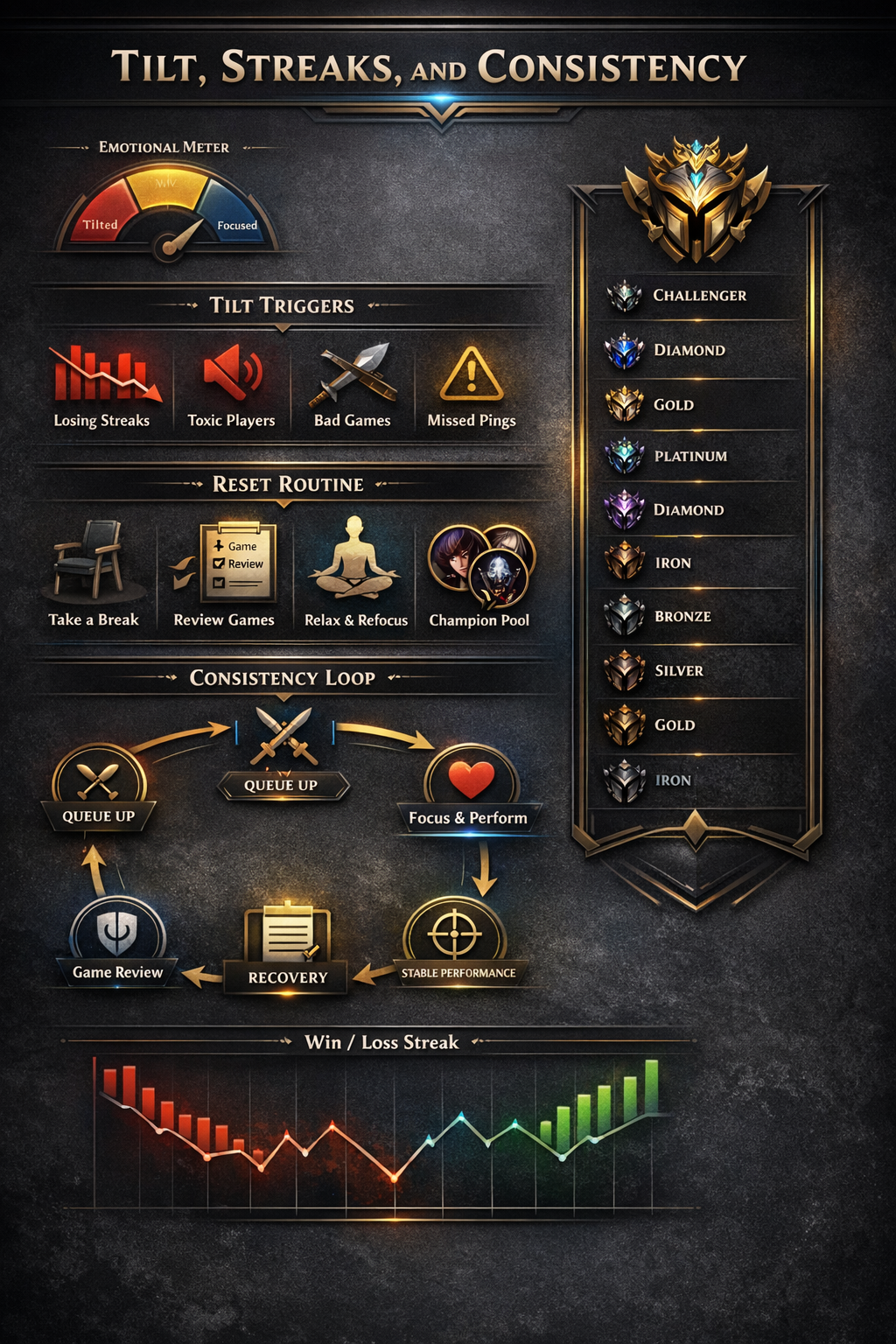
- Have I slept enough to focus?
- Am I hungry, dehydrated, or physically restless?
- Am I queueing to play well, or queueing to fix an emotion?
- Do I know which role and champions I am actually playing today?
- What is one process goal for this session?
That last question is powerful. A process goal is something you control directly. Examples include: “I will respect recall timings before objectives,” “I will stop contesting low-value fights,” “I will watch sidelane wave states before moving,” “I will mute instantly if chat becomes useless,” or “I will not queue a fourth game if my attention drops.” These goals improve play even when the result does not cooperate immediately.
A good pre-queue routine also includes intention. Say clearly what kind of session this is. Is it a short two-game focus block? Is it a learning block on one champion? Is it a normal grind session with extra review between games? When you define the session, you reduce emotional wandering.
Many players also benefit from a micro warm-up: one practice tool drill, one quick mechanical routine, or two minutes of replay notes from the last session. The purpose is not to become perfect. It is to get your brain into game mode before LP is on the line.
Finally, set a maximum rather than an endless grind. Endless queueing creates bad decisions. You do not need to commit to a giant volume before you even begin. Commit to quality first. Volume is useful only if the quality remains usable.
Champion pool, role choice, and mental load
Players often talk about champion pool only in mechanical terms, but it is also a mental game issue. The bigger and less structured your pool is, the more decisions you have to make before the game even starts. More uncertainty means more stress. More stress means more emotional fatigue. More emotional fatigue means more tilt when anything goes wrong.
If your goal is solo queue consistency, reduce unnecessary cognitive load. Play a role you genuinely understand. Use a small champion pool with clear identities. Know why each pick is in your pool. Know what you want to do in lane, what you want to do on the map, and what kind of fights your champion wants later. When these things are familiar, your mental energy stays available for the real chaos of solo queue.
A stable pool also improves confidence the right way. False confidence comes from recent wins. Real confidence comes from familiarity. It comes from knowing your damage windows, your common lane states, your basic recall patterns, your level spikes, and your options when behind. Familiarity reduces panic.
If you are serious about climbing, resist the urge to reinvent yourself after every rough session. A losing streak is not automatic proof that your champion pool is wrong. Sometimes the pool is fine and your decision quality is the problem. Sometimes your emotional state is making you abandon good long-term choices for exciting short-term experiments.
Champion pool rules that help the mental game
- Keep your main pool small enough that matchups feel familiar.
- Avoid “tilt picks” that you lock in only when angry or desperate.
- Have a simple fallback pick for low-energy days.
- Do not switch roles casually in the middle of a bad streak.
- Review whether your pool encourages stable play or ego play.
Some players climb faster not because they became smarter overnight, but because they stopped overloading themselves. Less randomness in champion choice creates more clarity in decision-making. More clarity means less tilt, better execution, and better review.
Your in-game anti-tilt system
You cannot control the lobby, but you can control your response architecture. That is what an anti-tilt system is: a set of rules that keep you functional even when the match gets messy. Most players do not fail because they have zero knowledge. They fail because they abandon their own knowledge under pressure.
Your in-game anti-tilt system should be built around reminders that return you to the fundamentals of League. When your emotions rise, your world shrinks. The fix is to return to concrete game objects: wave state, cooldowns, summoners, objective timers, fog, item spikes, side lane pressure, reset timing, and enemy positions. Specific thoughts calm the game down. Vague emotional thoughts make it chaotic.
A simple anti-tilt framework for the middle of a game
- Name the state: “I’m tilted,” “I’m rushing,” or “I’m scared after that death.”
- Shrink the horizon: ask what the next correct decision is, not how to win the whole game instantly.
- Reduce risk: stop taking vanity fights and return to high-percentage plays.
- Re-anchor: look at the minimap, wave, objective timer, and items.
- Use one clean sentence: “Play the map, not the emotion.”
This sounds simple because it is supposed to be simple. Under tilt, your brain does not need a speech. It needs structure. The best solo queue players often look calm not because they feel nothing, but because they have fewer possible reactions once the game turns chaotic.
Another important habit is learning how to play from behind without emotional collapse. Many players only know two modes: winning and forcing. That is why one bad early game becomes unwinnable. Playing from behind is a real skill. It means trading instead of contesting everything, preserving waves, protecting shutdowns, avoiding isolated deaths, waiting for item spikes, and taking the enemy’s impatience seriously. A lot of comeback potential appears only when you stop acting offended by the scoreboard.
Likewise, when ahead, you need to avoid greed tilt. Leads create arrogance. Arrogance creates overchases, lazy vision, disrespect for flanks, and random fights before objectives. The better your mental discipline, the more your leads turn into clean wins instead of highlight hunting.
Questions to ask in-game when emotions rise
- What actually matters in the next 60 seconds?
- What play gives the best result if everyone does something average?
- Am I trying to win, or trying to feel better?
- What is the safest useful action I can take right now?
- What mistake would tilt most likely make me repeat?
These questions pull you out of reactive autopilot. They stop you from turning a bad moment into a bad identity and then into a bad session.
Communication, chat, pings, and muting
Communication is one of the biggest hidden factors in solo queue tilt. Good communication helps coordination. Bad communication destroys focus. The problem is that many players treat chat as a place to manage emotions, assign blame, or correct strangers into becoming ideal teammates mid-game. That almost never works.
Your communication rule should be simple: use communication only when it improves the next decision. If it does not improve the next decision, it is noise. Helpful pings about vision, timers, lane movements, summoners, or danger are useful. Emotional essays are not. Sarcastic messages are not. Blame disguised as strategy is not.
Riot’s official player behavior pages and reporting tools make it clear that disruptive behavior is part of the competitive environment they actively moderate. If you need to report behavior or want to understand how those systems work, Riot’s Player Reporting Guide and FAQ and Instant Feedback System FAQ are useful official references. For your own climb, though, the main lesson is simpler: do not let somebody else’s lack of discipline steal yours.
Many players resist muting because they think it means giving up information. In reality, chat usually provides far less useful information than players imagine. If chat is pulling your attention away from the game, muting is not weakness. It is resource protection. You are protecting your working memory, your patience, and your next decision.
Strong communication rules for climbing
- Use pings for information, not emotion.
- Do not explain past mistakes during the game.
- Do not defend your ego in chat.
- Mute early if text chat stops being useful.
- Remember that silence is often a performance upgrade.
One of the most common LP leaks in LoL is “communication tilt,” where a player is technically still trying to win but is mentally spending half the match in arguments, judgments, or internal resentment. Even if you never type a single toxic word, fixation on teammate behavior can still ruin your game. The cure is blunt: your teammates are part of the map state, not a moral project. Work with what is happening. Stop negotiating with what should have happened.
How to handle losses, bad games, and streaks
The moments right after a loss often determine the next several games. This is where players either protect their climb or sabotage it. The typical bad pattern is familiar: lose a frustrating game, feel wronged, skip reflection, slam queue, carry the same emotion into champion select, and repeat. The result is not just another loss. It is an emotional chain reaction.
The first rule after a bad game is to separate result from response. You cannot change the result. You can absolutely change the next response. That response should not begin with “I need LP back.” It should begin with “What state am I in right now?” If the answer is angry, numb, shaky, distracted, or obsessive, then your next queue is already compromised.
Use a short post-game reset:
- Stand up.
- Take water.
- Do not instantly watch LP.
- Write one reason the game became hard.
- Write one thing you controlled badly.
- Write one thing to bring into the next game.
This takes less than two minutes, but it interrupts compulsion. The point is not deep analysis. The point is emotional decompression and control restoration.
You also need a stop-loss rule. A stop-loss is not surrender. It is a performance boundary. Good examples are: stop after two emotionally intense losses, stop when you catch yourself blaming every lobby, stop when your hands feel heavy and your attention drifts, stop when you are no longer tracking basic information, or stop when you are queueing for revenge instead of quality.
Some players fear that stopping after losses means they are “soft.” In reality, continuing a low-quality session is often ego, not toughness. Toughness is protecting your long-term climb. Toughness is leaving the client when your current self is the biggest threat to your LP.
Winning streaks need rules too. Many players only protect themselves from losses, then throw away LP by getting sloppy during wins. After several wins, keep the same structure. Same champions. Same warm-up. Same limits. Same review. Do not suddenly double your game count because you feel unstoppable. The best way to preserve a good streak is to act like it is ordinary.
A practical streak management system
- After 2 losses: pause and do a real reset.
- After 3 losses: end the session unless your review clearly shows stable play and calm focus.
- After 3 wins: continue only if energy is still high and discipline feels unchanged.
- After any emotionally chaotic game: reset before deciding to queue again.
- After a throw: do not insta-queue. Throws create some of the worst tilt states in solo queue.
These rules are not magic numbers. They are guardrails. Adjust them to your own patterns, but have them. Players without session rules are at the mercy of mood. Players with rules can survive bad variance much better.
How to review correctly without spiraling
Review is where a lot of players accidentally make their mental game worse. They either do not review at all, which leaves them trapped in vague frustration, or they review in an emotional, self-punishing way that kills confidence. Good review is neither avoidance nor self-attack. Good review is pattern detection.
The best review question is not “Why am I so bad?” It is “Where did this game become harder than it needed to be?” That framing is calmer and more useful. It leads you toward decision points instead of identity statements.
You do not need to review every second. In fact, that often creates noise. Focus on swing moments:
- Your first death
- Your first major recall before an objective
- A missed wave or bad roam timing
- A fight you took without enough information
- A mid-game moment where the map changed and you did not adapt
- A throw while ahead
Look for categories, not only individual mistakes. Categories include impatience, bad wave timing, poor vision respect, emotional forcing, lazy side lane management, poor resets, or bad target focus. Categories improve future play. Random self-criticism does not.
A review is especially strong when it produces one small correction for the next session. Not ten. Not twenty. One. For example: “I am forcing too hard after teammate mistakes,” “I’m staying on map with too much gold,” “I stop checking side waves when the game gets emotional,” or “I lose discipline after first blood goes wrong.” Those are climbable insights.
Review also helps with streak psychology. If your last four losses all include one repeated mistake, that is good news in a strange way. It means the problem may be narrower than it feels. Narrow problems are solvable. Emotional doom makes everything feel massive. Review makes it specific.
A five-minute post-session review template
- What went well consistently?
- What mistake category showed up the most?
- At what point did my mental state change?
- What will I actively do differently next session?
- Should I keep the same champions and role tomorrow?
If you want to stay current on broader game changes while keeping your review evergreen, use Riot’s official patch notes hub for system updates rather than rebuilding your whole mental approach around every meta discussion. Your mindset framework should survive patch cycles.
How to build long-term solo queue consistency
Consistency is not one trick. It is a chain of small reliable behaviors. When players say they want to be more consistent, what they often mean is that they want fewer collapses. That is a better way to think about it. You do not need to become superhuman. You need to become less volatile.
A long-term consistency plan should include the following:
1. Stable session design
Decide how you usually play ranked. Two focused games? Three-game blocks? One long session with a review break? Pick a structure and keep it. Structure reduces emotional improvisation.
2. Fixed role and champion logic
Know your main role. Know your core picks. Know your fallback pick. Build your ranked identity around familiarity rather than novelty.
3. One active correction at a time
Do not try to fix lane mechanics, map awareness, tilt control, teamfighting, vision, and farming all in one day. Pick one pattern. Improvement sticks when the focus is narrow enough to repeat.
4. Process-based confidence
Confidence should come from following your system, not from the last scoreboard. If your confidence rises and falls only with LP, it will always be unstable.
5. Session honesty
Some sessions are not fit for ranked. That is not a moral failure. If you are exhausted, emotional, distracted, or chasing compensation, honesty is stronger than denial.
Many players also benefit from separating climb mode from experiment mode. Climb mode means you use your most stable tools and care about repeatable quality. Experiment mode is where you test new things, which may be better done outside your most important ranked blocks. Mixing these modes carelessly creates mental confusion. You start every session unsure whether you are optimizing for learning, entertainment, revenge, or rank. That uncertainty creates bad emotional decisions.
There is also a deep mental benefit to accepting variance. Solo queue will never feel perfectly fair from game to game. Some games are easy. Some are bizarre. Some are heavy. Some feel stolen. If your mental game depends on every game feeling fair, you will tilt constantly. Better players accept variance faster and return attention to what they can still influence.
That acceptance does not mean passivity. It means realism. Realism is powerful because it stops you from wasting energy arguing with the structure of solo queue. Once you accept that weird games happen, you can become much better at managing them.
A weekly consistency framework
- Before the week: choose your main focus theme.
- Each session: set one process goal.
- After each session: write one repeated mistake and one stable strength.
- At week’s end: review patterns, not daily emotions.
- For the next week: keep what works, simplify what feels overloaded.
This is how you build trust in yourself. Not through hype, but through evidence. You start seeing that even on imperfect days, your process still holds. That is real confidence.
Sleep, breaks, exercise, and energy management
Many discussions about the LoL mental game stay inside the client, but some of the biggest performance advantages begin outside it. If your body is under-recovered, your emotional control drops. If your attention is weak, your patience drops. If your basic energy management is poor, your risk assessment becomes sloppier. This is not glamorous, but it is real.
Sleep is one of the clearest examples. Health authorities such as the CDC note that getting enough sleep improves attention, memory, and mood, which all matter directly in solo queue. If you want better concentration outside the game as well, the CDC’s sleep overview is a simple starting point. For players, the practical takeaway is obvious: tired brains tilt faster, tunnel harder, and recover slower after mistakes.
Physical activity helps too. A peer-reviewed review on esports and gaming performance highlights the role of emotional regulation, attention control, and calming techniques in better performance environments, and it also notes the broader value of physical activity for concentration and mood. You can read that overview here: AOASM Position Statement on Esports, Active Video Gaming, and the Athlete. You do not need to become an athlete overnight. Even brief movement between games can help clear agitation and reduce emotional carryover.
Breaks matter for the same reason. A break is not just time away from the game. It is the chance to reset your internal tempo. One of the biggest causes of ranked collapse is acceleration. Players get emotionally faster after losses. They stop breathing, stop scanning, stop reading, and start reacting. Small breaks protect your tempo.
Performance basics that support the mental game
- Sleep enough to think clearly.
- Do not play long ranked blocks while hungry or dehydrated.
- Move between games, especially after emotional ones.
- Use short breaks before your brain feels cooked, not only after.
- Respect that your focus has a limit even on good days.
None of this replaces in-game skill, but it helps you access the skill you already have. That matters a lot. Many players are not underperforming because they suddenly forgot how to play. They are underperforming because their physical and emotional state makes clean play harder to reach.
FAQ
How do I stop tilt in LoL fast?
You usually do not stop tilt by arguing with yourself emotionally. You stop it by interrupting the pattern. Name the state, narrow the horizon to the next correct decision, reduce risk, and return attention to concrete game information like wave state, timers, vision, and recalls. If the game is over, use a real reset before queueing again.
Should I stop playing after two losses?
Not automatically, but you should pause and check your state. Two losses can be harmless if your play is stable and your mind is calm. They can also be the start of a bad spiral if you are angry, rushed, or desperate. The key is not the number alone. The key is whether your decision quality is still intact.
Do win streaks mean I should spam queue?
Usually no. Win streaks often create overconfidence and looseness. If you are still fresh and disciplined, you can keep going. But the best way to protect a good streak is to keep the same structure and not suddenly abandon your rules because the last few games felt easy.
Is muting everyone bad for climbing?
It depends on how you use it, but muting harmful chat is often good for climbing. Text chat rarely provides enough value to justify losing focus. You can still use pings and map information. If chat pulls you into resentment, blame, or distraction, muting is usually a positive trade.
How many champions should I play in solo queue?
Enough to stay flexible, but not enough to overload yourself. For most players, a smaller core pool leads to better consistency because familiarity reduces stress, panic, and decision fatigue.
What if my teammates always tilt me?
Then your improvement target is partly attention control. Teammates will always be a source of variance in solo queue. If their mistakes reliably hijack your own gameplay, that is a mental game leak you can train. Focus on what changes your next decision, not on proving who is right.
How do I recover from a big throw?
Do not queue instantly. Throws produce a uniquely dangerous blend of shame, anger, and urgency. Stand up, breathe, get water, identify the exact decision category behind the throw, and do not return to ranked until the urge to erase the feeling is gone.
Does mindset really matter if my mechanics are not amazing?
Yes. Mechanics matter, but the mental game decides how often you can actually apply your mechanics and macro knowledge under pressure. Better emotional control creates more stable execution, and stable execution creates more climb.
Final thoughts
The LoL mental game is not about pretending ranked does not matter to you. It is about caring in a way that helps performance instead of hurting it. Tilt, streaks, and inconsistency are not random curses. They are patterns. Patterns can be recognized, interrupted, and replaced.
If you remember only a few ideas from this guide, remember these: protect your state before queueing, keep your champion pool and session structure stable, use simple in-game anti-tilt rules, do not let streaks rewrite your identity, and review for patterns rather than punishment. Improvement in solo queue is rarely one giant breakthrough. It is more often the removal of repeated self-sabotage.
For many players, the fastest climb is not about playing more emotionally charged games. It is about playing fewer bad ones. When your mental game becomes more stable, your real level shows up more often. When your real level shows up more often, the climb feels less dramatic and more reliable. That is what consistency looks like.
If you want extra support alongside your own practice, you can also check Boosteria’s LoL elo boost prices. And if you want to keep your ranked knowledge aligned with official game systems, Riot’s LP and MMR explainer plus the official patch notes hub are useful resources to revisit over time.
Solo queue will never be perfectly smooth. That is not the goal. The goal is to become the kind of player whose process survives the chaos better than before. Once that happens, tilt loses power, streaks lose drama, and consistency stops being a mystery.