



VALORANT Retake Guide: Site Retake Strategies & Basics
VALORANT Retake Guide 2026: Site Retake Strategies and Fundamentals
Retaking a bomb site in VALORANT is one of the purest tests of tactical discipline. You have limited time, incomplete information, dangerous chokepoints, enemy utility still in play, and a post-plant setup built specifically to punish impatient defenders. Many players think retakes are won by individual heroics. In reality, consistent retake success is built on structure: understanding when to regroup, when to pressure, when to force a duel, when to spend utility, and when to stop trying to be the first player through every smoke.
This guide is built to stay useful beyond one patch, one map rotation, or one agent trend. Instead of depending on short-lived “meta secrets,” it focuses on fundamentals that remain valuable at every level: timing, spacing, crossfire denial, utility layering, plant-position reading, clock pressure, and coordinated trading. Whether you play solo queue, duo, full stack, or ranked with limited communication, these principles will make your retakes cleaner, calmer, and more successful.
VALORANT’s core round objective is simple: attackers want to plant and defend the Spike, defenders want to prevent the plant or defuse after it goes down. Riot’s official beginner resources and map pages reinforce a timeless truth: maps, angles, verticality, and role diversity create different tactical problems every round, and good teams solve them with coordinated utility and information rather than panic peeks. If you want a broader official refresher on game basics, maps, and agents, you can also review the VALORANT Beginner’s Guide, the official maps page, and the official agents page.
Table of Contents
- What a Site Retake Really Is
- The Core Retake Win Conditions
- The Most Common Retake Mistakes
- A Step-by-Step Retake Framework
- How Each Role Contributes to a Retake
- Map Principles That Decide Retakes
- How to Retake in 2vX, 3vX, and 4vX Situations
- Economy, Weapons, Ultimates, and Save Decisions
- Communication and Solo Queue Shotcalling
- How to Practice Retakes Efficiently
- FAQ
- Conclusion
- Image Prompts and Alt Text
What a Site Retake Really Is
A site retake is not just “walking back onto site after the plant.” It is a compressed tactical problem with four layers happening at the same time:
- Information: Where are the post-plant players actually positioned?
- Space: Which parts of the site and surrounding lanes are safe, contested, or lethal?
- Time: How much room do you have to clear, pressure, fake, tap, and stick the defuse?
- Resources: Which guns, shields, abilities, ultimates, and bodies are still available?
Most failed retakes happen because teams only focus on one of those layers. They know roughly where enemies are, but they ignore time. Or they focus on the timer, but forget to clear the strongest post-plant lane. Or they use all their utility to enter site and have nothing left to defend the defuser. Good retakes work because they solve all four layers in the correct order.
The first mental shift is this: the retake is not won when you get onto site. It is won when you make the attackers unable to stop the defuse. That difference matters. Too many players celebrate “site control” while the actual dangerous positions are still alive outside site, in lineups, in late swing spots, or behind utility waiting for the tap sound. Your goal is not to stand inside the bomb site. Your goal is to create a defuseable position.
That is why the best retakers are not always the flashiest fraggers. They are the players who understand how to turn chaos into a sequence: regroup, isolate, clear, pressure, force reaction, trade, defuse.
The Core Retake Win Conditions
If you want to improve quickly, stop thinking of retakes as random fights and start thinking in terms of win conditions. A retake usually succeeds through one or more of these paths.
1. You isolate the post-plant positions
Attackers want overlapping lines of sight. If one player can see default, another can swing from main, and a third can spam from off-site, your retake becomes impossible. The defender answer is isolation. Smoke one angle, flash another, pressure the third, and suddenly the attacking setup is no longer a system. It becomes a series of disconnected players.
2. You create a tradeable entry
The first defender through a choke should almost never be unsupported. Retakes are easier when the first player’s death still advances the round. If your entry dies but gets traded instantly, the site opens. If your entry dies alone and everyone else freezes, the retake collapses.
3. You force attackers to peek into you
Attackers in post-plant often have the easier hold if defenders dry walk into every angle. The retake becomes much better the moment you make them react to a defuse tap, utility combo, flank threat, or positional collapse. Instead of you guessing where to look, they are forced to reveal themselves.
4. You spend utility in layers, not all at once
One flash may get you onto site. A second piece of utility might secure the plant box. A third piece may protect the defuser. Utility dumped all at once often looks impressive and still loses because the attackers wait it out. Layering wins more rounds than panic-dumping.
5. You read the plant position correctly
The Spike location tells a story. Default plants often enable safer spam, crossfires, and lineups. Open plants can favor off-site defenders. Hidden plants may force uncomfortable body positions for the defuser. When you understand what the plant is asking from the attackers, you can predict where they are likely playing.
6. You know when to stick and when to fight
Some rounds are lost because defenders never touch the Spike. Others are lost because someone sticks a hopeless defuse with three uncleared angles alive. Elite retake decision-making comes from knowing whether the correct play is a fake tap, half-defuse attempt, hard stick behind cover, or full clear before touching.
7. You value survival before the retake begins
The best retake is often set up before the plant. Saving one smoke, one flash, one molly, one recon tool, or one body with full shield matters more than taking a desperate duel during site loss. Many teams ruin the retake by overfighting the execute. Sometimes the correct call is to fall back, preserve numbers, and retake with structure.
When you review your VODs, ask one question: Which win condition did we actually play toward? If the answer is “none, we all just swung,” the retake was not tactical, no matter how close it looked.
The Most Common Retake Mistakes
Before learning advanced structure, it helps to remove the biggest errors that make average retakes unwinnable.
Retaking one by one
This is the classic ranked mistake. One player arrives first and tries to “make something happen.” They die. A second player tries to recover. They die. A third player is now in a 1v3 with twelve seconds left. Even if your team never speaks, you can already improve by waiting two extra seconds and entering together.
Using all utility for entry and none for defuse
Entering site is only half the job. If all your smokes, flashes, stuns, scans, and mollies are gone before anyone even touches the Spike, the attackers get a clean second wave. Save something for the actual finish.
Ignoring the strongest off-site position
On many retakes, the most dangerous enemy is not inside the site. It is the player in the lane, main choke, heaven, long, or deep post-plant position with an easy spam or swing on the Spike. If you take site but never solve that player, you did not really take control.
Tapping the Spike automatically
Newer players hear “tap the bomb” and turn it into a reflex. But not every retake needs an instant tap. Sometimes clearing one more angle first is smarter. Sometimes you need utility in place before tapping. Sometimes you have no cover and the tap only gives the attacker a free swing.
Poor spacing
If defenders are stacked shoulder-to-shoulder, one spray transfer or one piece of utility can ruin the round. If they are too far apart, nobody can trade. Good spacing means close enough to punish a swing, far enough apart to avoid getting farmed together.
No one takes responsibility for the defuse plan
Every retake needs someone thinking about the final sequence. Who is most healthy? Who has smoke or wall cover? Who holds the close swing? Who watches the lineup lane? Who taps first? When nobody claims those jobs, everyone assumes someone else will.
Flanking too slowly
A flank is only strong if it changes the timing. If you are so late that the rest of your team has already fought and died, your flank is not a tactic. It is cleanup after failure. Either synchronize it with the main retake, or call for your team to delay until it matters.
Retakes become dramatically cleaner when you remove these habits before adding anything fancy.
A Step-by-Step Retake Framework
Use the following framework as your default retake system. It works across ranks, maps, and team styles because it is built on sequence rather than hero plays.
Step 1: Count numbers and resources immediately
The first question after the plant is simple: what do we actually have? Count living players, health totals, key utility, ultimates, weapon quality, and where your teammates are coming from. A 4v4 with two ultimates and full utility is a very different retake from a 2v3 with low armor and one rifle.
Do not skip this. Many bad retakes happen because players act on emotion instead of inventory. If your team has numbers and utility, slow down and structure the retake. If you are low on both, you may need a faster, more decisive collapse before the attackers settle.
Step 2: Identify the dangerous lanes, not just the site
Where can attackers stop the defuse from? Usually there are two or three priority lanes. One might be an on-site pocket. Another might be main. Another might be heaven or long. Instead of saying “they’re on site,” say “they can stop us from here, here, and here.” That mindset creates a plan.
Step 3: Regroup unless there is a real timing window
As a rule, regroup first. Entering from two sides is stronger than entering from one, but only if the timing is shared. If one player is still five seconds away, ask whether you truly need to go now. The clock matters, but so does structure. Many retakes are still comfortably winnable if you wait briefly and hit together with proper layering.
The exception is when attackers are weak, exposed, or still planting utility late. If you see a real punish window, take it. But “I got bored waiting” is not a timing window.
Step 4: Decide your first contact tool
Every retake needs a first action. This could be a recon ability, a flash through smoke, a smoke to isolate a lane, a stun onto a common plant box, a dog/drone utility, a pressure swing from flank, or a dry clear if nothing else exists. Pick the first action intentionally. Do not let the first action happen by accident.
Ask yourself: what creates the most clarity with the least risk? Information tools are often best when you are uncertain. Space-taking tools are best when you already know the main hold. Delay tools are best when the attackers want to swing on your entry. The correct choice depends on the round.
Step 5: Enter to trade, not to win alone
The first players onto site should be aiming to create a tradeable fight. Clear the nearest death angle first, then the most likely swing angle, then the post-plant denial lane. Too many players flick their crosshair to the farthest possible danger and die to the close corner no one checked.
A useful rule: clear close danger first, swing threat second, defuse denial third. Not every retake follows that exact order, but many do.
Step 6: Claim plant zone control
Once the first layer of site is cleared, one or two defenders should establish ownership of the Spike area. This does not always mean touching it instantly. It means making sure the attackers cannot freely walk back in, swing from a smoke, or spam through the most obvious box uncontested.
Plant zone control is the bridge between entry and defuse. Without it, tapping becomes guesswork.
Step 7: Force the reaction
Now you make the attackers show themselves. Tap the Spike, start a half-defuse, throw the anti-swing utility, or pressure the remaining off-site angle. The best retake teams do not keep hunting forever. They create a moment where the attackers must decide: swing now, spam now, or lose the round.
That forced decision is where defender preparation pays off.
Step 8: Protect the defuser with a real setup
Do not treat the defuse as a solo act. Defending the defuser is a setup. One player may bodyguard close. One may hold the wide lane. One may anti-flash or anti-stun. One may sit ready to trade. One may hold the lineup route. If multiple defenders survive to the end but nobody covers the actual threats, the retake was poorly finished.
Step 9: Adapt after first contact
No retake goes exactly to script. Maybe the entry dies. Maybe the scan finds nothing. Maybe the strongest off-site player already repositioned. Maybe the tap gets no swing. Good teams adjust without panic. They do not say “our plan failed.” They say “what is true now?” and continue from there.
This is the real difference between disciplined and emotional teams. Emotional teams fall apart when the first duel goes wrong. Disciplined teams keep building the round from updated information.
Step 10: Review the sequence after the round
Even in ranked, you can get better fast by making one mini-review habit. After a failed retake, do not just say “unlucky.” Ask:
- Did we enter together?
- Did we isolate enough angles?
- Did we save utility for the defuse?
- Did we know who was protecting the defuser?
- Did we lose to the same lane we ignored?
One honest answer after each match improves retakes more than ten highlights on social media.
How Each Role Contributes to a Retake
Riot officially groups VALORANT agents into role categories, and that role diversity matters in retakes. You do not need a perfect composition to win, but understanding what each role should provide helps teams stop overlapping jobs.
Initiators: the retake accelerators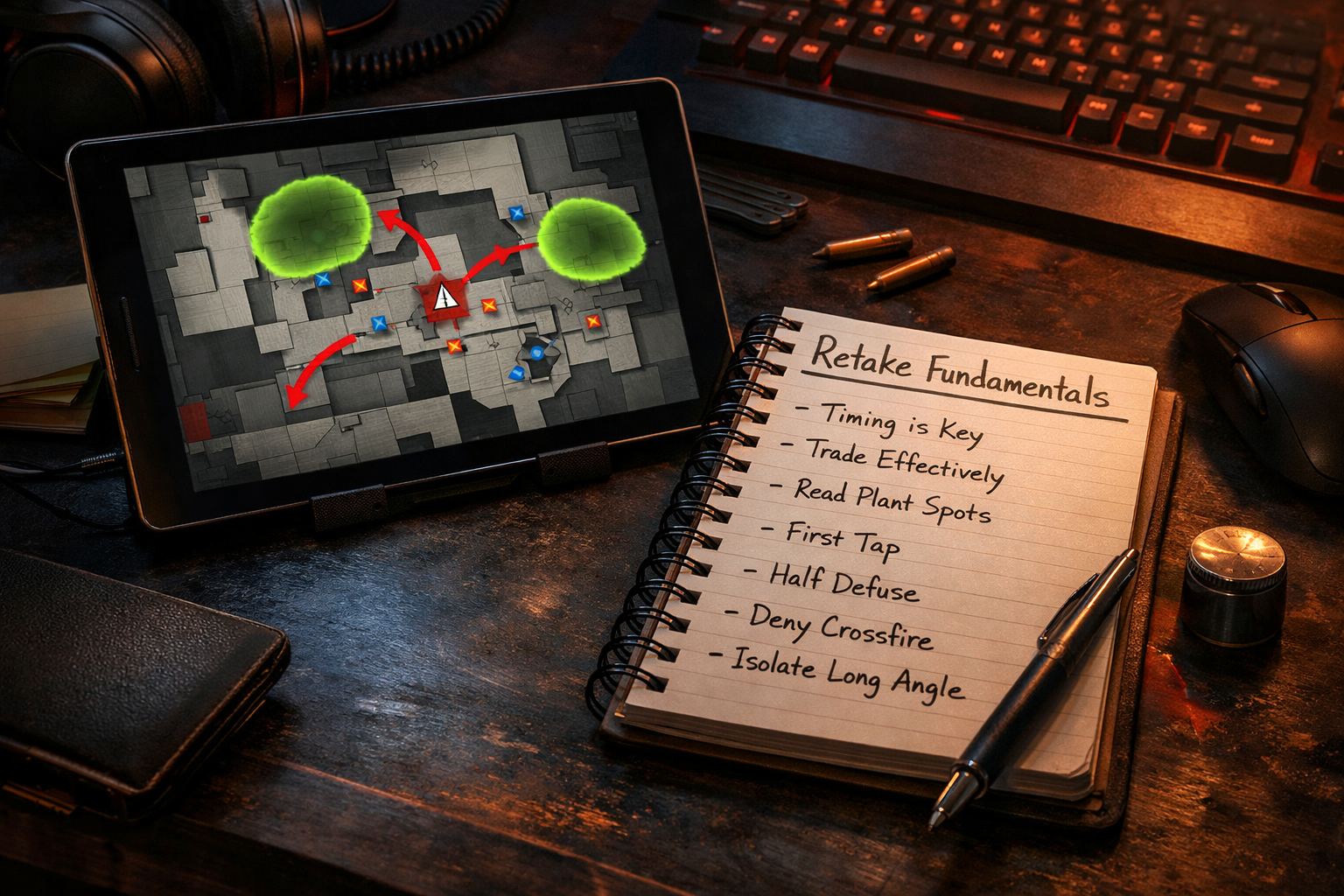
Initiators are often the most important retake role because they solve the hardest part: uncertainty. Retakes are full of dangerous guesses, and initiator utility reduces guessing. Recon, reveal, dog/drone pressure, stuns, flashes, and displacement tools let defenders enter without face-checking every angle.
A good initiator during retake does three things:
- Gathers info before or during first contact
- Forces defenders out of comfortable post-plant pockets
- Times utility so teammates can immediately capitalize
The biggest initiator mistake is using utility too early with no swing attached. A scan that reveals nothing because no one is ready is wasted pressure. A flash that pops while teammates are still rotating is only visual noise. If you play initiator, think in this pattern: info, cue, swing.
Controllers: the angle reducers
Controllers are the role that make retakes mathematically fair. Attackers love winning through too many simultaneous sight lines. Smokes and walls reduce those active lines and simplify the round. One good controller placement can turn a six-angle nightmare into a two-angle clear.
Controller retake priorities usually include:
- Blocking the most oppressive off-site post-plant line
- Cutting the crossfire between site and main/long/heaven
- Creating a safe or safer window for the defuser
- Denying the attackers’ ability to trade each other cleanly
The mistake many controller players make is dropping every smoke at once. Better results often come from staggering utility. One smoke gets you on site. Another, placed later, protects the actual defuse. Think of controller utility as chapter one and chapter two, not one giant intro.
Sentinels: the finish stabilizers
Sentinels are underrated in retakes because many players associate them only with anchoring and flank watch. In reality, sentinels are excellent at stabilizing the last third of the retake. Their stall, trap, lockdown, barrier, or anti-flank value lets the rest of the team focus forward.
Good sentinel retake value can look like:
- Making sure no late lurker ruins the retake from behind
- Securing one side of the site so teammates can face forward
- Using stall tools to buy defuse time
- Locking a zone so attackers are forced into a predictable swing
Sentinel players should think less about “fragging last” and more about “removing chaos.” If you can make the endgame simpler, you already did your job.
Duelists: the space claimers
Duelists are often blamed for failed retakes because they either overpeek or disappear. The best duelists understand their actual job in the retake: claim critical space fast enough that the utility players can function. They do not have to top-frag every retake. They need to threaten the positions that stop everyone else from entering.
Useful duelist behaviors in retakes include:
- Taking first contact with trade support
- Exploding through a choke after flash or stun
- Re-clearing close angles that teammates want to skip
- Pressure swinging on a tap to punish passive post-plant players
Bad duelists retake like it is a montage. Good duelists retake like they are a spearhead for the whole team. The difference is whether their aggression creates structure or destroys it.
When your comp is awkward
Ranked compositions are rarely perfect. Maybe you have no true controller. Maybe you have double sentinel. Maybe everyone picked self-sufficient fragging agents. The principle still holds: someone must gather info, someone must reduce angles, someone must protect the defuser, and someone must take first contact. Assign those jobs based on what you actually have, not what an ideal comp would have given you.
Map Principles That Decide Retakes
Retakes change shape based on map architecture. Riot’s official map pages highlight how different maps feature open spaces, doors, ropes, teleporters, vertical towers, long lanes, and varied site access. That matters because retake difficulty is rarely random. It comes from geometry.
1. Narrow choke retakes
Some sites funnel defenders through one or two obvious entries. These retakes are hard because attackers can stack utility and crosshair placement at the door. In these situations, the winning idea is rarely “swing harder.” It is usually one of these:
- Flash or stun through the choke before the first body appears
- Pressure from a second lane at the same time
- Smoke the strongest crossfire anchor and trade through the weaker side
- Use fake tap timing to pull a swing before full commitment
If you are retaking through a narrow entrance, your problem is not mechanical. It is predictable entry timing. Change the timing or change the angles.
2. Wide-open site retakes
Open sites create the opposite problem: too many angles, too much exposure, too many spam lines. These retakes reward smoke discipline and patient space claiming. You do not need to see every attacker immediately. You need to remove the angles that let them support each other.
On open sites, ask:
- Which long angle must be smoked first?
- Which box or raised platform gives attackers the easiest swing on tap?
- Can we claim a close pocket before touching the Spike?
3. Vertical retakes
When heaven, rafters, towers, or high boxes are involved, the retake becomes more mentally expensive. Defenders often over-focus on eye-level angles and give away the high ground. Vertical sites require deliberate crosshair sequencing. One player may need to clear elevated threats while another handles ground close. Do not let both players guess the same layer.
4. Long post-plant retakes
Some plants invite attackers to play far back. These rounds are dangerous because even after site is mostly taken, the real duel still has not happened. This is where lineups, delayed swings, spam, and off-site pressure matter most. The answer is usually not a blind stick. It is lane control plus anti-lineup awareness.
If attackers are playing deep, defenders should think:
- Can we smoke or wall the denial lane?
- Can someone pressure the lineup route?
- Can we fake a tap to force the off-site player to reveal?
5. Retakes on maps with fast rotation mechanics
Teleporters, ropes, doors, or tight mid connectors create faster collapses and faster punish windows. On these maps, information gets old quickly. The attacker you saw three seconds ago may already be somewhere else. Retake calls must be more concise and less emotional. Instead of “I think maybe one was there,” use “last seen here, could have moved through this route.”
6. Default plants vs anti-default plants
Default plants are common because they are usually easier to secure and easier for teammates to support. But that predictability also means defenders should develop default anti-default habits. Learn the common spam lines, the usual off-site holds, and the close corners that protect the planter’s favorite spot.
Anti-default plants often appear when attackers expect the standard retake protocol. These may be planted for a particular lane, hidden from one side, or positioned to force the defuser into the open. The answer is awareness. The Spike’s exact location should immediately change your expectations about where the post-plant players are.
7. Example map archetypes
You can think of official maps in broad archetypes rather than patch-specific rankings:
- Split-style problems: vertical control and elevated threat management
- Bind-style problems: compressed lane choices and surprise rotation paths
- Ascent-style problems: strong lane denial, doors, and punishing post-plant anchors
- Breeze-style problems: wide sight lines and long-range punishment
- Haven-style problems: more territory, more rotation uncertainty, more retake path variety
When you understand map archetypes, you learn faster than if you memorize one narrow setup on one patch. Fundamentals transfer. Geometry is the teacher.
How to Retake in 2vX, 3vX, and 4vX Situations
2v2 retakes
These are often decided by clarity and trust. If you split awkwardly or second-guess the plan, the attackers only need one favorable duel. In 2v2, simple plans are best. Clear one side together, tap with intention, and trade the first swing. Fancy solo lurks are less valuable because you do not have enough bodies to cover mistakes.
2v3 retakes
You need to create imbalance before the final defuse attempt. That usually means isolating one attacker with utility or forcing an overpeek on a tap. If you try to clear every angle perfectly, the clock beats you. Be decisive once you have one advantage lane solved.
3v3 retakes
This is the most “honest” retake state in VALORANT. You usually have enough bodies to trade, enough utility to stage a real sequence, and enough time to avoid panic. The winning formula is often: isolate one angle, take space together, claim site, force reaction, finish with coverage.
3v4 retakes
These rounds require proactive pressure. You are down a body, so you cannot slowly clear every layer. You need utility to create a favorable opening. A good flash, reveal, stun, or smoke split can make the 3v4 feel like a temporary 3v2. Without that, attackers simply hold numbers.
4v4 retakes
If you lose 4v4 retakes often, the issue is rarely lack of resources. It is usually sequencing. You have enough bodies to trade, enough guns to fight, and usually enough utility to isolate. The fix is team structure: enter together, assign responsibilities, and stop giving free isolated duels.
4v5 or 5v5 post-plants
These are less common but very instructive. With many players alive, information quality and utility discipline matter even more. The team that panics first usually loses. Do not rush just because the round feels loud. Bigger retakes are won by organization.
Economy, Weapons, Ultimates, and Save Decisions
Not every planted Spike should be retaken. Smart defenders know when the expected value is too low.
When to consider saving
- You are badly outnumbered with weak weapons
- You have almost no useful utility left
- Your approach paths are slow and predictable
- The attackers likely have strong anti-defuse utility ready
- Your weapons are more valuable next round than your small chance to win now
Saving is not cowardice. It is economy discipline. But save decisions should still be made early and clearly. Half-committing to a doomed retake often loses both the round and the guns.
Weapon quality changes retake timing
Short-range weapons often encourage faster contact before attackers fully stabilize. Rifles allow more patient angle clearing. Operators can be strong for lane control but awkward once the retake becomes close and layered. Think about what your loadout wants. Do not play every retake the same just because the timer looks similar.
Ultimates should change the whole plan
An ultimate is not just a stronger ability. It can redefine the retake. Some ults take space, some clear corners, some delay the attackers, some defend the defuser, and some create a free opening. If your team has a retake-focused ultimate available, build the round around it instead of using it as a panic button after two teammates die.
A useful habit is calling ult value before the plant happens. If you know your team has a strong retake ultimate, you can play the site loss differently and preserve bodies rather than forcing a low-value hero hold.
Armor and health matter more than ego
Low-health players can still be useful, but they should not always be first through the choke or first on the Spike. Health affects role assignment. Let the healthier player bodyguard or stick if needed. Retakes are easier when the jobs match the condition of the surviving players.
The hidden resource: sound
Sound is also economy in a tactical sense. Running, dropping, jumping, reloading, sticking, faking, and rotating all spend information. Quiet retakes sometimes create the best openings because attackers are unsure whether they are being flanked, rushed, or delayed. Not every retake needs maximum noise.
If you want a relevant product page worked naturally into the topic, you can also explore VALORANT boosting prices for players who want help improving rank while sharpening core match-winning habits like utility coordination, positioning, and decision-making.
Communication and Solo Queue Shotcalling
Retakes are communication checks disguised as aim duels. Even in solo queue, a few simple calls dramatically improve your odds.
The best retake calls are short
- “Wait for me.”
- “Smoke main, flash after.”
- “Tap and swing together.”
- “I hold close, you stick.”
- “One deep long, one site.”
- “Clear left first.”
You do not need a speech. You need a sequence.
Use last-seen information properly
Say where an enemy was, then whether they can move. “Last seen main, could be out.” “One was heaven, unknown now.” This is more useful than shouting a location as if it is still true forever.
Assign the endgame
Someone should always say who taps and who covers. This single call prevents the most common ranked confusion. If nobody speaks, make the call yourself. Simple confidence often creates instant structure among strangers.
Do not overload your teammates
During the final ten seconds, the brain cannot process a lecture. Give one high-value instruction, not five medium ones. “Stick, I hold swing” is excellent. “Maybe one could be left or right or heaven and maybe spam” is useless.
How to Practice Retakes Efficiently
Retake skill improves fastest when you practice decision patterns, not just raw aim.
1. Watch your own failed retakes
Pick three failed retakes from a recent session. For each one, write down:
- Where you entered from
- What utility you had left
- Which angle actually killed the retake
- Whether you tapped too early, too late, or correctly
- Whether the team entered together
You will quickly see patterns. Most players do not lose retakes in ten different ways. They lose them in the same two or three ways repeatedly.
2. Build common retake pathing on each map
Walk through maps in custom mode and study defender re-entry paths. Where are the default plants? Where are the strongest anti-defuse lanes? Which angles are commonly skipped by rushed teams? Learning pathing without combat makes real rounds feel slower and more readable.
3. Practice utility layering, not only lineups
Lineups are useful, but defenders improve more from learning multi-step retake utility. Practice combinations like smoke then flash, recon then swing, stun then tap, or wall then half-defuse. A layered defender is more complete than a one-trick utility user.
4. Play with a retake focus for one session
In one ranked or scrim block, ignore your scoreboard and judge yourself on five things:
- Did I preserve utility for retake situations?
- Did I wait for teammates more often?
- Did I call a simple plan?
- Did I clear the right lane first?
- Did I protect the defuser properly?
This creates targeted growth much faster than generic “play more games” advice.
5. Study official map and role resources with a retake lens
The official VALORANT maps page is useful not just for lore or visuals, but for understanding broad site identities like verticality, tight routing, long angles, and unique traversal. The official agent pages are useful for clarifying what each role can bring into post-plant or retake scenarios. Read them with one question in mind: How does this geometry or ability change my retake timing?
6. Train your anti-panic routine
When the Spike goes down, force yourself to think in the same order every time:
- Numbers
- Utility
- Danger lanes
- Regroup
- First action
- Tap/stick plan
This mental routine is one of the most valuable habits in tactical shooters because it replaces emotional instinct with structure.
FAQ
Should defenders always retake together?
Most of the time, yes. The default should be grouped pressure with trade potential. The main exception is when one player has a synchronized flank or when a lone defender has a true timing punish before attackers settle. Randomly peeking alone is not a good exception.
When should I tap the Spike?
Tap when the tap creates value. Good reasons include forcing a swing, checking whether attackers are disciplined, pulling a lineup player into motion, or starting the final sequence when your teammates are ready to cover. Do not tap just because you reached the site and feel nervous about time.
When should I stick the defuse?
Stick when the remaining threats are limited, covered, or blocked. A hard stick is strong when your teammates have already cleared the main denial lanes, when your cover utility is active, or when the attackers are so far away that they must wide-swing into prepared defenders.
How do I beat lineup-heavy post-plants?
Pressure the lineup lane earlier, keep one player aware of the likely off-site position, and use fake taps to force timing. Smokes, walls, or fast flank pressure can also reduce lineup value. The mistake is pretending the lineup threat does not exist until the last second.
Is it better to clear site fully before touching the Spike?
Not always. Full clear is safe in theory but often loses to time. Pure instant tap is aggressive in theory but often loses to uncleared danger. The correct answer is usually an in-between approach: clear the highest-probability kill angles, claim enough plant control, then force the reaction with the tap.
What if my team has no good retake utility left?
Then the retake becomes a spacing and timing problem. Enter together, isolate one lane with body pressure, and make the attackers react to a tap. When utility is scarce, discipline matters even more. Dry retakes are hard, but they are still winnable if the fights are tradeable and purposeful.
Should duelists always be first in?
Often, but not blindly. The first player should be the one best positioned to take space with trade support. That is frequently a duelist, but it can also be a healthy initiator or another player whose utility or movement suits the first contact better in that exact round.
How important is the plant spot?
Extremely important. Plant position often predicts post-plant structure. It suggests where attackers want to play from, which lane they intend to defend, and how exposed the defuser will be. Reading the Spike location is one of the fastest ways to improve your retake IQ.
Should I save if the retake looks difficult?
Only if the expected value of the retake is truly poor. Saving is correct when numbers, utility, economy, and timing all work against you. But many players save too early because they are uncomfortable, not because the round is actually lost. Learn the difference between low comfort and low probability.
What matters more in retakes: mechanics or teamwork?
Both matter, but teamwork usually decides more rounds. Strong mechanics help you convert duels. Teamwork decides whether those duels were favorable in the first place. Most players gain more retake win rate from cleaner sequencing than from slightly better aim.
Conclusion
VALORANT retakes are not random, and they are not reserved for pro teams. They are repeatable tactical situations with repeatable solutions. If you learn to count resources, read plant logic, isolate dangerous lanes, layer utility, create tradeable entries, and assign the defuse finish, your retakes will improve in every rank.
The key idea to remember is simple: do not retake the site just to stand on it. Retake the site so the attackers can no longer stop the defuse. That single perspective shift will make your utility smarter, your spacing cleaner, your comms shorter, and your results better.
Build your retake habits around fundamentals, and they will stay useful long after map rotations, balance changes, and agent trends come and go.