



Dota 2 Advanced Map Awareness Guide: Read the Map Like a Pro
Dota 2 Advanced Map Awareness Guide 2026: Reading the Map Like a Pro
Mechanical skill wins moments, but map awareness wins matches. A player with average last-hitting, decent spell usage, and strong map reading will often climb faster than a player with sharp fingers and poor decisions. That is because Dota 2 is not only a game of execution. It is a game of information, territory, timing, risk, pressure, and prediction. The better you understand what is happening on the map, the more often you will be in the right place at the right time, farming safely when danger is near, rotating before the fight starts, and punishing enemies before they realize they are exposed.
This guide is built for players who want to move beyond basic minimap checking and into true map interpretation. Advanced map awareness is not just looking at hero dots. It is understanding what those dots mean, what is missing, what should be happening but is not happening, and what the enemy team is probably planning next. Pro-level map reading is a continuous process of collecting clues, connecting them, and turning them into better decisions.
The good news is that map awareness is trainable. You do not need prodigy-level reflexes to improve it. You need a better framework. In this guide, you will learn how to read lane states, identify dangerous map zones, predict rotations, interpret ward information, react to missing heroes, recognize smoke patterns, and convert information into cleaner calls. If you want to improve your ranked consistency, this is one of the highest-value skills to develop. For players who also want to accelerate progress in a more direct way, Boosteria’s Dota 2 boosting prices page is the most relevant internal resource for this topic.
To deepen your own study outside the game, it also helps to browse trusted Dota resources such as the official Dota 2 site, Liquipedia Dota 2, Dotabuff, and OpenDota. Those resources are useful for understanding heroes, match patterns, vision habits, and broader strategic trends, but the core principles in this guide are designed to stay useful across patches because they focus on decision-making rather than fragile patch trivia.
Table of Contents
- What Map Awareness Really Means
- The Three Layers of Reading the Map
- How to Build the Minimap Habit
- Read the Lanes First
- Read Heroes, Not Just Icons
- How to Play the Fog Game
- Vision Control and Ward Logic
- Smoke Reads and Rotation Patterns
- Dead Lanes, Safe Lanes, and Farm Quality
- Objective-Based Map Awareness
- Role-Specific Map Awareness
- Midgame and Lategame Reading
- Common Map Awareness Mistakes
- Practice Drills to Improve Faster
- Final Thoughts
What Map Awareness Really Means
Most players define map awareness too narrowly. They think it means looking at the minimap often. That is part of it, but it is not enough. Plenty of players look at the minimap and still die to obvious ganks, farm the wrong area, or miss free objectives. Real map awareness means turning visual information into useful predictions.
When a high-level player checks the map, they are not simply noticing who is visible. They are asking a chain of questions in seconds. Which lanes are pushing? Which heroes are showing? Which heroes are missing? Which side of the map is currently strong for my team? Which objective is likely next? Who can connect to a fight faster? Where can I farm without forcing a bad response from my team? Where is the enemy likely warded? Where am I likely warded? What is the most dangerous part of the map right now?
That is why map awareness is tightly linked with every other macro concept in Dota 2. Vision matters because it improves information. Lane pressure matters because it reveals movement incentives. Tower states matter because they reshape safe access and control. Hero matchups matter because some heroes can threaten huge areas without showing. Teleports matter because proximity is not the same as actual response speed. Cooldowns matter because a hero may be visible and still not truly dangerous. Every piece connects.
The simplest way to think about map awareness is this: the map is constantly asking you where you are allowed to stand. If you answer correctly, your game becomes cleaner, safer, and more efficient. If you answer incorrectly, you donate kills, lose towers, miss timings, and blame your teammates for positions you should never have taken. The player who reads permission better usually wins more often over a large number of games.
The Three Layers of Reading the Map
Advanced map awareness works best when you split information into three layers: seen information, inferred information, and timed information.
Seen information is the obvious layer. You can see enemy heroes in lanes, under wards, hitting creeps, defending towers, or farming camps. You know where they are right now. This is the easiest layer and the one most players stop at.
Inferred information is where stronger map readers separate themselves. If two enemy heroes are defending bottom and the enemy carry just showed top, but their initiator and one support are missing, then the middle of the map may be dangerous even if you cannot see those heroes. If your pushed lane suddenly stops being defended, it usually means the enemy is moving or grouping. If a core disappears after clearing one wave and the nearest farm is untouched, he may be smoked, wrapping behind, or waiting on high ground. You do not need direct proof to play correctly. You need enough evidence to assign risk.
Timed information is the layer many players ignore. The map is not static. It is rhythmic. You should constantly think in windows: wave timing, rune timing, stack timing, teleport cooldown windows, death timers, ward expiration windows, smoke timing, Roshan opportunities, and power-spike movement. If an enemy support showed far away three seconds ago, that matters differently than if he showed twenty seconds ago. If two heroes just died, your team briefly controls more space. If the enemy big teamfight ultimate is likely unavailable, a part of the map becomes more contestable. Time changes the meaning of everything you see.
When you combine all three layers, the game slows down mentally. You stop reacting late and start anticipating. That is the heart of pro-level map reading.
How to Build the Minimap Habit
Before your interpretation improves, your scanning habit must improve. Many players look at the minimap too rarely, and when they do, they stare at it too long. Both are mistakes. The goal is to build a light, constant rhythm of short glances.
A useful principle is to tie minimap checks to gameplay actions. Look after every last hit sequence, after casting a spell, while your hero is moving between camp and lane, after a wave is secured, while an animation is completing, after using a mobility tool, or before you commit to the next farming location. This makes awareness automatic instead of forced.
Your glance should answer one immediate question: what changed? If nothing changed, return focus to your hero. If something changed, translate it into a plan. The enemy offlaner disappeared? Maybe your support needs a warning. Two enemy heroes just showed top? Bottom jungle becomes safer for a few seconds. Mid wave is shoved and nobody is catching it? Someone is about to reveal or that lane can be used as bait.
Do not stare only at hero icons. Watch lane position, tower pressure, creep movement, and where your teammates are standing. A teammate’s posture often reveals how safe an area feels. If your support abruptly backs away from a staircase or stops walking into a jungle entrance, they may sense danger before you do. Map awareness is not purely personal. It is collective information interpreted through five players, even in solo queue.
If your map awareness feels weak, enable a deliberate training habit for a few days. During every match, give yourself one specific scanning rule, such as “I must check the minimap before taking the next camp” or “I must glance every time I click a long move command.” Small structure builds lasting awareness faster than vague intention.
Read the Lanes First
The lanes tell the truth faster than almost anything else in Dota 2. If you want to read the map like a pro, start by reading lane states before you read hero portraits or chat pings.
Ask yourself which lanes are pushing and why. A lane that is naturally moving toward your side is safer to collect than a lane shoved deep into enemy territory. A lane that keeps reaching an enemy tower without being answered tells you someone is missing from that area, rotating, or preparing something elsewhere. A lane that is being quickly cut and reset tells you the enemy is trying to remove information and reduce pressure.
Every pushed lane creates visibility pressure. Even if you do not have wards, creeps act like temporary scouts. When your wave crosses farther down the map, it forces somebody to show or lose resources. That is why strong players say shove lanes before making moves. Lane pressure makes the map readable. It also creates smaller windows where enemy movement is less efficient because they must answer farm or structure pressure first.
On the other side, unaddressed enemy lane pressure makes your map darker. If two lanes are pushing into your structures and your team is spread out farming, the enemy has more cover to move through fog. You become easier to isolate. This is why farming patterns are a map-awareness issue, not just an efficiency issue.
One of the biggest upgrades low and mid MMR players can make is to stop thinking of creeps as gold only. Creeps are information. Waves show who is likely near, who must answer next, which objective is under pressure, and which portion of the map is becoming dangerous. If you learn to read the waves, you will often predict rotations before heroes appear.
Read Heroes, Not Just Icons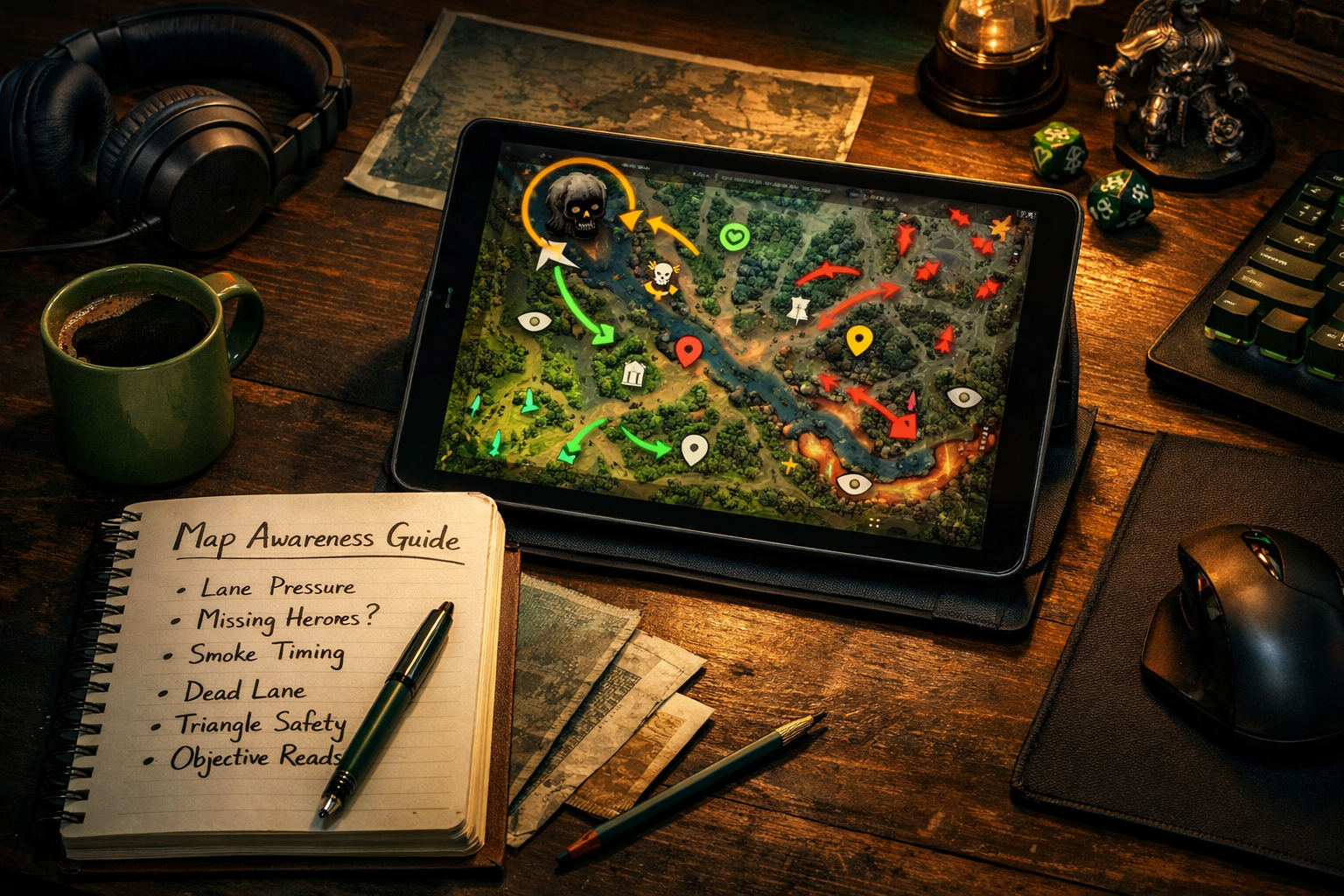
Map awareness is not only about locations. It is about identities. Different missing heroes create different levels of danger. If a slow farming offlaner disappears, the map changes in one way. If a mobile initiation hero disappears, the map changes in another. If a burst support with smoke potential disappears together with the enemy mid, your side lanes must suddenly become more careful.
Every time a hero shows, ask four quick questions. First, what is this hero doing right now? Second, what can this hero threaten next? Third, how quickly can this hero connect to another area? Fourth, does this reveal anything about the other four enemy heroes?
For example, if the enemy carry is showing on the opposite side of the map alone, that does not always mean you should dive him. The real question is whether his team can connect. Are teleports available? Is there a nearby tower? Is the fog full of enemy supports? Is your own team close enough to commit? Meanwhile, if the enemy playmaker is missing while the carry is showing far away, the visible carry may simply be bait for a counter-initiation setup.
You should also pay attention to how long heroes remain visible. Brief appearances matter. A support who showed to deward mid and immediately vanished may now be walking into triangle vision, preparing a smoke, or regrouping with a core. A mid hero who reveals for one wave and then disappears with no side-lane answer is often about to move. The shortest reveals are often the most informative because they indicate deliberate action instead of routine farm.
Finally, do not forget item and level context. A visible hero with a fresh timing is more dangerous than a visible hero without it. A hidden hero who recently hit a major power spike is more threatening than a hidden hero still recovering. Good map awareness is always filtered through threat level.
How to Play the Fog Game
The best Dota players do not panic when enemies are missing. They estimate zones. That is the fog game.
Instead of thinking “I cannot see them,” think “Where can they realistically be?” Start with available routes. Which lanes are pushed? Which camps are available? Which towers still stand? Which entrances are warded or likely warded? Which objective is attractive right now? The enemy team is not teleporting randomly across the universe. They are moving according to incentives, cooldowns, and map shape.
If your team just showed three heroes defending a lane, enemy playmakers are more likely to invade the opposite side. If your side lanes are extended and your defensive vision is weak, the enemy has many smoke routes. If a dangerous hero vanished from a lane right after shoving it, assume he is moving into fog with intention, not wandering aimlessly.
Strong players also think in terms of collapse speed. Even if an enemy is technically not next to you, an area can still be dangerous because several heroes can converge quickly. A jungle camp may look empty, but if two supports are missing and the enemy mid is one screen away from a staircase, that camp is not truly free. The key is not distance alone. It is how fast the enemy can punish your greed.
To improve your fog reading, pause your replay after a death and ask one question: “What should I have assumed?” Most avoidable deaths happen because the answer was available. Two heroes missing, lane shoved, no defensive ward, no tower behind you, objective coming up, teammate backing off. The clues were there. You just did not assign enough weight to them.
In Dota 2, fog is not mystery. It is probability. The player who respects probability more consistently dies less and farms more.
Vision Control and Ward Logic
Wards are not just about seeing enemies. They are about shaping behavior. The best vision creates either safety for your own movements or punishment for enemy habits. When you think about map awareness, do not view wards as passive information tools. View them as part of your territory system.
A strong ward usually does one of three things. It protects a farming pattern, secures an objective approach, or enables a kill area. Defensive wards let cores take one more wave, one more camp, one more minute on the map without guessing. Offensive wards allow smokes, wraps, and jump heroes to convert vision into action. Objective wards define where a fight can safely begin.
The placement logic matters more than memorized spots. Ask why a ward is needed. If your carry wants to play near a triangle and nearby lane, the correct ward is the one that reveals the enemy’s natural entry angles into that farm pattern. If your team wants to pressure a tower, the correct ward is the one that exposes the flank, the response route, or the high ground jump angle. If your team wants Roshan, the best ward is often not the one inside the pit area itself, but the one that tells you which enemy path is being used to contest.
Dewarding follows the same principle. Do not blindly sentry famous cliffs. Think about what the enemy wants to see. If they keep punishing your support rotation through one staircase, they likely have vision that covers that choke. If they repeatedly dodge ganks while farming one exact camp pattern, their ward probably protects the path into or out of that pocket. Dewarding becomes easier when you stop thinking in spots and start thinking in purposes.
Map-aware players also understand what vision cannot do. A ward is only useful if your team can act on it or avoid through it. Seeing three enemy heroes matters less if your team is split, your cooldowns are missing, or your core insists on overextending anyway. Vision supports good decisions. It does not replace them.
Smoke Reads and Rotation Patterns
One of the clearest signs of advanced map awareness is smoke detection before contact. You will never predict every smoke, but you can identify the conditions that make smoke highly likely.
Enemy teams usually smoke when one of several things is true: a key timing has just been reached, lanes have been pushed enough to hide movement, an objective is coming up, a hero just respawned and wants to re-enter with impact, or standard farming patterns no longer give enough value. In simple terms, smoke is used when direct walking would be too obvious or too slow.
Red flags include sudden disappearance of multiple heroes from active lanes, unusual passivity after a wave shove, supports vanishing together, or a quiet map right before a major objective. Another classic clue is when the enemy stops collecting obvious farm. If two lanes are available but nobody shows, they may be using that hidden time to move as a group.
Your own lane position should reflect that risk. If a smoke is likely, step away from exposed farm unless your team is set to counter-initiate. A smart retreat is not cowardice. It is awareness. You can often waste an enemy smoke simply by refusing to present a clean target. That one avoided death can preserve tower pressure, keep your carry on timing, and force the enemy back into visible farm.
It is also important to know where smokes usually want to end. Teams do not smoke to wander. They smoke toward high-value targets: the greedily farming core, the exposed support dewarding alone, the tower defense setup, the Roshan approach, or the deep lane pusher. If you identify who your team’s most obvious victim is, you will often know where the enemy smoke is headed.
Conversely, when your team uses smoke, pay attention to what information made it good. Over time, that builds reverse intuition. You start recognizing the same windows when enemies are likely to do it to you.
Dead Lanes, Safe Lanes, and Farm Quality
Not all farm is equal. One of the biggest reasons players throw leads or fall behind is that they judge farm only by gold amount, not by risk-adjusted quality. Advanced map awareness means understanding dead lanes, safe lanes, and transitional zones.
A dead lane is a lane or section of the map where it is difficult to remain safely because enemy heroes can collapse quickly, your towers no longer protect you, your team cannot connect easily, or your lane pressure reveals your position too clearly. This lane is often still playable for brief pressure, shove-and-leave patterns, summons, illusion heroes, or durable heroes with escape. It is just not a place to relax.
A safe lane, in practical macro terms, is not necessarily your original safe lane. It is whichever lane and nearby jungle area your team can currently defend, rotate to, and ward around. This changes throughout the match. The safe area shifts with towers, vision, hero positions, and objective priorities. One reason strong players seem hard to catch is that they update this answer constantly.
Farm quality improves when three things overlap: lane pressure is favorable, enemy response routes are limited or visible, and your team can support or trade if a fight starts. Farm quality drops when you are alone in open territory, all enemy threats are missing, and your death would hand over an objective.
This is why advanced players often give up one wave to preserve the next four. They are not being passive. They are protecting game flow. Dying for one risky lane shove is rarely worth losing map control, wards, teleport options, or a Roshan contest. The greedier decision often feels efficient in the moment but becomes expensive over the next two minutes.
If you improve nothing else after reading this guide, improve your ability to ask: “Is this farm actually good?” That question alone fixes a huge number of ranked mistakes.
Objective-Based Map Awareness
The map becomes much easier to read when you anchor your thinking around objectives. Teams move for reasons. Towers, Roshan, runes, torment-style side objectives, outpost-style control points, and key power spikes all pull heroes toward specific zones. If you understand the next likely objective, you understand the next likely movement.
Before every major phase of the game, ask what both teams want. Does your lineup want to play around Roshan? Does the enemy want to delay and split the map? Does your team need to secure outer towers before invading deeper? Is the opponent strongest when fighting into vision around one part of the river? Once you answer that, your minimap becomes more predictive because you stop treating movement as random.
Objective awareness also changes your personal job. If Roshan is the likely next contest, farming the opposite side with no teleport plan can be a strategic mistake even if it looks efficient. If a tower is low and your team wants to pressure it, shoving the nearest adjacent lane becomes part of map awareness, not just wave clear. If your team wants to avoid a fight until a core finishes an item, then showing too aggressively before that timing is a map-reading failure.
One of the cleanest habits strong players have is preparing space before the objective actually starts. They ward early, push waves first, occupy staircases, and show only when the map favors them. Weak players often arrive late, with bad lanes, no vision, and no idea where the enemy came from. The difference was decided thirty seconds earlier, not at the moment of contact.
When you watch high-level games, notice how often “objective control” begins with lane control and vision control, not direct fighting. That pattern applies to pubs too. If you want better map awareness, think one objective ahead.
Role-Specific Map Awareness
Every role reads the map differently because every role asks a different question.
Carry players should mostly ask: where can I take the most resources while still allowing my team to respond if pressure comes? Carries need to judge whether they are the target, whether their team is visible enough to discourage a dive, and whether the enemy can cross the map quickly. The carry’s best map awareness skill is farm discipline.
Mid players should ask: where can I influence the map next? Mids are often the hinge point between lane pressure and rotation threat. A map-aware mid sees which side lane is set up, which rune or power spike matters, and whether showing mid is needed to stabilize or whether disappearing creates more fear. Mid players shape the enemy’s information more than any other role.
Offlaners should ask: which area can I make unplayable for the enemy? Good offlaners understand territory denial. They stand where enemy cores feel unsafe, they threaten tower zones, they absorb pressure without dying, and they transform lane momentum into map control. Their awareness is less about hiding and more about controlling the dangerous edge of the map.
Position 4 players often function as connectors. Their map awareness should revolve around movement efficiency, smoke routes, ward timing, and identifying where pressure can be converted into a catch. The best roaming supports are early readers of opportunity.
Position 5 players are usually the team’s information managers. Their job includes vision, defensive posture, warning pings, and choosing when to accompany cores versus when to reveal elsewhere. A map-aware hard support knows when a ward protects farm better than a body, and when a body protects farm better than a ward.
No matter the role, remember this: your hero’s purpose changes what “good map awareness” looks like. The carry who greedily walks first into dark jungle is not being brave. The support who breaks smoke near the right objective at the right time may be winning the game. Read the map through your role’s value.
Midgame and Lategame Reading
The midgame is where map awareness starts deciding entire matches. Lanes matter more, death timers matter more, and one bad reveal can hand over Roshan, barracks pressure, or total control of a jungle quadrant.
In the midgame, ask which side of the map is stronger for each team. This is determined by vision, tower status, nearby heroes, and who can force better first contact. Do not treat the whole map as equally available. Strong teams compress the enemy into less space while expanding their own access to waves and camps. Weak teams either defend efficiently or split well enough to avoid collapse.
Lategame map awareness becomes even more psychological. Every reveal carries more weight because buybacks, pickoffs, and objective trades are massive. At this stage, you should care deeply about who is showing on lanes, who is preserving teleport options, and which hero cannot afford to die first. One visible core on a distant lane may invite a smoke on the opposite side. One support showing to push a dangerous wave may be intentional bait. One missing hero may force your entire team to delay a high-ground attempt.
Another lategame principle is respecting information asymmetry. If you see them and they do not see you, your options expand. If they see you and you do not see them, your options shrink. It sounds simple, but many players forget it during tense moments. They overchase, hit buildings without lane setup, or split too greedily after winning one fight. Late-game Dota punishes false certainty hard.
When in doubt, return to fundamentals: push waves, refresh vision, identify the next objective, and ask who benefits from silence on the map. The team that manages uncertainty better usually wins the final phases.
Common Map Awareness Mistakes
The first common mistake is checking the minimap without changing behavior. Information only matters if it changes your next move. If two heroes are missing and you still farm the same exposed camp, the glance had no value.
The second mistake is overreacting to one clue while ignoring the full picture. A single visible core does not mean the area is safe. A missing support does not always mean smoke. Good map awareness weighs multiple clues together.
The third mistake is reading only enemy heroes and ignoring allied posture. Your teammates communicate safety with movement. If everyone is backing, do not be the hero who keeps farming one extra wave without vision and then pings after dying.
The fourth mistake is treating wards as magic. Wards create possibilities, not guarantees. A warded area can still be dangerous if enemy initiation is fast, your team is split, or your strongest counterfight hero is showing elsewhere.
The fifth mistake is forgetting objective timing. Players often die right before major contests because they view the map as a farm puzzle instead of a timing puzzle. If Roshan, a tower defense, or a major smoke window is near, your position matters more than one extra camp.
The sixth mistake is repeating bad routes. Many deaths happen because players move through the same staircase, cliff path, or jungle entrance again and again. Predictable movement makes enemy vision stronger. If you want to be harder to read, vary your paths and respect the areas where the enemy has already punished you.
The final mistake is failing to ask what the enemy wants. Strong map awareness is not self-centered. It is opponent-centered. If you cannot answer what the enemy lineup is trying to do right now, your map decisions will often be half-blind.
Practice Drills to Improve Faster
Improvement happens fastest when you isolate one awareness skill at a time. Here are practical drills you can use.
Drill 1: Death Review
After every avoidable death, ask what information existed ten seconds earlier. Write it down mentally: missing heroes, lane pressure, lack of wards, objective timing, teammate distance. This turns vague frustration into pattern recognition.
Drill 2: Lane-State Calls
During games, verbally or mentally call which lane is most dangerous and which lane is most playable every minute or two. This forces you to track shifting territory instead of autopiloting farm.
Drill 3: Missing-Hero Threat Test
Whenever heroes disappear, say which one matters most. Missing support? Missing initiator? Missing carry? Rank the danger. This helps you stop treating all fog equally.
Drill 4: Before-You-Click Rule
Before you move into a new farming area, ask three quick questions: who is missing, what objective is near, and can my team connect? If you cannot answer, default safer.
Drill 5: Replay Vision Tracking
Watch one replay only from the minimap and observer perspective for several minutes. Ignore mechanics. Track movement, lane states, and ward impact. This is one of the fastest ways to train macro pattern recognition.
Drill 6: Predict the Next Move
In replay or live game, pause mentally whenever two enemies show and predict where the missing heroes are moving. Then check whether you were right. Prediction practice sharpens inference more than passive observation.
Do not try all drills at once. Pick one or two for a week. Consistent focus is better than scattered effort.
Final Thoughts
Reading the map like a pro does not mean becoming psychic. It means becoming structured. You gather visible information, infer what is hidden, respect the timing of everything, and let that shape your next decision. Over time, your games feel less chaotic because you stop relying on surprise and start playing with expectation.
The biggest reward of strong map awareness is not only fewer deaths. It is cleaner tempo. You arrive earlier. You waste fewer teleports. You take safer farm. You pressure better lanes. You support objectives before they start. You stop fighting blind. You start controlling the emotional pace of the match because you are less often caught off guard.
If you want a simple takeaway, use this sentence in every game: What is the map telling me I am allowed to do right now? If the answer is “farm safely on my team’s strong side,” do that. If the answer is “push one wave then leave,” do that. If the answer is “group before the enemy smoke arrives,” do that. If the answer is “do not show yet,” listen to it.
Dota 2 rewards players who respect information. Build the habit, study lane pressure, understand vision, and learn to read what is missing. Once that skill starts clicking, the game opens up in a different way. You stop feeling chased by the map and start feeling in control of it.
And that is when ranked improvement becomes much more repeatable.