



2XKO Frame Advantage Guide 2026: Frames, Pressure, Punishes
2XKO Frame Advantage Guide 2026: Understanding Frames and Pressure
Learning 2XKO frame advantage is one of the fastest ways to level up. Many players begin with combos, character picks, or flashy team synergy, but the matches they lose usually come down to simpler questions: When was it actually my turn? Why did my pressure end? Why did I get counter-hit after I thought I was safe? Why did that assist sequence feel impossible to challenge?
This guide is built to answer those questions in a way that stays useful long after a patch changes a few values. Instead of teaching one temporary setup or one exact route, this article explains the timeless structure behind 2XKO pressure: startup, active frames, recovery, blockstun, hitstun, frame advantage, true strings, frame traps, spacing traps, tick throws, assist-backed offense, and defensive decision-making. If you understand those concepts, you can adapt to any balance update, any team, and any matchup.
Because 2XKO is a tag fighter, frame advantage matters even more than it does in many 1v1 games. In a solo fighter, pressure is often about one character’s buttons and specials. In 2XKO, pressure can also involve assists, tags, layered screen control, delayed follow-ups, and resource-backed offense. That means the attacker can create situations where the raw number on one move is only part of the story. A move that looks only slightly plus can become oppressive with the right assist behind it. A move that looks safe can become punishable if spacing changes. A sequence that seems airtight may actually contain a gap big enough to mash, parry, jump, backdash, or call out with a defensive tool.
If you are brand new, do not worry: frame data is not advanced math. At its core, frame data is simply a language for timing. It tells you who recovers first, how risky a move is, how reliable your pressure is, and what kind of answers the defender has. Once that language clicks, matches become much easier to read.
For official game information, you can always check the official 2XKO website and Riot’s basic controls guide. For general fighting game terminology, Infil’s Fighting Game Glossary and Dustloop’s Using Frame Data page are excellent references. If you also play other ranked games and want a broader competitive service page, Boosteria’s Elo boosting prices page is the closest general fit.
Table of Contents
- Why Frames Matter in 2XKO
- What a Frame Actually Is
- Startup, Active, Recovery, Hitstun, and Blockstun
- How Frame Advantage Works
- Safe, Unsafe, Plus, Minus, and Punishable
- How Real Pressure Is Built
- True Blockstrings, Gaps, and Stagger Pressure
- Frame Traps, Tick Throws, and Conditioning
- Assist Pressure and Tag Pressure in 2XKO
- Corner Pressure, Knockdowns, and Oki
- How to Defend Against Frame Advantage
- Training Mode Drills for 2XKO Frame Data
- Choosing Teams by Pressure Style
- Common Mistakes Players Make with Frames
- A Simple Match Plan for Applying This in Real Games
- FAQ
- Final Thoughts
Why Frames Matter in 2XKO
Every fighting game is built on turns, even when those turns are invisible. Players often describe a match as feeling “scrambly,” “suffocating,” or “momentum-based,” but underneath that feeling is timing. Frame advantage tells you whether the attacker truly keeps pressure, whether the defender is allowed to challenge, and what kind of risk each side is taking.
In 2XKO, this matters for three huge reasons. First, the game is fast. Fast games punish hesitation. If you do not know whether you are plus or minus, you will either press when you should block or give up pressure when you should continue. Second, 2XKO is team-based. That means offense is not just about one attack into one follow-up; it is about how your point character and support character combine to extend turns. Third, the game rewards strong offense, but strong offense is rarely random. The best pressure comes from understanding exactly which part of your offense is airtight, which part is fake, and which part is deliberately fake to bait the defender.
Players who do not study frame advantage usually make one of two mistakes. They mash too often because they assume every gap is their turn. Or they never challenge because every sequence looks airtight. Both habits are exploitable. The goal is not to become robotic and memorize every number in the game. The goal is to learn how to identify the important numbers and interpret them in context.
That context is what separates knowledge from real skill. A move being minus does not always mean punishable. A move being plus does not always mean the attacker is automatically safe from every response. Spacing, pushback, assist coverage, meter, character hurtboxes, defensive system mechanics, and the attacker’s own habits all matter. Frames give you the structure. Match awareness gives you the answer.
What a Frame Actually Is
A frame is one unit of time in the game’s animation and logic. Fighting games break every action into frames. Walking, jumping, attacking, blocking, getting hit, recovering from knockdown, calling an assist, even standing still for a moment: all of it is happening frame by frame.
When players talk about a move being “5 frames,” “plus 2,” or “minus 8,” they are describing how long something takes and who is free to act first afterward. That is all frame data really is: a timing map.
If that still sounds abstract, imagine two players frozen after a blocked move. Now imagine time restarting one frame at a time. If the attacker can move first, that move was plus. If the defender can move first, that move was minus. If both can move at the same time, that situation is usually neutral in frame terms.
This is why players say a move is “my turn” or “not my turn.” They are talking about relative timing after an interaction. Frame advantage does not decide the entire outcome of a situation, but it tells you who gets the initiative.
Startup, Active, Recovery, Hitstun, and Blockstun
Before you can understand frame advantage, you need five basic terms.
Startup
Startup is the time before an attack becomes capable of hitting. If a jab has 5 frames of startup, that means the hitbox is not active immediately. It takes 5 frames before it can connect. Faster startup means a move is better for interrupting pressure, punishing unsafe moves, and winning close-range scrambles.
Active Frames
Active frames are the frames where the move can actually hit. A move with more active frames is often better at catching movement, meaty timing on wake-up, or controlling space. Long active windows can also make a move easier to space well or hit late for better advantage.
Recovery
Recovery is the portion after the active frames end but before the character can do anything again. This is where unsafe moves live. If a move whiffs and has a lot of recovery, it is vulnerable to a whiff punish. If a move is blocked and the recovery is long relative to the blockstun it caused, it is punishable.
Hitstun
Hitstun is how long the opponent is stuck after being hit. Moves with enough hitstun can combo into follow-ups. If a move leaves the opponent in hitstun for much longer than your own recovery, you can link more attacks, cancel into specials, tag to extend, or convert into a knockdown and run offense again.
Blockstun
Blockstun is how long the opponent is locked in place after blocking an attack. This is the foundation of pressure. If your move causes lots of blockstun and you recover quickly, you are plus. If the blockstun ends before you recover, you are minus.
When these pieces are understood together, frame data stops feeling confusing. The game is simply asking: how long until your move starts, how long it can hit, how long you are vulnerable after, and how long the opponent is stuck when it connects or gets blocked.
How Frame Advantage Works
Frame advantage describes who recovers first after an interaction. It is usually shown as a positive or negative number.
- Plus on block: you recover before the defender.
- Minus on block: the defender recovers before you.
- Plus on hit: you recover before the opponent after landing the move.
- Minus on hit: rare in useful terms, but it means your advantage is poor even after connecting.
Here is the easiest example. Suppose your move is +2 on block. That means after the opponent blocks it, you get to act 2 frames before they do. If both players press a button immediately after that point, your move effectively starts 2 frames earlier than theirs.
So if your next attack is 6 frames and the defender’s fastest button is 5 frames, your 6-frame move behaves like a 4-frame move in that exact situation because you had a 2-frame head start. You win the exchange.
Now flip it. Suppose your move is -4 on block. If the defender has a 4-frame or faster punish that reaches, they can hit you before you recover. If their fastest move is 5 frames, then the move may be “unsafe in theory but safe in practice” against that character from that spacing. That is why numbers alone are not enough; range matters too.
One of the best mental shortcuts is this: frame advantage modifies startup. A 7-frame attack after being +3 behaves like a 4-frame attack. A 4-frame jab after being -2 behaves like a 6-frame jab. Think of frame advantage as a head start or a delay.
This is the core of pressure. You are not only choosing moves because they hit hard or look strong. You are choosing them because they create timing advantages that let you keep attacking, trap retaliation, or steal space.
Safe, Unsafe, Plus, Minus, and Punishable
These terms are related, but they do not mean the same thing.
Plus
A move that is plus on block lets the attacker continue offense first. That does not mean the offense is unbreakable forever, but it does mean the attacker owns the initiative at that moment.
Minus
A move that is minus on block gives the defender the initiative. But some minus moves are only slightly minus, which may still allow the attacker to challenge with movement, spacing, or a delayed defensive choice.
Safe
A move is often called safe if the defender cannot realistically punish it on block. A move can be minus and still safe. For example, a move that is -3 may be safe if the defender’s fastest punish is too slow or too short-ranged.
Unsafe
A move is unsafe if the defender can hit the attacker before they recover. Unsafe moves are punishable, but how punishable depends on spacing, character tools, and awareness.
Punishable
Punishable means there is a guaranteed answer. If you block a move that is clearly punishable and you respond with the correct move in range, the attacker should not be able to defend in time.
This distinction matters because players often over-simplify. They say “that move is bad because it’s minus,” or “that move is amazing because it’s plus.” Real matches are more subtle. Plenty of strong pressure tools are slightly minus but hard to challenge because they create pushback, weird timing, or assist coverage. Plenty of plus moves are strong but predictable, making them vulnerable to defensive reads.
How Real Pressure Is Built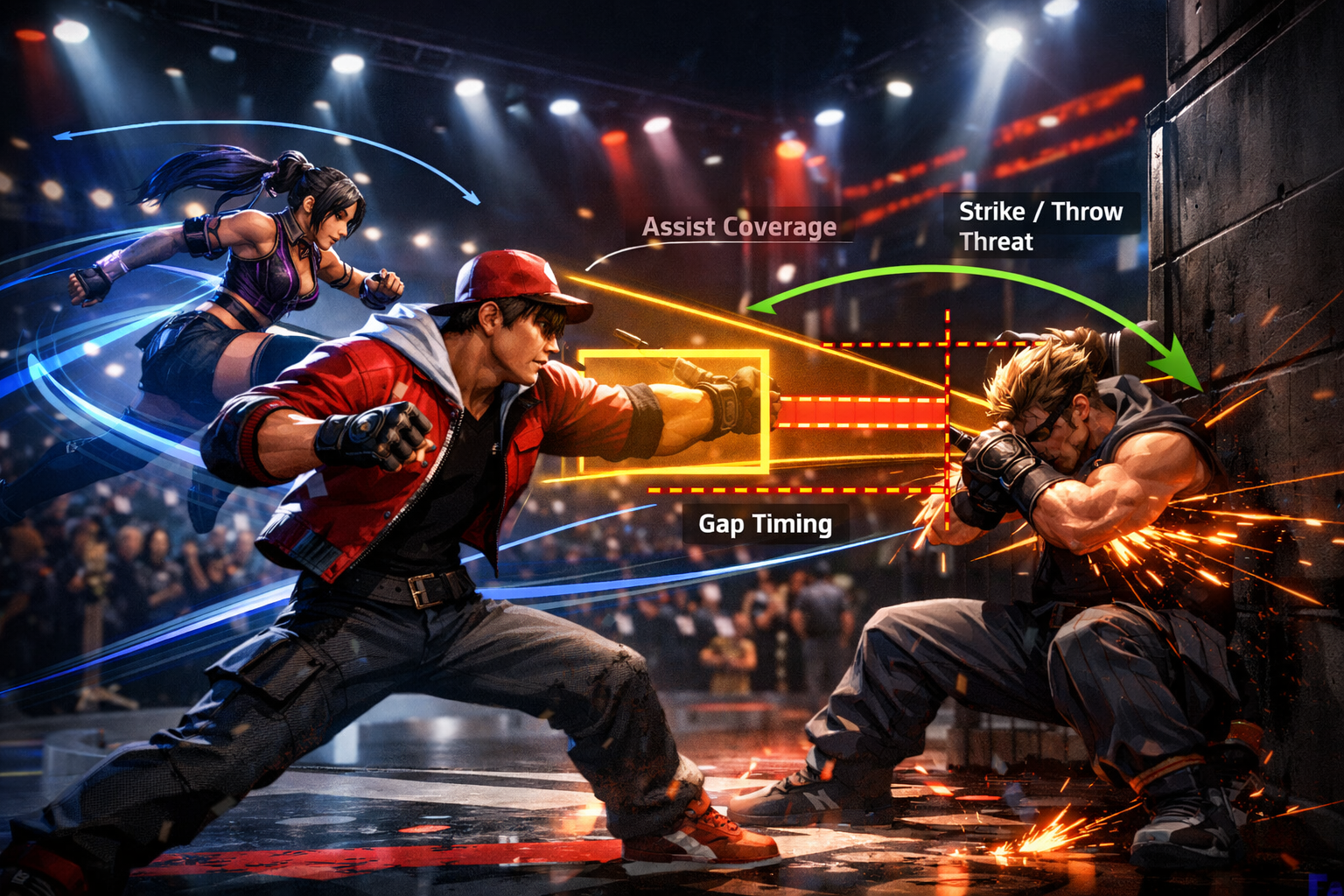
Pressure is not just “attacking a lot.” Good pressure has structure. Most strong offense in 2XKO is built from four layers:
- A stable starter that reaches, recovers well, or is easy to confirm.
- A turn-extender such as a plus normal, cancel, special, assist, or tag sequence.
- A threat that punishes passive defense, like a throw, overhead, low, left-right, or delayed frame trap.
- A reset point where the attacker chooses whether to stay safe, back off, call support, or recommit.
When players say someone has “good pressure,” they usually mean the character or team can repeatedly move between those four layers without exposing themselves too much. In 2XKO, the strongest pressure teams do not just stay close. They make the defender guess between several different kinds of loss: block too much and you get thrown, mash and you get frame-trapped, jump and you get clipped, try to escape and the assist keeps you pinned.
But none of that works if the attacker does not understand frame windows. If your reset point is too negative and not covered, your turn is over. If your throw attempt happens after a gap that is too obvious, you get interrupted. If your assist call is mistimed, the defender can challenge the point character before the support becomes relevant.
This is why frame advantage is not a narrow “lab monster” topic. It is the engine under every pressure sequence you will ever run.
True Blockstrings, Gaps, and Stagger Pressure
A true blockstring is a sequence where the defender has no gap to act between blocked hits. If the attacker times the sequence correctly, the defender must continue blocking. True strings are valuable because they remove guesswork for the attacker. They stabilize offense, build chip or meter pressure, push the defender toward the corner, and create the fear needed for later mind games.
However, true blockstrings alone are not enough. If every sequence is airtight and predictable, the defender can simply hold block, look for the end, and take back their turn. That is why good offense includes gaps.
A gap is a window where the defender can do something before the next attack connects. Gaps are not automatically bad. In fact, intentional gaps are where offense becomes dangerous. A small gap can bait a mash and convert into a counter-hit. A slightly larger gap can threaten a throw. A delayed cancel can catch fuzzy defense. A pause can freeze a defender who expects the usual rhythm.
This is called stagger pressure. Instead of canceling instantly into the next hit, the attacker delays slightly, trying to create a trap. Stagger pressure works because many players are trained to defend against tight strings but become impatient when they sense a possible turn. The attacker exploits that impatience.
Here is the key idea: not all gaps are equal. A 1-frame or 2-frame gap is very different from a 6-frame gap. Small gaps may only lose to fast buttons or invincible options. Larger gaps may lose to jump, backdash, reversal, parry, or system defense. The better you understand your own timing, the more precisely you can choose which defensive response you want to beat.
That precision is what separates random pressure from designed pressure. You are not just delaying for the sake of delay. You are choosing the size of the opening you want to present.
Frame Traps, Tick Throws, and Conditioning
A frame trap is an intentional gap designed to catch the defender pressing a button. The attacker makes the defender believe it might be their turn, but the follow-up arrives in time to counter-hit them.
For example, suppose you use a move that leaves you +1. Instead of continuing with an immediate fast option, you slightly delay a medium-speed move. If the defender mashes a 5-frame jab, your follow-up may counter-hit because your plus frames and the timing of the trap were built to beat exactly that response.
Frame traps are powerful because they make blocking scary. Once the defender learns that mashing loses, they become more likely to keep blocking. That opens the door to the next layer: throws.
A tick throw is a throw attempt after a fast blocked attack or a short sequence that leaves you close enough to threaten grab. Tick throws work because defenders who are worried about frame traps often stop pressing. Once they stop pressing, they become vulnerable to being thrown.
This creates the classic offensive triangle:
- Defender blocks to avoid getting hit.
- Attacker throws to beat blocking.
- Defender presses or jumps to stop throw.
- Attacker frame-traps to beat pressing or jump startup.
That cycle is called conditioning. Good pressure is not about forcing one answer forever. It is about teaching the defender to respect one threat so another threat becomes stronger.
In 2XKO, conditioning gets even stronger once assists enter the picture. A defender who is already scared of throws and frame traps becomes much easier to pin down when an assist removes easy movement options or covers the attacker’s risk.
Assist Pressure and Tag Pressure in 2XKO
This is where 2XKO becomes its own beast. In many fighters, frame advantage is mostly about the point character’s own move list. In 2XKO, pressure can be built from two-character timing. That means you are not only asking, “Am I plus after this move?” You are also asking, “What happens if my assist arrives here? Can I tag into a better angle? Can my teammate cover the gap? Can I make a minus situation functionally safe because the screen is still occupied?”
Assist-backed pressure changes how you should think about offense in five major ways.
1. Raw plus/minus matters less than covered recovery
A move that is only slightly minus may still be an excellent pressure tool if the defender cannot challenge because an assist is about to hit, pin, or force continued blockstun. This is one of the biggest lessons in tag games. The move’s frame data matters, but so does the timeline of the second character.
2. Gaps become layered rather than singular
Without an assist, a sequence usually has one main gap between hits. With an assist, you may have a point-character gap, then assist contact, then a re-entry into pressure. The defender must evaluate multiple timelines at once. That mental load is a kind of pressure on its own.
3. Spacing traps become stronger
If the defender tries to challenge a slightly negative move, they may run into an assist hitbox or get their button extended into a whiff punish situation. This means that spacing and coverage can transform a normal pressure reset into a real trap.
4. Pressure can continue after apparent turn-enders
In a solo fighter, a minus special often means the sequence ends. In 2XKO, the same visual rhythm may continue because the teammate sustains offense. This is why players new to tag fighters often feel like “the opponent never stops.” In reality, there are usually openings, but they are hidden inside overlapping timelines.
5. Defender choices must be more specific
Against solo pressure, a defender may challenge the obvious gap. Against assist pressure, the defender must ask: should I mash before the assist arrives, after the assist hits, during the point character’s recovery, after pushback changes spacing, or should I respect everything and wait for the actual resource end? Vague defense loses badly in team games.
The most important practical lesson is this: learn pressure in chunks. Do not try to memorize your whole team’s offense at once. Break it into small repeatable questions:
- What is my safest point-character starter?
- What assist gives me the easiest plus situation?
- Where is the first real gap?
- What defensive action am I trying to beat there?
- If the defender respects, what is my next threat?
- If they escape, where do I reset to neutral safely?
Those questions make team offense manageable. They also make your replays much easier to review.
Corner Pressure, Knockdowns, and Oki
Frame advantage becomes especially dangerous after knockdowns and in the corner. On knockdown, the attacker often gets time to position, time to call support, or time to place an attack so it hits late and grants better advantage. In the corner, the defender loses the ability to retreat backward, which makes even small plus situations more threatening.
Oki, short for okizeme, is offense against a waking-up opponent. Good oki uses timing to create strong post-knockdown pressure. Sometimes the goal is a true meaty attack that beats wake-up buttons. Sometimes the goal is to force block and stay plus. Sometimes the goal is a throw. Sometimes the goal is to represent a meaty, pause slightly, and bait a reversal or panic option.
The corner amplifies everything. Throws are scarier because the defender cannot walk back out of range as easily. Frame traps are scarier because pressure is easier to loop. Assists are scarier because space control converts into full pinning sequences rather than merely pushing the defender away. Even a modest advantage can become overwhelming when escape routes disappear.
That is why strong players do not only ask whether a move is plus. They ask where the plus frames occur. Mid-screen plus frames may lead to one more interaction. Corner plus frames may lead to an entire round-winning sequence.
How to Defend Against Frame Advantage
The answer to pressure is not “just block,” but blocking is the foundation. Good defense begins by understanding what the attacker wants from each layer.
Respect true pressure first
If a sequence is truly airtight, mashing only gives the attacker a counter-hit. Your first job is to identify whether you are actually in blockstun or just afraid of a possible follow-up.
Challenge only when you know the goal
Do not mash randomly because a move looked minus. Ask what you are trying to beat. Are you stopping a throw? Interrupting a delayed cancel? Checking a greedy assist call? Taking back space after pushback? Specific defense is much stronger than emotional defense.
Use movement as defense
In many pressure situations, the best answer is not a button but movement: jump, backdash, walk out, or reposition during the part of the string the attacker cannot truly cover. This is especially useful against players who over-focus on strike/throw and forget that movement is another layer of turn-taking.
Know when to spend resources
System defense exists for a reason. Team fighters often give defenders ways to push the attacker out, escape oppressive sequences, or call out greedy offense. The mistake many players make is spending these tools too late, after they have already lost too much health or corner space. If a sequence is leading to repeated high-value pressure, breaking it early can be the correct decision.
Watch the support character, not only the point character
This is one of the biggest differences between solo and tag defense. In 2XKO, the real turn may belong to the assist timing rather than the point normal you are staring at. If the teammate is about to arrive, your challenge window may not be where you think it is.
Do not confuse fear with frame trap
Some pressure is mathematically real. Some pressure is psychological. Skilled attackers use both. If you never test the attacker’s timing, you may end up respecting fake pressure forever. If you test recklessly, you get blown up. The goal is to gather information early in a set and become more precise over time.
Training Mode Drills for 2XKO Frame Data
You do not need to become a laboratory obsessive to improve. Ten to fifteen focused minutes in training mode can transform your offense and defense.
Drill 1: Find your fastest reliable check
Identify your quickest button that reaches at common pressure distance. Not the fastest in theory; the fastest one you can actually trust. Test it after blocking common situations and see what it interrupts.
Drill 2: Build one simple plus-frame sequence
Choose one close-range string that leaves you in a favorable spot. Practice three options from that same entry: immediate frame trap, throw, and safe disengage. If the sequence always looks the same, it will stop working quickly.
Drill 3: Record stagger pressure
Record the dummy doing tight pressure, then the same pressure with a slight delay, then the same sequence ending early. Practice defending without panicking. This drill teaches you to distinguish true strings from stagger traps.
Drill 4: Assist timing rehearsal
Take one pressure starter and pair it with one assist. Practice the timing until you understand exactly when the assist protects you, when it creates a gap, and when your point character is exposed. This is one of the highest-value drills in 2XKO.
Drill 5: Punish confirmation
Record unsafe moves you struggle to punish. Practice blocking and responding with the same punish every time until it becomes automatic. The point is not creativity. The point is reliability.
Drill 6: Meaty timing
After a knockdown, practice timing one button to hit as late and safely as possible. Good meaties improve offense, reduce scramble situations, and teach you how active frames influence advantage.
Drill 7: Replay review with one question
After each set, review only one thing: Where did I lose turns that I thought I had? This question quickly reveals whether you misunderstand your own frame data, over-respect fake pressure, or mistime assist coverage.
Choosing Teams by Pressure Style
You do not need exact tier placements to build a good pressure team. Think in terms of style instead.
Rushdown + lockdown
One character excels at getting in and staying close. The other provides stable assist coverage. This team style is ideal for players who want simple pressure loops, frequent strike/throw threats, and repeated corner carry.
Midrange + approach support
The point character controls space and takes plus situations when they appear. The assist helps them safely get from neutral into offense. This style is excellent for players who like structure and patience rather than nonstop scrambling.
Trap/setplay + re-entry
One character places durable screen threats or awkward defensive checks. The partner helps re-enter pressure after the defender blocks or avoids the initial setup. This style rewards timing and foresight.
Grappler/threat + coverage
If your point character scares the defender with throws, command grab-style pressure, or close-range fear, a supporting partner can make every blocked button much more dangerous. This style often wins by making defenders freeze.
The best beginner-friendly team is often not the flashiest one. It is the one where your assist timing is easy to understand and your pressure goals are obvious. If you cannot explain your team’s main offensive sequence in one sentence, it is probably too complicated for consistent match play.
Common Mistakes Players Make with Frames
Mistake 1: Treating every minus move as punishable. Many minus moves are safe because of spacing or pushback. If you overreach for a punish, you may get whiff-punished instead.
Mistake 2: Treating every plus move as unbeatable. Plus frames give initiative, not invulnerability. Movement, resource use, spacing, defensive reads, and offensive predictability still matter.
Mistake 3: Memorizing numbers without game plans. Knowing that a move is +2 is less useful than knowing what you will do at +2. Do you trap, throw, walk forward, reset spacing, or call support?
Mistake 4: Ignoring spacing. Frame data is not played on a spreadsheet. The same move can feel completely different at tip range versus point-blank range.
Mistake 5: Overusing one pressure rhythm. If your cancel timing never changes, defenders will learn the string quickly. Pressure needs variety in pacing.
Mistake 6: Calling assists without understanding exposure. Assist pressure is powerful, but poor timing can get your point character interrupted or your support character punished.
Mistake 7: Never labbing defense. Many players only practice their own offense. Then they freeze against someone else’s pressure because they have never rehearsed the defensive side of frame data.
Mistake 8: Confusing panic with adaptation. If you mash after every blocked sequence, you are not “checking pressure.” You are gambling. Real adaptation means learning where the attacker actually leaves space.
A Simple Match Plan for Applying This in Real Games
If you want to use this guide immediately, do not try to implement everything at once. Use this simple match plan:
- Pick one close-range starter. Learn what it gives you on hit and block.
- Add one layer after block. Choose either a frame trap or throw from that starter.
- Add one assist extension. Learn when the assist protects your turn.
- Learn one guaranteed punish. Do not worry about optimal yet; worry about consistency.
- Review one defensive question after each set. What pressure did you respect too much, and what pressure did you disrespect too much?
This approach works because improvement in fighting games is rarely linear. You do not become stronger by knowing more facts than your opponent. You become stronger by having a few reliable answers that hold up under stress. Frame advantage gives those answers structure.
Once you are comfortable, expand slowly. Add one new stagger pattern. One new corner reset. One new assist-backed entry. One new defensive response against common pressure. Over time, your understanding deepens naturally because each new layer is attached to something stable.
FAQ
Do I need to memorize all 2XKO frame data?
No. Start with your fastest normal, your safest pressure starter, your main plus situation, your main punish, and one common enemy threat. You can climb far with selective knowledge.
What matters more: plus frames or spacing?
Both matter, but spacing often decides whether the frame data actually applies. A punish that does not reach is not a punish. A plus move that pushes you too far away may not create real offense by itself.
Why does the opponent keep their turn even when their move looks minus?
Because they may be spacing it safely, covering the recovery with an assist, creating a timing trap, or using a move that is only slightly minus in a situation where your answer is too slow.
How do I know when to mash?
Mashing is strongest when you have identified a specific gap and chosen the right button for that range and timing. Blind mashing is weak. Informed challenge is strong.
What is the easiest way to improve my 2XKO pressure?
Build one repeatable blockstring into two branches: frame trap and throw. Then add one assist call that safely extends the same sequence. That alone can transform your offense.
What is the easiest way to improve my defense?
Stop trying to beat every option at once. First learn to recognize the attacker’s pattern. Then choose one response that beats one layer. Defense improves fastest when it becomes specific.
Final Thoughts
2XKO frame advantage is not just a technical topic for advanced players. It is the grammar of the game. Once you understand frames, pressure stops feeling random. You start to see why one button is strong after block, why one sequence is fake, why one assist call turns a normal reset into real offense, and why some defenders seem impossible to open up until you start manipulating their timing expectations.
The biggest payoff is confidence. Players who understand frame data do not panic as easily. They know when their offense is real, when their defense should hold, and when a challenge is justified. They also adapt faster after patches because they understand principles rather than depending on one exact setup.
If you remember only one idea from this guide, let it be this: frame advantage is a head start, not a full strategy. Numbers tell you who acts first. Winning still depends on how you use that head start. Use it to trap, throw, reposition, call support, bait defense, or reset safely. That is where strong 2XKO pressure is born.
Master that mindset, and you will improve in every phase of the game: neutral, offense, defense, corner control, assists, and post-knockdown situations. The exact values may change over time. The logic never does.