



How to Execute Sites in Valorant 2026: Basic Attack Setups
How to Execute Sites in Valorant 2026: Basic Attack Executes and Setups
Learning how to execute a site in Valorant is one of the fastest ways to improve your attacking half. Many players spend months grinding aim, memorizing lineups, and copying pro compositions, but still struggle to convert rounds because their team enters sites in a disorganized way. One player swings early, one player is still holding spawn, the smoke lands late, the spike carrier hesitates, and the round falls apart before the plant even starts. Sound familiar? That is exactly why site executes matter.
A good execute is not just “use utility and run in.” It is a repeatable team structure that helps five players solve the same problem together: how to take space, clear danger, plant the spike, and survive the retake. The best part is that the underlying rules stay useful across patches, maps, and metas. Agents may change, map pools rotate, and balance updates shift who is popular, but attacking fundamentals remain stable. If your team understands timing, spacing, utility layering, trade discipline, plant priorities, and post-plant shape, your executes will keep working even when the details around them evolve.
If you are still building your overall game knowledge, Riot’s official VALORANT Beginner’s Guide, the current Agents page, and the live Maps page are worth bookmarking. If you want to study how top teams convert site hits under pressure, the official VCT hub is still the best place to watch current pro executes. And if you want direct help improving your attacking structure, decision-making, or ranked results, you can also look at Boosteria’s Valorant boosting options.
This guide breaks down site executes from the ground up. You will learn what an execute actually is, how to build one with almost any agent composition, how to coordinate utility without wasting it, how to choose plants and post-plant positions, and how to avoid the most common mistakes that ruin otherwise winnable attack rounds. The goal is not to give you one rigid script. The goal is to teach you a system you can apply on almost any map with almost any team.
Table of Contents
- What Is a Site Execute in Valorant?
- Why Executes Win More Attack Rounds
- The Anatomy of a Clean Execute
- Defaulting vs Fast Hitting vs Full Executing
- Who Does What During a Site Hit?
- The Pre-Round Execute Checklist
- How to Layer Utility Properly
- Entry Timing, Trading, and Spacing
- How to Plant Without Throwing the Round
- How to Build a Strong Post-Plant
- Basic Attack Execute Setups You Can Use on Any Map
- How to Adjust to Different Defensive Setups
- How to Execute in Solo Queue
- Practice Plan for Better Executes
- Most Common Execute Mistakes
- Final Thoughts
What Is a Site Execute in Valorant?
A site execute is a planned attacking sequence used to take control of a bomb site with coordinated utility, pressure, and movement. Instead of five players peeking one by one and hoping they win aim duels, an execute creates structure. It assigns jobs. Someone blocks sightlines. Someone clears close corners. Someone pressures a second angle. Someone carries the spike into a safe plant position. Someone watches the rotate or lurk timing. The point is not speed alone. The point is synchronized pressure.
In simple terms, a clean execute answers six questions:
- Where are we hitting?
- What utility do we need first?
- Who enters first and who trades?
- What angles are most dangerous?
- Where is the spike being planted?
- What positions do we hold after the plant?
If your team can answer those six questions before contact, your round quality improves immediately. You will still lose some fights. That is normal. But you will stop losing rounds because nobody knew the plan.
Why Executes Win More Attack Rounds
Valorant is a tactical shooter, which means raw mechanics matter, but structure matters too. Defenders usually begin the round with positional advantage. They know the map, they control the choke points, and they can hold tight crossfires. If attackers challenge that setup carelessly, the defense gets easy first kills. Executing well changes the equation. It forces defenders to give ground, reposition, or fight through layered pressure.
Strong executes win rounds for five major reasons.
First, they reduce isolated duels. When your first player swings with support utility and a second player close enough to trade, the defender no longer gets a free 1v1. Even if the entry dies, the team can still take the site because the duel was not isolated.
Second, they compress defender decision-making. Good utility makes defenders choose between bad options. Stay in the smoke edge and risk being flashed. Hold close and get cleared by utility. Fall back and concede plant space. Fight through a recon or stun and lose timing. The more pressure arrives at once, the harder it is for defenders to make perfect choices.
Third, executes create cleaner plants. Many low-ranked teams “take” site but never truly secure the plant. They kill one anchor, hesitate, get pinched by rotates, and lose the spike in the open. A proper execute includes a plant plan and protection for the planter.
Fourth, they improve post-plant shape. Rounds are often decided after the spike goes down. If your execute finishes with everyone bunched on site or randomly chasing kills, you turn a winning position into chaos. Good executes naturally flow into strong post-plants.
Fifth, they scale with team skill. Even at high rank, teams still win with simple fundamentals. You do not need twenty lineups and pro-level set plays to improve. A reliable smoke timing, a clean flash, one entry path, one trade path, and one plant rule can carry a shocking number of rounds.
The Anatomy of a Clean Execute
Every solid execute has the same basic skeleton, regardless of map. Once you understand this structure, adapting it becomes much easier.
- Preparation: The team gathers, clears nearby map control, and confirms the target site.
- Information check: You identify likely defender positions, utility threats, and rotate timings.
- First utility wave: Smokes, scans, flashes, walls, stuns, or other zoning tools remove the defender’s easiest sightlines.
- Entry wave: The first players break the front layer of site and pressure the key anchor angles.
- Trade wave: Supporting attackers punish any defender who kills the entry.
- Plant phase: The spike is planted in a deliberate location while teammates cover the most dangerous re-peek and rotate paths.
- Post-plant spread: Attackers reposition into a shape that forces defenders to clear multiple angles under time pressure.
When executes fail, they usually fail because one of these steps is missing or rushed. Maybe the team skipped the preparation and walked into three stacked defenders. Maybe the first utility wave was late. Maybe the entry went in before the smoke bloomed. Maybe the spike was planted before close angles were cleared. Maybe everyone stayed on site and got wiped by the retake. Do not think of executes as one violent moment. Think of them as a sequence that must stay connected.
Defaulting vs Fast Hitting vs Full Executing
One common misconception is that every attack round should begin with a full five-man rush. That is not how consistent teams attack. The best attacking halves mix three approaches: the default, the fast hit, and the full execute.
Defaulting means spreading out to gather info, pressure multiple areas, force defensive utility, and discover where the defense is weak. A default is valuable because it creates options. You might start the round with light pressure across the map, draw out a smoke or trap utility, then regroup and execute the weaker site. Defaulting also prevents the defense from stacking one site for free.
A fast hit is a quick commitment with limited setup. It is useful when you expect the defense to be weak, low on utility, or vulnerable to surprise. Fast hits are strongest after conditioning. If the defense expects slow defaults every round, a sudden fast hit can catch them on bad timing.
A full execute is the most deliberate option. You gather enough control to safely stage, then commit layered utility with clear roles and plant structure. This is the best choice when defenders have dangerous utility, strong operators, or disciplined anchors. A full execute is also the cleanest way to attack when your team wants consistency rather than chaos.
Good teams do not ask, “Should we default or execute?” They ask, “What does this round need?” Sometimes a light default creates the best execute. Sometimes a fast punish is better than a slow setup. The art of attacking is not repeating one pattern. It is selecting the right one based on economy, defender tendencies, and your available utility.
Who Does What During a Site Hit?
You do not need perfect meta compositions to run good executes, but you do need role clarity. Here is the easiest way to organize a site hit.
1. The path opener. This is often your primary space-taker. Their job is to break the first layer of site, challenge the first defender, and force movement. They are not there to hard carry every round. They are there to create space that the rest of the team can use.
2. The trade player. This player stays close enough to punish the defender who kills the opener. Many bad entries look “inting” only because nobody was positioned to trade them. The trade player is what makes entry work.
3. The utility anchor. This player handles key setup tools: smoke timing, wall placement, recon value, stun timing, or anti-retake utility. They do not need to enter first, but they must be in sync with the entry wave.
4. The spike controller. This is usually not the first player in. The spike should stay with someone who can enter after the first layer of danger is managed. The spike controller must understand the plant plan before the hit begins.
5. The lurk or flank manager. Not every round needs a hard lurk, but every execute needs someone thinking about the back side of the map. Is a defender flanking? Is there a late pinch coming through mid? Is there a rotation you can catch? This player either holds that threat or turns it into an advantage.
In ranked, one player may perform more than one job. That is fine. The mistake is not role overlap. The mistake is role confusion. If three people all think they are entrying, nobody is trading. If nobody knows who has spike, the plant arrives late. If everyone walks in with utility out, the defense gets free gunfights.
The Pre-Round Execute Checklist
Before your team commits, ask these questions. This simple checklist fixes a huge number of bad rounds.
- Do we know which site we are finishing on?
- Do we expect one anchor or a stack?
- What defensive utility is likely stopping the choke?
- What is our first utility piece?
- Who swings first?
- Who is immediately behind them?
- Who has the spike?
- Where are we planting?
- Who watches the rotate or flank?
- What is the fallback if the first duel goes badly?
Notice that this checklist is not complicated. You do not need a whiteboard. In solo queue, you can simplify it even more: “We hit A. Smoke top and back site. Flash on my swing. Trade me. Plant default. One watch flank.” That alone is more structure than most random teams ever create.
How to Layer Utility Properly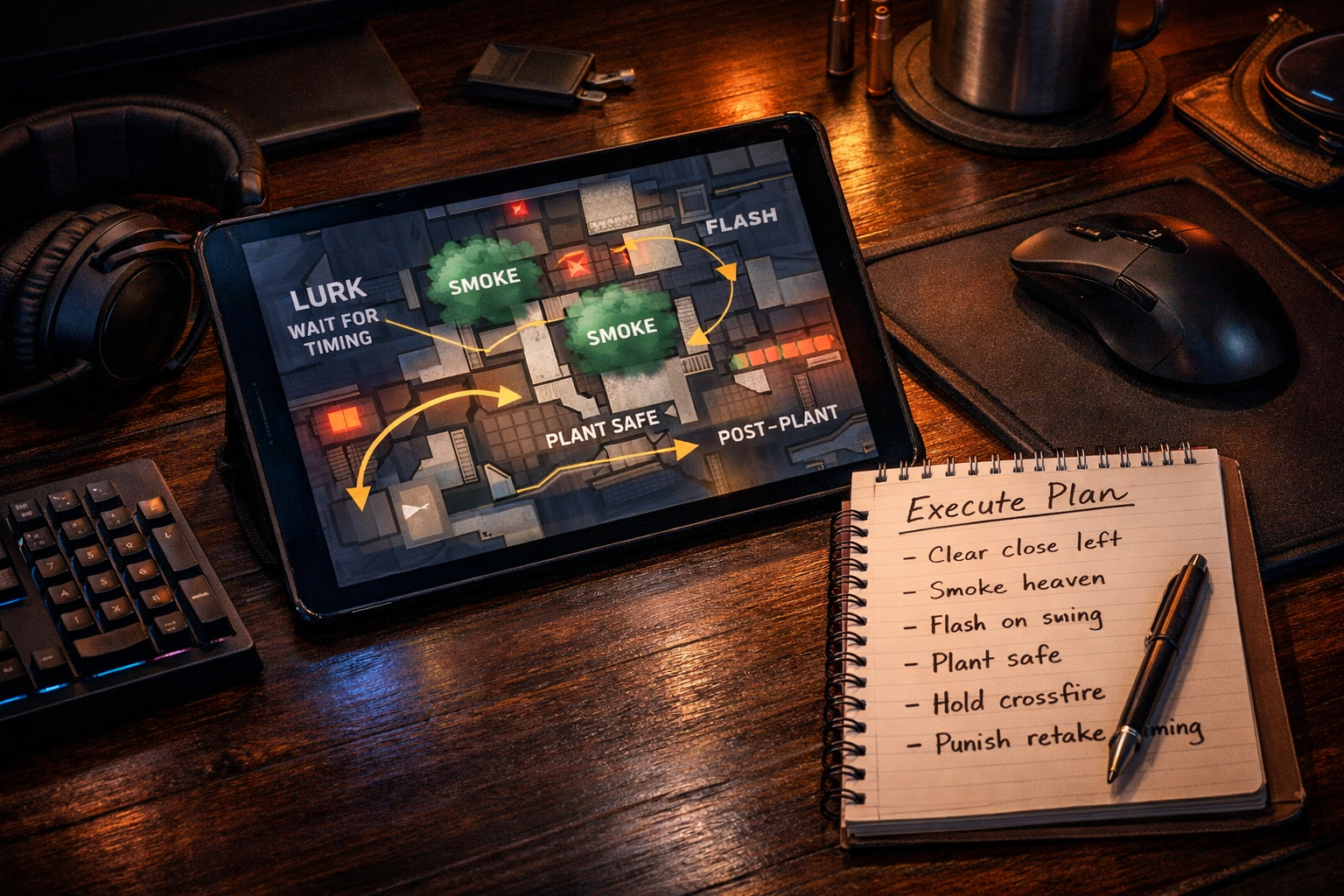
Utility layering is the heart of a site execute. Bad teams dump everything at once or use abilities in a random order. Good teams use utility in a sequence that creates progressive advantages.
Think of utility in four categories:
- Vision denial: smokes, walls, screens, or any tool that removes defender sightlines
- Space forcing: molotov-style damage, stuns, pulls, slows, displacement, zoning abilities
- Information: recon, scans, reveals, traps, or cues that tell you where defenders are
- Entry support: flashes, movement tools, survivability tools, or anything that lets the first player survive the swing
The most reliable layering sequence usually looks like this:
- Deny the longest and strongest defender sightline.
- Use info or force utility to identify close threats.
- Flash or pressure the first dangerous swing angle.
- Send the entry and trade together.
- Save at least one useful piece for post-plant or anti-retake.
Why this order? Because it solves the most dangerous problems first. Long sightlines are what let defenders farm easy opening kills. Close rat positions are what punish rushed entries. Flashing too early is pointless if your team cannot capitalize. Dumping every ability before the entry arrives just gives defenders time to wait it out.
Here are the most common utility errors that ruin executes:
- Smoking too late, so the entry swings into an open angle
- Flashing too early, so the defender dodges and re-peeks on the real hit
- Revealing site but not acting on the info
- Using all stall utility during the take and having nothing left for post-plant
- Blocking your own team’s vision without a clear follow-up plan
- Using utility in a panic after the first death instead of as part of a sequence
A good rule is this: your utility should create a timing window, and your team should attack inside that window. If the window opens and nobody moves, the execute loses value immediately.
Entry Timing, Trading, and Spacing
Even perfect utility will not save a team that enters poorly. Entry timing is what turns support tools into actual pressure.
The first principle is go together, not stacked. Your first two players should be close enough to trade but not so close that one spray transfer or one explosive ability punishes both. Imagine a chain, not a pile. You want connected pressure with slight spacing.
The second principle is clear in layers. Do not try to clear every angle at once with your crosshair. Divide site into front danger, mid danger, and back danger. The entry focuses on the first live threat. The second player watches the punish angle. The third player fills the gap. This is how clean teams take control quickly without becoming random.
The third principle is trade with intent. Trading is not just “be nearby.” It means knowing where the defender will likely appear after your teammate makes contact. If your entry swings close right and dies, your job is not to freeze. Your job is to instantly punish the killer or at least force them off the angle so the execute continues.
The fourth principle is do not overchase. Once the first layer of site is won, many players throw by sprinting deeper for hero kills. Your entry does not need to win the whole round alone. If you control enough space to plant, often the best next step is to stabilize instead of hunting.
A useful mental model: the entry creates instability, the trade player secures the break, and the rest of the team converts that break into a plant.
How to Plant Without Throwing the Round
Planting is one of the most underrated parts of executing. Players spend all their energy getting onto site, then plant lazily in the first available spot without thinking about protection or post-plant value. That mistake costs a massive number of rounds.
A strong plant follows three rules:
- Plant only after the critical close threats are handled. If a defender can still swing a common close angle on the planter for free, you are planting too early.
- Choose a plant that matches your post-plant positions. Do not plant for open lineups if your whole team plans to stay on site. Do not plant for close crossfires if everyone plans to fall back.
- Cover the planter with live guns, not assumptions. Someone must actively hold the most likely re-peek paths while the spike is going down.
There are generally three kinds of plants:
- Default plant: safest and easiest under pressure
- Open plant: stronger for line-of-sight post-plants from deeper positions
- Hidden plant: useful when you expect to hold site and force close defuse fights
Most teams should default to safe, repeatable plants unless they have a clear reason to choose differently. Fancy plant spots are not helpful if your teammates do not know how to play off them. The best plant is the one your team understands.
How to Build a Strong Post-Plant
A good execute is only half the round. If your team gets the plant and then dies one by one, the execute did not really succeed. Post-plant structure is what finishes the job.
The biggest post-plant mistake is overcommitting to the site you just took. Attackers often feel safe because they planted, but the real danger begins when defenders retake with grouped pressure. If five attackers all remain visible on site, defenders know exactly where to clear and how to use utility. The answer is to create a spread.
A strong post-plant usually includes:
- One player playing contact near the spike or a strong anti-defuse angle
- One or two players holding the first retake choke points
- One player in a repositioned off-angle or late swing spot
- Optional long-range support or lineup pressure if your composition supports it
- Someone aware of the flank or timing pinch
The goal is not to hide from every fight. The goal is to make the defense clear multiple threats while the spike timer works against them. Crossfires are king. Delay is king. Re-swing timing is king. If one player takes contact and survives for even a second longer than expected, that can be enough for the second player to punish the retaker.
Remember this rule: once the spike is planted, time belongs to the attackers. You do not need to force the next duel. Defenders do.
Basic Attack Execute Setups You Can Use on Any Map
Now let’s get practical. These setup templates are intentionally generic so you can adapt them to almost any Valorant map.
1. The Front-to-Back Standard Execute
This is the most universal setup for ranked and team play.
- One player uses vision denial on the longest defender angle.
- One player uses info or pressure utility on a close corner.
- First entry swings into the cleared lane.
- Second entry trades immediately and helps clear the second layer.
- Spike follows once the front of site is stable.
- Remaining players seal rotate routes and prepare post-plant.
This setup works because it handles the most dangerous problems in order: sightline, close threat, entry, trade, plant. If your team is new to executes, start here.
2. The Split Execute
A split execute pressures the site from two directions, usually a main choke plus a secondary mid or connector path. Splits are powerful because defenders struggle to hold both fronts at the same time.
- Main group shows presence and draws anchor attention.
- Secondary group arrives on a synced timer, not too early.
- Vision denial blocks defender support lines.
- Both groups pinch the anchor and collapse onto plant space.
The key to a split is timing. If the second group hits too early, they take isolated fights. If they hit too late, the main group dies before the pinch arrives. Good split timings feel simultaneous from the defender’s perspective, even if one group technically starts the motion first.
3. The Contact-into-Utility Execute
This is one of the best ways to punish defenders who waste utility early. Instead of exploding immediately, attackers walk close, hold discipline, and only use full execute utility when they are in a stronger staging position.
- Take quiet map control.
- Listen for defender cues or utility use.
- When close space is won, launch the first utility wave.
- Explode through the final choke with reduced warning.
This setup is excellent against defenders who rely on early spam, panic utility, or predictable re-peeks.
4. The Re-hit Execute
A re-hit is when attackers threaten one area, force a defender reaction, then quickly regroup and hit the original site again or a different site with a cleaner timing. It is strong against teams that overrotate or dump utility too fast.
- Show enough presence to trigger defender response.
- Back off before overcommitting.
- Count utility used by the defense.
- Hit the weakened site with a better utility trade.
Re-hits are not about indecision. They are about forcing inefficient defender resource usage and then converting that edge.
5. The Anti-Eco Execute
Against weaker weapons, many teams get reckless and throw. Do not let that happen. Eco rounds are dangerous because close stacks, short-range ambushes, and fast push plays become more likely.
- Clear close corners carefully.
- Use utility before dry-swinging choke points.
- Stay close enough to trade.
- Avoid gifting isolated shotgun fights.
- Plant quickly once site is secured and do not overhunt.
The rule versus eco teams is simple: play the percentage round, not the highlight round.
How to Adjust to Different Defensive Setups
Not every defense should be attacked the same way. The best executes respond to what the defenders are actually doing.
Against heavy utility anchors
If the anchor on your target site is using lots of stall tools, patience becomes part of the execute. You may need to bait the first layer of utility, wait a moment, then launch the real hit. Forcing through every piece of defensive stall is often a losing trade unless your entry timing is perfect.
Against an Operator player
Respect the longest opening sightline. Do not give the Operator a clean first duel. Smoke it, wall it, flash it, or take a different staging route. Once the operator is displaced, hit decisively before they can reposition to a second angle.
Against fast rotators
If defenders rotate aggressively, your window to plant is smaller. This means your execute must be tighter after the first kill. Do not waste five seconds debating the plant while the whole defense collapses. Win the front layer and convert immediately.
Against passive retake defenses
Some teams give site quickly and bet on a coordinated retake. Against these teams, do not overextend chasing the anchors. Take the free site, plant early, and spend the rest of your utility preparing the post-plant. If the defense wants to give you the site, accept the gift and punish the retake instead.
Against flanking defenders
If the enemy frequently pushes the other side of the map during your executes, assign a flank responsibility before the round starts. A single lurk trap, held timing, or patient player can neutralize that threat. Nothing throws an execute harder than getting pinched because everyone assumed someone else had flank.
How to Execute in Solo Queue
Solo queue Valorant is messy, but site executes still work if you simplify them. Your goal is not to run pro-level protocols. Your goal is to create enough clarity that random teammates can follow.
Use short, actionable calls:
- “Smoke back site and heaven, then I flash.”
- “Trade me close right.”
- “Plant default, one hold flank.”
- “Don’t overpeek after plant, play cross.”
- “Wait out the first utility, then we go.”
When solo queueing, choose execute plans with low communication burden. Simple front-to-back hits are much easier to coordinate than complicated splits. If you have one teammate willing to work with you, that may already be enough. Two players with a clear entry-and-trade plan can stabilize the entire round.
Also, adapt to your teammates’ natural tendencies. If they always overheat, call for faster plants and simpler post-plants. If they play too slow, make the execute trigger obvious: “When the smoke lands, go.” Good solo queue shot-calling is not about giving ten instructions. It is about removing uncertainty.
Practice Plan for Better Executes
You do not improve attacking structure by only playing more ranked. You improve by isolating the pieces of a good execute and practicing them intentionally.
1. Build two default execute calls per map
You do not need a massive playbook. Start with two reliable site hits per map: one standard hit and one variation. Example categories: a main-heavy front execute and a split execute. Repeat them until the team understands the timing without overthinking.
2. Practice utility timing in customs
Walk through the choke, place the smokes, test the flash timing, and identify when the entry should move. If your first player is arriving before the setup utility activates, the sequence needs work.
3. Review failed plants
After matches, ask why the plant failed. Was site not actually clear? Was the spike too far back? Did someone swing too deep? Did the team forget flank? Failed plants reveal execute problems faster than almost any other replay segment.
4. Review first-contact deaths
If your entry keeps dying without value, do not instantly blame mechanics. Check whether the utility was late, whether the trade player was too far away, or whether the entry had to clear too many angles alone.
5. Practice post-plant restraint
Many teams can take sites but cannot hold them. Make it a habit to call where each player goes after the spike is down. If the whole team naturally bunches, deliberately assign one player to reposition deeper.
6. Watch pro VODs with one question in mind
Do not watch pro Valorant passively. Watch one execute and ask: what was the order? Which sightline was denied first? Who traded the entry? Where was the spike planted? Where did they reposition? Copy the structure, not the cosmetics.
Most Common Execute Mistakes
Let’s cover the biggest round-killers directly.
1. Entering before utility lands
This is probably the most common mistake in ranked. The idea of the execute is right, but the entry gets impatient and swings before the smoke blooms or the flash pops. The result is the same as dry peeking.
2. Using all utility at the front door
If the team burns everything just to cross the choke, the post-plant becomes fragile. Save something for the conversion and retake denial.
3. Planting while key angles are still uncleared
The spike should not go down just because one defender died. The dangerous re-peek zones still need attention.
4. No one trades the first player
Entry without a trade path is just a gamble. Someone must be ready to punish the contact instantly.
5. Overheating after one kill
Getting the first site kill does not mean the round is over. Chasing deeper kills often turns a clean execute into a messy throw.
6. Everyone staying on site after plant
This makes the defense’s retake easier. Spread out. Build layers. Force defenders to clear multiple threats.
7. No plan for the flank
One defender coming behind at the wrong time can collapse the whole round. Assign the responsibility early.
8. Calling “rush” when the round needs patience
Fast rounds have value, but forcing speed into every situation is not good attacking. Sometimes waiting out the first piece of defender utility is the best move you can make.
9. Confusing commitment with panic
Once the hit begins, decisiveness matters. But decisiveness is not the same as losing structure. Your team still needs spacing, trades, and plant discipline.
10. Choosing a plant nobody can play around
If your team does not understand how to defend a specific plant, pick the safer option. Consistency beats creativity in most ranked rounds.
Advanced but Timeless Execute Concepts
Once your basic executes are reliable, these higher-level ideas make your attack even stronger.
Conditioning
Conditioning means teaching the defense to expect one pattern, then breaking that expectation later. If you default slowly for several rounds, a fast hit gains surprise value. If you always hit one site with full utility, a late split elsewhere becomes stronger because defenders are mentally anchored to your habits.
Utility trading
Great attacks think in resources, not just kills. If defenders spend more utility than attackers to survive the early round, the execute later becomes easier even without opening picks. Sometimes the best “setup” happens 25 seconds before the hit.
Tempo manipulation
Tempo is the pace defenders feel. You can pressure fast, slow down, then explode. Or you can hold still long enough that defenders get curious and re-peek into your staged take. Changing tempo within the same round makes the defense uncomfortable.
Plant economy
Not every execute needs the same amount of utility. When your economy is weak, prioritize simpler hits that require fewer coordinated pieces. When your economy is strong, invest more into layered entries that create higher conversion odds.
Information denial
Sometimes the strongest execute is the one the defense reads too late. Quiet staging, disciplined movement, and not revealing the spike too early can make a routine hit much deadlier.
Simple Communication Script for Teams
If your team struggles with comms, use this basic script every time.
- Call the target: “We finish B.”
- Call the first utility: “Smoke back site and top.”
- Call the trigger: “Flash on contact.”
- Call the entry order: “I go first, trade me.”
- Call the plant: “Plant default.”
- Call the post-plant: “One site, two main, one flank.”
This kind of communication wins rounds because it is short enough to remember and specific enough to guide action. Long speeches in buy phase are less useful than one crisp six-part plan.
Example of a Full Generic Execute Call
Here is what a clean ranked-level execute call can sound like:
“We default for early info, then hit A at 1:00. Smoke the deep sightline and the rotate support angle. Recon close side. Flash as I swing. Trade me through the choke. Spike follows once front site is clear. Plant safe default. One stays for anti-flank, two fall into post-plant crossfire, one holds close contact.”
That is not a pro stratbook. It is simply a complete round plan. And that level of clarity already puts you ahead of most attacking teams.
How to Know If Your Execute Was Actually Good
Do not judge an execute only by whether the round was won. Sometimes the execute is correct and the shots are lost. Sometimes the execute is sloppy and you still win because the defenders miss. Use better questions:
- Did utility land before the entry fought?
- Did the first two players have trade spacing?
- Did the team clear the critical front-layer threats?
- Did the spike get planted in a planned spot?
- Did the team create a real post-plant shape?
- Did the round loss happen because of structure or because of mechanics?
If the structure is improving, the results will usually follow.
Final Thoughts
Executing sites in Valorant is not about memorizing a thousand utility combinations. It is about giving your attack rounds a structure that creates repeatable advantages. Deny the strongest sightline. Clear the first layer of danger. Send the entry with support. Trade on contact. Plant with purpose. Spread into a real post-plant. That is the core of nearly every strong site take, from simple ranked hits to organized team play.
If you only remember one thing from this guide, remember this: a good execute is a sequence, not a stampede. Teams fail attacks not because they lacked talent, but because they broke the sequence. They entered too early, planted too late, forgot the trade, bunched after plant, or ignored the flank. Fix those issues and your attack halves become dramatically more stable.
Start small. Build one standard execute for each site type you play most. Use simple comms. Review failed plants. Improve your spacing. Save one piece of utility for the retake. Over time, your team will stop feeling like five players taking separate fights and start feeling like one unit solving the same tactical problem together.
That is when site executes stop looking forced and start looking easy. And in Valorant, “easy” usually means your fundamentals are finally doing the work for you.