



2XKO Mistakes Guide: Stop Mashing, Play Safe, Stay Calm
Avoiding Common Mistakes in 2XKO (2026 and Beyond): Button Mashing, Unsafe Moves, and Mental Fixes
Climbing in any fighting game is less about secret combos and more about eliminating the same few habits that bleed rounds: mashing when you feel pressure, picking high-risk moves at the wrong time, and letting tilt turn one mistake into ten. This guide focuses on timeless fundamentals you can apply across patches and metas—so you improve even when the game evolves.
You’ll learn how to replace button mashing with intentional “turns,” how to identify and remove unsafe choices from your toolkit, and how to build a repeatable mental routine that keeps you consistent in ranked.
Table of Contents
1) Quick Audit: The 12 Mistakes That Hold Most Players Back
Before you change anything, identify what’s costing you rounds right now. In most ranked games, your losses can be traced to a small set of repeated errors. Use this list like a diagnosis tool; if you fix only the top three that apply to you, your win rate will usually climb immediately.
Button mashing and input chaos
- Autopilot strings: you run the same sequence regardless of hit/block.
- Panic pressing: you press multiple buttons while blocking, hoping something “wins.”
- No confirms: you commit to a combo route without verifying you actually landed the hit.
- Fast hands, slow brain: your fingers move before your eyes process what happened.
Unsafe decisions
- Big swings in neutral: slow/heavy moves thrown out without coverage.
- Unsafe specials/raw commitments: high-recovery actions used “because they feel good.”
- Predictable wakeup options: you always choose the same escape and get punished for it.
- Bad tags/assists: you call help when you’re not protected, getting clipped and losing momentum.
Mental errors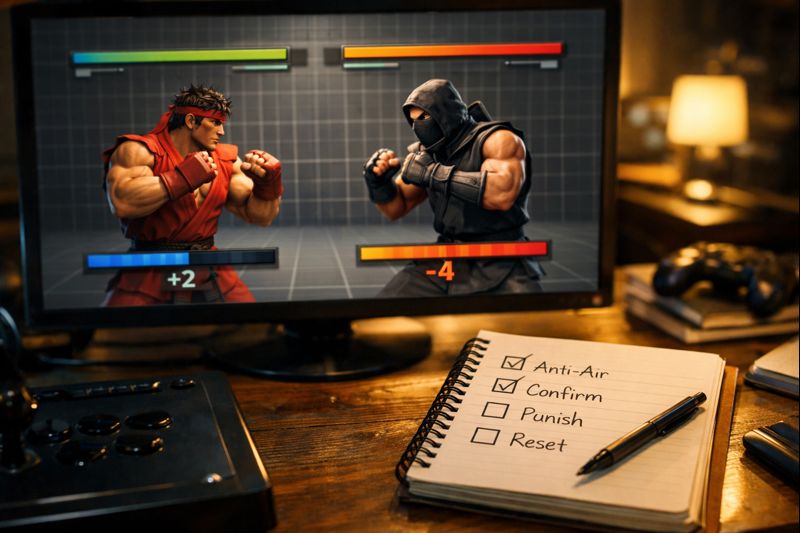
- Tilt escalation: one mistake turns into reckless play for the next 20 seconds.
- Outcome obsession: you focus on winning the game instead of winning the next interaction.
- No reset protocol: you have no routine to calm your hands and stabilize decisions.
- Learning leakage: you don’t review, so the same mistake returns tomorrow.
Pick three items you see the most. Throughout this guide, you’ll get concrete drills and rules that remove those errors systematically.
2) Why These Mistakes Happen (And Why They Persist)
Most “bad play” is actually a reasonable human response to uncertainty. Fighting games create fast, ambiguous situations. When you don’t know what’s safe, what’s punishable, or whose turn it is, your nervous system reaches for the fastest available strategy: press something and hope. Button mashing is often a symptom of missing structure, not a lack of talent.
Unsafe moves persist because they sometimes work. A risky option that steals one round today teaches your brain that it’s “good,” even if it loses five rounds tomorrow. Tilt persists because it feels like urgency: “I need to get it back.” That urgency kills your decision quality—especially in a tag environment where mistakes can snowball quickly.
The solution is not “be more disciplined” as an abstract idea. The solution is to build small systems: rules that guide your choices, drills that stabilize your execution, and mental routines that prevent emotional spikes from hijacking your hands.
3) The Core Model: Turns, Safety, and Risk Budgeting
If you learn only one concept, learn this: most interactions in fighting games can be modeled as turns. “Turn” doesn’t mean the game is truly turn-based; it means there are moments when one player is advantaged and can act first, and moments when the other player can act first. This turn model is how you stop mashing without becoming passive.
Turns come from advantage
Advantage often comes from what happens when an attack is blocked. If your move leaves you recovered sooner than your opponent, you can usually act first. If you recover later, the opponent can act first. This is commonly discussed as “plus” or “minus.” If you’re new to these terms, a clear explanation can be found in Infil’s Fighting Game Glossary: Plus and Minus.
You do not need to memorize every number to benefit. You need a working rule set: identify your safest options, identify your most punishable options, and build offense that ends in safety.
Safety is more than frame data
“Unsafe” typically means you can be punished if the opponent blocks. But safety also includes:
- Whiff safety: how punishable you are if your move misses.
- Spacing safety: some moves become safer at certain distances due to pushback.
- Situational safety: the same option is safe after a knockdown but unsafe in neutral.
- Team safety: assist calls and tags can be unsafe if not protected.
A practical reference for how on-block advantage is used is Dustloop’s guide on frame data: Using Frame Data.
Risk budgeting
Strong players do not “never take risks.” They budget risk. They spend it when: (1) the reward is large, (2) the opponent’s habits justify it, or (3) the game state demands it (low time, low health). Everyone else spends risk constantly—then wonders why ranked feels random.
In the rest of the guide, you’ll build a toolkit around this model: take your turn cleanly, choose safe options by default, and spend risk intentionally.
4) Button Mashing: How to Stop Without Playing “Slow”
“Stop mashing” is not helpful advice by itself. You need a replacement behavior: a simple decision loop you can run under stress. Use this three-step loop:
- Observe: Did I hit? Did they block? Did they jump? Did they whiff?
- Choose: What is the correct branch for this situation?
- Confirm: Only commit once I’ve verified the outcome.
Replace “random buttons” with a tiny gameplan
Mashing usually means you don’t know what you’re trying to accomplish in the next two seconds. Build a tiny plan with three parts:
- Opener: your low-risk poke or approach tool.
- Confirm: your simplest conversion if it hits.
- Ender: a safe finisher that leaves you stable (spacing, knockdown, or disengage).
The goal is not maximum damage. The goal is consistency. In ranked, consistency beats optimal routes because it reduces self-inflicted losses.
Three anti-mash rules you can apply immediately
- Rule 1: One decision per beat. If you are unsure, do less—block, walk, or use a safe poke. Your brain catches up.
- Rule 2: Stop finishing strings “just because.” Only finish if you confirmed a hit or you know the ender is safe.
- Rule 3: Don’t press while you’re scared. Fear makes you guess. When you feel panic, your default is block + reposition.
Training mode drill: “Clean Inputs” (10 minutes)
- Pick your most common opener.
- Set the dummy to block randomly (or alternate block / no block if random is unavailable).
- Do the opener 50 times. If it hits, do your simple confirm. If it’s blocked, do your safe ender or disengage.
- If you ever do the wrong branch, stop and reset the rep. Accuracy matters more than speed.
This drill builds the core habit that kills mashing: branching based on reality instead of hope.
Match drill: “Two Buttons Only” (5 matches)
In real matches, restrict yourself to two primary normals plus block. That’s it. This forces you to: (1) observe spacing, (2) stop autopiloting, and (3) win through timing instead of noise. After five matches, add one special and repeat. Your goal is not to win those matches—it’s to stabilize decision-making.
The hidden cause: you don’t trust your defense
Many players mash because they don’t believe blocking will work. They assume they must “take their turn back” instantly. In reality, good defense creates opportunities: you block something unsafe, then punish. You block pressure, then escape. When your defense improves, mashing fades naturally because you stop feeling desperate.
5) Neutral Mistakes: Over-Commitment, Whiffs, and Bad Spacing
Neutral is where you decide which risks you’re willing to take. Most ranked losses come from losing neutral repeatedly, then trying to “make it back” with high-risk offense. Clean neutral prevents the spiral.
Mistake: swinging too big too often
Big buttons and high-commitment specials feel powerful, but they are usually punishable on whiff or block. Use them as call-outs, not defaults. Your default should be a low-commitment poke, movement, and patience.
Mistake: standing at the wrong range
Many players stand at a range where their move barely reaches but the opponent’s best tools reach cleanly. Fix this with a simple concept: your “home range.”
- Identify the range where your safest poke hits reliably.
- Practice walking in and out of that range without attacking.
- Only attack when you’ve created a reason: they whiffed, they jumped, or they froze.
Mistake: whiffing because you’re impatient
Whiffs are often impatience expressed through inputs. If you whiff frequently, you are likely attacking without a trigger. Create triggers:
- Whiff trigger: they missed a move—hit their recovery.
- Jump trigger: they left the ground—anti-air.
- Freeze trigger: they stopped moving—take space safely.
Neutral drill: “Walk and Check” (8 minutes)
- In training mode, mark a visual reference on the stage (background element) as your “home range.”
- Walk in and out of that range for 2 minutes without attacking.
- Add one safe poke: only press it when you re-enter home range.
- Add a second poke: alternate between them slowly, focusing on spacing.
This drill retrains your hands to move first and press second—an essential anti-mash skill.
6) Unsafe Moves: A Practical Safety Checklist
“Stop using unsafe moves” is vague unless you define “unsafe” in a way you can test. Use this checklist in order. If an option fails any step, it must become situational—not your default.
Safety Checklist (use this for any move)
- On block: If the opponent blocks, can they hit you before you can block again?
- On whiff: If it misses, are you stuck long enough to be punished?
- On spacing: Does distance change the outcome (pushback, whiffed punish attempts)?
- On predictability: Are you using it in the same rhythm every time?
- On team context: Does this move leave your assist call or tag exposed?
How to test punishability without being a lab scientist
You do not need perfect frame knowledge to remove the worst unsafe habits. You need fast practical tests:
- Training mode record: Record yourself doing the move into block. Then play it back and try to punish with your fastest button.
- “Can I block in time?” test: After the move is blocked, hold block. If you still get hit consistently, the move is unsafe.
- Whiff test: Do the move at max range so it barely misses. If the dummy can walk up and hit you, it’s high whiff risk.
If you want a deeper understanding of how these tests relate to advantage, Dustloop’s frame data guide is a strong starting point: Using Frame Data.
The four common “unsafe categories” to watch for
- Raw specials with long recovery: great when they hit, terrible when blocked.
- Slow overheads/sweeps: they get blocked and punished unless set up properly.
- Reversal panic options: wakeup buttons that lose to block and bait.
- Uncovered team actions: calling assist/tagging without blockstun, hitstun, or screen control.
Rule of thumb: “Default safe, situational risky”
Your default offense should be built from options that are safe on block or safely spaced. Risky moves are for moments when you have evidence: the opponent’s habit, the matchup pattern, or a specific read. If you cannot explain why you used a risky move, it was probably autopilot.
7) Building Safe Pressure: The “2-Beat” Offense Framework
Good offense is not nonstop attacking—it’s controlled pressure that keeps you safe while forcing the opponent to guess. The simplest timeless framework is “two beats”:
- Beat 1 (contact): a safe button or string that makes them block.
- Beat 2 (decision): choose one of three branches—continue safely, reset spacing, or take a read.
The three branches
- Continue safely: use a plus/safe option or spacing that makes retaliation difficult.
- Reset spacing: back off slightly to bait a mash, then whiff punish.
- Take a read: throw, slower mix, or a riskier option—only if you’ve conditioned them.
How this stops mashing
Many players mash because they don’t know when to stop. The 2-beat model gives you a stopping point. If you don’t know what to do next, you choose the reset branch. This keeps you safe and often wins anyway, because opponents frequently swing into your bait.
“If blocked, end safe” is a ranked superpower
In ranked, people punish inconsistently—but they punish the same obvious unsafe enders over and over. If you remove unsafe enders, you stop giving away free turns. That single change often feels like your opponents got “worse,” because you are no longer donating momentum.
8) Defense Mistakes: Panic Options, Wakeup Habits, and Blocking
Defense is where mashing and tilt show up first. When you feel trapped, you want a fast escape. The problem is that predictable escape options are easy to bait and punish—especially at higher ranks. Your goal is not “never escape.” Your goal is “escape with intention.”
Mistake: pressing during blockstun
If you press while you should be blocking, you are gambling. Sometimes that gamble wins against sloppy pressure, but it loses hard against clean strings, frame traps, and baited gaps. If you want to understand what a frame trap is (and why mashing loses to it), Infil’s glossary is a clear reference: Frame Trap.
Mistake: always choosing the same wakeup option
Most players have a wakeup “comfort button.” They always jump, always reversal, always backdash, or always mash. The fix is not complicated: rotate between three wakeup scripts.
- Script A (patient): block first, then react.
- Script B (movement): small reposition option (if available) used sparingly.
- Script C (challenge): a chosen challenge option only after you’ve seen a gap.
If you rotate scripts, you stop being farmed by one bait. Even better: you’ll start noticing patterns because you’re not panicking.
Mistake: not anti-airing because you’re overwhelmed
In many ranks, jump-ins are a free source of offense. If you cannot anti-air consistently, you will feel permanently under siege— and you will mash more. Anti-airing is a “calm skill”: it comes from repetition, not reaction talent.
Anti-air drill (6 minutes)
- Record the dummy to jump at you with one attack option.
- Practice anti-airing 20 times with your simplest answer (a dedicated anti-air or fast button).
- Add a second recording: empty jump into block.
- Now your job is not “always anti-air.” Your job is “anti-air the attack, stay grounded vs the empty jump.”
This drill reduces panic and teaches you to respond to what you saw—not what you feared.
9) Punish Game: Converting Their Mistakes Into Real Damage
Eliminating your own mistakes is half the climb. The other half is learning to cash out when opponents hand you opportunities. If you block something unsafe and fail to punish, you give them another chance—and they will keep repeating the move.
Build one “universal punish” you never drop
Choose a punish route that works from your fastest button. It should be simple, stable, and lead to a favorable situation (knockdown, corner carry, or spacing). The goal is not maximum damage—the goal is guaranteed value.
Punish drill: “Block → punish” (8 minutes)
- Record the dummy doing an unsafe option into block (or a move you commonly see online).
- Playback on loop.
- Practice blocking and punishing with your universal route 30 times.
- Only count a rep if the punish is clean. If you drop it, restart the rep.
Stop trying to “optimize” before you stabilize
A common intermediate trap is chasing fancy conversions while dropping the easy ones. Ranked rewards stability. A simple route landed consistently beats a complex route landed sometimes. If you cannot perform an option 9 out of 10 times in training mode, it is not ranked-ready.
10) Team/Tag Mistakes: Assists, Tags, and Double-Commit Errors
2XKO’s 2v2 structure adds a new category of mistakes: team safety. Even players with solid solo fundamentals lose matches because they call assists at the wrong time, tag in unsafe spots, or double-commit into enemy control. The principles below are universal across tag fighters and remain useful even if specific mechanics change.
Mistake: calling assist with no protection
If you call your partner while you are not controlling space (no active hitbox, no blockstun, no screen threat), the opponent can often hit the assist call, hit you, or both. The fix is simple: only call assist when the opponent is busy.
- Busy blocking: you created blockstun with a safe button or string.
- Busy recovering: they whiffed a move and are stuck in recovery.
- Busy respecting: you established a threat and they froze.
Mistake: tagging out as a panic escape
Panic tagging is the tag equivalent of mashing. It often gets punished because the opponent is already in an advantaged position. Use tags as planned transitions:
- After knockdown: when the opponent cannot immediately retaliate.
- During controlled pressure: after you have established blockstun and spacing.
- After a confirm/ender: when your route is designed to make tagging safe.
Mistake: double-committing in neutral
Double-commit means you and your partner’s actions overlap in a way that creates one big punish window. Example patterns:
- You swing a big button and call assist at the same time.
- You tag and attack immediately without confirming the opponent can’t challenge.
- You spend resources and take risk simultaneously with no read.
The solution is “stagger your commitments.” One commitment at a time: first create contact (safe button), then call assist, then make the next decision.
Team roles: point vs stabilizer
Even if both characters can fight, your team usually benefits from a simple role split:
- Point: the character you’re currently piloting to run the main plan.
- Stabilizer: the partner whose job is to support safe pressure, protect risky moments, and reset the pace.
When you adopt roles, you stop calling assists randomly. You call them for a purpose: extend safety, confirm hits, or protect transitions.
11) Mental Fixes: Anti-Tilt Systems That Work Under Pressure
Mechanical mistakes and mental mistakes feed each other. You drop a confirm, then you panic, then you mash, then you get punished, then you tilt harder. Breaking that loop is a skill you can train.
Identify your tilt trigger
Tilt is not random. Most players have a predictable trigger:
- Injustice tilt: “That shouldn’t have worked.”
- Execution tilt: “I can’t believe I dropped that.”
- Identity tilt: “I’m not as good as I thought.”
- Time tilt: “I’m running out of time, I must rush.”
When you know your trigger, you can prepare a response instead of improvising one while angry.
The 10-second reset protocol (between interactions)
- Exhale: one long exhale to lower tension in your hands.
- Label: name the situation in one phrase (“blocked unsafe,” “lost neutral,” “dropped confirm”).
- Next rule: choose one rule for the next 5 seconds (“block first,” “poke only,” “anti-air priority”).
This protocol prevents emotional spirals because it converts frustration into a micro-plan.
Process goals beat outcome goals
“Win this set” is an outcome goal. It’s also uncontrollable because your opponent exists. “Punish blocked unsafe moves,” “no wakeup mash,” and “confirm opener correctly” are process goals. Process goals increase win rate indirectly by improving decision quality.
Session rules that protect your improvement
- Two-loss rule: after two consecutive losses, take a 3-minute break and review one replay clip.
- One focus rule: play the next match with a single improvement target (example: “end strings safely”).
- Stop point: end the session when your hands feel tense and your decisions feel rushed. Quality beats volume.
12) Replay Review: A Simple Method to Improve Every Session
Replays are where you turn experience into skill. Without review, you “play a lot” but keep the same mistakes. With review, even short sessions compound into real improvement.
The 3-question review (fast and effective)
- What interaction lost me the round? Identify the exact moment, not the story around it.
- Which mistake category was it? (mashing, unsafe move, spacing, defense habit, team safety, mental).
- What is the smallest fix I can apply next match? A rule, not a concept.
Create a “mistake log”
Keep a short note with three columns: Mistake, Trigger, Rule. Example:
- Mistake: unsafe ender on block
- Trigger: I want to “finish” the string
- Rule: if blocked, end safe and reset spacing
After a week, you’ll see patterns. Fixing patterns is how you climb.
13) A Weekly Training Plan (Minimal Time, Maximum Results)
This plan is built for consistency. It assumes you have limited time and want ranked results. If you can do only one thing: do the warm-up every session. The warm-up prevents mashing by stabilizing your hands.
Daily Warm-Up (12–15 minutes)
- Movement & spacing (3 minutes): walk, dash, stop, hold ground. No attacks.
- Hit-confirm drill (5 minutes): opener → confirm on hit / safe ender on block.
- Punish drill (4 minutes): block → universal punish route.
- Reset protocol (30 seconds): one exhale + one focus rule for today.
7-Day Schedule
- Day 1 (Safety day): remove one unsafe ender from your offense; replace it with a safe alternative.
- Day 2 (Anti-mash day): play 5 matches using the “two buttons only” restriction.
- Day 3 (Defense day): practice anti-air drill + play matches focusing on “block first.”
- Day 4 (Neutral day): walk-and-check drill + ranked games with “no big swings without a trigger.”
- Day 5 (Punish day): add one new punish situation (common unsafe move you see online) and drill it.
- Day 6 (Team safety day): restrict assist calls to “opponent is busy” situations only.
- Day 7 (Review day): review 3 losses, write 3 rules, then play short sets applying those rules.
How to know you’re improving (without guessing)
- You get punished less often for obvious mistakes.
- You can describe why you used an option (instead of “I don’t know”).
- You feel calmer under pressure because you have a default plan.
- Your losses look “cleaner”—you lose to better play, not to self-destruction.
14) FAQ
Do I need to study frame data to stop using unsafe moves?
No. Frame data helps, but you can get 80% of the benefit from practical tests: block it, try to punish it, and see what happens. Over time, you’ll naturally learn which tools are safe and which are situational. If you want to learn the terminology, Infil and Dustloop are excellent references: Fighting Game Glossary and Dustloop Wiki.
What if my opponent mashes constantly and it works?
Mashing “works” when your pressure has obvious gaps or you overextend into unsafe enders. Tighten your offense: end safe, reset spacing, and bait. When they swing into your bait, punish consistently. The goal is not to out-mash them—it’s to make mashing expensive.
How do I stop choking when the match is close?
Treat close moments as a rule-check, not a drama moment. Use one focus rule: “block first,” “poke only,” or “no risky tag.” Close matches are lost when you break your own rules. The player who stays stable usually wins the final interaction.
How can I climb ranked faster without burning out?
Use the weekly plan and keep sessions shorter but higher quality. Do a warm-up, play focused matches with one improvement rule, then review one loss. That loop compounds. Long tilted sessions do not.
15) Wrap-Up: Your “No More Free Rounds” Checklist
If you want a simple summary, here it is. These are the habits that remove the most losses the fastest:
- Stop mashing by branching: confirm hit vs block, then choose the correct route.
- End safe on block: remove unsafe enders from autopilot strings.
- Spend risk intentionally: risky options are for reads, not routines.
- Fix neutral first: move, space, and press with triggers—don’t swing out of impatience.
- Protect team actions: call assists and tag only when you are covered.
- Use a reset protocol: exhale, label, choose one rule for the next interaction.
- Review to compound: one replay clip per session is enough to keep improving.
If you want structured, pro-guided progress for ranked improvement across competitive games, you can also review our pricing here: Boosteria Elo Boost Pricing.
For official 2XKO updates, roster info, and news, refer to Riot’s official site: 2xko.riotgames.com.