



Marvel Rivals Mental Game Guide: Consistency in Ranked
Marvel Rivals Mental Game Guide (2026): Handling Losses and Building Consistency in Ranked
Ranked in Marvel Rivals is not only a mechanical challenge. It is a repeated psychological test: pressure, uncertainty, team variance, and the emotional whiplash of wins and losses. Players often assume that “getting better” means aim, matchups, or hero mastery. Those matter. But the difference between peaking sometimes and climbing consistently is usually the mental game.
This guide is written to stay relevant for years: it focuses on timeless performance principles you can apply across seasons, patches, and metas. You will learn how to process losses without spiraling, prevent tilt before it ruins a session, and build routines that produce stable ranked results.
Quick disclaimer: This article is educational and performance-focused, not medical advice. If gaming stress is impacting your health, sleep, or daily functioning, consider speaking with a qualified professional.
1) What “Consistency” Really Means in Marvel Rivals Ranked
Most players define consistency as “winning more.” In practice, consistency is a set of behaviors that remain stable regardless of the scoreboard. You can’t control your teammates, matchmaking variance, or occasional bad days. You can control your preparation, focus, decisions, and communication quality.
In Marvel Rivals ranked, consistency is the ability to repeatedly do the following:
- Start matches calm rather than already annoyed or rushed.
- Make high-percentage decisions under time pressure (positioning, timing, target selection, ability usage).
- Recover after mistakes without spiraling into panic plays.
- Communicate usefully instead of venting.
- End sessions deliberately (review, stop points) rather than rage-queueing.
If you want a simple mental model: your rank is the byproduct of your average decision quality. Tilt, ego, and emotional fatigue lower decision quality. A strong mental game protects it.
Key mindset shift: Your goal is not to “never feel bad.” Your goal is to perform well while feeling normal human emotions. Pros are not emotionless. They are trained at returning to the task quickly.
The Consistency Triangle
Consistency in ranked usually comes from three pillars:
- Stability: You can reset after setbacks and avoid emotional extremes.
- Systems: You have routines that reduce randomness (warm-up, stop-loss rules, review habits).
- Skill growth: You intentionally improve one small thing at a time instead of trying to fix everything mid-match.
Most players try to climb by force. Consistent players climb by system.
2) Why Losses Feel So Heavy (and How to Make Them Useful)
Losses in ranked feel personal because they trigger multiple psychological “alarms” at once:
- Status threat: rank represents identity (“I’m a Gold-level player”).
- Control threat: you can play well and still lose due to team variance.
- Time threat: losses feel like wasted time, especially in long matches.
- Social threat: criticism, blame, or silence from teammates.
When your brain perceives threat, it narrows focus and pushes you toward impulsive behavior. In hero shooters, that often looks like:
- Overchasing eliminations to “make something happen.”
- Forcing hero swaps without a plan.
- Taking low-percentage fights because patience feels like losing.
- Typing, ping-spamming, or arguing—anything to release pressure.
Loss Reframe: “Losses Are Tuition” (But Only If You Pay Attention)
It’s cliché to say losses teach you. The truth: losses teach you only if you extract a specific lesson. Otherwise, they just drain energy.
Use this three-question post-loss filter. It takes 60 seconds:
- What was the match’s “swing moment”? (The one fight or decision where the game started slipping.)
- What was my single biggest controllable mistake? (Not “team fed,” not “matchmaking,” one behavior.)
- What is the next-match adjustment? (One action you will do differently.)
If you can answer these in one minute, the loss becomes structured. Structure reduces emotional chaos.
Stop the “Perfect Story” Trap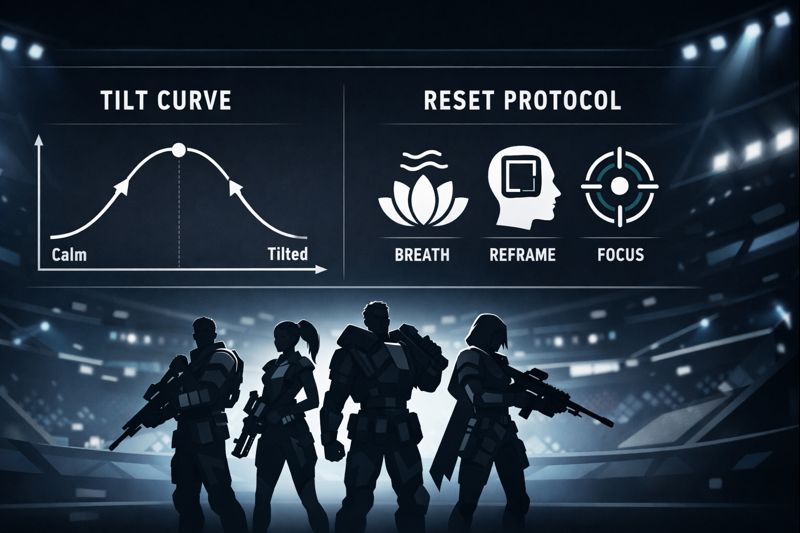
After a loss, your brain will try to tell a story that protects your ego:
- “My teammates were griefing.”
- “Their comp is broken.”
- “Ranked is rigged.”
Sometimes those factors are real. But the story is usually incomplete. A better story is:
“Even if this match was unwinnable, I can still improve my decisions.”
This keeps your agency intact without pretending you control everything.
3) Tilt: Early Warning Signs and Fast Resets
Tilt is not “being angry.” Tilt is decision-making under emotional distortion. It can be anger, frustration, shame, anxiety, or desperation. The earlier you detect it, the easier it is to control.
Early Warning Signs (Know Yours)
Most players notice tilt only after it has already ruined two games. Learn your early signs:
- Body cues: clenched jaw, shallow breathing, tight shoulders, tapping legs, increased heart rate.
- Thought cues: “I have to carry,” “I can’t trust anyone,” “Just one win to fix this.”
- Behavior cues: rushing spawns, skipping warm-up, forcing fights, typing more than calling.
- Attention cues: you stop tracking objective timing and start tracking blame.
Pick two signs that are most common for you. Those become your “alarm system.”
The 20-Second Reset (In-Game)
You cannot always take a long break mid-match. You can take 20 seconds. Use this reset after a bad fight, missed play, or teammate mistake.
- Exhale fully once. Long exhale signals safety to your nervous system.
- Name the emotion in one word: “frustrated,” “nervous,” “angry.”
- Name the next task in one sentence: “Play cover, wait for team, track their ult.”
This works because it moves you from emotion → interpretation → action. You don’t eliminate emotion; you prevent it from driving the next decision.
The 3-Minute Reset (Between Matches)
This is the simplest anti-tilt tool that most players refuse to use because it feels “too slow.” It is slow on purpose.
- Minute 1: stand up, drink water, breathe slowly (4 seconds in, 6–8 seconds out).
- Minute 2: write one sentence: “Next match I will focus on ______.”
- Minute 3: queue only if your body feels calmer than 60 seconds ago.
If minute 3 fails, that is data: you are not mentally ready to play your best. Queueing anyway is a decision—just not a good one.
What Tilt Actually Costs You
Tilt is expensive because it compounds:
- It increases variance: you swing between “hero moments” and “throw moments.”
- It breaks learning: you stop noticing patterns and start chasing emotional relief.
- It damages team synergy: even mild negativity reduces cooperation.
If you want consistency, your mission is to reduce variance—especially emotional variance.
4) The Ranked Routine: Pre-Game, In-Game, Post-Game
Routines are not superstition. Routines are performance insurance. They reduce randomness and help you show up as the same player more often.
Pre-Game: The 10-Minute “Consistency Warm-Up”
You do not need a long warm-up. You need a reliable one. Here is a 10-minute template:
- 2 minutes: posture check (feet grounded, shoulders down) + slow breathing.
- 5 minutes: mechanics warm-up (training range, quick drills, or short unranked).
- 2 minutes: “focus target” selection: one skill for today (examples below).
- 1 minute: set a stop rule (example: “If I feel tilted or lose 2 in a row, I take a 10-minute break.”).
Good focus targets are behaviors you can control:
- “Hold cover longer; stop wide-swinging first.”
- “Track one enemy ultimate and call it.”
- “Use cooldowns with intent; no panic presses.”
- “Play with team; no solo pushes after we lose a player.”
Bad focus targets are outcomes:
- “Win 5 games.”
- “Gain 200 points.”
- “Don’t get bad teammates.”
In-Game: The “Decision Stack”
When pressure rises, your brain wants to do everything at once. Instead, stack decisions in order:
- Survival: don’t die for free; hold cover; retreat on disadvantage.
- Value: contribute damage, utility, space, or peel without forcing.
- Timing: fight with team, not before them.
- Information: track threats (cooldowns/ults), communicate one useful call.
If you follow this stack, you avoid the most common tilt behavior: forcing hero plays that look brave but are mathematically losing.
Post-Game: The 2-Minute Review
Most players either over-review (spiral) or never review (repeat mistakes). The sweet spot is two minutes:
- One win: “What worked that I should repeat?”
- One loss: “What is one adjustment for next match?”
- One note: type it in a simple log (date + focus target + one takeaway).
That’s it. Consistency comes from repetition, not from writing a novel after every loss.
5) Process Goals: The Only Goals That Don’t Break You
Ranked is addictive because it offers immediate feedback. The downside is that the feedback is noisy. A single game can lie to you:
- You can play poorly and win.
- You can play well and lose.
That’s why outcome goals create emotional chaos. Process goals create stability.
Outcome Goals vs Process Goals
Outcome goal: “I must rank up this week.”
Process goal: “For 10 matches, I will play around cover and only take fights with at least one teammate present.”
Outcome goals increase stress and tilt risk because they turn every match into a referendum on your worth. Process goals turn matches into training reps.
The “Two-Layer Goal” System
Use this structure for every ranked session:
- Layer 1 (performance goal): one controllable behavior for the session.
- Layer 2 (emotional goal): one regulation behavior (example: “I will do a 20-second reset after every lost fight.”).
This approach is powerful because it trains both your mechanics and your mind at the same time.
How to Measure Process Goals Without Overthinking
Use “binary scoring.” After each game, answer:
- Did I do my focus behavior more often than usual? (Yes/No)
- Did I reset faster than usual after mistakes? (Yes/No)
Two simple checks keep you honest and prevent perfectionism.
6) Losing Streak Protocol: Stop the Bleed Without Quitting Forever
Losing streaks happen to everyone. The problem is not the streak; it is your response. Most players react in one of two extremes:
- Rage-queueing: “One more until I fix it.”
- Total collapse: “I’m washed; ranked is pointless.”
Consistency requires a middle path: structured recovery.
The 3-Step Losing Streak Protocol
Step 1: Identify the Streak Type
Not all streaks are the same:
- Variance streak: you’re playing normally, but games are messy; results swing.
- Fatigue streak: focus is dropping; you miss simple reads and timings.
- Tilt streak: decision quality is clearly emotional; you force plays.
Your fix depends on the type.
Step 2: Apply the Correct Intervention
- Variance streak: keep playing, but tighten fundamentals (safer positioning, fewer hero plays, more team timing).
- Fatigue streak: take a real break (10–20 minutes), or end the session if you feel foggy.
- Tilt streak: stop queueing until your body calms; do a short reset routine; consider switching to unranked practice.
Step 3: Use a Stop-Loss Rule
Stop-loss rules protect you from your worst self. Examples:
- Loss-based: “After 2 losses, I take a 10-minute break.”
- Emotion-based: “If I type anything negative, I stop ranked for 20 minutes.”
- Time-based: “I play ranked for 90 minutes max, then review and stop.”
Stop-loss rules feel restrictive until you realize they preserve your win-rate by preventing spiral queueing.
“But If I Stop, I’ll Lose Momentum”
This is one of the biggest ranked myths. Momentum is not “playing forever.” Momentum is reliable decision quality. If your decisions are degrading, you are not building momentum—you are spending it.
7) Team Communication Under Pressure (Without Becoming Toxic)
Marvel Rivals is a team-based shooter. That means your mental game includes your ability to influence the team environment. You do not need to be a cheerleader. You need to be useful and steady.
What “Good Comms” Actually Means
Good communication has three qualities:
- Short: one sentence.
- Specific: concrete timing or location cues.
- Actionable: it tells the team what to do next.
Examples of actionable comms:
- “We’re down one—play safe and regroup.”
- “Let’s hold corners and wait for cooldowns.”
- “Focus the same target—don’t chase.”
- “We can re-engage after we stabilize; protect backline.”
Non-actionable comms (avoid):
- “Where is our team?”
- “You’re throwing.”
- “Uninstall.”
- “This is unwinnable.”
The “No Blame” Leadership Trick
If you want to guide a team without triggering defensiveness, use “we” statements:
- Instead of: “You keep feeding.”
- Say: “We’re giving picks—let’s slow down and fight together.”
This reduces ego threat and increases cooperation.
Handling Toxicity Without Getting Dragged In
When someone flames, your options are:
- Ignore: focus on your play and only give objective calls.
- Defuse: one neutral line, then return to tasks.
- Mute: if it affects focus, mute quickly and move on.
Defuse script examples:
- “Let’s reset and focus next fight.”
- “We can still win—group and play cover.”
- “I’m focusing calls only.”
If you argue, you lose twice: you lose focus and you reinforce the team’s negative energy.
8) Confidence That Survives Bad Games
Many ranked players rely on fragile confidence: they feel strong only when they win or pop off. That style of confidence collapses during losing streaks and creates tilt.
Build “Evidence-Based” Confidence
Real confidence is not a feeling. It is a record of behaviors you trust. Build confidence by tracking evidence:
- “I warm up before ranked.”
- “I stop queueing when I tilt.”
- “I review one mistake per match.”
- “I communicate calmly.”
When you do these consistently, your identity becomes: “I’m a disciplined ranked player.” That identity does not disappear after a loss.
Detach Self-Worth From Rank
This is not motivational talk; it is a competitive advantage. If rank equals self-worth, then every match becomes high stakes. High stakes increase stress. Stress reduces performance.
Instead, use this mantra:
“Rank is feedback, not a verdict.”
Feedback can be used. Verdicts create shame. Shame creates tilt.
The Confidence Reset After a Bad Game
After an ugly loss, do this:
- State one thing you did well (even if small): “I regrouped instead of staggering.”
- State one fix: “Next game I will stop peeking without cooldowns.”
- State one identity behavior: “I will do a 3-minute reset before queueing.”
This prevents the “I’m terrible” spiral that ruins entire nights.
9) Mistake Management: How to Recover Mid-Match
Consistency is not “no mistakes.” Consistency is fast recovery. Everyone misplays. The key is what happens next.
The One-Mistake Rule
Give yourself permission to make one mistake. Then enforce a rule:
One mistake → one correction → next play.
No replaying it in your head. No self-insults. No revenge plays. Just correction.
Common “Revenge Play” Patterns (Avoid These)
- Overpeeking: trying to immediately “make up” damage or eliminations.
- Solo re-engage: entering fights early because waiting feels weak.
- Hero panic: swapping repeatedly without learning anything.
- Ult desperation: using big resources to relieve emotion rather than win a real fight.
The Recovery Checklist (In-Match)
After a mistake, quickly run:
- Position: am I in cover or exposed?
- Numbers: are we up/down players?
- Cooldowns: do I have the tools to fight?
- Timing: is my team with me?
If any answer is “bad,” your next play is simple: stabilize. Stabilizing is how you avoid throws.
10) Sleep, Breaks, and Environment: Your Hidden MMR
Players talk about aim trainers and hero pools, but ignore the biggest variable: your body. If your sleep is inconsistent, your focus, reaction time, emotional control, and patience degrade. That becomes missed shots, poor timing, and tilt.
Sleep as a Performance Tool
If you want a single habit that improves ranked performance across every game, it is consistent sleep. You do not need perfection. You need regularity.
- Keep a stable sleep/wake time when possible.
- Avoid queueing ranked when you are already exhausted.
- Use a wind-down routine after intense sessions.
For practical sleep hygiene guidance, you can reference public health resources like the NHS sleep tips page: Sleep tips (NHS).
Breaks Prevent Emotional Fatigue
Ranked drains attention. The longer you play, the more likely you become impulsive. Use micro-breaks:
- Every 1–2 matches: stand up, drink water, look away from the screen.
- After a stressful match: 3-minute reset before queueing again.
- After tilt signals: take a real break or end ranked.
Stress Tools That Transfer to Ranked
Stress management is not “soft.” It is competitive. If you want general, evidence-based stress coping tools, the American Psychological Association provides accessible resources: APA stress tips.
Optimize Your Setup for Calm
Small environment changes reduce mental friction:
- Lower distracting noise (or use consistent background sound).
- Reduce clutter in your play space.
- Keep water nearby.
- Disable unnecessary notifications during ranked.
Calm environments don’t make you a better player by themselves. They make it easier to execute your systems.
11) Review Loop: How to Improve Without Obsessing
Most players either do zero review or do so much review that ranked becomes stressful. The right approach is structured and light.
The 80/20 Review Rule
You will get most improvement from reviewing:
- Positioning errors (dying first, peeking angles, being isolated).
- Timing errors (fighting alone, staggering, re-engaging too early).
- Resource errors (cooldowns/ultimates used without purpose).
You do not need to analyze every fight. Find the pattern that repeats.
Two Review Methods (Pick One)
Method A: 30-Second Clip Review
After a loss, find one moment where everything went wrong. Ask:
- Where was I positioned relative to cover and team?
- What information did I ignore?
- What would the safer, higher-percentage play be?
Method B: The “Death Log”
For 10 games, track only deaths:
- Why did I die? (overpeek, isolated, cooldown misuse, tunnel vision)
- What is one prevention rule? (“No re-peek without cooldown,” “No solo pushes after a lost fight.”)
This method is effective because deaths are the most consistent performance leak in ranked shooters.
Hero Pool Consistency
For mental stability, keep your ranked hero pool small enough that you feel competent even on bad days. When your hero pool is too wide:
- You doubt your choices.
- You swap out of emotion.
- You never build deep confidence.
A timeless approach is to focus on a core pool plus one comfort fallback. Expand slowly, not during tilted sessions.
12) A Simple 30-Day Consistency Plan
If you want results, you need a plan that is realistic. Here is a 30-day structure that improves consistency without burning you out.
Week 1: Stabilize
- Use a 10-minute warm-up before ranked.
- Use a stop-loss rule (2 losses → break).
- Choose one focus behavior (cover discipline, team timing, or cooldown intent).
Week 2: Reduce Variance
- Add the 20-second in-game reset after lost fights.
- Track one repeated mistake pattern.
- Keep your hero pool consistent across sessions.
Week 3: Add Team Influence
- Make one useful call per fight cycle (not constant chatter).
- Practice “we” language and neutral resets.
- Mute quickly if needed to protect focus.
Week 4: Consolidate and Measure
- Review 3 short clips total for the week (not daily deep dives).
- Score your process goals (Yes/No) after each match.
- Adjust the plan based on what actually improved your sessions.
This plan works because it builds identity: you become the kind of player who prepares, regulates, and reviews—regardless of short-term rank fluctuations.
13) Checklists You Can Copy
Pre-Ranked (10 Minutes)
- Drink water
- 2 minutes slow breathing + posture reset
- 5 minutes warm-up drills
- Choose 1 performance focus target
- Choose 1 emotional focus target
- Set stop-loss rule for the session
During the Match
- After a lost fight: 20-second reset (exhale → name emotion → name task)
- Decision stack: survival → value → timing → information
- One actionable comm, not blame
Between Matches (3 Minutes)
- Stand up, hydrate
- Write 1 line: “Next match I will focus on ______”
- Queue only if calmer than 60 seconds ago
Post-Session (5 Minutes)
- Write 1 improvement note
- Save 1 short clip to review later (optional)
- End deliberately; don’t chase emotional closure
14) FAQ
How do I stop caring so much about ranked?
You don’t need to stop caring. You need to stop letting rank define your worth. Replace outcome obsession with process goals, and your emotional swings reduce dramatically.
What if my teammates are actually the problem?
Sometimes they are. That does not change your best strategy: protect your decision quality, communicate calmly, and extract one controllable lesson. Team variance is built into ranked systems; consistency is how you outperform variance over time.
Should I stop playing after one bad loss?
Not necessarily. Use your tilt alarm system. If your body and decisions are stable, keep playing. If you are forcing plays or feeling emotionally flooded, take a short break. The goal is not to avoid losses—it is to avoid spirals.
How many ranked games per day is optimal?
There is no universal number. The right number is the amount you can play while maintaining focus and emotional control. Many players perform best in short, deliberate blocks (for example, 60–90 minutes) rather than long marathons.
Where can I find official Marvel Rivals updates?
Use the official Marvel Rivals website and news pages for current rules, events, and patch notes: marvelrivals.com. For broader official Marvel coverage, see: Marvel.com (Marvel Rivals).
15) Next Steps
If your goal is to climb in Marvel Rivals ranked, the fastest path is to treat your mental game as a skill with systems—just like mechanics. Use one routine, one focus target, and one review note. Protect your decision quality. Over weeks, that consistency compounds into rank gains.
If you want structured help with ranked progress—whether you’re aiming for a specific tier, trying to break a plateau, or simply want a smoother climb—you can review Boosteria’s Marvel Rivals options here: Marvel Rivals boosting prices.