



How to Analyze LoL Replays for Faster Rank Climb
How to Analyze Your Replays in LoL 2026: Step-by-Step VOD Review for Faster Rank Climbing
Climbing in LoL isn’t just about mechanics, reflexes, or playing more games. The real difference between hardstuck players and consistent climbers often comes down to one powerful habit: structured replay analysis.
If you’ve ever felt like you’re “doing everything right” but still not gaining LP, this guide will show you how to break that plateau. In this timeless, patch-proof VOD review framework, you’ll learn how to analyze your replays step by step, identify recurring mistakes, optimize decision-making, and accelerate your rank progress.
This guide is designed to stay relevant for years because it focuses on core decision-making principles rather than patch-specific meta shifts. Whether you’re Bronze or Master, the fundamentals of VOD review remain the same.
Table of Contents
- 1. Why Replay Analysis Is the Fastest Way to Climb
- 2. Preparing for Effective VOD Review
- 3. The 5-Phase Replay Review Framework
- 4. Early Game Analysis (0–14 Minutes)
- 5. Mid Game Macro Breakdown
- 6. Late Game Decision Evaluation
- 7. Objective Control and Vision Review
- 8. Identifying Mechanical vs Decision Errors
- 9. Role-Specific Review Checklists
- 10. Tracking Patterns and Building an Improvement Plan
- 11. Using External Tools for Advanced Insights
- 12. Common Replay Review Mistakes
- 13. Weekly Improvement Structure
- 14. When to Consider Coaching or Rank Assistance
- 15. Final Thoughts: Turning Knowledge into LP
1. Why Replay Analysis Is the Fastest Way to Climb
Most players improve slowly because they rely on repetition alone. Playing 200 games with the same mistakes will only reinforce bad habits.
Replay analysis does three things:
- Turns vague frustration into measurable problems
- Reveals hidden macro mistakes
- Builds intentional improvement
Professional players and coaches across the esports scene, including insights shared on platforms like LoL Esports, consistently emphasize review sessions as a core growth tool.
If you treat every replay like free coaching, you’ll gain more from 3 games reviewed than from 15 played blindly.
2. Preparing for Effective VOD Review
Before opening your replay, prepare correctly:
- Choose a close loss or a confusing win
- Wait 10–15 minutes after the game to reduce emotional bias
- Open a notepad or improvement journal
- Have a clear goal (macro, laning, jungle tracking, etc.)
Never review when tilted. Emotional review leads to blame-based analysis instead of solution-based learning.
3. The 5-Phase Replay Review Framework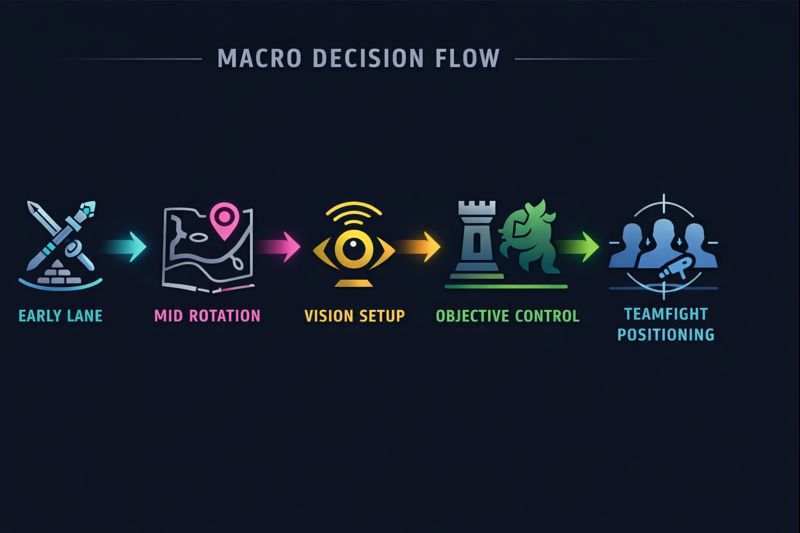
This timeless system works for every patch and every role.
Phase 1: First 5 Minutes – Setup and Intent
- Did you leash optimally?
- Did you control the first wave correctly?
- Was your ward placed with purpose?
- Did you track enemy jungle start?
Phase 2: First Death Analysis
Pause immediately at your first death and ask:
- Was this avoidable?
- What information did I ignore?
- Did I respect vision and cooldowns?
Phase 3: Gold & XP Efficiency
- Were there missed waves?
- Did you recall at inefficient timings?
- Did you roam at bad tempo moments?
Phase 4: Objective Decisions
- Was dragon/herald contest correct?
- Did you group too early?
- Were you farming while fight was winnable?
Phase 5: Game-Ending Moments
- Why did the final fight happen?
- Was your positioning optimal?
- Did you track enemy summoners?
4. Early Game Analysis (0–14 Minutes)
The early game defines tempo.
Laning Review Questions
- Did you trade around cooldown windows?
- Did you respect jungle pathing?
- Was your wave management intentional?
Wave control errors are among the most common reasons players get stuck. Reviewing slow push setups and freeze opportunities can dramatically improve consistency.
Resources like U.GG can help compare optimal builds and early pathing trends.
5. Mid Game Macro Breakdown
Mid game is where most LP is lost.
Ask yourself:
- Did I rotate correctly after tower falls?
- Was I pushing side lane without vision?
- Did I overgroup and lose farm?
Macro errors compound over time. A single bad side-lane death can flip tempo entirely.
6. Late Game Decision Evaluation
Late game review focuses on discipline.
- Did you face-check?
- Was your positioning aligned with your role?
- Did you peel or dive correctly?
Many players lose games not because of mechanics, but because of impatience.
7. Objective Control and Vision Review
Vision wins games.
- Did you place wards before objectives?
- Did you clear enemy vision?
- Were you contesting without setup?
Reviewing vision mistakes alone can add consistency to your climb.
8. Identifying Mechanical vs Decision Errors
Separate mistakes into two categories:
- Mechanical: missed skillshots, slow reactions
- Decision-based: wrong rotation, bad recall timing
Decision errors are usually more impactful long-term.
9. Role-Specific Review Checklists
Top Lane
- Wave crash timing
- Teleport usage
- Side lane discipline
Jungle
- Path efficiency
- Objective sequencing
- Countergank awareness
Mid
- Roam timing
- Lane priority control
ADC
- Teamfight spacing
- CS per minute
Support
- Vision setup timing
- Roam impact
10. Tracking Patterns and Building an Improvement Plan
After 5–10 reviews, patterns will emerge:
- Dying to ganks without vision
- Overstaying after kills
- Grouping too early
Create a 1–2 focus rule per week. Example:
“This week I will only fix my recall timing.”
11. Using External Tools for Advanced Insights
Advanced tools help quantify performance:
- OP.GG for performance tracking
- Damage graphs and gold graphs in client
Data supports objective improvement.
12. Common Replay Review Mistakes
- Watching entire game without pausing
- Blaming teammates
- Reviewing only losses
- Not writing notes
13. Weekly Improvement Structure
Example weekly system:
- Play 6–10 ranked games
- Review 3 of them deeply
- Focus on one improvement theme
- Re-evaluate after 7 days
14. When to Consider Coaching or Rank Assistance
If you’ve applied structured replay review for several weeks but feel plateaued, outside perspective helps.
Professional boosting and coaching services like Elo Boost Services can accelerate learning through expert-level play insights and practical examples.
Studying how higher-ranked players approach tempo and macro can clarify blind spots in your own decision-making.
15. Final Thoughts: Turning Knowledge into LP
Replay analysis isn’t glamorous. It’s slow, analytical, and sometimes uncomfortable. But it’s the single most consistent method for improving in LoL.
The players who climb aren’t always the most mechanically gifted — they’re the ones who correct mistakes faster than others.
If you apply this structured VOD review system consistently, you’ll:
- Reduce repeat deaths
- Improve macro consistency
- Make cleaner objective decisions
- Climb with confidence
Every replay is free coaching. Use it.