



Anti-Eco Guide in Valorant 2026: Punish Full Saves
Anti-Eco Guide in Valorant 2026: Punishing Full Save Rounds
Winning pistol rounds feels great. Winning the round after pistol is what makes the pistol round matter.
That is the core truth behind anti-eco play in Valorant. A huge number of games swing not because one team cannot win full-buy rounds, but because they fail to convert the “should-win” rounds that come immediately after an economic advantage. Teams win a clean pistol, then hand away momentum to sheriffs, classics, short-range stacks, a lurk through smoke, or one sloppy overpeek. The scoreboard says it was only one round. In reality, it often changes the entire flow of the half.
If you want to climb consistently, anti-eco rounds must stop feeling automatic and start feeling professional. These rounds are not “free.” They are controlled rounds. Your job is to remove randomness, deny the enemy their upset conditions, and turn your economy lead into map control, site access, favorable duels, and stable conversion.
This guide is built to stay evergreen. Weapon prices, patch details, and map rotations may change over time, but the fundamental principles of anti-eco Valorant remain the same: force bad ranges, protect your rifles, trade everything, clear traps patiently, and never give desperate opponents the exact kind of fight they want. Riot’s official VALORANT page and Beginner’s Guide continue to reinforce the game’s economy-and-utility foundation, and that foundation is exactly what anti-eco mastery is built on.
If you are serious about improving your ranked consistency and turning more advantages into wins, learning how to punish save rounds is one of the best places to start. And if you want faster improvement in your overall climb, you can also check Valorant-specific options here: Valorant boosting prices.
Table of Contents
- What Is an Anti-Eco Round?
- Why Teams Lose Anti-Eco Rounds
- Core Principles of Good Anti-Eco Play
- Buy Phase Decisions and Loadouts
- Spacing, Trading, and Crosshair Discipline
- How to Use Utility Properly Against Full Saves
- Attacking Anti-Eco Fundamentals
- Defending Anti-Eco Fundamentals
- Role-by-Role Anti-Eco Responsibilities
- Mid-Round Adjustments and Recovery
- Post-Plant Structure Against Eco Retakes
- Most Common Anti-Eco Mistakes
- How to Practice Anti-Eco Execution
- Solo Queue Communication Tips
- Sample Anti-Eco Round Plans
- Final Thoughts
What Is an Anti-Eco Round?
An anti-eco round is a round where your team has a strong economic equipment advantage while the enemy is on a full save or extremely light buy. Usually that means your team has rifles, armor, and some utility while the enemy has pistols, limited shields, minimal abilities, or maybe one stolen or saved gun from a prior round.
These rounds happen in several common situations:
- After winning pistol, when the losing team saves.
- After breaking the enemy economy and forcing them to reset.
- After the enemy prioritizes a weak buy to preserve future full buys.
- After a bonus transition where one team still has mixed lower-value weapons.
The key point is simple: an anti-eco is not only about having better weapons. It is about recognizing what the weaker team needs in order to steal the round. Eco teams usually need one or more of the following:
- Short-range fights.
- Isolated 1v1s.
- A free weapon pickup.
- A gamble stack that catches you unprepared.
- Chaos inside smokes or tight corridors.
- Overaggression from the favored side.
- A timing where your team splits apart and loses trade potential.
So anti-eco play is really the art of denying those upset conditions. You do not need to make the round fancy. You need to make it clean.
Why Teams Lose Anti-Eco Rounds
Most anti-eco losses come from psychology, not mechanics. When players see pistols across the server, they relax. They want clips. They want fast kills. They want to farm confidence. They stop respecting timing, stop using utility, and stop moving as a connected unit.
That is exactly what a weaker buy wants. A full-save team knows it is disadvantaged in a slow, organized, long-range round. Their best chance is to bait impatience. If you push an angle alone, swing without support, or run into a close stack with a rifle out and no flash, you are giving them the kind of round they were hoping for.
Here are the most common reasons anti-eco rounds get thrown:
1. Greedy range selection
Players with superior weapons willingly enter tight corners, close cubbies, shotgun-like ranges, or multi-contact choke points. That removes the value of their weapon advantage.
2. Broken spacing
One player entries too far ahead, the second is not close enough to trade, and the eco player converts a free kill into a gun pickup. Suddenly the round is live.
3. No utility investment
Teams think, “It’s just pistols, we don’t need util.” But one flash, recon tool, molly, slow, stun, or drone often prevents the exact stack or contact trap that steals the round.
4. Dry peeking stacked zones
Eco teams love hiding two or three players in one cheap, high-payoff area. If your team dry walks into that location without any info tools, you are playing into their highest-value setup.
5. Poor post-plant discipline
Even after securing site, players hunt kills instead of locking crossfires. Pistols thrive when rifle teams offer isolated retake duels.
6. Overrotation on defense
Defenders sometimes assume an eco team will rush and overcommit too many bodies early. This opens space for lurks, site pivots, or surprise hits onto the weaker side.
7. Refusing to adapt after first contact
If the enemy shows a four-man stack or heavy close pressure in one zone, that is information. Strong teams adjust. Weak teams keep forcing the same bad fight because they feel entitled to win it.
Understanding these patterns already makes you safer. But to consistently punish full saves, you need a repeatable system.
Core Principles of Good Anti-Eco Play
Respect the round
The first rule is emotional discipline. Stop calling anti-eco rounds “free rounds.” That phrase creates lazy habits. Instead, think of them as “conversion rounds.” Your objective is not entertainment. Your objective is conversion.
Preserve range advantage
Rifles beat pistols most reliably when you keep fights at medium to long range, take clean first bullets, and avoid funneling into stacked close corners without preparation. Anti-eco players must be range-aware at all times.
Trade every contact
One eco kill should almost always be answered instantly. That means you do not spread so far apart that teammates cannot punish the first shooter. Tight but not clumped spacing is ideal. You want enough distance to avoid multi-kill spray transfers, but close enough to convert every duel.
Spend enough utility to remove randomness
You do not need to dump everything, but you should absolutely spend useful utility on the highest-risk areas. Utility is not wasted if it prevents the one scenario that throws the round.
Protect dropped weapons
The fastest way to lose control of an anti-eco is to donate a rifle and fail to recover it. If a teammate dies first, the next decisions are immediate: trade the killer, secure the gun, and reset spacing before continuing.
Play percentage Valorant
Let the weaker buy be the side that has to gamble. Let them guess. Let them stack. Let them get impatient. The stronger team should be the predictable one in structure, but the unpredictable one in timing and final commitment.
Buy Phase Decisions and Loadouts
Good anti-eco rounds start in buy phase. A lot of teams throw before the barrier drops because their loadout logic is bad.
Do not sabotage your next full buy
The ideal anti-eco buy is one that gives you a strong conversion chance without compromising your future economy. Exact weapon choices change by patch, comfort, and team plan, but the principle is constant: buy enough to be favored, not so much that losing one round destroys your next two.
In many anti-eco situations, teams lean toward weapons that are strong against pistols while still allowing a stable economic path if something goes wrong. Full rifles are often correct when credits are healthy, but not always mandatory for every player. The important thing is shared understanding. You do not want half the team treating the round like a full anti-rush while the other half soft-buys for “value.”
Armor matters
Against pistols, shield value is often enormous. The enemy wants cheap burst damage and close-range trades. Surviving that first burst dramatically increases your conversion odds.
Prioritize round-winning utility
Some players overfocus on the gun and underbuy utility. Against full saves, key utility often carries more anti-throw value than upgrading one weapon tier. Recon, flash, mollies, slows, smokes, trip protection, and anti-rush stall are all powerful because eco rounds are usually decided in compressed, high-chaos moments.
Have a gun recovery plan
If one player is on a cheaper anti-eco weapon and another is on a premium rifle, know who should carry spike, who should entry first, and who is more likely to survive late round. Anti-eco planning is not only about first contact; it is about maintaining weapon quality if the round gets messy.
Think in team shapes, not individual preferences
A bad anti-eco buy often looks like this: one player wants to farm, one wants to save, one forgets shields, one buys no utility, and one announces a lurk with the best rifle. That is not a plan. That is five separate ideas. Strong teams buy for a round concept.
Spacing, Trading, and Crosshair Discipline
If you remember one section from this guide, make it this one. Anti-eco rounds are won by spacing.
Pistol rounds and eco rounds are dangerous because they create awkward, scrappy engagements. The answer is not to clump five players shoulder-to-shoulder. That can lose to one stacked angle or short-range spam. The answer is controlled spacing: close enough to trade instantly, far enough to avoid giving one enemy a lucky multikill.
Ideal anti-eco spacing
Your second player should be close enough to swing the first contact immediately. Your third player should be positioned to punish a second peek or stabilize after the trade. The farther your team stretches, the more likely the eco team gets one kill, steals a weapon, and escapes into another angle.
Crosshair placement must respect unusual positions
Eco players do not hold every angle the way rifle players do. They sit inside smoke edges, behind default objects, under elevated ledges, in double close corners, or on top of weird off-angles that maximize surprise value. If your crosshair placement is too “normal,” you will miss these trap setups.
Anti-eco crosshair placement should be slightly more paranoid:
- Check close left and close right more deliberately.
- Pre-aim anti-flash and anti-swing positions before entering choke points.
- Expect double stacks in small rooms or cubbies.
- Clear elevations where pistols can get one clean burst before dropping.
Do not over-chase first damage
Many players get tagged lightly by a pistol and immediately swing wider to “finish” the kill. That is a classic anti-eco trap. Eco teams often pair bait contact with a second hidden player waiting for the greedy repeek.
When in doubt, trade calmly, re-clear the space, and recover the area before continuing. A clean 5v4 is still a clean 5v4. There is no need to force a highlight.
How to Use Utility Properly Against Full Saves
The goal of utility in anti-eco rounds is not to create the most explosive execute. It is to remove the highest-value danger zones and force the eco team into less favorable fights.
Clear short-range traps
If an area commonly allows tight contact fights, utility should touch it. Flash the corner. Drone the lane. Dart the room. Molly the cubby. Smoke the cross. Dog the close angle. Slow the push path. Even one correct piece of utility often converts the round from risky to routine.
Force movement before taking duels
Pistols become deadly when they are stationary and hidden. Make them move. When eco players are displaced by utility, they lose timing, crosshair stability, and often their first-bullet accuracy window.
Use utility in layers, not panic dumps
A mistake many teams make is either using no utility or using every piece at once with no follow-up structure. Instead, layer your anti-eco utility with intention:
- Use information or clearing utility to locate or displace likely stacks.
- Use smokes or denial utility to limit swing options.
- Take the first controlled fight.
- Save enough utility to secure plant or deny retake chaos.
Respect the retake utility window
Even full-save teams can become dangerous after the spike goes down because the site geometry often forces closer fights. Keeping a flash, molly, smoke refresh, stun, or info tool for the post-plant can be more valuable than overusing everything on entry.
Riot has long positioned abilities as a system that creates opportunities for gunplay rather than replacing it completely, and anti-eco rounds are a great example of that balance in action. The cleaner your utility timing, the less often you hand pistols an opportunity to flip the round.
Attacking Anti-Eco Fundamentals
On attack, anti-eco rounds are usually about denying defender stacks, entering with trade structure, and planting in a way that keeps the retake long and uncomfortable for pistols.
Default first, commit second
Against a full save, defenders often compensate by stacking one site, pushing one extremity, or tucking multiple players into the most explosive choke on the map. If you instantly five-man sprint into the first site you see, you are playing the round on their terms.
A better approach is often a light default with clear anti-push protocols. Hold for early aggression. Use minimal utility to gather information. Check whether the enemy has overstacked a zone or given away too much space. Then hit the weaker side with connected spacing.
Do not entry alone through narrow chokepoints
Eco defenders love small doors, smoke exits, rope rooms, double boxes, and tight hallways. These spots compress your weapon advantage and increase the value of close pistol bursts. If your duelist or entry player runs through that space alone, the eco team gets exactly the duel type it wants.
Instead:
- Flash before the swing if the space is tight.
- Have the second player ready to trade instantly.
- Use a smoke or molly to cut one side of the close fight.
- Clear common rat spots before planting.
Attack the retake, not just the site
When you choose a site on anti-eco, you should already be thinking about what the retake will look like. The best plants force the enemy to enter from predictable routes at medium range. The worst plants let pistol players flood into cramped post-plant spaces from multiple short angles.
If possible, choose sites and plant spots that let your rifles play crossfires from distance, rather than hiding on site corners where Classics and Sheriffs can equalize the fight.
Be careful with lurks
Lurking is not wrong in anti-eco rounds. But it is much riskier than many players think. A solo lurker can easily die to a random stack, shorty hold, or push timing and donate a premium gun. If you lurk, it should be because your team understands the risk and has a specific reason: catching rotates, holding flank, or punishing overpushes.
Spike security matters
Never let the spike become the first casualty of an anti-eco. If the spike carrier dies in a weird close pocket, the eco team can turn the round into a recovery disaster. Give the spike to someone positioned to survive the first contact, or make sure the entry path is heavily supported.
Defending Anti-Eco Fundamentals
On defense, anti-eco play is about refusing cheap rush losses, avoiding isolated angle greed, and making the attackers cross dangerous sightlines to get value.
Expect fast groups and weird pace changes
Eco attackers often simplify the round. They may group early, rush through one choke, or explode after a short pause. They know a long, standard default usually favors the stronger buy. That means defenders should be especially alert for early contact and layered rush utility.
Do not donate first blood to a dry peek
A common anti-eco mistake on defense is a rifle player swinging out alone for “info” or “one easy kill.” Against pistols, that often becomes a trade disaster. If the attackers are grouped, your lone peek hands them a rifle and momentum.
Defenders should make eco teams come into anchored setups rather than volunteering opening duels without support.
Use stall utility early if the hit is obvious
When you identify a fast eco hit, your utility should aim to break the flood. Smokes, mollies, slows, stuns, and spam pressure are strongest before the eco team fully occupies your close spaces. Once pistols get into site corners, the round becomes much more dangerous.
Retake discipline beats panic re-entry
If the eco team somehow reaches site with numbers, defenders often rush back in one by one because they feel embarrassed about losing ground to pistols. That is when the upset completes itself. Instead, stabilize, wait for teammates, use retake utility, and take range-favored fights together.
Preserve rifles when the round turns ugly
There are times when an anti-eco defense goes wrong quickly. Maybe the attackers flood through a smoke, maybe a stack hits the weaker site, maybe the anchor gets overwhelmed. In those cases, stop making ego plays. Recover as a unit. Save if necessary. Dying alone with a rifle trying to “fix” a lost anti-eco can damage the next two rounds, not just one.
Role-by-Role Anti-Eco Responsibilities
Duelists
Your job is not reckless entry for content. Your job is controlled pressure. Against eco teams, duelists should create space without overcommitting into unsupported close fights. Ask for the flash. Let utility remove one side of the angle. Enter with a teammate right behind you. If you get first contact, either finish with support or fall back to maintain weapon value.
Initiators
Initiators are anti-eco kings when played properly. Your information and clearing utility prevents the most common full-save traps. Against likely stacks, your tools turn dangerous unknowns into manageable, pre-aimed gunfights. Save at least one useful piece for the post-plant or retake layer if possible.
Controllers
Controllers decide where the eco team is allowed to fight. Good smokes can cut off crossfire help, block weird close swings, or force defenders into narrower retake routes. But controllers should not autopilot their normal execute smokes. Anti-eco smokes should specifically reduce short-range volatility and protect weapon recovery routes.
Sentinels
On attack, sentinels should protect the team from desperation flanks and random pushes while helping maintain post-plant order. On defense, they are vital for anti-rush stability. Trap utility, slows, and hold discipline can make a pistol flood feel impossible. Sentinels should be especially careful not to overpeek after their utility gets value. If your setup has already slowed the eco hit, let the enemy walk into the trap completely.
Mid-Round Adjustments and Recovery
Even good anti-eco rounds can get weird. You might lose the opener, hit a stack, or see an unexpected push. What matters is whether your team understands the correct recovery pattern.
If you lose first contact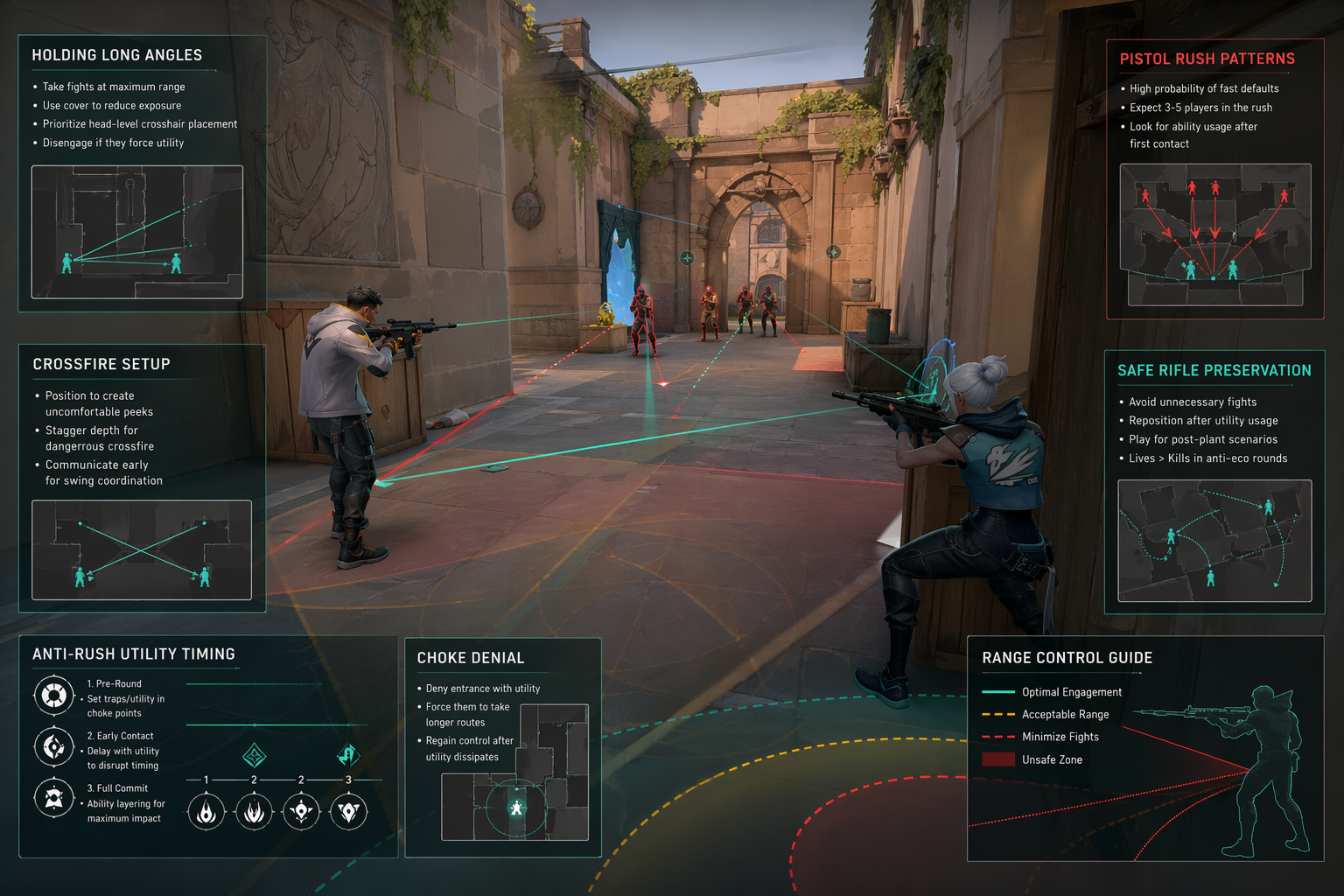
Immediately trade if possible. If the killer escapes, secure the dropped weapon area before making the next aggressive move. The worst response to losing first contact is emotional overflooding: three players swinging into a mess trying to instantly erase the mistake. Calm recovery is usually stronger than revenge swinging.
If you discover a heavy stack
This is one of the biggest anti-eco edges in the game. If your info utility or first clear reveals a stacked zone and you do not lose a player, you should strongly consider pivoting or reshaping the hit. A full-save team that stacks correctly has already spent part of its round win condition. Do not reward it by continuing into the trap anyway.
If the enemy gets a rifle
Mentally the round changes immediately. It is no longer rifle team versus pistols only. It is now mixed-weapon chaos, and you must treat the recovered rifle as a real threat. Re-clear likely off-angles, avoid ego swings, and communicate exactly who picked up the weapon if known.
If the round slows down too much
Sometimes anti-eco teams get so paranoid that they freeze. While patience is good, complete inactivity can also help eco teams because it lets them reshuffle stacks, re-clear space, and mentally reset. The answer is purposeful pacing: clear one layer, hold for aggression, take the next layer, then finish with utility-backed commitment.
Post-Plant Structure Against Eco Retakes
Many anti-eco throws happen after the spike is planted. Teams think the hard part is over. In reality, the post-plant is often where pistols get their best chance, because site terrain can compress fights and encourage overpeeking.
Play crossfires, not solo hero positions
The best anti-eco post-plants are boring. One player holds contact. Another holds the swing off that contact. A third watches a second lane. Utility covers the defuse or forces movement. Nobody wide-swings alone because they “hear one.”
Favor distance when possible
If you can play from safer medium-range positions that still pressure the spike, do it. Do not voluntarily sit in cramped corners just because the site is already yours. A planted spike is an advantage. Use it to pull pistols into your rifle angles.
Do not chase exits unless the round is truly dead
Anti-eco players often go hunting when they think the retake is over. But eco teams are at their most dangerous when they have nothing to lose and know rifles are chasing. Stay connected. Let the spike force the enemy’s timing.
Use utility late, not only early
A single late molly, smoke refresh, flash timing, recon pulse, or alarm utility can collapse the retake. This is why dumping everything on entry is not always optimal. The later your utility lands, the harder it is for a cheap-buy team to improvise around it.
Most Common Anti-Eco Mistakes
“We have better guns, just fight”
This mindset ignores map geometry. Not all fights are equal. A rifle in a tight corner versus two Classics at point-blank range is not the same advantage as a rifle holding a long lane.
Overconfidence after pistol
One of the most repeated mistakes in ranked is winning pistol, buying up, then sprinting through the next round with no structure because the team feels invincible. This is how momentum disappears.
Not expecting weird positions
Eco players use strange off-angles because strange off-angles increase variance. If you only clear textbook positions, you are helping them.
Unnecessary hero lurks
Lurking can be good, but many players use it as an excuse to avoid structure. On anti-eco, every isolated death carries extra punishment because of weapon recovery.
No dropped-gun discipline
If a rifle hits the floor, that spot becomes the center of the round. You either secure it or the enemy’s odds spike instantly.
Greedy reloads and knife moments
Never assume the area is clear because you got one kill. Anti-eco rounds punish lazy reloads, bad weapon swaps, and players who think the round is already won.
Forgetting the spike timer advantage
Once the spike is down, you often do not need another duel at all. Let time force the desperation peek.
How to Practice Anti-Eco Execution
Anti-eco skill is trainable. It is not just “game sense.” You can build it deliberately.
Review lost conversion rounds
After your matches, look specifically for rounds where your team had a buy advantage and still lost. Ask:
- Who took the first unsupported duel?
- Did we use any utility to clear the dangerous area?
- Was our spacing tradeable?
- Did we donate a rifle?
- Did we continue into a known stack?
- Did post-plant positioning become too close?
Create team rules
Even in duo or stack play, a few shared anti-eco rules go a long way:
- No solo dry peeks in the first 20 seconds.
- Always flash or clear the most dangerous choke.
- Always have second player in trade range.
- If we spot a heavy stack, we pivot unless the site is already won.
- Save at least one useful post-plant utility piece when possible.
Practice with intention in ranked
You do not need custom drills for everything. Pick one focus each session:
- One day, focus only on spacing.
- Another day, focus only on dropped-gun recovery.
- Another day, focus only on clearing close corners with utility.
Small repeated focus points build stronger anti-eco instincts than vague “play smarter” goals.
Watch how strong teams reduce variance
When you watch high-level Valorant, do not just admire aim. Study how disciplined teams look in advantage rounds. Notice how rarely they gift pistols clean 1v1s, how often the second player is ready to trade, and how frequently utility is used not for flashiness but for certainty.
Riot’s official ecosystem and update cadence constantly reinforce the importance of strategic adaptation in competitive play, but some of the most stable improvement gains still come from mastering fundamentals like round conversion, economy leverage, and utility discipline rather than chasing highlight-only habits.
Solo Queue Communication Tips
Anti-eco rounds are often lost because nobody says the obvious thing. In solo queue, a few short comms can massively improve conversion:
- “Don’t give them close fights.”
- “Trade me, don’t bait too far.”
- “They might stack this.”
- “Use util for close right.”
- “If we see three here, pivot.”
- “Protect the dropped gun.”
- “Play post, don’t hunt.”
These comms work because they are simple, actionable, and tied directly to the anti-eco win condition. You are not trying to lecture teammates. You are trying to anchor the round around one or two important behaviors.
Sample Anti-Eco Round Plans
Sample Attack Plan: Default Into Safe Site Hit
Objective: Avoid stacked choke rush disaster and force a predictable post-plant.
- Start 3-1-1 or 2-1-2 with clear anti-push coverage.
- Use one info tool toward the most dangerous early stack area.
- Hold for aggression for a few seconds instead of instantly bursting.
- If no pressure appears, group toward the weaker side of the map.
- Flash or clear the closest trap corner before entry.
- Enter with tight two-man trade spacing.
- Plant for long or safer post-plant angles.
- Keep at least one utility piece to deny defuse or break retake timing.
Sample Attack Plan: Punish a Stack, Then Pivot
Objective: Use enemy greed against them.
- Probe one high-risk site with info utility.
- If multiple defenders are confirmed and no one dies, stop committing.
- Leave one player to watch the stack’s push potential.
- Rotate with discipline, not sprint panic.
- Hit the opposite site with utility already planned for close corners.
- Plant fast and set distant crossfires before the stack can recover.
Sample Defense Plan: Anti-Rush Anchor Setup
Objective: Deny grouped pistol flood onto site.
- Anchors hold safer first angles, not isolated greed peeks.
- First sign of contact triggers stall utility immediately.
- Second defender plays ready-to-trade rather than overhelping too early.
- Rotators stop at safe points until the hit direction is confirmed.
- Once the rush is slowed, defenders retake map space together.
- If site is lost, regroup before retaking instead of trickling in.
Sample Defense Plan: Punish Mid-Round Eco Creep
Objective: Farm information without giving away a rifle.
- Use sentinel or passive info tools to identify map spread.
- Hold crossfires where attackers must clear at range.
- Do not dry swing extremities without support.
- When contact starts, let the eco team enter uncomfortable space before collapsing together.
- Prioritize weapon recovery and refrag paths over flashy chase kills.
Advanced Concepts for Players Who Want More Consistency
Tempo manipulation
A good anti-eco team can play both slowly and quickly, but never randomly. Going slow is useful when you want to reveal stacks, catch pushes, or drain defender patience. Going fast is useful when you have already found weakness and want to deny the eco team time to regroup. The mistake is changing pace emotionally rather than informationally.
Information asymmetry
Eco teams are strongest when they surprise you. If your team gathers information more reliably than you give it away, the round becomes much easier. This means watching flanks, respecting pushes, and not exposing your full commitment too early unless the round plan demands it.
Economic layering
Think beyond the current round. Anti-eco mastery improves full-half outcomes because successful conversions allow cleaner bonus setups, more stable rifle rounds, and less forced scrambling later. One disciplined anti-eco often creates momentum for three rounds, not one.
Weapon preservation as a hidden win condition
Even when you win the round, taking unnecessary losses can weaken your next phase. Great anti-eco teams do not just win; they win cleanly. That means fewer rebuys, stronger bonus potential, and more pressure on the enemy’s recovery economy.
Map geometry awareness
Every map has eco-favored spaces: narrow doors, under-cleared cubbies, short vertical transitions, smoke exits, and stacked close paths. Learn those spaces on every map in the pool. Ask yourself: “If I had only pistols, where would I want to fight?” Then clear those places first.
Anti-Eco Mindset Checklist
Before the barrier drops, run this mental checklist:
- What fights do they want?
- How do we deny short range?
- Who is first in, and who is trading?
- Which corner absolutely needs utility?
- What happens if we lose first contact?
- Where do we want the post-plant to be played from?
- How do we stop a rifle pickup?
If your team can answer those questions consistently, your anti-eco success rate will rise fast.
Final Thoughts
Anti-eco rounds decide more games than many players realize. Not because they are glamorous, but because they are structural. They sit at the crossroads of economy, momentum, confidence, and scoreboard pressure. Throw one and the enemy breathes again. Convert one cleanly and the entire match often feels easier.
The strongest anti-eco teams are not the ones that run over pistols with ego. They are the ones that understand what eco players are trying to achieve and refuse to offer it. They keep range. They trade instantly. They clear dangerous pockets with utility. They respect stacks. They secure dropped guns. They plant for disciplined post-plants. They let desperation belong to the other side.
If you want to become a more reliable Valorant player in ranked, tournament play, scrims, or duo queue, mastering anti-eco rounds is one of the highest-return improvements you can make. It is not the flashiest skill in the game, but it is one of the most profitable. Clean conversions create stable economies, easier mid-halves, stronger confidence, and better closing power.
So the next time your team wins pistol or breaks the enemy money, do not relax. Tighten up. That is the round where disciplined players separate themselves from highlight-chasers.
Win the easy-looking rounds properly, and many hard matches stop feeling so hard.