



How to Play Support in Dota 2: Early and Late Game Guide
How to Play Support in Dota 2 2026: Early Game Setup and Late Game Impact
Support is one of the most misunderstood roles in Dota 2. Many players reduce it to buying wards, sacrificing farm, and hoping their cores carry the game. In reality, support is the role that holds the structure of a match together. A strong support determines how the lane starts, how safe the map feels, how efficiently the team moves, and how cleanly fights are taken. A weak support leaves cores isolated, objectives uncontested, and teamfights disorganized.
If you want to win more consistently in Dota 2, learning support is one of the best long-term investments you can make. It teaches map awareness, timing, resource discipline, and decision-making under pressure. It also gives you influence at every stage of the game. In the first minutes, you shape lane equilibrium, secure vision, protect runes, and create kill pressure. In the mid game, you become the bridge between lanes, objectives, and team movement. In the late game, your positioning, saves, disables, and vision often decide whether a fight is won or instantly lost.
This guide is designed to stay useful for a long time. Instead of focusing on patch-specific gimmicks or temporary hero trends, it explains the timeless structure of good support play: how to set up the early game, how to move across the map with purpose, how to stay relevant without taking too much farm, and how to create major late game impact even if your net worth is modest. If you understand these principles, you will remain effective even when heroes, items, and numbers change.
For players who also want to study live data and trends, it is worth checking resources like Dotabuff, STRATZ, Liquipedia, and Valve’s official Dota 2 updates page. And if you are looking for help climbing or improving faster, Boosteria’s Dota 2 boosting prices page is the most relevant service link for this topic.
Table of Contents
- Why Support Matters More Than Most Players Think
- Understanding Position 4 and Position 5
- Pregame Planning and Draft Mindset
- Early Game Setup: The First Minutes That Shape the Lane
- Lane Control, Trading, Pulling, and Equilibrium
- Vision, Dewarding, and Information Control
- How to Play the First 10 Minutes Efficiently
- When to Rotate and When to Stay
- Mid Game Responsibilities and Map Flow
- How Supports Farm Without Hurting Their Team
- Itemization Principles for Every Support Player
- Late Game Impact: Positioning, Saves, and Fight Control
- Playing Around Objectives and Buybacks
- Communication and Team Coordination
- Common Support Mistakes That Lose Games
- Final Thoughts
Why Support Matters More Than Most Players Think
Dota 2 is not only a game of mechanics. It is a game of access. Which team has access to safe farm? Which team has access to vision? Which team has access to the next objective first? Which team is allowed to move on the map without fear? Supports are the players who create or deny that access.
A carry may finish the scoreboard with the most damage, but often that damage only exists because a support protected the first few waves, secured key regeneration, blocked a camp, broke enemy vision, or rotated at the exact moment the lane was about to collapse. In many matches, the carry does not “win alone.” The support builds the conditions that let the carry become powerful without falling behind.
The same applies later in the game. A single defensive ward can reveal a smoke wrap. One sentry can remove the enemy’s confidence. One properly timed save can turn a lost fight into a turnaround. One support hiding in the right tree line can begin the fight on favorable terms. These moments are rarely flashy in the post-game summary, but they are often match-winning.
This is why support is not a “poor role.” It is a leverage role. You usually do not need the most gold to have huge impact. You need timing, discipline, map reading, and the ability to think one step ahead.
Understanding Position 4 and Position 5
Before going deeper, it helps to separate support into its two common structures: position 4 and position 5. They are both supports, but they usually solve different problems.
Position 5 is the harder support in terms of economy. This hero usually protects the safelane carry early, buys a larger share of utility, and accepts lower farm priority. Position 5 heroes often provide lane security, reliable disables, healing, saves, defensive teamfight spells, or strong vision utility. Their game is built around enabling others while staying useful with minimal resources.
Position 4 is the more active, tempo-oriented support. This hero often starts in the offlane, applies pressure, contests pulls, rotates earlier, and can scale a bit more with items. Position 4 heroes often offer initiation, burst damage, catch, mobility, or skirmish impact. They still support the team, but they are usually allowed to take more dangerous farm and become a playmaker earlier.
The exact boundaries can blur depending on draft. Some heroes can play either role. Some lanes force the position 4 to babysit longer, while some games free the position 5 to move early. Still, the principle remains simple: one support is usually more economy-starved and defensive, while the other is usually more active and greedy. Good support players understand not just their hero, but their role in the team’s resource structure.
Pregame Planning and Draft Mindset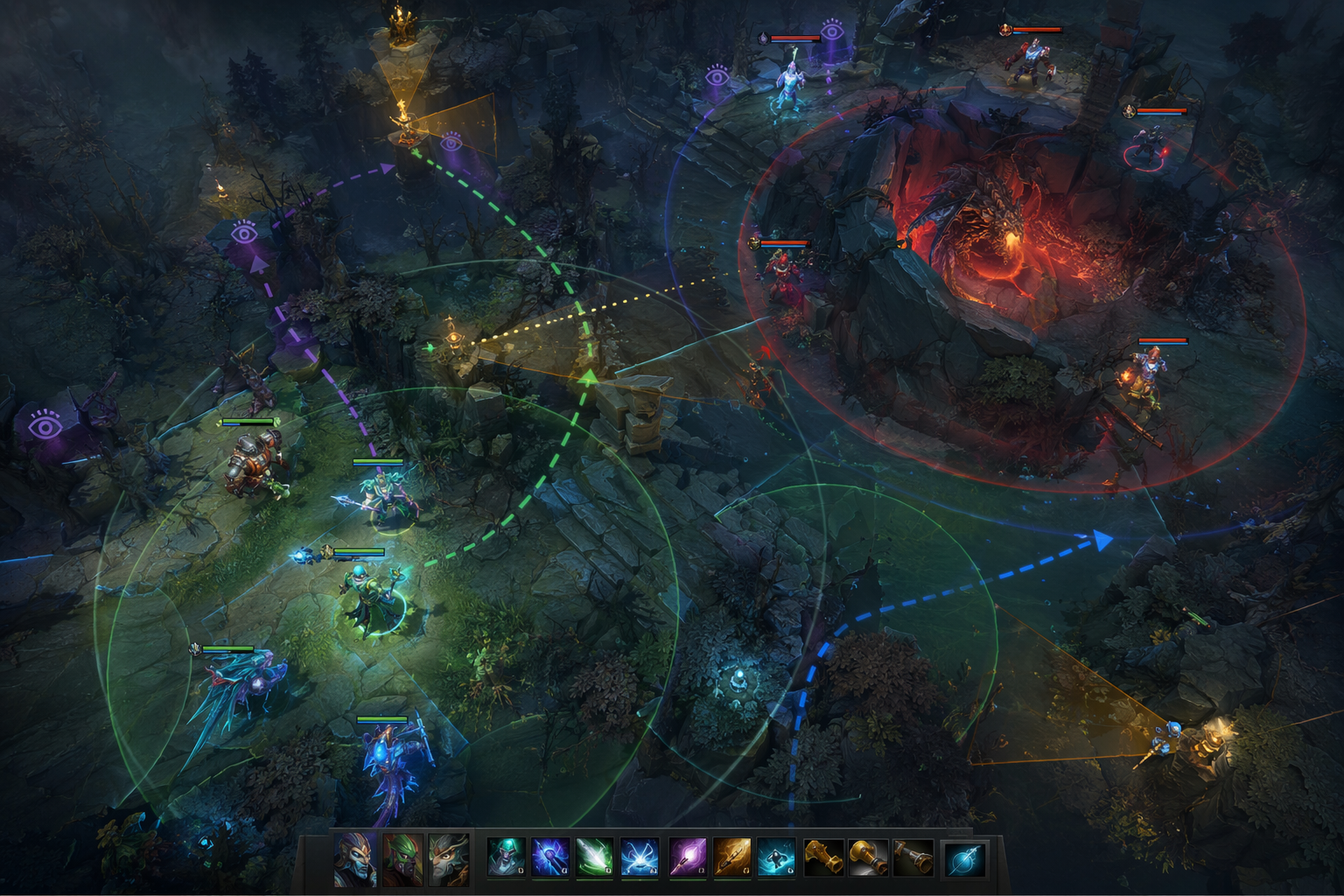
Support play starts before the horn. The best support players do not load in and improvise everything after creeps spawn. They already have a rough picture of the lane, the dangerous timings, and the main problems their team must solve.
Ask yourself several questions during the draft and loading screen:
- Which lane is likely to be volatile, and which lane is likely to be stable?
- Does my lane want to trade constantly, or mostly survive and secure farm?
- Which enemy hero is easiest to punish early?
- Which enemy hero becomes too dangerous if left unchecked?
- Do I need to protect a greedy core, or can I leave lane early?
- Will my job later be initiation, save, counter-initiation, vision, or utility?
This type of planning changes how you buy starting items, where you ward, and whether you should fight level one. For example, some lanes want extra regeneration and early spell trades. Others need sentry control and camp manipulation. Some supports must preserve health for repeated skirmishes, while others need mana efficiency so their threat remains constant. There is no universal starting build that fits every lane.
Your mindset should also be realistic. Not every support lane is meant to crush. Sometimes “winning lane” simply means preventing disaster. If your carry has a weak early matchup, your job might be to secure enough equilibrium and regen that the lane remains playable until levels or jungle access stabilize the game. Overforcing kills in a survival lane often does more harm than good.
Early Game Setup: The First Minutes That Shape the Lane
The early game is where support skill becomes visible immediately. Little actions in the first two minutes change lane flow far more than many players realize.
One of the most important concepts is starting the lane with intention. This includes your opening ward, your sentry usage, your positioning near the first wave, and your first trade pattern. You are not just “arriving” in lane. You are creating the conditions your core will experience for the next several minutes.
A strong early setup usually includes some combination of the following:
- Protecting or contesting bounty and early rune access
- Helping your lane start with favorable creep equilibrium
- Blocking or contesting enemy pull options when needed
- Establishing brush or tree-line control
- Trading your health efficiently so your core can last hit comfortably
- Recognizing whether level two timing creates kill pressure
Supports often lose lanes because they treat the first minute casually. They stand too far behind, fail to pressure the enemy support, or let the lane naturally drift into a bad state. Good supports do the opposite. They are proactive without being reckless. They force the enemy duo to react.
Another key point is understanding that your body is a resource. Early game support is not just about spells. It is about threatening space. Sometimes walking forward, cutting an angle, or controlling the side of the lane where the enemy wants to stand matters as much as casting anything. If the enemy carry or support has to reposition awkwardly, you have already generated value.
Lane Control, Trading, Pulling, and Equilibrium
Lane control is the heart of support play. Many low- to mid-level support players focus too much on fighting and too little on the wave. But the wave determines safety, vulnerability, deny access, and the risk of ganks. If you do not understand equilibrium, you will often make your own lane harder without realizing it.
Trading is the first part of lane control. Good trades are not random. They happen when your hero has a temporary advantage: more creeps nearby, better spell cooldowns available, more regeneration, better angle, or stronger hero matchup. Bad trades happen when you walk up simply because you feel you “should do something.”
As a support, your trades should serve one of three purposes:
- Reduce pressure on your core
- Create kill threat
- Force the enemy to spend more resources than your side spends
If your trade does not help one of those goals, it may be unnecessary. Walking up, taking damage, and then backing off without changing lane state is one of the most common support errors.
Pulling is the second part. Pulling is not just a mechanical trick. It is a lane reset tool. It can restore equilibrium, deny creeps, force enemy movement, and create temporary isolation. But blind pulling is also dangerous. If you leave your core alone at the wrong moment, the enemy duo may dive, zone, or shove the wave into tower while gaining lane momentum.
Ask before every pull:
- Can my core safely stand alone for these seconds?
- Is the wave in a state that actually needs correction?
- Will the enemy contest this and turn it into a bad trade?
- Am I better off just staying in lane and threatening?
The answer changes constantly. Strong support play is not “always pull” or “never pull.” It is knowing when lane presence is more valuable than lane manipulation.
Stacking is the third part. Stacking is powerful because it converts otherwise idle map moments into future economy. A good support looks for windows to stack while rotating, warding, or moving between duties. But stacking only has value if it fits your lineup and can realistically be taken. Stacking camps your team cannot safely farm is not automatically good support play. It can even become a liability if the enemy invades and steals them.
Equilibrium ties everything together. Supports should constantly ask: where is the wave going next, and is that good for us? If the answer is no, something must change. That might be a pull, an aggro adjustment, a heavier trade, or simply more lane presence to stop the enemy from dragging the lane state where they want.
Vision, Dewarding, and Information Control
Support players are often told to “buy wards,” but that advice is too shallow. Vision is not about placing observer wards mechanically. It is about controlling information. The team that sees more can move earlier, farm more confidently, initiate more cleanly, and avoid traps. The team that plays blind is always reacting late.
There are several kinds of useful vision:
- Laning vision for protecting pulls, spotting rotations, and enabling safe trades
- Defensive vision for protecting your jungle entrances, farming routes, and key structures
- Aggressive vision for invading, smoking, controlling enemy triangle or side jungle, and setting up objectives
- Fight vision for revealing high ground, tree lines, or flank angles before engagement
Good warding is contextual. A ward is not good because it is on high ground. A ward is good because it supports your team’s next move. If your team wants to pressure a tower, ward the routes that matter for that pressure. If your team is weak and split on the map, defensive wards around likely farming zones are usually better than deep vision that nobody can use.
Dewarding is equally important. Removing enemy information does two things at once: it makes your own movement safer and makes the enemy second-guess their reads. A support who consistently dewards the areas their team wants to occupy creates huge hidden value.
When thinking about sentries, avoid the trap of using them only reactively. Great support players use sentries proactively around likely enemy ward patterns, around objective setups, around smoke paths, and around places where invisibility or hidden positioning could decide a fight.
Another underrated concept is vision layering. One ward should rarely be expected to solve everything. If your team is playing around a section of the map for several minutes, combine observer coverage, sentry protection, hero presence, and sometimes summoned units or spell scouting. Vision works best when the whole team supports it.
How to Play the First 10 Minutes Efficiently
The first 10 minutes decide the emotional rhythm of many Dota matches. Supports who play this period efficiently often make the entire map feel easier for their team. The key is not doing one big thing. It is doing many small things without wasting time between them.
A strong support early game often follows this general pattern:
- Establish lane plan and starting vision
- Trade to protect your core or pressure the enemy core
- Manage pull opportunities and deny windows
- Check rune timings and lane rotations
- Stack during movement windows
- Refill resources or bring utility without abandoning lane at the wrong time
- Rotate only when the lane is stable or when a clear kill/objective opportunity exists
Efficiency means avoiding “dead support time.” Dead support time is when you are not guarding your lane, not stacking, not warding, not rotating productively, and not threatening anything. Walking in circles, hovering indecisively, or standing behind your core without pressure are all forms of dead time.
The best support players always have a reason for where they are standing. If they leave lane, it is for a purpose. If they stay, it is also for a purpose. This purpose-driven play is what separates structured support from passive support.
Resource delivery matters too. Regeneration, early utility, and small timing items can completely change how playable a lane feels. Bringing the right resources at the right moment is often better than trying to force a fight with no mana and half health. Support is about enabling winning conditions, not chasing random action.
When to Rotate and When to Stay
Rotations are one of the hardest support skills to master because the punishment for bad timing is often invisible at first. You rotate mid, nothing happens, and suddenly your safe lane loses a wave, your carry gets pressured, or your tower takes damage. The rotation itself looked harmless, but its cost was real.
A good rotation usually has at least one of these conditions:
- Your lane partner is stable alone for a short window
- The target lane has real setup or kill potential
- You are moving for a rune, objective, or power spike anyway
- The enemy is overextended and punishable
- Your presence changes the outcome meaningfully
A bad rotation usually happens from boredom, frustration, or habit. Many supports leave lane too early simply because they want to “make something happen.” But if your carry still needs protection, your best move may be to continue stabilizing the lane instead of forcing a low-percentage play elsewhere.
That said, staying too long is also a mistake. Some supports become attached to their lane even after their presence no longer creates value. Once your lane is secure and your core can farm independently, your time may be better spent contesting vision, enabling another lane, stacking, or helping secure map control around key objectives.
Think of rotations as investments. You are spending time and position on the map. Before you rotate, ask what return you expect. A kill? A rune? A tower? Vision? If the expected return is vague, the rotation is probably not strong enough.
Mid Game Responsibilities and Map Flow
The mid game is where support players either stay relevant or disappear. Laning is over, heroes spread out more, and the map becomes less scripted. This is the phase where support understanding of tempo matters most.
Your responsibilities in the mid game often include:
- Connecting your cores to safe parts of the map
- Establishing vision before objectives, not after
- Moving with the right hero, not just the closest hero
- Defending important towers without dying pointlessly
- Breaking enemy smokes or revealing movements through wards and positioning
- Creating or denying skirmishes based on your lineup’s power spikes
A critical support skill here is understanding who your team wants to play around. Not every core should be followed equally at every moment. Sometimes your most important job is protecting the greedier hero while the active core pressures the map. Other times the aggressive core needs your stun, smoke, or save to convert tempo into kills. The wrong support attached to the wrong hero can slow everything down.
Another key concept is playing ahead of action. Many supports react too late. They ward after the fight starts, arrive after the smoke lands, or move into contested territory after the enemy is already set. Strong supports think in advance: where is the next clash likely to happen, and what does my team need there before it begins?
This is why good mid game support play often looks deceptively simple. The player appears to “just be there” with the right spell, the right ward, or the right item. But that presence came from reading the map correctly 20 to 40 seconds earlier.
How Supports Farm Without Hurting Their Team
One of the biggest support misconceptions is that supports should never farm. That is false. Supports absolutely need gold and experience to remain relevant. The real question is not whether you farm. It is how you farm.
Good support farm follows three rules:
- It is taken from areas cores do not need immediately
- It is taken while moving between responsibilities
- It does not cost your team map control or fight readiness
For example, taking one dangerous wave near your defensive structure while your carry farms deeper and your mid controls the active side of the map can be excellent support play. Clearing a small camp while walking to ward can be efficient. So can farming a lane your cores cannot safely occupy for the next minute.
What hurts the team is greedy support farming that blocks core efficiency, exposes your lineup to a numbers disadvantage, or causes you to miss critical fight timings. If your team is about to smoke, defend a tower, or contest an objective, one extra wave is usually not worth being late.
Support farming also becomes much better when it is tied to wave management. Pushing out a side lane before it reaches your tower, especially when done safely, can provide gold while also reducing pressure on the map. This is one of the highest-value forms of support farm because it has strategic impact beyond net worth.
The most reliable support players are not those who stay poorest. They are the ones who quietly accumulate enough to hit meaningful utility timings without stealing the game from their cores.
Itemization Principles for Every Support Player
Support itemization should always answer a problem. Buying items because they are popular is far less effective than buying items because they solve what your game specifically demands.
In broad terms, support items usually fall into several categories:
- Survivability items that let you live long enough to cast again
- Save items that protect allies from burst, gap close, or disables
- Initiation items that let you start on favorable targets
- Catch and control items that extend your disable reach
- Aura or team utility items that improve collective fighting power
- Vision and detection tools for map control and invisibility management
A useful support habit is asking, before every major purchase: what changes after I buy this? If the answer is unclear, the item may not be right yet.
For example, a save item might let your carry survive the enemy jump. An initiation item might allow you to start before the enemy damage dealer reacts. A survivability item might prevent you from dying first and losing your spell contribution. A mobility item might let you reach high ground, break smokes, or reposition after casting.
Another key principle is recognizing whether your hero wants to be seen or unseen. Some supports want to stand behind the frontline and remain hard to reach. Others want to find angles and start the fight. Your item choices should match that identity.
Do not forget consumables and small utility. Detection, smoke, teleport readiness, extra sentries, and regeneration often influence games more than delayed luxury purchases. Great support players respect small resources. Their inventory always looks like it has a plan.
Late Game Impact: Positioning, Saves, and Fight Control
This is where many support players panic. The map is darker, death timers are longer, buybacks matter, and every fight can decide the game. Yet late game is also where elite support play becomes most visible.
In late game fights, supports often do not win through raw damage. They win through order. They create structure in chaos. They make sure the first spell is not wasted, the wrong target is not focused, the save arrives on time, the ward is placed before commitment, and the team does not overchase into blindness.
Late game support impact usually comes from five things:
- Positioning
- Spell discipline
- Target priority
- Save timing
- Vision before and during fights
Positioning is everything. If you show too early, you may get jumped before contributing. If you stand too far back, you may never cast on time. Good support positioning keeps you close enough to matter and far enough to survive. This often means using fog, trees, high ground edges, or backline angles rather than standing directly with the first hero entering vision.
Spell discipline means resisting panic. In late game, one wasted disable or save can lose the entire fight. Great supports do not always cast first. Sometimes the correct play is to wait half a second longer, identify the true commitment, and then answer the highest-value target or spell.
Target priority matters because not every fight should be played front to back. Some games are about controlling one diving core. Others are about instantly revealing and killing the enemy support save. Others require chain control on a key spellcaster. Your job is not automatically to cast on the nearest hero. It is to cast on the hero that changes the fight most.
Save timing is one of the highest-level support skills. Saving too early lets the enemy re-engage after your cooldown is gone. Saving too late means the ally dies before the effect matters. Good support players learn the rhythm of enemy burst and the patience required to let the danger become real before committing the answer.
Vision remains crucial in late game because information decides commitment. Teams hesitate into darkness for a reason. A single observer before a major objective, a sentry on likely initiation ground, or a support standing in the right fog pocket can completely change how a fight begins.
If you want to be a better late game support, think less about “doing more” and more about “doing the right thing at the right time.” Precision beats panic.
Playing Around Objectives and Buybacks
Support players often understand skirmishes but misplay objectives. Towers, Roshan areas, map outposts of control, jungle entrances, and high-ground approaches all require structure. You cannot treat objective play like random fighting.
Before an objective, supports should think through three layers:
- How does our team want to take or defend this area?
- Where is the enemy most likely to approach from?
- What vision or utility must be established before full commitment?
Too many teams walk into objective zones blind and then blame execution. But support decisions before the first spell often determine whether the teamfight is playable at all.
Smoking into an objective area is usually stronger when you already understand the enemy’s likely response path. Defensive wards should protect retreat routes as well as engagement zones. If your team is ahead, your wards should convert that advantage into safer territory. If your team is behind, your wards should make the enemy’s approach more predictable and punishable.
Buybacks become a major layer in late game objective play. Supports need to think about buyback status not just for themselves, but for both teams. If your role in the fight is mostly about first-round spells and vision, having buyback can be game-winning. A support who dies, buys back, teleports, and re-establishes fight structure can completely flip a late game situation.
This also changes how aggressively you spend gold. In ultra-late situations, the next item is not always worth more than guaranteed re-entry into a decisive fight. Disciplined support players understand when holding gold is strategically correct.
Communication and Team Coordination
Support players are often natural shot-callers because they spend more mental bandwidth on map state than on raw last-hitting or farming patterns. Even if you are not the official captain of the team, your role makes you well-positioned to improve coordination.
Good support communication is simple, early, and specific. It sounds like:
- “Wave is pushing back, I can leave for rune.”
- “Their ward is likely on this hill, bring a sentry.”
- “We can smoke after my item.”
- “Save stun for their jump hero.”
- “Back after the ward, we don’t need to chase.”
Notice the pattern: clear, practical, actionable. Support communication should reduce uncertainty, not create noise.
Another underrated skill is communicating limits. Tell teammates when your spell is not ready, when you have no detection, when you cannot save them, or when your warding route is dangerous. Many bad fights happen because players assume their support can cover something they actually cannot cover yet.
At the same time, do not fall into the trap of over-explaining during action. The best communication is often a few timely pings, a ward placed in advance, and one sentence before the move begins.
Common Support Mistakes That Lose Games
Improvement often comes faster when you remove errors than when you chase perfection. Here are some of the most common support mistakes that quietly lose games.
1. Leaving lane for no reason
Support players sometimes roam because they feel useless, but their lane still needs them. If your carry cannot safely occupy the lane alone, random movement usually creates more problems than opportunities.
2. Standing behind instead of controlling space
Being “safe” is not the same as being effective. If you stand too far back, the enemy support gets to walk up for free, the enemy core farms comfortably, and your own core takes more pressure than necessary.
3. Pulling automatically
Pulling is powerful, but not mandatory every wave. If the lane state is already good or your core is vulnerable alone, a pull can sabotage your own lane.
4. Warding without a plan
Random wards may feel productive, but if they do not support your team’s next area of play, they often expire with little value. Good wards connect to action.
5. Buying the wrong kind of utility
Not every support item solves every game. If you need survivability but buy greed, or need save but buy catch, your gold may be spent without changing the outcome of fights.
6. Showing first in late game
Supports who reveal themselves carelessly make enemy initiation easy. In late stages, one visible support can become the entire fight opener for the other team.
7. Dying for low-value vision
Not every ward is worth your life. If placing it requires blind walking into likely enemy control without backup, reconsider the timing or path.
8. Farming in the wrong place at the wrong time
Supports need gold, but not if it means missing the fight your team is about to take or taking farm from the hero who scales best with it.
9. Casting too fast in teamfights
Instantly using every spell can feel active, but late game support play often rewards patience. Use your abilities when the enemy’s real commitment is visible.
10. Forgetting that support is a tempo role
Support is not passive. Even defensive supports influence tempo through vision, lane structure, utility timing, and where the team is allowed to stand. If you stop shaping tempo, you lose much of your role’s value.
Final Thoughts
To play support well in Dota 2, you need to stop thinking of the role as low-status or low-impact. Support is one of the most demanding and rewarding roles in the game because it asks you to think holistically. You must understand lane matchups, wave control, vision, map flow, itemization, and teamfight structure all at once. But that difficulty is exactly why strong support players influence games so consistently.
In the early game, your mission is to create a playable lane: protect resources, shape equilibrium, pressure correctly, and prevent the enemy from taking easy control. In the mid game, your mission becomes movement and connection: guide your team through the map, enable the right hero, and make objectives easier to approach. In the late game, your mission becomes precision: survive, position well, use spells with discipline, maintain vision, and create order inside the most chaotic moments of the match.
If you focus on these timeless principles, you will improve regardless of hero trends or patch changes. The names of popular supports may change. Item costs may change. Specific map details may evolve. But strong support fundamentals remain constant: give your team information, stability, and fight structure they would not otherwise have.
And that is the real secret of support. You do not need the most gold on the map to be the reason your team wins. You need to make everyone else’s game easier while making the enemy’s game uncomfortable, uncertain, and dangerous.
If you can do that from minute one to the final fight, you are not just “playing support.” You are controlling the match from the shadows.