



Anti-Eco Strategies in CS2 2026: Crush Save Rounds
Anti-Eco Strategies in CS2 2026: Crushing Opponent Save Rounds
Table of Contents
- Introduction
- What Anti-Eco Means in CS2
- Why Anti-Eco Rounds Decide Matches
- Core Principles of Great Anti-Eco Play
- T-Side Anti-Eco Strategies
- CT-Side Anti-Eco Strategies
- Best Weapon Choices Against Save Rounds
- Utility Rules That Win Anti-Ecos
- Map Control and Space Management
- Mid-Round Adjustments vs Eco and Half-Buy Setups
- Post-Plant and Retake Discipline
- How to Read Opponent Save Habits
- Common Anti-Eco Mistakes
- Practice Plan for Better Anti-Eco Conversion
- FAQ
- Conclusion
Introduction
In CS2, everyone studies rifle rounds, set executes, lurk timings, utility protocols, and post-plant theory. Yet one of the most common reasons teams throw away winnable halves is much simpler: they fail to convert anti-eco rounds. A team wins pistol or survives a difficult rifle round, builds a money advantage, and then immediately gives the opponent a free path back into the game by disrespecting a save round. That single mistake can erase momentum, damage your economy, and flip a match that should have stayed under control.
That is why anti-eco strategy matters so much. If you want to become a consistent player in Counter-Strike 2, you cannot treat save rounds as free rounds. You have to treat them as trap rounds. They are cheaper for the enemy, but they are often more chaotic, more compressed, and more dangerous at close range. They invite overconfidence. They create strange pacing. They reward stacks, pushes, gamble plays, and contact bursts through tight areas. In other words, anti-eco rounds punish teams that stop thinking.
This guide explains how to crush opponent save rounds in a repeatable, timeless way. Instead of chasing a patch-specific gimmick, the focus here is on principles that survive updates: spacing, utility discipline, close-range respect, map control, trade structure, and economy awareness. If you build your anti-eco game around those foundations, your conversion rate will rise across maps, sides, and skill brackets.
The goal is not only to win anti-eco rounds. The goal is to win them cleanly. A messy anti-eco that costs four rifles can still damage your next gun round. A clean anti-eco that keeps your weapons alive and your grenades useful puts the opponent under maximum pressure. That difference matters over an entire match.
For players who want to stay sharp on the evolving competitive landscape, it also helps to keep an eye on the official Counter-Strike news page, the Liquipedia patch tracker, and major tournament coverage on HLTV. If you want help climbing more efficiently while improving your overall consistency, you can also check Boosteria’s CS2 boosting prices.
What Anti-Eco Means in CS2
An anti-eco round is any round where your team has a clear equipment advantage and the enemy is on a low-buy, light armor, pistol-heavy, or otherwise limited purchase. In everyday play, people often say “eco,” “save,” “half-buy,” and “force” almost interchangeably, but they are not identical. Understanding the difference helps you make better anti-eco decisions.
An eco or save round usually means the opponent has intentionally spent very little. They are trying to preserve money for a stronger future buy. A half-buy usually means they have invested enough to be dangerous at close range, but not enough to be fully equipped. A force buy means they have committed hard despite not having ideal money. Anti-eco strategy overlaps with all three situations, but the exact danger profile changes.
Against a true save, the biggest threats are stacks, contact plays, upgraded pistols in tight angles, and scavenging your dropped weapons. Against a half-buy, you have to worry more about armor, SMGs, cheap rifles if available, extra utility, and contact bursts with more trade potential. Against a force buy, you are often facing a round that plays almost like a real rifle round in terms of aggression, but with weaker long-range consistency.
The key idea is simple: anti-eco play is not about swagger. It is about reducing randomness. The under-equipped team usually needs chaos to win. Your job is to remove chaos from the round.
Why Anti-Eco Rounds Decide Matches
Every CS2 match contains economic swing points. Some are obvious, like pistol rounds, conversions after pistol, or final-round desperation buys. Others are quieter but just as important. Anti-eco rounds sit right in the middle of that category. If you win them cleanly, you build a stable money base and force the opponent into weaker future decisions. If you lose them, you often hand over rifles, money, confidence, and momentum all at once.
A single anti-eco loss can do four forms of damage. First, you lose the round itself. Second, you donate expensive weapons to players who should not have had access to them. Third, you break your own money for the next round. Fourth, you send a psychological message that the enemy can still punch through your advantage. Good teams understand that anti-ecos are not filler. They are economy protection rounds.
This is even more important in modern CS2 because short halves increase the value of every preventable mistake. You do not have endless time to recover from sloppy conversion rounds. Giving away one or two anti-ecos in a half can completely distort the economy battle.
That is why disciplined teams build real protocols for these situations. They do not improvise every anti-eco. They know how to enter dangerous zones, when to molotov common traps, how to space for pistol bursts, when to save armor, and how to avoid isolated duels. Their anti-eco rounds may look simple, but that simplicity is built on structure.
Core Principles of Great Anti-Eco Play
1. Respect Close Range More Than Long Range
Low-buy opponents usually want short-distance fights. Pistols, shotguns, stacks, and armor-less gamble plays all become stronger when they can fight you in cramped spaces. That means you should lean toward long-range control, safer angles, and utility-assisted entries whenever possible. You do not have to play scared. You have to avoid giving cheap weapons their ideal conditions.
2. Trade Structure Beats Hero Plays
The fastest way to lose an anti-eco is to peek one by one. A pistol stack is weak against synchronized pressure and strong against isolated swings. Two players trading each other with proper spacing are dramatically harder to punish than one player dry peeking into a close corner. If your team keeps a disciplined 2-for-1 trade structure, many eco rounds collapse instantly.
3. Utility Is Not Wasted on a Save Round
One of the most damaging mindsets in matchmaking is “don’t use nades, they’re just eco.” That logic loses rounds. Utility is exactly what turns a dangerous anti-eco into a controlled anti-eco. A single molotov can clear a close trap, an HE can soften a stack, and a flash can stop a contact rush before the fight becomes messy. Do not spend everything blindly, but do not hoard grenades while walking into gamble angles either.
4. The Objective Is a Clean Round, Not a Highlight
Anti-eco rounds should be evaluated by conversion quality. Did your team keep rifles alive? Did you deny weapon pickups? Did you control the tempo? Did you avoid feeding a pistol multi-kill? Players who hunt clips often damage the wider economy even when they technically win. Think bigger than one duel.
5. Protect Dropped Weapons Immediately
When you lose a player to pistols or a shotgun, the round becomes dangerous not only because of the frag count, but because of the dropped gun. A low-buy side that upgrades from pistols to rifles in the opening seconds suddenly becomes a full tactical threat. Whenever a teammate dies in an anti-eco, your first mental question should be: can the enemy recover that weapon?
6. Expect Aggression, Not Passivity
Some players assume eco rounds will be passive. In reality, many save rounds are highly aggressive because the under-equipped team knows they need surprise and variance. Expect pushes, close stacks, fast bursts through smokes, and weird timing fights. Anti-eco discipline starts with expecting the desperate play, not the standard one.
7. Keep the Round Simple
You usually do not need your most complex set piece to beat a save. You need a clean structure. Anti-eco rounds get worse when players overcomplicate them, separate too far, or take unnecessary map-wide risks. Simplicity plus discipline is usually enough.
T-Side Anti-Eco Strategies
On T side, anti-eco play is mostly about entering controlled space without donating rifles to hidden CTs. The defenders may stack sites, push for information, or sit in layered close angles hoping for one or two free guns. Your job is to remove their best conditions before you commit.
Default First, Commit Second
A strong T-side anti-eco often begins with a stable default rather than a blind five-man rush. Use early map presence to identify pushes and deny info. Leave players in positions that punish aggression. If CTs are on a save, many of them will want to reclaim space because they cannot win standard long-range duels reliably. By defaulting first, you allow their desperation to reveal itself.
This does not mean you must always play slow. It means you should collect enough information to avoid running five rifles into a four-man stack with pistols. Slow enough to read, fast enough to keep pressure. That balance is ideal.
Clear Common Trap Zones Properly
Every map has close corners, under-boosts, rat spots, off-angles, and smoke edges that eco players love. These positions become powerful because they are cheap to play and high value if they get one opening kill. On anti-eco rounds, you should clear these areas with deliberate pre-aim, double swings, flashes, or molotovs instead of casual shoulder peeks.
The principle is timeless: if a position is low-cost for the defender and high-punishment for the attacker, treat it seriously every time. It is much better to “over-clear” one corner than to drop an AK and turn the round into a scramble.
Use Layered Entry Utility
T-side players often save their grenades for post-plant, but against eco stacks the entry phase is usually where the round is won. Flash the first contact point. Molotov the deepest rat angle. Smoke the one line that lets pistols close distance safely. Then flood with trade spacing. That sequence denies the defenders what they want most: a raw, close-range brawl.
Good anti-eco utility does not have to be elaborate. It only has to solve the most dangerous zones. Think of it as buying clarity. The more clearly you can isolate the fights, the less likely pistols are to spiral the round out of control.
Do Not Overextend After Site Entry
One of the classic anti-eco mistakes happens after the bombsite is already won. Players smell blood, chase through smokes, push spawns, or hunt every last frag before the bomb is secure. That is exactly how eco teams recover weapons and flip rounds. Once site control is established, prioritize the bomb, establish anti-retake spacing, and force the under-equipped team to come into you.
If you want extra kills, let the bomb and time create them for you. Make the eco team enter crossfires. Do not run into their desperation with no structure.
Watch the Flank With Real Respect
Save rounds often include aggressive flanks because defenders have less to lose. A pistol player behind you is much more dangerous when your team gets distracted after a site hit. Assign flank responsibility clearly. Do not assume “someone has it.” Anti-eco rounds are frequently thrown by one late lurk or recovered rifle because nobody respected the backstab timing.
CT-Side Anti-Eco Strategies
On CT side, anti-eco strategy is about denying the T side a cheap entry and not letting a contact burst overwhelm isolated defenders. Many low-buy T rounds rely on explosive tempo, close-range groupings, and trading into one anchor before the defense stabilizes. CTs beat this by using supportive utility, layered positions, and disciplined support rotations.
Do Not Give the Opening Duel for Free
If you know the Ts are weak, you do not need to prove it by swinging dry into five pistols. The opening duel is the moment eco teams crave. Play strong opening lines with fallbacks available. Use angle advantage, range, and teammate support. Let them run into prepared resistance instead of feeding them a first rifle.
Anchor to Survive, Not to Farm
As a site anchor against a low buy, your first responsibility is survival and information. If you get one kill and live, the round is usually under control. If you get greedy for a second or third isolated duel and die, the site can collapse instantly. Anti-eco anchoring is about buying time for the rotate while staying difficult to trade.
This is why disciplined anchor setups are so effective. Play the first angle, reposition, stall with utility, and communicate the number of players seen. Make the Ts fight through layers, not a single exposed defender.
Use Counter-Utility Early
On CT anti-eco rounds, early HE grenades, flashes, and incendiaries are often round-winning tools. A well-timed grenade into a rush lane can remove half the health of multiple players. An anti-rush flash can stop the first burst and leave the attackers blind in a choke. An incendiary can force pistols to either wait or push through flame at bad timing. These are not luxury plays. They are efficient round control.
Crossfires Are Better Than Isolated Hero Angles
When the T side is weak, some defenders get tempted to take flashy solo positions. That can work, but it is less stable than supported crossfires. Against pistols and SMGs, crossfires are brutally effective because the attackers must close distance, and they usually do it in groups. Two defenders with coordinated spacing can delete that first wave before the round becomes dangerous.
Retaking Against a Low Buy Still Requires Structure
Even if the Ts are under-equipped, a planted bomb changes everything. Pistols become stronger when they can hide in post-plant corners and swing off sound cues. Do not assume a retake is free. Regroup, use utility, and clear together. If you are ahead in equipment, there is no reason to gift them isolated 1v1s.
Best Weapon Choices Against Save Rounds
Weapon selection matters in anti-eco rounds because not all guns solve the same problem. The best purchase is not always the most expensive one. The right anti-eco loadout balances economy efficiency, close-range denial, mobility, and survivability.
SMGs Still Have Real Value
SMGs are historically strong anti-eco tools because they are cheaper, mobile, strong at close to medium range, and often reward kills well. They can be excellent when you are expecting a true save or a weak force with limited long-range threat. They are especially useful for players who will be first through a choke or defending a tight lane.
That said, SMGs should not turn your team into a reckless brawl machine. Their strength comes from controlled aggression, not blind charging. Use them with flashes, spacing, and purpose.
Rifles Are the Safer Universal Option
If your economy is healthy and the enemy may mix in scouts, armor, or upgraded pistols, rifles provide the best all-purpose stability. They keep range advantage, offer consistent spray, and reduce the risk of losing duels in mid-range lanes. In many anti-eco rounds, the right move is not “full anti-eco buy,” but “normal disciplined buy played intelligently.”
Shotguns Are Position-Dependent
Shotguns can be devastating against low buys, especially on CT side in compressed positions. However, they are highly dependent on map geometry and role. If you understand the timing and the area you are defending, a shotgun can be a brutal anti-rush option. If you misread the round, it can become dead weight. Use them with purpose, not habit.
Do Not Strip All Utility to Afford More Gun
Players often make a strange mistake on anti-eco rounds: they buy better guns but fewer grenades, as if firepower alone solves the problem. In reality, utility is often what protects that firepower. A rifle without a flash, molotov, or HE can be more vulnerable than a slightly cheaper gun with a full grenade set.
Armor and Kits Still Matter
On CT side especially, do not get lazy with defuse kits and supportive purchases just because the enemy is weak. Anti-eco rounds can still become bombsite entries, late retakes, or messy clutches. A missing kit or missing smoke can turn a normally safe conversion into a disaster.
Utility Rules That Win Anti-Ecos
If there is one theme that separates clean anti-eco teams from sloppy ones, it is grenade usage. The best teams do not dump every nade at once, but they do solve the round’s real problems early and efficiently.
Molotovs and Incendiaries Remove Cheap Positions
Close corners, shadow spots, under-balcony holds, boost positions, and rat angles become much less dangerous when fire forces movement. The value of a molotov in an anti-eco is not only damage. It is information and displacement. It prevents the under-equipped player from choosing the exact timing they want.
HE Grenades Punish Stacks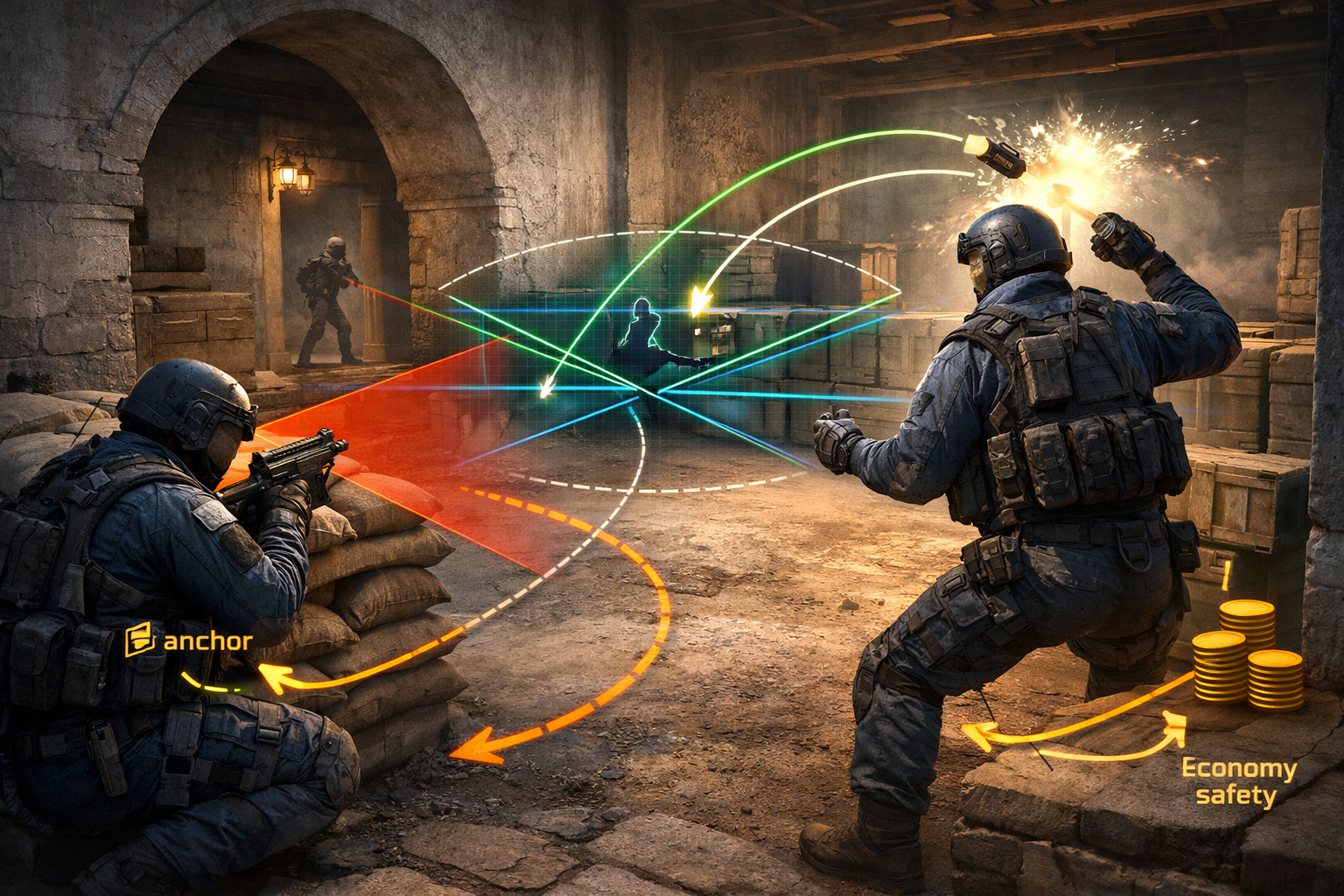
Stacked eco teams often group in one lane or one bombsite because they need trade density. HE grenades are ideal against that behavior. Even if they do not secure kills, chip damage changes the math of every follow-up duel. Low-buy players become much easier to finish when they are already softened.
Flashes Protect the First Fight
Many anti-ecos are lost on the first swing. A simple pop flash or support flash dramatically improves your entry or hold. It is one of the cheapest ways to deny a high-variance pistol duel. Players who say “save flashes for gun rounds” miss how often one flash is exactly what keeps the round clean.
Smokes Can Be Defensive Tools Too
People sometimes think smokes are less important against weak buys, but smokes can cut off rush lanes, isolate upgraded guns, protect bomb plants, or prevent weapon recovery. A smoke is not only an execute tool. In anti-eco rounds, it is often a control tool.
Map Control and Space Management
Map control in anti-eco rounds is less about creative lurking and more about safe territory acquisition. You want to occupy useful space without letting the enemy collapse onto isolated players. That means clearing key zones in order, watching timing pushes, and making sure your players are close enough to support each other.
One of the cleanest ways to think about anti-eco map control is this: move from safe space to contested space with support, then from contested space to objective space with utility. Do not skip stages. Most anti-eco disasters happen when players jump straight from spawn to objective without respecting the contested parts of the map.
This is especially true on maps with tight transitions and stacked choke points. Whenever you move through a narrow area where pistols can burst out from multiple close corners, ask whether your team is structured to trade instantly. If the answer is no, slow down and fix the formation.
Spacing is the hidden hero here. Too tight, and one shotgun or spray transfer can punish multiple players. Too loose, and the first player dies untraded. Good anti-eco spacing gives the entry room to fight while keeping the second player ready to punish the contact immediately.
Mid-Round Adjustments vs Eco and Half-Buy Setups
Not every anti-eco is solved in the first twenty seconds. Sometimes the enemy gives up space, hides information, or mixes upgraded weapons into odd setups. That is where mid-round adaptation matters.
If You See Nothing, Suspect a Stack
When the low-buy side is unusually quiet, there is a good chance they are condensed somewhere. Do not celebrate the empty area too early. Use that silence as data. Probe carefully, keep map coverage, and be ready for a stacked site or a late multi-player burst from an unexpected pocket.
If They Get One Rifle, Slow the Round Down
The moment the eco side upgrades into a rifle or strong SMG, the round changes. They now have a real weapon that can hold an angle, punish a rotation, or anchor a post-plant. Many players continue their original anti-eco tempo even after the round has clearly become more dangerous. That is a mistake. Reassess, regroup, and remove the upgraded weapon’s impact.
Adjust Your Utility After Contact
If the first fight reveals heavy pressure on one side of the map, do not keep spending grenades as if the original plan still matters. Reallocate utility toward the real danger. Anti-eco success often depends on who adapts faster once the weirdness starts.
Do Not Chase Every Piece of Information
Low-buy teams frequently bait overreactions. They make noise, show one player, drop a decoy, or fake pressure to pull you into poor repositioning. Your response should be measured. Gather information, but do not destroy your structure because one pistol jumped in a smoke somewhere.
Post-Plant and Retake Discipline
Anti-eco rounds do not end when the site is taken or the bomb is planted. In fact, this is where many teams lose their structure. They think the hard part is over. Then they take lazy post-plant positions, overpeek, or isolate themselves in hunt mode.
On T Side, Play Crossfires and Delay
If you have planted against a weak buy, you usually do not need to keep forcing fights. Set layered post-plant positions, protect the dropped weapons, and make the defenders walk into your crossfires. Eco retakes often rely on surprise speed and chaotic trade sequences. Delay that speed and the round usually stabilizes in your favor.
On CT Side, Retake as a Unit
Retaking against pistols can still be awkward because every box, smoke edge, and close corner becomes dangerous. The correct answer is not panic peeking. Regroup, use flashes, and retake with synchronized pressure. A low-buy post-plant is still a post-plant. Treat it with respect.
Do Not Feed Exit Kills
If the round is clearly won, avoid handing out meaningless exit kills that upgrade the enemy’s next buy. Winning a round while losing three rifles at the end is not a clean outcome. Protect your economy all the way to the final second.
How to Read Opponent Save Habits
Not all teams eco the same way. Some stack one site repeatedly. Some push extremities for surprise. Some buy armor and flash for one explosive contact play. Some hide and hope to recover a rifle after the first kill. Great anti-eco teams read those patterns and punish them over time.
Start by tracking where low-buy aggression usually appears. Does the opponent love close mid fights? Do they over-stack one bombsite after a pistol loss? Do they send one lurker on a deep flank every save round? These details matter because anti-eco rounds become much easier when you stop treating them as random.
Pay attention to player tendencies too. There is often one opponent who loves hero plays on low buys. Maybe they hide in a smoke, push through flame, or force every round with a specific role. Calling out those habits before the round begins helps your team stay alert.
At a higher level, this turns anti-eco play from generic discipline into targeted discipline. You are not just clearing corners. You are clearing their favorite corners.
Common Anti-Eco Mistakes
Dry Peeking Obvious Pistol Angles
This is the classic error. A player knows the enemy is weak and swings a close corner with no flash, no trade, and no respect. One pistol burst later, the round is unstable.
Grouping Too Tightly
Trying to stay “tradeable” does not mean standing shoulder to shoulder. Tight clustering feeds shotguns, spray transfers, HE damage, and multi-kills through narrow doors. Spacing must be supportive, not stacked.
Splitting Without Support
The opposite problem is also common. Players spread across the map as if it were a full default rifle round, but without enough support to survive random aggression. Eco teams love that because isolated duels are their dream scenario.
Saving Too Much Utility
A molotov unused at the end of the round did not generate value. Neither did the flash you died with while face-checking a close angle. Anti-eco utility should be purposeful, not hoarded.
Hunting Before Securing the Objective
Teams often chase eco frags before planting, before defusing, or before locking down post-plant coverage. That is ego-driven Counter-Strike, not winning Counter-Strike.
Ignoring Weapon Recovery
Once a rifle hits the ground, the anti-eco becomes a race. If your team does not immediately deny pickup paths, you can lose the entire advantage in seconds.
Assuming Every Low Buy Is the Same
A true eco, a half-buy, and a force buy create different threats. If you buy or position as if they are all identical, you will eventually run into the wrong kind of round.
Practice Plan for Better Anti-Eco Conversion
Improving anti-eco results is not only about reading a guide. It is about building team habits. The good news is that these habits are very trainable.
Create Anti-Eco Call Rules
Before you queue or scrim, agree on simple anti-eco rules. For example: no dry peeks into known close angles, first contact gets a support flash, site entry uses at least one clearing molotov, dropped rifles are called instantly, and flank responsibility is named out loud. Simple rules create repeatable structure.
Review Lost Conversion Rounds
When your team loses an anti-eco, do not shrug it off as unlucky. Rewatch the round and identify the first preventable mistake. Was it spacing? No utility? A dry swing? A missed weapon recovery? Most anti-eco losses become very teachable once you look at them calmly.
Practice Entry Paths With Utility
On each map, build one or two clean anti-eco entry protocols for your most common sites. Keep them simple. One flash, one molotov, one pair clearing the first zone, one player anti-flank. You do not need ten layers. You need a plan people will actually remember.
Practice CT Anti-Rush Reactions
CT teams should rehearse early anti-rush utility and fallback positions. Site anchors do not need magic. They need consistent first-contact reactions and a reliable way to survive until support arrives.
Track Clean Conversion Rate
Do not only track whether you won the anti-eco. Track whether you won it cleanly. If your team wins but regularly loses three rifles, the process is still flawed. Clean rounds are what build stable halves.
FAQ
Should you always buy SMGs against eco rounds in CS2?
No. SMGs are strong anti-eco tools, but they are not automatic buys every time. If the opponent can mix in armor, upgraded pistols, or stronger long-range threat, rifles may be safer. The right answer depends on your money, your side, and the map areas you expect to fight.
What is the biggest anti-eco mistake in CS2?
The biggest mistake is taking isolated close-range duels without utility or trade support. That is exactly the kind of fight save rounds are built to win.
How many grenades should you use in an anti-eco?
Enough to solve the dangerous parts of the round. You do not need to throw every grenade you own, but you should absolutely spend utility to clear trap angles, break rushes, and protect the first contact.
Is it better to play fast or slow against a save round?
Neither by default. The best anti-eco tempo is controlled. You want enough pace to stop the enemy from repositioning freely, but enough patience to avoid running blind into stacks and close traps.
How do you stop eco teams from recovering rifles?
By trading immediately, controlling dropped gun locations, and refusing to overpeek after the first death. The moment a rifle drops, protecting or denying that pickup becomes one of the round’s top priorities.
Conclusion
Anti-eco strategy in CS2 is not glamorous, but it wins matches. Great teams do not lose these rounds because they understand what eco teams need to succeed: chaos, close-range fights, isolated duels, free weapon pickups, and emotional overconfidence from the favorites. Once you understand that, the solution becomes clear. Slow down just enough to read the danger. Use utility to remove cheap positions. Space correctly for instant trades. Protect dropped weapons. Keep the round simple. And above all, play to convert cleanly, not stylishly.
If you build those habits, you will notice a major change in your results. Your halves will feel steadier. Your team’s money will survive longer. Your opponents will struggle to claw back momentum from low-buy rounds. That is the real value of strong anti-eco Counter-Strike: it turns “should win” rounds into rounds you actually do win.
And that is one of the fastest ways to become a more reliable CS2 player.