



LoL Roaming Guide 2026: Timing and Impact
LoL Roaming Guide 2026: Perfect Timing and Impactful Roams for Mid and Support
Table of Contents
- Why Roaming Decides So Many Games
- What a Good Roam Actually Is
- The Core Principles Behind Every Successful Roam
- Mid Lane Roaming Fundamentals
- Support Roaming Fundamentals
- How to Recognize the Perfect Roam Window
- Wave Management and Roaming
- Vision, Fog of War, and Pathing
- How to Roam with Your Jungler
- Choosing the Right Roam Target
- How to Execute the Roam Cleanly
- Turning Roams into Objectives and Lasting Leads
- Common Roaming Mistakes That Throw Games
- Roaming When Ahead, Even, or Behind
- How to Practice Roaming Efficiently
- FAQ
- Final Thoughts
Why Roaming Decides So Many Games
Roaming is one of the most misunderstood skills in LoL. Many players think roaming is just “leave lane and try to help somewhere else.” In reality, the best roams are controlled, timed, and purposeful. They are not random walks around the map. They are calculated windows where you temporarily trade your presence in one area for a bigger advantage somewhere else.
This matters because solo queue is rarely won by mechanics alone. Clean laning gives you a foundation, but map impact wins games faster. A good roam can secure a kill, burn summoners, deny vision, force a bad recall, protect your jungler, unlock an objective, or simply pressure the enemy into playing scared. Even when a roam does not produce a kill, it can still be valuable if it changes how the map is played.
That is why strong mid and support players often feel more influential than everyone else on the Rift. They are not just playing their lane. They are deciding which part of the map matters next. A mid laner with priority can move first to river fights, invade with the jungler, or appear on a side lane at the exact moment the enemy overextends. A support can disappear from vision, create panic across two lanes, set up deep wards, and turn the pace of the game in minutes.
The timeless truth is simple: roaming is not about moving more. It is about moving better. Good players do not roam because they are bored or impatient. They roam because the map has presented a profitable opportunity. Great players do not just ask, “Can I leave?” They ask, “What do I gain if I leave, what do I lose, and can I return without falling behind?”
This guide is built around those questions. Rather than tying everything to one patch or short-lived champion trend, the goal here is to teach evergreen roaming principles that stay relevant year after year. If you understand wave priority, information control, tempo, pathing, and target selection, you can adapt to almost any meta. Champion pools change, map details evolve, and item systems shift, but good roams still come from the same fundamentals.
If you want to improve ranked results consistently, review official system updates on Riot dev posts, use Riot Support for official game information, and compare route efficiency or replay patterns through tools like OP.GG and the League Wiki. If your goal is faster ranked progress while you sharpen macro fundamentals, you can also look at Boosteria’s LoL boosting prices as a related resource.
Now let’s break roaming down the right way: not as a highlight play, but as a repeatable system.
What a Good Roam Actually Is
A roam is a temporary lane exit made to create map value. That value might be direct, such as a kill or assist, or indirect, such as pressure, information, summoner spell advantage, wave denial, vision control, or objective setup. If you leave lane and gain nothing while sacrificing experience, gold, wave position, or turret health, that is not a good roam. It is wasted tempo.
The first step to becoming better at roaming is redefining success. A successful roam is not only the montage version where you appear in side lane and pick up two kills. Sometimes the best roam is short and subtle. You move with your jungler to secure river control. You hover top side to stop a dive. You fake a roam so the enemy bot lane backs away from the wave and loses pressure. You cover your jungler’s invade so the enemy mid cannot contest safely. These plays often decide games just as much as flashy kills do.
Think of roaming as map investment. You invest time and lane presence in exchange for a chance at something bigger. The best investments are low risk and high probability. That is why lane state matters so much. If you roam on a bad wave, you may miss two waves and plates just to accomplish nothing. If you roam on a good wave, your opponent must answer the minions first, giving you the first move and protecting your own economy while you act.
Good roaming also has an exit plan. Too many players know how to leave lane, but not how to end the roam. They hover too long, chase too deep, or continue forcing a dead play after the timing has already expired. Great roamers know when a play is gone. They cut losses quickly, drop vision if possible, and return before the cost becomes too high.
So when you judge your roams, ask these questions:
- Did I leave on a good wave or after a useful reset?
- Did I know where key enemy players probably were?
- Was my target actually vulnerable?
- Did I communicate the roam early enough for teammates to respond?
- Did I convert the roam into something measurable?
- If the play failed, did I leave quickly enough to minimize losses?
If you build your review process around those questions, roaming stops feeling random and starts feeling coachable.
The Core Principles Behind Every Successful Roam
Roaming looks different from game to game, but the best ones usually follow the same principles.
1. Priority creates freedom
Lane priority is your permission slip. If your wave is pushing into the enemy tower or your ADC can safely collect the wave alone, your movement costs less. If the enemy must choose between following you and losing farm, you have created a real roam window instead of gambling.
2. Information reduces risk
You do not need perfect vision to roam, but you do need a reasonable read on the map. Roaming blind into missing enemy players is how throws happen. The better your information on jungle location, ward lines, and summoner cooldowns, the more efficient your movement becomes.
3. Distance matters
Not all roams are equal. A short hover from mid to river is cheap. A full sprint from bot lane to top lane is expensive. The farther you move, the higher the price. That means long roams need clearer payoff or stronger setup.
4. Numbers beat mechanics
Many roams work because they briefly create an outnumbered fight. You are not always roaming because you are stronger. You are roaming because you can arrive before the enemy answer does. That timing edge is often more valuable than raw damage.
5. Tempo is everything
Roaming is tempo management. You are trying to use your spare seconds more efficiently than the enemy uses theirs. If you spend too long deciding, pathing, or forcing the play, the tempo edge disappears.
6. Every roam should have a purpose
Before you move, identify the likely reward. Protecting a jungle invade, punishing an overextended side lane, contesting vision, setting up an objective, or collapsing on a low-health enemy are all good reasons. “Maybe something happens” is not.
These principles are the skeleton of roaming. The rest of this guide will show you how mid and support apply them differently.
Mid Lane Roaming Fundamentals
Mid is the natural center of the map, which makes it the most flexible roaming role in the game. As a mid laner, you can reach both rivers, both side lanes, and many jungle entrances faster than almost anyone. That access gives you huge influence, but it also means poor roams are punished quickly because your lane is so short and central. If you roam carelessly, your opponent can hard shove, take plates, and gain control over both sides of the map.
The first mid lane roaming rule is simple: manage the wave before you move. Crash the wave if possible. If you cannot fully crash, at least create a state where the enemy mid must spend time fixing the wave instead of instantly following you. Mid roams become much stronger when the enemy loses minions or arrives late.
The second rule is to understand your champion’s roam profile. Some mids roam through raw movement speed and fast waveclear. Others roam through burst threat, crowd control, or ultimate access. Some do not need to fully commit; just leaving vision can create fear. A control-oriented mid can still roam well if they leave after a clean crash and move with their jungler. A skirmish-focused mid can roam harder and earlier, but still needs to respect lane losses.
As a mid laner, your most common roam options are:
- Move to river to secure vision or a neutral fight
- Follow your jungler into enemy jungle entrances
- Collapse on an overextended top or bot lane
- Cover a side lane against a dive
- Fake a roam to force side lane caution, then return mid
One of the most underrated mid skills is threatening a roam without fully taking it. If you crash a wave and disappear toward one side, the enemy side lane must often back up even before you arrive. That alone can deny a trade window, protect your teammates, or relieve pressure. Good mids understand that pressure is value, not just kills.
You should also think about river control as an extension of roaming. Mid players who move first to river are often deciding whether the next objective setup is winning or losing. Even a 10-second move to help place or deny vision can shape the next minute of play. That is why many high-level mids are less obsessed with solo kills than lower-level players expect. They know that map initiative beats small lane advantages.
Finally, remember that your lane still matters. Some mid players become roam addicts and abandon fundamental farming patterns. That is a trap. The best mids use roams to amplify a stable economy, not replace it. If you are missing waves repeatedly for low-percentage plays, you are not impactful. You are coin-flipping.
Support Roaming Fundamentals
Support roaming is different because your freedom depends on bot lane state, recall timing, and ADC safety. Unlike mid, you are usually sharing lane. That means your movements affect another player directly. A good support roam creates map impact without sacrificing your ADC’s lane beyond reason.
The most common mistake support players make is roaming at emotionally appealing times instead of strategically good times. They get bored in lane, dislike the matchup, or see a fight breaking out and sprint away without checking whether the wave is safe. Then their ADC gets zoned, dove, or loses a stacked wave alone. Roaming is not bad because your ADC dies once after you leave. Roaming is bad when you leave in a way that made that outcome predictable.
Support roam windows usually come from one of four sources:
- You crashed the bot wave and your ADC can reset or collect the rebound safely
- You recalled and can path out of base toward mid, river, or jungle before returning bot
- Your ADC is also resetting, so your time is temporarily free
- Your lane is unwinnable to fight directly, so creating elsewhere is more valuable than staying static
The base-path roam is especially powerful and underused. Instead of always running directly back to bot, a smart support can move through mid or river, place wards, threaten a gank, or assist a skirmish on the way. These roams are efficient because they stack multiple actions into one route: returning to lane, generating pressure, and improving vision all at once.
Supports also shape the psychological map more than almost any other role. When a support vanishes from bot, every enemy lane has to guess where they are. That uncertainty creates room for your team. Even if you are only placing wards or hovering mid briefly, the possibility of your presence changes enemy behavior.
Still, great support roaming requires discipline. Ask:
- Can my ADC safely farm the next 20 to 30 seconds?
- Will the wave push toward us or away from us?
- Do I have a meaningful stop on my route, or am I just wandering?
- Am I arriving with enough health, mana, and cooldowns to matter?
Support roaming is less about heroics and more about stitching the map together. You are the role most capable of turning small windows into chain reactions: ward one entrance, force one flash, unlock one river fight, and suddenly bot lane is safer and the next objective is easier.
How to Recognize the Perfect Roam Window
Timing is the heart of roaming. Most players know where they could roam. Fewer know when they should. The perfect roam window is usually a moment when your current responsibilities are low and the enemy’s vulnerability is high.
Look for these signals:
Your wave is secured
If the wave is under enemy tower, slow enough to buy time, or bouncing back toward you, you have breathing room. This is the cleanest timing signal in the game. Roam windows built on wave control are repeatable and reliable.
The enemy is stuck catching the wave
If your lane opponent has to stay and clear, they cannot match your move immediately. This creates a temporary numbers edge elsewhere.
An enemy side lane is overextended
If a side lane is pushing far without proper vision, the chance of success rises dramatically. Long lane distance makes collapses more punishing.
Your jungler is moving toward conflict
Roams become stronger when linked to your jungler’s path. If your jungler is contesting river, invading, or preparing a gank, moving with them multiplies impact.
Key cooldowns or summoners are missing
A target without flash or with low mobility is much easier to punish. Track who is vulnerable before you move.
An objective is spawning soon
Sometimes the best roam is not a gank at all. It is an early move into river to establish wards, control angles, and deny enemy setup. This type of roam wins objectives before the fight even starts.
The bad timing signals matter just as much. Avoid roaming when your wave is crashing into your tower, when your teammate is too low to participate, when the target can simply walk away, or when the enemy jungler’s location makes your route dangerous. Players often think failed roams are execution problems. Many are timing problems decided before the move even begins.
A useful mental model is this: roam when the cost is predictable and the reward is realistic. If neither is true, wait.
Wave Management and Roaming
If roaming is the art of movement, wave management is the engine that powers it. Players who do not understand wave states will always feel inconsistent when roaming because they are acting without controlling the timer.
The crash roam
This is the classic pattern. You push the wave fully into tower and leave immediately. The enemy must farm, giving you first move. This is the most stable type of roam because it protects your economy while creating map pressure.
The bounce roam
When you crash a wave and the next one starts pushing back toward you, you may gain an even longer window. This is especially strong if you can return before the bounce becomes dangerous. Good players understand these windows instinctively; they know whether they have 8 seconds, 15 seconds, or enough time for a deeper move.
The fake roam after shove
You shove, leave vision briefly, and force reactions. If the enemy side lane backs off, you already created value. You can then reset your position, ward, or return to lane without overcommitting.
The support rebound roam
Bot crashes the wave, then the next wave pushes back toward your side. That often allows support to leave while ADC collects a safer wave closer to home.
The recall roam
Wave is handled, you reset, and you path creatively out of base. This type of roam is efficient because it layers movement with reset tempo.
There are also dangerous wave states that make roaming bad:
- Large enemy wave about to crash into your tower
- Thin wave that the opponent can instantly shove after you leave
- Bot wave exposed in a way that makes your ADC vulnerable to engage or dive
- Mid wave frozen in a way that lets the enemy gain too much if you leave
If you want dramatic improvement in roaming, stop reviewing only the roam itself. Review the 10 seconds before it. That is where the real decision usually lives. Ask whether the wave gave you permission to move. Over time, you will notice that clean roams almost always begin with clean wave work.
Vision, Fog of War, and Pathing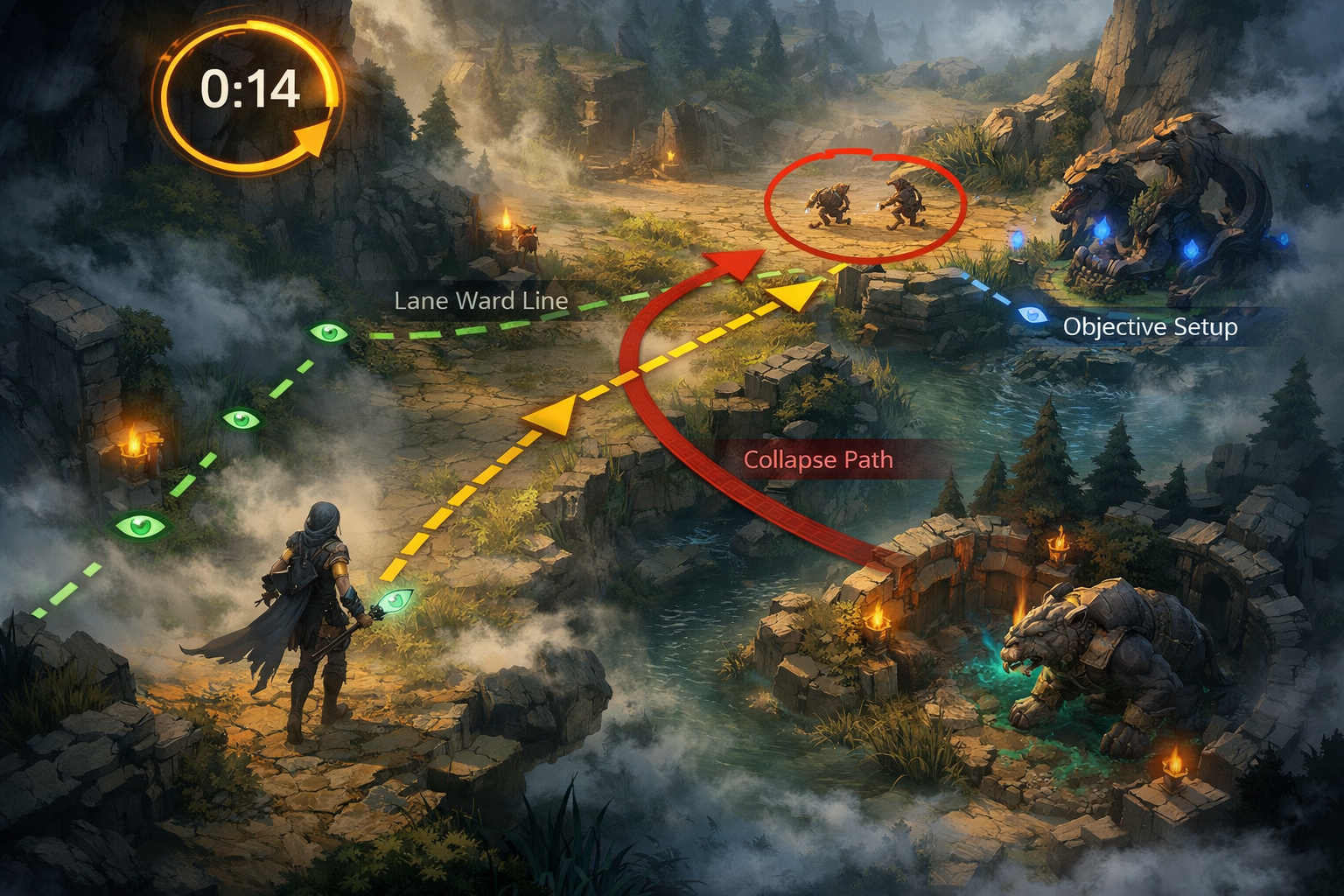
Roaming is strongest when the enemy does not know exactly where you are. Vision control is what turns movement into pressure. Pathing is what turns pressure into real threat.
Good roamers think in terms of information layers. First, what does the enemy definitely see? Second, what do they probably suspect? Third, what can I make them fear even if I am not there yet?
For example, if you leave lane through a common warded path every time, your roams lose bite. The enemy side lane backs up early and the play dies. But if you vary your exits, sweep key routes, use blast cones or terrain creatively, and disappear from vision at ambiguous moments, your movements become much harder to read.
Pathing should match the goal of the roam. If you are collapsing on an overextended enemy, choose the route that cuts off escape instead of the route that is shortest for you. If you are protecting your jungler, choose the path that lets you arrive safely and first. If you are denying vision before an objective, prioritize ward lines and choke points over direct engagement.
Support players especially should think of wards as roam multipliers, not separate chores. A support that roams, places one deep ward, clears one control point, and then pressures mid has achieved several map wins in one trip. Mid players should similarly value information on entry points. Even one good ward can make later roams much safer and can protect your return to lane.
A few timeless pathing rules help almost every game:
- Approach from fog whenever possible
- Do not walk over obvious ward lines if an alternate route exists
- Cut off escape paths instead of arriving where the target already is
- Keep your return route in mind before committing too deep
- Use your appearance timing, not just your presence, to create impact
Players often ask how to avoid “being seen on every roam.” The answer is not only more sweepers or more control wards. It is better route planning and better timing. When you leave on strong tempo, even a partially spotted roam can still work because the enemy cannot respond fast enough. When you leave late, even the best hidden route may fail because the opportunity is already gone.
How to Roam with Your Jungler
If you want your roams to matter more, sync them with jungle activity. Mid and support are the two roles best positioned to amplify the jungler, and many games are decided by which trio controls the river first: mid, jungle, and support.
There are several high-value situations where roaming with your jungler creates more than roaming alone:
- Scuttle or river control fights
- Invades on camps or jungle entrances
- Counterganks on overextended lanes
- Herald, dragon, or other neutral objective setups
- Deep vision during tempo windows after a shove or reset
The main advantage of moving with your jungler is not just damage. It is certainty. A solo roam can fail if your teammate hesitates or if the target escapes early. A linked move with jungle often arrives with better numbers, more crowd control, and cleaner follow-up. It also protects both of you from getting collapsed on by the enemy mid or support.
Mid players should constantly ask whether their wave state lets them move first with jungle. Support players should ask whether base pathing or bot priority lets them meet jungle in river rather than arriving after everything has already happened. Small timing differences decide these fights. Being there one second earlier often means placing the first ward, gaining the first position in brush, or forcing the enemy to walk into you.
There is also a macro principle here: roaming with jungle is often more consistent than raw lane ganks. Why? Because jungle interaction touches everything. Securing vision with jungle protects side lanes. Winning a river fight can lead to objective control. Invading can deny camps and tilt tempo across the map. Even if no kill happens, the map often changes in your favor.
If you want a simple habit, start watching your jungler every few seconds when you have priority or are moving out of base. Ask, “Can I make their next move stronger?” That one question alone improves roaming quality dramatically.
Choosing the Right Roam Target
Not every lane deserves your attention. Good roamers choose targets based on probability, payoff, and map consequence.
Here is a practical target selection order:
1. Overextended enemy with limited escape
This is the classic roam target because the lane geometry is already working against them. Long lane, no flash, and poor vision often equals free value.
2. Fight around your strongest carry
If one teammate is already ahead, roaming to their lane can snowball the game harder than helping a weak lane stabilize. Feeding strength is often more decisive than spreading it evenly.
3. Objective-side pressure
If an objective is the next major map event, roams near that side gain extra value. A forced recall or summoner burn there may decide the next setup.
4. Defensive coverage against an obvious enemy play
Sometimes the best roam is a counter-roam. If the enemy dive looks telegraphed, arriving first can flip the game hard.
5. Vision and space denial
If kills are low-probability, a roam that secures vision, controls river, or clears wards can still be the best option.
Avoid targeting lanes that lack setup, are too healthy, or can disengage easily unless you have overwhelming numbers or a clear angle. Many failed roams happen because players confuse a lane being “active” with it being “gankable.”
Also evaluate return value. Roaming to a lane that allows instant conversion into plates, objective setup, or reset tempo is usually stronger than a low-impact kill that strands you awkwardly on the map. Think beyond the kill itself. The best roam target is often the one that changes the map after the play ends.
How to Execute the Roam Cleanly
Once you commit to the move, execution matters. Clean roams are usually fast, direct, and decisive.
First, ping early. Your teammates need time to prepare the wave, bait the enemy forward, or hold cooldowns. Late pings create confusion. Early pings turn a solo idea into a coordinated play.
Second, approach with patience. Do not reveal too early. Many roamers sprint into vision and immediately lose the only advantage they had. Let the enemy step into a worse position if possible. Use brush, terrain, and fog well.
Third, understand role order. In some roams, the engager should start. In others, the threat of your follow-up is stronger than leading the play. Mid players with burst often want the target already committed or crowd controlled. Supports with reliable engage may start earlier. The right order depends on the tools involved, but the key is not overlapping everything badly.
Fourth, be realistic about time. If the enemy backs off and the play dies, do not chase endlessly. Drop a ward, take vision, maybe help shove if appropriate, and reset your map position. Overstaying is one of the most expensive mistakes in roaming.
Fifth, always ask what comes immediately after. Can you help push the wave? Can you hit plates? Can you move to river? Can you reset cleanly? The best roam execution includes the conversion step by default.
A clean roam often looks boring in replay because it is efficient. No wasted pathing, no indecision, no overchase, and no awkward ending. That is exactly what you want.
Turning Roams into Objectives and Lasting Leads
The difference between average and high-level roaming is conversion. Many players can create one good fight. Fewer can turn that fight into a lead that lasts. If your roams only produce scattered kills but no structural gain, your games stay volatile.
Here are the most common and valuable conversions after a successful roam:
- Shove the wave so the enemy loses farm and tempo
- Take turret plates if the timer and health bars allow
- Secure vision around the nearest objective
- Start or threaten an objective with numbers advantage
- Invade camps while the enemy is dead or forced to recall
- Reset on favorable tempo before the enemy can answer
This is why roaming near objective timing is so strong. A good roam before a neutral spawn does more than create one kill. It removes enemy presence from the map long enough for your team to own the setup. That often matters more than the kill gold itself.
Even modest conversions add up. Burning flash on a side lane and then returning later with jungle can be better than forcing a desperate all-in immediately. Roaming is not always about a single explosive outcome. Sometimes it is about layering pressure until the enemy side of the map becomes impossible to play.
Ask yourself after every roam: what changed? Did the enemy lose a wave, lose vision, lose objective control, or lose the ability to contest something next? If the answer is yes, the roam had lasting value. If the answer is no, the play may have been less impactful than it looked.
Common Roaming Mistakes That Throw Games
Most players do not fail because they never roam. They fail because they roam at the wrong moments, for the wrong reasons, or for too long.
Roaming on a bad wave
This is the biggest one. If you leave a wave that will punish you hard, the roam starts from a losing position. The play has to succeed massively just to break even.
Roaming without information
If enemy jungle and lane states are unclear, your route can turn into a trap. Blind aggression often looks like confidence until the collapse happens.
Targeting ungankable lanes
Just because a lane is fighting does not mean it is vulnerable. If the enemy can disengage easily or your ally has no setup, your odds are lower than they look.
Telegraphing the roam too early
Walking through obvious vision or leaving lane in the same pattern every time kills pressure. Good opponents react before you arrive.
Overstaying after the window closes
This is the hidden killer. The roam was fine at second five, bad at second ten, and terrible at second fifteen, but the player keeps forcing it.
Ignoring bot lane consequences as support
If your roam leaves your ADC exposed in a predictable way, you must count that in the cost. Supports sometimes judge only what they gained, not what their ADC lost.
Confusing movement with impact
Running around the map feels proactive, but not all activity is productive. Good roaming is measured by value, not distance walked.
If you want to improve quickly, do not just review successful-looking roams. Review the ugly ones. Most of the biggest rank-ups in macro come from deleting bad habits rather than inventing new genius plays.
Roaming When Ahead, Even, or Behind
Your game state should change how you roam.
When ahead
Roams should become more decisive but not reckless. Use your stronger lane control, better item timing, or higher pressure to move first and squeeze the map. Your goal is to spread your lead, not donate shutdowns through greedy overextends. Roam to the side that gives objective leverage or to the teammate most able to help end the game.
When even
Look for efficient, lower-risk moves. Vision roams, jungle support, and punish windows on missing summoners are often best. In even games, patience matters because one clean numbers advantage can break the balance.
When behind
Many players stop roaming entirely when behind, but that is not always correct. Blind, ambitious roams are bad from behind, but defensive or reactive roams can be game-saving. Covering dives, moving with jungle for safe vision, or collapsing on overextensions can help you regain tempo. What you want to avoid is abandoning a losing lane only to create a worse loss somewhere else.
When behind, your best roams often come from necessity and structure rather than aggression. You do not need to force hero plays. You need to move smartly enough to stop the map from collapsing.
How to Practice Roaming Efficiently
Roaming improves fastest when you simplify the review process. You do not need to analyze every second of every game. Focus on the decision points.
After each match, review these moments:
- The first two times you considered leaving lane
- Your first successful roam
- Your first failed roam
- Any roam that changed an objective fight
For each one, answer:
- What was the wave state?
- What information did I have?
- Why did I choose that target?
- How long did I spend on the move?
- What did we gain or lose after it?
You can also build one in-game training focus per session. For example:
- Today I only roam after a clean crash
- Today I track enemy flash timers before roaming
- Today I look for base-path roams as support
- Today I move with jungle whenever I have priority
This kind of narrow practice works better than trying to “be smarter everywhere.” Roaming is a layered skill. Improve one layer at a time and the whole system gets stronger.
It also helps to compare your habits against stronger players. Replay tools, stat sites, and VOD review can show whether you are leaving lane too late, ignoring objective-side movement, or failing to convert success. Numbers alone do not teach macro, but they can reveal patterns worth fixing.
FAQ
Should mid roam more than support?
Not necessarily more, but often differently. Mid has shorter access to both sides and can move in small windows more often. Support can influence more areas through vision and base pathing. The better question is which role can move at the current moment for the lowest cost and highest value.
Is a roam still good if it gets no kill?
Yes, if it creates real value such as summoner burns, wave denial, vision control, objective setup, jungle protection, or lane relief. A kill is only one kind of reward.
How long should a roam take?
As short as possible. The exact number changes by lane state and route, but in general, a roam gets worse the longer it lingers without payoff. Quick, clear, purposeful roams outperform long, uncertain ones.
Should I always follow an enemy roam?
No. Sometimes matching is correct. Sometimes pushing the wave, taking plates, pinging danger, and arriving later to the next map point is better. Blindly following can be worse than punishing the enemy’s leave.
What is the safest way for support to roam in solo queue?
Leave on a good wave, preferably after crash or reset, path through useful ward routes, and choose short, high-probability stops such as mid pressure or jungle assistance. Solo queue punishes overlong roams more than disciplined ones.
How do I know if I roam too much?
If your farm, experience, lane control, or ADC stability is consistently poor without enough map conversion, you are probably over-roaming. Repeated movement with low return is the usual sign.
Final Thoughts
Perfect roaming in LoL is not about magic instincts or nonstop action. It is about understanding when the map is paying you to move. Mid and support are powerful because they can convert temporary freedom into permanent advantages, but only if they respect the basics: wave control, information, timing, pathing, and conversion.
If you remember one idea from this guide, let it be this: the best roam is usually obvious after you learn to read the setup. It starts with a good wave. It uses real information. It aims at a vulnerable target or meaningful objective. It ends quickly if the window closes. And when it works, it changes more than one fight. It changes the map.
That is what separates random movement from elite macro. Roaming is not decoration on top of laning. It is one of the clearest ways to turn a small lead into a winning game, or a difficult lane into a playable one. Learn to see the window, and your impact as mid or support rises immediately.
Master that process, and your roams stop being hopeful. They become inevitable.