



Valorant 2026 Utility Guide: Smokes, Flashes, Mollies
Utility Usage Fundamentals in Valorant 2026: Smokes, Flashes and Mollies Rules
Utility is one of the biggest skill separators in Valorant. Aim will always matter, but clean utility usage is what turns good mechanics into reliable rounds. Players who understand when to smoke, when to flash, when to molly, and when to hold utility instead of wasting it win more rounds with less risk. They clear dangerous angles faster, enter sites with better spacing, stop rushes more often, retake with more structure, and convert post-plants at a much higher rate.
This guide is built to stay evergreen. Instead of focusing on short-term patch quirks or one temporary meta trend, it teaches the durable rules behind strong utility usage. Those rules stay valuable across maps, team comps, rank brackets, and even agent balance updates. If you learn the principles, you can adapt to any version of Valorant much more easily.
We will cover the fundamentals of smokes, flashes, and mollies, how they interact with timing and space, and how to use them correctly on attack, defense, retakes, and post-plants. We will also cover the most common mistakes players make with utility and how to practice better habits in real matches. For official game resources and updates, you can always check the official Valorant website, the Valorant Esports hub, and Riot support for Valorant. If your goal is faster rank progress while sharpening your macro and round management, you can also review Valorant boosting prices for an additional improvement option.
Table of Contents
- Why Utility Matters More Than Most Players Think
- The Core Principles of Good Utility Usage
- Smokes Fundamentals
- Flashes Fundamentals
- Mollies Fundamentals
- Utility Rules on Attack
- Utility Rules on Defense
- Utility Rules for Retakes
- Utility Rules for Post-Plants
- Solo Queue vs Team Play Utility Usage
- Common Utility Mistakes
- How to Practice Utility Properly
- How Utility Helps You Rank Up Faster
- Final Thoughts
Why Utility Matters More Than Most Players Think
A lot of players think of utility as something secondary. They see it as support for gunfights rather than part of the gunfight itself. That mindset holds people back. In Valorant, utility changes what fights are even available. It changes who can see first, who can swing safely, who is forced off an angle, who is blinded, who loses time, and who has to move under pressure. Before a bullet is fired, good utility already shapes the duel.
That is why players with average mechanics can still outperform mechanically stronger opponents. They reduce uncertainty. They take cleaner fights. They isolate defenders instead of peeking two angles at once. They stop defenders from comfortably holding narrow chokes. They deny info when rotating. They turn a chaotic retake into a structured clear. In other words, they do not rely on raw reaction speed for every round.
Utility also matters because rounds in Valorant are about resources, not just health. Your team starts every round with a set of tools. If you spend them poorly, you may still have all five players alive but no clean way to take a site or hold one. If you spend them well, you may take a site with minimal damage and force the enemy into a weak retake. The round economy is not only credits. It is also cooldowns, charges, timing, and information.
The best way to think about utility is simple: every useful piece of utility should either gain space, deny space, gain information, deny information, force movement, or make a fight unfair in your favor. If your utility does none of those things, it was probably low value.
The Core Principles of Good Utility Usage
Before breaking down smokes, flashes, and mollies separately, there are a few universal rules that apply to almost every piece of utility in the game.
1. Utility should solve a problem, not decorate the round
The biggest difference between purposeful utility and wasted utility is intention. Do not throw a smoke because the round started. Do not flash because you have a flash. Do not molly because you saw a clip where someone did it. Start by asking: what problem am I solving?
Is a defender holding a dangerous operator angle? Is your team about to enter a narrow choke? Are you trying to deny a fast push? Are you trying to stall a defuse? Is your teammate isolated and needs cover to escape? Utility becomes much sharper when every use has a clear reason.
2. Good utility creates decisions for the enemy
Strong utility is not just about landing perfectly. It is about creating bad options for the other team. A smoke forces defenders to decide whether to sit behind it, push through it, or reposition. A flash forces them to turn, hold, or fall back. A molly forces them to move, tank damage, or lose time. The more pressure your utility creates, the less comfortable the opponent becomes.
3. Timing matters as much as placement
Even correctly placed utility can fail if used at the wrong moment. A smoke that fades before the team enters is almost useless. A flash thrown before the entry is ready gives defenders time to recover. A molly used too early may stop nothing. Utility timing should match your team’s movement, not just your own animation.
4. Utility should reduce the number of angles you must fight
This is one of the most important concepts in Valorant. Most lost entries happen because attackers peek too many angles at once. Smokes block sightlines, flashes make certain angles unplayable for a moment, and mollies dislodge common anchor positions. If your utility is not making the site simpler to enter or hold, it is probably not doing enough.
5. Layer utility, do not stack it blindly
Layering means combining utility so each piece supports the next. A smoke blocks vision, then a flash punishes defenders trapped near the edge, then a molly clears a close corner, then an entry swings. Blind stacking means dumping everything at once with no structure. The first approach gives your team control. The second often leaves you empty after the first five seconds.
6. Holding utility can be higher value than spending it
Many players feel uncomfortable ending a round with unused utility. That feeling causes waste. Sometimes the best decision is to keep a flash for the retake, keep a smoke for the cross, or keep a molly for the defuse. Utility has value because of the threat it represents, not only when it is activated.
7. Communicate what your utility means
Even in solo queue, one short call can dramatically increase value. “Smoking Heaven.” “Flashing out.” “Molly default.” “Holding smoke for defuse.” These are simple calls, but they help teammates move in sync. Utility becomes more powerful when your team understands both its location and its purpose.
Smokes Fundamentals
Smokes are among the most powerful utility tools in Valorant because they reshape vision. Vision control decides which players can participate in a fight and from where. That makes smokes essential on attack, defense, and retake.
What smokes are supposed to do
A smoke should usually do one or more of the following:
- Block a critical defender sightline during an execute
- Delay a push or punish an aggressive angle
- Give your team safer movement across open space
- Isolate one defender so you do not fight multiple players at once
- Deny information during a rotation or fake
- Create pressure by threatening a push through the smoke
The mistake many players make is treating all smokes the same. There is a big difference between an entry smoke, a stall smoke, a re-hit smoke, a reposition smoke, and a retake smoke. Good controller play starts with understanding the purpose of the smoke before placing it.
Good smoke placement principles
Cut the dangerous angle first. On most site hits, the first smoke should remove the most oppressive angle, not the easiest one. If one position can see the entire choke or punish the entry path heavily, that angle usually takes priority.
Place smokes deep enough to deny vision cleanly. Weak smokes often leave awkward gaps or allow defenders to play too comfortably on the front edge. A smoke should usually make the enemy choose between giving space or taking a risk. If it lets them keep vision while staying safe, it is probably too shallow or badly centered.
Do not smoke for the defenders. Some smokes accidentally protect the enemy by letting them hide in strong pockets or play unexpected one-and-done positions. If your smoke makes it harder for your own team to clear close space, it may be helping the defenders more than you.
Respect fade timing. A smoke is strongest when teammates are ready to use the window it creates. If the smoke goes down and your team waits five seconds, defenders can reposition, stack utility behind it, or let it fade. A smoke without follow-up is often just a temporary pause, not real pressure.
Attack smoke rules
On attack, smokes should make entry cleaner. They should remove high-impact defender lines of sight and simplify the map. A good rule is this: if your team is entering a site, your smokes should reduce how many exposed directions the first two players must handle.
For example, if attackers are entering through a main choke, they often need help against deep anchor positions, elevated angles, or defender crossfires. Smokes should be used to break those crossfires so the entry group can focus on close clears and immediate duels.
Another strong attack use is the mid-round rotate. Smokes become especially dangerous when defenders are uncertain. If you fake presence on one side of the map and later hit another area, a well-timed smoke can cut off early rotators or prevent site anchors from seeing the actual commitment until it is too late.
Defense smoke rules
On defense, smokes often buy time. Time is a defensive resource because attackers are usually the side that must commit. A smoke on defense does not always need to deny a kill angle. Sometimes its job is simply to force the attackers to wait, burn more utility, or reveal more about their plan.
A strong defensive smoke makes attackers ask difficult questions. Do they push through? Do they flash through? Do they wait? Do they rotate? Every extra second matters, especially when your team is repositioning or gathering information elsewhere.
Defensive smokes also matter in anti-rush situations. If the enemy likes fast hits, your smokes should not be automatic at round start every time. Vary the timing. Sometimes early. Sometimes delayed. Sometimes held until you hear commitment. Predictable smoke timing makes it easier for enemies to pre-plan their entry.
Retake smoke rules
On retake, smokes are less about denying the initial entry and more about isolating post-plant positions. This is where many players misuse them. They place vague smokes with no specific purpose. Instead, ask which enemy position is currently the hardest to challenge. Smoke that line and reduce the number of players who can assist each other.
Retake smokes are also excellent for cutting off long-range support. If one attacker is playing a long off-angle with utility or spam potential, smoking that lane can let your teammates clear the site core first.
Common smoke mistakes
- Smoking too early so the team arrives late
- Smoking too shallow and leaving usable gaps
- Smoking common defender spots that are easy to prefire anyway while leaving stronger angles open
- Using all smokes in the first contact and having none for post-plant or retake
- Throwing predictable defensive smokes every round at the same timing
- Smoking off your own team’s vision during a retake
The best smoke players are not just accurate. They understand round flow. They know when a smoke should accelerate pressure, when it should slow the game down, and when it should be saved.
Flashes Fundamentals
Flashes are some of the highest-skill utility tools in Valorant because their value depends heavily on timing, spacing, line of sight, and team coordination. A good flash can win a site. A bad flash can blind your own team, give away your plan, or simply do nothing.
What flashes are supposed to do
- Force defenders off an angle
- Create a safe window for an entry or re-peek
- Punish players holding narrow chokes
- Break crossfires before your team swings
- Support a teammate taking space
- Give a disadvantaged player a chance to escape or fight back
The best flashes are not always the ones that fully blind enemies for the longest duration. The best flashes are the ones that align perfectly with a swing or force defenders into a bad choice. Even a partial blind can be enough if the timing is precise.
Different flash jobs
Entry flash. Used right before or during site entry to make the first duel easier. This is the most common use.
Support flash. Thrown for a teammate who is peeking. The thrower may not peek with it immediately, but it enables another player.
Anti-rush flash. Used defensively to stop fast pressure and create chaos in a choke.
Retake flash. Used to help defenders re-enter a site or swing a post-plant position.
Re-fight flash. Used after contact to take back control of a contested area or punish a player who is stuck behind cover.
When players get more disciplined with flashes, they stop seeing them as random engagement starters and start using them as timing tools connected to movement.
Good flash rules
Flash for a swing, not for hope. If nobody is in position to take advantage of the blind, the flash usually accomplishes little. A flash should create a very short, exploitable window. Someone needs to use that window immediately.
Match the flash to the angle. Tight chokes, deep site positions, and close corners all require different flash placements and different peek timings. One generic flash will not solve every problem. The geometry of the fight matters.
Do not over-warn the enemy. Many players telegraph their flashes with predictable setup sounds, repetitive timing, or obvious body language. Better players start turning or tucking before the flash even pops. Variation matters.
Avoid flashing teammates. Friendly flashes destroy momentum. Even a strong flash is bad if it blinds your entry. That means your spacing, callouts, and lineups need to be practical. Simple and clean beats fancy and inconsistent.
Use flashes to punish defenders near smoke edges. One of the most effective combinations in Valorant is smoke plus flash. Defenders often play close to the edge to contest exits. A well-timed flash as your team bursts through can make those defenders helpless.
Attack flash rules
On attack, flashes should remove the confidence of site anchors and help the first two players claim space quickly. Flashes are especially valuable when defenders are tucked into narrow positions or relying on strong one-and-done spots.
One important rule is that flashes should complement clearing order. If your team still has to check close left, close right, and a deep off-angle, the flash should be timed so those first clears become easier, not so late that the entry is already exposed.
Another rule is that not every execute needs multiple flashes. Sometimes a single clean flash is better than two poorly spaced flashes that give defenders staggered warning. Overusing flashes can slow your own team because players hesitate, wait for the second piece, or lose track of when to swing.
Defense flash rules
On defense, flashes are excellent at punishing overconfidence. If attackers are grouping in a narrow choke or trying to burst through a smoke, a defensive flash can immediately stop momentum. But defensive flashes should not be panic tools. If you flash too early, attackers simply reset and hit later. If you flash too late, you may already be overwhelmed.
A strong defensive flash often comes right as attackers cross a threshold or after they commit to a piece of space they can no longer easily abandon. That is why patient defenders get more value. They wait until the enemy is truly committed.
Retake flash rules
Retake flashes need clear purpose. Are you flashing to get someone off the spike? Flashing a known post-plant angle? Flashing to let a teammate cross? Flashing to clear site core? The better you define the job, the better the flash becomes.
Retake flashes are strongest when combined with count-based swings. “Flash and swing in three, two, one” is simple, but it wins rounds because the flash actually converts into pressure. Random retake flashes with no synchronized movement often just hand the enemy a reset.
Common flash mistakes
- Flashing too far ahead of the peek
- Stacking multiple flashes with no reason
- Blinding teammates during entry
- Throwing the same flash every round until enemies learn the counter
- Using flashes as a habit instead of a response to a real problem
- Not punishing the blind immediately with movement
A great flash is not just mechanically correct. It arrives at the exact moment an opponent wants to hold their ground. That is why flash timing is one of the clearest signs of a high-level player.
Mollies Fundamentals
Mollies are often underestimated because many players reduce them to damage tools. That is too narrow. In Valorant, mollies are zone control tools first. The damage matters, but the real value is how they force movement, deny space, delay timing, and create panic in fixed positions.
What mollies are supposed to do
- Clear strong corners or common anchor spots
- Deny a defender from comfortably holding a choke
- Stop or slow a fast push
- Force players off the spike or away from cover
- Delay a defuse in post-plant situations
- Shrink the safe space available to the enemy
When used well, mollies make the map feel smaller for the opponent. They strip away safe positions and compress enemy options.
Good molly rules
Use mollies where movement is costly. A molly is most effective when the target cannot reposition comfortably. Tight corners, plant spots, narrow paths, and predictable hold positions are ideal. The more awkward the enemy’s escape path, the stronger your molly becomes.
Do not throw mollies just for chip damage. Small damage can be nice, but chip damage alone rarely wins rounds. Better value comes from displacing a defender before your entry, denying a push on defense, or forcing a post-plant defender off the spike.
Coordinate mollies with pressure. A molly becomes much more dangerous when the enemy is already being threatened by angles, smokes, or flashes. If a player must choose between taking molly damage or swinging into a crosshair, your utility has done its job perfectly.
Hold mollies for late-round impact when appropriate. On many agents, the strongest molly in the round is the one saved for post-plant or retake denial. Throwing it early with no forced commitment can reduce your win chances later.
Attack molly rules
On attack, mollies are excellent for removing stubborn defenders from common anchoring spots. If a site anchor is comfortable tucking into a known position while your team enters, a molly can force them into a worse fight or out into the open. That makes the entry dramatically easier.
Mollies also work well to protect plants by temporarily denying a fast swing from a dangerous lane. Even a short zone denial can buy enough time to plant safely and establish post-plant positions.
Defense molly rules
On defense, mollies are classic stall tools. If attackers are about to flood a choke or cross a narrow path, a molly buys precious seconds. That time may allow a rotate, a reposition, or a second piece of utility to follow. Defensive mollies are especially powerful when attackers are low on time and cannot wait comfortably.
However, defensive mollies should not always be used at the first sound cue. Smart attackers can bait them out with light presence. The more disciplined defender waits until pressure is real enough that the molly actually disrupts something meaningful.
Post-plant molly rules
This is where many players think of mollies first, and for good reason. A well-timed molly can deny a defuse, force defenders off the spike, or split their retake rhythm. But post-plant molly play should still be disciplined. Do not automatically throw it the moment you hear a tap unless your timing is perfect for the round context.
Sometimes the best use is to wait half a second longer and force the defender into a fake tap, a stick attempt under pressure, or a re-clear into your teammates. Strong post-plant utility is as much about understanding the clock as it is about landing the lineup.
Common molly mistakes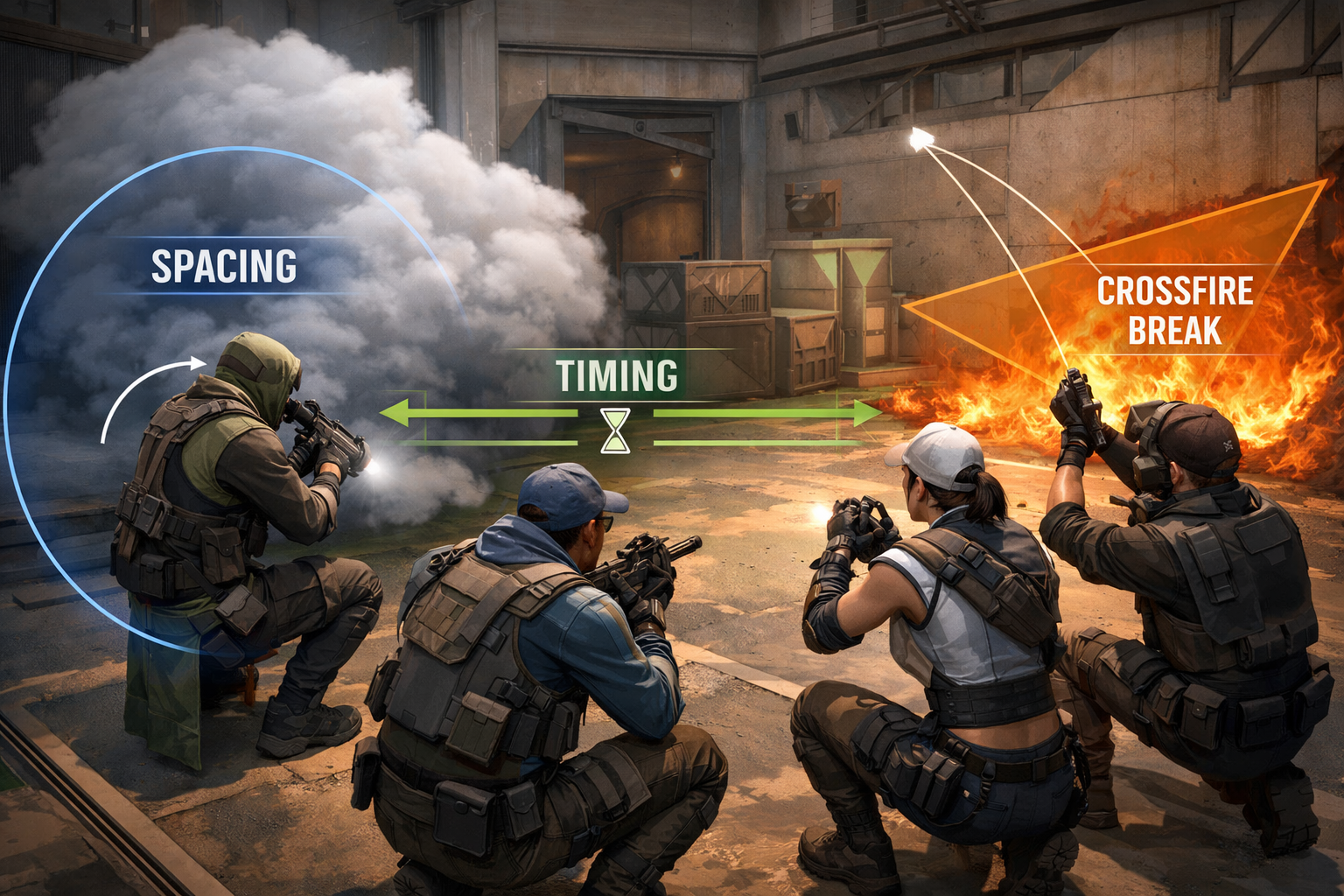
- Using the molly early for minor damage and having none later
- Throwing it with no pressure so enemies simply step away and reset
- Using it on low-value areas instead of strong hold positions
- Wasting it on a choke before attackers fully commit
- Panicking and missing spike-denial timing in post-plant situations
Think of a molly as a time and position weapon. The damage is important, but the real question is always the same: what space am I making impossible for the enemy to use right now?
Utility Rules on Attack
Attacking is where utility often decides the entire round. Raw aim can sometimes brute-force a site, especially in lower ranks, but consistent attacking requires structure. Smokes, flashes, and mollies should work together to remove the most dangerous defenders, compress the map, and let your entries take fairer fights.
1. Utility should make the first two seconds of the hit easier
The opening seconds of a site hit matter the most. That is when defenders are still positioned comfortably and attackers are most exposed. Your utility should target that exact moment. Smokes should already block the key sightlines. Flashes should punish defenders who try to contest the choke. Mollies should clear or displace the stickiest anchor spots.
2. Enter while utility is still active
This sounds obvious, but many failed executes come from hesitation. Players spend utility correctly, then stop moving. The result is that the window closes before anyone uses it. If your team is committed, enter decisively while the defenders are still denied vision or blinded.
3. Do not use every piece on the initial burst
Attackers still need utility after the site is taken. You may need a smoke for the retake lane, a flash for the first defender swing, or a molly for spike protection. The best attacks spend enough to claim the site, but not so much that the post-plant becomes fragile.
4. Utility should support the plant, not only the entry
Winning the site means little if the plant is unsafe. Attackers often focus so hard on the first duel that they forget the planter is vulnerable. Smokes can block long retake vision, flashes can stop immediate re-peeks, and mollies can deny the most dangerous defender path while the spike goes down.
5. Re-hit with purpose
If your first attempt stalls, do not automatically keep forcing. Sometimes the best move is to reset, hold for aggression, and use remaining utility on a second hit. Re-hit utility is especially strong because defenders may think the pressure has passed.
Utility Rules on Defense
Defense is not just about holding angles. It is about making attackers uncomfortable, delayed, and uncertain. Good defensive utility forces attackers to reveal more before they can commit.
1. Time is a defensive weapon
Every second attackers spend waiting through a smoke or a molly is a second your teammates can rotate or gather info elsewhere. Utility on defense often does not need to get kills to be valuable. If it burns fifteen seconds and forces more setup from the attackers, it may have already done enough.
2. Do not show your full hand too early
If you instantly smoke, flash, and molly at the first sign of presence every round, smart attackers will adapt. They will bait your utility, reset, and hit later when you have less to work with. Discipline matters. Make them prove commitment.
3. Use utility to keep favorable fights, not only to panic survive
Defenders often waste utility after they are already overwhelmed. The stronger pattern is to use utility slightly earlier, when it can preserve your position or let you fall back cleanly. That way you keep structure instead of scrambling.
4. Defensive utility should guide teammate rotations
If your smoke or molly buys time, use that time actively. Communicate whether the pressure feels real, whether enemies are respecting the utility, and whether teammates can cheat toward your site. Utility is not just delay. It creates rotation decisions.
5. Save at least one strong piece when possible
Defensive rounds often become messy late. A saved flash for retake or a saved smoke for the spike can be the difference between a lost site and a recoverable round. Avoid the trap of spending everything during first contact unless the round truly demands it.
Utility Rules for Retakes
Retakes are where disciplined utility usage shines. Many players think retakes are just desperate aim battles. In reality, they are structured puzzles. The attacking team has planted, but they are often spread into post-plant positions. Good retake utility isolates those positions and breaks their support network.
1. Identify the strongest post-plant angle first
Before spending anything, identify what actually makes the retake hard. Is there a long sightline controlling the spike? A close player behind cover? A crossfire between site and main? Your first smoke, flash, or molly should address the most dangerous problem first.
2. Retake in layers, not in panic
Many failed retakes happen because defenders run in separately with separate utility. The better approach is to layer actions. Smoke a long lane. Flash a close swing. Molly a sticky corner. Clear one segment of the site at a time. Retakes become much easier when the team creates a sequence instead of five isolated hero plays.
3. Use utility to create one fair defuse window
You do not need permanent control. Often you only need a short period where attackers cannot see or contest the spike comfortably. One smoke on a long post-plant position, one flash to push a close defender back, and one molly to clear a pocket may be enough to create that window.
4. Do not waste utility before your team is ready to swing
Retake flashes and smokes lose value fast if teammates are still far away. Make sure the players who need the opening can actually move on it. Timing is everything.
Utility Rules for Post-Plants
Post-plant play is where many rounds are thrown. Players either over-peek when they should play utility, or they play too passively and give defenders a free retake. Smokes, flashes, and mollies are all vital here, but only if used with patience.
1. Play for the spike, not for random duels
Once the spike is planted, your goal shifts. You do not need to chase every fight. Instead, use utility to make the spike difficult to access or difficult to stick. A smoke can block the defuse cover lane. A flash can punish the tap. A molly can force defenders off the spike entirely.
2. Keep crossfires alive
Post-plant utility should support teammate spacing. Do not smoke in a way that removes your own crossfire unless it directly helps spike denial. Do not flash blindly into a fight your teammate is already winning. Good post-plant utility increases control without breaking your structure.
3. Use the clock intelligently
Late-round utility is about timing, not speed. A molly used too early may expire before the defuse attempt. A flash used before the tap may reveal your position for free. Think in terms of pressure windows. Force the defender to make multiple uncomfortable decisions under time pressure.
4. Punish the first real commitment
The first tap is not always the best utility cue. Sometimes it is just information bait. Watch for patterns. If the defender is isolated, low on time, or under angle pressure, the first tap may be real. If the retake still has multiple players and plenty of time, patience may be stronger.
Solo Queue vs Team Play Utility Usage
Utility principles stay the same in solo queue, but the execution must be simpler and more self-sufficient. You cannot assume perfect timing or deep coordination. That means your utility should be clear, practical, and easy for random teammates to understand.
In solo queue
- Use simple utility with obvious purpose
- Give short calls before you use it
- Avoid fancy sequences that require exact team timing
- Prefer utility that directly helps the next fight
- Hold more utility for late-round self-sufficiency if teammates are unreliable
For example, a simple “smoking Heaven, flashing site, swing now” is much better than a complicated layered plan no one follows. Solo queue rewards clarity.
In coordinated team play
- Layer utility in specific order
- Assign roles clearly for entry, support, and post-plant
- Use utility to condition the enemy across multiple rounds
- Save niche lineups and re-hit patterns for mapped situations
- Play around exact timing windows and crossfires
In organized play, utility becomes more strategic because everyone understands the sequence. But the fundamentals still apply. Even with a stack, utility should solve problems, reduce angles, and support movement.
Common Utility Mistakes
If you want fast improvement, fix these errors first:
1. Auto-piloting utility
Many players throw the same smoke, flash, or molly every round regardless of enemy behavior. That becomes predictable and low value. Utility should respond to the round, not only to your habit.
2. Spending utility with no follow-up
A smoke with no hit, a flash with no swing, a molly with no pressure. These are classic wastes. Utility works best when paired with movement or a plan.
3. Overcommitting early
Using everything in the first contact leaves nothing for post-plant, retake, or clutch moments. Strong players think ahead.
4. Poor communication
You do not need a speech. You just need clarity. If teammates know what is coming, your utility becomes dramatically stronger.
5. Ignoring enemy adaptation
If opponents start playing anti-flash, pushing smokes, or baiting your mollies, you must adjust. The best utility users are adaptable, not rigid.
6. Treating utility as separate from gunplay
Utility exists to shape gunfights. If you throw it and then take the same bad duel anyway, you wasted the opportunity it created.
How to Practice Utility Properly
Improving utility usage is not just about memorizing lineups. In fact, lineup obsession can distract from more important fundamentals. The best practice focuses on decision-making first and mechanics second.
1. Review your own rounds
After matches, ask simple questions:
- Why did I use that smoke?
- Did anyone benefit from that flash?
- Did my molly actually deny something important?
- Could I have saved utility for a higher-value moment?
Those questions reveal waste quickly.
2. Learn a small pool of reliable setups
You do not need twenty flashy lineups per map. You need a dependable set of smokes, entry flashes, and practical mollies that you can use under pressure. Reliability beats variety for most players.
3. Practice utility with movement
Do not practice only the throw. Practice the throw plus the swing, the smoke plus the cross, the molly plus the clear. Utility is part of action flow.
4. Work on timing with teammates when possible
Even one practice partner helps. Count down simple peeks. Test how long a smoke window feels during a real entry. Practice flashing for each other on common paths. Timing becomes cleaner very fast with repetition.
5. Focus on one improvement theme at a time
One week, focus on not wasting defensive mollies early. Another week, focus on cleaner retake flashes. Another week, focus on saving one smoke for post-plant. Small focused improvements stack into major progress.
How Utility Helps You Rank Up Faster
Players often search for the fastest way to climb in Valorant, and many focus only on aim routines, sensitivity, or duel habits. Those matter, but utility is often the easier improvement path because most players misuse it badly. That creates huge room for quick gains.
If you smoke more intentionally, flash with better timing, and save mollies for real impact, you will:
- Take fewer impossible fights
- Convert more site entries
- Hold sites longer on defense
- Win more retakes and post-plants
- Support teammates more consistently
- Become less streaky from game to game
That last point is important. Good utility makes your performance more stable. Even on off-aim days, you can still produce value through structure, timing, and space control. That stability is one of the clearest paths to long-term rank gains.
It also improves your understanding of round flow. Instead of seeing each fight as isolated, you start seeing how the round is built. Which angles matter most. Which utility pieces should be saved. Which timing windows are real. That is exactly the kind of game sense that separates average players from consistently climbing players.
Final Thoughts
The timeless truth about utility in Valorant is this: strong utility makes the game smaller, simpler, and more favorable for your team. Smokes remove dangerous vision. Flashes interrupt comfortable holds. Mollies force movement and deny time. When used with purpose, they reduce chaos and increase control.
The key is not throwing more utility. It is throwing better utility. Every smoke should have a reason. Every flash should support a swing. Every molly should deny meaningful space or timing. Once you start thinking this way, your utility stops being random and starts becoming a win condition.
If you want to improve quickly, focus on fundamentals instead of gimmicks. Solve real problems. Reduce angles. Match timing to movement. Save utility when the round calls for patience. Communicate simply. Adapt when the enemy adapts. These rules stay valuable across patches, maps, and metas, which is exactly why they matter.
Valorant rewards players who can combine mechanics with structure. Utility is where that structure becomes visible. Learn the rules, practice them with discipline, and your impact will rise in every phase of the round.