



Apex Legends Endgame Basics: Zone Reads, Height Control
Apex Legends — Endgame Basics: Zone Reads, Height Control, Third-Party Timing
Table of Contents
- Introduction
- What Counts as an Endgame in Apex Legends
- Zone Reads: How to Understand the Ring Before It Forces You
- Early Planning for Late Circles
- Height Control: When High Ground Wins and When It Gets You Killed
- Third-Party Timing: When to Push, When to Wait, When to Leave
- Fight Selection in Top 10 to Final 3
- Simple Endgame Team Roles and Communication
- Legend-Agnostic Endgame Principles
- Common Endgame Mistakes
- How to Practice Endgames on Purpose
- FAQ
- Final Thoughts
- Image Prompts
- Tags
Introduction
Most Apex Legends players spend a lot of time thinking about aim, loot speed, favorite weapons, or how to survive the mid game. Those things matter, but many matches are decided much later. A squad can rotate well, collect strong gear, and still lose the final circles because they misread the zone, overvalue a piece of height, or enter a fight at the wrong moment. Endgame mistakes are expensive because the room for recovery becomes tiny. There are fewer safe paths, more angles to track, and much less time to fix a bad choice.
This guide focuses on the three ideas that decide an enormous share of late-game outcomes in Apex Legends: zone reads, height control, and third-party timing. These are timeless skills. Maps change, loot changes, legends shift in strength, and balance updates come and go. But the core truth remains the same: teams that understand where the final space will matter most, when elevation is actually useful, and when to join or avoid a fight will win more often than teams that simply shoot first.
If your goal is to become more consistent rather than merely flashy, late-game decision-making is one of the highest-value areas to improve. A good endgame player is rarely surprised. They already know which side of the circle is weak, which team is trapped, which piece of cover becomes premium in 20 seconds, and which gunfight will attract the entire lobby. That makes their matches feel slower, calmer, and more controlled even when everything around them looks chaotic.
In this article, we will break down how to read late rings, how to think about height beyond the simple idea of “high ground is good,” and how to time third parties so your squad gets clean value without becoming the next team to be collapsed on. We will also cover communication, roles, common mistakes, and practical training habits that help you improve faster.
To stay current with the game itself, you can always check the official Apex Legends page, the official news and patch notes hub, and high-level competitive examples through ALGS coverage. If you want to speed up your rank climb while sharpening your overall macro, you can also review Apex Legends boosting prices and compare options that fit your goals.
What Counts as an Endgame in Apex Legends
Many players use the word “endgame” only for the final two or three squads, but that definition is too narrow if you want to improve. In practice, the endgame begins when ring pressure, available cover, and team density start shaping every decision. Depending on the map, lobby strength, and mode, that can begin earlier than people think. Sometimes the real endgame begins the moment your next rotation choice determines whether you will own a playable spot in the last circles or get forced through open ground.
A useful working definition is this: the Apex Legends endgame starts when your decisions must be made with the final ring structure in mind rather than just short-term survival. Once you are no longer rotating for loot or general safety, but rotating for the next winning position, you are in the endgame. Your squad should stop thinking, “Where can we go for now?” and start thinking, “Which location will still be strong after two more closures?”
This shift matters because late circles punish reactive teams. If you only move when the zone starts hurting, you often arrive late, tired, exposed, and predictable. If you treat the endgame as a series of linked decisions instead of one final messy brawl, you begin taking space earlier, protecting better angles, and saving resources for the moments that truly matter.
The endgame also changes what “good” means. A strong building in round three may be terrible in round five if it becomes edge-locked with no escape. A cliff that looks dominant now may become a trap when the circle pulls away from it. A weak squad with little ammo can still win if they arrive first at the only playable cover, while a mechanically superior squad can lose because they held the wrong side of the zone for too long. That is why endgame skill is not just about aim. It is about seeing the future of the fight.
Zone Reads: How to Understand the Ring Before It Forces You
Zone reads are the foundation of strong endgames. They are not only about predicting the exact final pixel of the ring. They are about understanding what space becomes valuable, what routes become dangerous, which teams will be forced to move first, and where you can establish priority before the lobby compresses. Good ring reading gives your team time. Time gives you choices. Choices win games.
The first mistake many players make is thinking of the circle only as a border. In reality, the ring is a pressure system. It squeezes teams into narrower paths, removes certain lines of sight, increases the value of some cover, and destroys the usefulness of others. When you read zone well, you are not just asking, “Where does the ring end?” You are asking:
- Which side of the next circle offers natural cover?
- Which side is overcrowded and likely to produce chain fights?
- Which teams are currently safe but will become desperate in 30 to 60 seconds?
- Which elevation pieces remain strong after the next closure?
- Where can my team rotate without exposing itself to three different sightlines?
A practical way to improve zone reads is to stop staring only at the center. Instead, study the shape of the safe area against terrain. The circle does not exist in a vacuum. Rocks, buildings, ridges, bins, walls, valleys, zip lines, and open lanes matter more than the ring graphic itself. A final zone that looks “centered” can still strongly favor one side because that side has three hard-cover anchors while the opposite side is a death field.
Another important concept is playable space versus visible space. A lot of ground may technically be inside the zone, but only a small portion is truly playable once multiple squads have line of sight. Newer players often overestimate how much room they have because they count all legal space equally. Experienced players understand that some safe ground is fake safety. It is in the ring, but not in the game. If crossing it means getting shot by three teams, it is effectively unplayable.
When possible, think in layers. First layer: where is the next safe place? Second layer: from that place, where can we go after the following close? Third layer: what teams can contest that plan? This turns endgames from panic reactions into route chains. Even if your first plan fails, you will still have a second and third option because you considered them before the pressure peaked.
One more habit helps enormously: identify the forced movers. Every late circle creates winners and losers before a shot is fired. Some teams already have cover and sightlines. Others are stuck on the weak edge, on low ground without protection, or behind teams that will gatekeep them. If you can spot who must move first, you gain information about timing. You know where action is likely to begin, which lane may open temporarily, and when a third party might become available.
Strong zone reads do not mean you always predict the exact last rock. They mean you arrive in the final minutes with fewer surprises and more control than the squads around you.
Early Planning for Late Circles
One of the best ways to improve your Apex Legends endgame is to begin thinking about it sooner. A team that plans early uses the middle of the match to make the late game easier. A team that never plans early has to solve every problem under stress. That difference is huge.
Early planning starts with honest evaluation. Ask three simple questions as soon as the lobby begins to thin out:
- Are we a team that wants priority position, or are we better playing edge and entering late?
- Do we currently have the meds, ammo, utility, and armor state to survive a long hold?
- What kind of terrain are we likely to face in the last two circles?
These questions stop your team from following generic rules. Some squads hear “rotate early” and do it every game, even when they are under-equipped, badly positioned, or likely to be pinched on arrival. Other squads hear “play edge” and keep fighting too long, only to die while crossing impossible open space into the late zone. The correct choice depends on your current resources, legend tools, and the kind of ground available.
For example, rotating early into a strong building or ridge can be excellent if your team has enough healing, enough ammo to poke selectively, and good tools for holding angles. But if you are already low on cells, short on grenades, and lacking escape options, arriving early can turn into a slow bleed. In that case, a cleaner edge approach with one decisive fight and a late wrap may be stronger.
Pay attention to the types of cover that will matter later. In some endings, hard cover is everything. In others, micro-terrain such as slopes, head glitches, railings, or tiny ridgelines decide whether you can survive the last collapse. If you train yourself to notice future anchors early, your rotations become less random. You will stop landing in “safe for now” positions and start choosing spots that remain useful as the ring tightens.
Early planning also means protecting resources. Too many teams spend grenades for low-value pokes, overpeek and waste shields, or burn mobility tools to take meaningless mid-game duels. Then they reach the endgame with no way to crack a hold, no throwable pressure, and no reset options. Great late-game squads look disciplined partly because they preserve the right resources for the right minute.
Think of the endgame as an exam you start preparing for several minutes in advance. If you wait until the last second to study, you will feel rushed and helpless. If you prepare early, the same situation becomes manageable.
Height Control: When High Ground Wins and When It Gets You Killed
“Take height” is some of the most common advice in Apex Legends, and it is not wrong. The problem is that it is incomplete. High ground is powerful, but it is not automatically correct. Height becomes valuable only when it gives better sightlines, safer damage, better information, and a sustainable next move. If elevation offers none of those things, it can be a trap dressed up as an advantage.
Let us start with why height is usually good. High ground lets you see rotations earlier, damage teams before they arrive, and control movement through narrow lanes. It often reduces the number of angles from which enemies can shoot you, especially if the platform has clean edges and solid retreat cover. Height also makes it easier to drop for a finish and harder for other teams to surprise you from below. In chaotic late circles, that information edge is massive.
But there are several reasons why the strongest players do not blindly commit to every elevated position:
- Dead height: Some high ground is strong only until the circle shifts. If you cannot leave cleanly after the next closure, you are sitting on a delayed death sentence.
- Exposed height: If multiple squads can beam your team from side angles or neighboring peaks, your elevation is not true control. It is a spotlight.
- Overcrowded height: Some elevated areas attract so much attention that holding them becomes harder than holding grounded cover nearby.
- Low-quality height: A roof or ridge with no head cover, no reset corner, and no drop option is weaker than a lower position with stable cover and better future access.
The real question is not “Do we have height?” It is “What does this height allow us to do next?” If the answer is only “shoot people for a bit,” you may be overstaying. If the answer is “see both rotate lanes, force weak teams to move first, protect our own reset, and drop late into the winning area,” then the height is truly valuable.
Another important distinction is between owning height and renting height. Owning means you can reasonably defend it, reset on it, and leave it on your terms. Renting means you are on it temporarily while stronger teams, ring pressure, or lack of cover make your stay limited. Many losses happen because a squad mistakes rented height for owned height and commits too long.
Good teams also know when to play just under or beside high ground instead of on top of it. Sometimes the winning move is to let another squad advertise itself from the peak while your team quietly plays the safest grounded cover that the next circle will favor. That way, the “power” team above becomes the lobby’s main target and is forced to descend into your prepared angle later.
In short, high ground in Apex Legends should be evaluated through four filters:
- Information: Can we see enough to justify the position?
- Protection: Can we heal, armor swap, and avoid side angles?
- Transition: Can we leave if the ring shifts away?
- Conversion: Can we turn this position into a real endgame win instead of temporary poke damage?
If your height fails two or more of these tests, be careful. It may look strong but play weak.
How to Hold Height Correctly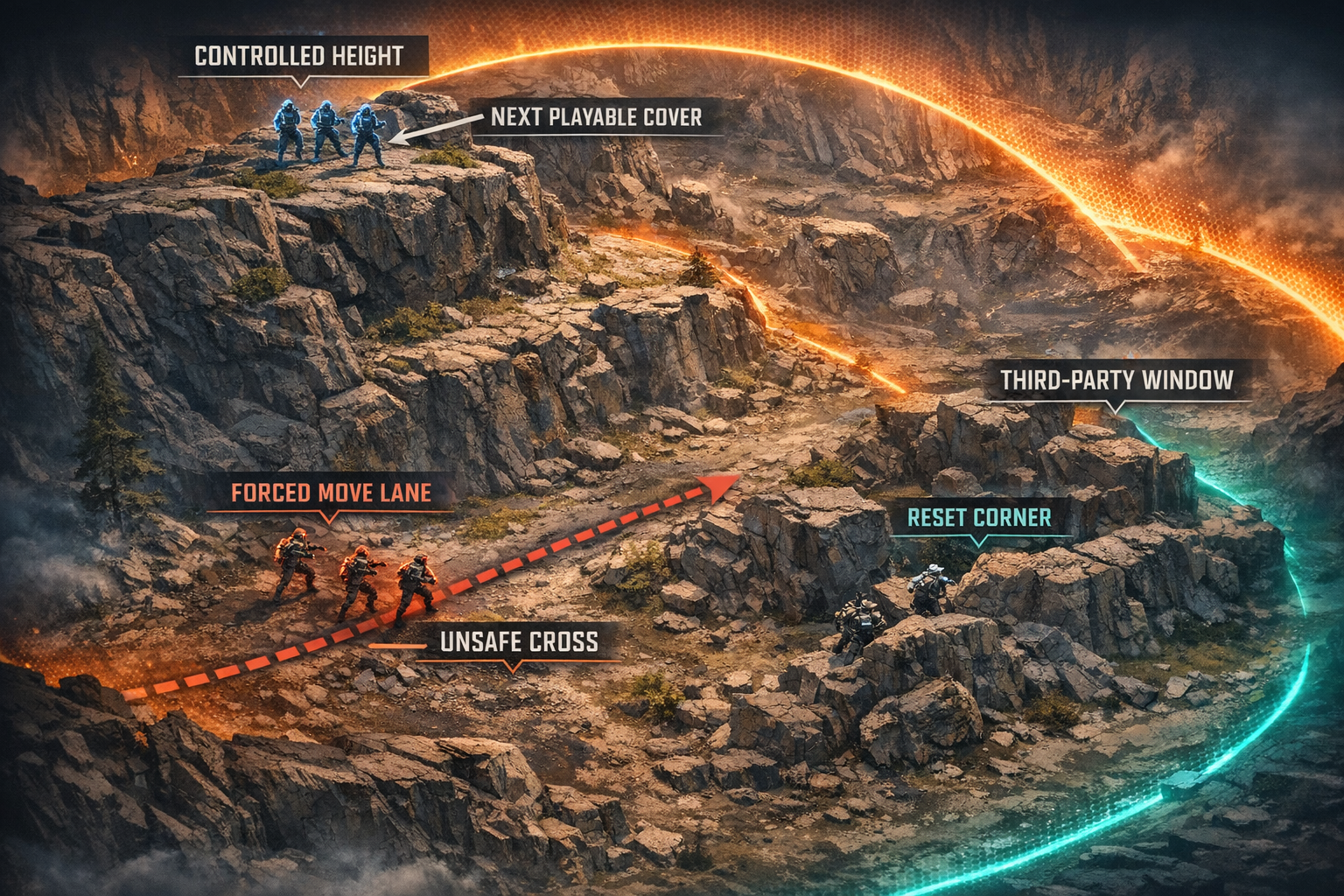
Once your team does choose a strong elevated position, the next mistake is overextending for damage. The goal of height is not to chase every knock. The goal is to control tempo. That means managing peek discipline, watching climb points or approach lanes, and avoiding split positioning where one teammate is isolated on a greedy off-angle.
Hold height with layered spacing. One player watches the most likely entry or climb, one controls the main damage angle into moving teams, and one stays ready to support either side. This flexible triangle prevents a single crack from collapsing your whole structure. If all three teammates stare at the same squad below, you are not controlling height well. You are tunnel-visioned.
You should also decide in advance what triggers a drop. Do you only drop on a clean knock? Do you drop if another team starts fighting below? Do you never drop unless ring forces it? Teams that discuss these triggers early are much less likely to throw a winning perch because one player got excited by a cracked enemy.
Height should create calm, not chaos. If your squad feels frantic while holding it, you probably do not truly own it.
Third-Party Timing: When to Push, When to Wait, When to Leave
Third-party timing is one of the defining skills of Apex Legends. In the endgame, it becomes even more important because every fight is louder, every reset is harder, and every extra second increases the chance that another squad joins. Many players understand that third partying is good. Far fewer understand when it is actually correct.
A bad third party is easy to recognize after the fact: your team arrives too early, gets focused by both squads, uses too many resources to enter, secures no instant advantage, and then dies to a fourth team. A good third party is almost the opposite. You enter when damage has already been traded, attention is divided, abilities are committed, and one or both teams are weak enough that your presence converts into quick control rather than a long 3v3.
The best timing window is usually not at the first sound of gunfire. It is slightly later, when at least one of the following is true:
- One team has a player knocked or nearly knocked.
- Both teams have already used key cooldowns or defensive tools.
- The fight location leaves limited escape paths.
- The ring will force the survivors into your angle immediately after the fight.
- You can arrive from a side that neither team is currently watching.
A useful question to ask is: are we entering a fight, or are we collecting a fight? Entering means you are becoming a normal combat participant in an unresolved 3v3. Collecting means you are arriving to finish weakened teams, secure loot and armor swaps, and immediately own the space. Endgame success comes from collecting more often than entering.
Another major factor is sound range and visibility. In late circles, even silent-looking fights attract attention because every team is already close enough to hear or see something. That means your ideal third party must be fast. If your push requires climbing an awkward wall, crossing 40 meters of open ground, or burning half your utility just to arrive, the clock is already working against you.
Sometimes the best third-party decision is not to take one. This surprises aggressive players, but it matters. If two teams are fighting in a terrible location that does not help your own endgame path, joining them may only drag you into a long messy exchange while a different squad quietly claims the winning spot. In those moments, it is better to let the lobby remove itself while you improve your position.
There is also the issue of sequencing. If you know a third party is likely but not yet ready, posture for it. Hold the angle that punishes the winner’s reset. Watch exits. Prepare grenades. Deny the heal timing rather than charging in blindly. Many endgame wipes happen because a team grows impatient and tries to force the fight one second too early instead of trapping the survivors one second later.
Signs a Third Party Is Good
- Your route into the fight is short, covered, and quick.
- You have visual confirmation of cracks, knocks, or reset attempts.
- Another team cannot easily take your back while you push.
- The reward is position, loot, armor swaps, or immediate elimination value.
- Your squad can finish the action in under one reset cycle, not a prolonged duel.
Signs a Third Party Is Bad
- You heard shots but have no real information.
- Your path requires crossing open sightlines from multiple teams.
- The ring will punish you before you can finish and reset.
- You are entering from the same front angle the original teams are already fighting through.
- Your team is split on whether to commit, which leads to staggered entry.
Late-game Apex is ruthless about hesitation. A half-committed third party is often worse than no third party. Either arrive cleanly and decisively, or keep your position and punish the survivors afterward.
Fight Selection in Top 10 to Final 3
As the lobby shrinks, every fight has to answer one question: what does this win us? If the answer is vague, the fight is probably unnecessary. This is where many squads sabotage good games. They see an opening, take a 50-50 duel, and forget that in Apex Legends the objective is not to win a random fight. It is to survive and control the last playable space.
In top 10 situations, fight selection should be guided by outcomes, not emotion. There are several good reasons to fight:
- You need space and the team in front of you blocks your only safe route.
- You can quickly remove a weak squad and gain a powerful position.
- You have a clean third-party window with fast conversion potential.
- You need resources and the fight is likely to provide a safe reset afterward.
- The ring timing makes that team vulnerable and unlikely to be supported.
There are also several bad reasons to fight:
- You tagged someone and feel compelled to finish the engagement.
- You are bored and want to create action before the zone closes.
- You assume your mechanics are enough to justify a poor position.
- You want KP even though the fight weakens your chance to win the match.
- You are chasing a knock into a space owned by another team.
As the game reaches final five, every duel becomes more public. This means one of your biggest skills is learning how to threaten without fully committing. You can pressure doors, hold exits, throw grenades into likely heal spots, or pin a team that must move, all without becoming overexposed. The goal is to extract mistakes from other teams while keeping your own structure stable.
In final three, the logic changes again. At that point, timing and sequencing matter more than raw damage totals. Often the winning team is not the one that dealt the most damage over the last minute. It is the one that let the other two teams look at each other first. Your late-game instincts should begin to ask: how do we become the least urgent target until the exact second we become the most decisive actor?
This can mean briefly giving up a damage angle to avoid becoming the obvious focus. It can mean letting a weak team live for 10 extra seconds because they are distracting a stronger team. It can mean refraining from thirsting a knock if that bullet commitment reveals your position too early. Final-three discipline is about timing your visibility.
One of the best habits for fight selection is to constantly rank teams by danger. Which squad has the best position? Which squad is desperate? Which squad is noisy, low, or trapped? Your decisions should usually be built around the strongest threat and the easiest victim. Attack when those two identities align. Avoid getting stuck in long exchanges with teams that are hard to finish and easy for others to hear.
Simple Endgame Team Roles and Communication
Even mechanically skilled players throw endgames because their communication becomes messy. The final rings create overload: multiple audio cues, moving enemies, ring countdowns, ability effects, and uncertain angles. If your squad tries to solve this with random shouting, your information quality collapses right when it should become most precise.
A clean late-game team does not necessarily say more. It says better things. Short, useful, repeated information matters most. Good endgame comms usually focus on four categories:
- Space: where your team is playing and where it can move next.
- Threats: which team or angle is most dangerous right now.
- Timing: who has to move first, when the ring closes, when to swing.
- State: cracks, knocks, heals, armor swaps, and resource problems.
It helps to assign loose roles without becoming rigid. A simple structure might look like this:
- Anchor: protects the team’s safest cover, watches for flanks, and keeps the group from overextending.
- Info caller: tracks ring timing, enemy movement, and likely future space.
- Pressure player: looks for cracks, nade value, and punish windows without isolating.
These roles can overlap, but having them in mind prevents three people from trying to do the same job. In many losing teams, everyone wants to be the pressure player and no one wants to be the anchor. Then the squad gets a knock but loses its own position immediately afterward.
Your comms should also include decision words that reduce ambiguity. Phrases like “hold,” “stabilize,” “swing left on my crack,” “do not drop,” “play late,” “ignore them,” or “we own this rock until close” are far better than vague hype. They give the team a shared script under pressure.
Another overlooked communication skill is calling what not to do. In late circles, discipline wins. A clear “do not chase” or “do not peek wide” can prevent the exact mistake that loses the game. These preventive comms are often more valuable than reactive ones because they stop panic before it starts.
Finally, remember that confidence and calm are contagious. A composed voice helps the whole team make cleaner choices. Endgames feel faster when the comms are bad. They feel slower when the comms are good.
Legend-Agnostic Endgame Principles
A timeless Apex Legends guide should not depend too heavily on one meta or one set of balance numbers. The strongest endgame concepts survive across roster changes because they are built on space, timing, and pressure rather than one specific ability interaction. Here are the legend-agnostic rules that stay valuable across seasons.
1. Play Cover Before Damage
The late game rewards players who protect their own stability first. A tempting damage angle is never worth it if it abandons your reset spot, opens a fatal crossfire, or separates you from support. Cover is what allows your damage to matter. Without cover, even a strong beam can turn into a losing trade.
2. Value Resets More Than Peaks of Aggression
Many endgames are won by the team that resets cleaner, not the team that peaks highest. Armor swaps, heal timing, reloading in safety, regrouping after a knock, and restoring clean spacing are all winning habits. If your team cannot reset, your earlier damage becomes irrelevant.
3. Keep Angles Connected
Off-angles are useful only if teammates can support them. Connected angles create crossfire without isolation. Unconnected angles create highlight clips for the enemy. In late circles, your squad should be hard to collapse on. If one player gets cracked, the other two must still be able to protect or trade.
4. Make the Ring Fight for You
The ring is not just a threat to survive. It is a tool to exploit. Teams that are late, weak, or trapped by terrain can be pressured by the circle even before you hard commit. Sometimes the correct play is to hold the exit lane and let the ring do part of the work.
5. Enter Final Three With a Plan, Not Hope
By the time only three squads remain, your team should already know the most likely first target, the biggest threat, and the condition that triggers your swing. Hope is not a plan. “Let’s see what happens” is how teams lose winnable endings.
6. Utility Is Time
Whether your composition offers defense, zoning, movement, scans, healing support, or explosive pressure, its real value in the endgame is often measured in seconds. Every second gained can mean a safer rotate, a cleaner reset, or one more forced enemy move. Think of utility not as spectacle, but as time control.
7. Do Not Confuse Information With Permission
Seeing a weak team does not automatically mean you should push it. Information creates options, not obligations. Good players separate “we know they are weak” from “we are in position to kill them safely.”
Common Endgame Mistakes
Improvement becomes much faster when you know what errors repeat most often. Below are some of the biggest late-game mistakes Apex Legends players make, even at decent ranks.
Rotating Too Late Because the Current Spot Feels Fine
A temporary safe position can hide a future disaster. Teams often stay one closure too long because they are comfortable in the moment. Then the next move becomes impossible. Comfort now is not the same as strength later.
Overcommitting to Height
Players love high ground, so they sometimes treat it like a victory condition instead of a tool. If the next circle leaves your platform exposed, isolated, or dead-ended, staying there out of pride is a throw.
Turning a Good Third Party Into a Bad Full Fight
You arrive with advantage, secure one knock, and then keep chasing deeper than needed. Suddenly you are healing in a bad spot while another squad arrives. Good third parties are about speed and structure, not emotional momentum.
Ignoring Forced Movers
Some squads burn resources poking teams that are already safe while completely ignoring the teams that must rotate through them in 10 seconds. This is backwards. Forced movers are often the easiest source of efficient damage and control.
Using Every Resource Before the Final Collapse
Grenades, movement tools, defensive options, and healing all become more valuable as space shrinks. Spending them for low-value mid-late pokes can leave your squad empty when the final push or hold actually matters.
Peeking for Confirmation Instead of Playing the Odds
Some players keep wide swinging just to “check” an angle they already know is dangerous. In the endgame, extra confirmation can be deadly. If two squads likely see that lane, trust the macro read and reposition instead of feeding for certainty.
Failing to Armor Swap Fast Enough
Late circles reward decisive resets. If a fresh shield is available and your team hesitates, you can lose the fight window or get overrun during a slow heal. Fast armor swaps are not a flashy mechanic; they are a core endgame survival skill.
Breaking Team Shape for One Knock
A downed enemy is tempting, but thirsting or chasing too deep often destroys spacing. Good teams ask whether securing that elimination is worth losing their own structure. Often it is not.
Thinking Damage Equals Pressure
Not all damage matters. Fifty safe damage that delays an enemy cross may be huge. One hundred risky damage that exposes your team to three sightlines may be worthless. Pressure is about what the damage changes, not the number itself.
How to Practice Endgames on Purpose
A lot of players say they want better endgames, but they do not train them directly. They simply play matches and hope experience accumulates. Experience does help, but targeted practice is far faster. The key is to review and repeat the decisions that decide late circles.
1. Review Losses by Decision Point, Not by Final Death Screen
When you lose, do not stop at “we got third-partied” or “we died in final three.” Go backward. Ask where the real loss began. Was it the late rotate? The greedy roof? The unnecessary swing? The wasted grenade stack? Most endgame losses begin 20 to 60 seconds before the death actually happens.
2. Track One Endgame Theme at a Time
Pick one concept for several sessions. For example:
- Today I will focus on identifying forced movers.
- Today I will leave bad height earlier.
- Today I will only third-party if we have a short, covered route.
- Today I will call the next playable cover out loud every ring.
This makes improvement measurable. If you try to fix everything at once, you usually fix nothing clearly.
3. Watch High-Level Play With Specific Questions
If you watch strong players or professional matches, do not watch passively. Focus on one question per session, such as: why did this team leave height here? Why did they not swing on that crack? Why did they accept low ground? Why did they wait five more seconds before third partying? When you watch with a purpose, the game starts to reveal its deeper structure.
4. Practice Clean Micro-Resets
Endgames are full of tiny reset windows. Train yourself to reload behind cover, swap armor instantly, cancel greed, and rejoin teammates quickly. These habits look small, but they create huge differences in final-circle survival.
5. Use Simple Post-Game Notes
After each session, write down three things:
- One endgame choice that worked.
- One endgame choice that failed.
- One pattern you want to test next time.
This turns random experience into deliberate learning.
6. Build a Repeatable Late-Game Checklist
Before every major rotation in the late game, ask:
- Where is the next playable cover?
- Who has to move before us?
- What is the best height and is it actually sustainable?
- What fight helps us win, not just farm damage?
- What resources must we keep for the final collapse?
If you repeatedly ask these questions, your endgame performance becomes much more stable.
FAQ
Is it always better to rotate early in Apex Legends endgames?
No. Early rotations are powerful when they secure premium space that remains playable and when your team can afford to hold it. But rotating early into weak cover, a dead building, or a spot that drains resources can be worse than arriving slightly later through a better lane. The correct rule is not “rotate early every game.” It is “arrive with a plan before your choices disappear.”
How important is high ground in final circles?
High ground is very important, but only if it provides real control. Strong height gives information, protected damage angles, and a clean future transition. Weak height looks good but becomes a trap when the next circle shifts or multiple squads can see it. Evaluate height by sustainability, not by appearance.
When should I third-party in Apex Legends?
You should third-party when the fight is already developed enough that your entry creates fast value. Look for cracks, knocks, used abilities, limited escape paths, and a short safe route into the fight. If you are pushing only because you heard gunfire, the timing is probably not good enough yet.
Should I prioritize kills or placement in endgame?
You should prioritize the fight that improves your chance to win the match. Sometimes that means taking kills. Sometimes it means refusing a tempting engagement so your squad keeps the better position. Strong endgame players understand that not every damage opportunity is a winning opportunity.
What is the biggest habit that helps average players improve their endgames?
Probably learning to think one ring ahead. Many players only solve the current moment. Better players solve the next moment before it arrives. That single habit improves positioning, resource management, timing, and communication all at once.
Final Thoughts
Apex Legends endgames look chaotic from the outside, but the players who win them consistently are usually following a stable set of ideas. They read the zone as terrain and pressure, not just a shrinking circle. They value height, but only the kind that can be held and converted. They time third parties with discipline instead of rushing at the first sound of combat. Most importantly, they understand that late-game success is less about hero plays and more about clean sequencing.
If you want to close out more matches, stop treating the final circles like a separate mini-game that begins at the last second. Build toward them. Think about your future cover. Protect your resources. Rank the danger of each team. Know who is forced to move. Decide whether your height is owned or rented. Enter fights for outcomes, not emotion. And communicate in ways that make the game simpler for your squad, not louder.
These are the habits that scale. They work in ranked. They work in organized play. They work across maps, patches, and legend changes because they are built on fundamentals. Once you start seeing endgames this way, Apex Legends slows down. The lobby still moves fast, but your decisions stop feeling random. That is where consistency begins.