



Hearthstone Mulligan Guide: A Timeless Decision Framework
Hearthstone — Mulligan Guide: A Timeless Decision Framework
In Hearthstone, the mulligan is the only phase of the game where you can improve your draw before the first turn begins. That makes it one of the highest-value decisions in the entire match. A strong mulligan does not guarantee a win, but a weak mulligan often creates a game you must spend several turns trying to repair. If you want to climb more consistently, understanding your opening hand matters just as much as learning trades, resource management, and endgame planning.
This guide is built to stay useful over time. Instead of telling you to keep or throw away a list of temporary meta cards, it gives you a decision framework you can apply across formats, expansions, classes, and archetypes. Whether you play fast decks, greedy decks, combo decks, or reactive control lists, the same core questions appear every time the mulligan screen opens: What is my role? What is my opponent likely to do first? Which cards help me play the first three turns well? Which cards become powerful only if the game already goes the way I want?
If you learn to answer those questions quickly and accurately, your mulligans will improve in every version of Hearthstone. You will keep fewer dead cards, build smoother early turns, and enter more games with a clear plan instead of vague hope. For official card text and deck tools, the Hearthstone Card Library and official Deck Builder are useful starting points. If you want matchup trends and deck data, many players also reference HSReplay and Vicious Syndicate. But numbers alone are not enough. The best players combine data with role recognition and real game context.
This article will teach you how to do exactly that. By the end, you should be able to build a mulligan plan from first principles, adapt when you are unsure of the opponent’s exact list, and review your own mistakes without relying on a patch-specific cheat sheet.
Why the Mulligan Matters So Much
Many players treat the mulligan as a quick housekeeping task. They look for a familiar one-drop, toss expensive cards, and move on. That approach works sometimes, but it leaves a lot of win rate on the table. The mulligan is not only about finding “cheap cards.” It is about shaping the first phase of the game around the deck’s real objective.
In Hearthstone, early turns create momentum in several different ways. Sometimes you are fighting for board. Sometimes you are preventing snowball damage. Sometimes you are digging for a specific engine. Sometimes you are trying to avoid hand clunk and buy time until your powerful stabilizers come online. Your opening hand decides whether you start that process cleanly or awkwardly.
A good mulligan gives you one or more of the following advantages:
- A smoother mana curve for the first three turns.
- A clearer plan for who is the beatdown and who is the defender.
- More efficient use of removal, pressure, or setup tools.
- Fewer stranded cards that cannot be played on time.
- Better alignment between your opening hand and the matchup.
A bad mulligan usually creates the opposite:
- You float mana early.
- You keep powerful cards that have no support.
- You fail to contest the board against aggressive starts.
- You miss your first proactive turn against slower decks.
- You confuse “high value” with “high priority.”
The most important lesson here is simple: mulligan decisions should be judged by how well they improve your next few turns, not by how exciting the kept card looks in a vacuum. A six-mana bomb may be one of the best cards in your deck, but if it causes your first turns to collapse, it was not the best card to keep.
The Core Four-Question Framework
If you remember only one part of this guide, remember these four questions. Every strong Hearthstone mulligan can be built from them:
- What is my role in this matchup?
- What is the opponent most likely to do in the first three turns?
- Which cards let me spend mana efficiently while advancing my role?
- Which cards are only good if the game is already going well?
That fourth question is the one many players skip. They keep payoff cards because those cards win games when drawn in the right scenario. But the mulligan should favor cards that help create the right scenario in the first place. Put differently: setup is usually more important than payoff.
For example, an aggressive deck usually wants early tempo, sticky threats, and strong openers. A slow control deck may keep cheap interaction, card selection, or a matchup-defining answer. A combo deck may keep a setup piece if it is fast enough, safe enough, and consistent enough to matter early. In each case, the “correct” keep is not about the card’s reputation. It is about its job in that exact matchup.
Step 1: Define Your Role Before Turn One
The first mulligan mistake is failing to identify your role. Many decks are not locked into one identity. A midrange deck can pressure slower opponents and defend against faster ones. A control deck may become the aggressor if the opposing strategy is even slower or more combo-oriented. A combo deck may need to spend its early turns surviving rather than assembling pieces immediately.
Before you keep any card, decide which of these roles you are playing:
- Tempo aggressor: You want to use mana proactively, take initiative, and force inefficient answers.
- Board stabilizer: You expect early pressure and need to survive, answer, and reclaim the board.
- Resource manager: You are not fighting purely for tempo; you are trying to trade efficiently and reach stronger turns.
- Engine setup deck: Your early turns are about finding or protecting a repeatable advantage source.
- Combo or inevitability deck: You want to buy time, draw intelligently, and avoid unnecessary damage or waste.
Your role changes what “good” means. If you are the aggressor, keeping a reactive removal card that has no clean early target is often too passive. If you are the defender, keeping a slow synergy package because it looks powerful on turn six is often too greedy. The card itself has not changed. Your role has.
A useful mental shortcut is this: ask who benefits if nothing happens for the first few turns. If that favors you, you may be allowed to keep slower value or setup tools. If that favors the opponent, you usually need early board impact or faster interaction.
This role-first approach is why timeless mulligan advice always beats patch-specific memorization. Even when cards rotate and lists evolve, roles remain. You still need to know whether you are pressuring, stabilizing, setting up, or reacting.
Step 2: Predict the Opponent’s Most Likely Early Game
Your mulligan is never made in isolation. It is shaped by what the opponent is likely to do before turn four. This does not mean you must know their exact 30 cards. It means you need a practical expectation.
Think in broad patterns:
- Will they open with cheap minions and fight hard for board?
- Will they spend early turns drawing, discounting, or assembling synergies?
- Will they likely skip the board and rely on removal later?
- Do they usually punish greedy keeps?
- Do they tend to present one must-answer early threat, or many small ones?
This style of prediction matters more than card-by-card guessing. In the mulligan, a good model of the opponent’s first three turns is usually enough. You do not need perfect certainty. You need a correct enough plan.
For ladder play, especially in anonymous queues, use the most common early-game pattern associated with the class and current environment. If the class has multiple viable archetypes, ask which opening hand is least punished across the range. That often leads to a “safe keep” approach: keep flexible cards that are rarely dead rather than narrow cards that are amazing only against one version.
When in doubt, prioritize cards that:
- Contest the board early.
- Cycle efficiently.
- Answer broad categories of threats.
- Advance your own game plan without requiring too many conditions.
Another useful habit is to pay attention to what the opponent keeps. A full keep often signals a hand with a defined curve or key matchup cards. A full throwback may indicate they are searching aggressively for early structure. This information is not perfect, but it can sharpen your first few decisions after the mulligan ends.
Step 3: Sort Your Hand into Keep Buckets
Once you know your role and the opponent’s likely early plan, sort every card in your opener into one of four buckets:
- Always keeps in this matchup
- Conditional keeps
- Support keeps
- Throwbacks
1. Always Keeps
These are the cards that are good almost every time in that matchup. Usually they are efficient early plays, premium setup tools, or uniquely important answers. A true always-keep card should meet at least one of these standards: it fits your curve perfectly, it performs a critical role early, or it is so efficient that it shapes the matchup by itself.
2. Conditional Keeps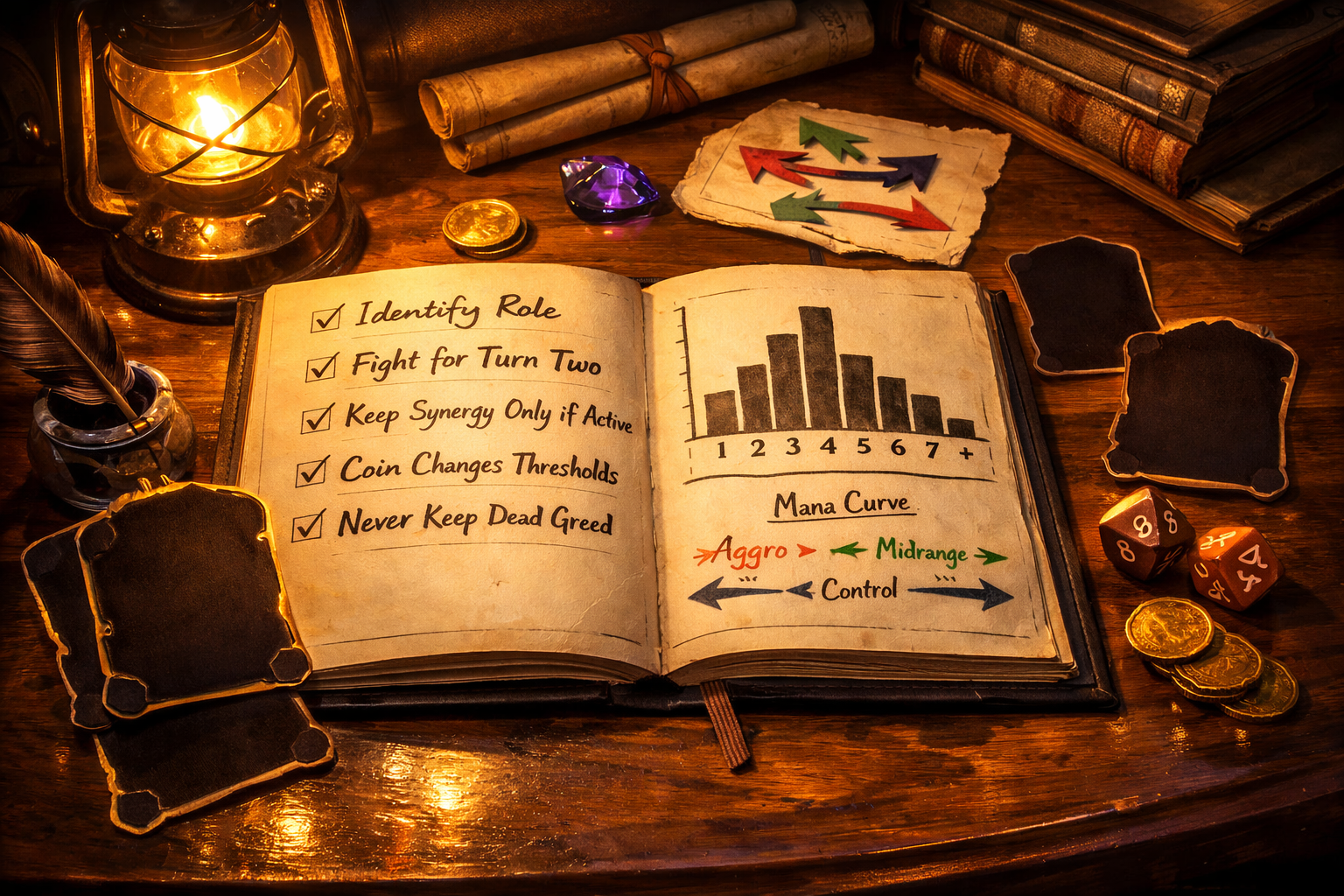
These cards are good only when specific conditions are met. Maybe they require another card already in hand. Maybe they are excellent only with the Coin. Maybe they are strong if you already have turn one and turn two mapped out. Many mulligan errors come from treating conditional keeps as automatic keeps.
3. Support Keeps
These are cards you keep because your hand is already strong. They are not worth keeping alone, but they become reasonable when the first part of your curve is secure. Think of them as “bridge” cards or synergy enhancers. They make a good hand better, but they do not fix a weak hand by themselves.
4. Throwbacks
Throwbacks are cards that either arrive too late, are too narrow, or solve a problem the matchup may not present soon enough. A card can be one of the strongest cards in your deck and still be a throwback in the mulligan. Strength later is not the same as priority now.
This bucket system helps you stay disciplined. Instead of thinking “this card is strong,” you think “what bucket does it belong to, and why?” That shift prevents greedy autopilot keeps.
Step 4: Curve and Sequencing Beat Raw Card Quality
One of the most timeless truths in Hearthstone is that unused mana in the early game is expensive. Even decks that eventually win through big turns usually perform better when they reach those turns from a stable position. The mulligan should therefore emphasize playability and sequencing.
Ask yourself these practical questions:
- What is my likely turn one, turn two, and turn three?
- If I keep this card, when do I realistically play it?
- Does this hand use my mana efficiently without relying on topdecks?
- Do my plays conflict with each other, or do they build naturally?
A hand with three “good cards” can still be bad if those cards collide on the same turn or leave earlier turns empty. Conversely, a hand with modest card quality can be excellent if it spends mana smoothly and creates initiative.
Sequencing also reveals hidden greed. A player may keep a synergy card because it feels like part of a powerful package, but if the enabling card is not already present, the keep may just be fantasy. Always judge synergies by how many moving parts are already in place. The fewer assumptions a keep requires, the better it usually is.
Think of your mulligan as the construction of a runway. If your first three turns are clean, the rest of the deck can take off. If the runway is broken, even your strongest draw steps often arrive one turn too late.
How the Coin Changes Mulligan Decisions
The Coin is not just one extra mana. It changes the value of your opening hand in several ways. It can smooth a curve, enable a jump turn, protect a synergy keep, or increase the value of a card that would otherwise be too slow. But it can also tempt players into keeping cards that are still clunky even with the Coin.
When deciding whether the Coin changes a keep, ask:
- Does the Coin let this card come down at a truly meaningful breakpoint?
- Does it complete an already solid curve, or is it just masking a weak hand?
- Would I still be happy if I had to spend the Coin elsewhere?
A common error is keeping a three-cost card with the Coin in a hand that still has no turn one or turn two plan. That is often not a strong curve. It is just one acceptable turn. Good Coin keeps improve the whole hand, not only a single play.
The Coin also increases the value of conditional hands when your deck can snowball initiative. If your strategy benefits massively from landing a premium tempo card one turn early and protecting it, then the Coin can justify keeping that card. But if the matchup is about survival, flexibility is often better than greed. Do not let the Coin talk you into ignoring the actual texture of the matchup.
A Matchup Framework for Aggro, Midrange, Control, and Combo
While every Hearthstone deck is unique, most mulligan decisions become easier when you understand the four classic matchup families. These categories are broad on purpose. They help you build a timeless framework even when archetype labels change.
Against Aggro
Against aggressive decks, your mulligan should respect survival, board control, and mana efficiency. Cheap removal, early minions that trade well, armor or healing enablers, and sticky contest cards all rise in value. Slow greed falls sharply. The main question is not “what wins late?” but “what prevents me from falling behind too far to recover?”
If you are also an aggressive deck, the matchup often becomes a board race where initiative matters more than theoretical value. In those games, the best keep is usually the one that secures the first efficient board presence rather than the one with the highest ceiling.
Against Midrange
Midrange matchups are often about role fluidity. Some midrange decks curve out and force trades. Others pivot into value once they stabilize. Your mulligan should identify whether you must contest board immediately or whether you can keep a stronger engine or payoff because the pace is slightly slower. Flexible cards are especially important here because midrange decks can punish both passivity and overcommitment.
Against Control
Against slower control strategies, proactive keeps gain value. You generally want cards that create pressure, stickiness, recurring threats, draw toward pressure, or establish a durable engine. Purely reactive cards often lose value unless they are necessary to defend against an early specialized package. Control opponents usually want time, so your mulligan should ask how to deny them a comfortable setup.
Against Combo
Against combo, the correct mulligan depends on whether your deck beats combo by killing them, disrupting them, or out-scaling them. Aggressive decks should usually maximize fast and consistent pressure. Control decks may keep draw, disruption, or a reliable early engine. The most common mistake in these matchups is keeping slow value with no clock. If the opponent’s late-game inevitability is stronger, you cannot mulligan as if the game will be long by default.
The deeper principle across all four families is this: your opener should answer the matchup’s main question, not just your deck’s favorite fantasy.
How Different Deck Archetypes Mulligan
Now let us translate the framework into archetype logic. These are not card lists. They are timeless tendencies that remain useful as expansions and card pools change.
Aggro Decks
Aggro decks usually want cheap proactive plays, pressure that survives interaction, and cards that convert early initiative into lasting damage. Their best keeps often include one-drops, premium two-drops, or cards that make the first board difficult to answer efficiently. They may also keep a buff, weapon, or burn setup piece if the rest of the hand is already fast and coherent.
Aggro players often lose games in the mulligan by keeping too much reach and not enough board. Damage from hand is powerful later, but board pressure is what turns that damage into a real clock. If your hand cannot claim tempo early, your “finisher” may become a stranded consolation prize.
Midrange Decks
Midrange decks value curve discipline more than almost any other archetype. They want to spend mana efficiently and remain flexible enough to pressure or defend depending on the opponent. Their best mulligans often include independently strong early plays, cards that scale with board presence, and tools that let them keep initiative on turns three and four.
The key for midrange decks is avoiding identity confusion. Do not keep overly reactive cards against slow decks when you should be pressing. Do not keep slow greed against fast decks when you should be contesting. Midrange’s strength is adaptability, but that only works if your opener supports the correct adaptation.
Control Decks
Control decks should mulligan based on the opponent’s ability to punish slow starts. Against fast strategies, they need cheap interaction, anti-snowball tools, and a line to stabilization. Against slow strategies, they can often keep card draw, value engines, or especially efficient matchup-defining pieces.
One classic control mistake is keeping expensive inevitability while assuming early interaction will be drawn in time. That is backwards. The mulligan should reduce risk, not increase reliance on topdecks. Control wins long games because it survives the early game cleanly, not because it daydreams about turn ten from the opening hand.
Combo Decks
Combo mulligans depend heavily on speed and vulnerability. Some combo decks can afford to keep dedicated setup because they cycle fast and are not under immediate pressure. Others must mulligan like control decks early, especially if they lose to any meaningful chip damage or board snowball.
The best combo players know the difference between a true setup keep and a fake one. A true setup keep advances the combo while preserving enough tempo or defense to survive. A fake setup keep is one that looks clever but leaves the hand unable to function if the opponent develops normally.
Highlander, Singleton, or Value-Oriented Decks
Decks with lower redundancy demand even more discipline in the mulligan. Because you cannot rely on duplicates to patch awkward draws, you should value universal early functionality. Flexible cards, draw smoothing, and generally useful interaction go up in importance. Narrow keeps become even riskier when your list is less redundant.
Hard Keeps, Soft Keeps, and Trap Keeps
A very practical way to sharpen your mulligan logic is to classify cards by confidence level.
Hard Keeps
Hard keeps are cards you are happy to keep in most hands for that matchup. They are efficient, reliable, and aligned with your role. If your deck guide ever says “always keep,” it is trying to describe a hard keep. These are your anchor cards.
Soft Keeps
Soft keeps are context-dependent. They often require one of the following:
- Another card already in hand
- The Coin
- A specific matchup speed
- A confirmed early curve
- Knowledge that the opponent’s likely list is vulnerable to that card
Most real mulligan skill lives here. Players with poor mulligans either treat soft keeps as hard keeps or throw away too many strong soft keeps because they do not understand the conditions.
Trap Keeps
Trap keeps look smart but usually underperform. They often include:
- High-cost bombs with no early hand support
- Synergy cards without the enabler
- Narrow tech cards against an uncertain field
- Card draw that is too slow to matter in the matchup
- Reactive answers with no likely target in the first turns
A good rule is this: if a card needs several things to go right before it becomes good, it probably does not belong in your opener.
Common Mulligan Mistakes That Cost Games
Even strong players occasionally sabotage their own opening hand. These are the most common mistakes to remove from your game.
1. Keeping for Ceiling Instead of Consistency
Big payoff cards are seductive. But mulligans are not about your deck’s best-case scenario. They are about your most common path to a stable early game.
2. Ignoring the Matchup
The same hand can be excellent against control and terrible against aggro. If you mulligan the same way every time, you are leaving free wins behind.
3. Overvaluing Synergy
Synergy matters only if it is online soon enough and safely enough. A synergy keep without support is often just a clunky card wearing a clever disguise.
4. Underestimating Flexible Cards
Players sometimes throw away “boring” cards that contest board, cycle, or interact efficiently because they are searching for flashy openers. Flexible cards win many more games than they get credit for.
5. Pretending the Coin Fixes Everything
The Coin can improve a hand, but it does not excuse a structurally weak opener. If your hand still has no clear sequence, the Coin is not a miracle.
6. Keeping Reactive Cards Without a Real Target
A removal card is not automatically a good keep. It is a good keep only when the matchup gives it relevant timing and good mana exchange.
7. Refusing to Throw Away Expensive “Signature” Cards
Some players emotionally attach themselves to the most iconic card in their deck. That is understandable. It is also costly. Your best card later is often your worst card now.
How to Use Stats Without Becoming Dependent on Them
Modern Hearthstone players have access to more information than ever. Mulligan win rates, matchup data, deck trackers, and aggregated reports are all useful. Resources like HSReplay and Vicious Syndicate can help you confirm which cards overperform in specific archetypes or matchups. That is valuable, especially when learning a new list.
But data should inform your judgment, not replace it.
Mulligan statistics are strongest when used as a map, not a script. They show patterns across many games, but they cannot fully capture your hand texture, your read on the opponent’s likely list, the exact role you need to play, or how one keep changes the value of another. A card with a strong mulligan win rate may still be wrong in your specific opener if your other cards make the hand too slow or too inconsistent.
The best way to use stats is in layers:
- Learn which cards are generally powerful keeps.
- Understand why those cards perform well.
- Apply that logic to your actual opener and matchup.
If you stop at step one, you become a memorizer. If you complete all three, you become adaptable. That distinction matters whenever the meta shifts, your list changes by a few cards, or the opponent’s class supports multiple viable builds.
For improvement over the long run, reasoning beats memorization. Statistics are at their best when they help you sharpen reasoning.
How to Review Your Mulligans After a Match
Many players review only the flashy moments: the topdeck, the lethal miss, the big swing turn. But the mulligan deserves review because it influences everything that follows. A clean self-review process can improve your win rate quickly.
After each loss, especially a frustrating one, ask:
- Did I correctly identify my role in the matchup?
- Did my opening hand have a realistic turn-one-to-turn-three plan?
- Did I keep any card because it looked powerful rather than timely?
- Would a more flexible keep have reduced dependence on topdecks?
- Did the Coin distort my judgment?
Then go one step further: imagine the best alternative mulligan. Not the perfect draw outcome, but the best reasonable process. What card should have been thrown back? What kind of card were you actually supposed to find?
This review method teaches pattern recognition. Over time you will notice recurring leaks, such as overkeeping expensive synergy, underkeeping anti-aggro tools, or throwing away perfectly functional curve cards because they seemed unexciting. Once you identify your personal pattern, fixing it becomes much easier.
Practice Drills to Build Better Mulligan Habits
Good mulligans are a skill, and skills improve fastest with deliberate practice. Here are simple drills that work well.
The Three-Turn Drill
Before locking your mulligan, state your planned turn one, turn two, and turn three. If you cannot do that, your hand may be less coherent than it looks.
The Role Sentence
Summarize the matchup in one sentence: “I am the defender until turn five,” or “I need early board and then sustained pressure,” or “I just need safe setup.” This forces role clarity.
The Support Test
For every conditional or synergy card, ask: “Would I keep this if the rest of my hand were average?” If the answer is no, it is probably a support keep, not a core keep.
The Dead Card Test
Ask which card in your opener is most likely to sit uselessly in hand through the first four turns. That card is usually your best throwback candidate.
The Replay Bookmark
If you use a tracker, bookmark games where the opener felt awkward. Review only the mulligan, not the full game, and decide whether the problem began before turn one.
These drills are simple, but they build excellent instincts. Over time you will start seeing opening hands less as a pile of cards and more as a set of lines, breakpoints, and matchup answers.
Quick Mulligan Checklist
- Know your role before keeping anything.
- Respect the opponent’s likely first three turns.
- Prioritize curve and playability.
- Keep setup before payoff.
- Use the Coin as a tool, not an excuse.
- Prefer flexible cards when uncertain.
- Throw back greed that needs too much help.
If you follow this checklist consistently, your average opener will improve even before your matchup knowledge becomes advanced.
Why This Framework Helps You Climb
Players often think climbing is mostly about learning advanced lines, rare interactions, or elite decklists. Those things matter, but many ladder gains come from smaller repeatable edges. The mulligan is one of the cleanest examples. It happens every game. It influences every rank. It rewards structure, patience, and discipline.
Better mulligans do not just improve early turns. They simplify the rest of the match. When your opener matches your role, your later decisions become easier. You spend less time improvising from behind and more time converting a clear plan. This matters whether you are a new player trying to understand tempo, or an experienced player trying to maximize every percentage point on ladder.
If your goal is not only to learn but also to climb more efficiently, some players also explore services such as Hearthstone boosting prices while still improving their own fundamentals. But even if you prefer to climb entirely on your own, mastering the mulligan gives you a stable foundation that every strong run is built on.
FAQ
What is the biggest mulligan mistake in Hearthstone?
The biggest mistake is keeping cards for their ceiling instead of their timing. A powerful late-game card often looks tempting, but if it makes your first turns weak, it usually hurts more than it helps.
Should I always keep one-drops?
No. One-drops are often strong, especially in aggressive and tempo-oriented decks, but the real question is whether they fit your role and the matchup. Some one-drops are low impact, while some two-cost or reactive cards matter more in specific matchups.
How much should matchup knowledge change my mulligan?
A lot. Matchup knowledge is one of the main drivers of strong mulligans. The same card can be a premium keep against aggro and an easy throwback against control.
Should I keep synergy cards together?
Only if the package is fast enough, consistent enough, and safe enough. Keeping synergy without early structure is a common trap.
How do I mulligan when I do not know the opponent’s exact deck?
Use broad class expectations and prioritize flexible cards. Keep the cards that are least likely to be dead across multiple archetypes and that still help your own plan.
Do mulligan stats solve everything?
No. Stats are very useful, but they do not replace judgment. Your role, your exact hand texture, and the matchup context still matter.
Final Thoughts
A timeless Hearthstone mulligan guide should not tell you to memorize a changing list of favorite keeps. It should teach you how to think. The best opening hands come from a repeatable process: define your role, predict the opponent’s first steps, favor curve and playability, and separate setup from payoff. That process remains valuable across metas because it is rooted in decision quality rather than temporary fashion.
If you want to improve quickly, start treating the mulligan as the first real turn of the game rather than a pregame formality. Plan the first three turns. Respect the matchup. Throw back greed more often. Keep cards that do something now, not only something amazing later. When you do that, you will notice a quiet but powerful shift: more games begin on your terms.
That is the real goal of a strong mulligan. Not perfection. Not clairvoyance. Just a better, cleaner, more disciplined start to every match.