



Apex Legends Gunskill: Recoil, Tracking & Sens Setup
Apex Legends — Gunskill Fundamentals: Recoil, Tracking, and Sens Setup
Apex Legends rewards more than quick reactions. To win fights consistently, you need repeatable gunskill: the kind that still works when the lobby is sweaty, the enemy is strafing hard, and your nerves start speeding up your hands. That is why this guide focuses on timeless principles instead of patch-dependent advice. Weapons rotate, balance changes, and favorite loadouts come and go. But recoil control, smooth tracking, disciplined crosshair placement, and a stable sensitivity setup remain the foundation of high-level Apex aim.
Many players think aim is mostly talent. In reality, most missed shots come from a small number of fixable problems: sensitivity that is too fast or too inconsistent, weak tracking fundamentals, poor recoil discipline, bad fight spacing, panic spraying, and practice that is too random to build skill. The good news is that all of those problems can be trained. You do not need pro-level genetics. You need a system.
This guide breaks that system down into practical parts. We will cover how Apex gunfights actually work, how to choose and refine a sensitivity, how to control recoil at different distances, how to improve tracking on both mouse and keyboard and controller, how to practice in the Firing Range without wasting time, and how to transfer that training into real matches. Where useful, you can also check the official Apex PC settings guide, the official guns and weapons guide, the official game modes guide, the official terms guide, the ALGS website, and this useful explanation of cm/360 from Aimlabs.
If your goal is ranked improvement and you want a faster path while you build your mechanics, you can also review Apex Legends boosting prices. But even if you never buy anything, the principles below will make you better because they teach you how strong aim is built from the ground up.
Table of Contents
- 1. Why Apex gunskill feels different from other shooters
- 2. The three pillars: recoil, tracking, and sensitivity
- 3. Build a stable baseline before you train aim
- 4. Understanding sensitivity in a useful way
- 5. How to find your own sens setup
- 6. Recoil fundamentals that stay relevant
- 7. Tracking fundamentals for real Apex fights
- 8. How to practice by weapon class
- 9. Mouse and keyboard fundamentals
- 10. Controller fundamentals
- 11. A simple Firing Range routine that actually works
- 12. How to transfer range aim into real matches
- 13. Common mistakes that ruin gunskill progress
- 14. A weekly improvement plan
- 15. How to break plateaus without changing everything
- 16. Final thoughts
1. Why Apex gunskill feels different from other shooters
Apex is not a one-burst tactical shooter where a single headshot decides every duel. It is also not a pure arena shooter where everyone has the same weapon and identical movement options. Apex sits in a demanding middle space. You have longer fights, armor swaps, sliding, climbing, jump movement, peeking around natural terrain, frequent third parties, and weapon variety that changes the shape of each engagement. That means your aim has to do more than snap once. It has to stay stable through motion, chaos, and stress.
That is why tracking matters so much in Apex. In many fights, especially with SMGs and flexible all-round weapons, you are not just placing one precise shot. You are following a moving target through strafes, crouches, slides, and directional changes while controlling recoil at the same time. If your crosshair stays connected to the enemy but your recoil drifts, you still lose damage. If your recoil is perfect but your target reading is poor, you still lose damage. Apex punishes incomplete mechanics.
The game also asks you to make constant range decisions. Shotguns reward spacing discipline and peek timing. Marksman and sniper weapons reward steadiness and prediction. Assault rifles and SMGs reward smooth tracking and recoil control across mixed distances. So when players say they want “better aim,” what they usually need is not one skill but a package of connected habits: proper setup, stable hand speed, clean visual focus, better spacing, and practice that reflects the way Apex fights really unfold.
The useful mindset is this: gunskill in Apex is not random confidence. It is a trainable system of inputs. If your system gets better, your fights get cleaner. Cleaner fights mean more damage, faster knocks, more shield advantage, fewer panic moments, and more wins.
2. The three pillars: recoil, tracking, and sensitivity
To simplify improvement, think of Apex gunskill as three pillars.
The first pillar is recoil control. Recoil is the movement your weapon creates while firing. Some guns kick hard vertically. Some pull to the side. Some feel stable for the first few bullets and then become harder to hold. Recoil control is your ability to keep the weapon’s spray centered enough to convert magazine size into real damage. It is not about memorizing one perfect pattern for every gun forever. Balance changes happen. Attachments change. Your own movement changes. The timeless part is learning how to read kick, respond calmly, and maintain a stable pull.
The second pillar is tracking. Tracking is your ability to keep your crosshair on a moving target over time. In Apex, tracking is king because enemies rarely stand still and fights often last long enough for movement habits to matter. Great tracking is not frantic. It is smooth, predictive, and disciplined. Instead of overreacting to every tiny motion, strong trackers stay centered on likely movement and make efficient corrections.
The third pillar is sensitivity. Sensitivity is the bridge between your intention and the crosshair. If it is too high, you become shaky and lose precision. If it is too low, you struggle to turn, re-center, and adapt in close-range chaos. A good sensitivity does not feel flashy. It feels reliable. It lets you make micro-corrections without losing macro-control.
Most aim slumps come from one of these pillars dragging down the others. A sensitivity that is too fast makes recoil harder to stabilize. Poor tracking makes you think your sensitivity is bad. Weak recoil control makes you think your raw aim is worse than it is. So do not treat these as isolated issues. Train them together.
3. Build a stable baseline before you train aim
Before you start changing sensitivity or grinding recoil drills, build a stable baseline. A huge number of players sabotage their aim with unstable settings, inconsistent equipment habits, and constant tinkering. Mechanical skill improves when your environment is predictable.
Start with performance. Your game should feel smooth enough that your eyes can actually read enemy movement. If your FPS is unstable, your aim will feel unstable even when your hands are fine. Use settings that prioritize consistent performance over visual vanity. You do not need the prettiest Apex to aim well. You need clarity and stability. The official EA settings guide is a good starting reference if you want to review common recommendations for smoother play.
Second, remove obvious inconsistency. On mouse and keyboard, turn off mouse acceleration if you use standard competitive FPS habits. Keep your polling rate and DPI fixed. Use the same mousepad area and seating position each session. On controller, avoid bouncing between different response curves, deadzones, and ALC experiments every few days. If you are using ALC, do it because you understand what you want to change, not because a highlight clip convinced you that copying a pro’s numbers will unlock magic.
Third, keep your FOV and visual comfort stable. A wide field of view can make targets appear smaller. A narrower one can make targets feel bigger but reduce peripheral awareness. There is no universal best number that fits everyone forever. What matters is choosing a value that feels readable and then staying with it long enough to adapt. If you keep changing FOV while also adjusting sensitivity, you make it much harder to evaluate either one.
Finally, protect your training quality. Use a proper warm-up. Sit the same way. Grip the mouse the same way. Rest your thumb placement on controller the same way. Mechanical consistency starts before the first bullet is fired.
4. Understanding sensitivity in a useful way
Sensitivity conversations often get messy because players compare numbers without context. One player says 1.6, another says 4.0, another says 800 DPI, and none of it means much until you know the whole picture. The better way to think about sensitivity is in terms of what your hand must physically do to move your view in-game.
That is why many aim-focused players use concepts like eDPI and cm/360. eDPI combines mouse DPI and in-game sensitivity into one rough comparison number. cm/360 describes how many centimeters of physical mouse movement it takes to spin 360 degrees in-game. The exact value matters less than the principle: your sensitivity should be measured in a way that stays meaningful across games and sessions. If you understand your setup physically, you stop making random changes based only on how “fast” a number looks.
For Apex, the best sensitivity is rarely the fastest one you can survive with for five minutes. It is the one that gives you enough control for recoil and tracking while still letting you clear angles, react to pushes, and handle close-range fights. This usually means choosing a sensitivity that feels stable first and exciting second. Strong mechanics usually look calm.
Your setup also needs role balance between hipfire and ADS. Hipfire should let you control close-range chaos. ADS should let you stabilize mid-range beams without feeling trapped. Some players make their ADS multiplier too low and then feel sticky or slow when the fight gets hectic. Others keep everything too fast and lose precision. The timeless rule is simple: your hipfire and ADS should feel related, not disconnected. You want one aim identity, not two separate games happening inside your settings menu.
On controller, the same idea applies. Sensitivity should let you track smoothly without constantly overshooting. Deadzone should be as low as you can handle comfortably without unwanted drift ruining stability. Response curve should support control, not force you into overcorrection. If your crosshair is always wobbling around the target, the problem may not be your reaction speed. It may be that your baseline input is too loose.
5. How to find your own sens setup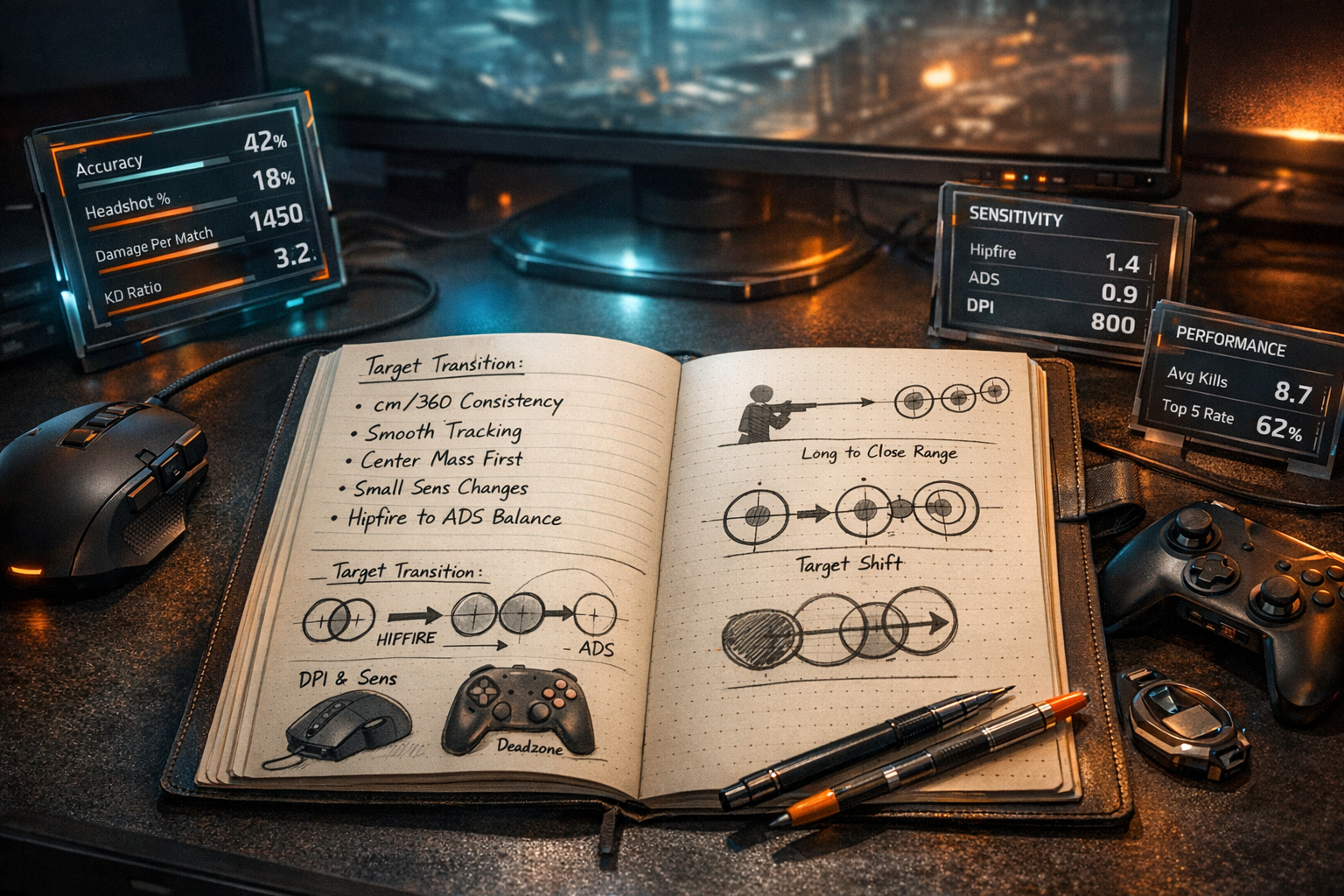
The worst way to find a sensitivity is to copy five streamers in one week and keep the one that feels “cracked” for ten minutes. The best way is a controlled process.
Step one: pick a stable starting point. On mouse and keyboard, that usually means a low-to-medium sensitivity that allows precise control without forcing giant desk movements for every close-range turn. On controller, start with something balanced enough for both tracking and turning, not an ultra-fast setup that only feels good in clips.
Step two: keep everything else fixed. Do not change FOV, crosshair habits, mouse grip, and chair height at the same time. If multiple variables move together, you cannot tell what helped or hurt.
Step three: test the sensitivity in three ways: recoil holding at medium range, close-range tracking on a moving target, and a quick turn into re-centering. A setup that passes only one of these tests is incomplete. Some sens values feel excellent on still targets but collapse in real duels. Others feel fast in room clearing but too twitchy for sustained damage.
Step four: make very small changes. Tiny adjustments teach you more than drastic jumps. If you move too much, your body has to relearn too many things at once. That creates false negatives. A good sens may feel bad for a day simply because the jump was too large.
Step five: stay with the change for several sessions unless it is obviously terrible. Real evaluation takes enough reps to get past novelty. New settings often feel “off” before they feel natural.
Step six: judge by outcomes, not vibes. Are your beams cleaner? Are your micro-corrections calmer? Are you overshooting less? Are your one-mag opportunities increasing? Those answers matter more than whether the settings feel exciting.
Step seven: lock it in once you find a solid baseline. The player who spends a month practicing on a good setup usually improves more than the player who spends a month hunting for a perfect setup.
A useful test for any sensitivity is this: when an enemy strafes left-right at close to medium range, can you stay connected without frantic shaking? If yes, you are in a workable zone. If your crosshair keeps bouncing past the body, you are likely too fast or too tense. If you cannot keep up with direction changes and turns, you may be too slow or too passive with your arm or thumb input.
6. Recoil fundamentals that stay relevant
Recoil control in Apex is often misunderstood. Players either treat it like pure memorization or ignore it completely and hope raw tracking carries them. The truth is in between. Yes, every weapon has its own behavior. But the timeless skill is not memorizing a spreadsheet of spray patterns. It is learning to read upward and sideways kick quickly, apply the right counterpressure, and keep the center of your spray where it belongs.
The first rule of recoil control is do not fight the weapon with panic. When players miss, they often yank harder, speeding up the collapse. Good recoil control is smooth and measured. You are not slamming the crosshair back onto the body each bullet. You are guiding the spray so the average center stays connected.
The second rule is range changes recoil difficulty. A weapon that feels easy up close may become much harder at medium range because small vertical drift becomes meaningful. That means you should not evaluate recoil only at one distance. Practice each weapon category at close, medium, and longer sightlines so you understand when the same spray becomes less forgiving.
The third rule is movement affects your spray value. Apex is not a stationary firing simulator. You often strafe while shooting. That means you need to learn when to commit to a smoother beam, when to short-burst, and when to stop forcing damage through a low-value angle. Recoil control is not just hand control. It is shot discipline.
The fourth rule is bursting is not weakness. Many players lose huge amounts of damage because they insist on full-mag spraying outside their comfortable range. Strong players know when to cut the spray into cleaner segments. A controlled burst that lands is better than a long spray that only looks committed.
The fifth rule is start by mastering the beginning of the spray. The first bullets are the most valuable because they often decide shield pressure, crack timing, and whether the enemy has to give space. If you always lose control after the first few bullets, build practice around making the opening part of each spray perfectly reliable before extending it further.
A simple recoil training progression looks like this. First, fire into a wall or target and observe how the gun climbs. Second, counter the vertical kick until the spray tightens. Third, add side correction. Fourth, repeat while lightly strafing. Fifth, repeat while switching distances. Sixth, practice short reset bursts instead of only full sprays. Once you can do that calmly, your recoil control starts becoming transferable to real fights.
One more timeless point: attachments and patches may change exact feel, but your core method should not. Observe kick, stabilize with smooth input, stay centered on target, and choose the spray length the fight allows. That formula keeps working.
7. Tracking fundamentals for real Apex fights
Tracking is where many Apex duels are won. Not because flicking is useless, but because the game gives enemies room to move and gives your weapons enough sustained fire potential to reward continuous contact. If you want better tracking, stop thinking of it as chasing. Start thinking of it as controlled prediction.
The first rule of tracking is look at the target, not the crosshair. Your hands move the crosshair. Your eyes read the enemy. If your visual focus stays trapped on your reticle, you will react late to strafes and speed changes. Instead, let your peripheral awareness manage crosshair position while your eyes stay locked on the enemy’s center mass and movement cues.
The second rule is reduce unnecessary corrections. Bad trackers overreact to tiny motion and create their own inaccuracy. Good trackers let the target move slightly inside a controllable zone and make smoother, fewer corrections. This is especially important in Apex because enemies do not move like target dummies. They weave, stop, crouch, climb, and use terrain. If you twitch on every micro-change, you fall apart the moment the fight becomes messy.
The third rule is center first, then refine. In close- to mid-range tracking, staying centered on the torso is usually more valuable than forcing risky head-level correction and losing contact entirely. You can always convert to better damage once the target movement becomes readable. But if you lose the body line trying to be too precise too early, your overall output drops.
The fourth rule is match the movement speed. Good tracking feels like the crosshair is traveling with the enemy, not jumping after them. On mouse and keyboard, that often means leading with the arm for bigger movement and refining with the wrist for smaller correction. On controller, it means steady stick pressure instead of repeated hard flicks. The smoother your speed matching becomes, the less aim feels like an emergency.
The fifth rule is expect direction changes. Apex players strafe because they know tracking is powerful. That means you should anticipate the possibility of a reverse strafe before it happens. This does not mean wildly pre-flicking back and forth. It means maintaining enough control that when the reversal happens, your correction is small and calm rather than huge and panicked.
The sixth rule is understand projectile reality. Not all Apex gunfights feel identical across range because bullet travel and drop matter more on some weapons and distances than others. At close range, this usually matters less than your raw tracking and recoil control. At longer ranges, prediction quality rises in importance. So do not train all tracking as if every weapon is a laser pointer. Train range-appropriate tracking.
A strong tracking drill is to keep a moving target centered while firing in controlled strings, then repeat with no firing at all. Many players actually track better without shooting because recoil and emotional tension disappear. That reveals the truth: their “bad aim” is often a blend of visual panic and spray mismanagement. Separate the problems, then reconnect them.
8. How to practice by weapon class
A timeless Apex player does not learn only one favorite gun. They learn weapon families and the mechanical demands each family creates. Since loot is not guaranteed, adaptable gunskill is more valuable than one narrow comfort pick.
Assault rifles: These are classic all-round tools. They teach recoil control, medium-range discipline, and the balance between tracking and burst timing. If you want a foundation class, start here. Assault rifles help you learn how to stabilize damage without needing point-blank chaos to be effective.
SMGs: These expose weak tracking fast. In close-range fights, poor tracking gets punished immediately because time on target matters more than theoretical accuracy. SMG practice should focus on smooth body tracking, maintaining contact through movement, and avoiding panic overcorrection. If your crosshair always jitters at point-blank range, this class reveals it.
Marksman weapons: These teach rhythm, patience, and crosshair discipline. They punish spam and reward calm follow-up shots. Use them to improve medium-to-long-range control, clean sight alignment, and understanding of when to shoot versus when to re-center.
Snipers: These are less about sustained tracking and more about precision, timing, and target reading. Even if snipers are not your main style, they build visual discipline. They teach you to respect movement patterns, bullet timing, and fight tempo.
Shotguns: These are spacing teachers disguised as weapons. Good shotgun aim is not only about raw accuracy. It is about when you peek, how wide you swing, how close you commit, and whether your crosshair arrives where the enemy actually is. If your shotgun damage feels random, the issue is often positioning and timing more than hand mechanics.
Pistols: Pistols sharpen precision and punish lazy centering. They are useful for warm-up because they expose aiming shortcuts. If you can make pistols feel stable, your overall discipline often improves.
For most players, the most effective practice split is simple: spend the largest portion of your time on assault rifles and SMGs, use marksman or shotguns to sharpen discipline, and dip into other classes enough that you are never helpless when the loot is awkward. Adaptability wins more matches than theory-crafted comfort.
9. Mouse and keyboard fundamentals
On mouse and keyboard, great Apex aim usually comes from role clarity between the arm, wrist, fingers, and eyes. Bigger turns and major tracking lines often belong to the arm. Smaller corrections and final stabilization often belong to the wrist and fingers. When these jobs are confused, aim gets messy. Players either become too rigid and cannot track fluidly, or too wrist-heavy and shake through every beam.
If you are an MnK player, ask yourself how you miss. If you miss by overshooting targets repeatedly, you may be too fast or too tense. If you lag behind enemy movement, you may be too slow or too passive. If your first bullets look good and then your spray unravels, your issue may be recoil discipline rather than raw sensitivity. Diagnose the pattern before touching the settings menu.
Your mousepad usage matters too. If you aim only from a tiny central area and keep lifting constantly, your consistency drops. Learn to use enough pad space that you are not trapped in one cramped zone. Good MnK aim usually looks spacious, not cramped.
Another huge factor is grip pressure. Under stress, many players squeeze the mouse harder, which makes motion less smooth. That can turn a fine sensitivity into a terrible one. Relaxed control produces cleaner tracking than forced control. If your aim feels worse in ranked than in the range, tension is likely part of the problem.
For MnK practice, a good structure is: smooth tracking drill, recoil beam drill, burst discipline drill, then close-range strafe tracking. This keeps your input honest. You are not just farming static accuracy. You are rehearsing the exact interactions Apex asks for: moving target, sustained fire, visual reading, and controlled correction.
Finally, remember that flashy movement does not excuse weak aim. Apex movement is valuable, but if your own movement destroys your beam every time, you are making the fight harder than necessary. First learn to shoot while moving simply. Then layer in harder motion without losing damage.
10. Controller fundamentals
Controller aim in Apex also depends on discipline, not only settings. Yes, aim assist exists. No, it does not replace good mechanics. Players who rely on aim assist without building centering, composure, and stick control plateau fast. The best controller players use aim assist as support, not as their whole identity.
Your first priority is clean centering. Aim assist helps most when your crosshair starts in a useful place. If your reticle begins off target, your corrections are still doing too much work. So in every room entry, peek, and post-slide re-center, ask whether your crosshair arrived at chest level and in a likely line of enemy contact.
Your second priority is smooth stick pressure. Many controller players lose accuracy because they treat every correction like a mini-flick. This creates a jerky aim style that breaks contact during close-range tracking. Strong controller aim is often quieter than people expect. It stays glued because the input is measured.
Your third priority is sensible settings discipline. If you are using standard sensitivity options, choose values that let you track comfortably and turn fast enough for pressure situations. If you use ALC, change one thing at a time and understand what it does. The official terms guide defines ALC as a way to get greater control over aiming and movement, but “greater control” only helps if you actually know what control you want.
Deadzone is especially important. Too much deadzone can make tracking feel muddy and delayed. Too little can make your reticle feel restless if your sticks drift. The goal is a calm center with responsive movement, not theoretical perfection on paper.
Controller players should also train without becoming lazy in the Firing Range. If you always rely on the same easy rhythm and never test your centering, you can create false confidence. Mix close-range strafing, medium-range beam control, and target transitions. The point is not to prove that your setup works once. The point is to create a setup and input style that keep working when a real squad swings you together.
11. A simple Firing Range routine that actually works
The Firing Range is useful only if you enter with a purpose. Random shooting is relaxing, but it is not the same as deliberate practice. A strong routine should be short enough to do regularly, specific enough to measure progress, and varied enough to touch your real weaknesses.
Here is a simple 20-to-30-minute routine you can use.
Phase 1: Five minutes of centering and visual warm-up. Start with easy targets. Do not care about speed. Care about clean visual lock and smooth crosshair arrival. This tells your hands that the session is about control, not panic.
Phase 2: Five minutes of recoil beams. Choose one or two weapons from an all-round class and beam targets at short, medium, and slightly longer range. Focus on keeping the first part of your spray clean. If the beam falls apart, stop, reset, and shorten the string instead of grinding bad reps.
Phase 3: Five minutes of tracking. Use moving targets if available, or create your own movement challenge by strafing while keeping a target centered. Alternate between firing and no-firing reps. This helps you see whether your issue is visual tracking or recoil plus tracking together.
Phase 4: Five minutes of target transitions. Move from one target to another calmly. This matters because real Apex fights often involve armor swaps, angle changes, second targets, or a teammate appearing after the first crack. Smooth re-centering between targets is a hidden damage multiplier.
Phase 5: Five to ten minutes of weapon-specific work. Practice the class you currently trust least. For some players, that is shotgun peeks. For others, medium-range marksman control. Improvement accelerates when you stop only rehearsing your comfort zone.
Two rules make this routine effective. First, never extend a bad habit just to finish a timer. Quality over volume. Second, log what felt wrong. Were you overshooting? Was recoil drifting up-right? Were close-range reversals beating you? Those notes tell you what the next session should target.
The Firing Range is best used for calibration, not self-deception. It should answer questions. Is this sens stable? Is my recoil improving? Are my transitions calmer? If the answer becomes yes more often, your matches will eventually show it.
12. How to transfer range aim into real matches
A lot of players aim well in practice and then fall apart in real games. That is not unusual. Range aim happens in safety. Match aim happens under information overload. The transfer problem is usually not that the practice was useless. It is that the practice was incomplete.
To transfer aim into real matches, you need to combine mechanics with decision quality. Start with fight selection. Even strong aim looks weak when you take low-value angles, swing too wide, or challenge from bad cover. A clean beam becomes much easier when your position supports it. That means you should think of aim and positioning as partners. Cover buys time. Time buys accuracy.
Next, pre-aim more. Many missed shots happen before the fight truly begins. If your crosshair enters every angle too low, too wide, or too late, you are forcing yourself into emergency corrections. Better centering creates easier tracking windows and more comfortable first bullets.
Then, slow down your emotional tempo. In Apex, panic is expensive because magazines matter. Players who rush their spray often turn a winning peek into a low-damage trade. Your goal is not to shoot first at any cost. Your goal is to land meaningful damage first. Calm, clean first bullets are worth more than wild speed.
Another huge transfer skill is knowing when not to full commit. If your spray breaks, if the target reaches strong cover, or if the angle becomes too thin, stop forcing the beam. Re-center, reposition, or re-peek. One reason pro-level fights look so clean is that good players stop taking low-percentage continuation shots.
Finally, review your losses correctly. Do not just say, “my aim sucked.” Ask what kind of aim failed. Was it recoil? Tracking? Crosshair placement? Sens panic? Or was it a terrible swing that made any aim difficult? Specific review produces specific improvement.
13. Common mistakes that ruin gunskill progress
Mistake one: changing settings too often. Improvement needs adaptation time. Constant settings changes keep you in permanent re-learning mode.
Mistake two: practicing only when you feel good. Real consistency is built by showing up even on average days. If you practice only when your hands already feel sharp, you never learn how to stabilize mediocre sessions.
Mistake three: training speed before control. Fast, messy reps build messy habits. Start smooth. Speed grows from clean mechanics.
Mistake four: ignoring recoil because tracking feels more fun. In Apex, sustained damage requires both. You cannot outsource one pillar to the other.
Mistake five: treating every weapon the same. Different classes ask different questions of your aim. Respect that. Shotgun timing is not SMG tracking. Marksman rhythm is not spray control.
Mistake six: letting tension control your hands. Ranked anxiety often turns acceptable settings into bad performance. Learn your own stress signs. Death grip, rushed peeks, and over-flicking are all fixable once you notice them.
Mistake seven: measuring improvement only by kills. Gunskill improves before your stats always catch up. Look at cleaner beams, fewer wild misses, better first bullets, and more consistent damage output.
Mistake eight: copying pros without context. Pro settings, routines, and weapon choices make sense inside pro habits. Borrow ideas, not blind numbers.
Mistake nine: neglecting visual habits. If your eyes are late, your hands will always feel late. Good aim begins with good reading.
Mistake ten: expecting one breakthrough session. Gunskill is usually built quietly. Small quality gains compound. That is how real consistency appears.
14. A weekly improvement plan
If you want structure, use a simple weekly plan instead of relying on mood.
Day 1: sensitivity confirmation and recoil focus. Do not change sens unless the problem is clear. Spend most time on clean beams and medium-range control.
Day 2: tracking focus. Use close- and mid-range drills, then play matches with deliberate attention on staying calm through enemy strafes.
Day 3: target transitions and crosshair placement. Play with the goal of arriving ready on every peek, not reacting late.
Day 4: weak weapon class day. Train the category you avoid. This improves adaptability and removes panic when loot is awkward.
Day 5: mixed routine plus match review. Play, then analyze three lost fights. Label the miss type and the positioning error separately.
Day 6: shorter warm-up, more live reps. Let the week’s practice express itself in actual matches. Focus on decision quality and composure.
Day 7: light session or rest. Mechanical skill needs recovery too. Sometimes a short, high-quality session beats a forced grind.
This plan works because it keeps mechanics specific without making training complicated. The biggest long-term advantage comes from regularity. A player who follows a decent plan for eight weeks usually surpasses the player who relies on random grind and occasional inspiration.
15. How to break plateaus without changing everything
Almost every improving player hits a plateau. Your aim is no longer awful, but it no longer rises quickly either. That usually means your biggest weakness has changed. Early on, almost any practice helps. Later, generic practice stops being enough.
When you plateau, first ask what failure still repeats most. Are you losing close-range reversals? Missing medium-range continuation sprays? Struggling after a slide or while peeking right-side cover? Plateaus break when practice becomes targeted again.
Second, reduce variables. Plateaus create the temptation to rebuild everything. Resist that. Change one thing at a time: maybe a slight sens adjustment, maybe a more disciplined warm-up, maybe more focus on transitions instead of static beams.
Third, review video if possible. A five-second missed spray feels mysterious in memory but obvious on replay. You may discover that your “tracking problem” is actually poor centering before ADS. Or that your “bad recoil” begins because you always start firing while still adjusting your strafe.
Fourth, raise the quality of your reps, not just the quantity. More hours of sloppy practice do not solve refined problems. Better intent does.
Fifth, compare yourself to your old form, not to montage highlights. Real improvement is measured by reduced chaos, cleaner decision-making, and better control under pressure. If your beams are calmer now than one month ago, progress is happening.
16. Final thoughts
Apex Legends gunskill is not built from hype. It is built from repeatability. Recoil control keeps your spray honest. Tracking keeps your damage connected. Sensitivity setup turns your intention into consistent input. Put together, those three pillars create aim you can trust.
The best part is that none of this depends on the current flavor of the season. The weapon pool may shift. New content may arrive. Some guns may feel easier or harder over time. But the player who understands recoil, tracking, and sens discipline will always adapt faster than the player who depends on temporary comfort.
If you want a clean path forward, keep it simple. Build a stable baseline. Choose a sensitivity carefully and stop changing it every other day. Train recoil and tracking with intention. Use the Firing Range to solve problems, not just to shoot randomly. Review your fights with precision. Respect positioning and crosshair placement as part of gunskill, not separate from it. And give improvement enough time to compound.
That is the timeless route to better Apex aim. Not a miracle setting. Not a copied config. Not one lucky hot streak. A system.
For extra reference, review the official Apex settings guide, the official weapons guide, the official game modes guide, and keep an eye on top-level play through the ALGS. If you want support for faster ranked progress while you sharpen mechanics, you can also check Boosteria’s Apex Legends pricing page.