



TFT Itemization Guide: BIS vs Flexible Items That Work
Teamfight Tactics — Itemization Principles: BIS vs Flexible Items (Timeless Rules)
Ask ten TFT players why they lost a game and many will blame their shop, their augments, their lobby, or the fact that they “never hit.” Yet a huge share of bad finishes begin much earlier, at the item bench. Players often hold components too long because they are dreaming about perfect best-in-slot combinations. Others slam the wrong early item because it looks efficient on paper but does nothing for the actual board they are playing. The result is familiar: lost HP, broken economy, a weak transition, and a Stage 4 board that is too unstable to convert decent odds into a top 4.
This guide is about the timeless middle ground. In TFT, itemization is not simply “play BIS” or “slam everything.” Strong itemization is the skill of converting uncertain resources into reliable power. That means understanding when best-in-slot really matters, when flexible items are better, when tempo is worth more than greed, and how to make choices that stay good even if your final board changes.
Because Teamfight Tactics changes over time, this article avoids narrow patch advice and focuses on rules that keep working across sets. Specific carries, traits, and exact numbers rotate. The core logic does not. Damage still needs support. Frontlines still buy time for backlines. HP is still a resource. Tempo still matters. Utility still wins rounds that raw stats cannot. If you master those rules, you will itemize better in almost any TFT environment.
If you want live game updates, set-specific mechanics, or current announcements, the official Teamfight Tactics site and Riot’s TFT support hub are good places to check. For current stat trends, match histories, and comp references, many players also use LoLCHESS. But if your goal is to build better fundamentals instead of chasing the flavor of the week, read on.
What BIS Really Means in TFT
BIS means “best in slot,” but many players use the term too loosely. In practice, BIS is not just “the strongest three completed items on a champion in a vacuum.” Real BIS is context-sensitive. It depends on what the unit’s job is, how the board fights, how long combats last, whether the unit needs protection, whether the lobby is burst-heavy or sustain-heavy, and whether your board needs immediate power or eventual ceiling.
That is why blindly copying a comp sheet often creates mistakes. A listed BIS trio may assume a capped version of the board, ideal positioning, upgraded frontline, a stable economy, and specific utility support elsewhere. If you copy only the carry items but your frontline is weak, your “BIS” setup may underperform. If you copy late-game max-cap items onto a midgame board that needs tempo right now, your itemization may be theoretically correct and practically losing.
A better definition is this: BIS is the item setup that gives the highest expected value on the final version of the unit under the conditions where that unit is actually supposed to carry. That is a much stricter standard. It means BIS is real, but narrower than most players think. It also means flexible alternatives can be stronger for your actual game even if they are weaker in spreadsheets or idealized capped boards.
In timeless TFT terms, BIS matters most when a carry has very specific needs. Some carries require attack speed thresholds, mana access, crit conversion, or survival tools to function properly. Others are much more forgiving and can use a wider range of damage items effectively. The more “engine-dependent” a carry is, the more valuable true BIS becomes. The more naturally efficient a carry is, the more valuable flexibility becomes.
Why Flexible Items Win More Games Than People Think
Flexible items win because TFT is not a puzzle where all pieces arrive on command. It is a game of incomplete information. You do not know your full component future early. You do not know whether your shops will support your intended comp. You do not know whether you will hit your upgrades on time. In that environment, playable power now often beats perfect power later.
Flexible items are not “bad items you settle for.” They are items that keep multiple lines open while still improving your board today. A flexible damage item can be held by several different AD or AP carriers. A flexible frontline item can stabilize almost any tank. A flexible utility item can remain valuable even if your main carry changes. These items reduce the risk of dead components and increase the number of transitions your game can support.
This matters because TFT rewards consistency. A player who preserves HP, reaches stable roll timings, and keeps options open will top 4 more often than a player who tunnels on perfect items and crashes whenever the lobby or shop does not cooperate. High-roll games can disguise bad item habits because almost anything works when you hit everything. Your long-term results improve when your item decisions are robust in average games and bad games, not just perfect games.
Think of flexible itemization as probability management. You are converting uncertain future components into a board that can continue earning gold, preserving streaks, and buying time. That is often more valuable than gambling on a future combination that might never arrive. In practical ladder climbing, fewer dead benches and fewer emergency rolldowns usually matter more than having the cleanest final screenshot.
Tempo, HP, and the Real Cost of Greed
One of the biggest timeless TFT lessons is that HP is not just health. HP is time. Every 10 to 20 HP you preserve gives you more rounds to finish key items, reach higher levels, find your upgrades, or pivot away from a contested line. When you greed components too long, you are often spending HP without admitting it. Players remember the one game where they held out and hit perfect items. They forget the many games where that greed quietly converted into an 8th.
Tempo is the board strength you can deploy now. It affects streaking, damage dealt, damage taken, and the freedom you have later. Item slams are one of the most reliable ways to buy tempo because they do not depend on rolling. You can miss shops and still gain power from components. That is why early slams are so powerful in TFT fundamentals: they are guaranteed strength in a game full of uncertainty.
The hidden mistake is treating all HP loss equally. Losing 5 HP on Stage 2 is not the same as losing 15 or 20 across several rounds because you never stabilized. Tempo compounds. A stronger board does not only save HP in one round; it may preserve a streak, generate extra gold, reduce desperation rolling later, and help you reach key levels with more resources. Greed can also compound in the opposite direction: a weak board loses streak, drops HP, forces ugly rolldowns, and reaches late game poor and unstable.
The timeless rule is simple: if slamming an item now clearly improves multiple future rounds and does not completely kill your late-game outs, it is usually correct. Many players understand the phrase “slam for tempo,” but they apply it too late. By the time the board feels desperate, the opportunity window is gone. Strong TFT itemization often looks proactive rather than reactive.
The Four Item Families You Should Think In
A powerful way to make better item decisions is to stop thinking in isolated item names and start thinking in item families. Across sets, names and exact effects may change slightly, but the core categories remain stable. Most TFT item choices fit into four families: damage, durability, mana/engine, and utility.
1. Damage Items
These increase a carry’s raw output through attack speed, attack damage, ability power, critical scaling, execute pressure, burn-like effects, or fight extension through sustain. The important question is not “Is this a damage item?” but “What kind of damage pattern does my board need?” Some carries want front-loaded burst. Some need repeated casts. Some need long-fight scaling. Some need to keep hitting safely for a long time. Picking the wrong damage profile can make a strong unit feel weak.
2. Durability Items
These keep frontline units alive longer through health, resistances, damage reduction, self-healing, shields, or anti-burst patterns. Durability items matter because carries need time. If your carry has three expensive items but your frontline evaporates instantly, your itemization has failed. Tank items are not secondary in TFT; they are the foundation that converts carry stats into actual combat value.
3. Mana and Engine Items
These help a unit start its spell cycle faster, cast more often, or generate resources that let its kit function. Some units are not really “damage carries” until they cast early enough or often enough. Engine items also matter on utility units. A support unit that casts two seconds sooner can swing an entire fight even if it never tops the damage chart.
4. Utility Items
These include effects like healing reduction, resistance reduction, anti-shield pressure, crowd-control enhancement, backline access, or teamwide support patterns. Utility items are the most underrated family in TFT because they do not always create flashy damage numbers. But they often change whether your damage actually sticks. A board that lacks anti-heal or armor/magic resist break may look “fully itemized” and still lose to units it should beat.
The key principle is balance. Most winning boards need enough from each family to function. A board with only damage often dies too fast. A board with only tank items cannot finish fights. A board with no engine may cast too slowly. A board with no utility may lose to sustain or stacked resistances. Itemization is strongest when it solves the whole fight, not just one unit’s stat line.
When to Slam and When to Hold Components
The classic TFT question is whether to slam a decent item now or hold for a better one later. There is no universal answer, but there are timeless filters that make the decision much easier.
Ask These Questions Before You Hold
- Will holding likely weaken my board for several rounds?
- Does the slam preserve a streak or prevent a dangerous loss streak?
- Can the completed item transfer cleanly to multiple future units?
- Am I holding for a truly important upgrade, or just a prettier final build?
- How likely is it that I actually hit the missing component in time?
- Am I healthy enough to be greedy?
If the answer is that the slam helps now, remains usable later, and the item you are waiting for is not absolutely critical, slamming is usually correct. This is especially true in Stage 2 and Stage 3, where tempo often decides whether you get to play the rest of the game from a position of stability or panic.
Holding is best when three conditions align. First, the board is already stable enough to survive without the slam. Second, the alternative item meaningfully changes your endgame ceiling, not just its aesthetics. Third, your future line is reasonably likely. If you are stable, have strong economy, and are clearly aiming for a carry whose performance changes dramatically with a specific third item, then patience can be justified. But that is a narrower situation than many players imagine.
A timeless trap is incomplete flexibility. Sometimes players say they are “staying open,” but really they are doing nothing. Staying open does not mean refusing to commit resources. It means committing them in ways that preserve options. A strong flexible slam is often a more open play than holding two or three components on bench while losing every round.
How to Identify the Right Carry Item Pattern
Instead of memorizing every current carry’s exact BIS, learn to identify carry archetypes. Once you can recognize what a unit needs functionally, itemization becomes much easier even when a new set arrives.
Burst Casters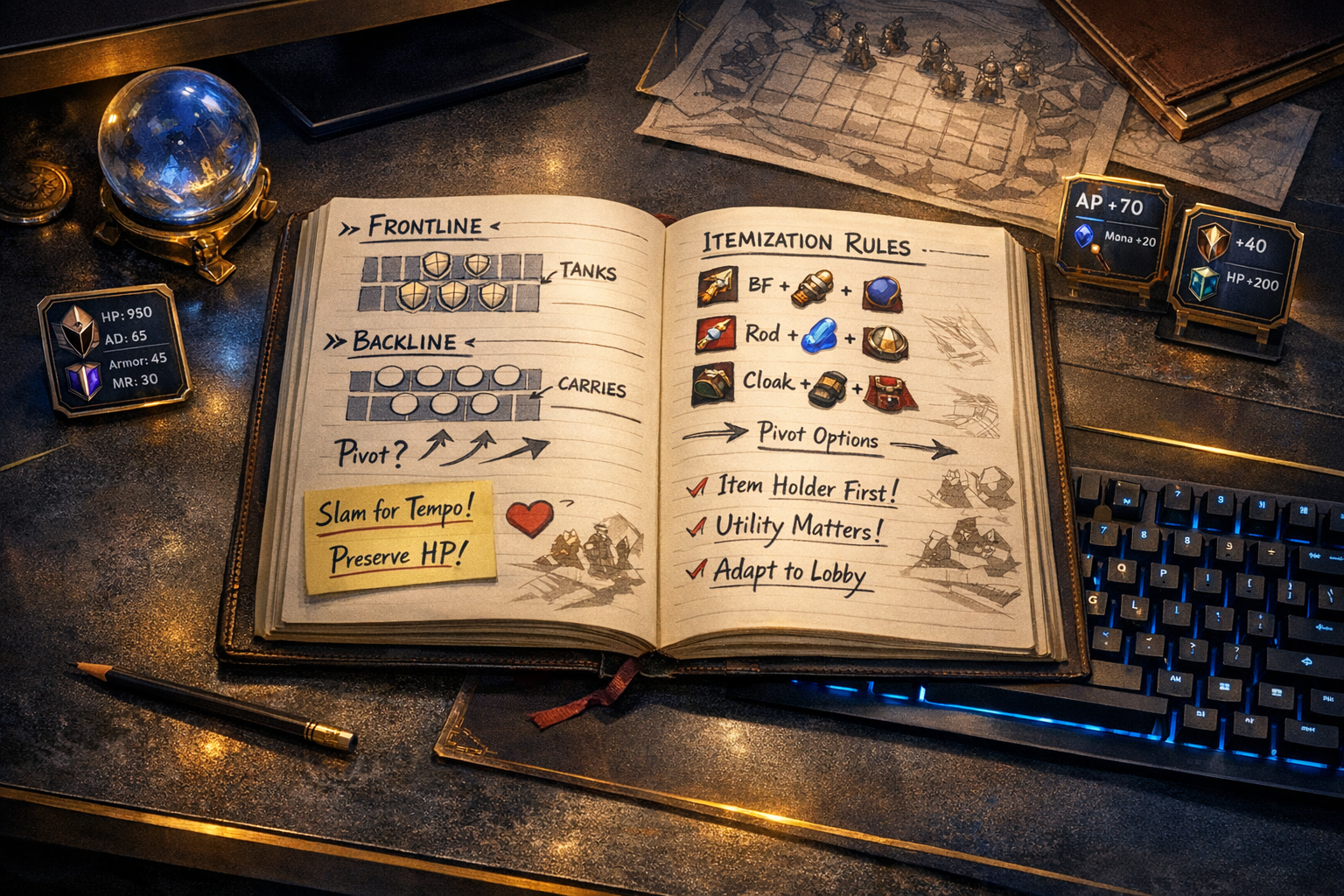
These units want to cast quickly and hit hard enough to remove targets before the fight becomes dangerous. They often value mana access, front-loaded AP, crit conversion if their spell supports it, and sometimes penetration or shred support elsewhere on the board. Over-investing in long-fight scaling on burst casters can be inefficient if they are supposed to decide the fight early.
Sustained Casters
These units care less about one massive cast and more about cycling abilities repeatedly over a longer fight. They often prefer mana reliability, survivability through positioning or support, and item patterns that let their total damage ramp through repeated spell use. If you only itemize for one big cast but the unit wins through repeated casts, your “damage itemization” may be conceptually wrong.
Auto-Attack Carries
These carries usually want a mix of attack speed, raw damage, survivability, and sometimes ways to cut through frontline. Many auto-attack carries do not need three pure damage items. If they already have enough output, a survival or sustain item can create more real DPS by keeping them alive longer. This is one of the most common ways flexible itemization beats spreadsheet BIS: the board context matters more than isolated theory.
Backline Utility-DPS Hybrids
Some units contribute decent damage but are most valuable because they apply crowd control, debuffs, or team support while still threatening enemy boards. These carries often do not need perfect selfish damage items. Giving them one engine item and one utility item can produce more total board value than chasing pure damage.
Frontline Carries
These units fight near the front and need to survive while dealing damage. They typically require mixed itemization: enough damage to matter, enough durability to keep casting or attacking, and sometimes sustain to bridge the gap. Many players over-greed for pure carry setups on frontline damage dealers and then wonder why the unit disappears before using its items properly.
The timeless lesson is to itemize for a unit’s job, not just its label. “Carry” does not automatically mean triple selfish damage. Ask what the unit needs to do in the fight, how it dies, and what the board lacks around it. Those answers matter more than memorized templates.
How to Itemize Frontline Without Throwing Away Damage
Bad TFT itemization often comes from over-focusing on the carry bench and under-focusing on the units buying time. Frontline items are never glamorous, but they are often the difference between a carry getting six seconds to work and getting two. In many average games, one strong tank item slam does more for your placement than waiting on a theoretically perfect third carry item.
The first principle of frontline itemization is that effective HP is contextual. Raw health is strong into mixed damage and anti-burst scenarios. Armor and magic resist are best when you know which damage types are threatening you or when your health pool is already decent. Self-healing or damage reduction shines in longer fights. Shielding effects are better against burst. This means “best tank item” is often lobby-dependent, not universal.
The second principle is that one immortal tank is not the same as a good frontline. Sometimes a board needs one primary anchor with heavy investment. Other times it needs two moderately itemized frontliners so the entire line does not collapse the moment one unit dies. If your board spreads aggro naturally, a balanced frontline can outperform one hyper-stacked tank and several paper units.
The third principle is that tank itemization should match your carry profile. Fast burst backlines may only need a frontline that survives the first cast cycle. Slow scaling carries need more durable combat length. Melee carries may need crowd-control support or secondary tankiness around them so they are not focused immediately. The carry and frontline should be viewed as one system, not separate shopping lists.
A timeless rule of thumb is this: if your board loses because your carry never gets to play, add frontline. If your board loses because fights go long but enemies eventually out-sustain you, add utility or more efficient damage. If your board wins early fights but falls off later, ask whether your frontline items are generic early power or true scaling durability. These are better questions than “Do I have my tank BIS?”
Utility Items: The Hidden Difference Between 6th and 3rd
Utility items are where many TFT games are quietly won or lost. Players love visible carry spikes, but utility often decides whether that damage is meaningful. Healing reduction, resistance shred, anti-shield pressure, mana disruption, team buffs, and fight control effects can completely change matchup quality. In a lobby with strong sustain, ignoring anti-heal is not greed. It is a strategic error. In a lobby with stacked frontline resistances, refusing to build resistance-break tools can make your carry feel fake.
Utility is especially powerful because it multiplies existing resources. A damage item increases one unit’s output. A good utility effect can increase the value of your entire team. That is why many “slightly lower damage” item sets outperform prettier carry trios in real combat. The board as a whole becomes more functional.
Another timeless point: utility is often the best use of awkward leftover components. Not every component set can make a premium carry item. Strong players do not complain about this as much because they know a useful support or debuff item can rescue the value of a strange drop pattern. Flexible itemization improves dramatically when you stop viewing non-carry combinations as failures and start seeing them as tools.
There is also a psychological trap here. Because utility numbers are harder to “feel,” players often attribute a later win to upgraded units rather than the enabling item that made the fight work. But when you review rounds honestly, utility often explains why your carry started finishing targets, why enemy healing stopped spiraling, or why your frontline lasted just long enough. In TFT, invisible value still counts on the scoreboard.
Item Holders, Transitions, and Pivots
One of the strongest timeless itemization concepts is the item holder. A good item holder lets you turn components into tempo before you hit your final carry. This reduces the opportunity cost of slamming and gives you smoother transitions. If you are always waiting for the perfect unit before building items, you are making the game much harder than it needs to be.
The best item holders share at least one of three traits with your eventual destination. They use similar damage profiles. They attack or cast in a similar rhythm. Or they can hold generic power without wasting stats. For example, a flexible backline unit can often use a wide range of damage items before handing them off to a later carry. A sturdy bruiser or guardian-type unit can carry generic tank items for nearly any final board.
This is why flexible slams are so powerful. They are not just “good enough for now.” They are bridges. In TFT, bridges matter because your strongest rounds often happen before your final board exists. A game is not won only at level 8 or level 9. It is shaped by whether you arrive there with enough HP, gold, and board strength to make intelligent decisions rather than desperate ones.
Pivots also become easier when items are functional rather than hyper-specific. If your bench and shops suggest that your initial line is not coming together, flexible items let you reroute. Hyper-specific greed traps you. The worst TFT feeling is not merely “I missed.” It is “I missed and my items only work on one board.” Strong itemization reduces that disaster scenario.
In timeless terms, your item bench should help answer this question: if I miss my first plan, what are my second and third plans? If the answer is “none,” your itemization is probably too rigid. If the answer is “several,” you are giving yourself the kind of flexibility that wins over hundreds of games.
When Chasing BIS Is Correct
After all this, it would be wrong to conclude that BIS does not matter. It does. The trick is recognizing when the value of perfection is truly worth the cost of waiting.
Chasing BIS is usually correct when your board is already stable, your HP is healthy, your economy is strong, and your intended carry has a narrow item dependency that meaningfully affects late-game ceiling. It is also more justified when the lobby is strong enough that a generic version of your carry will not cap high enough to win decisive Stage 5 and Stage 6 rounds. In those situations, preserving components can be an investment rather than greed.
Chasing BIS is also stronger when your line is natural instead of forced. If your shops, augments, traits, copies, and item components already point toward one clear carry, the opportunity cost of holding is lower. The game is already helping you. By contrast, forcing BIS while your board, gold, and units are all sending mixed signals is often a disguised refusal to adapt.
Another time BIS matters more is in first-place games. Flexible items are incredible for consistency and top 4 rates, but exact item optimization can sometimes be the difference between stabilizing for 3rd and capping for 1st. That does not make flexible play wrong. It means your goals change based on game state. Healthy, rich, high-cap games reward precision more than shaky, average-resource games.
The timeless framework is not “never greed” or “always slam.” It is “understand what your game is asking for.” If the game is asking you to survive, build power. If it is asking you to convert a winning position into a capped board, then yes, more exact itemization becomes worth more.
Common Itemization Mistakes
1. Treating every comp guide like a commandment
Comp guides are references, not laws. They often show idealized endboards, not the best choice for your exact spot. Use them to understand patterns, not to ignore context.
2. Greeding without a health cushion
If you are losing rounds and dropping fast, you usually cannot afford pretty item dreams. Players who are low HP should value immediate board function more heavily.
3. Over-itemizing one carry and ignoring the rest of the board
Triple-item carry with zero frontline and zero utility is one of the most common low-ELO mistakes. TFT fights are team fights. A carry needs time and support.
4. Building pure stats without solving matchups
If the lobby has heavy healing, giant tanks, or long stall fights, pure damage may not solve the problem. Utility is often what turns “close losses” into clean wins.
5. Refusing to use item holders
Dead components on bench are dead tempo. If a useful temporary holder exists, use it unless the opportunity cost is truly too high.
6. Tunnel vision on item names instead of item functions
The best players think in jobs: burst, ramp, sustain, tankiness, anti-heal, shred, mana, team support. That mindset survives patches much better than memorized lists.
7. Forgetting that flexibility itself has value
Some items are stronger than their raw numbers because they fit many boards. This strategic value is real even if it does not appear in a simple damage comparison.
A Stage-by-Stage Itemization Framework
Stage 2: Build a Board, Not a Dream
Early game itemization should mostly serve two goals: preserve HP and keep multiple outs alive. This is where flexible slams are at their best. Generic damage, generic frontline, and widely transferable utility items are premium because they create immediate power without locking you too hard. If you have a good opener and a chance to winstreak, early slams become even stronger. Streak gold plus HP advantage can shape the entire match.
Do not over-interpret early components. A couple of damage pieces do not always mean you are an AD player. A mana start does not always mean you are committed to AP. Early itemization should strengthen your strongest board while letting later information refine your direction.
Stage 3: Decide Whether You Are Pressuring or Preserving
By Stage 3, you should start identifying whether your game wants tempo or patience. If you are strong and streaking, continue building in a way that protects that advantage. If you are unstable, do not be afraid to use components to stop the bleeding. This is also the stage where item holders matter enormously. A good midgame carrier can convert flexible items into several rounds of saved HP and extra gold.
This is not the stage to be stubborn. If your original line is not natural, your items should help you reroute. Flexible itemization makes Stage 3 much easier because it reduces the pain of changing direction.
Stage 4: Clarify Your Endgame Win Condition
Now the question becomes more focused: what unit or board pattern is actually supposed to win your fights? Once that answer is clearer, exact item needs matter more. This is often when you decide whether your last item slots should be more selfish ceiling, more utility, or more frontline. By now, you should also be reading the lobby. Are you losing to sustain? Burst? Frontline walls? Positioning traps? Your item choices should respond.
Many players make the mistake of continuing to itemize generically forever. Flexibility is strongest when information is incomplete. Once the game gives clearer information, good players become more precise. Flexible early does not mean vague late.
Stage 5 and Beyond: Optimize Matchups, Not Just Units
In late game, the best itemization decisions are matchup-aware. Your board may already be “complete” in a generic sense, but the final few decisions should answer real combat problems. Do you need more anti-burst? More backline access? More protection for a fragile win condition? More stall for a scaling carry? More utility to punch through enemy sustain? At this point, placements often hinge less on raw item count and more on whether your item mix solves what the lobby is actually doing.
This is also where first-place thinking separates from survival thinking. If you are stable and playing for top 2 or 1st, exact optimization becomes more valuable. If you are scraping for top 4, immediate function may still outweigh elegance. Strong TFT itemization is always tied to game state.
Quick Decision Checklist
Whenever you are unsure about an item decision, run through this checklist:
- What is my board missing right now: damage, frontline, mana, or utility?
- Will this item change the next two to four rounds in a meaningful way?
- Can this item transfer to more than one future board?
- Am I healthy enough to hold, or do I need power now?
- Is my intended carry narrow and BIS-dependent, or flexible and forgiving?
- Does the lobby require anti-heal, shred, or another specific utility effect?
- Am I itemizing a unit, or am I solving the whole fight?
If you answer those questions honestly, many item choices become obvious. The problem is not usually lack of knowledge. It is lack of disciplined evaluation. Players often know the right principles but ignore them because a prettier theoretical board is emotionally appealing. Ladder rewards practical decisions more than aesthetic ones.
FAQ
Is BIS overrated in TFT?
BIS is not overrated, but it is over-chased. Exact best-in-slot setups matter most in stable games, narrow carry lines, and high-cap endboards. In many normal ladder games, flexible items create better average results because they preserve HP and keep pivots open.
Should I always slam early items?
No. Slam when the item clearly improves your board now, remains usable later, and the alternative you are waiting for is not essential enough to justify the delay. Hold when you are already stable and the future item meaningfully changes your endgame.
How many tank items do I need in TFT?
There is no fixed number, but most winning boards need real frontline investment. If your carry is not getting enough time to deal damage, tank items are probably undervalued on your board.
Are utility items really worth giving up raw damage?
Often yes. Utility can multiply the value of your entire team by enabling damage to land properly. Anti-heal, shred, and support effects are frequently the difference between a close loss and a clean win.
How do I know whether an item is flexible?
A flexible item is useful on multiple current and future holders, contributes to a common combat need, and does not overly lock you into one narrow board. Generic frontline items, broad damage items, and reusable utility tools are usually the best examples.
What is the biggest itemization mistake for climbing?
Holding too many components while losing HP. The most common habit that ruins average placements is waiting for perfection when the board needs strength immediately.
Conclusion
The timeless truth about TFT itemization is that items are not trophies. They are tools. Best-in-slot matters, but only inside real game conditions. Flexible items matter because TFT is uncertain, tempo matters, and HP buys time. Tank items matter because your carries cannot deal damage while dead. Utility matters because raw stats do not always solve real fights. Item holders matter because most games are won through transitions, not just endboards.
If you remember only one lesson from this guide, make it this: do not ask, “What is the perfect item?” Ask, “What does my board need to win more rounds from this spot?” That question is the bridge between theory and ladder results. Sometimes the answer will be exact BIS. Often the answer will be a strong flexible slam, a frontline stabilizer, or a utility tool that makes the entire board function.
Players who improve at TFT itemization usually notice the same thing: they top 4 more often before they start winning more lobbies. That is not failure. That is proof that the fundamentals are working. Better itemization creates smoother games, fewer disasters, better pivots, and stronger average placements. Over time, that consistency gives you more chances to convert good openings into firsts as well.
If you want a faster climb while refining your fundamentals, you can also check Boosteria’s TFT boosting prices. But whether you climb on your own or with help, this principle stays true: in Teamfight Tactics, the player who uses their items best is often the player who makes the whole game look easier.
Stop worshipping the prettiest final build. Start building the strongest game. That is the real itemization edge in TFT.