



Apex Legends Legend Roles & Synergy Guide for Balanced Squads
Apex Legends — Legend Roles & Synergy: Building a Balanced Squad
Apex Legends is not won by picking three strong legends in isolation. It is won by building a squad that can solve the real problems every match presents: finding safe information, entering or avoiding fights on command, controlling space, surviving mistakes, recovering from damage, rotating into better positions, and finishing engagements before third parties arrive. The most reliable teams do not ask, “Which legend is strongest today?” They ask, “What jobs does our squad need to perform from drop to final ring, and which legends let us do that consistently?”
That shift in thinking is what separates random lineups from balanced squads. A balanced squad does not need to follow one rigid template. It simply needs enough tools to function in every phase of the game. Some teams solve that through defense and ring control. Others do it through mobility, scanning, and fast edge fights. Others rely on reset power and strong counter-engage. The exact trio can change over time, but the underlying logic does not. That is why role-based squad building remains one of the most timeless ways to improve in Apex.
If you want to review the official game ecosystem while reading, it helps to keep the current Apex Legends official site open for news and season context, the live class overview on Meet the Legends, the latest EA Help Ranked explainer, and the official ALGS overview to study how high-level teams think about structure and adaptation. If your main goal is faster rank progress, you can also compare options on Boosteria’s Apex Legends boosting pricing page.
This guide focuses on evergreen principles instead of short-lived patch numbers. Legend balance will move. Map pools will rotate. Individual perks and ranked details may get adjusted. But squad-building fundamentals stay useful because the core question never changes: can your team gather information, take or deny space, survive pressure, reset after damage, and turn advantages into placement and kills?
Table of Contents
- Why Balance Matters More Than Three Comfort Picks
- Legend Roles vs. Official Classes
- The Five Jobs Every Good Squad Must Cover
- How to Evaluate Any Team Composition
- Balanced Squad Archetypes That Always Make Sense
- The Real Meaning of Synergy in Apex Legends
- How to Build for Solo Queue, Duo Queue, and Premades
- Best Role Pairings and Why They Work
- Squad Building for Early Game, Mid Game, and Endgame
- Common Team Comp Mistakes
- A Simple Legend Select Process for Better Comps
- Timeless Example Squad Templates
- How Ranked Changes Squad Priorities
- How to Improve Synergy Without Changing Legends
- FAQ
- Final Thoughts
Why Balance Matters More Than Three Comfort Picks
Comfort picks matter. Confidence matters. Mechanical familiarity matters. But comfort alone can quietly create one-dimensional squads. A lineup with three aggressive duelists may feel amazing in the first thirty seconds of a clean fight, then completely fall apart when it needs to scan ring information, stabilize after a knock, or hold a narrow endgame angle without getting flooded. A squad with only defensive tools may survive well yet fail to force openings when another team takes priority space first. A team with great movement but no sustain can secure entry damage, then lose every extended battle because it cannot recover cleanly.
Balanced composition solves those problems before they happen. It reduces the number of situations where your team simply lacks an answer. That does not mean your trio must contain one exact class from each category. It means your combined toolkit should check enough boxes that you are not forced into predictable play every game. Strong team building is less about labels and more about coverage.
Think of Apex as a repeated sequence of decisions. Where do we land? Do we contest? Do we play zone or edge? How do we clear space? How do we cross dangerous terrain? How do we recover if one player gets cracked? Can we revive safely? Can we punish another team’s mistake? Can we rotate early? Can we hold late? Balanced squads make more of those decisions available. Unbalanced squads narrow your options until the lobby dictates everything for you.
That is why composition affects consistency more than highlight potential. In public games you can sometimes overpower bad fights with mechanics. In organized Ranked lobbies, consistency wins more often than chaos. The teams that keep climbing are usually not the flashiest. They are the teams whose legends let them survive bad spots, clean up good spots, and avoid coin-flip decisions.
Legend Roles vs. Official Classes
Apex’s official classes give a useful starting point, but players often misunderstand what they mean. A class is not the same thing as a role. A class describes broad utility and shared perks. A role describes what your legend is actually doing inside your team’s plan. One Support legend might function as a reset anchor. Another might act more like a loot and tempo enabler. One Skirmisher may be your space-creating entry. Another may be your emergency reposition tool. The class matters, but the squad job matters more.
Assault
Assault legends are usually the most direct expression of pressure. They tend to help squads break stalemates, force respect, or convert damage into momentum. Their value often increases when your team already has information and wants to capitalize quickly. Assault picks are strongest when paired with tools that help them arrive on time and survive after initial contact.
Skirmisher
Skirmishers usually bring mobility, unpredictability, or angle creation. They are often the legends that make impossible terrain playable, create off-angles, open disengage routes, or threaten fast follow-up after a crack. They are rarely enough by themselves. Their biggest strength appears when the rest of the team can convert the space they create into real control.
Recon
Recon tools reduce uncertainty. They help squads understand ring plans, enemy locations, timing windows, and route safety. Information is one of the most underrated forms of power in Apex because it changes how every other ability gets used. Damage is stronger when you know where enemies must move. Rotation tools are better when you know where not to go. Defensive play is safer when you understand the ring flow before the lobby collapses.
Controller
Controllers are space specialists. They turn open ground into dangerous ground, delay pushes, secure buildings, split enemy teams, and make late rings more manageable. Their value rises sharply in coordinated play because control abilities become far more oppressive when teammates understand how to hold angles around them. Controller picks are often the difference between “we reached endgame” and “we can actually survive endgame.”
Support
Support legends give teams more room for error. They improve sustain, reset speed, recovery, and long-fight stability. In a battle royale where third parties punish every overextension, the ability to recover efficiently is a massive competitive advantage. Support picks do not just save losing fights. They often let winning teams maintain tempo instead of spending too long healing, looting, and re-stabilizing.
The most important lesson is simple: classes tell you what a legend generally contributes, but true team building begins when you ask how those tools interact. A Controller without follow-up may only delay the inevitable. A Recon without a team ready to act on information may feel passive. A Support without safe positioning may die before the reset matters. Synergy is the difference between having abilities and having a plan.
The Five Jobs Every Good Squad Must Cover
Rather than forcing yourself into rigid class quotas, evaluate whether your lineup can handle these five jobs. If the answer is yes, your comp is probably balanced enough to climb.
1. Information
Your squad needs a reliable way to reduce uncertainty. This might come from Recon tools, strong scouting habits, map awareness, ring reading, or utility that safely checks positions. Information determines whether you can rotate early, avoid stacked buildings, punish isolated teams, or commit to a fight before a third party arrives. Teams without information are usually reacting late, and late reactions in Apex are expensive.
2. Space Creation or Space Denial
Every good team must either create room to move or deny room to the enemy. Skirmishers and Assault legends often create space through threat, pressure, or movement. Controllers often deny space through zoning and hold power. The exact method is less important than the result: your squad needs a way to decide where the fight can happen.
3. Sustain and Reset
A surprising number of fights are decided after the first exchange, not during it. One team takes damage, panics, and collapses. The other team stabilizes, repositions, and takes the second wave cleanly. Sustain includes healing tempo, revive safety, banner recovery potential, survival items, and the ability to recover after trading resources. Support legends shine here, but disciplined movement and cover usage matter too.
4. Rotation Safety
Balanced squads need a way to move through the map without donating free damage. That can mean mobility tools, cover creation, ring knowledge, area denial, or simply enough control utility to cross dangerous sightlines safely. If your lineup has no method for taking space between points of cover, it will suffer against organized teams that hold power positions early.
5. Fight Conversion
Opening damage alone does not win. Good squads convert advantages. That means they know how to collapse on a crack, isolate one side of a fight, stop revives, punish doors, deny resets, and finish before a new team appears. Some comps are brilliant at surviving but poor at ending fights. Others are explosive but throw after the initial knock. Conversion is what turns strong mechanics into reliable RP.
Whenever you review a team composition, run this five-job test. Can we gather useful information? Can we create or deny space? Can we reset? Can we rotate safely? Can we convert advantages? If you cannot answer yes to at least four of those with confidence, your squad probably has a structural weakness.
How to Evaluate Any Team Composition
Most players judge comps by legend popularity. A smarter approach is to ask six practical questions before the match starts.
- What is our intended fight shape? Do we want front-to-back, split-angle pressure, hard dive, building hold, poke-to-collapse, or reactive counter-engage?
- How do we enter bad space? If we must cross open ground or breach a held building, what is the plan?
- How do we leave bad space? If the fight turns or a third party arrives, can we disengage in one piece?
- Who anchors the team? One player usually needs to stabilize positioning, cover the reset, or hold a survivable line.
- Who makes the first call to commit? Ambiguous engage timing is one of the biggest causes of bad teamfights.
- What is our win condition in endgame? Are we playing space denial, survivability, burst entry, vertical control, or angle superiority?
If your comp answers those questions clearly, it is already ahead of many random squads. Team composition is not just about abilities. It is about reducing confusion. A good comp tells players what the fight should look like. That clarity makes decision-making faster and comms cleaner.
Balanced Squad Archetypes That Always Make Sense
There is no single perfect trio, but several squad archetypes remain healthy across patches because they solve Apex’s fundamental problems.
Front-to-Back Stability Comp
This archetype wants clear layers. One player anchors and protects space, one player pressures or chips, and one player ensures recovery or safer timing. These squads tend to do well in Ranked because they survive longer and punish undisciplined pushes. They are especially strong for teams whose mechanics are decent but whose greatest edge comes from discipline and positioning.
The weakness is speed. If this comp lacks enough engage power, it may watch cracked enemies escape or struggle to take crowded structures before ring pressure forces a move. The solution is not abandoning stability. It is adding one timing tool that helps the team shift from passive to decisive.
Edge Fighting Snowball Comp
This squad thrives on catching rotating teams, securing quick kills, and building momentum through pressure. It usually values mobility, information, and one strong fight-conversion tool. Edge comps can be excellent in lobbies where teams rotate late or tunnel vision on zone. They punish hesitation and often create the most kill opportunities.
The risk is greed. If an edge comp takes too long on fights or lacks enough reset power, it becomes third-party food. To play this style well, your squad must understand when a fight is truly free and when it only looks free.
Zone Control Comp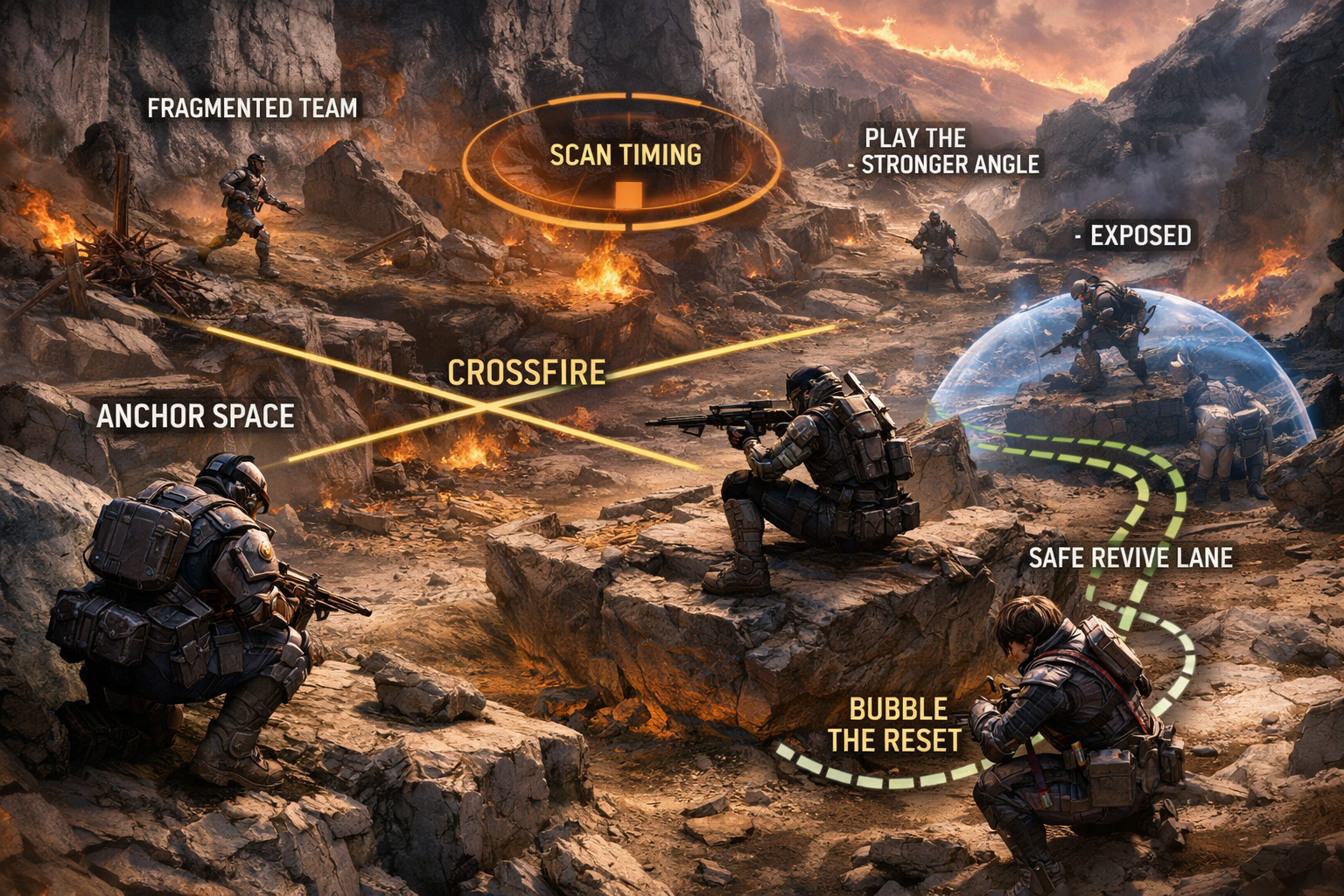
This archetype prioritizes early ring reads, space denial, structure control, and safe survival into later circles. It usually includes strong defensive utility, some ring planning, and enough sustain to weather poke damage. Zone comps are ideal for squads with strong macro awareness and patient comms.
The common mistake is becoming too static. Good zone teams are not passive. They reposition early, punish overextensions, and know exactly when to leave one spot for a better one. Great zone play is active control, not fearful hiding.
Hybrid Flex Comp
This is often the best choice for general Ranked climbing. Hybrid comps may not dominate one specific phase, but they are rarely useless. They bring a mix of information, survivability, and tempo. They can play ring when needed, fight edge when needed, and recover from small mistakes better than more specialized trios.
Hybrid flexibility is powerful because most Ranked games are messy. The lobby does not always give you the game plan you wanted. The more your comp can pivot, the more consistent your results become.
Reset-and-Reengage Comp
These squads are built around surviving bursts, reviving safely, buying time, and turning fights after the enemy overcommits. They can feel frustrating to play against because even clean opening damage does not guarantee a finish. This style rewards composure and punishes impatient opponents who collapse without clearing all threats.
The danger is low initiative. If your team only reacts and never forces, stronger squads will box you in before your reset tools matter. A reset comp still needs a way to take space at chosen moments.
The Real Meaning of Synergy in Apex Legends
Players often talk about synergy as if it means “these two ultimates combo together.” That is only the surface level. True synergy in Apex is broader and more important. It means your squad’s tools make each other easier to use, harder to punish, and more valuable at the moment they are needed most.
Timing Synergy
Abilities are strongest when their windows overlap correctly. A scan used before your entry takes space is powerful. The same scan used after your teammate has already committed may be wasted. A defensive cooldown used before the enemy fully swings can deny the push entirely. Used one second late, it only delays defeat. Good comps create natural timing chains.
Range Synergy
Many teams fail because their legends want different fights. One player wants to poke from distance, one wants to hard entry, and one wants to sit on anchor. There is nothing wrong with mixed ranges, but the comp must have a bridge between them. If your squad cannot transition from poke to collapse or from pressure to hold, your damage never turns into wins.
Positional Synergy
Balanced teams occupy complementary space. One player may hold the safe lane, one may pressure the side angle, and one may float between support and collapse duties. If all three players need the exact same position to function, the comp is easy to predict and easy to pin down.
Cooldown Synergy
A common mistake is stacking similar abilities without thinking about diminishing returns. Two zoning tools can be amazing if they secure different layers. They can also be redundant if both are needed for the same doorway. Likewise, too many reactive cooldowns can leave your team toothless when it actually needs to force. Balanced synergy spreads power across multiple fight moments.
Recovery Synergy
Good comps plan for imperfect fights. What happens if your entry player gets cracked first? What happens if your scout is isolated? What happens if you win but with low resources? Synergy is not only about how you start fights. It is about how you survive the messy middle and the dangerous aftermath.
Macro Synergy
At a higher level, synergy also means your legends agree on map strategy. Some comps naturally prefer early zone setups. Others prefer wide edge clears and fast collapses. Problems begin when your trio contains legends built for conflicting macro plans. You can still win, but every rotation feels awkward because your tools are pulling in different directions.
If you remember only one sentence from this section, make it this: synergy is when your legends make the same decision feel correct at the same time.
How to Build for Solo Queue, Duo Queue, and Premades
Solo Queue
Solo queue rewards self-sufficiency and clarity. You cannot assume perfect comms, perfect trust, or shared plans. The best solo queue picks usually provide one of three benefits: they gather information cleanly, they create personal survivability, or they help random teammates recover from mistakes. In solo environments, balanced squads matter even more because coordination gaps already exist. Picking a legend that adds stability is often worth more than picking a flashier option that requires synchronized follow-up.
When solo queueing, avoid compositions that require complex layered timings to function. Lean toward legends that make value obvious. Information, sustain, and flexible repositioning tend to age well because they reduce dependency on strangers.
Duo Queue with a Random Third
Duo queue works best when the duo covers the squad’s foundation and leaves the random room to contribute naturally. For example, the duo can handle engage plus support, or information plus reset, while the third fills damage, mobility, or defensive value. The biggest mistake duos make is choosing two selfish legends that only work if the third randomly picks the exact missing piece. Build the spine of the team first.
Premade Trio
Premades can exploit tighter synergy and more specialized plans. This is where clear archetypes become strongest. A coordinated trio can run layered space control, planned crossfires, precise scan timings, and safer reset sequencing. Premades also benefit more from deliberate role assignment. One player can permanently anchor, another can be the primary entry, and the third can manage information or mid-fight support.
Still, even premades should resist over-specialization unless they scrim together consistently. In Ranked, adaptable hybrid comps usually outperform fragile “perfect on paper” trios that collapse the moment a fight happens off-script.
Best Role Pairings and Why They Work
Recon + Controller
This is one of the cleanest strategic pairings in Apex. Information tells you where space will matter; control tools help you own it. Together, they support strong ring play, safer rotates, and better late-game holds. Their weakness is sometimes tempo. Add a third legend who can either convert openings or protect resets and the trio often becomes very complete.
Support + Skirmisher
This pairing is excellent for teams that like aggressive positioning but do not want to implode after the first trade. The Skirmisher creates the opening or escape route, while the Support increases forgiveness. It is a strong core for Ranked because many fights begin with messy partial commits rather than perfect coordinated bursts.
Assault + Recon
Pressure becomes much stronger when it is informed. Recon reduces guesswork, while Assault gives the team the power to capitalize before opponents can stabilize. This pairing often shines in edge comps and mid-game picks where fast decisions create kill opportunities.
Controller + Support
This is a classic survival backbone. Controller secures safer territory. Support helps the team survive long enough to benefit from that territory. The result is a squad that can weather pressure, recover efficiently, and remain dangerous in protracted rings. It often needs a third legend with initiative, but the base is strong.
Skirmisher + Assault
This is the volatility pairing. It creates huge pressure, quick entries, and strong collapse potential. When it works, the enemy feels overwhelmed. When it fails, the team can burn resources too quickly and become vulnerable to the next squad. This pairing needs either recovery support or smarter information to become truly consistent.
Recon + Support
Underrated and highly practical. Knowing more while recovering better gives teams freedom to make better macro decisions. This pairing is often ideal for methodical players who care about consistency, cleaner rotations, and fewer catastrophic wipes.
Squad Building for Early Game, Mid Game, and Endgame
Early Game
Early game asks simple but brutal questions. Can your team survive an awkward loot spread? Can it contest if another squad lands nearby? Can it leave quickly if the drop becomes bad? Balanced early-game squads usually have one legend who helps create safety, one who helps find information or tempo, and one who improves fight conversion.
A common early-game mistake is overvaluing raw duel strength while ignoring how scattered first fights actually are. The best contest legends are not always the “strongest duelists” on paper. They are the ones whose abilities remain useful when armor, ammo, and sightlines are uneven.
Mid Game
Mid game is where macro and third-party risk explode. This phase rewards information, rotation planning, and the ability to reset quickly after partial fights. Many squads that look powerful in isolated 3v3s struggle here because they cannot take a fight, heal, loot, and reposition before the next team arrives. A balanced mid-game comp does not just win. It wins fast enough or safely enough to survive the lobby reaction.
Endgame
Late rings expose composition flaws mercilessly. If your squad cannot hold space, deny pushes, survive chip damage, or create one decisive entry window, it will often be squeezed out by better-structured teams. Endgame power usually comes from one of four things: superior space control, better information, stronger reset tools, or cleaner collapse timing. The best squads bring at least two of those.
When players say a legend “feels weak,” they are often describing a phase mismatch. That legend may not be weak at all. It may simply solve a problem your current squad does not understand how to create value from. Always ask in which phase your comp wants to be strongest, then build around that deliberately.
Common Team Comp Mistakes
Picking Three Independent Legends
This is the most common error. Each legend is strong alone, but nothing connects them. No clear entry, no layered defense, no coordinated reset path, no shared fight shape. The squad becomes a collection of solo plans.
Ignoring Reset Power
Teams love damage and mobility. They often forget that Apex punishes extended fights and imperfect finishes. A squad with no meaningful reset plan may still dominate easy fights, then lose to every competent third party.
Stacking Too Much of One Function
Three legends that all want to pressure the same way can feel fun, but they often overinvest in one moment of the fight and underinvest in everything else. Redundancy is valuable only when it secures different layers of the same goal.
Building for Perfect Conditions
Many compositions are amazing when they get first scan, first angle, first damage, and clean terrain. Ranked rarely offers that. Good comps are not only strong when ahead. They are recoverable when behind.
No Endgame Identity
If your squad reaches ring five and still does not know whether it wants to bunker, split, collapse, or rotate aggressively, the problem started in legend select. Your composition should make late-ring priorities obvious.
Forgetting Player Identity
The strongest theoretical comp may still be wrong if it forces players into unnatural jobs. A balanced squad must fit the people using it. If your best aimer hates anchoring, or your smartest macro player is stuck on pure entry duty, performance usually drops. Composition should support your players, not fight them.
A Simple Legend Select Process for Better Comps
Use this quick checklist during legend select, especially in Ranked.
- Lock the foundation first. Start with information, survivability, or space control.
- Add initiative second. Choose the legend that helps the team actually force value.
- Check recovery. Ask how your team stabilizes after taking damage or losing one angle.
- Check rotation. Ask how you cross bad ground or leave a losing fight.
- Check endgame. Ask what the comp wants the final circles to look like.
This process prevents the classic trap of picking by habit. It also makes adaptation easier. If your first two legends already cover information and sustain, your third can safely be more aggressive. If your first two are explosive and mobile, your third may need to add stability. The point is not memorizing fixed trios. It is learning how to fill missing jobs on the fly.
Timeless Example Squad Templates
Template 1: The Safe Climb Trio
Core idea: information + control + reset.
This trio works for players who value consistency, placement, and fewer unforced losses. It usually rotates well, survives longer, and creates cleaner late rings. It may not farm the most kills, but it tends to produce stable Ranked progress because it minimizes bad deaths.
Template 2: The Flexible Ranked Trio
Core idea: one information tool, one pressure tool, one sustain or safety tool.
This is arguably the most practical structure for most players. It can play edge or partial zone, take medium-risk fights, and recover from imperfect openings. If your squad only learns one template, learn this one.
Template 3: The Edge Punish Trio
Core idea: scouting + fast entry + rapid cleanup.
Best for confident teams that read rotations well and know when to disengage. This comp thrives when it catches weak rotates, but it requires discipline because every extra second in a fight increases third-party danger.
Template 4: The Endgame Hold Trio
Core idea: space denial + anchor survivability + one angle creator.
This trio is built for late-circle power. It wants to claim good territory early, protect it efficiently, and punish desperate pushes. It can feel slower in the middle of the game, but it becomes terrifying when ring space shrinks.
Template 5: The Forgiveness Trio
Core idea: mobility or escape + support recovery + defensive delay.
This setup is ideal for inconsistent lobbies, new teammates, or chaotic solo queue environments. It gives the squad extra chances to survive mistakes, which is often more valuable than theoretical damage ceilings.
Notice that these templates are described by function, not by locked legend names. That is the evergreen mindset. Functions survive balance changes. If a favorite legend gets nerfed, replace the job, not just the character.
How Ranked Changes Squad Priorities
Ranked rewards survival, intelligent fights, and efficient conversion. Because placement and eliminations both matter, your composition should help you avoid zero-point disasters while still leaving room for kill value. That usually pushes strong Ranked comps toward a blend of survivability and initiative.
In lower and mid tiers, self-sufficiency and fight recovery often matter more than perfectly optimized pro-level structures. Players make more positioning mistakes, so your team benefits from being able to punish chaos and survive chaos. In higher tiers, information quality, route discipline, and endgame structure rise in value because more squads understand how to hold good space.
Ranked also punishes greed more than many players realize. A team comp that dominates isolated 3v3s may still be bad for ladder climbing if it cannot finish fast, stabilize quickly, or leave after a partial win. That is why practical Ranked compositions usually contain at least one legend whose primary value is not damage. Information, control, and recovery are RP tools.
If your goal is pure climbing rather than highlight clips, ask which legends lower your chance of an early wipe. Players often improve their rank faster by removing disaster scenarios than by adding theoretical carry potential.
How to Improve Synergy Without Changing Legends
Sometimes the comp is not the problem. The team is. Before replacing your trio, tighten your structure.
Assign Jobs Explicitly
Decide who scouts, who anchors, who initiates, and who calls the reset. These roles can shift during the match, but they should not be mysterious. Many “bad comps” feel bad because players duplicate jobs or abandon them.
Use Simple Trigger Words
Create fast callouts such as “hold,” “swing now,” “reset,” “full leave,” “play roof,” or “anchor left.” A good composition becomes much stronger when every player recognizes the same fight states instantly.
Fight in Two Waves, Not Three Solos
Most strong Apex teams do not all peek at once or all hide at once. They pressure in layers. One angle threatens, another angle capitalizes, and the anchor protects the team from overcommitment. Practice that rhythm and many comps suddenly make more sense.
Review Failed Fights by Missing Job
Instead of saying “our legends were bad,” ask: did we lack information, deny space poorly, fail to reset, rotate too late, or fail to convert? This keeps reviews productive and helps you separate player error from composition error.
Build Around Your Best Habit, Fix Your Worst Habit
If your trio is excellent at holding ground but weak at leaving fights, add tools that support cleaner disengage. If you are strong at entry damage but poor at recovery, add sustain or defensive structure. Composition should magnify what you already do well while patching the problem that costs you the most games.
FAQ
Do you always need one Support legend?
No, but almost every successful team needs some form of recovery plan. Support legends often provide the clearest answer, which is why they remain so valuable. If you do not run Support, make sure your comp still handles resets, banner pressure, and post-fight stability another way.
Do you always need Recon?
No, but you always need information. Recon is the cleanest path to it, especially for ring planning and safer decisions. If your squad skips Recon, your macro awareness and comms must compensate.
Are Controller legends only for passive teams?
Not at all. Controllers are often misunderstood as “sit in building” picks. In reality, they are space managers. Aggressive teams can use control tools to isolate targets, cut escape routes, protect pushes, and dominate late circles.
Should I copy pro-team compositions from ALGS?
You can learn from them, but you should not copy blindly. Pro teams play with tighter comms, cleaner macro, and more reliable timing. Use ALGS comps as inspiration for structure, not as automatic answers for your own lobbies.
What makes a comp good for most Ranked players?
Flexibility, forgiveness, and clarity. The best general-use Ranked comps can gather information, survive mistakes, take smart fights, and remain useful in endgame without requiring perfect coordination.
How often should we change our squad composition?
Not after every bad session. Change when you notice a repeated structural problem across many games. If the team repeatedly dies during rotations, add rotation safety or information. If fights are good but resets are awful, add sustain. Change based on patterns, not frustration.
Final Thoughts
Building a balanced squad in Apex Legends is less about chasing the flavor of the month and more about understanding what a trio must actually do to survive the entire match. The strongest teams are not just powerful. They are complete. They know how they gather information, how they take or deny space, how they rotate through danger, how they recover after mistakes, and how they finish fights before the lobby punishes them.
That is the real value of role-based thinking. It stays relevant even when individual legends rise or fall. If a favorite pick changes, the deeper lesson remains: every team needs structure. Every structure needs synergy. And every squad that wants consistent results must answer the same core question before the dropship door opens: what jobs are we covering, and how do our legends make each other better?
When you start thinking that way, legend select stops being random. Your macro improves. Your comms sharpen. Your endgames become less chaotic. Your losses become easier to review. And your wins stop feeling accidental.
In Apex, balance does not mean boring. It means prepared. And prepared squads climb.