



Wild Rift Jungle Tracking Basics: Pathing, Vision, Calls
Wild Rift — Jungle Tracking Basics: Pathing, Vision, and Objective Calls
Most players know that Wild Rift is not only about mechanics. Hitting your skillshots, spacing well, and piloting your champion cleanly absolutely matters, but ranked games are often decided by information long before a fight starts. One of the biggest information advantages in Wild Rift is jungle tracking. If you know where the enemy jungler is likely to be, where they are likely to go next, and what objective they are likely to play for, your entire team becomes harder to punish and easier to coordinate.
That is why jungle tracking is one of the most transferable macro skills in the game. It works whether you play jungle, duo lane, mid, Baron lane, or support. It helps you survive early ganks, choose better recall timings, decide when to push or hold a wave, place wards with purpose, and prepare for dragons, Herald, and Baron with much less guesswork. The beauty of the concept is that you do not need perfect information. You only need enough information to rule out the most dangerous possibilities and narrow the enemy jungler’s likely location.
In this guide, we will build jungle tracking from the ground up. We will cover how to read opening paths, how lane priority changes jungle movement, how to use wards as prediction tools instead of decoration, how to connect vision to objective calls, and how to stay useful even when the enemy jungler disappears from the map. The goal is not to teach a patch-specific gimmick. The goal is to teach a durable framework you can keep using across metas, champion pools, and balance updates.
If you want to keep up with the latest Wild Rift changes, it is worth checking the official Wild Rift patch notes hub and the official Wild Rift website. For newer players who want a Riot-hosted overview of systems and basics, the Wild Rift support page is also useful. If your goal is faster ranked progress while you sharpen macro, you can also review Wild Rift boosting prices on Boosteria.
Table of Contents
- Why Jungle Tracking Matters
- The Core Principles of Jungle Tracking
- How to Read the Enemy Jungler’s Start
- Default Pathing Templates You Should Expect
- How Lane States Change Jungle Movement
- Vision Basics: Wards With a Purpose
- Scuttle and River Control
- Tracking in the Mid Game
- Objective Calls: Dragon, Herald, Baron, and Trades
- How to Track When Ahead or Behind
- Role-Specific Jungle Tracking Tips
- Common Jungle Tracking Mistakes
- Practice Drills to Improve Faster
- Final Thoughts
- Image Prompts + SEO Alt Text
Why Jungle Tracking Matters
Jungle tracking matters because the jungler is the role most likely to create number advantages across the map. Laners are visible by default. Their location is usually obvious because they need to catch waves, defend towers, and contest lane control. The jungler is different. Their power comes from not being forced to reveal themselves. That means if you do not actively infer their position, you are giving them their biggest strength for free.
Think of jungle tracking as a safety system and an aggression system at the same time. Defensively, it prevents disaster. If you know the enemy jungler started on the opposite side and is likely pathing toward your lane, you can avoid a greedy trade, save your escape tool, or keep the wave on your side. Offensively, it creates openings. If you know the enemy jungler showed on the far side of the map, you can crash your wave, invade, start an objective, dive a weak side lane, or place deep wards with less risk.
Good tracking also improves your calls around neutral objectives. Many teams lose dragons or Herald not because their fight is weaker, but because they arrive late, have no prior vision, and do not know whether the enemy jungler is nearby. Once you understand the enemy jungle route and current camp cycle, objective setups stop feeling random. You begin to see when the enemy is early for a contest, when they are late, and when they are choosing a cross-map trade instead of a fight.
Even more importantly, jungle tracking reduces panic. Players who do not track tend to play reactively. Every missing enemy feels dangerous. Every objective becomes a coin flip. Every pushed wave feels risky. Players who do track still respect fog of war, but they make decisions with a reason behind them. That calmness is one of the hidden advantages of good macro.
The Core Principles of Jungle Tracking
Before we talk about routes and wards, you need to understand the three core principles that drive jungle tracking: starting information, resource logic, and reveal updates.
Starting information is what you know at the beginning of the game. Which lane arrived late to lane? Which buff side was likely leashed, if any? Which jungler is stronger early? Which lane is most gankable? Which side objective is most attractive for each team? These clues let you build your first hypothesis.
Resource logic is the idea that junglers do not move randomly. They want camps, tempo, pressure, and access to objectives. They usually prefer efficient paths that combine camp clears with practical influence on lanes or neutral monsters. When players say “track the jungler,” what they really mean is “follow the most efficient logic available to that champion in this game state.”
Reveal updates are all the moments when the game gives you fresh information: the jungler appears on a ward, shows in lane, starts an objective, uses a plant, contests Scuttle, reveals a buff timer through a duel, or is seen recalling after a play. Every reveal should update your map model. Strong players do this instantly. Weak players notice the reveal but fail to connect it to the next 30 to 60 seconds.
If you only remember one formula from this guide, use this one: last known position + likely camps up + nearby lane setup + objective timer = best jungle prediction. That simple formula works from the first minute to the final Baron fight.
How to Read the Enemy Jungler’s Start
The first tracking decision starts before any fight happens. You want to identify which side the enemy jungler started on. In many games, the easiest clue is lane arrival. Watch which enemy lane shows late to lane or appears to have briefly assisted. If duo lane arrives later than expected, that can hint at a nearby start. If Baron lane arrives instantly while bot side appears delayed, that can point in the same direction. Be careful, though: not every game gives a perfect leash clue, and not every composition wants to leash at all.
The second clue is champion identity. Some junglers prefer full clears. Others like level-three pressure or early fights. A farming jungler is often happy to clear multiple camps before showing. A skirmish-oriented jungler may prioritize fast access to a lane or river fight. You do not need to memorize every champion at a professional level. It is enough to ask simple questions: Is this champion more likely to rush tempo and gank, or to keep farming until a stronger breakpoint? Does this pick want to duel early around river? Does it need a specific side of the map because of lane setup?
The third clue is lane volatility. Enemy junglers are naturally drawn to lanes where crowd control, poor mobility, or wave position create easy pressure. If your duo lane is shoving hard without vision, that lane is attractive. If your mid laner has no dash and the enemy mid has setup, that lane is attractive. If the Baron lane matchup is snowbally and one player is already trading aggressively, that lane is attractive. Good tracking never ignores lane conditions.
Once you combine those clues, build your first expectation. For example: “The enemy jungler likely started bot side and will path upward after a multi-camp clear.” Or: “This early-game jungler probably starts top side and looks mid or duo after a short route.” You do not need certainty. You need a working map story.
Default Pathing Templates You Should Expect
Most jungle paths can be simplified into a few common templates. Learning these templates is valuable because tracking becomes much easier when you stop thinking of jungle movement as endless chaos.
1. Full Clear Into River or Recall
This is the classic economy path. The jungler wants to collect camps efficiently, hit an early power point, and either contest river, take vision, or reset cleanly. When you suspect this path, the key question is which side they will finish on. That finishing side is where pressure becomes more likely. If your lane is on that side, be careful with wave position and cooldown usage.
2. Three-Camp Into Gank
This route is about speed. The jungler wants an early lane interaction before lanes stabilize. This is common when a lane offers easy setup, when the jungler has strong early CC or burst, or when a winning lane can be snowballed immediately. When you suspect this route, the danger window is earlier than many players expect. Your ward timing and first trade timing become much more important.
3. Buff-to-Buff Into Pressure
Some junglers care about quick access to power and map access more than perfect camp efficiency. They may move from one major camp cluster to the other, then choose between gank, invade, or river contest. This path can feel awkward to track if you only think in terms of full clears. The solution is to focus on objective direction. Ask where they are trying to arrive with tempo.
4. Vertical or Disrupted Pathing
Sometimes the game breaks standard routes. An invade happens. A lane fight forces the jungler to cover. A camp gets stolen. A failed gank ruins tempo. This is where many players stop tracking altogether. Do not do that. Even in chaos, junglers still care about resources and map side. If their original path is broken, they usually look for the nearest efficient recovery path, not a random walk.
Whenever you watch the minimap, ask yourself: which of these templates best fits what I have seen so far? That question alone will make your predictions sharper.
How Lane States Change Jungle Movement
Many players try to track jungle only through camps. That is incomplete. Lanes constantly pull jungle attention. A strong tracker always evaluates lane state together with jungle logic.
The most important lane concept is priority. A lane with priority can move first. That matters because junglers prefer to operate near lanes that can help them. If enemy mid and support can move before your team, the enemy jungler has safer access to river vision, invades, and neutral setups. If your side has priority, your jungler can act more freely and the enemy jungler must respect collapse risk.
The second lane concept is wave position. A lane pushed far forward is easier to gank. A lane frozen or held close to tower is harder to attack directly but easier to dive if the setup is massive and there is enough allied support. Tracking is not only about “where can the jungler be” but also “which lanes make sense for them right now.”
The third lane concept is setup quality. Not all ganks are created equal. A lane with reliable crowd control, burst follow-up, or strong all-in threat is more attractive than a lane with weak lockdown and no damage. If you see the enemy composition has clean setup in one side lane, you should weight that lane more heavily in your predictions.
The fourth concept is lane fragility. A low-health lane, a flashless lane, or a lane with poor escape tools effectively becomes a beacon for jungle pressure. If your team burns summoner spells in lane, update your tracking model immediately. The enemy jungler may change path priorities to punish that vulnerability.
This is why jungle tracking and laning cannot be separated. A perfect camp prediction is useless if you ignore that your lane is overextended into the most obvious gank window on the map.
Vision Basics: Wards With a Purpose
Bad vision is reactive. Good vision is predictive. That is the biggest difference between players who place wards because they know they should and players who use vision to control the map.
A useful ward answers a question. Is the enemy jungler pathing toward my lane? Is river safe for my support to move through? Is the objective entrance already controlled? Is the enemy crossing from one side of the map to the other? If your ward does not answer one of those questions, it is probably low value.
There are three broad types of wards you should think about: defensive wards, transition wards, and objective wards.
Defensive wards protect lanes and jungle entrances. They are best when your lane is vulnerable, your team is weaker in the current window, or you are playing without priority. Their job is to give time. The earlier you spot the approach, the easier it is to back off before the gank becomes unavoidable.
Transition wards cover movement between zones. These are some of the most powerful wards in the game because they reveal not only where the enemy is, but where they are going. A ward on a likely rotation path often gives more value than a ward placed directly on a camp. Tracking improves when you see the route, not only the destination.
Objective wards are placed before a neutral fight is active. Too many teams ward only after the dragon or Herald is already being hit. By then, the enemy may already control the choke points. Good teams use early setup wards to claim information before the fight begins. That allows them to choose whether to start, contest, collapse, or trade.
Another critical vision rule is timing. A great ward placed too late is worse than a decent ward placed early. If dragon is likely to become the next play, do not wait until it spawns to think about vision. If the enemy jungler is finishing toward your side, do not ward only after they could already be there. Good vision is about anticipating the moment of danger or opportunity.
Finally, remember that wards are only powerful if your team reacts to them. If your ward spots the jungler crossing river and you still take a greedy trade with no escape, the vision did its job and you ignored it. The point of information is decision-making.
Scuttle and River Control
River control is the bridge between early pathing and objective macro. Scuttle, river entrances, and mid-to-river movement all matter because they shape who reaches the next neutral play first.
When the enemy jungler paths toward river, the question is not only whether they want Scuttle itself. Often, the real value is the route. River access opens up gank angles, pressure on mid, entry to objective zones, and safer transition to the other side. If your team gives river for free, you often lose more than a single neutral unit. You lose tempo and information.
This does not mean every Scuttle must be fought. Smart players understand context. If your lanes cannot move, if your champion loses the duel, or if your composition is weaker in that window, giving river and preserving health can be better than flipping a bad fight. Jungle tracking helps you make that decision early. If you know the enemy is pathing into a side where they have lane support, you can warn your team and avoid a losing skirmish.
On the other hand, if your team has priority and you know the enemy jungler is finishing into your strong side, you should be ready to contest earlier, not later. Arriving first matters. Even a small timing edge can force the enemy to retreat, spend cooldowns badly, or give up control without a fight.
Scuttle and river fights are also good for updating your jungle model. If the enemy reveals there, note their health, buffs, lane backup, and next likely direction. Are they healthy enough to gank after? Are they likely to reset? Are they naturally moving toward an objective or simply taking the shortest exit? Strong trackers use each reveal to plan the next minute of the game.
Tracking in the Mid Game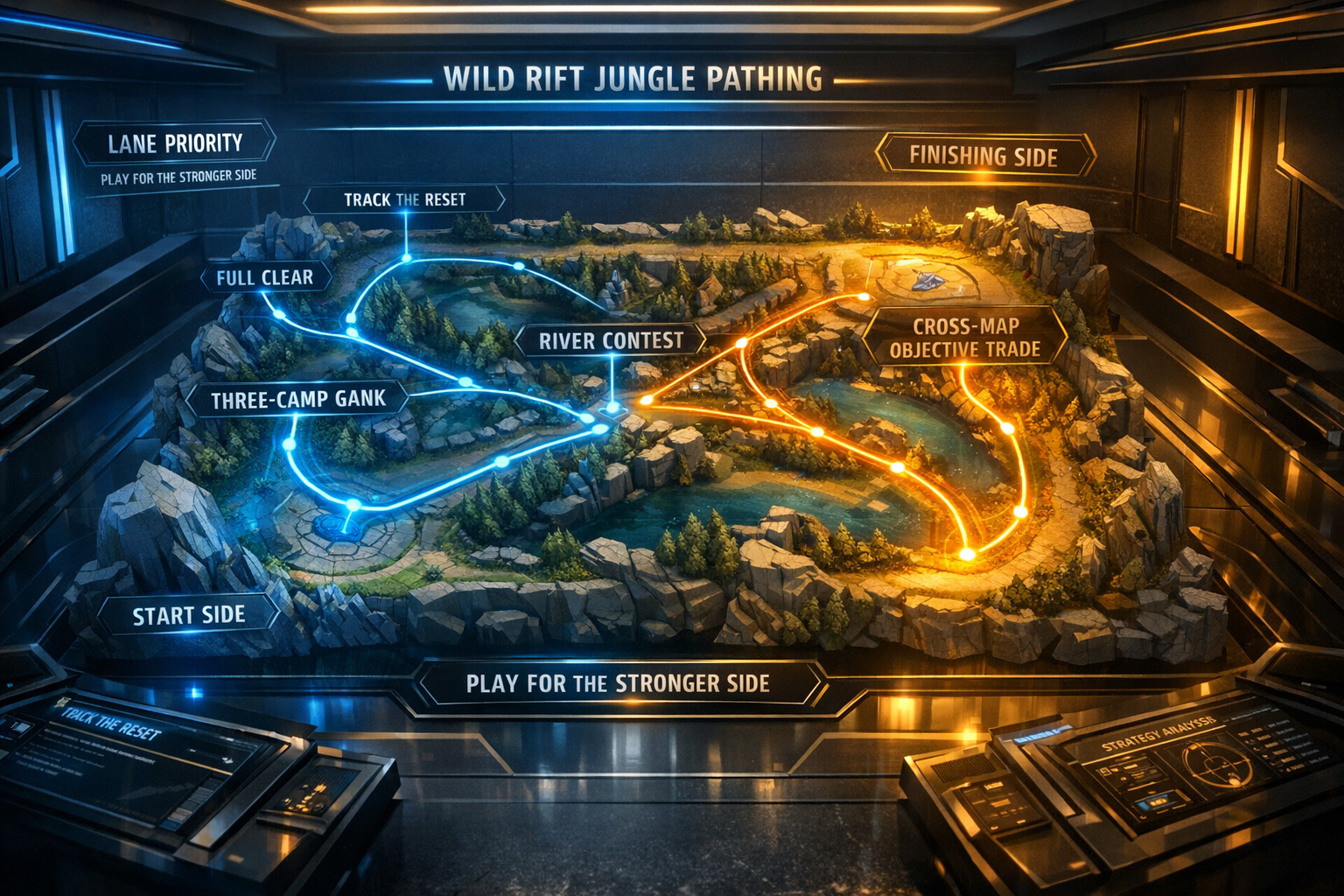
Early tracking is usually cleaner because camp routes are more structured and lanes are still mostly assigned. Mid game is harder because towers fall, players rotate more freely, and fights can start from unexpected angles. Still, the same logic applies if you simplify the map correctly.
In mid game, track the jungler through sides, not camps. Ask whether they are currently playing top side, bot side, or central transition. Then ask why. Is an objective coming soon? Is a side wave overextended? Is their red or blue side likely respawning? Did they just reset and walk out from base toward a particular quadrant?
Deep vision becomes more valuable in this phase because movement between quadrants matters more than single-lane pressure. A ward that catches the enemy jungler crossing through central fog or entering a side objective area can prevent a disastrous face-check and help your team choose whether to group, push, or trade.
Mid game tracking also depends heavily on wave management. Side waves act like magnets. If your side wave is pushing deep with no tower left, someone has to answer it eventually. If the enemy jungler is missing while a side wave is vulnerable, they may hover nearby for a pick. If your team is the one pushing side first, you can often create pressure that forces the enemy jungler to reveal on defense or on the opposite side.
A key habit here is checking the minimap every few seconds and asking, “What objective or lane resource is worth the most right now?” The enemy jungler is probably moving toward one of the best answers to that question.
Objective Calls: Dragon, Herald, Baron, and Trades
Objective calls are where jungle tracking pays off the most. Many ranked players think objective calls are mainly about courage or teamfight confidence. In reality, they are mostly about timing, priority, information, and trade value.
Dragon Calls
Dragon calls should start before the objective is attackable. First, identify lane priority around the area. Second, establish vision on key entrances and likely enemy routes. Third, track the enemy jungler’s side. If they were just seen top side on a long sequence, that is a good window to threaten dragon. If they disappeared bot side after a reset and your lanes cannot move, forcing dragon may be bad.
Do not think of dragon as “take or don’t take.” Think in terms of posture. Sometimes the correct call is to start it immediately. Sometimes it is to threaten it and turn on the enemy when they face-check. Sometimes it is to clear vision, hold mid priority, and wait for a better window. Sometimes it is to give it and use the time to gain something else on the opposite side.
Rift Herald Calls
Herald is often strongest when your team can convert it into structure pressure or tempo, not merely when you can kill it. That means the best Herald windows usually appear when your top side and mid side can move together, when the enemy jungler is committed elsewhere, or when your team has a specific tower plan ready. Tracking matters because Herald fights are often less obvious than dragon fights. Players get caught assuming “nobody is here” when the enemy jungler is already rotating through fog.
Baron Calls
Baron is not a damage test. It is an information and control test. The most reliable Baron calls happen when you know the enemy jungler’s position, force them to show on a wave, pick them first, or deny their access path with vision and zone control. Starting Baron blindly while the enemy jungler is missing and your flanks are dark is one of the most common macro errors in ranked.
Even when your team is ahead, Baron calls should follow simple logic: get side pressure, secure river access, deny enemy vision, watch likely approach routes, and decide whether you are committing to the take or using Baron to force a favorable fight. If the enemy jungler is alive and untracked, the call is weaker by default.
Elder and Late Objective Fights
Late neutral fights amplify every tracking mistake. Death timers are longer, picks are more expensive, and one lost smite contest can decide the game. In these moments, your goal is not merely to know whether the enemy jungler is near the pit. Your goal is to know from which direction they are likely to arrive, how much support they have, and whether your team should burst the objective, peel off, or turn on entry.
Cross-Map Trades
One of the most underrated macro skills in Wild Rift is identifying when you cannot contest in time and should take value elsewhere. Jungle tracking makes this much clearer. If the enemy jungler is already set on one objective with lane priority and numbers, sprinting late into the area often turns a lost objective into a lost objective plus kills. A better call may be to invade the opposite side, take a tower, crash side waves, or secure vision for the next play. Good teams do not contest everything. They contest the right things at the right times.
The best objective callers are not the loudest players. They are the ones who combine jungle location, lane priority, team strength, and timing into a call with low guesswork.
How to Track When Ahead or Behind
Your tracking priorities change depending on game state.
When ahead, tracking helps you squeeze the map. You want to place deeper wards, deny enemy entries, and predict where the jungler must go for safe farm. When your team controls tempo, the enemy jungler has fewer comfortable routes. That makes them easier to read. Use that advantage to set traps, secure neutral areas first, and force bad choices. Ahead teams should not just take objectives; they should make the enemy jungler feel late to every setup.
When behind, tracking becomes survival-first. Your job is to identify danger zones and avoid face-checking into them. Defensive wards, wave discipline, and clear cross-map planning become more important than ambitious invades. A team that is behind can still win through information if it avoids unnecessary deaths, keeps waves manageable, and contests only the fights with a real setup advantage.
Players often make the mistake of turning off their brains when behind. They say the game is dark, so tracking is impossible. That is not true. In fact, because the enemy team wants specific things when ahead, their jungler often becomes more predictable. They want your outer jungle, your objective entrances, and your isolated side laners. If you understand those goals, you can guess where pressure is likely to be and avoid the worst traps.
When behind, also remember that your best tracking tool may be the wave. If a side wave is far out and dangerous to collect, the enemy jungler may hover there. If the enemy starts grouping visibly around one side, the opposite side may be your breathing room. You do not need to control the whole map. You only need to make informed decisions in the part of the map you can safely touch.
Role-Specific Jungle Tracking Tips
For Junglers
If you play jungle, tracking the enemy is partly about mirroring and partly about exploiting. Know when your champion wants to match presence and when it wants to take the opposite-side trade. If you are weaker early, avoid ego contests just because an objective exists. If you are stronger and your lanes can move, use your tracking advantage to deny river, invade respawning camps, and arrive first to neutral fights. Also remember that your laners cannot read your mind. Ping intent early.
For Mid Laners
Mid has the best access to both sides of the map, which makes mid one of the most important roles for jungle tracking. Your wave control often decides whether river is contestable. Watch which side the enemy jungler is favoring and adjust your warding and lane posture. If you have priority, do not waste it standing in lane with nothing to do. Use it to support vision or shadow your jungler.
For Duo Lane
Duo lane players should treat jungle tracking as part of lane spacing. If the enemy jungler is likely bot side, do not take a high-risk trade without vision and summoners. If the enemy jungler is top side or revealed elsewhere, that is your chance to push, plate, reset, or set up river control. Supports, especially, should think about objective vision before the fight becomes urgent.
For Baron Laners
Baron lane often feels isolated, but that makes jungle tracking even more valuable. Because help is farther away, you must know when you can pressure and when you must respect a hover. Baron lane is full of matchups where one greedy trade can open the lane to a punish. If your wave is long and the enemy jungler is missing on your side, assume danger until proven otherwise.
For Supports
Support players are often the team’s best bridge between lane and macro. Your ward placements, movement timing, and pings can make jungle tracking visible for the whole team. Support is not only about placing wards. It is about placing them early enough, in the right corridors, and then helping your team play around what they reveal.
Common Jungle Tracking Mistakes
1. Tracking only after the jungler appears. If you only think about the enemy jungler when they are already on your screen, you are too late. Tracking starts from the opening assumptions and updates continuously.
2. Ignoring lane priority. Players often say, “The jungler should be here,” while forgetting that the enemy lanes can move and their own lanes cannot. A possible path is not the same as a practical path.
3. Warding the pit but not the approach. Seeing the objective itself is useful, but seeing the enemy approach route is often better. Approach vision gives your team time to decide.
4. Contesting every neutral objective. Good macro is not stubborn. Sometimes the correct call is to trade. Jungle tracking helps you know when the enemy is already too well set.
5. Not updating after resets. A jungler who just recalled does not remain in the same mental location. Think about where they will walk from base, which camps are likely alive, and which objective side is next.
6. Forgetting summoner spell information. A flashless lane or low-health target changes the enemy jungler’s priorities. Tracking is not just map geometry; it is opportunity awareness.
7. Overcommitting to certainty. The goal is not to be 100% right. The goal is to reduce bad outcomes. Good trackers work with likelihoods, not fantasies of perfect vision.
Practice Drills to Improve Faster
If you want to improve jungle tracking quickly, use simple deliberate drills instead of trying to remember everything at once.
Drill 1: Call the Start Side
In every game, identify the enemy jungler’s likely start side before the first minute fully develops. Say it to yourself. Even if you are wrong sometimes, building the habit matters.
Drill 2: Update Every Reveal
Each time the enemy jungler shows, immediately ask where they can logically go next. Do not stop at “they are bot.” Ask, “after bot, what is the best next action?”
Drill 3: Ward With a Question
Before placing a ward, state the question it answers. “Is the jungler coming through river?” “Are they moving from mid to dragon?” This makes your vision purposeful.
Drill 4: Predict the Objective Posture
About half a minute before an important neutral play, predict whether the enemy wants to start, contest late, or trade cross-map. Then compare your prediction with what actually happens.
Drill 5: Review One Death Per Game
After each match, review one death caused by fog of war or jungle pressure. Ask what clue you missed. Most “random” deaths become understandable when you reconstruct the enemy jungler’s likely route.
These drills are powerful because they teach the habit loop of prediction, observation, and correction. That is how tracking becomes instinctive.
Putting It All Together
Let’s combine the framework into one practical sequence.
You enter the game and estimate the enemy jungle start from lane arrival and champion identity. From there, you predict the likely finishing side of the first route. You then compare that predicted route with lane volatility. If your lane is the natural target, you adjust your wave and ward timing. If the opposite side is more likely, you can pressure more confidently.
Next, you watch for the first reveal. Maybe the jungler shows in river, on a ward, or in a lane. Now you update the model. You ask what camps are likely next, whether they are healthy enough to continue pressuring, whether an objective timer is pulling them somewhere, and whether they will probably reset first.
As the first neutral objective approaches, you shift from lane-focused tracking to area-focused tracking. You care less about exact camps and more about which side the jungler can reach on time, which lanes can move first, and which entrances your team has vision over. That leads to a clearer call: start, posture, trap, or trade.
In the mid game, you simplify again. Instead of obsessing over every camp, you track by map side, wave pressure, and objective gravity. If the enemy jungler is missing, you ask which area makes the most sense for them to influence right now. Then you position accordingly.
That is really all jungle tracking is: a disciplined habit of turning limited information into practical probabilities. It is not magic. It is not reserved for high elo only. It is a learnable skill built from repeated questions and good reactions.
Final Thoughts
Wild Rift rewards mechanics, but macro wins a huge number of ranked games that never look spectacular in the highlight reel. Jungle tracking is one of the cleanest examples of that truth. It prevents overextensions, supports smarter wards, improves objective calls, and helps every role make decisions with less guesswork. Most importantly, it gives you control over the pace of your own play.
If you want to climb, do not wait until you become a mechanical prodigy before learning map logic. Start with small habits. Identify the likely start side. Respect the likely finishing side. Place wards with a question in mind. Update after each reveal. Tie your tracking to objective timers. Over time, these habits turn into instinct, and the map begins to feel slower and more readable.
That is when ranked starts changing. Ganks feel less surprising. Objective fights feel less chaotic. Rotations feel cleaner. Even losses become easier to analyze because you can explain what happened instead of calling it random. And that kind of clarity is one of the biggest edges you can build in Wild Rift.
If you want extra support while improving your Wild Rift macro and climbing more efficiently, you can explore Boosteria’s Wild Rift boosting options. You can also stay current on game systems through the official Wild Rift patch notes, and browse the official Wild Rift site for broader updates and champion information.