



Teamfight Tactics Tempo vs Greed: When to Roll or Level
Teamfight Tactics — Tempo vs Greed: When to Roll, When to Level
In Teamfight Tactics, many games are not decided by your opener, your first item slam, or even your first chosen carry. They are decided by a quieter question that repeats from Stage 2 until the final fight: should you spend now for strength, or hold now for a stronger future? That is the heart of tempo versus greed.
Most players understand the surface-level version of this debate. If you are weak, roll. If you are rich, level. If you are healthy, greed. But strong TFT players know that these shortcuts are incomplete. The correct answer depends on your board strength relative to the lobby, your item flexibility, your future outs, your current streak, your health total, your expected power spike, and how expensive your transition will be.
This guide is built to stay useful across sets, because the exact champions, traits, Augments, and shop odds may change over time, while the macro logic behind tempo and greed stays relevant. If you want the official TFT hub, ranked info, or current system updates, you can always check Riot’s official Teamfight Tactics page, the TFT Ranked FAQ, and the latest official patch notes.
If your goal is to climb with cleaner decisions and more stable results, mastering this one concept will do more for your rank than memorizing a single meta composition. And if you want help accelerating your climb while learning stronger fundamentals, Boosteria’s Teamfight Tactics boosting prices page is the most relevant service link for this topic.
What Tempo and Greed Really Mean in TFT
Tempo means spending resources earlier than later to gain immediate strength. In TFT, that usually means leveling sooner, rolling sooner, slamming flexible items, or committing to a board that is strong now even if it lowers your peak later. Tempo is about preserving health, maintaining streaks, and forcing the lobby to react to you.
Greed means delaying power to preserve long-term value. In TFT, that usually means holding gold for interest, skipping marginal upgrades, delaying a level, or accepting short-term losses so your future roll-down or level timing is much stronger. Greed is about maximizing economy, preserving flexibility, and reaching expensive win conditions that weaker econ lines never reach.
Neither approach is inherently correct. Tempo without purpose becomes panic spending. Greed without discipline becomes fake economy that costs too much HP. The best players do not “always tempo” or “always greed.” They convert game state into the correct spending pattern.
A simple way to think about it is this:
- Tempo buys survival and streak value.
- Greed buys future access to better units, cleaner transitions, and higher board caps.
The entire art of TFT macro is learning which of those purchases matters more at the exact moment you are deciding.
Why Most Players Mismanage Gold
Most players mismanage tempo and greed because they look only at their own board. TFT is a relative game. A board that feels strong in isolation may be weak against the current lobby. A board that looks poor on paper may be acceptable if the whole lobby is weak and your losses are small. This is why scouting matters so much.
Players also make the mistake of treating gold as the only economy resource. Gold matters, but HP is also a currency. So is round timing. So is bench space. So is mental clarity during a fast transition. If you save 30 gold but lose 35 HP to get there, that was not always “good econ.” If you hold too many fringe units and miss a clean pivot, that was not true flexibility either.
Another common issue is copying timing rules without context. “Always roll on 3-2.” “Always go 8 first.” “Never roll before 50.” These rules can help beginners build structure, but they become traps when followed blindly. The right line depends on whether you are protecting a streak, bleeding out, contesting units, trying to hit a narrow upgrade, or aiming for a level-based cap.
The Four Core Resources: Gold, HP, Time, and Board Slots
To understand tempo versus greed, stop thinking only in terms of gold. Every TFT decision converts one resource into another.
1. Gold
Gold is obvious. It buys shop refreshes, levels, and unit purchases. It also multiplies through interest in standard TFT formats, which means unspent gold often has future value beyond the number shown on your screen.
2. Health
Health is the permission system of TFT. A healthy player can greed, pivot, wait, scout longer, and accept a few bad fights. A low-health player loses those options. HP is not just survival; it is strategic freedom.
3. Time
Time means stages and rounds. A future power spike has value only if you live long enough to use it. If your board becomes amazing at Level 8 but you reach that spot at 18 HP with no gold, the “late-game plan” may have arrived too late.
4. Board Slots and Bench Space
Every unit you hold is an opportunity cost. Every extra synergy splash, transition pair, or speculative carry competes for space. Greed often looks smart until your bench is jammed, your item holders are messy, and you cannot execute your rolldown. Cleaner boards often convert gold more efficiently than cluttered ones.
The best TFT decision is usually the one that converts your current strongest resource into the one you are missing. If you have a lot of HP and mediocre gold, you can spend health by greeding. If you have a lot of gold and low HP, you often spend gold to buy safety immediately.
Tempo Fundamentals: What Spending Gold Actually Buys
Players often describe tempo as “playing aggressively,” but that is too vague. In practical TFT terms, spending for tempo usually buys one or more of the following:
- Protection of a win streak
- Smaller losses while you transition
- Access to a stronger level bracket earlier
- Higher odds of fielding additional traits or utility units
- More immediate combat power from upgrades
- More stable item holders while waiting for final units
Tempo spending is strongest when the board strength gained is immediate and reliable. For example, leveling to add a premium frontline unit, rolling to hit a necessary two-star tank, or slamming a flexible combat item to convert near-losses into wins are all strong tempo actions.
Tempo is weakest when spending produces only cosmetic upgrades. Rolling 20 gold for pairs that do not meaningfully change combat, or leveling without a useful add, often feels active but does not actually save enough HP or generate enough streak value to justify the cost.
Good tempo spending is intentional. You are not spending because you feel nervous. You are spending because you understand what your gold is supposed to accomplish this round and the next few rounds.
Greed Fundamentals: What Saving Gold Actually Buys
Greed is also misunderstood. It is not merely “being greedy.” Good greed is disciplined economy preservation that leads to a sharper power spike later. When done well, it buys:
- More total gold through interest
- A larger and cleaner rolldown on a key level
- Access to higher-cost units that better fit your endgame
- More flexibility before you commit to a line
- Stronger comeback potential once your comp direction becomes clear
Greed is strongest when your current board can afford it. That may mean you already have enough strength to keep losses small, or you have enough HP to absorb temporary losses without entering danger.
Greed is weakest when it is based on fantasy rather than probability. Holding 70 gold for a perfect future board sounds amazing, but if your current board is collapsing, the real future may be an eighth-place finish before you ever assemble the dream setup.
Strong greed is selective. You are not refusing to spend forever. You are choosing not to buy low-value strength now because you know exactly where your real power spike is supposed to happen.
When to Roll: Clear Signs You Must Spend
Rolling is correct when upgrades matter more than economy. That sounds simple, but players often roll too early, too late, or too shallow. Here are the clearest signs that you should roll.
Your frontline is collapsing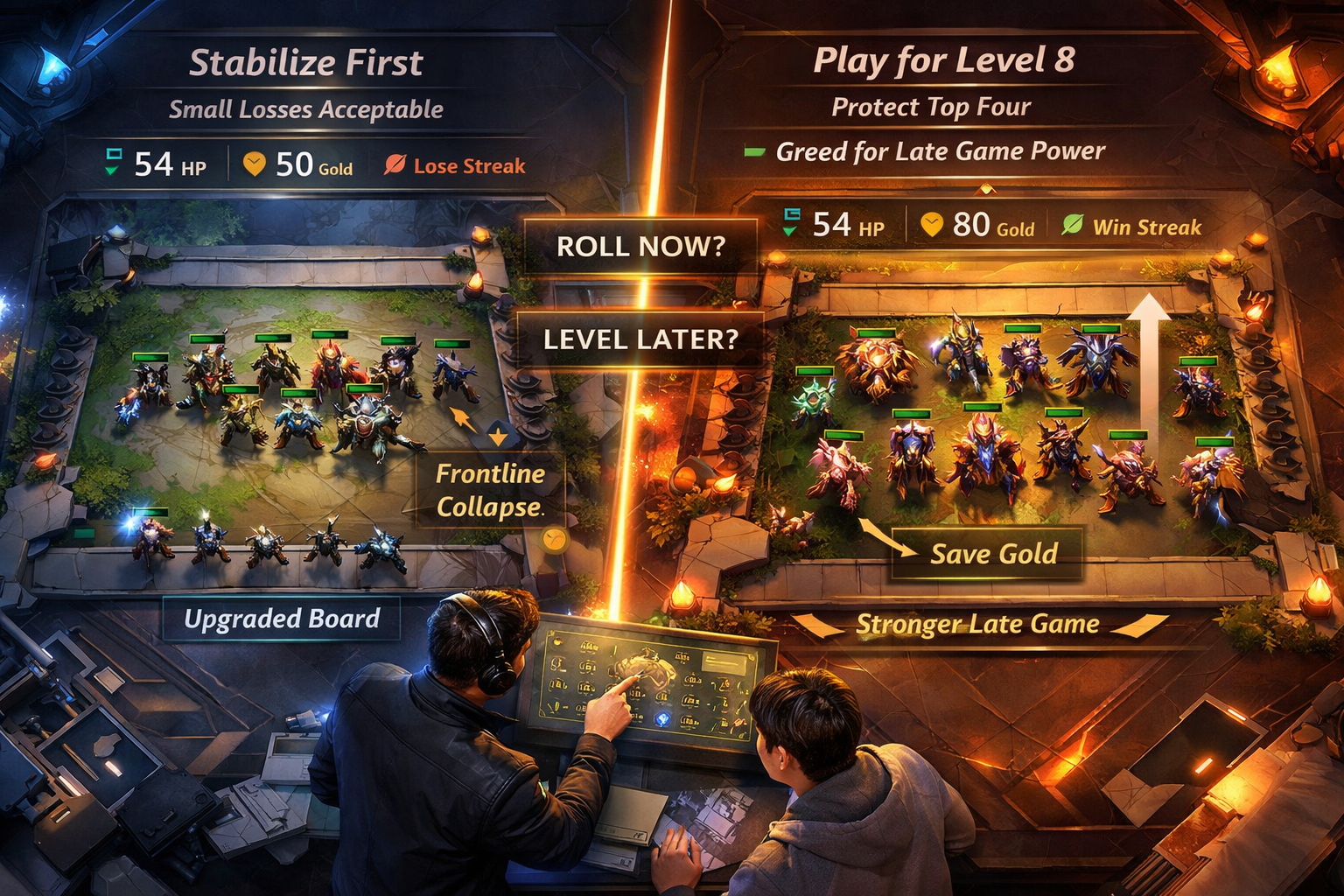
If your frontline dies instantly, your backline never gets to function. Even strong carry items cannot save a board that has no time to deal damage. Rolling for tank upgrades is often more important than greedily fishing for a carry upgrade, especially in the mid game.
You are about to take heavy losses
Not all losses are equal. A narrow loss against a stronger board is acceptable. Repeated multi-unit losses are dangerous because they accelerate your HP collapse. If your board is consistently losing by several units, you often need to roll to reduce damage.
You have pairs that convert efficiently
Rolling becomes much better when your bench already contains multiple live pairs or partial upgrades. Spending gold is more efficient when you are close to several meaningful hits rather than hoping to spike from nothing.
You are in a key stabilization window
Some rounds are natural points to stabilize because the lobby spikes around them. If you know your board is behind and the lobby is about to get stronger, waiting one more cycle can cost far more HP than the saved gold is worth.
Your comp needs unit quality more than an extra slot
Some boards improve more from hitting two-star core units than from leveling for a low-impact filler. If an extra unit does not transform your board, but upgrades do, rolling is often superior.
You are low HP and cannot afford setup losses
Once you drop into a fragile HP range, abstract future value matters less. Your goal shifts from optimizing first-place equity to ensuring top-four survival. At that point, rolling to stabilize is frequently mandatory.
When to Level: Clear Signs XP Is Better Than Rolls
Leveling is not just about fitting one more unit. It is about buying access: access to stronger shop odds for certain unit costs, better trait combinations, more utility, more frontline density, and more flexible endgame boards.
Your next unit is high impact
If leveling gives you a real board upgrade right away, it becomes much stronger. A premium tank, a key utility trait, extra crowd control, or a powerful secondary carry often justifies XP spending.
Your board is already stable enough
If your current board is not in danger of being run over, rolling for tiny upgrades can be wasteful. In those spots, rushing a stronger level bracket is often better than spending gold on low-value shop refreshes.
You are playing for expensive units
Some endgames rely more on access to higher-cost units than on rerolling lower-cost pieces. In those games, leveling on time or even slightly ahead of curve can be the difference between arriving at your intended cap and getting stuck in an awkward midpoint.
You need another board slot for structure, not greed
Sometimes your board is one slot short of coherence. Maybe your frontline is thin, your utility is missing, or your items are split across bad holders. Leveling is best when the added unit cleans up the whole board rather than simply increasing unit count.
Your rolldown becomes much better on the next level
Greedy players often miss this point. Sometimes the most efficient use of gold is not to roll now but to level first and then roll, because your shop access and board ceiling both improve. If the level meaningfully improves your outs, save for that timing.
When to Greed: Clear Signs You Should Hold
Greed is correct when spending now does not buy enough power. Here are the best conditions for it.
Your losses are small and controlled
If you are losing by one or two units while preserving economy and preparing a cleaner spike later, that is often acceptable. Small losses are the price greedy lines are designed to pay.
Your board still has future item-holder value
A mediocre board can still be functional if it carries your items cleanly into a later transition. If your current holders are buying time without forcing awkward commitment, you can often afford to wait.
You know your next power spike
Good greed is scheduled. You are not passively hoping things improve; you know the level, stage, or gold threshold where you intend to spend.
The upgrades available now are weak
If rolling is unlikely to hit anything meaningful, or leveling gives you only a filler unit, the best action may be no action. Smart restraint wins many TFT games.
You have enough HP to rent time
Healthy players should use that advantage. Health is not only for surviving mistakes; it is also for enabling stronger economy lines that other players cannot afford.
Stage-by-Stage Decision Making
Stage 2: Establish identity without overcommitting
Stage 2 is where players begin to split into tempo and greed lines. Your main goal here is to understand what kind of opener you actually have. Are you strong enough to protect a streak? Are you weak enough to intentionally loss streak? Or are you in the awkward middle where you should preserve flexibility and avoid inefficient spending?
If you have upgraded units, strong early item slams, and decent synergy, tempoing Stage 2 can be excellent because streak gold compounds. But if your opener is weak and your items are not yet clear, forcing wins with poor spending can ruin both your economy and your transition.
Many players make the mistake of trying to win every Stage 2 board. That is not the goal. The goal is to choose a coherent line. Either protect a likely streak, build a clean loss streak with controlled damage, or stay flexible if the lobby is messy and outcomes are uncertain.
Stage 3: The truth stage
Stage 3 reveals whether your earlier plan was real. This is often where fake greed gets punished and low-value tempo gets exposed. By now, you should know whether your board can continue holding, whether your item holders are still appropriate, and whether you need to spend to stabilize.
If you are healthy and economically strong, Stage 3 is often where greed pays off. If you are weak, this is frequently the stage where rolling for stability matters most. Many TFT games are lost because players refuse to acknowledge that their board is no longer competitive once the lobby upgrades around them.
Stage 4: The biggest macro fork
Stage 4 is where the difference between “stabilize” and “cap” becomes decisive. At this point, the lobby’s damage output increases, and poor boards can get punished fast. If you are ahead, this is where tempo can convert a good game into a dominant one by preserving streak and forcing weaker players to panic roll. If you are behind, this is often where you must spend enough to stop the bleeding.
The critical mistake here is rolling without a target. Do not enter Stage 4 rolldowns asking only, “Can I hit something?” Instead ask, “What board am I trying to leave this round with?” Stabilization boards and first-place boards are different. Know which one you can actually afford.
Stage 5 and beyond: Survival versus cap
In late stages, greed becomes more selective. Your economy matters, but each fight can now define placement. If you are healthy and rich, you can play for cap and chase first. If you are fragile, you often stop optimizing for perfection and start optimizing for the strongest board you can field immediately.
This is also where many players misread win conditions. A board with first-place ceiling is not always the correct board if reaching that cap requires two more rounds of weakness. Sometimes the right play is to lock a strong top-four line now instead of gambling everything on a fantasy pivot later.
Win Streaking, Loss Streaking, and Protecting Your Economy
Streaks are one of the clearest bridges between tempo and greed. A win streak is tempo that generates economy. A loss streak is greed that is partially protected by planned economy. Both can be good. Both can fail if mismanaged.
How to protect a win streak
When you are win streaking, spending to preserve that streak is often worth more than static econ math suggests. The value is not only the extra gold. It is also HP preservation, lobby pressure, and easier future transitions because you are playing from ahead.
That said, not every streak is worth protecting at any cost. Spending 30 gold to save one round of streak value is often bad unless that spending also sets up future strength. Protect streaks with efficient upgrades, not desperation.
How to run a healthy loss streak
A good loss streak is controlled. You want to maximize economy while minimizing damage. That means keeping enough board quality to avoid total blowouts, slamming items when necessary to reduce incoming damage, and preserving your future outs rather than holding every possible pivot piece.
The worst type of loss streak is the accidental one: not strong enough to win, not weak enough to guarantee losses, and not rich enough to justify the damage taken. That line often leaves players broke, low HP, and without a clean spike window.
Never break a streak cheaply
One of the classic TFT mistakes is breaking your own streak for no real reason. If you are loss streaking, random upgrades that accidentally turn one round into a win can damage your econ plan. If you are win streaking, choosing not to spend when one efficient action would preserve the streak can be equally bad. Commit to the line you are on unless the board state clearly tells you to change.
How to Judge Board Strength Correctly
Board strength evaluation is the skill that decides whether tempo or greed is correct. You do not need perfect scouting every round, but you do need to answer a few core questions honestly.
How strong is my frontline?
Frontline strength determines whether your carry gets to play the game. If your frontline is weak, your board usually needs spending sooner than you think.
Is my damage profile stable?
Some boards rely on one unstable unit carrying all damage. Others have layered damage sources that still function through imperfect fights. The less stable your damage profile, the more cautious you should be about greed.
Are my items functional now?
Perfect items are great, but playable items now often matter more than ideal items later. If slamming an item turns a weak board into a stable one, that is often a tempo decision worth taking.
What am I actually losing to?
Do not just note that you are losing. Identify why. Are you lacking frontline, utility, anti-burst, backline access, or pure damage? Rolling is only good if it targets the real weakness.
How contested is my line?
If many players are contesting your units, greedy waiting can backfire because your hit rate later drops. Sometimes spending sooner to secure upgrades before the pool dries up is the better line.
Stabilizing vs Capping: Know What You’re Buying
This distinction is essential. Stabilizing means buying enough power to stop losing hard. Capping means spending to maximize your final board ceiling. Confusing the two causes massive gold waste.
If you are low HP, your immediate need is often stabilization, not luxury. Roll until your board is good enough to survive, then rebuild economy if possible. If you are healthy and rich, you can think more about capping: stronger levels, premium utility, cleaner synergy completion, and higher-end carries.
The biggest trap is trying to cap from a weak position. Players roll past efficient stabilization points because they are chasing a perfect final board. Then they run out of gold and die with an almost-complete dream. Better to stabilize first and cap later if time allows.
How Deep Should You Roll?
Rolling is not binary. The depth matters.
Shallow roll
A shallow roll is useful when you need just a little help: maybe one frontline upgrade, one pair completed, or one utility add to keep a streak alive. You are not rebuilding the entire board, only polishing it.
Medium roll
A medium roll is for stabilization. You spend enough to leave the round with a board that can reasonably fight the lobby. This is often the most disciplined approach because it solves the current problem without destroying all future econ.
Deep roll
A deep roll is a commitment. You usually choose it when your HP is low, your current board is unacceptable, or the timing is uniquely powerful for your comp. Deep rolls should have a purpose. If you do not know what your end board looks like after the roll, you are probably rolling too emotionally.
A useful rule: stop rolling once the board accomplishes the goal that justified the roll. If the goal was stabilization and you are now stable, do not continue just because the shop is tempting.
Common TFT Tempo vs Greed Scenarios
Scenario 1: Healthy, rich, but weak board
This is one of the most deceptive spots. Because you are rich, it feels safe to greed. Because you are healthy, it feels safe to delay. But if your board is weak and the lobby is about to spike, the correct line is often to spend enough to preserve your healthy position. HP should not become an excuse to take avoidable collapse damage.
Scenario 2: Strong board, low gold, good streak
In this case, tempo is already working for you. The right move is usually to preserve strength efficiently, avoid unnecessary greed, and let the streak rebuild your economy. Do not sabotage a winning position by forcing greed too early.
Scenario 3: Medium board, medium HP, unclear direction
This is where flexibility matters most. Avoid hard-committing unless your items and shops force a direction. Preserve econ where possible, scout carefully, and spend only on upgrades that stay useful across multiple pivot options.
Scenario 4: Low HP, high gold, narrow outs
Spend. This is where players die with money. If your future requires surviving now, gold has no value until converted into board strength. Roll and/or level for the strongest board you can field immediately.
Scenario 5: Strong econ, contested reroll line
If your line is heavily contested, waiting forever can be disastrous. Your probability of hitting key copies worsens as more units leave the pool. Sometimes earlier rolling to secure your core upgrades is less greedy in theory but smarter in practice.
Scenario 6: Win streak with awkward items
When streaking, do not be too precious about ideal itemization. If a flexible slam keeps your board strong and prevents a streak break, the tempo value often outweighs perfect greed for later item combinations.
The Biggest Tempo vs Greed Mistakes
Greeding because the number 50 feels sacred
Interest thresholds matter, but they are not magic. Staying above 50 while taking huge losses is one of the most common low-rank mistakes. Economy exists to create future power, not to become a museum piece.
Rolling because losing feels uncomfortable
Some players spend every time they lose two rounds in a row. That is fear, not strategy. Ask whether the losses are acceptable, whether the board is actually unstable, and whether the available upgrades are worth the gold.
Leveling without a useful add
XP is powerful only when it meaningfully changes your board or your future odds. Buying a level for a filler unit that does not improve combat much is often worse than either rolling or holding.
Holding too many possible pivots
Bench greed is real. If you keep every transition option alive, you often weaken your actual board decisions. Better to maintain two or three realistic paths than six imaginary ones.
Ignoring lobby tempo
TFT is not a single-player economy puzzle. If the whole lobby is spiking and you are still planning for “one more round,” your greed is probably late.
Overrolling after already stabilizing
Once your board becomes acceptable, continued rolling can destroy your top-four floor. Many players turn a solid recovery into a bad finish by refusing to stop.
Confusing first-place lines with every-game lines
Not every game should be played for max greed and legendary cap. Strong climbing comes from placement consistency. Sometimes the best line is the one that secures fourth or third instead of gambling for first and risking eighth.
A Practical In-Game Checklist
When you feel uncertain, run through this checklist quickly:
- Am I strong, average, or weak relative to the lobby?
- Are my losses small or heavy?
- Is my HP giving me freedom, or am I entering danger?
- Does leveling give me a meaningful add right now?
- Does rolling have high hit value because of pairs or key upgrades?
- Am I protecting a streak or breaking one?
- What exact board am I trying to leave this round with?
- Am I stabilizing, or am I capping?
- If I hold, when exactly will I spend?
- Am I making this choice because it is correct, or because it feels safer emotionally?
If you can answer those ten questions honestly, your tempo versus greed decisions will improve dramatically.
Evergreen Principles That Stay True Across Sets
Because TFT changes over time, many players worry that macro guides become outdated. The details shift, but these principles remain useful in almost every set:
- Do not greed when your board cannot afford it.
- Do not roll without knowing what you are rolling for.
- Protect strong streaks efficiently.
- Use HP as a resource, but do not waste it casually.
- Level when the board slot or shop access matters more than immediate upgrades.
- Roll when unit quality matters more than one extra slot.
- Stabilize before chasing luxury.
- Scout the lobby before committing to greed or tempo.
- Not every game is a first-place greed game.
- Gold on your bench is worthless if you die before spending it.
How Better Tempo Decisions Improve Rank Over Time
TFT ranked improvement is rarely about dramatic genius. It is about reducing the number of games you throw away with poor spending patterns. Strong tempo decisions turn doomed eighths into sixths, shaky sixths into fourths, and strong fourths into firsts because you arrive at your power spikes with more HP, better positioning, and cleaner board states.
That is why this skill matters so much for climbing. On Riot’s standard TFT ranked ladder, consistency is everything, and your macro choices shape that consistency more than highlight-reel highrolls do. You can learn more about ranked basics on Riot’s official Ranked FAQ.
If you also want to review general TFT systems or current updates before queuing, Riot’s official TFT hub and the latest patch notes section are the cleanest places to verify modern details while keeping your core macro evergreen.
And if your goal is to combine learning with faster ladder progress, Boosteria’s TFT boosting prices page is the most natural internal resource to pair with this guide.
Final Thoughts
Tempo versus greed is not a gimmick or a niche concept. It is one of the central languages of Teamfight Tactics. Every level bought, every roll pressed, every item slammed, and every streak protected reflects a stance on the question of power now versus power later.
The strongest players are not the ones who always save or always spend. They are the ones who understand why they are saving or spending, what that choice is supposed to buy, and when the value of that choice has changed.
If you want one final takeaway, let it be this: greed when your board can absorb time, tempo when your board needs immediate help, and always spend with a purpose. When you do that, your TFT decisions become cleaner, your transitions become calmer, and your placements become far more consistent.