



Apex Legends Ranked Explained: RP, Placement & Climbing
Apex Legends Ranked Explained: RP, Placement, and Consistent Climbing
Apex Legends Ranked is simple on the surface and surprisingly demanding once you try to climb seriously. You queue up, pay an entry cost, fight through a lobby, earn or lose Ranked Points, and try to move upward over time. But anyone who has played more than a few sessions knows that the real challenge is not understanding the menu. The real challenge is understanding why some players steadily gain RP across weeks while others bounce up and down without ever building lasting momentum.
This guide is built to solve that problem. Instead of giving you a short summary of what Ranked is, it explains how the system actually rewards behavior and how to align your decisions with those rewards. If you understand the relationship between placement, eliminations, risk timing, consistency, and session discipline, Apex Legends Ranked becomes far less random. You stop treating every fight like a coin flip and start treating each match like an RP investment.
The goal here is to keep the advice as timeless as possible. Exact numbers, thresholds, or split details can change from season to season, but the core Ranked logic usually stays recognizable: placement matters, clean eliminations matter more when paired with survival, bad early decisions are expensive, and climbing depends far more on repeatable habits than on highlight plays. If you want to check current official values for entry costs, scoring details, or split updates, use the official EA Ranked overview. For the broader mode structure, the official Apex game modes guide is also useful.
If your main goal is to improve efficiently, this article will walk you through how RP works in practice, how placement should shape your decisions, how to fight without throwing matches, how to solo queue more effectively, how to review your own gameplay, and how to build a climbing routine that survives bad sessions. If you are looking for additional help beyond self-study, you can also compare options on our Apex Legends boosting prices page.
Table of Contents
- What Apex Legends Ranked Really Is
- How RP Works Without Overcomplicating It
- Why Placement Comes First
- How to Get Eliminations That Actually Count
- Consistency vs. Pop-Off Games
- The Early Game: Landing, Loot, and First Decisions
- The Mid Game: Rotations, Space, and Fight Selection
- The Endgame: Converting Good Positions Into RP
- Legend Choice and Team Composition for Climbing
- How to Climb in Solo Queue
- How to Climb as a Duo or Full Trio
- Common Ranked Mistakes That Stall Progress
- How to Review Your Matches and Improve Faster
- Mental Game, Tilt Control, and Session Management
- Apex Legends Ranked FAQ
- Final Thoughts on Consistent Climbing
What Apex Legends Ranked Really Is
Apex Legends Ranked is not just a more serious version of public matches. It is a system designed to measure how consistently you create high-value outcomes against other players who are also trying to optimize their results. That sounds obvious, but many players still approach Ranked emotionally instead of structurally. They queue with the mindset of “I need kills” or “I just need decent teammates” rather than “I need to make enough correct decisions across enough matches that my average RP trend moves upward.”
That difference in mindset matters. Public matches often reward speed, chaos, ego challs, and entertainment. Ranked punishes those habits more often than players expect. A flashy 1v3 in a casual lobby can feel amazing, but in Ranked the real skill is often choosing the correct 3v3 to take, disengaging from the wrong one, rotating before the lobby collapses on you, and reaching a placement threshold where your eliminations become more valuable.
In other words, Ranked is a game of decision quality under pressure. Mechanics matter, of course. You still need aim, movement, recoil control, clean peeks, good armor swaps, and disciplined use of abilities. But as you climb, the biggest difference between stuck players and climbing players is usually not raw aim. It is how often they:
- avoid low-value fights,
- take fights with a clear advantage,
- play ring with intention,
- stabilize after winning an engagement,
- protect placement when a match becomes volatile,
- and reset mentally after losses instead of forcing bad queues.
That is also why watching high-level competition can help. The ALGS official site is worth following because top competitive Apex constantly shows the same timeless truths: strong teams value space, timing, information, crossfire, and repeatability. You do not need to copy pro play one-to-one in standard Ranked, but you can absolutely learn the principles that make good teams hard to punish.
How RP Works Without Overcomplicating It
If you strip away the exact season-to-season details, Apex Legends Ranked always revolves around the same essential loop. You enter a match, there is a cost to participate, and you earn RP back through performance. That performance is shaped mainly by where you finish and what combat value you contributed along the way. The cleaner your performance, the more likely you leave with positive RP. The sloppier your choices, the more often the entry cost turns your bad game into a meaningful loss.
The easiest way to understand RP is to break it into four questions:
- Did you survive long enough to reach a meaningful placement?
- Did you contribute to eliminations that the system values?
- Did you avoid dying before your combat value had time to matter?
- Did you repeat that process across multiple matches?
Players get stuck because they often optimize only one of those questions. Some are good at surviving but never convert pressure into kills or assists. Some take constant fights and collect early eliminations but die before placement turns those actions into strong RP. Some play well in one match and then sabotage the next three by chasing the same tempo regardless of lobby conditions.
A better model is to think of RP as stacked value. Placement builds the foundation. Clean kills and assists increase the return on that foundation. Smart timing protects both. This is why the same three kills can feel worthless in one match and excellent in another. If those kills happen early and your team dies soon after, the system often treats them as incomplete work. If those same kills happen during a controlled route toward a high placement, the value compounds.
This is the central Ranked lesson: your actions are not judged only by what you do, but by when you do them and what they allow afterward.
That is also why you should avoid obsessing over one-match outcomes. A good Ranked player is not the player who has the most explosive game in a night. It is the player whose average game quality is high enough to overcome variance. If you play ten matches and seven of them are structurally solid, your RP graph usually reflects it. If you play ten matches and rely on one huge win to erase six reckless losses, your climb becomes unstable.
Why Placement Comes First
Every serious Apex Legends Ranked guide eventually comes back to the same point: placement is not a side bonus. Placement is the skeleton of the system. If your team consistently dies too early, you are trying to climb on a cracked foundation.
This does not mean you should rat every game or avoid all combat. It means survival creates the conditions that make the rest of your performance matter. A team that reaches later phases of the match has more chances to:
- find higher-value eliminations,
- loot stronger armor and utility,
- play from better zones,
- capitalize on third parties,
- and let weaker teams remove each other.
Players who misunderstand placement often say things like, “I had four kills, but still lost RP, this system is bad.” In reality, the system is teaching a lesson: battle royale Ranked is not deathmatch. If your team wipes a squad off drop and then gets deleted in the next messy fight, you did not demonstrate a complete match. You demonstrated partial success followed by structural failure.
Placement matters because it reflects many core skills at once: ring awareness, route discipline, fight filtering, resource management, patience, and the ability to survive chaos. Those skills are not passive. They are competitive advantages. A squad that arrives in zone with shields, ammo, abilities, and line-of-sight options is far more dangerous than a squad that won two random fights but enters late game broken and disorganized.
If you want to climb more consistently, start each match with a placement-oriented framework:
- Choose a landing plan that balances loot and survival.
- Leave your drop with enough resources to play your first real fight on your terms.
- Track the ring early and think one rotation ahead.
- Avoid coin-flip fights in bad terrain.
- Stabilize after every engagement before greedily pushing the next one.
- Value playable space more than ego.
The best part is that this approach does not reduce kill potential. It usually increases it. High placement teams often find better kill windows because they reach later circles with stronger setups while the rest of the lobby is stressed, rotating late, or desperate for space.
How to Get Eliminations That Actually Count
Eliminations matter in Apex Legends Ranked, but players regularly sabotage their own combat value by chasing the wrong fights. The solution is not to become passive. The solution is to become selective.
A good Ranked fight usually has at least three of these qualities:
- your team has information first,
- your team has angle control or height,
- your team can isolate one player,
- your team can finish quickly and reset,
- your team is unlikely to be instantly third-partied,
- and winning the fight improves your position or resources.
A bad Ranked fight usually looks like the opposite. It starts because someone cracks an enemy and tunnels. Then the team pushes through open space, loses formation, trades damage unevenly, takes too long to finish, and gets collapsed on by a second or third squad. Even if you technically win the first fight, the result is often a net disaster.
The highest-value eliminations are rarely the loudest ones. They are often the cleanest ones. Think of them as efficient combat. Efficient combat means you convert an advantage into a wipe while keeping enough health, ammo, utility, and time to survive what happens next.
Here are a few timeless rules for getting eliminations that support your climb:
1. Fight when the map gives you permission
If ring is closing, your route is bad, and two other teams can hear everything, the map is telling you that the fight is expensive. Listen to it.
2. Entry damage is not the same as a winning window
Cracking one enemy does not automatically justify a full send. Ask whether your team can actually close the distance without losing the trade.
3. Prioritize down conversions
Many squads throw advantage by celebrating a knock instead of securing the wipe or defending the knock from a counterpush. One down is pressure, not victory.
4. Maintain spacing
Stacking too tightly creates grenade value against you and makes one bad peek punish the whole squad. Good spacing gives you crossfire, escape options, and cleaner trades.
5. Reset after success
Heal, swap armor, reload, scan your surroundings, and ask where the next threat is coming from. Most lost RP after a good fight comes from failing the reset.
If you treat eliminations as a multiplier on already-good positioning instead of a replacement for it, your average results improve dramatically.
Consistency vs. Pop-Off Games
One of the biggest traps in Apex Legends Ranked is confusing peak performance with climb-worthy performance. A pop-off game feels amazing. You get a strong landing, your shots hit, your team wins every trade, and the RP payout is huge. But a real climb is built on what happens in the other matches, especially the ordinary ones.
Consistency is the true engine of Ranked progress. If you want to know whether your system is working, ask questions like:
- How often do we die before our match has structure?
- How often do we reach late game with resources?
- How often do we leave a session because of tilt rather than good judgment?
- How often are our losses caused by the same repeated mistake?
Climbing players usually have boring strengths. They land with a plan. They know their preferred routes. They communicate when to leave. They do not get baited by every fight they hear. They identify when a lobby is fast and when it is slow. They salvage ugly matches instead of hard-inting them. Over time, this “boring” style produces RP far more reliably than hero-ball.
That also means you should not evaluate yourself only on your best weapon day or your best legend day. Evaluate yourself on how stable your decisions remain when your aim is just average. Strong Ranked fundamentals are what keep you profitable when you are not mechanically peaking.
A useful mindset shift is this: your goal is not to win every match. Your goal is to make each match as non-wasteful as possible. Sometimes that means converting a strong start into a win. Sometimes it means turning a bad start into top-half placement. Sometimes it means recognizing a doomed fight early and retreating before the loss becomes total. Players who climb consistently know how to protect RP even on imperfect games.
The Early Game: Landing, Loot, and First Decisions
The early game decides more Ranked outcomes than many players realize. Not because the drop must always be decisive, but because your landing determines the quality of your first resources, your first timing window, and your first risk profile.
A good landing spot in Ranked usually offers four things:
- enough loot for your whole team,
- a clear read on nearby contest risk,
- a route to ring or to the next playable area,
- and options if your loot is weak.
That does not mean you should always choose isolated edge drops. Sometimes a light contest is correct if your team is coordinated and your drop plan is practiced. The key is intentionality. Bad early games often come from vague landings where one teammate wants to full contest, one wants to split, and one is still deciding mid-air.
Your opening minute should answer three questions quickly:
- Are we fighting immediately, disengaging, or looting through?
- What does our equipment allow right now?
- Where do we need to be before ring pressure starts?
Loot greed kills a lot of Ranked games. Players overstay in a POI trying to complete a dream loadout while other teams already claim the better pathing and terrain. Remember that a “pretty good” loadout with early positioning is often stronger than a “perfect” loadout with a bad route.
Also, early KP temptation is one of the most expensive habits in the game. Hearing shots nearby does not always mean you should run at them. Ask:
- Will we arrive first, second, or third to this fight?
- Do we have the ammo and meds to sustain it?
- Does winning this fight improve our ring plan or ruin it?
In many lobbies, the best early game is not the most aggressive one. It is the one where your squad leaves the opening phase intact, equipped, and positioned to choose its next engagement rather than react to someone else’s chaos.
The Mid Game: Rotations, Space, and Fight Selection
Mid game is where most Apex Legends Ranked matches are truly won or lost. The early game gives you a starting point. The endgame pays the reward. The mid game determines whether you reach that reward in good condition.
Strong mid-game play revolves around space management. That means understanding how to move through the map while minimizing exposure, maximizing information, and preserving your ability to take or deny ground. Many teams lose not because their mechanics fail, but because they rotate too late, through the wrong choke, or into an area that cannot be defended once occupied.
Your job in the mid game is to answer a series of map questions before they become emergencies:
- Where is the next playable zone?
- Which routes are already likely occupied?
- Where can we hold without being pinched from multiple angles?
- Which teams nearby are vulnerable?
- Do we need a fight for space, or can we rotate around one?
Many hardstuck players rotate emotionally. They move only when forced, then blame the game when the lobby already controls the best ground. Better players rotate proactively. They arrive early enough to choose a defendable area, gather information, and punish late movers.
Fight selection in the mid game should be brutally practical. Good reasons to fight include:
- you need that space to continue rotating,
- the enemy team is isolated or weak,
- you can finish quickly before other teams arrive,
- or winning gives you a clear upgrade in position or resources.
Bad reasons to fight include:
- you are bored,
- you heard shots and want “easy KP,”
- someone on your team cracked one target and overcommitted,
- or you have no exit plan if a third party appears.
A practical rule: if your team cannot explain why a fight is good in one sentence, the fight is probably not that good. “We need this ridge for next ring.” Good. “They are split and we can pinch left side.” Good. “I don’t know, I thought we could kill them.” Usually bad.
The mid game is also where utility discipline becomes critical. Throwing every tactical, ultimate, grenade, and stack of ammo to finish a medium-value fight can leave you toothless when the next, more important fight starts. Smart teams do not just ask whether they can win a fight. They ask whether they can win it cheaply enough to stay strong afterward.
The Endgame: Converting Good Positions Into RP
Endgame is where Apex Legends Ranked punishes panic and rewards structure. By this point, the map is compressed, sightlines are dangerous, and even a strong team can disappear in seconds if they overpeek, mis-time a rotation, or split badly.
Players often lose winning endgames because they stop respecting the fundamentals that got them there. They get impatient. They swing for damage that is not needed. They expose two angles at once. They abandon cover to thirst a knock. They forget that every surviving squad is under pressure and likely to make a mistake if given enough time.
Your endgame priorities should usually be:
- Secure the best available cover or height you can actually hold.
- Preserve team spacing without isolating anyone.
- Track all likely enemy positions.
- Use damage to deny movement and force bad rotates.
- Commit hard only when a real opening appears.
One of the most valuable Ranked skills is learning the difference between pressure and commitment. Pressure means poking, holding angles, forcing teams to spend meds, and punishing rotations. Commitment means fully swinging or hard pushing into a fight. Many squads commit when they should simply pressure. They turn a strong hold into a messy collapse because they wanted certainty too early.
Endgame also rewards communication more than raw mechanics. Clear, short calls matter:
- “Two left, one separated.”
- “Hold this rock, no need to swing.”
- “Play our side, let them fight.”
- “Knock on right, now we go.”
If you are solo queueing, you may not get perfect coordination, but you can still improve your own endgames by reducing chaos in your decisions. Do not be the player who creates unnecessary movement when the team already has safety. Do not waste your armor trying to confirm meaningless damage. And do not let kill hunger override the fact that a second-place match with disciplined timing is often worth far more than a fifth-place match that died during a greedy push.
Legend Choice and Team Composition for Climbing
Legend choice in Apex Legends Ranked matters, but not in the way many players think. Most players lose more RP to poor execution than to imperfect composition. That said, the right legend for your skill set and team style absolutely makes climbing easier.
In general, strong Ranked lineups provide some mix of:
- information,
- mobility or repositioning,
- space control,
- and fight stabilization.
You do not need a perfect meta copy to climb. What you need is a composition that helps your team solve common Ranked problems. Can you scan or gather info? Can you rotate or escape? Can you hold space? Can you reset after a trade? If the answer to all of those is “not really,” your matches become harder than they need to be.
When choosing legends, consider three things:
1. Your real comfort level
A strong “meta” pick you play awkwardly is often worse than a familiar legend you pilot with confidence.
2. Your queue type
Solo queue often rewards self-sufficiency, clarity, and legends that can create information or stabilize uncertain teammates. Full trio play can justify more specialized synergy.
3. The jobs your team currently lacks
If your squad already has damage and mobility but no space control, another ego fragger may not fix your problems.
This is also a good place to build weapon logic around your role. The official Apex weapons guide is a good general reference, but the bigger rule for Ranked is role coherence. Your weapons should help you do your actual job. If you anchor space, you need reliable damage at the angles you hold. If you entry aggressively, you need weapons that let you finish quickly and survive the close-range trade windows you create.
Too many players choose a legend, then pick weapons randomly, then wonder why fights feel awkward. Your legend, weapon pair, and role should make sense together.
How to Climb in Solo Queue
Solo queue is where many players feel Apex Legends Ranked is unfair, and yes, solo queue adds volatility. Teammates vary. Communication varies. Aggression varies. But solo queue is still climbable if you stop expecting full control and start optimizing what you can control.
Your main solo queue priorities are:
- be readable to teammates,
- avoid low-information hard commits,
- protect your life value,
- and create followable decisions.
Readable play is underrated. Random teammates are far more likely to help a clear plan than a vague impulse. Ping the rotation. Ping the hold spot. Ping the retreat. Ping the target. If your intentions are consistent, many teammates will naturally align better than you expect.
In solo queue, avoid taking responsibility for every problem at once. You cannot fix every bad push, every missed shot, or every late rotate your teammates make. What you can do is reduce how often you amplify those mistakes. For example:
- If a teammate overextends, support the recovery path instead of blindly copying the overextension.
- If the team is underlooted, play safer until the next stable opportunity.
- If comms are weak, simplify your own calls instead of giving speeches.
Solo queue climbing also benefits from a “minimum guaranteed value” mindset. Ask yourself: what is the safest useful contribution I can make right now? Sometimes that is anchoring the team’s back angle. Sometimes it is scanning for third parties. Sometimes it is telling the team to stop fighting and move. The more often you provide stable value, the less dependent you become on random teammate chemistry.
Another solo queue truth: not every match is winnable, but many more matches are salvageable than players think. A rough start does not always mean a dead game. If you can escape a bad fight, respawn a teammate, craft banners, reset resources, or rotate into a better pocket of the map, you can still protect placement and create RP value from a nearly lost position.
How to Climb as a Duo or Full Trio
If you play as a duo or full trio, your advantage is not just communication. Your real advantage is repeatable structure. Premade squads climb faster when they reduce the number of “what are we doing?” moments in their matches.
You do not need military-level protocols, but you do need answers to predictable questions:
- Who makes the final rotation call?
- Who watches for third parties during resets?
- When do we full push a crack, and when do we hold?
- What are our preferred landing zones and fallback routes?
- What is our plan if one player gets knocked first?
Teams that climb steadily usually solve these questions in advance. That makes the match itself calmer. Less debate, fewer contradictory pings, faster reactions.
As a duo, one of your biggest jobs is not isolating the random third teammate. Make your plan easy to follow. Ping clearly. Do not assume the third player understands your habits. If you move as a silent two-stack and expect the solo to read your mind, you create avoidable fractures.
As a full trio, try to specialize lightly without becoming rigid. One player can naturally lead rotates, one can focus target calls, and one can keep wider awareness of space and flanks. That kind of light role clarity helps without locking you into scripted play.
Also, do not overlook post-fight routines. Some of the best premade squads have almost automatic reset habits:
- first armor swap,
- then reload,
- then scan surroundings,
- then loot only what is needed,
- then move before the lobby collapses.
That kind of discipline saves huge amounts of RP over long sessions.
Common Ranked Mistakes That Stall Progress
Most players do not plateau because of one giant weakness. They plateau because of a handful of repeated mistakes that keep converting winnable matches into mediocre or losing ones. Here are some of the most common.
Taking every sound cue as a fight invitation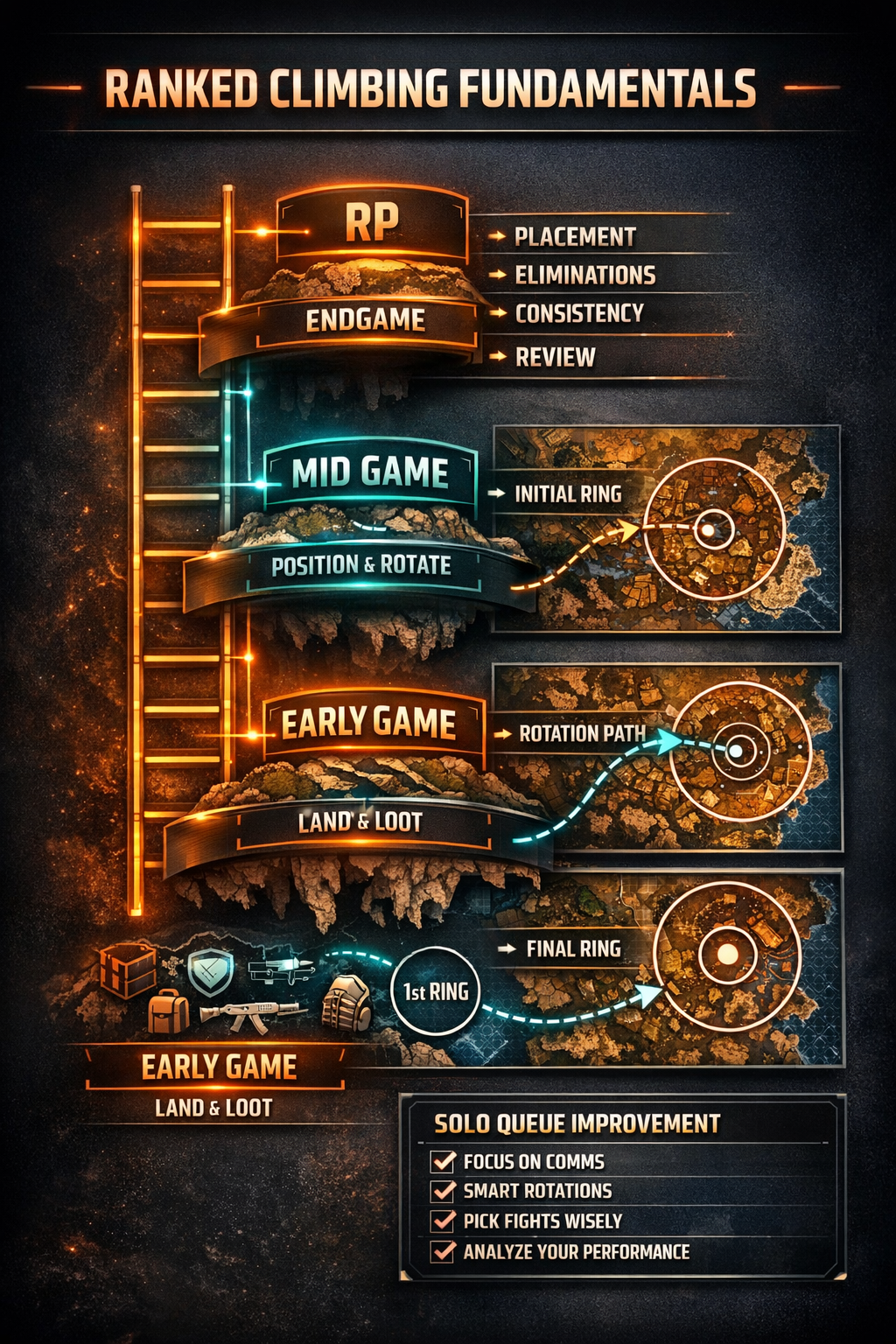
Just because shots are nearby does not mean they are profitable. Many players lose RP by treating noise as opportunity instead of context.
Overvaluing cracks and undervaluing position
Damage is only useful if it creates a safe advantage. Chasing a crack across bad terrain often throws the stronger team.
Rotating too late
Late rotations force desperate choices, ugly fights, and weak positioning. You want options, not emergencies.
Losing discipline after a win
Winning one fight is often the most dangerous moment in Ranked because players instantly start looting, splitting, or ego pushing the next sound cue.
Playing every match at the same tempo
Some lobbies are fast. Some are slow. Some are edge-heavy. Some collapse early. Good players adapt instead of forcing one rhythm every time.
Not protecting life when teammates misplay
Supporting a bad decision is not always the same as copying it. Sometimes your job is to create the best possible recovery angle.
Tilting into queue spam
Many players lose more RP to the three matches after tilt begins than to the original bad game.
If you want faster improvement, identify which two or three of these happen most often in your games. Fixing a small set of recurring mistakes is usually more powerful than trying to improve everything at once.
How to Review Your Matches and Improve Faster
Improvement in Apex Legends Ranked accelerates when you stop asking “How did we die?” and start asking “What earlier decision made this death likely?” That shift turns review from emotional blame into useful diagnosis.
You do not need a complicated VOD system. A simple review routine works:
- After a bad match, identify the moment where the game started going wrong.
- Ask whether that moment was mechanical, positional, informational, or emotional.
- Write one sentence about what should have happened instead.
- Look for patterns over multiple matches.
For example:
- “We took a mid-game fight with no ring plan.”
- “I wide swung alone after cracking one.”
- “We looted too long and lost all playable space.”
- “I kept queueing tilted and forced fights.”
Those are actionable. “My teammates were bad” usually is not.
One of the best questions you can ask after any match is: what was the highest-leverage mistake? Not the last mistake, the biggest one. The last mistake might be missing a shot. The highest-leverage mistake might be choosing the wrong route three minutes earlier. Players improve faster when they target the decision that changed the whole structure of the game.
If you are serious about climbing, keep a short log with categories like:
| Match Issue | Example | Fix |
|---|---|---|
| Landing | Contested without a clear split plan | Choose primary and fallback landing assignments |
| Rotation | Moved late into a choke | Start ring-based movement earlier |
| Fight Selection | Third-partied a fight with no exit | Only commit when reset timing is realistic |
| Team Discipline | Split after a knock | Hold crossfire and confirm before swinging |
| Mental | Queued angry after a bad loss | Take a short break before next game |
Small review habits compound. Over time, you stop repeating expensive mistakes and your climb becomes steadier.
Mental Game, Tilt Control, and Session Management
Apex Legends Ranked is mentally demanding because the game compresses high-stakes decisions into short windows and then immediately asks you to do it again. That makes tilt one of the most underrated reasons players stop climbing.
Tilt is not just anger. It can also look like impatience, overconfidence, blame, autopilot queueing, or refusal to adapt. In all forms, tilt makes your decision quality worse. And because Ranked punishes repeated low-quality decisions, a tilted session can erase a lot of good work.
The simplest solution is to build rules before you need them. For example:
- stop after three clearly avoidable losses,
- take a short break after a frustrating contest death,
- do not instant requeue if you are still arguing about the last game,
- end the session when your communication becomes emotional instead of useful.
This is not softness. It is discipline. Competitive players in every game benefit from protecting decision quality. One of the clearest signs of mature Ranked play is knowing when more matches are no longer productive.
It also helps to redefine what a “good session” means. A good session is not only one with lots of RP. A good session is one where your process stayed strong. Maybe the RP was moderate, but your landing plans were clean, your mid-game decisions improved, and your losses were understandable rather than chaotic. That kind of session usually leads to future gains.
By contrast, a high-RP session built on messy decision-making can hide problems you will pay for later. Process first, points second. Over time, the points tend to follow.
Apex Legends Ranked FAQ
Is Apex Legends Ranked more about kills or placement?
It is about both, but placement is the structure that makes eliminations more valuable. The best climbing approach is to survive into meaningful placement while converting smart, efficient fights along the way.
Should I play aggressively in Ranked?
You should play proactively, not recklessly. Proactive play means taking fights with purpose, moving early, and using pressure well. Reckless play means forcing combat without considering ring, terrain, resets, or third parties.
Can I climb in solo queue?
Yes. Solo queue is less stable, but clear pings, readable decisions, better life protection, and stronger fight filtering make a major difference.
What is the biggest reason players get stuck?
Inconsistent decision-making. Many players know what a good match looks like, but they do not reproduce those decisions often enough across a full session or full split.
How often should I review my games?
A short review after your worst losses is often enough. The goal is not to turn every match into homework. The goal is to identify recurring mistakes quickly and stop paying for them repeatedly.
Do I need the perfect meta composition to climb?
No. A sensible, coherent composition that your team understands is usually more important than copying a top-level comp you cannot execute well.
Final Thoughts on Consistent Climbing
Apex Legends Ranked can feel volatile, but the climb becomes far more understandable once you stop seeing each match as a separate drama and start seeing Ranked as a long-form test of repeatable quality. The system rewards players who survive with purpose, fight with intention, reset with discipline, and improve their average game rather than chasing one huge result.
If you want a practical summary, remember this:
- Placement gives your match value.
- Eliminations multiply that value when timed well.
- Rotations protect both.
- Discipline preserves your gains.
- Consistency is what turns good ideas into actual rank progression.
That is the real answer to how to climb in Apex Legends Ranked. Not a secret exploit. Not a magic legend pick. Not a single mechanical trick. Just stronger structure, applied over and over until your results stop depending on luck and start reflecting skill.
If you use this guide well, focus first on one change at a time. Clean up your landing plan. Then improve your rotation timing. Then review your fight selection. Then tighten your session discipline. Small corrections compound. And in a system built around consistent climbing, compounding is exactly what you want.