



Wild Rift Wave Management Guide: Freeze, Slow Push, Recall
Wild Rift — Wave Management for Mobile: Freezes, Slow Pushes, Recall Timers
Wave management is one of the most reliable ways to improve in Wild Rift because it gives you control over something that appears in every game, every lane, and every rank: the minion wave. A lot of players think lane advantage comes mostly from kills, flashy trades, or hard mechanical outplays. Those things matter, but they are inconsistent. Wave control is different. It quietly shapes gold, experience, pressure, recall timing, jungle access, objective setup, and even how easy or difficult a future fight becomes.
In Wild Rift, that matters even more than many players realize. The map is compact, the pace is fast, and small mistakes travel quickly across the map. A wave pushed at the wrong time can expose you to a jungle punish, delay your item timing, remove your move priority, and make your team late to a dragon or Herald setup. On the other hand, one good freeze or one clean crash before a recall can create a lead without any kill happening at all.
This guide is designed to stay useful across patches. Champion numbers, specific lane matchups, or certain system details can change, so it is always smart to skim the official Wild Rift patch notes before applying exact timing assumptions. But the core logic behind good wave management does not really age. If you understand why to freeze, why to slow push, and why to recall after a proper crash, you can apply those ideas in Baron lane, mid, or dragon lane across many different metas.
If you are still getting comfortable with the map itself, Riot’s Map and Modes guide and Preferred Positions overview are useful starting points. And if your main goal is improving your ranked climb, Riot’s Ranked Overview explains the ladder structure, while players who want outside help can also check Boosteria’s Wild Rift boosting prices for structured rank progress options.
The point of this article is simple: help you stop treating waves like background decoration and start treating them like a tool. Once you do that, your lane becomes easier to read, your recalls become cleaner, your roams become more purposeful, and your ranked games become more stable.
Table of Contents
- Why Wave Management Matters More on Mobile
- The Core Wave States You Must Know
- The Invisible Resources Behind Every Good Wave Decision
- How to Freeze in Wild Rift
- How to Slow Push for Pressure and Tempo
- How to Crash Before Recall
- Recall Timers in Wild Rift
- Lane-Specific Wave Management
- How Junglers Should Read Waves
- Syncing Waves with Objectives
- How to Play From Ahead or Behind
- The Most Common Wave Mistakes
- A Simple In-Game Decision Framework
- Practice Drills for Improvement
- Champion Archetypes and Wave Preferences
- FAQ
- Final Thoughts
Why Wave Management Matters More on Mobile
Wild Rift rewards quick decisions, but that does not mean random speed. In fact, one of the biggest differences between average players and strong players is that strong players stay disciplined in a fast environment. They know when to act quickly and when to leave the wave alone. That discipline matters because the game compresses time. Rotations are shorter. Skirmishes start faster. One missing lane priority can become one lost river entrance, one lost vision line, and one late team arrival.
Wave management matters on mobile for five major reasons.
1. It improves your gold consistency
Good wave states let you farm more safely and more efficiently. That alone creates an edge. Many players lose lane not because they get solo killed, but because they slowly bleed minions through bad positioning, rushed shoves, or poor recall timing.
2. It improves your experience pacing
Even when gold feels similar, levels can create huge differences in lane control. A level lead can turn a neutral lane into a trade advantage, and a trade advantage can become wave control. That loop is how many “small” lane wins become larger ones.
3. It changes jungle pressure
A lane frozen near your side is harder to gank and easier to receive help in. A lane shoved too far without vision becomes a bright invitation for the enemy jungler. Good players do not think of jungle risk as separate from wave state. They know the wave is often what creates the risk in the first place.
4. It sets up better recalls
Players often say, “I need to base,” as if wanting to shop is enough reason. It is not. A smart recall is earned through the wave. If you recall on a bad wave, you may come back down minions, down health, and down tempo. If you recall after a crash, you often come back with items and without donating pressure.
5. It creates objective priority
Dragon, Herald, river fights, and cross-map rotations often begin one wave earlier than people think. If your wave is crashing and the enemy must answer it, you move first. If your own wave is hitting your tower, you are often late or forced to choose between farm and presence.
The best way to think about wave management is this: waves create time. A freeze steals time from the enemy. A slow push buys time for a future play. A crash protects your time during a recall. Once you understand that, lane decisions become much clearer.
The Core Wave States You Must Know
A lot of players use wave terms loosely. That causes bad decisions. If you call every hold a freeze and every shove a crash, you miss the actual purpose of the lane state. Clean language leads to clean thinking, and clean thinking leads to better execution.
| Wave State | What It Means | Main Goal | Best Use |
|---|---|---|---|
| Neutral | The wave is relatively even, usually near the middle or not strongly stacked. | Stay flexible | Early lane, uncertain jungle info, matchup testing |
| Freeze | You hold the wave near your side with a slight enemy minion edge. | Deny and punish | When ahead in trades, with jungle support, or versus farm-dependent enemies |
| Slow Push | You build a larger wave over time by keeping your minions alive. | Create future pressure | Before recall, roam, dive, plate pressure, or objective setup |
| Fast Push | You clear quickly to send the wave in immediately. | Gain instant tempo | After enemy recall, before your own fast reset, or for move priority |
| Crash | Your wave fully reaches the enemy turret and gets locked there. | Secure reset or pressure | Before recall, before roam, before objective move |
| Bounce | After a crash, the lane begins returning toward your side. | Create a safer next lane state | Protecting recalls or setting up future control |
Neutral wave
A neutral wave is not a failure. It just means neither player has committed the lane into a strong state yet. Neutral is useful when you are still learning the matchup, when you do not know where junglers are, or when you want to keep options open before deciding whether to trade, hold, or push.
Freeze
A freeze is a controlled hold, usually near your side of the lane, where the enemy wave stays alive just enough to keep the lane from drifting away. The purpose is not cosmetic. The purpose is to force the enemy to walk too far forward for farm. That creates deny pressure, all-in windows, and gank opportunities.
Slow push
A slow push happens when you start building a bigger and bigger wave by killing enemy minions selectively while preserving enough of your own. This becomes extremely powerful because a stacked wave is hard to contest, takes longer to clear under tower, and creates natural tempo for whatever you want next.
Fast push
A fast push is urgent. You are not building a future wave. You are solving a current timing problem. Maybe the enemy recalled. Maybe you want to recall. Maybe your team is contesting river right now. Fast pushes are strong when you know exactly why you need the wave gone.
Crash
A crash is not “I pushed the lane a bit.” A crash means the minions actually reach the enemy turret and force a response there. That distinction matters. Many bad recalls come from half-shoves that never truly make turret contact.
Bounce
A bounce happens when the lane returns toward you after your crash. This is a huge part of recall timing. A good crash often causes the next wave pattern to become safer for you. That is why smart players try to recall after true crashes instead of random partial pushes.
The Invisible Resources Behind Every Good Wave Decision
Minions are visible, but the best wave decisions are actually built on four invisible resources: health, cooldowns, vision, and time. If you ignore these, you can choose a theoretically correct wave state at the wrong moment and still lose.
Health
Your health bar determines whether you can defend a freeze, escort a slow push, or contest a crash. A low-health player may know the “right” wave concept but still be unable to enforce it. Never ask only, “What is the ideal lane state?” Also ask, “Can I protect that lane state if the enemy challenges it?”
Cooldowns
Wave and trade are connected. If you spend your key spell on the wave, the enemy may immediately trade into you. If you save everything for a fight, you may fail to crash before a recall. Great laners blend these decisions instead of separating them.
Vision
The farther your wave sits on the enemy side, the more vision and jungle information you need. A freeze near your side reduces how much information is required to play safely. A slow push on the enemy half of the lane often needs better map awareness. Your wave shape changes your risk profile.
Time
This is the most important concept in the whole guide. Every wave action should answer a time question. Are you buying time to recall? Burning time before an objective? Forcing the enemy to waste time under tower? Waiting for your jungler to arrive? If you do not know what the wave is buying, you may be manipulating it for no reason.
How to Freeze in Wild Rift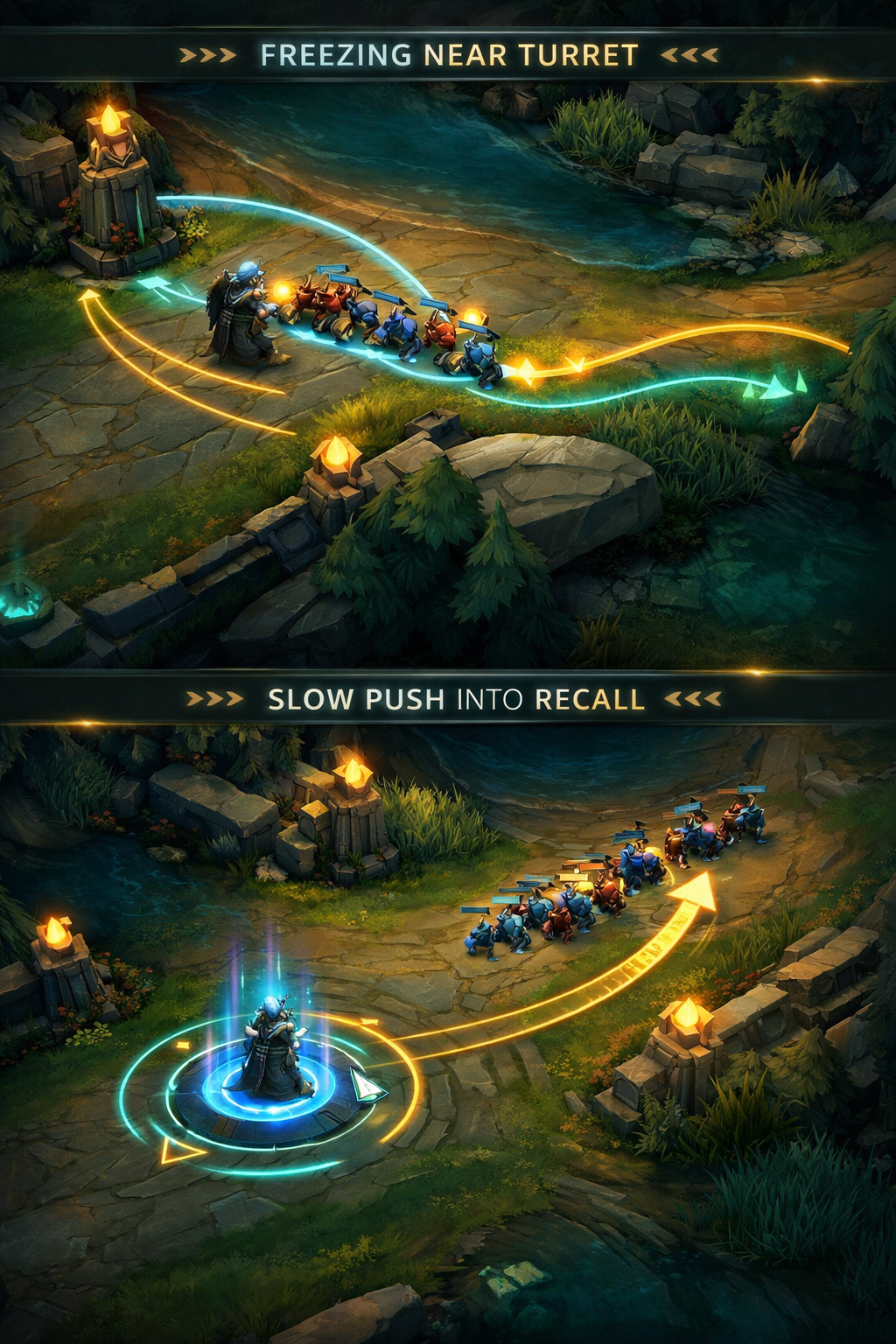
Freezing is often copied badly because players think it means “stop hitting minions.” That is not enough. A freeze is a controlled imbalance. You are usually keeping a small enemy minion advantage so the lane stays near your side without running into your turret.
How to set up a freeze
- Let the enemy wave come slightly deeper toward your side.
- Trim the wave instead of clearing it.
- Keep a small enemy minion surplus so their wave keeps winning slowly.
- Last-hit carefully and, if necessary, briefly tank minions outside turret range to hold the state.
The exact number of minions needed to hold a freeze changes by wave type and lane timing, so do not obsess over one fixed number in every situation. The practical idea is simpler: the enemy wave should be slightly stronger, but not so strong that it crashes into your tower for free.
When freezing is strongest
Freeze after winning a trade
If the enemy is chunked and scared to walk up, a freeze converts your health lead into denied farm. That is how small trade wins become meaningful lane leads.
Freeze after enemy mobility or summoners are gone
The longer lane becomes much scarier when the opponent cannot easily escape. A freeze then becomes a trap, not just a farm tool.
Freeze when your champion spikes early
Champions that love repeated short punish windows or strong all-ins benefit a lot from forcing the opponent to overextend for last hits.
Freeze to punish a bad recall
Many players automatically shove after the enemy bases. Sometimes that is right. But if the wave state allows you to hold and make them miss more over time, a freeze can be the better punishment.
Freeze when your jungler is pathing toward you
This is one of the cleanest gank setups in Wild Rift. The enemy must walk farther forward than they want to, and you are already on the safer half of the lane.
How enemies break your freeze
Smart opponents will not just accept it. They will try to shove it with abilities, ask for jungle help, trade into you so you cannot hold the wave, or force the minions into tower. That means a freeze is only as strong as your ability to defend it. If you cannot contest the break attempt, the freeze may be temporary. That is still fine. Even a short freeze can deny valuable gold and experience.
Mobile-specific freeze tips
- Use deliberate last-hitting instead of panic taps.
- Do not reflexively use AoE abilities on the whole wave.
- If the wave is about to enter your turret, step up early instead of reacting late.
- Ping your jungler before the enemy has already broken the freeze.
Because Wild Rift is faster than PC League, freezes are often shorter windows, not permanent lane prisons. That does not make them weak. It just means you should value a freeze for the tactical advantage it creates in the next 15 to 30 seconds, not only for long-term theory.
How to Slow Push for Pressure and Tempo
If a freeze says, “Walk up to me if you dare,” a slow push says, “Deal with this first.” It is one of the best tools in the game for creating future pressure.
How to build a slow push
The most common method is to clear enemy backline minions first or trim in a way that leaves your wave slightly stronger. Then you stop over-clearing. As the next wave joins, your minion stack grows. That larger wave becomes harder for the enemy to contest and more valuable when it reaches the turret.
Why slow pushes are so strong
They create safer recalls
A stacked wave takes longer for the enemy to clear under tower. That extra time protects your reset and helps prevent an immediate punish.
They create roam windows
If the enemy must stay and catch a large wave, you can move first. That can mean river vision, a side-lane hover, or faster arrival to an objective setup.
They enable dives
A big minion wave adds damage, creates visual pressure, and makes tower defense much harder. Even if a dive does not happen, the threat often forces awkward enemy decisions.
They force bad choices
The opponent may have to choose between contesting you, catching the wave, protecting plates, or helping their team elsewhere. Good wave management is often just creating uncomfortable trade-offs for the enemy.
They help scaling champions stabilize
If your champion does not want constant raw fighting, a slow push can reduce chaos and let you control when the lane becomes active.
The biggest slow push mistake
The biggest mistake is pushing too fast. Players intend to stack, but they clear too aggressively and arrive at turret with a weak wave that gives them none of the real benefits. A true slow push is patient. You are building a future problem, not instantly solving the current wave.
Start slow pushes with a purpose
Never stack a wave just because it looks satisfying. Ask what comes next. Are you recalling? Roaming? Setting up vision? Threatening a dive? Taking a plate? If the answer is nothing, you may simply be giving the enemy free farm.
How to Crash Before Recall
If you only learn one wave habit from this guide, make it this one: whenever possible, recall after a real crash, not in the middle of a random wave.
Why crashing first matters
When your wave reaches the enemy turret, the opponent must often spend their next several seconds clearing it. That reduces their ability to instantly shove back, freeze against you, or punish your tower. It also helps the wave return toward you afterward, creating a safer lane state on your next return.
What a good recall looks like
- Your wave is already in or clearly entering turret range.
- The enemy cannot create a larger punish than the value of your reset.
- You are spending meaningful gold or solving an important resource problem like low health or mana.
What a bad recall looks like
- Your wave is floating near center and can be frozen against you.
- You leave while a large enemy wave is building into you.
- You base while the enemy remains healthy, present, and ready to push.
- You recall for a weak purchase instead of a meaningful timing.
Do not think of recall as “I feel like shopping.” Think of it as “I earned a lane reset.” That mentality alone improves consistency.
Recall Timers in Wild Rift
Recall timing is one of the most underrated parts of climbing. Players often know what item they want, but not when they are actually allowed to go buy it. Strong recall timing is where wave management becomes practical and visible.
The real recall checklist
Before you base, think about these six questions:
- How much gold am I holding?
- Is my health or mana too low to keep contesting?
- What is the current wave state?
- Where are both junglers likely to be?
- Is an objective or skirmish window coming soon?
- Does my next purchase meaningfully change the next fight or trade?
The best recall timer is usually not “the first time I can buy something.” It is “the first time the wave protects my reset and my purchase actually matters.”
Examples of strong recall timers
After crashing a stacked wave
This is the classic and most reliable reset. The enemy has to clear. You get time.
After chunking the enemy under tower
If the opponent is too weak to punish or contest, your recall is safer even if the wave state is not absolutely perfect.
After the enemy recalls first and you answer properly
If the enemy leaves, shove decisively if you can, then reset yourself so they do not come back and trap the tempo advantage.
Before an objective if your buy is important
Walking into river with unspent gold is one of the most common ranked mistakes. A good pre-objective base can matter more than one extra wave.
After a bounce returns toward you
If your earlier crash was clean, the returning lane can make the reset much less punishable.
Examples of weak recall timers
Recalling on a slow push that has not crashed yet
This is one of the worst habits in lane. You often donate a good wave to the enemy and lose the tempo you tried to create.
Recalling in a neutral wave just because you are mentally tired of lane
Emotion-based recalls lose more games than people realize.
Recalling while your side of the map is about to fight
Not every wave decision is about lane alone. Sometimes the correct wave play is staying one more cycle because your team needs your presence immediately.
Lane-Specific Wave Management
Baron lane
Baron lane is where wave management feels the most pure. It is often isolated, matchup-sensitive, and punishing when the lane gets long.
When to freeze in Baron lane
Freeze when you are stronger in trades or all-ins, when the enemy needs farm to scale, or when your jungler is pathing to your side. Baron lane freezes are brutal because the lane can become very long and unforgiving for anyone forced to overextend.
When to slow push in Baron lane
Slow push when you want a clean recall, plate damage, river priority, or a dive setup with your jungler. If the opponent has poor wave clear, a stacked Baron wave becomes very hard to handle.
Baron lane mistake to avoid
Do not perma-shove just because your champion can. Constant random pushing often removes your own safety and makes the lane easier for the opponent to survive.
Mid lane
Mid is different because the lane is short and both river entrances matter. Freezes exist in mid, but they are often shorter and more tactical than side-lane freezes. Mid is less about permanent denial and more about priority and first movement.
Use controlled shoves in mid when:
- You want to roam.
- Your jungler is contesting river.
- An objective window is approaching.
- The enemy mid is stuck under tower and cannot follow fast.
Use holds or light freezes in mid when:
- You lack vision and want the enemy to walk farther up.
- Your champion likes short punish trades.
- You want to stay safer while still keeping the lane playable.
Mid players often lose games by auto-clearing every wave with no plan. Sometimes that gives away priority. Other times it exposes side lanes because you never force the enemy mid to make a difficult choice.
Dragon lane
Dragon lane is the most chaotic lane because there are four laners interacting with the same wave. That is exactly why discipline matters.
For ADC players
Your first duty is not to “play aggressive.” Your first duty is to collect gold while maintaining a useful wave state. A freeze near your side can protect you from engage. A slow push can create a recall or dragon setup. Before you auto the wave, know whether you are helping your support’s plan or breaking it.
For support players
One of the easiest ways supports sabotage lane is by touching the wave for no reason. Help shove when the plan is to crash. Help thin when the plan is to stabilize. Do not constantly auto-push because the minions are there. Dragon lane often fails because the two allied players are managing different wave plans at the same time.
Best dragon lane patterns
- Freeze near your tower when the enemy duo is stronger in open-lane fighting but vulnerable if they walk too far.
- Slow push when both of you want to recall together and come back with items.
- Fast shove when the enemy duo bases or dies and you can force a crash.
- Crash and move when dragon vision or river access matters more than one extra auto on tower.
How Junglers Should Read Waves
This is a laning guide, but junglers gain a huge advantage by reading wave states properly. You do not really gank “lanes.” You gank lane states.
Best lane states to gank
- A freeze near your team’s side.
- An enemy overextended wave with low mobility or no summoners.
- An allied slow push that can become a dive.
- A lane where your ally has enough health and cooldowns to assist.
Worst lane states to gank
- A huge enemy wave moving into your ally when your ally is too weak to fight.
- A lane already fully crashing where the enemy can disengage safely.
- A lane where your ally cannot follow at all.
Junglers should also understand side-wave value. Collecting lane farm is sometimes correct, especially when it prevents waste or matches your tempo, but it should be purposeful. Never treat side waves like random leftover gold.
Syncing Waves with Objectives
The strongest objective setups often begin one wave earlier than most players expect. If dragon, Herald, or a river fight is likely, your first question should not be “Can we fight?” It should be “What does the lane state look like before we fight?”
The best pre-objective pattern
- Stabilize or build your wave one cycle before the objective matters.
- Crash the wave so the enemy must answer it.
- Move first into river with better timing, health, and information.
- Force the enemy to arrive late, sacrifice farm, or enter a worse fight.
If your opponent has a large wave hitting their tower, they are often slower to rotate. If you are the one losing that wave, your rotation becomes expensive. That is why objective control usually starts in lane, not at the pit itself.
How to Play From Ahead or Behind
Playing from ahead
When you are ahead, your goal is not to fight nonstop. Your goal is to make the enemy’s safe options disappear.
- Freeze when you can deny farm and force overextension.
- Slow push when you want to spread pressure, threaten plates, or enable a dive.
- Crash before every major reset so your lead stays protected.
- Protect your shutdown by refusing low-value fights when a safe wave state already favors you.
Good players stay ahead by keeping the lane uncomfortable for the enemy, not by overforcing every fight.
Playing from behind
Wave management is also one of the best comeback tools in the game. When behind, your job is to reduce risk and maximize guaranteed income.
- Collect experience safely.
- Thin large waves before they fully crash.
- Hold near tower when possible.
- Recall only on wave states that do not make the problem worse.
- Accept some lost pressure if it prevents a game-losing death.
A defensive wave state often matters more than trying to “outplay” your way back with low resources.
The Most Common Wave Mistakes
1. Perma-shoving with no reason
This is one of the most common Wild Rift habits. Players feel active, but random pushing often removes their own options.
2. Recalling on bad timing
If you do not crash first, you often come back to a freeze, a lost plate, or both.
3. Fighting inside a huge enemy wave
Large minion waves add meaningful damage and make extended trades much harder to win.
4. Trying to freeze without defending it
A freeze is not a magic trick. If the enemy can walk up and break it without consequence, the setup loses value fast.
5. Not thinking one wave ahead
High-level wave management is predictive. You are not just managing the current minions. You are shaping the next event on the map.
6. Duo lane partners pushing for different reasons
Dragon lane gets ruined quickly when ADC and support do not share a wave plan.
7. Ignoring the map
A correct freeze can become incorrect if your team needs you at an objective immediately. A correct slow push can become griefing if the enemy jungler is clearly waiting nearby. Context always matters.
A Simple In-Game Decision Framework
If you want a practical system, use this six-question check whenever the next wave arrives:
- Am I stronger, weaker, or even right now?
- Where are the junglers likely to be?
- Do I want to recall soon?
- Is an objective or roam window coming?
- Does my champion want a longer lane or a shorter lane right now?
- What is the enemy’s best response if I freeze, slow push, or shove?
Then choose the wave state that makes the enemy’s best response feel worst.
Quick examples
- If you are ahead and your jungler is near: freeze.
- If you want to recall and the enemy cannot contest well: slow push into crash.
- If the enemy already recalled: fast shove and reset.
- If an objective is coming and you need first move: crash and rotate.
- If you are weak, blind to jungle, and vulnerable: keep the lane safer and avoid unnecessary push.
Practice Drills for Improvement
Wave management improves fastest when you train one piece at a time instead of trying to “just play better.”
Drill 1: Recall-only focus
Play one full game where your main review question is simple: did I crash before recalling? You will learn a lot immediately.
Drill 2: Freeze windows
Any time you win a trade, see if you can hold the wave near your side for even 15 to 20 seconds. You do not need a perfect textbook freeze to learn the benefit.
Drill 3: Purposeful slow pushes
Every slow push must have a declared reason: recall, roam, dive, plate, or objective setup. If there is no purpose, do not stack.
Drill 4: VOD review
After lane deaths, pause the replay and ask: what was the wave state 20 to 30 seconds before this? That question often reveals the real cause.
Drill 5: Duo lane language
If you play dragon lane with a partner, say one word before touching the wave: hold, stack, shove, or crash. Shared wave language improves execution instantly.
Champion Archetypes and Wave Preferences
You should always adapt to the exact matchup, but champion classes still suggest useful defaults.
Early duelists
Usually love freezes because they punish long-lane overextensions very hard.
Scaling marksmen
Usually prefer safe farming patterns, controlled crashes, and coordinated recall timings.
Poke mages
Often want safe access to the wave and then priority to move or pressure elsewhere.
Hard engage supports
Like waves that force the enemy to step too far forward.
Roaming mids
Often value clean crash timings more than long static lane holds.
Split-pushers
Need both sides of wave management: denial freezes when ahead and pressure-building slow pushes when spreading the map.
The goal is not to stereotype every champion. The goal is to begin with a logical default and then adapt based on lane state, jungle pathing, items, and matchup pressure.
FAQ
Should I always shove after killing my lane opponent?
Not always. If you can secure a clean crash safely, that is often best. But sometimes a hold or freeze punishes the enemy more over time, especially if the lane state already favors you and you are healthy enough to defend it.
Can I freeze in mid?
Yes, but usually for shorter windows than in side lanes. Mid is more about timing and priority than permanent denial.
When is a slow push bad?
When you cannot escort it safely, when no follow-up exists after the crash, or when it simply gives the enemy easy farm without creating any real pressure.
What matters more: one extra wave or a good recall?
Across a full game, good recall timing usually creates more value than greedily staying for one more wave on a bad setup.
How do I stop auto-shoving on mobile?
Reduce unnecessary AoE use, decide your plan before the wave meets, and remind yourself out loud if needed: hold, stack, or crash. Intent reduces panic inputs.
Final Thoughts
Wave management in Wild Rift is not about being passive. It is about being precise. The best laners are not the ones who hit minions the most. They are the ones who understand what each wave is buying them.
A freeze buys denial, safety, and punish windows. A slow push buys future pressure, roam timing, and clean recalls. A crash buys a safer reset or first movement. And strong recall timers convert all of that into better item spikes, healthier map movement, and more stable ranked climbing.
If you want to improve quickly, stop seeing lane as random combat. See it as controlled traffic. Every wave is either coming toward you, leaving you, or waiting for you to shape it. Once you can read that flow, the game slows down mentally even when it stays fast mechanically.
That is why wave management remains one of the highest-value skills in Wild Rift. It works in winning lanes, losing lanes, solo queue, duo queue, mid, side lanes, and almost every patch. Kills feel dramatic, but waves are what make strong games repeatable. Learn to manage them well, and ranked will start feeling much less chaotic.