



Fortnite Ranked Explained: What Actually Moves Your Rank
Fortnite Ranked Explained: What Actually Moves Your Rank
Fortnite ranked can feel mysterious even when you play a lot. One match gives you a satisfying jump, the next seems to move the bar only a little, and sometimes a decent game barely changes anything at all. That confusion leads many players to ask the same question: what actually moves your rank in Fortnite?
The short answer is that Fortnite ranked does not reward only one thing. It does not care only about eliminations. It does not care only about placement. It does not care only about survival time. Instead, it looks at your overall quality of performance inside a competitive lobby. That means your rank movement is best understood as a combination of placement, eliminations, the quality of the opponents involved, the timing of those actions, and how consistently you repeat strong games.
If you want a practical way to climb, stop thinking of ranked as a simple “kills equal points” system. Think of it as a performance evaluation. The system is trying to decide whether you are outperforming players at your current level often enough to belong higher. Once you understand that, a lot of Fortnite ranked suddenly makes sense.
This guide breaks down the logic behind ranked progression in plain English. You will learn what helps, what hurts, what many players misunderstand, and how to build a climb strategy that works in both Battle Royale and Zero Build. If you want to follow official competitive updates, Epic’s Fortnite Competitive hub, the official competition schedule, and Epic’s ranked update posts are useful references. We will also keep this guide focused on principles that stay valuable even as loot pools, maps, mobility, and seasonal mechanics change.
Table of Contents
- 1. How Fortnite Ranked Actually Works
- 2. The Rank Ladder and What It Means
- 3. What Actually Moves Your Rank
- 4. Placement Matters More Than Most Players Think
- 5. Eliminations Matter, But Not All Eliminations Are Equal
- 6. The Strength of the Lobby and the Players You Fight
- 7. Why Timing Changes the Value of Your Game
- 8. Consistency Is the Real Engine of Climbing
- 9. Battle Royale, Zero Build, and Reload: Why They Feel Different
- 10. Reveal Matches, Resets, and Why One Game Is Not the Whole Story
- 11. Common Ranked Mistakes That Slow Your Climb
- 12. Solo Queue vs Duos, Trios, and Squads
- 13. The Mid-Game Is Where Most Rank Is Thrown Away
- 14. Endgame Habits That Separate Fast Climbers From Stuck Players
- 15. Best Playstyle for Stable Rank Gain
- 16. How to Review Your Matches the Smart Way
- 17. Tilt, Streaks, and Ranked Psychology
- 18. Practice Goals That Actually Transfer to Ranked
- 19. Why Rank Also Matters Outside Ranked
- 20. Fortnite Ranked FAQ
- 21. Final Takeaway
1. How Fortnite Ranked Actually Works
Fortnite ranked is best understood as a live judgment of how well you perform against competitive opposition over time. Many players want a fixed public chart that says, “Top 10 equals this much, three eliminations equals that much.” But in practice, the system behaves more like a living rating model. It evaluates the full match instead of only one stat.
That matters because a lot of bad ranked advice starts from the wrong assumption. Some players tell you to camp every game. Some tell you to hot-drop nonstop. Some tell you that damage dealt is the secret. Others insist placement is all that matters. Those one-line explanations are too simple. Fortnite ranked rewards complete games, not isolated moments.
A complete game usually includes several things:
- surviving long enough to reach meaningful placements,
- taking fights that improve your match instead of ruining it,
- earning eliminations without dying early for them,
- avoiding reckless mistakes in rotation, editing, peeking, or positioning,
- repeating this profile often enough that the system can trust the result.
That is why two players with the same number of eliminations can gain very different rank. One player may have cleaned up weak opponents early and died before late game. Another may have reached moving zones and eliminated stronger players when the lobby was smaller and the stakes were higher. On paper they both got three eliminations. In ranked terms, those are not the same performance.
The most useful mindset is this: Fortnite ranked asks whether you are beating your current bracket in a reliable way. If the answer is yes, your bar moves. If the answer is “sometimes, but only when chaos favors you,” the climb slows down.
2. The Rank Ladder and What It Means
Fortnite’s ranked ladder is designed to spread players across a full competitive spectrum. In recent official rules and competitive posts, Epic has defined the ladder as Bronze, Silver, Gold, Platinum, Diamond, Elite, Champion, and Unreal, with multiple divisions inside the earlier tiers and a narrower top end once you reach the highest levels. That ladder matters because it affects matchmaking quality, perceived pressure, and eligibility for certain events.
But the visible badge does not tell the whole story. Two players can both sit in Gold or Diamond and still look completely different in game. One may be mechanically sharp but strategically impatient. Another may have average aim but excellent zone discipline. A third may climb mostly through duo synergy and then struggle alone. Your badge tells the system where you roughly belong right now; it does not explain why you belong there.
For climbing purposes, the ladder matters in four practical ways:
- Lower and mid tiers usually punish obvious decision-making errors more than elite micro-mistakes.
- Upper mid tiers start exposing weak rotations, poor fight selection, and sloppy resource use.
- High tiers heavily reward clean endgame survival, conversion of advantages, and emotional control.
- Top tiers become less about “pop-off moments” and more about avoiding low-quality losses.
That last point surprises people. Players chasing Unreal often think they need highlight plays every session. In reality, the biggest difference-maker is usually reducing bad games. If you turn five disaster matches into five average matches, your climb often improves more than if you chase one montage win and four early exits.
So when you ask what moves your Fortnite rank, always connect the answer to the ladder itself: at every tier, the system wants stronger evidence that you can survive, convert, and repeat results against better players.
3. What Actually Moves Your Rank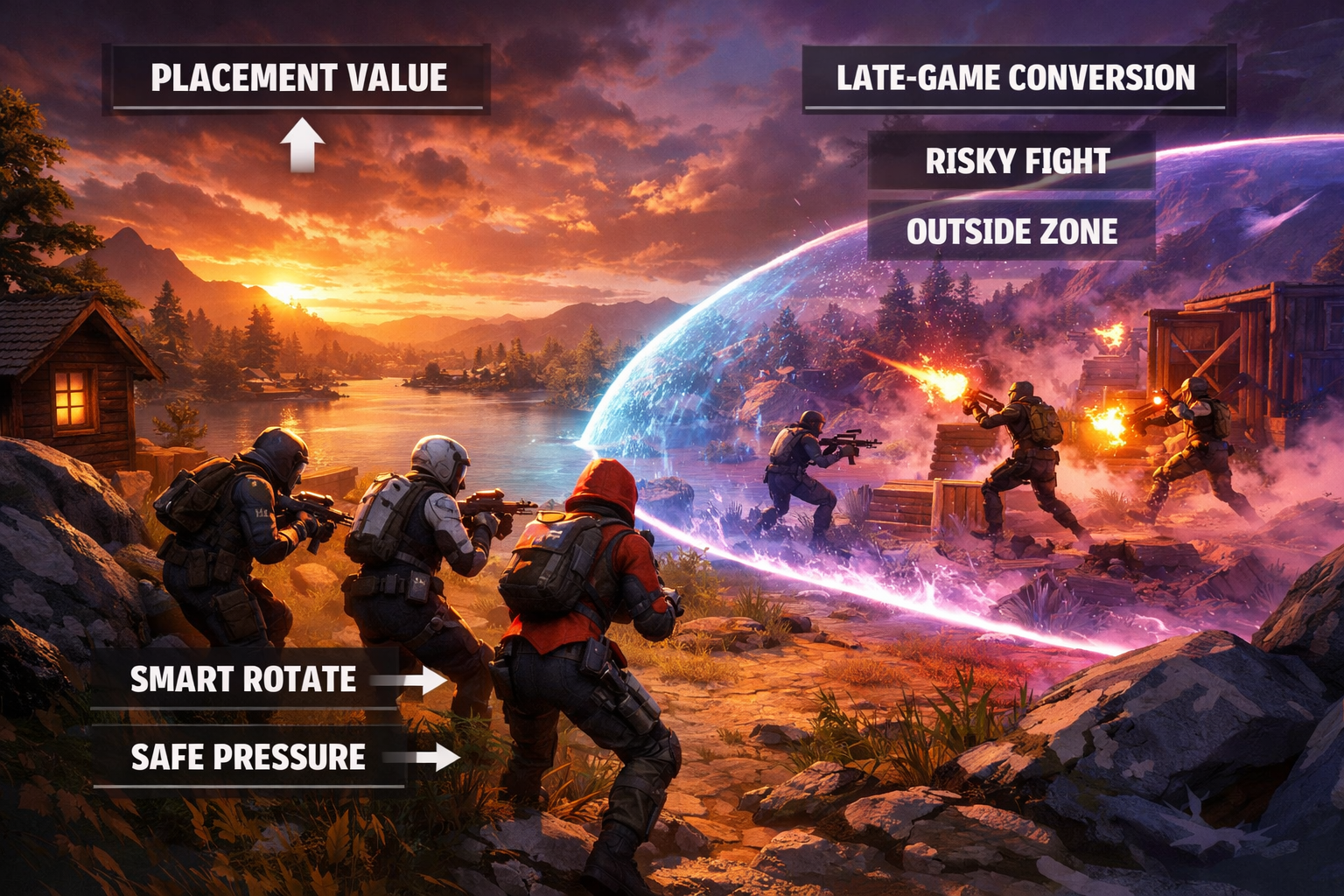
Let’s simplify everything into the most useful ranked model possible. Your Fortnite rank is mainly moved by five real signals:
- Placement — how late you survive and where you finish.
- Eliminations — especially meaningful eliminations that improve your game state.
- Opponent quality — who you eliminate, who eliminates you, and the strength of the lobby.
- Timing and context — when events happen during the match.
- Consistency — how often you produce strong games over a session.
Notice what is missing. The system does not appear to care about meaningless style points. Fancy piece control that ends in a trade is not automatically better than a simple right-hand peek that keeps you alive. Looting five mythic items does not matter if you rotate late and die to zone pressure. Winning spawn with no plan for mid-game can still be a losing ranked habit.
A useful way to think about ranked is to divide a match into three questions:
- Did you survive long enough to matter?
- Did you influence the lobby instead of only hiding from it?
- Did your decisions look like they belonged in a higher bracket?
If the answer to all three is yes, rank movement is usually positive. If only one is yes, gains become thin. If none are yes, you generally slide backward or stall.
This is why smart climbing is a balance, not an extreme. Pure passivity can get you some placement, but often too little impact. Pure aggression can get you flashy eliminations, but too many early exits. The sweet spot is controlled pressure: fight when you have reason, survive when the risk is bad, and enter late game with enough health, mobility, position, and composure to convert.
4. Placement Matters More Than Most Players Think
If you remember only one section from this guide, remember this one: placement is the foundation of ranked progression. It is not the only thing that matters, but it is the stage on which everything else gains value. The longer you survive, the more relevant your match becomes.
Why does placement matter so much? Because survival proves multiple ranked skills at once. Good placement usually means:
- you did not lose your opening fight for no reason,
- you rotated with some awareness,
- you managed resources reasonably well,
- you avoided at least some bad engagements,
- you kept your match alive long enough for later decisions to matter.
Players often underestimate how much rank they throw away before top 25, top 15, or top 10 ever arrives. A match where you land, loot, get one elimination, and die 70th is usually far less valuable than a calmer game where you reach the later circles, then pick your moment to fight. Even if both games include an elimination, the second match gives the system more proof that you can actually play a full ranked game.
That does not mean you should hard-camp every match. Passive survival with zero lobby influence is often a slow, frustrating climb. But it does mean you should treat placement as your non-negotiable base. Your eliminations work better on top of placement, not instead of it.
A good rule: never risk your entire game for a low-value fight if the likely reward is small and the likely punishment is a bad placement. Many players lose more rank from unnecessary coin flips than from actual skill gaps. Smart climbing begins by refusing to end your match cheaply.
5. Eliminations Matter, But Not All Eliminations Are Equal
Now the other half of the ranked puzzle: eliminations do matter. Fortnite would not be a real competitive battle royale if the system ignored combat impact. But one of the biggest ranked mistakes is assuming every elimination has equal value. It does not.
An elimination can be valuable for several different reasons:
- it removes a threat blocking your rotation,
- it upgrades your loadout or materials,
- it secures a stronger position,
- it happens late enough that the lobby quality and pressure are higher,
- it comes against a stronger player,
- it turns a stable match into a high-conversion one.
By contrast, an elimination can be low value if:
- you overcommit and die immediately after,
- it happens early on a weak player and gives you little control afterward,
- you burn all your mobility and heals to get it,
- it drags you into third-party danger,
- it gives no realistic improvement to your endgame odds.
This is why ranked players should stop asking, “How many kills do I need?” and start asking, “Which kills are worth taking?”
Three well-chosen eliminations in a top-10 game often mean more than five chaotic eliminations spread across spawn and mid-game with an early death at the end. The system rewards impact, but it also rewards staying alive long enough to turn that impact into a real finish.
Good climbers learn to classify fights fast. Is this fight necessary, favorable, and likely to improve the game? Or is it a vanity duel? The better you get at that distinction, the more efficiently your rank moves.
6. The Strength of the Lobby and the Players You Fight
One of the least understood parts of Fortnite ranked is that context matters. Epic has previously said ranked adjustments during Season Zero included reducing the penalty for early eliminations and giving bonus credit for eliminating players ranked above you. That tells us something important: the system is not blind to who is involved in the outcome.
In simple terms, beating stronger opposition should count more than farming weaker resistance. Likewise, losing to a clearly stronger player is not treated the same as throwing away your game to a lower-quality mistake. Even without seeing every internal formula, that design principle is obvious enough to help your climb strategy.
What does this mean in real matches?
- If you are in a tougher lobby, average results may still be respectable.
- If you remove a stronger player, your match becomes more valuable than the raw elimination count suggests.
- If you repeatedly die in avoidable ways to players you could have avoided, the system sees that too.
That is also why players sometimes feel confused after copying a streamer’s hyper-aggressive style. A top player can fight constantly because their mechanics, reading speed, and positioning let them win many of those encounters cleanly. A lower-level player copying only the aggression is not copying the skill behind it. The system notices the difference very quickly.
Your goal is not to imitate the most exciting player in the lobby. Your goal is to produce the best evidence that you deserve a higher lobby next time. Sometimes that evidence is a huge frag game. Sometimes it is a patient top-five with two late eliminations on strong opponents. Understanding this makes ranked feel much less random.
7. Why Timing Changes the Value of Your Game
Timing is where placement and eliminations come together. The same action means different things depending on when it happens.
Consider two examples:
Game A: You get two eliminations off spawn, leave weak, spend half the match healing and looting, and die before the late circles.
Game B: You play a stable opener, rotate early, preserve resources, reach the endgame, then get two eliminations while contesting a powerful zone position.
Both games have two eliminations. Ranked often treats them differently because Game B is proving more advanced skills under more meaningful conditions.
Late-game actions tend to matter more because the lobby is smaller, pressure is higher, and each decision has more competitive weight. Good timing turns average stats into strong ranked results. Bad timing turns solid mechanics into wasted matches.
That is why experienced players value:
- rotating before panic starts,
- taking height or edge control at the correct moment,
- not griefing their own match for a random beam,
- waiting for third-party windows that are actually safe,
- choosing endgame fights that produce placement and loot at once.
If you often feel “I played well but my bar barely moved,” timing may be the answer. You may be doing the right things at the wrong stage of the match. Ranked rewards quality decisions, but it rewards them most when they happen in moments that shape the final outcome.
8. Consistency Is the Real Engine of Climbing
The hardest truth in Fortnite ranked is also the most freeing one: you do not need perfect games to climb, but you do need repeatable games.
A lot of players judge themselves by their best match of the day. Ranked judges them more by their average match profile over time. One Victory Royale with eight eliminations feels amazing, but if it is followed by four poor games, the session may still be mediocre. By contrast, a calm stretch of top-15, top-10, top-8, top-6, and top-12 with useful eliminations can quietly outperform the highlight session.
Consistency has three ranked advantages:
- it reduces the number of severe losses that erase your good games,
- it gives the system repeated proof that your results are not luck,
- it builds better habits, which then produce stronger spikes naturally.
This is why serious climbers often look boring compared with highlight creators. Their sessions are built on good drop discipline, clear loot routes, stable rotations, risk filtering, and mental control. They are not chasing constant hero moments. They are trying to remove the dead games that keep them stuck.
A strong ranked question after every match is not “Did I pop off?” It is “Could I play this same structure again next match?” If the answer is yes, you are building a climb. If the answer is no, you may only be gambling.
9. Battle Royale, Zero Build, and Reload: Why They Feel Different
Fortnite now has multiple ranked experiences, and that matters because the climb can feel different across them. Epic’s official posts have treated Battle Royale Ranked, Zero Build Ranked, and Ranked Reload as distinct tracks. In practical terms, that means you should not assume identical habits produce identical results everywhere.
Battle Royale Ranked generally gives more room for recovery through building, editing, retakes, protective tunneling, and defensive reaction speed. Because of that, mechanics, piece control, and build-based awareness can rescue mistakes that would be fatal elsewhere.
Zero Build Ranked usually punishes bad positioning harder. Cover usage, terrain reading, mobility timing, and clean peeks matter enormously. A bad rotate is often unrecoverable because you cannot instantly build your way out.
Ranked Reload changes pacing further. The tempo is faster, the structure is tighter, and the kinds of engagements you get can feel more compressed and immediate than on a traditional BR map.
The ranked lesson is simple: identify what the mode punishes most.
- In Battle Royale, sloppy build decisions can cost a winning fight.
- In Zero Build, bad pathing and cover denial can end the game instantly.
- In Reload, tempo errors and poor fight flow often punish you faster.
If you are switching modes and wondering why your rank stalls, do not only ask whether your aim is good enough. Ask whether your decision model matches the mode. Separate ranked tracks reward separate habits, even when the core principles of placement, eliminations, and consistency remain the same.
10. Reveal Matches, Resets, and Why One Game Is Not the Whole Story
Another common misunderstanding is the first ranked match after a reset or a new period. Epic has explicitly said that your reveal match does not simply create your initial rank from that one performance alone. Instead, it reveals your rank and then updates your bar based on the match result. That tells us two practical things.
First, one match is not your whole identity. Players often panic if their first game feels weak or celebrate too early if it feels incredible. The system already has broader context.
Second, resets are fresh starts, not total amnesia. Official posts have also described beginning ranks after resets as being based on prior finishing ranks. In other words, the system is not pretending it has never seen you before. It is recalibrating.
Why does this matter for climbing? Because many players waste the first days after a reset either forcing everything or playing scared. The better approach is to treat the opening stretch as a calibration window:
- play your most repeatable style,
- avoid ego fights,
- collect stable data on your current strengths and weaknesses,
- do not overreact to one reveal result.
When players think one match defines them, they become emotional. When they understand ranked is reading a larger pattern, they make better choices. Calm players climb faster.
11. Common Ranked Mistakes That Slow Your Climb
Most players stuck in Fortnite ranked are not stuck because they lack talent. They are stuck because they repeat a handful of expensive mistakes. Here are the biggest ones.
Taking unnecessary opener fights
Landing contested every game can improve spawn fighting, but it also creates extreme volatility. If your goal is pure climb, do not make every match depend on a coin flip. Choose drop spots with a plan, not just hype.
Looting too long
Some players survive early but still lose rank because they arrive late to every important rotation. Safe loot is good. Endless loot is how you get pinched by zone and timing.
Forcing mid-game duels with no reward
If the fight gives you no pathing improvement, no material edge, no better position, and no likely endgame value, why are you taking it?
Playing for eliminations without exit options
Even a favorable fight can become a disaster if you have no mobility, no cover plan, and no answer to a third party.
Overvaluing damage and undervaluing conversion
Beaming someone for 150 means less than fully capitalizing on the opening. Ranked cares more about outcomes than pretty numbers.
Panic rotations
Bad players think rotating late is unlucky. Strong players know it is often self-created stress. Position early and your whole match changes.
Session tilt
One bad match becomes two, then four. Many ranked losses are mental, not mechanical.
Remove even two of these habits and your rank movement often improves before your aim gets any better.
12. Solo Queue vs Duos, Trios, and Squads
Team modes add another layer to ranked. Your visible results come from the squad’s performance, but the quality of your decisions still matters inside that team result. This makes team ranked both powerful and dangerous for climbing.
It is powerful because a reliable duo or trio can stabilize everything: cleaner comms, safer rotates, planned heals, focused beams, and better endgame layering. Good teammates remove randomness.
It is dangerous because weak team structure hides individual problems. Some players climb with a good duo and assume they are ready for higher solo play. Then they queue alone and suddenly every bad peek, greedy push, and sloppy rotate is exposed.
If you mostly play team ranked, ask yourself:
- Am I creating advantages or just following stronger players?
- Do I understand our rotates or only copy them?
- When a fight starts, do I improve the team’s odds or add confusion?
- If my best teammate went down, could I still make quality decisions?
For climbing, team modes reward three things especially hard: clear comms, synchronized pressure, and disciplined re-peeks. Teams that lose rank often do not lack aim. They lose because one player swings alone, another tunnels on loot, and a third gives delayed information.
In solo queue, the ranked priority is self-sufficiency. In team queues, it is coordinated value. Learn which environment you are in, and your rank will move more predictably.
13. The Mid-Game Is Where Most Rank Is Thrown Away
Everyone talks about spawn and endgame, but the mid-game is where ranked sessions are quietly won or lost. Why? Because mid-game decisions determine whether you reach the stages where placement and high-value eliminations can really matter.
Bad mid-game habits include:
- rotating too late because the POI route was inefficient,
- taking storm-edge fights with no urgency,
- crossing open space without cover or scan information,
- burning mobility to greed an elimination that changes nothing,
- holding low-ground dead zones when safer edges exist.
Strong mid-game players ask better questions:
- Where can we move now before everyone else does?
- Which side of zone is likely to become crowded?
- Can this fight be avoided without losing value?
- What resource is most likely to kill us later: health, mobility, ammo, or position?
If you often die “for no reason” in ranked, mid-game is probably the reason. Rarely is it truly random. Usually the problem started 60 seconds earlier with route choice, greed, or lack of anticipation.
Players who climb steadily do not merely survive the mid-game. They use it to build a better endgame. They arrive with enough to work with.
14. Endgame Habits That Separate Fast Climbers From Stuck Players
Endgame is where the best ranked gains are usually converted. By late circles, placement is high, pressure is real, and every correct decision carries more weight.
Key endgame habits include:
- preserving composure when many players are alive in small space,
- choosing the right layer instead of mindlessly claiming height or hard low,
- looking for free refreshes rather than forcing impossible pushes,
- staying aware of zone timing before you commit to damage,
- avoiding ego edits and ego peaks when placement is already valuable.
A player who consistently reaches late game but still struggles is usually making one of two mistakes: they panic mechanically, or they misread priority. For example, they tunnel on a damaged enemy while zone is about to move, or they chase height when their materials cannot support it, or they forget that a safe second-place structure is often better than a reckless first-place attempt that ends in seventh.
Good endgame ranked play is not passive. It is selective. You apply pressure where it improves your finish. You do not spend everything for a maybe. The better you get at trading aggression for survival without becoming invisible, the faster your rank will rise.
15. Best Playstyle for Stable Rank Gain
So what playstyle should you actually use if your goal is climbing?
The best long-term answer is controlled proactive play. Not passive hiding. Not nonstop fighting. Controlled proactive play means:
- drop with intention,
- secure a playable loadout quickly,
- take obvious favorable fights,
- avoid ego fights and low-reward chaos,
- rotate early enough to keep options open,
- enter late game prepared to convert.
This style works because it builds both sides of rank movement. You get placement often enough to matter, and you still create enough combat impact to avoid the painfully slow “camp only” problem.
If you want a session rule, try this:
Do not take fights that lower your average finish unless they clearly increase your chance to win the match.
That sentence is the entire climb philosophy. It filters out most bad pushes instantly.
Over time, as your mechanics improve, you can expand the number of “clearly good” fights you are willing to take. That is how higher-ranked players look aggressive without looking reckless. Their fight selection is simply more refined.
16. How to Review Your Matches the Smart Way
If you really want to understand what moves your rank, review your matches by decision points, not by feelings. Players remember the unlucky moments and forget the earlier mistakes that set them up.
After each match, ask these five questions:
- Was my drop uncontested, manageable, or needlessly volatile?
- Did I lose or delay my rotate because of greed?
- Which fight improved my game, and which fight only risked it?
- What was my resource state entering late game?
- What exact decision most reduced my final placement?
That review style is powerful because it reveals patterns fast. Maybe your real issue is not aim at all. Maybe it is late rotates. Maybe you tunnel too hard after cracking someone. Maybe you waste mobility before zone four. Maybe you heal in the wrong places. These are rank-moving problems.
If possible, clip or save matches where your result felt unfair. Those are often the most educational. Calm review turns “the game is random” into “I can fix this.” That mindset alone helps climbing.
17. Tilt, Streaks, and Ranked Psychology
Fortnite ranked is mentally expensive because every match feels like judgment. That is exactly why emotional control becomes a hidden rank stat.
Tilt shows up in obvious ways, like angry hot-drops or reckless re-queues. But it also shows up subtly:
- you stop respecting zone timings,
- you overpeek because you want revenge,
- you take 50-50s you would skip when calm,
- you confuse urgency with impatience.
The fix is not to become robotic. The fix is to create session rules before emotion appears. For example:
- two bad games in a row means a short reset,
- no contested landing after a frustrating loss,
- if focus drops, switch from ranked to practice,
- review one mistake before the next queue.
Stable climbers protect their decision quality. They understand that a session is rarely ruined by one bad game. It is ruined by the three bad decisions made because of that game.
18. Practice Goals That Actually Transfer to Ranked
Not every form of practice helps ranked equally. If your goal is faster climbing, focus on skills that directly affect the five ranked signals.
Best practice areas:
- Spawn efficiency — loot path, first weapon speed, chest routing.
- Fight conversion — how often you turn damage into secure eliminations safely.
- Cover and peek discipline — especially crucial in Zero Build.
- Build survival habits — especially crucial in Battle Royale.
- Rotation reading — pathing before pressure arrives.
- Endgame composure — staying useful when chaos rises.
Less useful ranked practice includes endless free-build with no decision pressure, aim drills disconnected from real peeking habits, or creative fighting that encourages unrealistic overexposure. Mechanics matter, but ranked mechanics are mechanics inside context.
If you want your training to transfer, always ask: “Will this help me survive longer, choose better fights, or convert more often in actual ranked matches?” If not, it may still be fun, but it is probably not the fastest way to climb.
19. Why Rank Also Matters Outside Ranked
Fortnite rank is not only a badge. Epic has also used ranked thresholds as eligibility gates for official competition. In past official competitive posts, some events required Bronze, others Gold, and some higher-level events required Platinum or above depending on the format. That makes rank useful beyond personal progress.
If your long-term goal is to enter community cups, cash cups, or larger competitive pathways, learning how ranked works becomes even more important. Rank does not just mirror your form; it can open or block access to certain opportunities.
That is one reason many players seek structured improvement instead of random grinding. They want cleaner routines, better rotations, better fight selection, and a steadier climb. If that is your goal, study official tournament details through the Fortnite Competitive portal and the FNCS rules ecosystem when relevant. And if you want a shortcut to compare service options, you can also review Fortnite boosting prices to see structured progression support.
20. Fortnite Ranked FAQ
Does placement matter more than eliminations in Fortnite ranked?
Placement is usually the base of strong rank gain because it keeps your match relevant. Eliminations then increase the value of that match. The best climb combines both.
Do early eliminations count?
Yes, but early eliminations are usually less valuable than eliminations that happen in more meaningful match states. If you die immediately after, the total result may still be weak.
Can I climb by camping only?
You can gain some progress through survival alone, especially in lower ranges, but it is often slow and unstable. Controlled impact tends to climb better than pure passivity.
Why does one match move my bar more than another similar match?
Because the visible stats may look similar while the hidden context is different: lobby strength, timing, opponent quality, placement depth, and overall match profile all matter.
Does Fortnite ranked reset?
Epic has used resets between ranked periods and has explained that reveal matches show your rank while prior results still help shape the starting point.
Is Zero Build ranked easier than Battle Royale ranked?
Not really. It is different. Battle Royale rewards build skill heavily, while Zero Build punishes pathing and cover mistakes more harshly.
What is the best way to rank up fast?
Use a repeatable drop, avoid low-value fights, rotate earlier, improve endgame survival, and stop throwing away entire matches for small rewards.
21. Final Takeaway
If you want the cleanest possible answer to the question “What actually moves your rank in Fortnite?” here it is:
Your rank moves when you repeatedly prove that you can survive deep, create meaningful combat impact, and do it against competitive players without throwing your match away.
That is the core of the system. Placement matters. Eliminations matter. Opponent quality matters. Timing matters. Consistency matters most of all.
So stop chasing a fake secret formula. The real solution is better match quality. Land cleaner. Rotate earlier. Fight smarter. Enter late game with resources. Convert advantages without ego. Review your losses honestly. Protect your mental. Repeat the structure.
Fortnite ranked feels confusing when you focus on single moments. It becomes much clearer when you view each match as a full performance profile. Once you do that, your climb stops feeling random and starts feeling trainable.
And that is what actually moves your rank.
For official updates, patch-adjacent competitive information, and event requirements, keep an eye on Epic’s Fortnite News, the Fortnite Competitive hub, and the official event schedule.