



ADC Guide 2026 – Complete LoL Marksman Basics, Positioning & Late-Game Strategy
INTRODUCTION TO THE MARKSMAN BASICS GUIDE
The Cornucopia of Extremely Helpful Guides hath returned. Houdini’s back again, baby, and this time we’re going to get down to business. Today,
the Marksman.
In every meta, from the oldest seasons to the modern 2025 ranked grind, one thing has stayed true:
if your ADC plays well, your team always has a win condition. The marksman role is the primary source of sustained DPS, tower damage, and late-game scaling in LoL. Whether you’re trying to climb out of Silver, stabilize in Diamond, or push for Master and beyond, understanding the fundamentals of ADC play will do more for your rank than any flashy montage combo.
It’s widely thought that mechanical skill and actions per minute (APM) are among the most consequential qualities when learning to play the marksman. This, however, is only half of the truth. While those may be prerequisite aspects of the role in question, the ones you need to really watch out for are
quick-decision making
and a
consistent appraisal system.
These are your invisible stats: the “brain items” that separate a good ADC from a true late-game raid boss.
Modern LoL is fast, volatile, and snowbally. Objectives spawn earlier, mistakes get punished harder, and everyone has watched at least three pro guides on YouTube. To survive in this environment you need a clear framework for:
- How to think as an ADC (macro mindset, risk vs reward, wave and tempo management).
- How to position in lane, skirmishes, and chaotic solo queue teamfights.
- How to adapt your playstyle to different supports, comps, and enemy threats.
- How to review your own gameplay and fix recurring mistakes.
This guide will walk through all of that while keeping the classic Houdini flavor. We’ll mix in practical examples, modern 2025 considerations, and even ways to train your decision-making using other competitive games. And if you ever feel your improvement is too slow, remember that you can always get help from
Boosteria’s professional boosting and coaching services, where high-elo ADC mains can show you in real games how these concepts work.
QUICK-DECISION MAKING
One might think this would be important for any role, and it is, however, it’s ten-fold important for the Marksman. This is due to the razor-edge that the Marksman must always balance upon. Due to the
inherent roles in LoL, the Marksman often, if not always, focuses on damage per second (DPS), and this is true for builds as well.
What does this mean?
The marksman will always be working with the
lowest health values, thus, they will be the
nearest to death
at any given moment. A single mechanical error can cause issues, of course, but often such
fatal
mechanical errors only occur due to panic, anxiety, frustration, or even a combination of these and more.
There’s a reason the fight-or-flight response is a reaction to a
threat to survival. As aforementioned, the Marksman will be the role most commonly in these situations, second to Mid-Lane. This means that a calm, collected mindset and ability to decide quickly and decisively will always be paramount to the Marksman as long as the role exists.
What does this mean in micro-terms?
Keep your flash trigger-finger as itchy as humanly possible!
In 2025 LoL, there are more dashes, more burst combos, and more crowd control chains than ever before. This means your decision window—whether to step forward for one more auto or to instantly kite back—is often less than half a second. The best ADCs don’t just “react”; they already know what they will do before the enemy engages. They’ve pre-decided: “If this Leona walks past that minion, I’m flashing instantly.” That’s real quick-decision making: decisions made in advance.
Practical drills for faster ADC decisions
- Replay & pause: Watch your VODs and pause just before a fight. Ask, “If I die here, what should I have done?” Then play it and see. This trains your brain to recognize patterns.
- Custom kiting practice: Use the in-game practice tool or a custom game to dodge skillshots while last-hitting. The more “automatic” your mechanics become, the more brain space you free for decisions.
- Pro game study: Watch high-elo replays on platforms like OP.GG stats or VODs from LoL Esports. Pause in fights and try to predict the ADC’s move.
- One rule per game: Each ranked game, give yourself one simple decision rule (“Never hit tower if three enemies are missing” or “Always back after pushing tier-1 if my flash is down”). Enforce it ruthlessly.
Over time, these little training routines turn panic into automation. When a Rell flies at you, your hands will move before your fear does.

CONSISTENT APPRAISAL SYSTEM
An ADC in the long run must be cognizant of the advantages each action provides. Something as simple as farming a minion wave might provide a gold reward, but will mean something entirely different if one’s
jungler is dead. Each and every action an ADC takes early game is centered around gold, tempo, and safety, as those provide a paved road to the late-game. Just as the marksman will always be working with the
lowest health values, they will also often work with the
highest consistent damage outputs.
An ADC that cannot accurately identify leads will not stumble upon the correct answer by following empty habits, like a support might while haphazardly warding, or a tank might by simply soaking damage. There’s a reason
 Lee Sin says “Master yourself, master the enemy” in that order.
First you must comprehend what is best for your future in-game, as late-game tends to be ADC-centric, directly or indirectly.
In 2025, with frequent changes to items and runes, having a mental “pricing list” is critical. You should know, roughly:
- How much a wave is worth compared to a plate.
- How much risk is acceptable for a dragon vs your own life and shutdown.
- When a single death will give enemy scaling carries the comeback they dream of.
A simple question to ask yourself constantly:
“If I die for this, is it worth it?” Doing this mid-game becomes second nature, and suddenly you’re the one punishing other ADCs who chase too far for “just one more auto.”
THE MARKSMAN’S DEEP-ROOTED ADVANTAGES
The Marksman has a few vital advantages over other characters and playstyles. Intrinsically, Marksmen are ranged, which allows damage to be dealt while being relatively unharmed in a perfect scenario. As such, you see Marksmen build mainly damage items. However, many bruisers, assassins, supports, mages, and even other ADCs have a stop-gap measure to ranged harass: dashes, hard engage, or long-range CC.
The amount of mobility incorporated into the game has changed ADC expectations, and now more calculations are needed to utilize that ranged advantage. It’s no longer enough to “outrange”; you must also understand:
- Threat circles: How far can each enemy realistically travel in one second?
- Cooldown windows: When are key engage tools down so you can step forward?
- Front-to-back vs dive comps: Can you safely hit the frontline, or must you kite sideways and back constantly?
To know the innate advantages of Marksman allows you to make use of those strengths. Every decision made should take into account the value of a potential outcome and the repercussions of such. An obvious example: an ADC wishes to attack an engage tank like
 Sejuani
or perhaps
 Gragas.
A single auto-attack landed has a reward of dealing minor damage to the victim’s health. The risk belongs more to the ADC, and directly regards the engage potential apparent.
A Belly Slam into
Gragas
Ultimate can mean death for the ADC, but a single auto means little to the tank. Is the risk worth the reward? It depends. What are the goals of the attack? Was the objective to bait an engage? Well, then I would call that “risky” auto a complete success. Let’s hope the hypothetical result is swell as well, but it all depends on allies and their respective positioning.
Therefore:
AN ADC MUST ALWAYS BE AWARE OF ONE’S ALLIES. I CAN’T UNDERPLAY THIS.
Location of allies is one of the most accurate pieces of information you can track at any given time. Barring
 Nocturne,
 Graves,
and a few others who love darkness and fog of war, the map gives you a lot of clues. Even then, you, not just
Lee Sin,
have senses capable of determining allied locations: predictive and deductive reasoning.
Before stepping forward to hit a tower or farm a risky wave, ask:
- “Where is my support? Can they follow up if I’m engaged on?”
- “Is my jungler on my side of the map or on the opposite side?”
- “If a fight breaks out in the next three seconds, am I actually in range to hit anyone safely?”
This sort of thinking might feel slow at first, but it quickly becomes automatic, especially if you combine it with regular VOD review or coaching from experienced ADC mains through services such as
LoL elo boosting and duo-queue assistance at Boosteria.org.
EARLY GAME: PREPARING THE MINDSET
The early game should be something of an incubation period for an ADC. The game’s economy has been structured so that one role—the marksman—gets priority access to a steady gold stream. That’s what minion waves, support items, and bot lane setup are all about:
you are the long-term investment.
Remember, these so-called “supports” are volatile and may do anything, but try to react in kind. Namely, get that gold. You’d let the world burn as long as you’ve got those shiny pieces.
In a general sense, there’s a few hard and fast rules for the
laning Marksman.
1. The level two power-spike, not just a meme.
Many streamers, ex-pros, pros, and even regular players have participated in this cultural experiment. Sadly, the “Imaqtpie” we all know and love has pulled the ultimate deception.
Disparaging a massive advantage. I believe his underlying strategy is to convince his enemies the level two power-spike is weak, only to reap the full benefits personally.
Jokes aside, pushing the wave with abilities and auto-attacks is a powerful strategy. If you reach level 2 before the enemy, you have a plethora of options. Among those include:
Zoning, pushing even harder, taking a favorable all-in, or freeing your support to roam/ward.
Let’s take a moment to borrow from pro play. Often, the blue side might push up, hit level 2 first, and then free the support to ward the enemy jungle entrances. With the information this gives, it’s clear to see the advantages of such a play.
All fabricated from simple pushing.
Don’t condemn those random autos from supports; they might be for a very important purpose.
In the same fashion, if you will be under threat in the near future,
do not attempt to push. This will simply leave you vulnerable.
Respect your enemy.
Staying in lane auto-attacking minions as a
Level One
 Twitch
can mean death against a
Level Two
 Lucian
and
 Leona
Leona
combo regardless of how or when you will reach Level Two. If that
Leona
has ignite, and is willing to blow summoners when you are inevitably forced to, consider yourself a dead rat.
Perhaps that grueling image will shock you into smart play. Don’t tell anyone I didn’t try.
2. Missed CS isn’t the end of the game, but a death can mean the end of the lane.
To put it in perspective, the first wave has a gold value of roughly a small item component. The first kill has a value of a big chunk of gold plus lane pressure, wave control, and often summoner spell advantage.
Do the math.
Stem the bleeding.
3. Play with your support, not against.
If you’ve trouble cooperating, and are considerably pessimistic, try to inform your support that you will not fight under any circumstances, in any way possible. But be brief. A few pings or a single sentence can get this point across; any more and you’re risking jumping into a vat of salt.
The only way either of you is getting out of the lane alive is if you cooperate, however little that may be. Take that to heart. Of course, don’t follow blindly and don’t order blindly. It takes two to tango, and you don’t know if the enemy lane has the skills to match.
It could be Michael Jackson or a rock that’s blind, deaf, and dumb.
4. Stay aware and count summoner spells.
Anything and everything that can affect your lane should be something you’ve kept an eye on. Naturally,
 Flashes,
 Exhausts
and
 Ignites
are important, but if the enemy has come a-barrlin’ in with
Flash /
Exhaust
 Vayne
Vayne
for gods sake don’t take the 1v1. (Thanks for that one, Gosu.)
Luckily enough,
 Heal
Heal
is commonly taken in bot lane, but double-checking enemy summoners on the scoreboard should be a permanent habit.
However, if the enemy
 Renekton
and
 Malzahar
both have
 Teleport,
you can bet your bottom britches they’ll come knocking on your door if you venture too far out. (Hint: In this scenario door means lane.)
5. If the enemy has a lead, respect them.
A lead can mean many things, but generally translates into priority around objectives and warding.
This means that it’s more likely to be ganked, dove, or lose a straight up 2v2.
It’s better to give up the turret and perhaps push for different objectives than stay and give over even more gold. If you’ve got backup in the form of a teleport, jungler, or mid roam, remember that while you may have a temporary advantage, the enemy reinforcements won’t be too far behind. The fastest way for your
entire team to lose a lead
is to attempt to bail you out of a bad situation and fail.
MAKING IT TO THE MID-GAME
The mid-game is a special time period where the traditional laning phase ends and macro-positioning truly begins. Picks, skirmishes, team-fighting, and general jockeying for position occur at a higher rate due to objective capabilities opening up.
A simple rule every LoL player knows: you cannot push without minion pressure. Thus, minions become the avenue to success.
An ADC values the minion wave above all else and understands the true value of minion management that is often overlooked.
A method to create pressure.
A simple rule: if you wish to group with your team, push your lane first and then proceed to team up. If you wish to freeze your lane, be prepared for your allies to take extra pressure and/or ganks. Informing your allies of missing enemies is a must in this situation. Often times, if one can freeze, it will merely displace the enemy, key word: displace.
The adversary in question will almost definitely travel somewhere else.
If you’re able to push as efficiently as possible when need be, you can quickly alleviate pressure when the team is being harassed on another side of the map. Faster wave pushing means that your time is freed up; treat your time as a resource. If you’re free to do something else, you can match the location of the enemy ADC or perhaps gain gold or objective advantages in other locations. Remember, if you happen to lose your turret, never overextend. This is doubly true if in a bad match-up. Respond to enemy and allied roams accordingly.
A few quick rules for understanding and completing minion management are as follows:
1. You need to know your farm patterns, fast and slow.
Different champions have different farm speeds. Some love attack-speed and on-hit items, others rely on ability AoE or crit to clear waves. Learn how your main ADCs prefer to clear:
can you insta-clear with an ability and autos, or do you need to slowly thin the wave to set up a freeze?
Be able to farm without using too much mana, while conserving abilities, at max distance from the creeps, and be able to maximize ability damage. In some cases, abilities can be used to assure that no farm is missed, due to being able to quickly cast those farming tools between auto-attacks.
2. Understand what lanes can be frozen, and how to do so.
Some lanes simply can’t be frozen; this has to do with minion reinforcement timing, amount of minions present, and proximity to turret. In short, if your reinforcements will arrive sooner than the enemies’, that adds a push factor. To match that, there must be more enemy minions than one’s own. However, too many enemy minions and the enemy wave will push towards oneself. Practice setting up freezes just outside your turret range; this is your “safe farm zone” when behind.
3. Know when to push, and how to do so safely.
In most cases, the ADC cannot afford being caught and collapsed upon while pushing.
 Udyrs
Udyrs
and
 Shyvannas
may be capable of this, but it is often not worth it. Perhaps in the case of
Vayne,
but even then, split-pushing is a risky endeavor for the average ADC. Leave that to the rats. Oh wait, this isn’t Dota.
Playing mid-game fights and skirmishes
By mid-game, most champions have their core abilities ranked and one or two core items. This is where ADCs start dealing serious damage—but also where enemy assassins and bruisers start smelling shutdown gold.
- Front-to-back fights: Stand behind your tank, hit the closest safe target, and let your DPS speak for itself. Don’t ego dive the enemy backline unless their tools are gone.
- Skirmishes around objectives: Play around choke points; avoid face-checking. Let your support or jungler walk first while you hold a safe angle.
- Side lane vs grouping: If you don’t have vision and your team can’t protect you, group. A dead ADC in a side lane is worth more than one extra wave of farm.
If you struggle with mid-game decisions, reviewing your games or playing some duo games with higher-elo teammates via
Boosteria.org
can massively speed up your learning curve. Watching someone position correctly in your own games is much easier to copy than trying to copy pro play instantly.
THE STANDARD TEAM FIGHT
The marksman in the team-fight needs to be a survivor. Above all else, force the enemy to overextend to kill you. The lower your attack range, the more risk you will have to partake in to participate in the fight.
“Vaynespotting” can occur to any average greedy ADC. If you limit yourself to attacking the closest target it may seem like you are limiting yourself,
but you are also limiting the enemy’s avenues of attack upon you.
This is where threat analysis is extremely vital. Combine that with positioning, and you’ve encroached upon the quick-decision making and consistent appraisal system utterly vital to the ADC mindset.
Practical teamfight checklist for ADCs
- Before fight: Who can kill me? (Name 2–3 champions.) What cooldowns do I need to see used before I step forward?
- During engage: Am I in range to hit the nearest safe target? Can I reposition sideways instead of backwards to keep DPS up?
- After big cooldowns: When enemy hard CC and ults are down, that is your green light to step forward and take over.
Watching pro ADCs on the
official LoL website
or tournament VODs can help visualize perfect front-to-back fights. Notice how rarely they hit tanks when a safer target is available, and how they never move into zones with no allied presence.
SOLO QUEUE FLANK THEORY
In theory, team-fighting might be easy, but it’s all about execution. Hopefully not yours. With a little help from even the most basic diagrams, the importance of flanks can be exemplified. Inherently, an ADC might know this information, but maximizing its usage is difficult.

Three Avenues of Attack
As you can see, each of the three foes has access to the ADC.
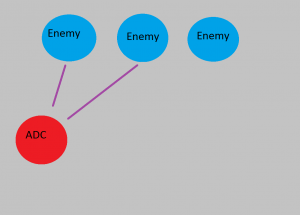
Two Avenues of Attack
Now only two.
Have you learned the lesson yet?
Naturally, you have, my readers are intelligent people. After all, it’s not every day you get a simple, easy to understand guide directly from a master player.
While I may have construed this situation as simple, a similar one in-game is not always as such. One must account for attack ranges, abilities, gap-closers, and a plethora of other similarly important items. However, the logistics still stay the same: fewer angles of attack on you = easier fight to play.
How to reduce angles of attack in real games
- Hug terrain: Stand near walls or structures so you cannot be surrounded from every direction.
- Use your frontline as a shield: Position slightly behind and to the side of your tank/jungler. Let them soak the first engage.
- Don’t chase into fog: Running blindly into dark jungle removes your positioning advantage and hands flanks to the enemy for free.
- Track side-lane threats: If an assassin is missing, assume they are flanking. Move towards your team, not away.
A TYING UP OF LOOSE ENDS: THE LATE GAME
The late-game is almost solely consisting of battles over objectives, whether that be your own base, Baron, Dragons, or Elder Dragon. Teamfighting happens frequently, as everyone has their eyes on the prize, rather then measly things like gold-generating activities. It is your duty to be near the team for a teamfight, but not your duty to engage. Perhaps you’re playing a heavy utility ADC like Ashe or Sivir,
you still should not engage. You may fire the first shot, but you are no front-line tank.
The all-praised positioning has to do with decisions before the teamfight even breaks out. Decisions such as; “How far away from my tanks am I?” While you may not be front-line, if you’re too far back and can’t deal any damage at all consider your contribution moot. You might as well go push another lane to create pressure.
This balance of location is a tough one to keep in equilibrium,
but I believe in you. Worst case scenario, you learn what not to do. In the late-game, it is better to be safe than sorry. Take as little risk as possible when you’re holding shutdown gold or when your death would mean a free Baron or Elder for the enemy.
ADC shotcalling in late-game
As the primary DPS, your opinion matters. You see which fights are playable and which are doomed. Use pings and short messages to:
- Ping “danger” when your team wants to fight with no vision and you’re far away.
- Ping “on my way” + Baron/Dragon when you know you can burn it fast with items.
- Ping enemy flashes and key ultimates after fights; this helps you and your team plan the next fight.
If macro and late-game decisions feel overwhelming, watching educational content from sites like
Mobalytics LoL analytics
can help you understand win conditions, or you can have a high-elo partner play with you through
Boosteria’s duo and coaching options.
CROSS-GAME SKILLS & HEARTHSTONE DECISION-MAKING
Here’s a fun twist: some of the best ADC players develop their patience and decision-making outside of LoL. Card games like Hearthstone, strategy games, or even auto-battlers all teach you to calculate risk, evaluate value, and think several turns ahead—exactly what a good ADC needs to do with waves, items, and objectives.
Hearthstone, in particular, trains:
- Resource management: Your mana and cards in Hearthstone are like your cooldowns and summoner spells in LoL.
- Win-condition clarity: You often ask, “Am I the beatdown or the control?” Just like in LoL you ask, “Is my comp scaling or must we fight now?”
- Risk vs reward calculations: Do you trade this minion or go face? Same logic as deciding whether to take one more wave or recall safely.
If you enjoy optimizing across multiple games and want to push your rank there too, you can even check
Hearthstone boosting prices on Boosteria.
Training your strategic brain in a methodical card game and then applying that mindset to ADC decision-making is a surprisingly effective way to level up your overall competitive instincts.
CONCLUSION OF BASIC ADC GUIDE
Keep your feet on the ground, and your eyes on the ball screen. To play the Marksman is to assure one’s footing in both
quick-decision making
and keeping one’s mind sharp with
solid assessments. A single mistake can mean death,
but not just for you. Farm as many minions as possible. Buy as many items as possible. But most importantly,
win as much as possible.
Now get out there and get those Pentakills soldier, they don’t grow on trees.
If, along the way, you feel stuck in a certain elo or can’t convert your knowledge into wins, remember that there are professionals whose entire job is to pilot and teach these roles at the highest level. With
Boosteria,
you can watch how Master+ ADC mains lane, teamfight, and position in your own games and learn directly from their decisions.
An excerpt from the Cornucopia of Extremely Helpful Guides
Houdini.
LEGACY META NOTES (OLDER ADC ADVICE)
The original version of this guide was written for much older seasons of LoL. While the fundamentals above have been updated to stay relevant in 2025 (positioning, wave management, decision-making), some specific references from the early days are preserved here for historical interest. Treat them as fun snapshots of how ADC theory looked in previous metas, not as strict build instructions for modern ranked games.
-
Old itemization references:
In earlier seasons, items like Statikk Shiv were considered somewhat niche on certain ADCs, with memes about “only Sneaky building Shiv every game.” Runaan-style multi-target items were highlighted mainly for champions such as
 Caitlyn
and
Twitch.
Modern item systems have been reworked multiple times since then; always check the latest patch notes or updated tier lists on sites like
OP.GG
or
Mobalytics
before locking in specific builds. -
Old plus/minus on summoner spell trends:
References in this guide to Heal vs Ignite vs Exhaust frequency reflect their popularity in older metas. In 2025, the exact mix of defensive and aggressive summoners can change patch to patch, especially in coordinated play. The underlying principle remains timeless:
track enemy summoners and adjust your aggression accordingly. -
Legacy ADC stereotypes:
Roles like “hypercarry only in late game” or “supports do almost no damage” came from an era before modern support itemization and scaling changes. These days even enchanters can dish out respectable damage and engage supports bring significant burst. Nonetheless, the idea that ADC is the long-term DPS engine of the team is still true—you just share more of the spotlight than before.
In short: the names of items, runes, and pro players might change over the years, but good ADC fundamentals age like fine wine. Keep updating your specific builds with current resources, but let the macro concepts in this guide be your permanent foundation.
The following content we provide may interest you:
- ELO boost LoL francais
- Elo boost from Gold to Diamond league
- Best LoL coaching
- History of 14 February in LoL


