



How to Close Out Games in LoL 2026 and Convert Leads Faster
How to Close Out Games in LoL 2026: Converting Leads into Wins Faster
Learning how to close out games in LoL is one of the biggest differences between players who climb consistently and players who keep throwing winning positions. Almost everyone knows how good it feels to get ahead early: your lane is winning, your team has more kills, your jungle is yours, and the map feels open. Then 10 minutes later, the match is suddenly even again. One bad Baron call, one greedy push without vision, one poorly timed reset, or one carry caught in a side lane can erase everything you built.
That is why closing games is not just about being mechanically strong. It is about macro discipline, objective sequencing, wave timing, vision control, and understanding when your team should pressure, reset, bait, force, siege, or simply wait. The fastest climbers do not merely gain leads. They know how to convert those leads into towers, dragons, Baron, inhibitors, and eventually the Nexus.
This guide is built to stay useful for a long time. Instead of focusing on one narrow patch or one temporary meta trend, it explains the timeless principles behind ending games faster in League. Whether you play solo queue, duo queue, or flex, these patterns keep showing up because the structure of closing out a lead does not really change: get control of the map, deny enemy recovery tools, force them into bad positions, and take the highest-value objective available without flipping the game.
If you want to keep up with current system changes, it is still smart to check the official League patch notes, review role and champion details on the official champion pages, and compare broader trends on trusted stat sites like Lolalytics and League of Graphs. But the core ideas below are the foundation that helps you finish games in almost any season.
If your goal is not only to understand League macro but also to push rank more efficiently while improving, some players also compare climb-assist options such as Boosteria’s Elo boost prices. Either way, the better you understand closeout fundamentals, the easier it becomes to turn winning games into actual LP.
Table of Contents
- Why Winning Teams Still Throw Games
- The Correct Closeout Mindset
- The Core Formula for Ending Games Faster
- How to Turn Kills into Real Advantages
- Tempo, Recall Timing, and Reset Discipline
- Side Lane Control and Wave Management
- Vision Control That Actually Ends Games
- How to Use Baron to Close Out Games
- Dragon Soul, Elder, and Objective Priority
- Sieging, Breaking Base, and Choosing the Right Inhibitor
- How Different Team Comps Should Finish
- Role-by-Role Closeout Responsibilities
- Solo Queue Shotcalling and Communication
- Most Common Throw Patterns
- Practical Closeout Checklist
- Final Thoughts
Why Winning Teams Still Throw Games
Most thrown games in LoL do not happen because the losing team suddenly becomes better. They happen because the winning team stops playing around structure. Once players get ahead, they often become impatient. Instead of asking, “What is the cleanest path to the next objective?” they start asking, “How do we fight them again right now?” That single change in mindset causes endless mistakes.
Here are the most common reasons teams fail to close out winning games:
- Chasing kills over map value. A kill is only useful if it creates an opening. If your team burns flashes and ultimates to dive for one more kill while waves are bad and no objective is available, the risk usually outweighs the reward.
- Ignoring side waves. Players group randomly mid for two minutes while farm dies in side lanes. That wastes gold, removes pressure, and makes objective setups weaker.
- Resetting at different times. One player bases after pushing, another stays for jungle camps, another walks into fog. Suddenly your team is never on the map together with item spikes and cooldowns aligned.
- Starting objectives without lane priority. Baron and dragon setups get much easier when side lanes are already pushing. Without that preparation, you give the enemy more routes into the river and more time to contest.
- Overforcing the base. Teams often get one inhibitor tower low and think the game must end immediately. They dive too deep, split formation, lose shutdowns, and give the losing team a way back.
- Not respecting death timers. Late-game deaths change everything. A single pick at 30 minutes can be worth more than five early kills if it gives Baron, Elder, or open Nexus towers.
- Poor understanding of team identity. A poke comp should not dive like a hard engage comp. A split push comp should not ARAM five mid for no reason. A front-to-back comp should not chase into dark jungle with its carries exposed.
The bigger point is this: being ahead does not automatically mean your game is easy. In many cases, the winning side actually has to be more disciplined. The losing team gets to simplify the game. They can turtle, wait for your mistake, and play around your impatience. That means the team with the lead must keep asking higher-quality questions.
Instead of forcing chaos, ask:
- What objective matters most in the next 60 to 90 seconds?
- Which lane should be pushed before we move?
- Who needs to reset first for items and wards?
- Where is the enemy likely to face-check?
- Do we need a fight, or do we only need pressure?
- If the enemy gives this objective, what do we take next?
That is what good closeout play looks like. It is not always flashy. It is usually clean, patient, and repeatable.
The Correct Closeout Mindset
If you want to close games faster in League, your mindset needs to shift from “keep winning skirmishes” to “keep reducing enemy options.” Every good closeout makes the map smaller for the team that is behind. They lose jungle access, lose vision, lose safe farm, lose control of neutral zones, and lose the ability to start fights on their terms.
Think of a lead as pressure, not as permission to play recklessly. Gold only matters because it lets you control more parts of the game. The moment you stop using your lead to control space, the advantage becomes inefficient. You may still be stronger in a straight fight, but if you keep giving windows, the enemy team will eventually find one.
A strong closeout mindset has five traits:
- Patience. You do not need the fastest possible ending every time. You need the safest fast ending. There is a big difference.
- Clarity. Everyone should understand the next major objective or map action.
- Discipline. Do not break formation for greed, random camps, or low-value chases.
- Respect. Even behind teams can punish mistakes with hard engage, picks, scaling, or shutdown gold.
- Conversion. Every successful play should lead to something tangible: tower, vision line, dragon, Baron, enemy jungle denial, inhibitor, or end.
Many players think closing out is only about Baron. Baron is important, but Baron is really just one tool inside a broader macro cycle. The real art is sequencing: push waves, reset, place vision, create pressure, threaten objective, punish the enemy response, then convert that response into something permanent. The team that sequences best usually closes best.
The Core Formula for Ending Games Faster
Here is the evergreen formula for closing out a lead in LoL:
- Identify your true win condition.
- Push the correct lanes before an objective timer.
- Reset early enough to spend gold and buy vision.
- Move first into the relevant area of the map.
- Establish vision and deny enemy entry points.
- Force the enemy to choose between bad options.
- Take the highest-value objective available without overcommitting.
- Repeat until the enemy base becomes impossible to defend.
That sounds simple, but each step matters. Let us break it down.
1. Identify your true win condition
Not every lead should be closed the same way. Some teams want 5v5 front-to-back fights around objectives. Some teams want to split the map and stretch the enemy until they break. Some teams want picks through fog of war. Some teams want poke before touching towers. If you misread your team’s actual identity, you may force bad endings even while ahead.
Ask these questions:
- Are we strongest in grouped fights or side lanes?
- Who can answer our fed side laner?
- Can the enemy engage on our carries if we walk up mid?
- Do we have reliable Baron damage?
- Do we need vision denial to find picks?
- Are we better at poke, siege, engage, or map splitting?
The answer tells you how to close. A fed split pusher plus strong disengage behind them wants a different map than a wombo-combo teamfight comp. Do not treat all leads equally.
2. Push the correct lanes before objective timers
Objective fights start long before the monster spawns. If dragon is spawning in 70 seconds and both side waves are pushing into your side, your setup is already poor. Good teams pre-push lanes first, then move. This forces the enemy to choose between losing farm and showing up late, or collecting side waves and giving up vision control.
As a rule, you want the lane opposite the objective to be pushing away from you, because it stretches the map. For example, if Baron is the next target, pressure bot side first. If dragon is the next target, pressure top side first. Mid lane also matters because it is the fastest route into either river.
3. Reset early and together
One of the biggest differences between messy and clean teams is reset timing. Winning teams often overstay because the map feels safe. That is exactly how a lead becomes awkward. If you know Baron or dragon will matter soon, recall early, spend gold, refill wards, and walk back together. Having a fresh item and proper control wards is often worth more than one extra jungle camp or one extra wave.
4. Move first into the right side of the map
Priority is power. The team that moves first gets to decide where wards go, which angles are dangerous, and how the enemy must enter. If your support and jungler arrive first and clear vision, the enemy support and jungler lose freedom. That often means the enemy carries are forced to walk blind behind them, which opens pick windows.
5. Force bad choices
The best closeouts do not rely on miracle engages. They rely on giving the enemy only losing options. If they contest vision, they may die. If they ignore the side wave, they lose tower HP or farm. If they face-check the river, they risk getting chunked or picked. If they give the objective, they fall further behind. Once your setup creates those forks in the road, the game accelerates naturally.
How to Turn Kills into Real Advantages
A kill by itself does not win games. What wins games is what the kill unlocks. A lot of players get a pick, celebrate, then scatter across the map. That is a wasted opportunity. Every time someone dies on the enemy team, you should immediately ask what becomes available because they are gone.
After a successful fight or pick, think in this order:
- Can we end? If the death timer is long, waves are near base, and key defenders are dead, ending is always the first question.
- Can we take Baron, Elder, or Soul? If a major neutral objective becomes safe, it usually has the highest value.
- Can we take towers or an inhibitor? If neutral objectives are not available, permanent structure damage is excellent.
- Can we steal jungle camps and place deep vision? This is lower value than major objectives, but still useful if nothing bigger is available.
- Can we force a favorable reset? Sometimes the correct answer after a winning skirmish is to push waves, reset together, and come back with item advantage before the next timer.
This is where many teams lose tempo. They get a kill on the enemy support, then spend 20 seconds chasing the enemy jungler through fog while a free tower sits mid. Or they win a fight near dragon, but instead of taking dragon instantly they run toward two low HP enemies and end up with nothing. The cleaner habit is simple: take what is guaranteed before you reach for what is uncertain.
The same logic applies to lane advantages. If your top laner forces the enemy to base, that does not always mean top tower must fall immediately. It may mean your jungler can invade that quadrant. Or it may mean your top laner can rotate first to Herald or river vision. Converting a lead is about reading the chain reaction that each advantage creates.
Tempo, Recall Timing, and Reset Discipline
Tempo is one of the most misunderstood parts of League macro. In simple terms, tempo is your ability to act on the map before the enemy is ready. Good closeouts feel smooth because the winning team keeps preserving tempo. Bad closeouts feel messy because players are constantly out of sync.
Imagine your team takes mid tower and earns a few hundred gold. Now Baron spawns in 90 seconds. If three players instantly reset, one stays for wolves, and one walks bottom for an extra wave, your map timing falls apart. The enemy team gets to reset cleanly, reach the river together, and maybe even arrive first. Your gold lead is still there, but your timing edge is gone.
Clean resets should happen for three main reasons:
- To spend meaningful gold. Sitting on 1500 to 2500 unspent gold before a major objective is often a hidden throw.
- To refresh consumables and wards. Vision is part of your combat power in closeout scenarios.
- To align with objective timers. Recalling 45 to 70 seconds before a key objective is often better than recalling 10 seconds before it spawns.
One advanced but timeless concept: sometimes the team that is ahead should not instantly start the objective when it spawns. If you have better vision and lane pressure, simply controlling the area can be stronger than rushing the monster. The enemy feels pressured to walk in, and that is where many games are really won. A bad team sees Baron and thinks “hit it now.” A better team sees Baron and thinks “how do we force their worst response?”
Tempo also matters after taking Baron or Soul. Some players recall instantly even when waves are perfect; others greed for one more camp when the whole point of the buff is synchronized pressure. Good teams understand that tempo windows are precious. Use them while the enemy is still reacting.
Side Lane Control and Wave Management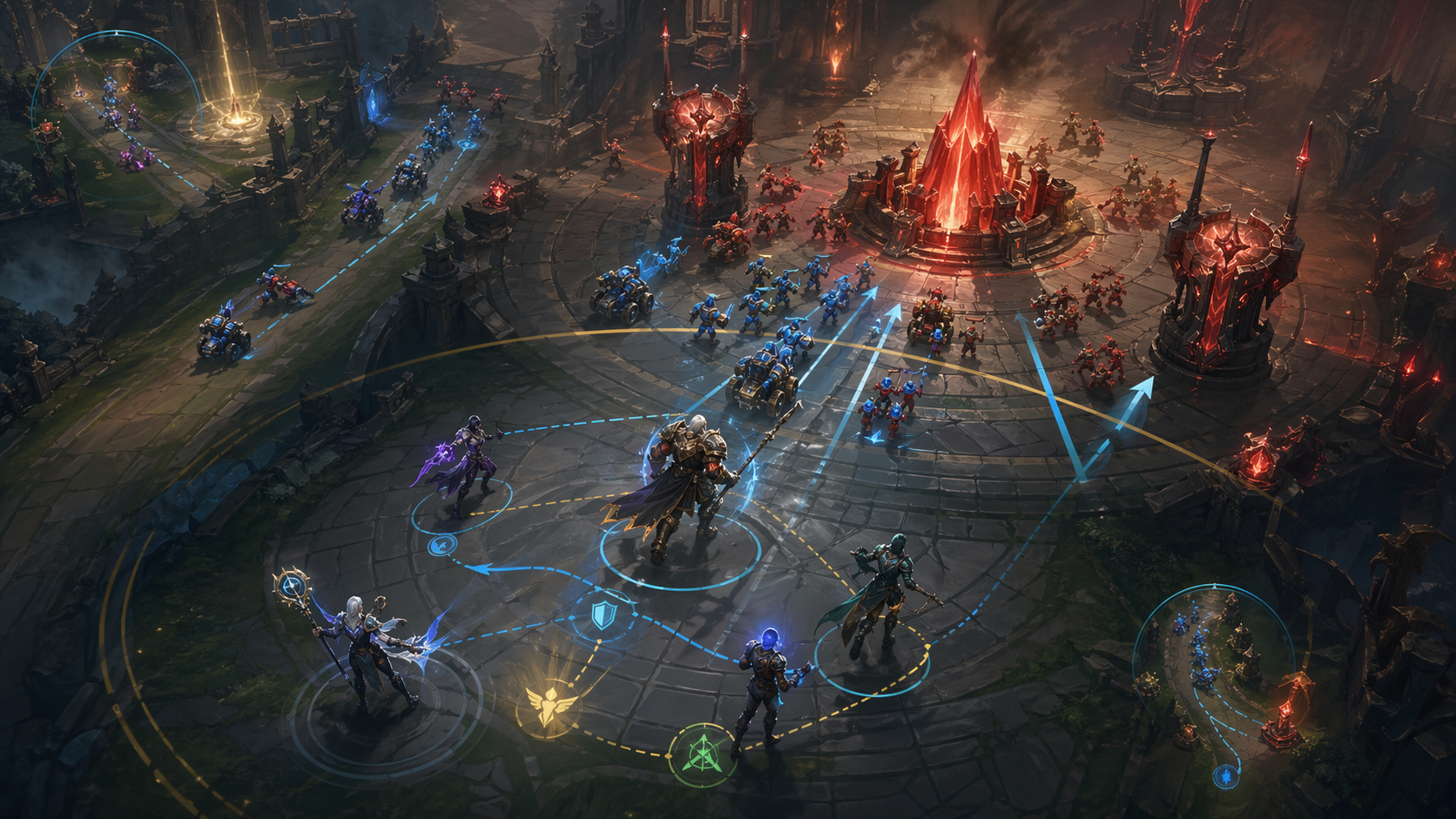
If you want to close out games faster in LoL, you cannot ignore side waves. Side lane control is what makes objectives safer, sieges cleaner, and enemy movement more predictable. Without side pressure, the game stays too easy for the losing team.
There are three major reasons side lanes matter so much when closing:
- They create map stretch. The enemy cannot defend everything at once.
- They give information. Whoever answers a wave usually reveals their position.
- They buy time. A stacked wave crashing into a tower forces the enemy to respond or lose gold and HP.
The most common low-ELO mistake is random grouping. Players win one fight, then permanently stand mid without preparing side waves. Mid pressure is important, but if top and bot are both pushing toward your side, the enemy gets free farm and easy defensive positioning. You are basically asking them to hold one narrow front.
Instead, learn the basic closeout relationship between side waves and neutral objectives:
- Baron focus: push bot first, then control top-side river and mid priority.
- Dragon focus: push top first, then control bot-side river and mid priority.
- Base siege: make sure at least one side lane is prepared so the enemy cannot fully stack mid.
Stacking a wave matters too. A large slow push creates better pressure than instantly hard-shoving every lane at the same time. If you build a bigger side wave, the enemy has to spend longer answering it, which gives your team a larger timing window elsewhere.
This is also where split push and 1-3-1 concepts become powerful. If your side laner can win the isolated matchup or at least demand two defenders, your team does not have to brute-force a 5v5. You can use the side lane to pull defenders away, then take vision, start Baron, or siege another lane. The point is not always to kill towers instantly. The point is to make the enemy formation unstable.
One caution: do not send side laners too deep without information. Side pressure only works when it is connected to the rest of your map. A fed top laner dying alone in bot lane with no vision and no objective timer is one of the classic ways winning teams throw.
Vision Control That Actually Ends Games
Vision is not about randomly placing wards everywhere. In closeout situations, vision should serve a specific purpose: protect your pressure, deny enemy approach angles, and create picks when they try to contest.
When you are ahead, your vision plan should become more aggressive. Defensive wards are still useful, but they do not close games by themselves. What closes games is moving the fog line forward. That means clearing enemy wards from the river, jungle entrances, and flanking corridors near the next objective or siege lane.
Here is what strong closeout vision looks like:
- Control wards in the area that matters next, not the area that mattered 90 seconds ago.
- Sweeper timing coordinated with lane push. Clear vision after waves are moving so the enemy has to walk out under pressure.
- Layered ward lines. One deep ward alone is fragile. A network of wards around choke points gives better information.
- Trap positions around likely face-check routes. You do not always need to start Baron or dragon if the enemy support is about to walk blind into your team.
Support and jungle usually lead this process, but every role contributes. Carries must resist the temptation to reveal themselves too early. Top and mid laners should help establish river control if they have wave priority. ADCs should not step into dark jungle to place “just one ward” and lose the game for free.
One timeless trick for solo queue: if your team is ahead and Baron is up, do not all show on mid wave at the same time unless you have a reason. Sometimes the mere uncertainty of your exact positioning creates more pressure than openly hitting the wave. When the enemy cannot tell whether you are on Baron, setting a trap, or controlling top jungle, their movement becomes slower and less confident.
How to Use Baron to Close Out Games
Baron is often the cleanest accelerator in LoL, but it is also where many leads get thrown. A good Baron is not just about damage. It is about setup, threat, and enemy response. In other words, Baron is as much a strategic zone as it is a neutral monster.
When Baron should be your next priority
Baron becomes a strong closeout tool when:
- Your team can kill it quickly enough to punish delayed reactions.
- You have lane priority, especially mid plus the opposite side lane.
- You can control vision in top river and enemy top jungle entrances.
- The enemy has to face-check to contest.
- Your comp benefits from siege, split pressure, or buffed minion waves.
How to set up Baron properly
- Push mid and bot waves first.
- Reset early enough for wards, items, and formation.
- Move into top side together.
- Clear vision in river and relevant jungle entrances.
- Hide your exact numbers when possible.
- Choose between three options: start Baron, threaten Baron, or trap the enemy approach.
The mistake most teams make is starting Baron with no pressure elsewhere. If bot wave is crashing into your own side and mid is neutral, the enemy can walk in quickly with full numbers. That turns your Baron into a flip. But if bot is already pushing into them and mid is controlled, their response is slower and more awkward.
Threat Baron vs. Start Baron
You do not always need to finish Baron the first time you touch it. Sometimes hitting Baron briefly is enough to force the enemy into a bad angle. If they walk through a choke point, you turn and fight. If they give space, you can re-engage on the objective. This “pressure and turn” style is especially effective when your comp has better terrain control or engage tools.
Using Baron after you take it
Once you have Baron, do not waste it by mindlessly grouping five mid with no side waves. Baron works best when it amplifies an already-prepared map. Usually, you want at least one side lane pushing, with the rest of the team threatening another lane or hovering between lanes depending on your comp.
Strong Baron usage includes:
- Rotating between lanes instead of standing still.
- Protecting the buffed cannon minions and letting them chip towers.
- Keeping formation so the enemy cannot engage on an isolated carry.
- Using the buff to take jungle camps and further starve the enemy if an immediate siege is risky.
- Being willing to take two inhibitors over forcing a desperate Nexus dive.
Remember: Baron is not only an ending buff. It is also a map compression buff. If you cannot end safely, use Baron to break enough of the map that the next objective or siege becomes impossible for the enemy to hold.
Dragon Soul, Elder, and Objective Priority
Not every game should be centered on Baron. Sometimes dragon stacking is the cleaner win condition, especially if your comp thrives in 5v5s or if Soul threatens a nearly unwinnable fight for the enemy. The key is understanding when to value one objective over another.
In general:
- Dragon/Soul is often better when your team wants structured fights and long-term scaling pressure.
- Baron is often better when you need siege strength, side lane amplification, or map-breaking power.
- Elder is often the final forcing tool that ends games through fight threat alone.
When dragon is the next target, the same principles apply: push top, secure mid priority, reset in time, arrive first, and establish vision. The losing team often feels compelled to contest Soul point even in terrible conditions. That makes it one of the easiest moments to punish desperate engages or face-checks.
Elder Dragon is even more decisive. If both teams are strong enough to fight, Elder can effectively replace Baron as the central objective because the execute pressure changes everything about combat. In many games, the cleanest sequence is Baron into map pressure, then Soul or Elder as the final unavoidable fight.
The main closeout lesson is this: do not treat every objective as automatically equal. Ask which one gives your team the easiest, most reliable route to end. Sometimes that means delaying Baron for a free Soul. Sometimes it means ignoring a low-value dragon because Baron plus base pressure ends the game faster. Context matters.
Sieging, Breaking Base, and Choosing the Right Inhibitor
Once towers start falling and the enemy is forced into base defense, many teams suddenly become much worse at decision-making. They either hesitate too much and waste pressure, or they over-dive and throw. Good sieging is about controlled aggression.
Principles of clean siege
- Do not walk up before the wave. Let minions arrive first.
- Maintain formation. Frontliners zone, carries hit what is safe, support protects angles.
- Track engage tools. If the enemy has a major engage cooldown available, respect the radius where it can punish you.
- Value chip damage. You do not need to force instantly if the tower is slowly falling and the enemy is trapped.
- Be ready to rotate. If one lane becomes too hard to crack, move pressure elsewhere rather than overforcing.
When to take an inhibitor
Inhibitors are powerful, but timing matters. Taking an inhibitor too early can sometimes hand the enemy extra safe farm if you cannot pressure the map properly afterward. Taking it right before Baron, Soul, or Elder is often much stronger because the super minions create synchronized pressure during the next objective cycle.
As a general idea:
- Take an inhibitor when it helps open the map for the next major objective.
- Take it when the enemy cannot immediately use the supers as free catch-up gold because your team will keep pressure.
- Do not greed for double or triple inhib if the first one plus a safe reset already puts the game in a winning state.
Which inhibitor is best?
There is no universal answer, but think about map geometry and the next objective. A bot inhibitor often increases Baron pressure because it drags someone bot later. A top inhibitor can improve dragon setups. Mid inhibitor opens the base most directly but can be easier for the enemy to manage in some scenarios. The right answer depends on what objective cycle comes next and which lane is easiest to weaponize.
When to end instead of resetting
This is one of the hardest skills in League. Many teams throw by trying to end when they should reset; others miss a free end because they play too cautiously. To judge correctly, ask:
- How many defenders are alive?
- How long are the death timers?
- Where is the nearest wave?
- Do we have ultimates and enough HP/mana?
- Can their waveclear stall us until respawns?
- Can one key enemy champion stop the push alone?
If the answer is uncertain, taking inhibitor plus reset is often correct. If the answer is clearly yes, commit quickly and decisively. Half-committing is the dangerous middle ground.
How Different Team Comps Should Finish
You cannot close games well without understanding how your comp naturally wins. The same gold lead will demand different decisions depending on whether your team is built for engage, poke, split push, pick, or scaling front-to-back.
1. Hard engage teamfight comp
If your comp has reliable engage and layered follow-up, you often want to close through objective control and forced fights. Your strength is making the enemy enter your zone under pressure. Baron setups, dragon setups, and choke-point control are ideal.
Your closeout priorities:
- Group around major objective timers.
- Push side waves enough to gain entry priority.
- Hide engage angles in fog.
- Punish face-checks or overcommitted wave clears.
2. Front-to-back scaling comp
These comps do not always need flashy picks. They win by keeping formation, protecting carries, and fighting in structured terrain. Closing usually means controlling space around dragons, Baron, and towers while refusing coin-flip chases.
Your closeout priorities:
- Never split formation for low-value targets.
- Use vision to protect your carries rather than only hunting picks.
- Siege patiently with minion waves and objective buffs.
- Force the enemy to walk into your DPS line.
3. Poke and siege comp
These comps should not rush hard dives unless the enemy is already low or out of cooldowns. Their best endings come from wave pressure, Baron buff, and repeated chunking before towers or objectives.
Your closeout priorities:
- Protect vision lines so you can throw poke safely.
- Use Baron to strengthen siege and avoid raw engages.
- Rotate once enemy defenders are too low to hold.
- Do not gift the enemy a clean all-in window.
4. Pick comp
Pick comps want darkness, traps, and punished rotations. Their best closeouts often come from denying vision around Baron or dragon and catching someone who tries to contest. If you reveal too much too early, you lose that advantage.
Your closeout priorities:
- Control fog and force face-checks.
- Threaten objectives without always starting them.
- Punish side-lane catches and jungle movement.
- Convert picks instantly into Baron, towers, or inhibitors.
5. Split push or 1-3-1 comp
These teams close by stretching the map until defenders cannot cover every lane safely. They do not want pointless five-man mid grouping if the whole strength of the comp is side pressure.
Your closeout priorities:
- Keep side waves alive and synchronized.
- Protect vision around the side laner’s routes.
- Use mid trio to hold central pressure without overengaging.
- Start Baron only when the side lane has already forced a response.
The more honestly you assess your team’s identity, the easier it becomes to choose correct closeout decisions. A lot of throws come from trying to play a style your draft does not support.
Role-by-Role Closeout Responsibilities
Top lane
Top laners often decide whether the map is stretched or collapsed. If you are the strongest side-lane threat, your job is not to randomly force 1v3 hero plays. Your job is to create pressure that pulls defenders, then communicate what that pressure unlocks for your team.
Good top closeout habits:
- Push the correct side lane before objective windows.
- Do not overextend without vision and purpose.
- Be ready to flank only when your team can actually follow.
- Track which enemy can match you and whether they can leave lane.
Jungle
The jungler is often the bridge between lane pressure and objective conversion. Great junglers do not just secure smites. They help shape the entire next minute of the map.
Good jungle closeout habits:
- Path toward the next objective before it becomes urgent.
- Coordinate vision clearing with support and lane priority.
- Hover the side of the map where your pressure matters most.
- Do not start neutral objectives blindly without lanes prepared.
Mid lane
Mid controls access. Because mid lane is the fastest rotation lane in the game, your priority often determines whether your team enters river first. Mid laners also frequently provide waveclear, pick threat, or teamfight control during closeout sequences.
Good mid closeout habits:
- Push mid before objective setups whenever possible.
- Protect your side lane pressure by being first to move.
- Hold key crowd control or burst for face-check punish windows.
- Do not disappear into side lanes at the wrong time while your team loses mid priority.
ADC
ADC is often the role that converts pressure into structures, but it is also the role most punished by greed. One bad step forward in a closeout can hand over shutdown gold and stall the entire game.
Good ADC closeout habits:
- Hit what is safe before chasing what is flashy.
- Respect fog and engage range even when ahead.
- Protect Baron-empowered waves and siege patiently.
- Reset on time for item spikes instead of overstaying for one more wave.
Support
Support often has the biggest macro influence when closing. Wards, sweep timing, positioning in river, and how you escort carries through fog all change the quality of your team’s endgame decisions.
Good support closeout habits:
- Lead vision control with purpose, not autopilot warding.
- Track enemy engage and flank routes during siege.
- Stay connected to your carries instead of drifting too far alone.
- Use pings to communicate objective setup and danger zones.
When every role understands its part in the closeout, games end far more smoothly. When everyone just “does their own thing,” even a large lead can feel hard to finish.
Solo Queue Shotcalling and Communication
Solo queue is messy, but that does not mean closeout structure is impossible. In fact, simple, repeatable communication often works better than complicated plans. You do not need a speech. You need clear pings and short calls.
Effective solo queue closeout calls include:
- “Push bot then Baron.”
- “Reset now for dragon.”
- “Don’t chase, take mid tower.”
- “Wait in fog, let them check.”
- “Top wave first, then Soul.”
- “Take inhib and reset.”
The best shotcalls are specific and immediate. “Play macro” is useless. “Push mid then reset” is useful. Also remember that pings often matter more than typing. Ping the objective timer. Ping the wave. Ping retreat when teammates get greedy. Ping on my way when moving to support a side lane.
Another underrated solo queue skill is emotional control. Many throws happen because one player gets impatient after a failed end and then tries to force the next play even harder. If a push fails but your team remains ahead, the answer is usually not panic. It is reset, re-establish vision, and repeat the next clean cycle.
Most Common Throw Patterns
If you want to improve quickly, study how winning games are lost. These patterns repeat constantly across ranks:
1. ARAM mid with bad side waves
The team is ahead, but everyone groups mid for no reason while side lanes collect into the enemy. The losing team gets easy waveclear and free farm. Result: no map stretch, no timing edge, no clean objective entry.
2. Starting Baron with no vision or lane prep
Players think Baron itself creates pressure, but without setup it often creates risk. The enemy arrives together, your formation is awkward, and the fight becomes a flip.
3. Greedy split push with no timer
A fed side laner pushes too far while no objective is spawning and the rest of the team cannot trade anything meaningful. One death gives shutdown gold and removes map pressure.
4. Overdiving in base
The enemy inhibitor tower is low, but instead of taking it cleanly, players dive under Nexus towers for kills. The losing team revives, claims shutdowns, and suddenly the game state changes.
5. Desynced recalls
Everyone buys at a different time, so there is no moment when the team is fully ready together. The enemy gets first move to the next objective despite being behind.
6. Chasing instead of converting
After winning a fight, players hunt survivors through jungle instead of taking the guaranteed tower, dragon, Baron, or inhibitor.
7. Ignoring enemy engage tools
Being ahead does not make you immune to crowd control. One overstep into a hard engage combo can erase thousands of gold worth of advantage.
8. Treating every lead like an instant end
Sometimes you are ahead enough to control the map, but not ahead enough to brute-force base. If you cannot safely end, take the structures or objective that makes the next push stronger.
Fixing just these mistakes will dramatically improve your win conversion rate.
Practical Closeout Checklist
When you are ahead and want to close faster, run through this checklist:
- What is the next important objective timer?
- Which side lane should be pushed first?
- Does anyone need to reset for a real item spike?
- Do we have control wards and sweepers ready?
- Which enemy champion must be tracked before we walk into fog?
- Are we stronger grouped, split, or in pick scenarios?
- If we get one kill, what is the guaranteed conversion?
- If we cannot end, what is the next permanent gain?
And when in doubt, default to the clean option. Clean macro wins more games than heroic greed. A secure inhibitor plus reset is often better than a coin-flip dive. A trapped face-check is often better than a rushed Baron. A synchronized wave setup is often better than random mid pressure.
Final Thoughts
Closing out games in LoL is one of the most valuable macro skills you can build because it improves every stage of ranked play. It turns small leads into reliable wins, reduces throws, punishes enemy mistakes more efficiently, and helps you climb with less frustration. The players who consistently convert leads do not rely on luck. They understand tempo, respect the map, prepare waves, move first, control vision, and choose objectives with intention.
If you remember only one thing from this guide, let it be this: winning faster is not about forcing more fights, but about forcing better choices. Push the correct waves. Reset on time. Own the next objective area. Make the enemy walk into bad positions. Take what is guaranteed. Repeat until the base breaks.
That is how strong players close. And the more consistently you apply those habits in League, the more often your early leads will become actual wins instead of “almost had it” losses.