



CoD BO6 Ranked Play Explained: SR, Matchmaking & Climbing
CoD BO6 — Ranked Play Explained: SR, Matchmaking, and How to Climb
Ranked Play is where Black Ops 6 stops feeling like casual multiplayer and starts feeling like a true competitive ladder. The pace gets tighter, mistakes get punished faster, and every decision carries more weight. That is exactly why so many players love it. Every win matters. Every rotation matters. Every bad habit becomes easier to spot. And every improvement shows up on the ladder sooner or later.
If you have ever asked yourself why one win gives strong SR, why some losses feel harsher than others, why your lobbies suddenly become tougher, or why you can dominate a public match but still stall out in Ranked, this guide is for you. The goal here is not to chase one season’s temporary exploit or one patch’s flavor-of-the-month class. It is to explain the structure underneath BO6 Ranked Play so you can understand what the system rewards and climb with habits that stay useful over time.
Officially, BO6 Ranked Play is built around the same competitive framework used by the Call of Duty League competitive ruleset, while the game’s official Ranked Play support page and matchmaking intel post explain the broader structure behind SR, ranks, matchmaking quality, vetoes, and ranked progression. If you want the raw source material, those are the best starting points: the official BO6 Ranked Play support page, the Ranked Play Matchmaking Intel article, and the official mode guides for Hardpoint, Search & Destroy, and Control.
In this guide, we will break Ranked Play down into simple parts: what SR actually measures, how matchmaking tries to build lobbies, why your climb can speed up or slow down, what each mode demands, what good players do differently, and how to improve in a way that survives season changes. If you want a faster route with experienced help, you can also compare options on the BO6 boosting prices page, but first it is worth understanding the system itself. The more clearly you understand Ranked Play, the easier it becomes to improve inside it.
1. What BO6 Ranked Play Actually Is
At its core, BO6 Ranked Play is the official competitive multiplayer environment inside the game. That matters because it is not just “multiplayer with visible ranks.” It is a curated format designed to be more competitive, more standardized, and more skill-sensitive than normal public matches. The game trims away parts of the standard experience, narrows the ruleset, and centers everything around match outcomes and consistent performance.
That is why Ranked Play feels different the moment you enter it. The map and mode pool are more deliberate. The restrictions are tighter. The average player in your lobby is more engaged. There is more structure before the match starts, including systems like map and mode veto. The game is no longer asking, “Can you farm kills in a loose environment?” It is asking, “Can you win under competitive conditions against players close to your level?”
BO6 also uses a cleaner approach than some earlier Call of Duty ranked systems. Instead of splitting progress across multiple visible layers that can confuse newer players, the BO6 version focuses more directly on SR and rank progression. In practical terms, that means your visible standing is meant to tell a more direct story about your competitive level.
Another important point: Ranked Play is not a static museum mode. It follows the spirit of competitive Call of Duty, so details such as map pools, restricted items, and playlist composition can evolve over time. That is why the smartest way to think about Ranked is not “memorize this one patch forever.” The smarter approach is “understand what the mode is designed to reward.” Once you understand that, temporary updates become easier to handle.
So what does Ranked Play reward? Not random hero plays. Not constant ego challs. Not highlight clips without context. It rewards winning. It rewards disciplined pressure. It rewards coordinated play. It rewards doing the right thing at the right time, even when the stat line looks less flashy than a public-match stomp.
That is the first big shift many players need to make. Ranked is not about proving you can top-frag against unstructured opposition. It is about proving you can influence the outcome of competitive matches over and over again. If you internalize that early, your climb becomes much smoother.
2. Rank Structure and What SR Means
BO6 Ranked Play uses a rank ladder built around eight major levels: Bronze, Silver, Gold, Platinum, Diamond, Crimson, Iridescent, and Top 250. On the official side, Activision explains that BO6 combines the visible structure more tightly around skill progression, with SR serving as the key number that moves you upward through the ranks.
Think of rank as your public competitive address. It tells the ladder roughly where you live right now. SR is the movement currency that gets you there. You gain it by winning and lose it by losing, but the story is more nuanced than that. Rank is the label; SR is the force that pushes the label up or down.
Many players make the mistake of treating SR as a simple “kills earned” score. That is not how the system is framed. Official BO6 support makes it clear that SR changes are connected to match results, performance, margin of victory, and how far you are from where the system believes you should be. That means SR is less like a pure scoreboard and more like a ladder-adjustment tool.
This matters because it explains a lot of common player frustrations. If two players both win, they may not receive the same amount of SR. If two players both lose, they may not lose the same amount of SR. If one player is rising through ranks quickly and another feels “stuck,” the system may be treating them differently because it views their current placement differently.
The easiest way to understand rank and SR together is this:
- Rank is your visible ladder position.
- SR is the point system that moves that position.
- Wins matter most because Ranked is built around competitive match outcomes.
- Your personal impact still matters because the system does not ignore how you perform inside those wins and losses.
- The system has a projection in mind for where it thinks you belong, which influences how fast it pushes or holds you.
This is why a healthy mindset is so important. Players who obsess only over the current number often spiral. Players who understand the ladder logic tend to adapt better. The number is feedback, not identity. If your SR dips, that does not automatically mean you are getting worse. It may mean you are playing above your current consistency level, queueing poorly, taking too many low-value fights, or failing to adapt to mode-specific win conditions.
On the other hand, if your SR jumps rapidly, that usually means the system is seeing strong evidence that you belong higher. This often happens when a player improves faster than their visible rank has caught up, returns to the game stronger than before, or plays in a way that lines up extremely well with competitive win conditions.
In short, SR is not random. It may feel mysterious at times because the full weighting is not public, but the broad design is understandable. BO6 Ranked Play wants to move players toward the rank they consistently deserve, not merely reward whoever had one hot streak on a weekend.
3. How SR Is Awarded and Lost
The official support explanation for BO6 is very useful here: SR is awarded after wins, deducted after losses, and the amount is influenced by your projected rank distance, your match performance, and the margin of victory. That single explanation tells you almost everything you need to know about how to think like a climber.
Winning is the center of the system
First, winning is still the foundation. BO6 Ranked Play is not designed as a mode where you can lose repeatedly and expect your personal score line to save you forever. Strong personal performance can shape your SR movement, but Ranked is fundamentally a competitive win-based ladder. If your habits are not helping your team win, the climb will eventually stall no matter how pretty some stat lines look.
Your performance still matters
Second, the system does care about how you perform. That does not mean “drop the most kills at all costs.” It means your contribution inside the match matters. In ranked Call of Duty, useful contribution includes much more than final kills: opening pressure, trades, objective time, anchoring spawns, staying alive in high-value moments, forcing good spawns, communicating rotations, and converting advantages rather than throwing them away.
A common trap is the player who posts solid raw kills but takes those kills in the wrong places. Maybe they farm useless damage after the hill is lost. Maybe they lurk too long while their team gets collapsed on. Maybe they chase an isolated flank instead of helping secure the real win condition. Those players often feel “unlucky,” but the ladder is usually telling them something real: high activity is not the same as high value.
Margin of victory matters
The support page also mentions margin of victory. This is important because it rewards cleaner wins. A narrow escape and a controlled stomp are not necessarily equal signals. If your team wins while looking organized, decisive, and stable, the system can read that as stronger evidence than a chaotic squeaker.
That is why disciplined teams often climb faster than mechanically similar but sloppy ones. They do not just win. They win in ways that look sustainable: better setups, better trades, fewer unnecessary deaths, more efficient closes. Over time, those details add up.
Projected rank is the hidden accelerator or brake
The phrase that many players overlook is “distance away from projected rank.” This is one of the most important concepts in any modern ranked system. Put simply, the game is not only reading your current badge. It is also estimating where you should be. If you are below that projection, strong wins can move you faster. If you are near it, gains can become smaller and losses may feel more meaningful. If you are above it, the climb can become harder until you prove you belong there consistently.
That is why one player can gain fast with a modest win streak while another barely moves on the same record. The system is not treating every account as an empty slate in every moment. It is constantly updating confidence in where each player belongs.
What this means in practice
Here is the practical takeaway: if you want stronger SR movement, you should build a profile the system likes. That means:
- Win more often than you lose.
- Win cleanly instead of barely surviving every match.
- Perform in a way that clearly supports victory.
- Avoid long streaks of low-impact losses.
- Reduce self-inflicted chaos like tilt queueing, bad party choices, and reckless role-swapping.
Notice what is not on that list: mindless slaying. BO6 Ranked rewards slaying that creates value. A two-piece to crack open a hill is valuable. A late round pick in Search & Destroy that unlocks a plant is valuable. A control break that removes the last AR off the point is valuable. But random kills while the real objective is collapsing are much less impressive than they look.
Why some players feel “hard stuck”
Most hard-stuck players are not actually blocked by hidden unfairness. They are blocked by one of three things:
- They are close to the rank the system believes they deserve right now.
- They are inconsistent across modes and maps.
- They misunderstand what the system reads as valuable contribution.
The good news is that all three can be improved. If you become more complete as a player, the SR picture usually changes with you.
4. How Matchmaking Works in Ranked Play
One of the clearest official BO6 explanations comes from the Ranked Play Matchmaking Intel article. According to that post, Ranked Play matchmaking considers three major search parameters: connection quality, search time, and relative skill. The article also explains that Ranked searches are allowed to take longer than normal multiplayer searches in order to improve match quality.
That one design choice explains a huge amount of what players experience in practice.
Connection still matters
Even in Ranked, the game does not ignore connection. That is important because a supposedly fair ranked match is not very fair if one side is fighting the lobby more than the enemy. Good matchmaking still needs reasonable connection quality. Ranked is competitive, but it cannot become blind to playability.
Relative skill matters more than in casual play
BO6 Ranked also tries to group players in a narrower skill band, starting from a tighter search and expanding as needed. The official post specifically notes that the game begins with a small target SR disparity and expands the acceptable range over time. This is why some queues feel very balanced and others feel a little wider after a longer wait.
In other words, the system would prefer to give you a reasonably fair match quickly, but it is also willing to stretch the search window if the player pool is not ideal at that moment. That is normal ladder behavior. It is not a sign that the system has no logic. It is a sign that matchmaking is always balancing competitive integrity against real-world queue availability.
Search time is not just waiting; it is a tradeoff
Some players panic when a queue takes longer and assume the system is broken. Often it simply means the game is taking extra time to build a better lobby. Ranked Play explicitly tolerates longer queue times because fairer matches are worth more than instant but messy matchmaking. That can feel annoying in the moment, but it is usually healthier for the ladder overall.
Why your lobbies get harder after improvement
Because Ranked actively targets relative skill, your matches often get more demanding the moment you improve. This confuses players who expect a climb to feel easier once they start winning. In a competitive ladder, improvement does not create easier lobbies for long. Improvement usually creates more appropriate lobbies. The better you prove you are, the less likely you are to keep farming weaker opposition.
This is why climbing often feels like a staircase rather than a straight line. You improve, win, rise, hit better competition, adapt, then rise again. That pattern is normal. It does not mean the game is punishing you for doing well. It means the system is updating its estimate of where you belong.
Partying changes the experience
BO6’s matchmaking framework also interacts with party composition. Official BO6 materials describe special handling for parties and note that higher-level party members can shape the level of competition the team faces. In plain English: if you queue with stronger players, expect stronger opposition. That is not the system being cruel. That is the system trying to preserve competitive integrity.
For climbing, this matters a lot. A team of four with structure, comms, and role clarity can outperform a group of solo players even if the individual mechanics are similar. But parties can also sabotage themselves if they stack conflicting playstyles or drag a weaker player into matches that are too fast for them. Good party quality helps. Bad party quality creates false confidence and messy losses.
Common matchmaking myths
“The game forces a 50% win rate.”
Competitive ladders naturally pull players toward balanced win rates as they approach their true level. That is not the same thing as a script.
“If I top frag, matchmaking is broken if I still lose SR.”
Ranked is not deathmatch. If your top-fragging did not create winning value, the result still matters.
“Long queues mean bad matchmaking.”
In Ranked, longer queue times often mean the opposite: the system is trying harder to build a quality lobby.
“Every unfair game means the system failed.”
No matchmaking system can produce perfect balance every single time. The question is what happens over many matches, not one frustrating evening.
The healthy way to read your lobbies
Do not obsess over every perceived mismatch. Instead, ask better questions:
- Was the lobby genuinely unwinnable, or did our team misplay key moments?
- Did I adapt my role to the mode and map?
- Did I lose to mechanics, timing, poor discipline, or poor coordination?
- Am I queueing at a time or in a party structure that lowers consistency?
Players who treat matchmaking as the whole story stop improving. Players who treat it as one variable among many usually keep climbing.
5. Why Your Climb Slows Down
One of the hardest emotional moments in Ranked Play is when your early climb feels smooth and then suddenly slows down. Your wins give less SR. Losses feel heavier. The lobby quality goes up. Old habits stop working. This is not random. It usually means one of two things: either the system thinks you are near your current deserved level, or your playstyle has unresolved weaknesses that stronger lobbies expose immediately.
Here are the most common reasons players stall:
You are too one-dimensional
Some players climb early because they are mechanically sharp. Then they hit lobbies where everyone can shoot. Once raw aim stops being a major advantage, their weaknesses become obvious: poor route selection, late rotations, weak comms, panic deaths, bad bomb decisions, or an inability to play patiently when needed.
You are leaking rounds and hills through impatience
Ranked punishes impatience brutally. One ego chall can flip an S&D round. One mistimed roam can break a Hardpoint setup. One desperate solo push can waste Control lives. Players who stall often think they need to “do more,” when the real answer is to throw away fewer good situations.
You are queueing badly
Even strong players can sabotage their climb through poor queue choices: playing tired, playing tilted, switching teammates constantly, or trying to force long sessions after momentum is gone. Ranked improvement is not just in-game. It is also about protecting your decision quality.
You do not understand your role on each map
Some maps reward pressure. Others reward timing and lane control. Some hills demand early setup. Others reward good break coordination. Search rounds can swing on bomb pressure, information, or off-angle timing. If you play every map the same way, better players will farm your predictability.
You chase stats instead of leverage
Leverage is what actually wins Ranked games. Who controls the spawn? Who gets the first blood? Who closes the trade? Who blocks the pinch? Who reaches the next hill ten seconds earlier? Who stays alive long enough to force the enemy to waste time? These are the details that create wins. Players who ignore them may still get kills, but they plateau.
The answer to a stalled climb is almost never “I need to rage harder.” Usually it is “I need to become more complete.”
6. Understanding Hardpoint, Search & Destroy, and Control
BO6 Ranked Play draws from the CDL-style competitive mode pool, and understanding the mode logic is one of the fastest ways to improve. A lot of “mysterious” SR problems are really mode problems in disguise. If you are strong in one mode and shaky in the others, your overall climb becomes fragile.
Hardpoint: the mode of timing, setup, and pressure
Many players think Hardpoint is mostly about piling into the hill. It is not. At a higher level, Hardpoint is about who controls the pace of the next engagement. Good Hardpoint teams understand when to soak, when to block, when to rotate, when to pinch, and when to cut losses.
The strongest Hardpoint players do three things well:
- They recognize when current scrap time is worth contesting and when the next hill matters more.
- They understand how kills translate into spawn pressure, not just scoreboard numbers.
- They trade efficiently instead of taking isolated fights.
If you are trying to climb, stop thinking only in terms of “How do I get in hill?” Ask better questions:
- Who on our team is blocking the correct spawn?
- Do we need one player soaking while three create map pressure?
- Are we hitting together or trickling?
- Did we rotate too late and turn a hold into a scrap disaster?
Hardpoint rewards players who can feel the tempo of a map. You do not need to be the flashiest player in the lobby. You need to be the player who keeps ending up in the right place before the real fight starts.
Search & Destroy: the mode of information and restraint
Search & Destroy exposes bad habits faster than almost any mode. Because there are no respawns, every decision gains weight. The best S&D players are not necessarily the most aggressive. They are the most deliberate.
To improve in Search, think in these layers:
- Information: what do we know and what is still hidden?
- Numbers: are we up a player, down a player, or even?
- Space: which lanes, bomb sites, and timings are controlled?
- Clock: who is actually pressured by time right now?
Many players throw Search rounds because they treat every round like a gunfight challenge. Good Search is usually slower in the mind than it looks in the killfeed. It is about clearing uncertainty, forcing bad choices, and collapsing on the right moment.
If you want to climb in Search, practice these habits:
- Value first bloods, but do not overforce them.
- Trade your teammate instead of swinging alone five seconds later.
- Do not plant just because you can; plant because your team can defend the post-plant.
- As a defender, avoid gifting isolated duels when you already control time.
- As an attacker, understand when map control matters more than instant site commitment.
The quiet secret of Search is that discipline often beats creativity until higher levels. Fancy plays are great when they are earned. Fundamentals win more rounds.
Control: the mode of lives, layering, and composure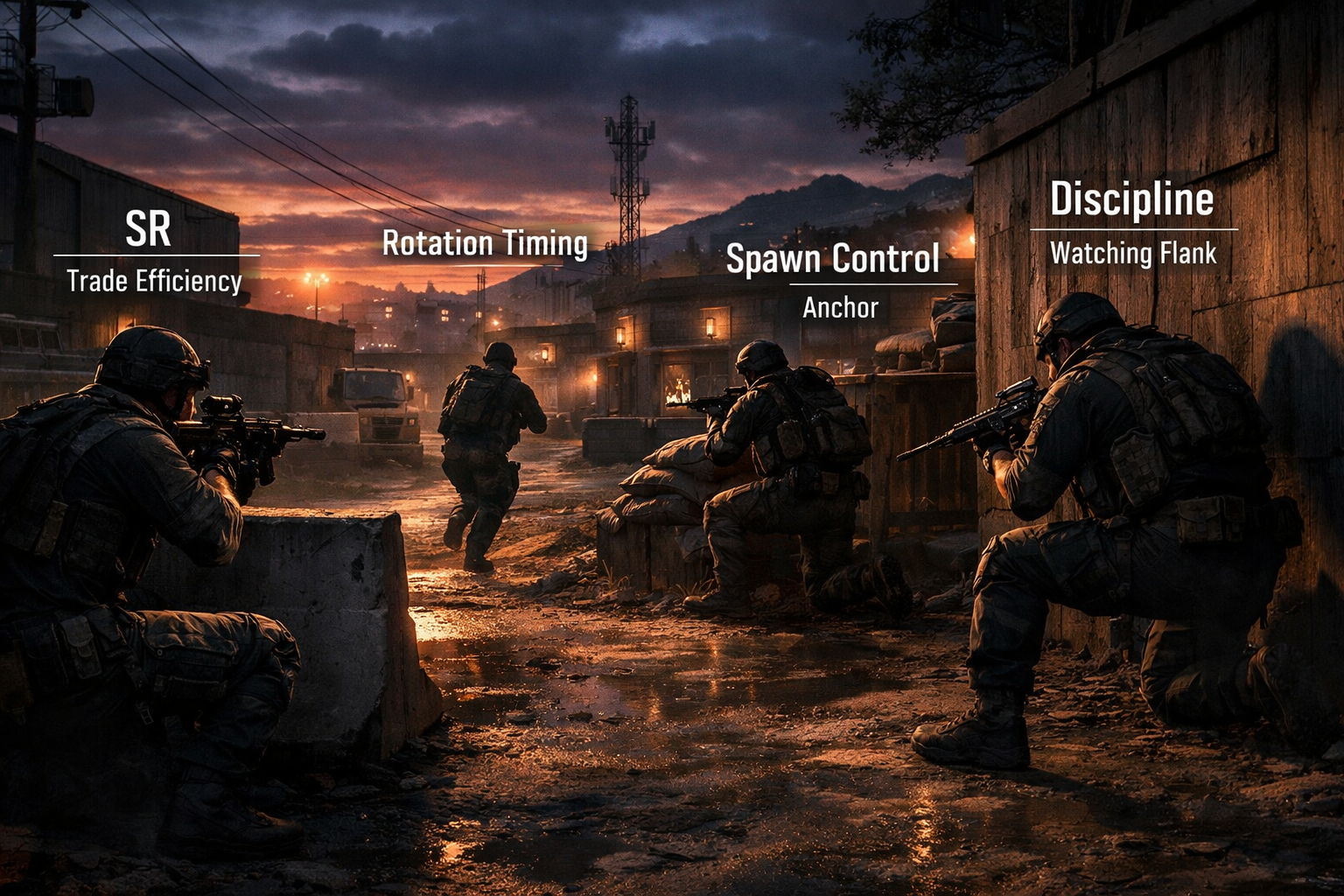
Control is where many Ranked players become careless. Because there are respawns, they treat it like a looser mode than it really is. In reality, Control punishes life mismanagement and bad sequencing harder than people expect.
Control asks you to think about three things at once:
- The objective zones.
- The life count.
- The shape of the map around those zones.
If your team floods a zone without controlling the lanes around it, you often gain a few seconds and lose the round. If you chase kills too far after a break, you may flip the structure in a way that ruins the next setup. If you play too passive when the enemy is low on lives, you may miss the window to close.
Great Control teams layer pressure. They do not all enter the point the same way. They create angles, force defenders to split attention, and keep enough map presence to punish re-entry attempts. On defense, they understand that time and life pressure are allies. On offense, they understand that panic feeding destroys rounds.
Mode-specific improvement is underrated
A player who is “good at Ranked” is usually just someone who has stopped playing all three modes with the same brain. Hardpoint wants tempo and rotation sense. Search wants information discipline and round management. Control wants layered pressure and life awareness. Once you start switching mental gears correctly between modes, your consistency jumps.
7. The Core Skills That Actually Help You Climb
Now we get to the most important part of the guide: what actually makes players rise. Not what sounds impressive. Not what looks good in clipped highlights. The real skills that BO6 Ranked consistently rewards.
1. Trade efficiency
Trading is one of the cleanest signs of a structured team. If one player dies and the enemy immediately gets punished, the fight stays manageable. If one player dies and the rest of the team reacts late or from the wrong angles, the enemy turns a small edge into map control. Better players do not just take duels; they take duels that can be traded.
To improve this, stop wandering alone in critical moments. Play close enough to influence the same fight, but not so stacked that one grenade or spray ruins you both.
2. Objective intelligence
Objective intelligence means understanding the actual value of each second, each life, and each area of the map. It is knowing when to hop in hill and when to hold a lane. It is knowing when a bomb plant is strong and when it is bait. It is knowing when a Control stack is real progress and when it is a trap.
Objective intelligence separates players who “play the mode” from players who merely happen to exist inside it.
3. Rotation timing
Many Hardpoint games are lost before the hill fight even begins. If one team rotates earlier, gets better positioning, and forces the other team to attack into prepared crossfires, the whole sequence becomes harder. Players who climb consistently develop a feel for when staying is greedy and when leaving early is smart.
Bad players ask, “Can I squeeze 10 more scrap seconds?” Good players ask, “What does this choice do to the next 40 seconds?”
4. Survival in high-value moments
Not every death is equal. Dying after securing a break can be fine. Dying as the only deep map presence before a rotation can be catastrophic. Dying with bomb in a terrible spot can lose an S&D round instantly. Dying first in Control while your team is setting up a coordinated push can waste the whole wave.
Climbers learn to protect their life when its value is highest. This is not passivity. It is awareness.
5. Spawn awareness
Call of Duty ranked is full of fights that are really spawn fights in disguise. You think the issue was “we lost too many gunfights,” but the real issue was “we lost the part of the map that made the next 20 seconds playable.” Even if you are not a textbook spawn expert, you need to understand basic anchor logic, what routes threaten your hold, and when pushing too deep can ruin your own setup.
6. Communication quality
Good comms are not constant noise. They are fast, relevant, and useful. “Two weak outer, one pushing old, I’m backing up, watch pinch” is good communication. “He’s there! He’s there! Where are you guys?” is not. BO6 Ranked becomes much easier when your team communicates information instead of panic.
If you solo queue, your own comms should still be clean. Calm players get listened to more often than emotional ones.
7. Micro-discipline
Micro-discipline is the habit of refusing low-value mistakes. Not rechalling from ego. Not sprinting blind into a known setup. Not peeking the same angle twice without purpose. Not forcing hero plays every time the team falls behind. This skill sounds small, but it is one of the biggest differences between average and high-level ranked players.
8. Adaptation
Some players lose the same way three rounds in a row and call it bad luck. Better players notice patterns quickly. Is the enemy overcommitting to one lane in Search? Is their AR always late to rotate? Are they leaving a gap on a specific break? Are they overstacking B in Control? Ranked rewards players who think between fights, not just during them.
9. Emotional control
This is one of the least glamorous but most valuable ranked skills. Tilt destroys SR. It ruins comms, pacing, and judgment. It makes players force bad fights to “make something happen.” It turns one bad game into four. If you want to climb steadily, emotional control is not optional. It is part of your loadout.
10. Repeatable consistency
The ladder does not care much about your best two games of the week. It cares about what you do over dozens of matches. The most underrated skill in Ranked Play is being solid on a boring day. Can you still contribute when your aim is not peak? Can you still rotate well? Can you still play patient Search rounds? Can you still avoid tilt after a bad teammate? Those are ladder-winning traits.
8. Solo Queue vs Team Queue
Solo queue and coordinated team play are almost different versions of Ranked. The mechanics are the same, but the experience is not.
Solo queue
Solo queue is the best teacher and one of the hardest environments. You get less control over teamwork, pacing, and comms, which means you must create value with fewer assumptions. To climb in solo queue, prioritize the skills that transfer regardless of teammate quality:
- Reliable trades.
- Smart rotations.
- Clear, calm communication.
- Staying alive in important moments.
- Playing for the mode even if others do not.
Solo queue players should also avoid one major trap: trying to do everyone’s job. When you get frustrated with teammates, it is tempting to overcompensate by sprinting everywhere and forcing every play yourself. That usually makes things worse. You still need discipline. The goal is not to become the loudest player in the lobby. The goal is to become the most stabilizing one.
Team queue
With a real group, your ceiling goes up because structure goes up. You can pre-plan routes, define roles, coordinate veto preferences, and clean up mid-round decisions much faster. But team queue only helps if the team is healthy. A team with bad chemistry, vague roles, or ego clashes can be worse than solo queue.
If you play as a team, establish these basics:
- Who usually soaks and who usually roams?
- Who makes rotation calls?
- Who carries bomb in common Search openings?
- Who is best at anchoring or holding deep map space?
- How do you reset mentally after a blown round?
Structured teams climb faster because they reduce randomness. But only disciplined structure helps. Loud structure without trust becomes chaos with extra steps.
9. Common BO6 Ranked Mistakes
Most players do not lose because they are missing one secret trick. They lose because a handful of repeatable mistakes keep draining their win rate. Here are the most common ones.
Overchallenging after getting one kill
One pick does not mean you must sprint into the next one instantly. In Ranked, the first kill often creates the opportunity. Throwing your life away right after that kill can erase the advantage you just created.
Playing the scoreboard instead of the situation
Not every low-stat game is bad, and not every high-stat game is good. If your numbers look fine but your team keeps losing critical moments, your value may be lower than you think.
Rotating too late
Late rotations are one of the classic Hardpoint rank killers. Players stay for scrap time, get collapsed on, and then arrive late to the next fight with no map control. This creates a loop of chasing instead of controlling.
Forcing hero bombs in Search
Plants win rounds only if the post-plant is defensible. Throwing bomb down in a bad setup or without map control often turns a promising round into a panic scramble.
Ignoring lives in Control
Control is not just about touching the zone. If you burn too many lives for low progress, the round gets away from you quickly. Good Control players always track whether aggression is buying real value.
Queueing while tilted
This one is huge. Mechanical skill drops when emotional judgment drops. Tilt makes players chase revenge challs, blame teammates instead of adapting, and keep queueing long after their decision-making has collapsed.
Copying pro behavior without understanding it
Watching high-level Call of Duty can help, but copying isolated pro plays without understanding the context often hurts average players. Pros make aggressive-looking decisions because they understand timing, support, spawn implications, and opponent tendencies. If you copy the movement without the reasoning, you get punished.
Changing everything after one bad session
One rough night does not mean your role, settings, routes, or classes all need a total rebuild. Constant overreaction kills consistency. Make targeted changes, not emotional overhauls.
10. A Practical Improvement Plan for Climbing
If you want real progress, you need a process, not just motivation. Here is a simple improvement framework that works well for BO6 Ranked Play.
Step 1: Pick two focus areas, not ten
Do not try to fix everything at once. Choose two issues that appear constantly in your games. For example:
- Late rotations in Hardpoint.
- First deaths in Search.
- Bad life management in Control.
- Poor comm clarity.
- Overchallenging after a pick.
Improvement becomes real when it is narrow enough to measure.
Step 2: Review your losses honestly
After a rough match, ask:
- What actually decided the game?
- Which deaths mattered most?
- Did I help the win condition or just stay busy?
- Was I early enough to the important area of the map?
- Did I create tradable fights?
This kind of review is more valuable than staring at KD alone.
Step 3: Build a pre-queue routine
Good Ranked sessions often begin before the first match. Warm up mechanically, yes, but also mentally. Decide your queue length. Decide what will make you stop for a break. Decide what your focus area is. Ranked punishes players who enter every session emotionally unplanned.
Step 4: Use a simple session rule
Many players benefit from a clean rule such as:
- Take a break after two ugly losses in a row.
- Stop after obvious tilt.
- Do not force “one more game” when attention is fading.
Protecting your floor is just as important as chasing your ceiling.
Step 5: Learn one route or setup at a time
Trying to memorize every map immediately is messy. Instead, add one reliable idea per session. One early rotation route. One Search opener. One Control break pattern. Small layers of certainty add up fast in Ranked.
Step 6: Improve your communication structure
Even if you are not the loudest person in the party, you can become the cleanest. Keep your calls brief, specific, and calm. Mention numbers, locations, timing, and intent. Replace emotional calls with useful calls. Teams trust players who sound clear under pressure.
Step 7: Respect your role but stay flexible
If you are a natural slayer, great. If you are a strong objective player, great. But Ranked rewards players who understand their primary role without becoming trapped inside it. Sometimes the hill player must take a critical gunfight. Sometimes the slayer must be the one who soaks because the map state demands it. Smart flexibility wins more than rigid identity.
Step 8: Track progress by patterns, not mood
Your emotions are not always accurate. Some days feel awful even though you improved in important areas. Other days feel great even though you were sloppy and got carried. Track patterns instead:
- Am I losing fewer first deaths in Search?
- Am I getting to early rotations more often?
- Am I throwing away fewer favorable rounds?
- Am I communicating more clearly?
- Am I tilt queueing less?
If those trends improve, SR usually follows.
Step 9: Study official resources with a purpose
Use official materials well. The BO6 mode guides are useful for refreshing the purpose and structure of each mode. The matchmaking intel page is useful when you want to understand why Ranked queues and lobby quality feel different from normal multiplayer. The CDL ruleset is useful when you want to better understand the competitive environment Ranked is trying to mirror. Do not just skim them. Use them to answer a specific weakness in your game.
Step 10: Know when to get help
Sometimes a player is improving slowly not because they lack potential, but because they are stuck inside their own blind spots. A stronger duo, a smarter team environment, or outside coaching can speed up learning dramatically. That is one reason many players compare options like the BO6 boosting prices page—not only for rank gains, but also to reduce friction when they feel trapped. Even then, the strongest long-term results come when you also understand what Ranked is rewarding and build your own consistency around it.
11. FAQ
Does KD matter in BO6 Ranked Play?
It matters, but not in isolation. A strong KD can reflect smart play, but Ranked is not a pure slaying mode. Your kills need to create value inside the win condition. A lower-KD player who rotates early, soaks critical time, trades well, and stops enemy pressure can be more valuable than a higher-KD player who takes low-impact fights.
Why do I sometimes gain less SR than my teammate after a win?
Because BO6 Ranked does not treat every account identically. Officially, SR movement is influenced by performance, margin of victory, and your distance from the system’s projected rank for you. Two teammates can therefore receive different SR from the same result.
Why do my games get harder after I start winning?
Because Ranked matchmaking is designed to group players by relative skill while balancing connection quality and queue time. If you are improving, the system will try to place you into more appropriate competition rather than leaving you in easier lobbies forever.
Is solo queue worth it?
Yes, but it demands more discipline. Solo queue is harder because teamwork is less reliable, but it is also excellent for identifying whether your fundamentals are truly stable. If you can create value in solo queue without tilting, your overall Ranked game usually becomes much stronger.
Should I always play with a full stack?
Not automatically. A coordinated full team is powerful, but only if roles, trust, and comms are actually good. A messy four-stack can be worse than a stable duo or even a focused solo session.
How important is mode knowledge?
Extremely important. Hardpoint, Search & Destroy, and Control reward different decisions. If you only understand one mode well, your ladder consistency will suffer. The more naturally you switch mental gears between modes, the faster you usually climb.
Do I need to copy pro play exactly?
No. You should learn from competitive Call of Duty, but not imitate blindly. Copy principles before copycat plays. Learn why strong teams rotate early, why they layer Control pressure, why they protect first blood advantages in Search, and why they value trades so heavily.
What is the best mindset for climbing?
The best mindset is long-term and evidence-based. Do not ask, “Why did I get unlucky today?” Ask, “What habits am I repeating across 30 matches?” Ranked rewards players who treat improvement like a process instead of a mood.
12. Final Thoughts
BO6 Ranked Play is easier to understand once you stop treating it like a mystery and start treating it like a competitive system with clear priorities. It wants players to win. It rewards players who support winning through performance and discipline. It uses matchmaking to build reasonably fair lobbies around connection, queue health, and relative skill. And it pushes players toward the rank they can sustain, not just touch briefly.
That is why real climbing is usually not about finding one broken trick. It is about becoming harder to beat in all the ways that matter: better timing, better trades, better comms, better emotional control, better mode understanding, and fewer useless mistakes. If you improve those things, SR usually follows. Not always instantly, but reliably over time.
So if your BO6 ranked goal is to rise, keep the formula simple: play for the win condition, create value instead of noise, review your mistakes honestly, and build habits that stay strong across maps, modes, teammates, and seasons. That is the kind of improvement the ladder respects.